
Dive into the 12-slide analysis of the Revolut pitch deck that helped them secure $1.5M in seed funding from leading investors in 2015.
Building your own pitch deck?
Get expert guidance from the team behind $2B+ in investor interest.
Revolut was founded in 2015 by Nikolay Storonsky, a former trader at Credit Suisse, and Vlad Yatsenko, a software engineer, in London. Frustrated by exorbitant foreign exchange fees during personal travel, Storonsky envisioned a mobile app that democratises access to interbank exchange rates, disrupting legacy banking for everyday users. The founding insight came from a simple but powerful realisation: banks were charging customers margins of 3-4% on currency exchanges while accessing interbank rates themselves. This innovative approach highlights the importance of having a solid strategy, which is where investor-ready pitch deck consulting can provide valuable assistance.
Early days involved rapid prototyping amid challenges like regulatory hurdles for electronic money institutions and building trust without a physical presence. They pivoted from a narrow FX tool to a full digital banking alternative, securing initial partnerships with MasterCard and Barclays while bootstrapping to 4,800 pre-launch sign-ups. The duo’s complementary skills—Storonsky’s financial markets expertise and Yatsenko’s technical prowess—proved crucial in navigating both regulatory complexity and product development.
Fundraising began with warm introductions to European VCs; the seed deck targeted sceptical investors in a crowded fintech space. Interactions highlighted the need for concrete traction proof, leading to emphasis on subscribers and partnerships rather than just theoretical market opportunity. The founders learned to balance ambitious projections with credible near-term milestones, addressing concerns about regulatory risk and customer acquisition in financial services.
The 2015 pitch landed £1.5M seed from Seedcamp, Index Ventures, and Balderton, fueling product launch and explosive growth to millions of users. This deck represents one of the most successful early-stage fintech pitches of the decade, providing a blueprint for founders seeking to disrupt entrenched financial institutions with mobile-first solutions.
The cover slide features the Revolut logo prominently alongside the tagline “Personal Money Cloud” with minimal contact details, establishing a clean, tech-forward brand identity. The tagline attempts to position Revolut as more than a traditional banking app, suggesting cloud-based financial services that transcend physical limitations. However, the abstract nature of “Personal Money Cloud” leaves room for interpretation and doesn’t immediately communicate the core value proposition of low-cost international transfers.
This minimalist approach reflects 2015 design trends but lacks the clarity that modern pitch decks demand from the opening slide. The absence of a concrete one-liner means investors must wait until slide 2 or 3 to understand what the company actually does. The design choice prioritises brand mystique over immediate comprehension, a risk when competing for investor attention spans measured in seconds rather than minutes.
What investors see: A company that has invested in professional branding but may lack clarity in market positioning. The clean aesthetic suggests technical competence and consumer focus, but the vague tagline raises questions about whether the founders can articulate their value proposition succinctly. Sophisticated investors recognise this as a common early-stage challenge where product vision exceeds messaging maturity.
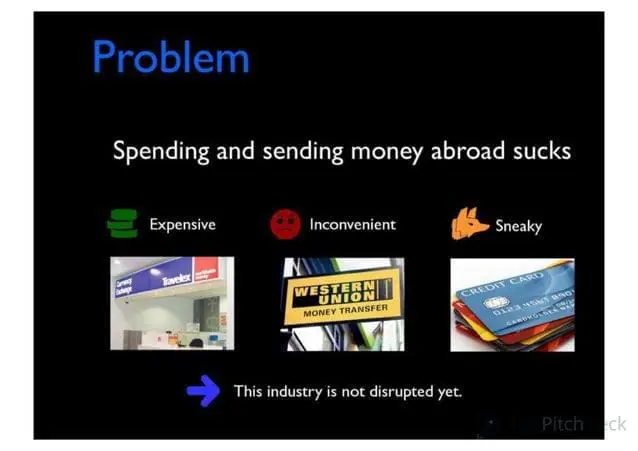
This slide immediately grounds the pitch in universal customer frustrations: excessive banking fees and cumbersome processes for international transactions. By highlighting pain points that resonate across demographics—from business travellers to international students—Revolut establishes emotional connection before diving into technical solutions. The problem framing is deliberately broad, capturing both B2C and potential B2B use cases without narrowing the addressable market prematurely.
The strategic brilliance lies in positioning traditional banks as the villain rather than competing fintech startups, creating an “us versus them” narrative that investors can easily grasp. This approach sidesteps detailed competitive analysis whilst establishing Revolut as a consumer advocate challenging an entrenched oligopoly. The timing aligned perfectly with post-2008 anti-bank sentiment and growing smartphone adoption, creating favourable conditions for financial services disruption.
What investors see: A massive, validated market problem with clear customer willingness to pay (evidenced by current fee tolerance) and switching potential. The universal nature of international transfer pain suggests strong product-market fit opportunity across multiple customer segments. Investors recognise this problem-first approach as evidence of customer-centric thinking rather than technology-first product development.
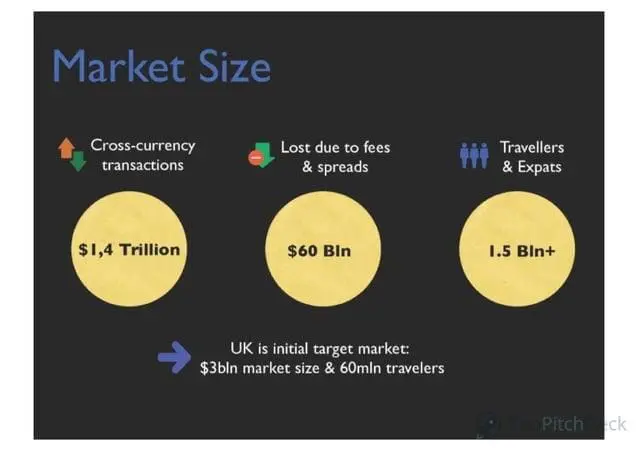
The market size slide presents compelling statistics about the global money transfer and currency exchange markets, establishing the scale of opportunity available to potential disruptors. By quantifying transaction volumes and fee structures, Revolut demonstrates that even capturing a small percentage of market share could generate significant revenues. The data validation approach shows founders who understand investor requirements for addressable market analysis rather than relying solely on anecdotal evidence.
This slide strategically follows the problem identification, creating a logical flow from customer pain to market opportunity quantification. The timing was particularly relevant in 2015 as globalisation accelerated cross-border transactions whilst traditional banking infrastructure remained antiquated and expensive. By presenting credible market research, Revolut positions itself as a data-driven team capable of capturing meaningful market share through superior customer experience and pricing.
What investors see: A billion-dollar market with structural inefficiencies ripe for disruption by mobile-native solutions. The market size validates the problem significance whilst suggesting sufficient room for multiple winners, reducing competitive risk concerns. Investors appreciate the research depth as evidence of founders who understand both customer needs and market dynamics necessary for successful scaling.
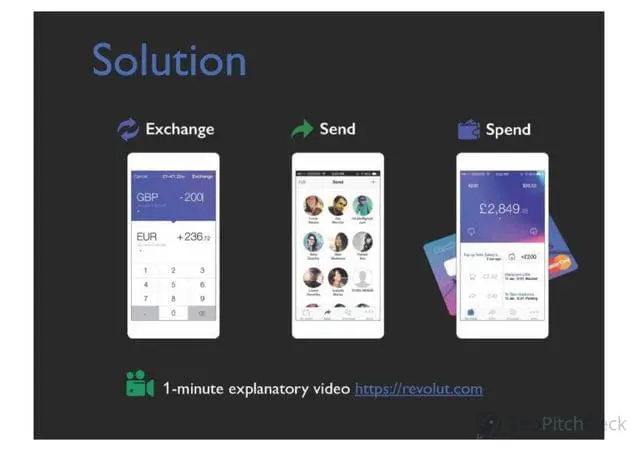
Revolut’s solution directly addresses the identified banking pains by promising access to interbank exchange rates through a mobile application, complemented by viral features and patent-pending technology. This positioning is strategically powerful because it frames the product as fundamentally superior to existing alternatives rather than merely cheaper. The emphasis on interbank rates communicates sophisticated financial infrastructure whilst remaining accessible to non-technical audiences through simple mobile interface promises.
The mention of “viral features” and “patent-pending technology” adds intrigue whilst suggesting both growth potential and defensibility without revealing specific intellectual property details. This approach balances transparency with competitive protection, a delicate equilibrium crucial in investor presentations. The mobile-first positioning aligned perfectly with 2015 consumer behaviour trends as smartphone adoption accelerated and users became comfortable with app-based financial services.
What investors see: A technically differentiated solution with clear customer value proposition and potential network effects. The combination of cost savings (interbank rates) and user experience (mobile-native) suggests sustainable competitive advantages over incumbent banks. Patent references indicate intellectual property protection whilst viral features hint at organic growth potential reducing customer acquisition costs.
The product demonstration reduces complex financial technology to three intuitive steps: open app, select currency, send money. This simplification is strategically brilliant because it makes institutional-grade financial services feel accessible to mainstream consumers whilst proving product usability through visual evidence. The step-by-step approach addresses investor concerns about user adoption barriers in financial services, where complexity often determines success or failure.
By including actual interface screenshots or mockups, this slide provides tangible proof that Revolut exists beyond PowerPoint concepts, addressing the common investor concern about execution capability. The visual demonstration format allows non-technical investors to understand the user experience whilst technical investors can assess interface design quality and functionality scope. This dual-audience approach maximises slide effectiveness across diverse investor backgrounds.
What investors see: A functional product with intuitive user experience that reduces friction in complex financial transactions. The three-step simplicity suggests strong product-market fit potential whilst visual proof demonstrates execution capability beyond just vision. Investors recognise this as evidence of customer-centric design thinking and technical competence necessary for fintech success.
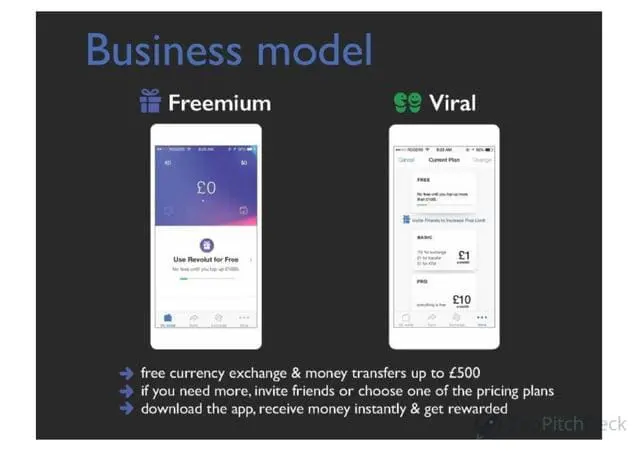
The freemium business model explanation demonstrates sophisticated monetisation strategy that balances user acquisition with revenue generation through premium subscriptions and transaction fees. This approach allows Revolut to capture price-sensitive customers through free basic services whilst monetising high-value users who require advanced features or higher transaction limits. The model particularly suits fintech because it builds trust through free usage before requesting payment commitments.
By positioning premium features as upgrades rather than essential services, Revolut creates natural upselling opportunities whilst maintaining competitive pricing against traditional banks for basic functionality. This strategy addresses the common fintech challenge of customer acquisition cost by using free services as loss leaders to build relationships before introducing paid features. The model also provides multiple revenue streams, reducing dependence on any single monetisation method.
What investors see: A scalable monetisation strategy with clear upgrade paths and diversified revenue streams. The freemium approach suggests strong unit economics potential as users demonstrate value before paying, reducing churn risk. Investors appreciate the balance between customer acquisition and revenue generation, recognising this as a proven model in consumer technology with fintech applications.
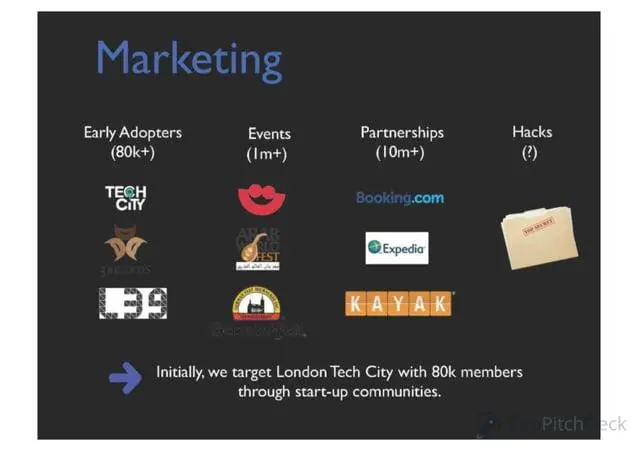
The marketing strategy outlines a go-to-market approach leveraging viral features and strategic partnerships to acquire users efficiently, addressing the critical fintech challenge of customer acquisition cost. By emphasising viral growth mechanisms, Revolut suggests organic user expansion that reduces dependence on expensive paid marketing channels. The partnership focus indicates strategic relationship building with established financial services players, providing credibility and distribution access.
This dual-approach strategy combines organic growth with institutional validation, addressing both customer acquisition efficiency and trust building in financial services. The viral components likely include referral programmes and social sharing features that turn satisfied users into acquisition channels, whilst partnerships provide regulatory backing and payment infrastructure access. This comprehensive approach demonstrates understanding of fintech market dynamics beyond pure product development.
What investors see: A capital-efficient customer acquisition strategy with multiple growth channels and credibility mechanisms. The viral focus suggests strong product-market fit confidence whilst partnership emphasis indicates regulatory and operational maturity. Investors recognise this balanced approach as reducing customer acquisition risk whilst building sustainable competitive advantages through network effects and institutional relationships.
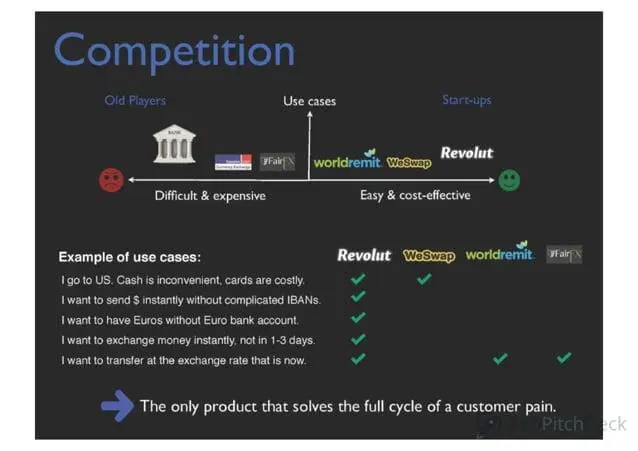
The competitive analysis positions Revolut as demonstrably cheaper and faster than traditional banks through direct comparison graphs, focusing on measurable advantages rather than subjective benefits. By benchmarking against established players like Barclays, Revolut establishes credibility whilst highlighting substantial cost savings that justify customer switching. The data-driven approach provides concrete evidence of value proposition superiority rather than marketing claims.
This competitive framing is strategically focused on incumbent banks rather than emerging fintech competitors, positioning Revolut as a category creator challenging legacy institutions rather than fighting for market share with similar startups. The emphasis on transaction speed and fee advantages addresses the two most important customer decision factors in financial services, creating clear switching incentives. The visual comparison format makes investor evaluation straightforward whilst reinforcing customer value messaging.
What investors see: Quantifiable competitive advantages that create compelling customer switching incentives and defensible market position. The focus on established competitors suggests market validation whilst superior metrics indicate sustainable differentiation. Investors appreciate the data-driven competitive analysis as evidence of strategic thinking and market understanding necessary for successful market disruption.
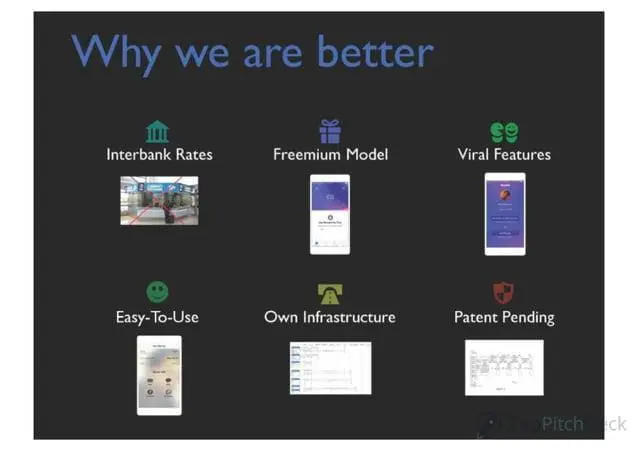
This slide consolidates Revolut’s unique selling points through icon-supported messaging covering interbank rates, transaction speed, security features, and strategic partnerships. The visual approach makes complex financial services accessible whilst reinforcing key differentiators that justify investor confidence and customer preference. Each element addresses specific customer concerns or competitive advantages, creating a comprehensive value proposition summary.
The strategic positioning emphasises both rational benefits (lower costs, faster transactions) and emotional benefits (security, partnerships) that appeal to different customer decision-making processes. By combining technical superiority with trust indicators, Revolut addresses the full spectrum of customer evaluation criteria in financial services adoption. The icon-based presentation format is designed for presenter elaboration whilst providing clear visual anchors for investor memory retention.
What investors see: A comprehensive competitive differentiation strategy addressing multiple customer value drivers and market positioning requirements. The combination of cost, speed, security, and partnership advantages suggests sustainable competitive moats across key business dimensions. Investors recognise this multi-faceted approach as reducing competitive risk whilst providing multiple customer acquisition and retention drivers.
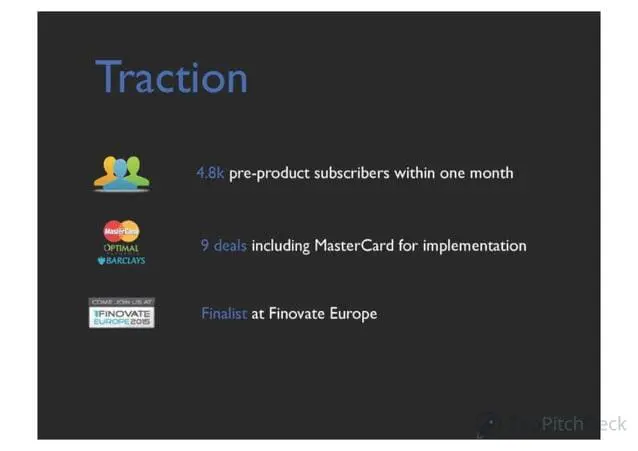
The traction slide presents compelling early validation through 4,800 pre-product subscribers accumulated in just one month, alongside strategic partnerships with MasterCard and Barclays. This combination of organic demand and institutional endorsement provides powerful evidence of market opportunity and execution capability before full product launch. The subscriber growth rate suggests strong product-market fit potential whilst partnership logos provide credibility and regulatory validation crucial in financial services.
The strategic value of pre-launch traction cannot be overstated in seed-stage fundraising, as it demonstrates customer willingness to engage before experiencing full product benefits. MasterCard and Barclays partnerships indicate sophisticated business development capabilities and regulatory compliance preparation, addressing common investor concerns about fintech operational complexity. This traction mix reduces multiple risk factors simultaneously: market demand, technical execution, and regulatory navigation.
What investors see: Strong market validation through organic customer demand and institutional partnership endorsement, significantly reducing investment risk. The rapid subscriber acquisition suggests powerful customer value proposition whilst major partnerships indicate operational and regulatory credibility. Investors recognise this dual traction approach as evidence of both customer pull and institutional push necessary for fintech success.
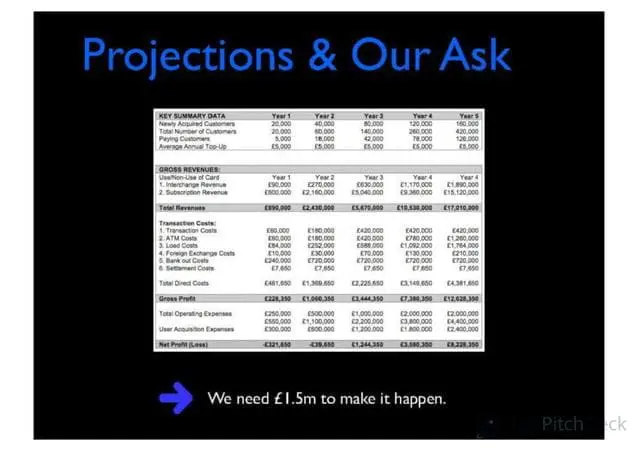
The financial projections present an ambitious revenue growth trajectory from £690,000 to £17 million over five years, demonstrating the massive scalability potential that attracts venture capital investment. These projections reflect the explosive growth characteristics of successful fintech companies whilst remaining grounded in addressable market size and customer acquisition assumptions. The steep growth curve aligns with investor expectations for venture-scale returns whilst showing mathematical basis rather than pure optimism.
The 25x revenue growth projection over five years represents aggressive but achievable scaling for mobile financial services with strong network effects and viral growth components. By presenting specific financial targets, Revolut demonstrates business model understanding and provides concrete success metrics for investor evaluation. The projections also establish valuation framework for future funding rounds whilst showing path to profitability and eventual exit opportunities.
What investors see: Venture-scale growth potential with mathematical foundation supporting ambitious projections rather than unfounded optimism. The revenue trajectory suggests strong unit economics and scalable business model capable of generating substantial returns on investment. Investors appreciate the specific targets as evidence of strategic planning whilst recognising the growth rates as consistent with successful fintech companies in comparable markets.

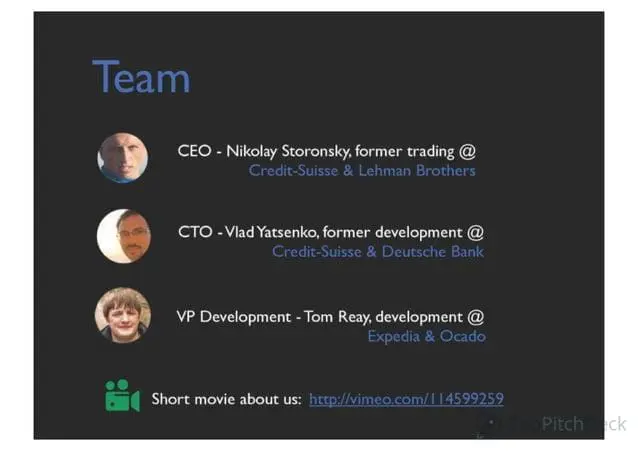
The final slide requests £1.5 million to scale team capabilities and execute the freemium business model, providing specific use of funds that directly connects investment to growth acceleration. The funding ask aligns with seed-stage expectations whilst being substantial enough to achieve meaningful milestones before requiring additional capital. By including team information highlighting founders’ relevant experience, this slide addresses both capital requirements and execution capability in a comprehensive closing argument.
The combination of funding request with team credentials creates a natural progression from financial needs to capability demonstration, reinforcing investor confidence in successful capital deployment. The specific use of funds shows strategic thinking about resource allocation whilst team backgrounds provide credibility for achieving projected milestones. This dual focus addresses the two primary investor concerns: capital efficiency and execution risk.
What investors see: A clear funding requirement with specific deployment strategy and credible team to execute against ambitious projections. The £1.5M ask provides sufficient runway for meaningful progress whilst maintaining capital efficiency attractive to seed investors. Investors appreciate the connection between funding amount and growth acceleration, combined with founder credentials that support successful capital utilisation.
From insight to investor-ready, in weeks not months.
Apply these lessons to your raise — we’ll build your deck, financial model, and IM together.
While this deck secured one of the most successful seed rounds in fintech history and laid the foundation for Revolut’s explosive growth to a $60 billion valuation, it is not without gaps that modern pitch decks would be expected to address. The 2015 fundraising environment was less sophisticated in its due diligence requirements, allowing certain omissions that today’s investors would find concerning. To avoid such pitfalls, many startups now seek guidance from expert pitch deck consultants.
Lacks a concise ‘what we do’ statement on the cover; modern decks start with this to immediately orient investors, preventing confusion about the ‘Personal Money Cloud’ tagline.
Team info is minimal or absent in core version; today’s decks dedicate space to founders’ expertise and advisors to build credibility early.
No user quotes or case studies; essential for seed decks to humanise traction beyond raw metrics.
Marketing slide is high-level; modern pitches detail CAC, LTV, and channel strategies for scalable growth proof.
Ignores regulatory/fintech risks; addressing them proactively shows maturity and reduces investor concerns.
No mention of potential acquirers or IPO path; VCs want vision for returns.
Missing future features timeline; helps investors see defensibility and expansion beyond MVP.
These gaps reflect the evolving sophistication of venture capital due diligence rather than fundamental flaws in Revolut’s original presentation. At Projects RH, we help founders address these modern investor expectations whilst maintaining the narrative clarity and strategic focus that made this deck successful. The key is balancing comprehensiveness with conciseness, ensuring every slide adds value rather than complexity.
Target universal frustrations like high FX fees to instantly connect emotionally; founders should test if investors nod in recognition within seconds.
4800 sign-ups validated market pre-launch; build waitlists or LOIs early to de-risk for seed investors.
Demo app in 3 steps without jargon; simplifies comprehension and proves usability – recreate with native mockups.
Combine metrics (subscribers) with partnerships (MasterCard); layers credibility beyond one data point.
Tie £1.5M to team scaling/freemium; always answer ‘how will money accelerate returns?’ explicitly.
£690k to £17M in 5 years excited VCs; base on traction multiples, avoid uncredible hockey-sticks.
Problem → Solution → Traction → Ask creates domino logic; sequence slides to guide without overload.
Ready to raise? Let’s talk.
We’ve helped founders secure $2B+ in investor interest. Your round could be next.
The distance between the Revolut that presented this deck and the Revolut that exists today is one of the most remarkable growth stories in fintech history. In 2015, Revolut was a pre-revenue startup with 4,800 subscribers and ambitious projections; today, it serves over 52 million customers with $4.5 billion in annual revenue and a $60 billion valuation. This transformation represents not just successful execution, but the compounding power of venture capital when deployed behind exceptional founders and market opportunities.
For investors who backed Revolut’s £1.5 million seed round, the returns have been extraordinary. Assuming early investors maintained their positions through subsequent rounds, their investment has generated returns exceeding 4,000x – transforming a £100,000 investment into over £400 million. This level of return exemplifies the venture capital model at its most successful, where exceptional companies can generate fund-making returns from single investments.
The Revolut success story demonstrates why investors are willing to accept high failure rates in exchange for potential exposure to category-defining companies. For founders, it illustrates the importance of thinking beyond immediate product needs to long-term market transformation possibilities. The twelve slides that secured Revolut’s seed funding ultimately enabled the creation of one of Europe’s most valuable fintech companies, proving that exceptional pitch decks are not just fundraising tools, but blueprints for building generational businesses.
At Projects RH, we help companies across all industries create investor-ready materials that close deals. Our integrated capital raising package ensures consistency across all your investor documentation.
Built in-house for accuracy and investor confidence.
Comprehensive investor documentation following global best practices.
12-slide investor-ready presentation with supporting materials.
High-impact snapshot to capture investor attention fast.
Browse our collection of real pitch deck breakdowns from the world’s most successful companies.
The 2015 seed deck has 12 slides, following a logical flow from problem to ask, balancing brevity with key proof points like traction and projections.
£1.5M ($1.5M-$1.8M equivalent) in seed funding from investors including Seedcamp and Index Ventures, used to scale the team and launch the freemium app.
Clear problem-solution fit, pre-product traction (4,800 subscribers), big-name partnerships, and ambitious projections created a compelling, low-risk narrative in a hot fintech market.
Yes for structure (problem-traction-ask) and simplicity, but update with modern elements like team depth, testimonials, and risks; adapt to your stage and avoid dated design.
Seed stage in 2015, pre-product launch but with strong validation via waitlist and partnerships, targeting first institutional capital.
Creating an effective pitch deck requires more than following a template — it demands strategic clarity about your value proposition, a deep understanding of your target investors, and rigorous financial modelling to support your narrative. At Projects RH, we combine financial expertise with strategic storytelling to build pitch decks, information memorandums, and financial models that meet the standards of institutional investors worldwide. Our team has generated over USD 2.0 billion in expressions of interest across mining, energy, technology, medtech, and financial services sectors. Schedule a consultation to discuss how we can help position your company for successful capital raising.