
A slide-by-slide analysis of the 17-slide pitch deck Dropbox used to secure $1.2M in seed funding from Sequoia Capital and Y Combinator in 2007.
Building your own pitch deck?
Get expert guidance from the team behind $2B+ in investor interest.
Dropbox emerged from a moment of pure frustration that every digital professional has experienced. Drew Houston, an MIT computer science student, repeatedly forgot his USB drive on Boston’s public transport, leaving him unable to access critical files when he needed them most. This personal pain point crystallised into a business insight: file storage and synchronisation was fundamentally broken, requiring users to email files to themselves or rely on unreliable, clunky enterprise solutions that were designed for IT departments, not individual users. Recognizing the need for streamlined solutions, many professionals turn to pitch deck consulting services to enhance their workflows and address similar challenges.
Houston partnered with fellow MIT student Arash Ferdowsi to build what would initially be called “Evenly” – a simple cloud synchronisation service that would make files universally accessible across devices. The timing was fortuitous: they entered Y Combinator’s summer 2007 batch when broadband was becoming ubiquitous, storage costs were plummeting, and the shift toward web and mobile computing was accelerating. However, they faced the classic chicken-and-egg problem of marketplace businesses – they had no users, no revenue, and were competing against established enterprise players with deeper pockets.
The breakthrough came through Houston’s strategic decision to create a demonstration video rather than build a full product first. Posted on Hacker News, this simple screencast showing seamless file synchronisation across devices went viral, generating over 70,000 views and creating a massive beta waitlist without any marketing spend. This organic validation proved product-market fit existed before they had built the actual product, giving them unprecedented leverage when pitching investors.
Armed with this viral momentum and their status as Y Combinator’s #1 company in their batch, Houston and Ferdowsi used this 17-slide deck to secure meetings with top-tier venture capital firms. Sequoia Capital, impressed by the combination of a massive market opportunity, elegant technical execution, and demonstrated user demand, led the $1.2 million seed round that would launch one of the most successful SaaS companies in history.
The opening slide establishes Dropbox’s ambitious global mission with the tagline “Moving the world’s files” – a deceptively simple phrase that hints at massive scale and universal utility. The minimalist design featuring just the logo, tagline, and website URL creates confidence through restraint, suggesting the founders are focused on execution rather than flashy presentations. This restraint is particularly powerful given that most early-stage companies overcompensate with elaborate graphics and lengthy taglines that dilute their core message.
The strategic choice to avoid any financial metrics, team photos, or product screenshots on the title slide demonstrates sophisticated presentation craft. By withholding details, the slide creates curiosity and positions the following slides as a carefully orchestrated reveal rather than an information dump. The inclusion of the website URL subtly reinforces that this is a real, accessible product rather than just a concept.
What investors see: A team that understands the power of simplicity and has the confidence to let their story unfold naturally. The global scope implied by “world’s files” signals total addressable market thinking from slide one, while the clean execution suggests these founders won’t get distracted by unnecessary complexity. This opening immediately differentiates Dropbox from enterprise storage solutions by positioning it as consumer-friendly and universally relevant.

This slide is a masterclass in visual storytelling, using a photograph of a desk cluttered with USB drives, cables, and storage devices to instantly communicate the chaos of file management. The bold declaration “Storage is a mess” requires no explanation when paired with this universally recognisable scene of digital disorganisation. The emotional impact is immediate – every viewer has experienced this frustration, making the problem deeply personal rather than abstract.
The strategic brilliance lies in choosing a problem that transcends demographics and use cases – everyone from students to executives struggles with file management chaos. By avoiding technical jargon or industry-specific pain points, Dropbox positions itself as solving a universal human problem rather than a niche software challenge. This inclusive approach expands the potential market from IT professionals to every knowledge worker globally.
What investors see: A problem with massive market potential that doesn’t require education or evangelisation. The visual approach demonstrates the founders’ understanding that investor attention spans are limited and emotional resonance drives decision-making more than logical arguments. This slide effectively qualifies the entire room – if you’ve never experienced this problem, you’re not the target customer, but if you have, you immediately understand the value proposition.
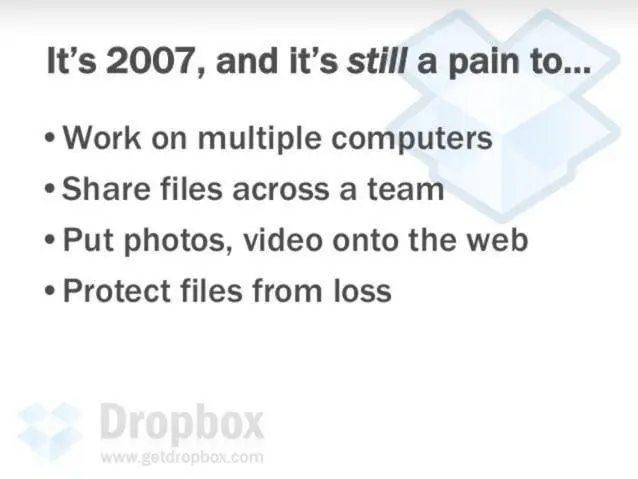
Building on the emotional hook, this slide systematically breaks down the specific frustrations that compound the storage problem: emailing files to yourself, dealing with version conflicts, and experiencing unreliable syncing across devices. Each pain point is presented with simple icons and minimal text, maintaining the visual storytelling approach while providing the rational framework investors need to understand market size and solution requirements.
The slide strategically positions existing solutions as inadequate – highlighting that enterprise tools are too complex for individual users while consumer options are unreliable or limited. This competitive landscape analysis is woven into the problem definition, showing that while alternatives exist, none address the core user experience challenges that create the opportunity for disruption.
What investors see: A systematic breakdown that transforms an emotional problem into a logical investment thesis. The specific pain points create multiple angles for solution validation and provide a framework for measuring product-market fit. This level of problem granularity suggests the founders have done deep customer development and understand the nuanced requirements for a successful solution.
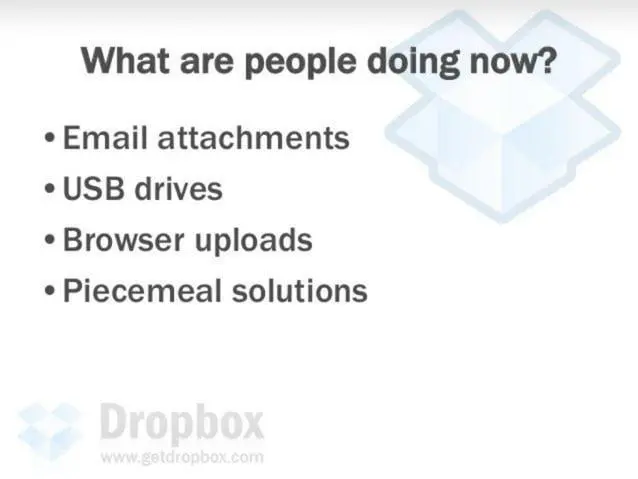
This slide transforms the universal problem into a quantified market opportunity by illustrating the massive scale of global file storage and transfer activity. The visual representation of billions of files being stored and moved daily provides concrete evidence that the pain point identified earlier affects a substantial addressable market. The graphics effectively communicate scale without overwhelming viewers with complex market research data or industry analyst reports.
The strategic positioning focuses on activity volume rather than traditional market sizing metrics like total addressable market (TAM) or serviceable addressable market (SAM). This approach reinforces that Dropbox is solving an active, growing problem rather than trying to create a new category, which significantly reduces market risk and customer acquisition complexity.
What investors see: A massive opportunity that grows organically as digital adoption increases, requiring no market creation or extensive customer education. The focus on file activity rather than storage capacity suggests a platform play with recurring engagement rather than a one-time storage purchase, implying stronger unit economics and customer lifetime value potential.
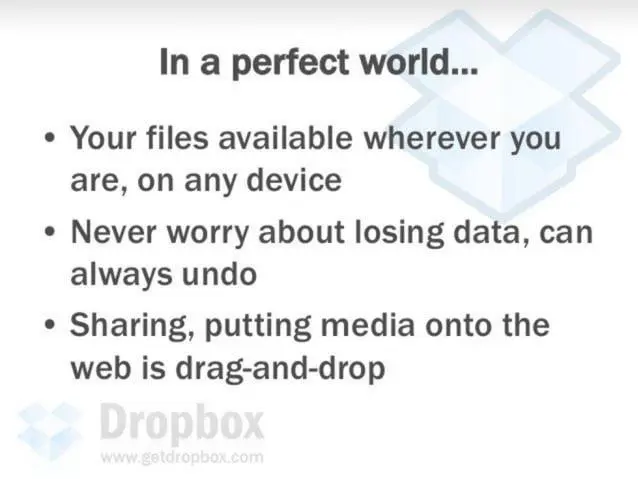
The “In a perfect world…” framing creates aspirational tension between current reality and desired future state, positioning Dropbox as the bridge to this ideal world. The slide outlines three core value propositions: universal access, peace of mind through security, and drag-and-drop simplicity. This trifecta addresses functional, emotional, and usability requirements simultaneously, creating a comprehensive solution vision that resonates across different user motivations.
The strategic use of “perfect world” language manages expectations while building desire – it acknowledges that current solutions fall short without making unrealistic promises about Dropbox’s capabilities. This positioning allows the subsequent solution slides to exceed expectations by delivering on the vision while maintaining credibility through measured claims.
What investors see: A clear product vision that balances ambition with achievability, demonstrating the founders understand both user needs and technical constraints. The focus on outcomes rather than features suggests customer-centric thinking that will drive product decisions and market adoption. This vision also provides a roadmap for iterative development and feature prioritisation post-funding.
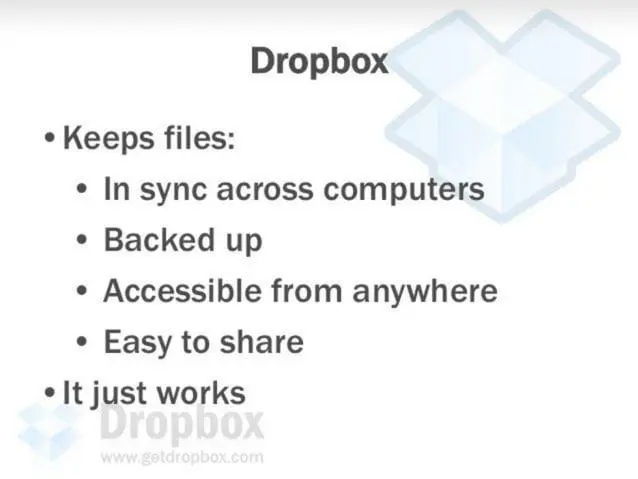
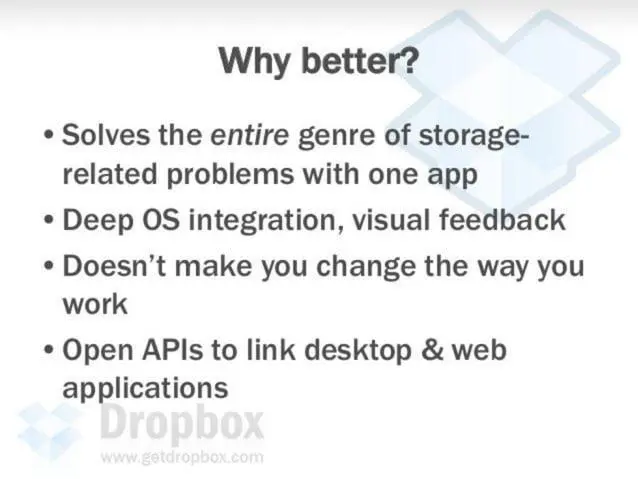
The solution introduction immediately establishes the freemium model with “2GB free storage” while emphasising the seamless experience across computers, phones, and web browsers. The key phrase “works automatically without user effort” positions Dropbox as invisible infrastructure rather than another application users need to manage. This messaging directly addresses the complexity problems identified earlier while introducing the viral acquisition strategy through the free tier.
The strategic focus on “magic-like simplicity” differentiates Dropbox from enterprise storage solutions that require IT support and complex setup procedures. By positioning the product as working automatically, the slide suggests that technical complexity is handled behind the scenes, making sophisticated cloud synchronisation accessible to mainstream consumers rather than just technical users.
What investors see: A solution that reduces user friction to near-zero while creating natural viral growth through the freemium model. The multi-platform approach suggests network effects and switching costs that increase over time, while the emphasis on automation implies a scalable solution that doesn’t require proportional customer support growth.

The demo slide showcases the product through actual screenshots rather than conceptual diagrams, demonstrating that Dropbox is a real, working solution rather than just a prototype. The interface screenshots show Windows Explorer integration, browser access, and real-time syncing in action, providing concrete evidence of the “magic” promised in previous slides. The confident “Demo” title suggests the founders are prepared to show live functionality during the presentation.
The strategic selection of screenshots emphasises seamless integration with existing workflows rather than requiring users to adopt entirely new interfaces or behaviours. By showing familiar file management experiences enhanced by cloud synchronisation, the slide reduces perceived adoption risk and demonstrates immediate utility within current user patterns.
What investors see: Execution capability and product-market fit validation through working software that integrates elegantly with existing user behaviours. The polished interface screenshots suggest the team can deliver consumer-grade user experiences, while the integration approach indicates deep understanding of customer workflow requirements. This tangible demonstration significantly reduces technical execution risk.
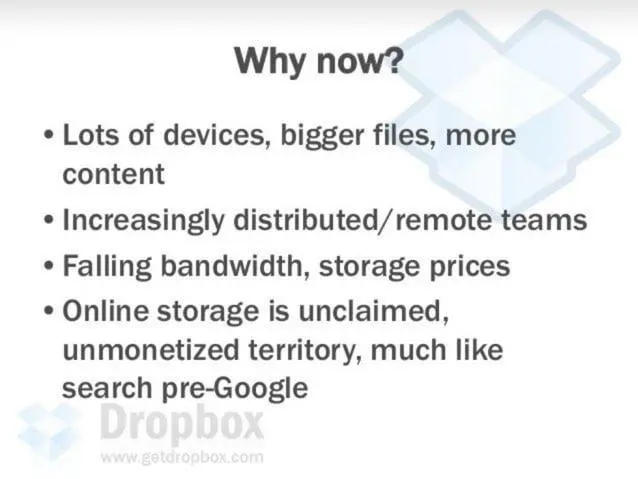
This slide identifies three converging trends that create the perfect timing for Dropbox: rising internet speeds enabling large file transfers, plummeting storage costs making free tiers economically viable, and the accelerating shift toward web and mobile computing. The combination of these macro trends creates a window of opportunity where consumer cloud adoption becomes both technically feasible and economically attractive.
The strategic presentation through charts and data visualisations lends credibility to the timing argument while demonstrating that the founders understand market dynamics beyond their immediate product. This macro-level thinking suggests they can navigate competitive responses and market evolution as the company scales, rather than being blindsided by industry changes.
What investors see: A rare alignment of technological and economic factors that creates a narrow window for market entry and early mover advantage. The convergence of these trends suggests that waiting would mean missing the opportunity, while the data-driven approach demonstrates analytical capability that will be crucial for navigating rapid market changes and competitive dynamics.
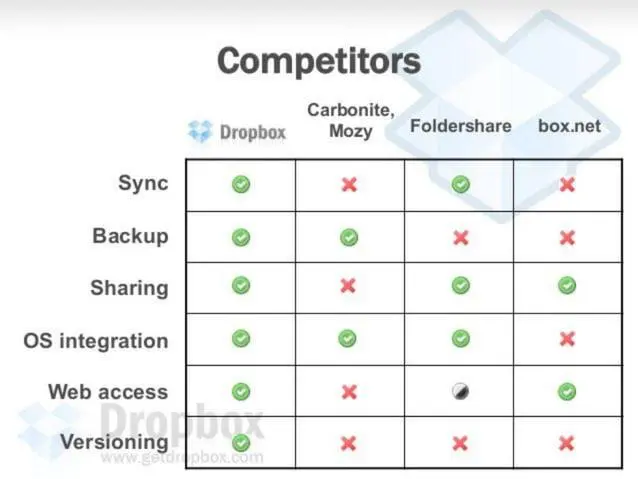
The competitive analysis matrix positions Dropbox favourably against established players like Box.net, Mozy, and XDrive across key dimensions of ease of use, storage capacity, and pricing. Rather than claiming no competition exists, this honest assessment acknowledges the competitive landscape while highlighting Dropbox’s superior user experience as the primary differentiator. The matrix format allows for quick visual comparison without requiring extensive explanation.
The strategic emphasis on user experience over technical features suggests that Dropbox understands the market is ready for a consumer-focused solution rather than another enterprise tool. By positioning ease of use as the primary competitive advantage, the slide reinforces that customer adoption will be driven by experience quality rather than feature quantity or price competition.
What investors see: A team that understands competitive dynamics while identifying a clear differentiation strategy based on user experience rather than price or features. The matrix approach demonstrates analytical thinking and honest market assessment, while the focus on usability suggests a sustainable competitive advantage that will be difficult for enterprise-focused competitors to replicate quickly.
The business model slides outlines a sophisticated freemium strategy: a free 2GB tier designed for viral acquisition, paid individual upgrades at $10 monthly for additional storage, team collaboration plans, and future enterprise sales opportunities. This multi-tier approach creates multiple revenue streams while using the free tier as a customer acquisition engine rather than a cost centre, addressing both viral growth and monetisation simultaneously.
The progression from individual to team to enterprise sales creates a natural expansion revenue model where customers grow with the platform rather than churning to competitors. This approach reduces customer acquisition costs over time while increasing lifetime value through organic account expansion, creating powerful unit economics that improve as the company scales.
What investors see: A scalable business model that balances growth and monetisation through proven freemium mechanics, with clear paths to expand revenue per customer over time. The multi-tier structure suggests strong potential for negative churn and expanding market opportunity as users’ storage needs grow, while the viral component reduces customer acquisition costs below traditional SaaS benchmarks.
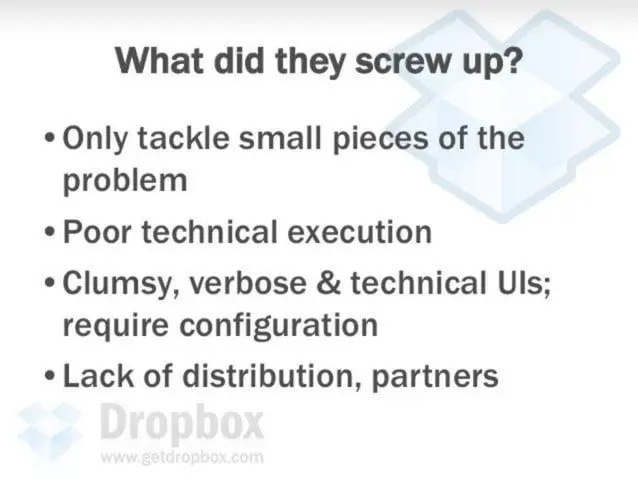
The marketing strategy centres on a viral referral loop where users can “invite friends to get additional storage,” creating a win-win incentive structure that drives organic growth without traditional advertising spend. The slide projects explosive user growth from zero to millions through network effects, with existing users becoming active acquisition channels rather than passive customers. This approach transforms customer acquisition from a cost centre into a value exchange.
The strategic genius of this viral mechanism lies in its alignment with core product value – additional storage is exactly what users want, making the referral reward inherently valuable rather than feeling like a marketing gimmick. This creates authentic user motivation to share the product, resulting in higher-quality referrals and better conversion rates than traditional incentive programmes.
What investors see: A growth engine that becomes more powerful and cost-effective as it scales, with viral coefficients that could drive exponential user acquisition without proportional marketing spend increases. The alignment between referral incentives and core product value suggests sustainable viral mechanics rather than artificial growth that could plateau or require ongoing subsidisation.
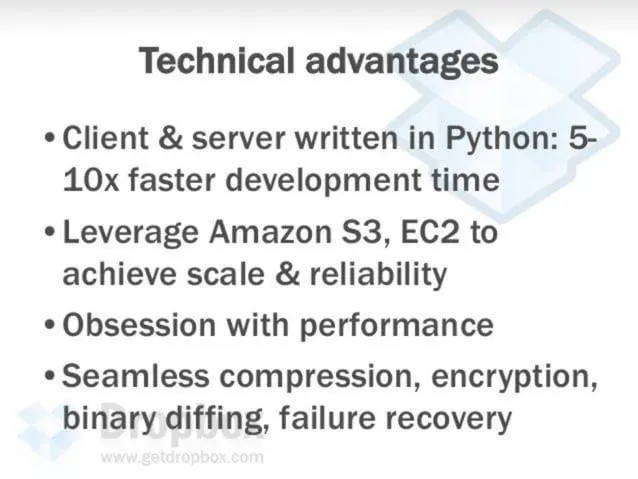
The growth projections translate the viral marketing strategy into concrete forecasts, showing user growth trajectories and revenue ramp projections over a 3-5 year horizon based on viral coefficient assumptions. The charts demonstrate how network effects could drive market penetration while showing the relationship between user acquisition and revenue generation through the freemium conversion funnel. These projections provide investors with tangible targets for measuring progress and return potential.
The strategic presentation of multiple growth scenarios shows the founders understand the inherent uncertainty in viral growth while providing realistic and optimistic cases for investor evaluation. This range approach demonstrates analytical rigor while acknowledging that viral mechanics can create exponential rather than linear growth patterns, setting appropriate expectations for potential scale and timeline.
What investors see: A data-driven approach to growth planning with scenarios that account for viral uncertainty while showing massive scale potential if the viral mechanisms perform as designed. The projections provide a framework for measuring execution against plan while demonstrating the founders’ understanding of key metrics that will drive business success.
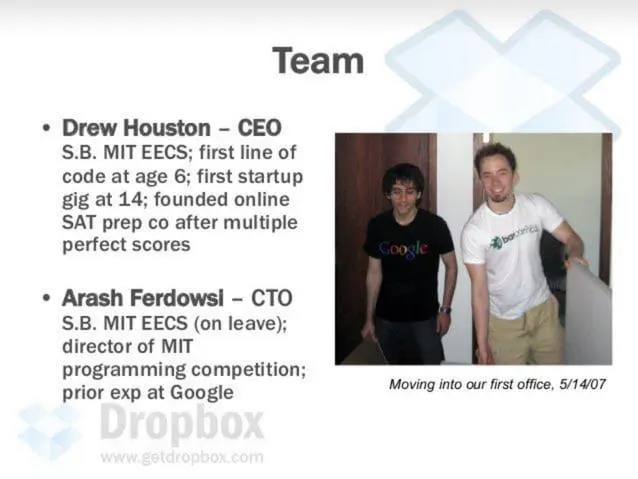
The team slide introduces co-founders Drew Houston and Arash Ferdowsi, emphasising their MIT computer science backgrounds and relevant experience, including Houston’s internship at Google. The presentation focuses on technical credibility while humanising the founders through professional photos and concise biographical information. This personal approach builds trust while establishing the technical expertise necessary to execute on complex cloud infrastructure and user experience challenges.
The strategic emphasis on educational pedigree and relevant industry experience addresses a critical investor concern about execution risk in a technically complex space. By highlighting both founders’ computer science backgrounds and Houston’s exposure to Google’s engineering culture, the slide suggests the team can build scalable infrastructure while maintaining the consumer-focused design philosophy that differentiates Dropbox from enterprise solutions.
What investors see: A technically competent founding team with the right combination of engineering depth and consumer product sensibility to execute on the vision. The MIT credentials and Google experience suggest they can attract top engineering talent while building enterprise-grade infrastructure, while their young demographic alignment with target customers indicates natural product intuition for the consumer market.
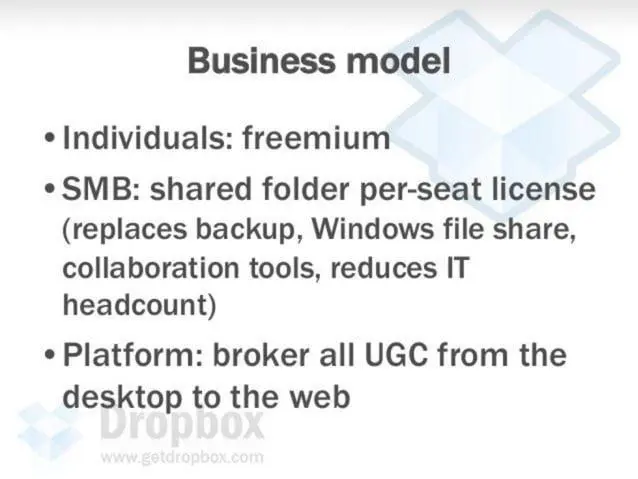
The advisors slide showcases the network of experienced mentors and early supporters who provide strategic guidance and industry credibility beyond the core founding team. This external validation demonstrates that respected industry professionals believe in the vision and are willing to invest their reputation and time in the company’s success. The diversity of advisor backgrounds suggests comprehensive support across technical, business, and strategic dimensions.
The strategic presentation of advisor credentials addresses potential gaps in the founding team’s experience while showing the company can attract high-quality guidance from successful entrepreneurs and industry experts. This advisory network also provides implicit due diligence, as experienced advisors typically evaluate opportunities carefully before committing their time and reputation.
What investors see: A company that has already attracted quality external validation and strategic support, reducing execution risk and increasing the likelihood of successful scaling. The advisor network also suggests potential for business development opportunities and strategic partnerships that could accelerate growth beyond organic user acquisition.
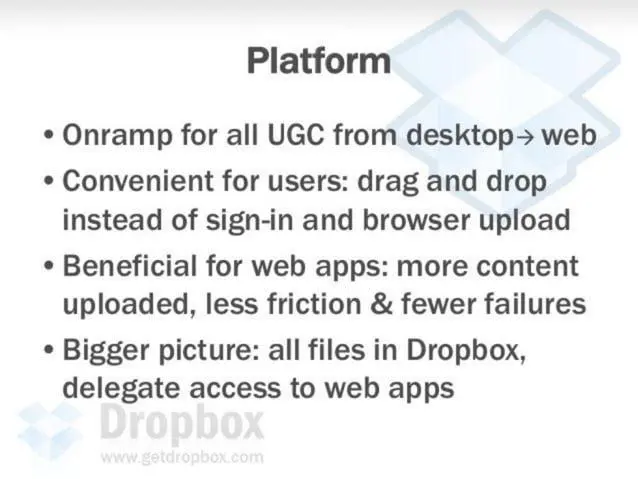
The funding request slide provides a clear and specific ask with detailed allocation of funds across product development, marketing initiatives, and operational scaling requirements. The transparency in fund deployment demonstrates financial discipline and strategic thinking about capital allocation priorities. This level of specificity helps investors understand exactly how their money will be used to drive measurable progress toward key milestones.
The strategic breakdown shows appropriate balance between product development to maintain competitive advantage and marketing investment to fuel the viral growth engine described earlier. The allocation ratios suggest the founders understand that great products require both technical excellence and effective user acquisition to achieve market success, avoiding the common trap of over-indexing on either development or marketing at the expense of balanced growth.
What investors see: A disciplined approach to capital deployment with clear priorities and measurable outcomes, reducing the risk of inefficient fund utilisation. The specific allocations also provide a framework for ongoing investor updates and performance tracking, demonstrating accountability and systematic thinking about resource management.
The traction slide presents early validation metrics including prototype user feedback, viral Hacker News demo video performance with over 70,000 views, and the company’s #1 ranking in the Y Combinator summer batch. These metrics demonstrate product-market fit indicators and user demand validation without requiring a fully launched product, providing concrete evidence that the viral marketing strategy can work in practice.
The strategic emphasis on organic viral performance through the Hacker News demo validates the core assumption underlying the business model – that users will naturally share and promote the product when they see value. The massive beta waitlist generated from this organic viral moment provides proof that the target market exists and is actively seeking the solution Dropbox provides.
What investors see: Compelling evidence of product-market fit and viral potential before significant capital investment, dramatically reducing market risk and proving the founders can execute effective growth strategies. The YC ranking and organic viral performance suggest this team can outperform competitors and attract quality customers through superior product and marketing execution.

The closing slide reinforces the company’s credibility through a VentureBeat quote praising Dropbox’s simplicity and the prominent display of their #1 Y Combinator batch ranking. This third-party validation from respected industry sources provides external confirmation of the internal narrative presented throughout the deck, adding credibility without appearing boastful or self-promotional.
The strategic placement of social proof at the end reinforces key messages about product quality and market validation while leaving investors with positive external perspectives rather than internal claims. The combination of media coverage and accelerator recognition suggests both consumer market appeal and investor community validation, addressing multiple stakeholder perspectives simultaneously.
What investors see: Independent validation of the company’s value proposition and execution capability from credible industry sources, reducing due diligence burden and providing confidence that other sophisticated investors and media organisations share positive views of the opportunity. This external validation often carries more weight than internal metrics or projections.
From insight to investor-ready, in weeks not months.
Apply these lessons to your raise — we’ll build your deck, financial model, and IM together.
While this deck secured one of the most transformational seed investments in tech history, launching a company that would eventually reach a $10+ billion valuation, it reflects the simpler expectations of 2007-era venture capital and lacks several elements that modern investors consider essential for due diligence and risk assessment. For those looking to enhance their presentations, seeking fundraising-grade pitch deck consulting can be a crucial step.
Lacks detailed 3-5 year revenue forecasts, cash flow, or burn rate; modern decks require these to show path to profitability and unit economics, helping investors model returns.
Minimal quantitative traction like user signups or waitlist size; today’s investors demand MAUs, retention rates, or LTV/CAC to validate growth before funding.
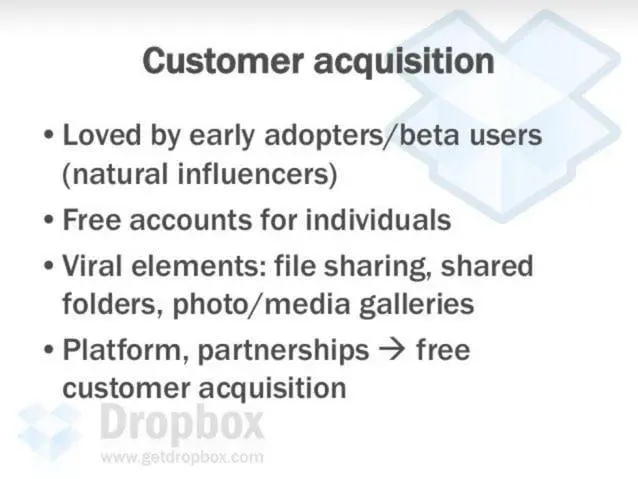
Vague on customer acquisition beyond virality; current decks need specifics on channels, partnerships, and sales funnels to prove scalable distribution.
Basic competition slide without defensible advantages like IP or network effects depth; modern pitches emphasise barriers to entry for sustainability.
No ownership structure or dilution details; investors now expect transparency on existing investors and post-money ownership for alignment.
Omits potential risks like data security or competition; contemporary decks address these proactively to build trust and show realism.
No timeline for features or milestones; VCs want a clear post-funding plan to track progress and accountability.
These gaps don’t diminish the deck’s historical success but reflect how investor expectations have evolved toward greater diligence and risk management. At Projects RH, we help founders bridge these gaps by developing comprehensive financial models, traction dashboards, and risk assessment frameworks that meet modern investor standards while maintaining the clarity and compelling narrative that made the original Dropbox deck so effective.
Use relatable images like the cluttered desk to instantly convey pain points; founders should test slides for immediate emotional resonance without text overload.
A simple ‘Demo’ slide with screenshots builds confidence; apply by preparing live demos or videos to show, not tell, product magic.
Highlight referral mechanics early; design your model around inherent growth loops to prove scalability without heavy marketing spend.
Short bios with credible backgrounds like MIT/Google; focus on why this team wins, personalising to humanise the pitch.
Quotes and rankings validate without bragging; curate third-party endorsements to reinforce your narrative subtly.
Cover essentials without fluff; ruthlessly edit to fit 10-20 slides, ensuring every one advances the story.
‘Moving the world’s files’ is bold yet simple; craft one memorable phrase encapsulating your massive ambition.
Ready to raise? Let’s talk.
We’ve helped founders secure $2B+ in investor interest. Your round could be next.
The transformation from the company that presented this 17-slide deck in 2007 to the Dropbox that went public in 2018 represents one of the most remarkable scaling stories in modern technology, demonstrating how a simple viral loop and relentless focus on user experience can create massive enterprise value from a consumer-focused freemium model.
For Sequoia Capital and early investors, this transformation represents one of the most successful seed investments in venture capital history. The $1.2 million seed investment at a ~$3 million pre-money valuation grew to be worth hundreds of millions at IPO, delivering returns that justify the entire fund multiple times over. This exceptional performance was driven not just by market timing or technical execution, but by the founders’ deep understanding of viral growth mechanics and their ability to maintain product simplicity while scaling to hundreds of millions of users.
The Dropbox story validates the power of betting on exceptional founders with a clear vision, proven execution capability, and a business model designed for viral scalability. While the specific market opportunity may not be replicable, the principles of product-market fit validation, viral growth design, and relentless user experience focus continue to drive successful outcomes for founders who can execute on these fundamentals with similar discipline and strategic clarity.
At Projects RH, we help companies across all industries create investor-ready materials that close deals. Our integrated capital raising package ensures consistency across all your investor documentation.
Built in-house for accuracy and investor confidence.
Comprehensive investor documentation following global best practices.
12-slide investor-ready presentation with supporting materials.
High-impact snapshot to capture investor attention fast.
Browse our collection of real pitch deck breakdowns from the world’s most successful companies.
The Dropbox pitch deck consists of exactly 17 slides, balancing brevity with comprehensive coverage of problem, solution, market, and team to maintain investor attention.
Dropbox raised $1.2 million in seed funding using this deck, primarily from Sequoia Capital following their Y Combinator Demo Day presentation in summer 2007.
Success stemmed from its simplicity, relatable visual problem statement, confident product demo, viral freemium model, and credible team; it told a clear story without overwhelming data.
Yes, as a foundational template for seed-stage decks emphasizing problem-demo-viral growth, but adapt for modern expectations like traction metrics, financials, and risks to align with current VC standards.
Dropbox was at the seed stage, post-Y Combinator acceptance with a prototype but pre-public launch, using the deck for their Demo Day to secure initial institutional funding.
Creating an effective pitch deck requires more than following a template — it demands strategic clarity about your value proposition, a deep understanding of your target investors, and rigorous financial modelling to support your narrative. At Projects RH, we combine financial expertise with strategic storytelling to build pitch decks, information memorandums, and financial models that meet the standards of institutional investors worldwide. Our team has generated over USD 2.0 billion in expressions of interest across mining, energy, technology, medtech, and financial services sectors. Schedule a consultation to discuss how we can help position your company for successful capital raising.