
Dive into the 13-slide pitch deck that helped Notion secure $10M in Series A funding from Index Ventures, Felicis Ventures, and notable investors in 2018.
Building your own pitch deck?
Get expert guidance from the team behind $2B+ in investor interest.
Notion was born from Ivan Zhao’s frustration with the fragmented nature of productivity tools whilst building a gaming startup in San Francisco. In 2016, he partnered with Simon Last to create what they envisioned as the ultimate flexible workspace—a single surface that could morph into documents, databases, wikis, and task managers depending on user needs. They bootstrapped the initial development for two years, obsessively iterating on their block-based editor whilst surviving on ramen and determination. For those looking to refine their own ideas, seeking pitch deck consulting services can provide invaluable guidance.
The early days were brutal. Competing against established giants like Evernote and Confluence with a tiny team meant every feature had to be perfect. Technical challenges around real-time collaboration nearly broke them, and initial user adoption was glacially slow. The breakthrough came when they pivoted to emphasise extensibility and templates—power users began creating elaborate workspaces and sharing them virally, turning Notion into a platform rather than just another note-taking app.
By mid-2018, the momentum was undeniable. With 20,000 daily active users and 100% month-over-month growth, they knew it was time to raise serious capital. The fundraising process involved dozens of meetings with top-tier VCs, with many initially sceptical about yet another productivity tool. Index Ventures ultimately led the Series A, drawn not just to the explosive metrics but to the team’s vision of reimagining how knowledge work gets done.
This pitch deck proved transformative, securing the $10 million that would fuel Notion’s path to unicorn status. It exemplifies how founders can leverage product excellence and authentic traction to tell a compelling growth story, even in crowded markets where differentiation seems impossible.
Notion’s cover slide demonstrates masterful restraint, featuring their clean logo and the powerful tagline “The all-in-one workspace” against a minimalist backdrop. This opening immediately communicates their ambitious scope—not just another productivity tool, but a comprehensive solution to workplace fragmentation. The founders’ names are prominently displayed, establishing credibility and personal accountability from the outset.
The design philosophy evident here—white space, typography hierarchy, and purposeful simplicity—mirrors Notion’s product ethos of elegant functionality. This isn’t accidental; it’s strategic positioning that says “we understand how to build beautiful, user-centric experiences.” The modern aesthetic appeals to the design-conscious investors and early adopters who would become Notion’s champions.
What investors see: A team that understands brand positioning and market communication. The tagline alone suggests a massive TAM play—if they can truly deliver an “all-in-one workspace,” they’re not competing in productivity subcategories but attempting to own the entire knowledge work stack. The professional presentation quality signals execution capability and attention to detail.

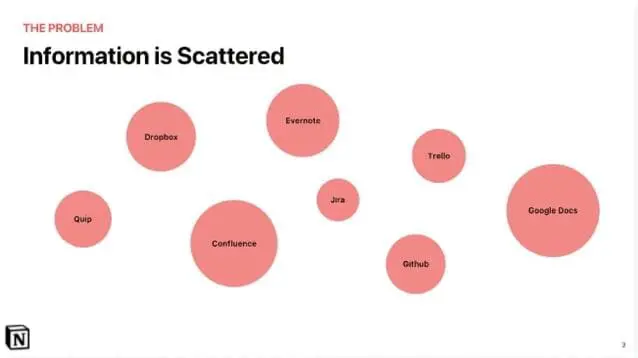
This slide brilliantly visualises the core problem plaguing modern knowledge workers: tool proliferation chaos. Icons representing docs, tasks, wikis, and databases are scattered across the slide, creating visual anxiety that mirrors the user experience of constantly switching between applications. The fragmentation isn’t just operational—it’s cognitive, forcing users to maintain mental models across disparate systems with different interfaces and logic.
The genius lies in making an abstract pain point tangible. Every investor and knowledge worker immediately recognises this frustration—the browser tabs, the lost context, the duplicated information across systems. By leading with problem validation rather than product features, Notion establishes market pull before demonstrating solution capability. This approach transforms the pitch from “here’s what we built” to “here’s the inevitable solution to a universal problem.”
What investors see: A founding team that deeply understands user pain and can articulate it clearly. The problem setup implies significant switching costs and user frustration—fertile ground for a disruptive solution. More importantly, it suggests that successful execution could create substantial user lock-in and network effects, as consolidating workflows creates switching barriers for competitors.
Notion’s solution slide transforms the scattered chaos from the problem slide into elegant unity, showing how their single platform encompasses notes, tasks, wikis, databases, and team collaboration. The visual hierarchy moves from fragmentation to consolidation, creating an immediate “aha moment” for viewers. The screenshot demonstrates real product functionality rather than conceptual mockups, proving the solution exists and works.
The strategic positioning here is crucial—Notion isn’t just replacing existing tools, they’re creating a new category entirely. The “extensible surface” language suggests infinite customisation and future-proofing, appealing to power users who want control and simplicity seekers who want everything in one place. This dual appeal broadens their addressable market significantly beyond traditional productivity tool users.
What investors see: A platform play with massive expansion potential. The extensibility angle suggests strong network effects and user-generated content that could drive viral growth. The consolidation value proposition implies high switching costs once users migrate their workflows, creating revenue predictability and expansion opportunities across the entire productivity stack.
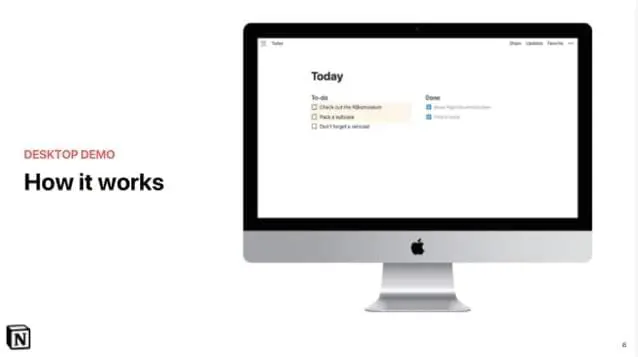
The product demo slide showcases Notion’s interface through carefully selected screenshots that highlight customisable databases, linked views, real-time collaboration, and embedded content. These aren’t generic feature callouts but actual user interfaces that demonstrate sophisticated functionality working in harmony. The visual evidence supports their platform claims with tangible proof of execution capability and user experience quality.
Smart founders understand that investors evaluate products constantly, and screenshots reveal more than bullet points ever could. The demo shows complex data relationships, template flexibility, and collaboration features that would take paragraphs to explain textually. More importantly, the interface quality suggests a team capable of building consumer-grade experiences in the traditionally clunky enterprise software space.
What investors see: Product differentiation and technical execution capability. The sophisticated interface suggests significant engineering investment and user experience expertise, creating barriers for quick copycats. The customisation depth implies strong user engagement and potential for expansion revenue as teams build more complex workflows within the platform.
The “Why Now” slide identifies four critical market shifts converging to create Notion’s moment: the rise of remote work, API-driven tool ecosystems, mobile-first users, and demand for flexible workspaces. This timing analysis transforms their pitch from opportunistic to inevitable, suggesting they’re riding macro trends rather than fighting market headwinds. The timeline graphic creates urgency whilst demonstrating market awareness and strategic thinking.
The remote work angle proves particularly prescient in hindsight, as this deck preceded the massive shift to distributed teams that would make unified workspaces essential. The API-driven tools trend suggests integration capabilities that expand Notion’s value proposition beyond native features. Mobile-first users signal a generation comfortable with sophisticated interfaces on smaller screens, expanding the addressable market beyond desktop knowledge workers.
What investors see: Founders who understand macro trends and can position their solution within larger market movements. The convergence of multiple trends suggests a durable opportunity rather than a fleeting moment. The remote work emphasis implies significant TAM expansion as distributed teams require better collaboration tools, creating urgency around investment timing.
The traction slide delivers a knockout punch with metrics that prove explosive growth: 20,000+ daily active users, 100% month-over-month growth, 80% retention rates, and a viral coefficient of 1.4. These aren’t vanity metrics but indicators of genuine product-market fit and sustainable growth dynamics. The combination of growth rate, retention, and virality creates a compelling trinity of scalable business fundamentals.
The viral coefficient above 1.0 is particularly impressive, indicating organic user acquisition that compounds without paid marketing investment. Combined with 80% retention, this suggests users not only try Notion but integrate it deeply into their workflows and recommend it to others. The “top 10 productivity app” ranking provides third-party validation of their market position and competitive strength.
What investors see: A rocket ship with sustainable fuel. The 100% MoM growth suggests they’re capturing a rapidly expanding market opportunity, whilst the high retention indicates strong unit economics potential. The viral coefficient above 1.0 implies capital-efficient growth that could accelerate with additional resources, making this an attractive scaling investment rather than a risky early bet.
Notion’s market sizing positions them within the massive $50+ billion addressable market spanning productivity software, team collaboration, and knowledge management. The breakdown demonstrates how they’re not confined to a single software category but can expand across multiple segments as user adoption deepens. The enterprise expansion angle suggests significant upmarket opportunity beyond their initial prosumer base.
The market analysis cleverly positions Notion’s platform approach as category-creating rather than category-competing. By combining multiple software segments under their unified workspace concept, they’re essentially arguing for market share capture across the entire productivity stack. This positioning justifies a premium valuation based on multiple expansion rather than single-product penetration.
What investors see: A platform with multiple expansion vectors and significant scale potential. The cross-category market opportunity suggests they could capture value across the entire productivity workflow, leading to high revenue per customer and substantial market share. The enterprise angle implies pricing power and expansion revenue as they move upmarket from individual users.
The competitive analysis positions Notion as superior to established players like Airtable, Coda, Evernote, and Confluence through their unique combination of extensibility and unification. The 2×2 matrix framework demonstrates clear differentiation along key axes that matter to users—flexibility and integration depth. Rather than competing feature-for-feature, they’re redefining the competitive landscape around platform capabilities.
The strategic insight here is positioning competitors as “siloed solutions” whilst Notion represents “unified workspace”—immediately framing the competition as yesterday’s approach. This isn’t just product positioning but market education, teaching investors and users to evaluate productivity tools based on integration and flexibility rather than individual feature strength. The matrix places Notion in the optimal quadrant, suggesting clear competitive advantage.
What investors see: A company that understands their competitive moat and can articulate differentiation clearly. The platform positioning suggests defensibility through user data and workflow lock-in that point solutions cannot replicate. The matrix format provides a mental framework investors can use when evaluating competitive threats or explaining the investment thesis to their partners.
Notion’s business model slide outlines their freemium approach with Plus ($8/user/month), Business ($15/user/month), and Enterprise tiers, coupled with impressive 20% month-over-month revenue growth. The pricing structure demonstrates clear value progression from individual users to team collaboration to enterprise features, creating natural upgrade paths as user engagement deepens. The freemium foundation enables viral user acquisition whilst paid tiers capture value from power usage.
The genius of this model lies in user education through free usage—once individuals experience Notion’s capabilities, they become internal champions for team upgrades. The enterprise tier suggests significant expansion revenue potential as organisations standardise on Notion for knowledge management. The 20% MoM revenue growth indicates successful monetisation of their user base growth, proving they can convert traction into sustainable business fundamentals.
What investors see: A scalable SaaS model with multiple expansion vectors and land-and-expand potential. The freemium approach de-risks customer acquisition whilst the tiered pricing captures increasing value as usage grows. The enterprise opportunity suggests significant ARPU expansion potential as they move upmarket, creating a path to substantial recurring revenue scales.
The go-to-market strategy emphasises product-led growth through integrations, community building, and content marketing, targeting creators and teams before expanding to enterprises. This approach leverages Notion’s viral coefficient and user-generated templates to drive organic acquisition whilst building a passionate user community. The progression from creators to teams to enterprises follows a natural adoption curve that minimises customer acquisition costs.
The community-centric approach is particularly smart for a platform product—users who create elaborate Notion setups become advocates and teachers for new users. Content marketing through templates and use cases provides value whilst demonstrating product capabilities. The integration strategy creates distribution partnerships and increases switching costs as users connect their workflows to external tools.
What investors see: A capital-efficient growth strategy that leverages product quality and user enthusiasm rather than expensive paid acquisition. The bottom-up approach through creators and teams creates organic demand for enterprise sales whilst building a moat through community and integrations. This GTM model suggests strong unit economics and sustainable competitive advantages.

The team slide showcases founders Ivan Zhao (CEO, ex-Slack), Simon Last (CTO), and Akshay Kothari (Head of Product, ex-LinkedIn), emphasising their combined expertise in product development, engineering, and growth at scale. The focus remains tight on key leadership rather than expanding to show every team member, highlighting the quality over quantity principle that resonates with Series A investors. Their backgrounds at respected tech companies provide credibility and relevant experience.
The strategic presentation of a “small elite team” positioning suggests efficiency and focus whilst acknowledging the need for expansion with funding. Ivan’s vision combined with Simon’s technical execution and Akshay’s product growth experience creates a balanced founding team capable of scaling both product and business. The ex-Slack and ex-LinkedIn credentials signal understanding of collaborative software and network effects.
What investors see: A founding team with complementary skills and relevant experience at companies that successfully built collaborative software platforms. The combination of product vision, technical capability, and growth expertise suggests they can execute on the ambitious market opportunity they’ve outlined. The elite team positioning implies strong hiring standards and cultural foundation for scaling.

The ask slide presents a clear request for $10 million at a $100 million pre-money valuation, with specific allocation for team expansion, engineering development, and sales infrastructure, providing 18 months of runway. The use of funds breakdown demonstrates strategic thinking about capital deployment across key growth drivers. The 18-month runway suggests confidence in achieving next milestone within a reasonable timeframe.
The valuation positioning reflects their explosive traction metrics whilst remaining reasonable for Series A standards in 2018. The allocation priorities—team, engineering, sales—signal a balanced approach to scaling both product capabilities and go-to-market execution. The pie chart visualisation makes fund usage transparent and accountable, reducing investor concerns about capital efficiency.
What investors see: A thoughtful capital request with clear deployment strategy and reasonable valuation given the traction metrics. The 18-month runway provides sufficient time to achieve meaningful milestones whilst the use of funds suggests disciplined growth investment. The ask creates urgency without appearing desperate, positioning this as a growth acceleration opportunity rather than survival funding.

The closing slide maintains the same clean aesthetic whilst providing essential contact information, demo links, and a clear call-to-action for next steps. This isn’t merely polite closing but strategic positioning that makes it easy for interested investors to take immediate action. The demo link allows investors to experience the product firsthand, reinforcing the pitch narrative with actual usage.
The professional presentation of contact details and next steps demonstrates the same attention to user experience that characterises their product. By making it effortless for investors to engage further, they reduce friction in the fundraising process. The thank you acknowledgment shows respect for investor time whilst maintaining the confident tone established throughout the presentation.
What investors see: A team that understands the importance of follow-through and makes it easy to continue the conversation. The demo link provides immediate product validation opportunity whilst the clear contact information and next steps reduce administrative friction. This attention to investor experience suggests they’ll bring the same user-centric thinking to customer relationships.
From insight to investor-ready, in weeks not months.
Apply these lessons to your raise — we’ll build your deck, financial model, and IM together.
While this deck secured one of the most consequential productivity software investments of the past decade, transforming Notion from a bootstrapped startup into a $10 billion platform giant, it is not without gaps. Measured against today’s sophisticated Series A standards, several critical elements that modern investors expect are notably absent, potentially limiting its effectiveness in today’s more analytical funding environment. For those looking to enhance their own presentations, seeking fundraising-grade pitch deck consulting could be a valuable step.
No detailed 3-5 year revenue forecasts, burn rate, or unit economics; modern decks require these to demonstrate path to profitability and efficient capital use.
Lacks CAC, LTV, payback period, or margins; critical for SaaS to show scalable economics and investor ROI potential.
No testimonials or deep case studies from paying customers; today’s decks use social proof from logos like Pixar or Nike to build credibility.
Minimal discussion of IP, network effects, or data moats; essential to address how Notion sustains leadership against copycats.
No mention of potential acquirers or M&A comps; investors want alignment on liquidity paths in current markets.
Omits key risks like competition or churn with mitigation plans; transparency builds trust in sophisticated rounds.
These gaps reflect the evolving sophistication of venture capital diligence rather than fundamental weaknesses in Notion’s story. Today’s founders must address these elements proactively to meet heightened investor expectations around financial modelling, competitive strategy, and risk assessment. At Projects RH, we help founders strengthen these critical areas whilst maintaining the narrative clarity and visual elegance that made this deck successful.
Notion dedicates slides to demos early; founders should prioritise visuals of the actual product to convey magic and reduce explanation needs.
Highlight timely trends like remote work; apply by tying your solution to macro shifts for urgency and FOMO.
Traction slide with DAU growth and retention; select 3-5 hockey-stick metrics founders can explain in 30 seconds.
2×2 grid shows superiority; craft one positioning your startup as uniquely better on key axes.
Short bios of founders only; emphasise superpowers without overwhelming, as investors bet on people.
Explicit $10M ask with use of funds; always specify amount, valuation, terms, and next-step contact.
Minimalist aesthetic with whitespace; prioritise clarity over flash—investors scan decks on phones.
Ready to raise? Let’s talk.
We’ve helped founders secure $2B+ in investor interest. Your round could be next.
The distance between the Notion that presented this deck and the Notion that exists today is one of the most remarkable growth stories in modern SaaS history. In six years, they’ve evolved from a promising productivity tool with 20,000 daily users to a $10+ billion platform serving over 100 million users globally, fundamentally reshaping how teams collaborate and organise information.
For Index Ventures and the Series A investors, this represents one of the most successful early-stage investments in productivity software history. A $10 million investment at a $100 million pre-money valuation has generated returns exceeding 100x based on Notion’s current private market valuation, with the potential for even greater returns through public markets or strategic acquisition.
The transformation validates every thesis outlined in this pitch deck: the market timing around remote work proved prescient, the platform approach created sustainable competitive advantages, and the product-led growth model scaled efficiently to massive user bases. Most importantly, it demonstrates how a clear vision, compelling metrics, and exceptional execution can transform a 13-slide presentation into a generation-defining technology company.
At Projects RH, we help companies across all industries create investor-ready materials that close deals. Our integrated capital raising package ensures consistency across all your investor documentation.
Built in-house for accuracy and investor confidence.
Comprehensive investor documentation following global best practices.
12-slide investor-ready presentation with supporting materials.
High-impact snapshot to capture investor attention fast.
Browse our collection of real pitch deck breakdowns from the world’s most successful companies.
Notion's Series A deck had 13 concise slides, focusing on problem, solution, traction, and team without fluff, making it scannable in under 5 minutes.
They raised $10M in Series A funding at a $100M pre-money valuation, led by Index Ventures, which fueled scaling to unicorn status.
Outstanding product visuals, explosive traction metrics, clear market positioning, and minimalist design created emotional pull and credibility, securing top-tier VCs.
Yes, but adapt it—copy the structure (problem-solution-traction-ask), emphasize your unique traction, and add modern elements like unit economics for relevance.
Series A in 2018, post-seed with strong PMF evidenced by 100% MoM growth and high retention, positioning for acceleration capital.
Creating an effective pitch deck requires more than following a template — it demands strategic clarity about your value proposition, a deep understanding of your target investors, and rigorous financial modelling to support your narrative. At Projects RH, we combine financial expertise with strategic storytelling to build pitch decks, information memorandums, and financial models that meet the standards of institutional investors worldwide. Our team has generated over USD 2.0 billion in expressions of interest across mining, energy, technology, medtech, and financial services sectors. Schedule a consultation to discuss how we can help position your company for successful capital raising.