
Dive into our analysis of the 10-slide pitch deck that helped Netflix secure $30 million in Series B funding in 1999 from top investors.
Building your own pitch deck?
Get expert guidance from the team behind $2B+ in investor interest.
Netflix was founded in 1997 by Reed Hastings and Marc Randolph in Scotts Valley, California, born from Hastings’ frustration after incurring a $40 late fee at Blockbuster for Apollo 13. They launched the service in 1998 with a simple website offering DVD rentals by mail, starting with 925 titles and 30 employees, positioning it as a convenient alternative to physical video stores. The initial concept was revolutionary yet straightforward: eliminate the friction of video rental through postal delivery and subscription pricing, a strategy that highlights the importance of expert guidance, such as investor-ready pitch deck consulting for startups looking to innovate in their industries.
Early challenges included low DVD player penetration (under 1% of U.S. households), building a reliable mail logistics system, and competing against giants like Blockbuster. The team iterated on user experience, introducing subscription models to eliminate per-rental fees and late charges, which drove initial traction despite skepticism about mail-based rentals. Their breakthrough came from recognising that convenience and selection could triumph over instant gratification, particularly for movie enthusiasts willing to wait a day for access to titles unavailable at local stores.
By 1999, with proven demand and 140,000 subscribers generating $5 million in annualised revenue, Netflix pitched to investors focusing on the massive untapped DVD market and their unique no-late-fee model. They secured $30M from Institutional Venture Partners and Tech Crossover Ventures after Hastings invested $2.5M personally, validating their vision that physical media distribution could be disrupted through superior logistics and customer experience.
The pitch’s straightforward narrative on problem-solution fit resonated with investors who recognised the scalability of subscription commerce married to efficient fulfilment networks. This funding propelled Netflix toward dominance in DVD rentals, creating the cash flow and customer base necessary for their eventual pivot to streaming in 2007, fundamentally reshaping how content reaches consumers worldwide.
Netflix opens with remarkable simplicity—just the company name and “Online DVD Rental” subtitle against a clean background. This minimalist approach immediately communicates the value proposition without distraction, establishing Netflix as a technology company rather than a traditional entertainment business. The absence of elaborate graphics or marketing speak signals confidence in the core concept’s strength.
The cover’s strategic positioning as an “online” service was crucial in 1999, when e-commerce was emerging but not yet mainstream for physical goods delivery. By leading with this digital-first identity, Netflix immediately differentiated itself from Blockbuster’s retail model and signalled its technological sophistication. The deliberate choice to emphasise “online” over “mail” reflects deep understanding of investor psychology—positioning within the growing internet economy rather than logistics.
What investors see: A technology-enabled disruption of a massive consumer market, positioned within the rapidly expanding internet commerce sector. The simplicity suggests operational focus and clarity of vision—traits investors value highly when evaluating management teams. This cover immediately frames Netflix as a scalable technology business rather than a niche mail-order operation.
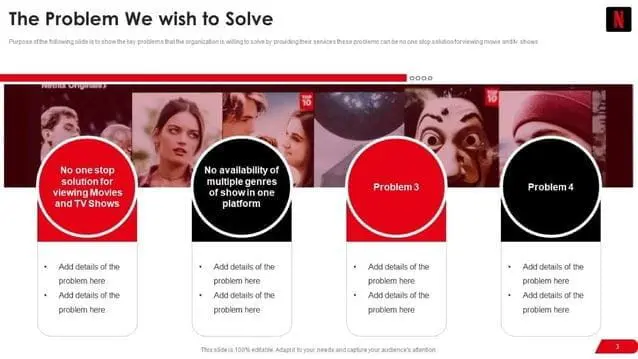
Netflix brilliantly opens their problem statement with universally relatable frustrations: late fees, limited selection, inconvenience of store visits, and long queues. Every investor in the room had personally experienced these pain points, creating immediate emotional resonance before diving into market data. The emphasis on late fees was particularly strategic, as this revenue stream for video stores represented pure customer friction—a clear opportunity for disruption.
The slide’s power lies in highlighting systemic inefficiencies in the existing model rather than attacking competitors directly. By focusing on structural problems—inventory constraints, inconvenient locations, punitive policies—Netflix positioned themselves as solving market failures rather than simply offering an alternative. This approach suggests a large addressable market of dissatisfied customers ready to switch to a superior model.
What investors see: A massive incumbent industry ripe for disruption, with clear consumer pain points that create switching motivation. The universality of these problems suggests strong product-market fit potential and validates the market opportunity. Most importantly, these aren’t minor inconveniences but fundamental business model flaws that generate customer resentment—exactly the conditions that enable new entrants to capture significant market share rapidly.
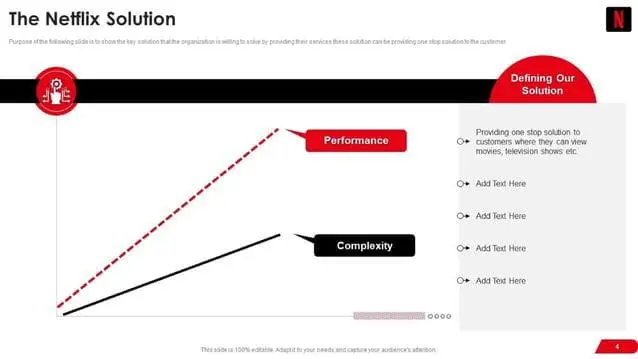
The solution slide elegantly maps each problem to a specific innovation: online ordering eliminates store visits, mail delivery removes geographic constraints, and the no-due-date policy completely eliminates late fees. This point-by-point problem resolution demonstrates systematic thinking and thorough market analysis. The emphasis on “return at leisure” transforms a traditional pain point into a competitive advantage, repositioning inconvenience as customer freedom.
Netflix’s genius lies in recognising that convenience could compensate for immediacy—a counterintuitive insight in 1999 when instant gratification was becoming the e-commerce standard. By trading off immediate access for superior selection and pricing, they identified an underserved customer segment willing to plan their entertainment consumption. This solution also inherently creates switching costs through the subscription model and user preference data.
What investors see: A comprehensive solution that doesn’t just address symptoms but fundamentally reimagines the customer experience around convenience and choice. The mail-based model creates natural barriers to entry through logistics complexity while the subscription approach generates predictable recurring revenue. This isn’t incremental improvement—it’s business model innovation that could capture disproportionate value from market incumbents.
Netflix presents a dual pricing strategy: $4 per DVD plus $2 shipping for occasional users, and subscription plans for unlimited rentals that eliminate transaction friction. This model brilliantly addresses different customer segments while steering behaviour toward the higher-value subscription tier. The promise to “stock every DVD available” signals ambitious inventory goals that would be impossible for physical stores, creating a compelling selection advantage.
The subscription model represents a fundamental shift from transactional to relationship-based revenue, creating predictable cash flow and higher customer lifetime value. By eliminating per-rental decisions, Netflix reduces friction while encouraging exploration of their full catalogue. This approach also generates valuable usage data that enables personalised recommendations—laying groundwork for the algorithmic differentiation that would later define the company.
What investors see: A recurring revenue model with strong unit economics and natural scalability advantages. The subscription approach creates customer stickiness while the unlimited rental promise drives utilisation that justifies monthly fees. Most appealingly, this model generates predictable cash flow that can fund aggressive expansion and inventory growth—exactly what’s needed to compete against well-capitalised incumbents like Blockbuster.
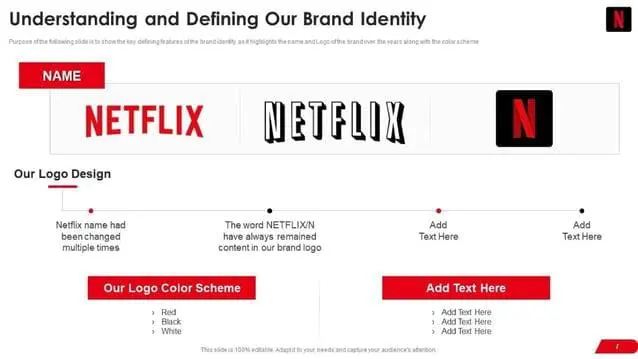
This slide positions Netflix perfectly at the intersection of technology adoption and market growth, highlighting that DVD player penetration was under 1% in 1998 but accelerating rapidly. The projection to become a “top 10 video rental company” demonstrates ambitious yet achievable goals that validate the business opportunity. By emphasising the DVD format’s superiority over VHS—better quality, smaller size, no rewinding—Netflix aligns with an inevitable technology transition.
The timing was strategically brilliant: Netflix launched early enough to establish logistics and customer acquisition before DVD adoption reached mainstream penetration, but late enough to avoid the risks of premature market development. This slide effectively communicates that investors aren’t just funding a startup—they’re investing in a company positioned to capture disproportionate value from a predictable technology transition affecting millions of households.
What investors see: A massive market expansion opportunity driven by hardware adoption curves that are largely predictable and inevitable. Netflix isn’t creating demand for DVDs—they’re positioning to capture value from an existing trend while incumbents remain focused on VHS. This market timing advantage, combined with their operational innovations, creates a window for rapid scale before traditional competitors can respond effectively.
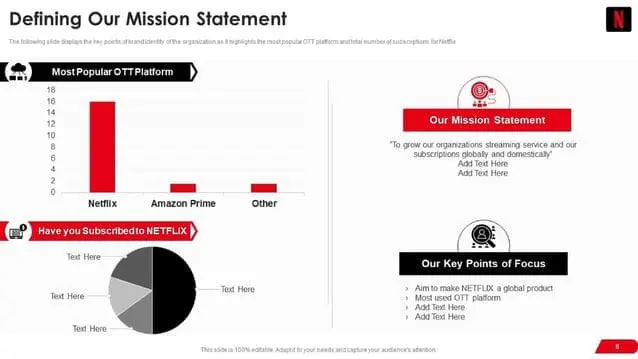
The product demonstration showcases Netflix’s early website interface alongside their initial inventory of 925 titles, emphasising the technological sophistication behind seemingly simple mail delivery. Early hints at recommendation engine capabilities signal the data-driven personalisation that would become Netflix’s defining advantage. The logistics infrastructure for reliable mail delivery represents significant operational complexity hidden beneath user-friendly browsing and ordering.
This slide effectively demonstrates that Netflix understood they were building technology infrastructure, not just a catalogue business. The website serves as both customer interface and operational backbone, enabling inventory tracking, customer preference learning, and logistics optimisation. The emphasis on seamless user experience combined with backend sophistication shows appreciation for both customer needs and scalability requirements.
What investors see: A technology platform disguised as an entertainment company, with early indicators of the data advantages that create sustainable competitive moats. The recommendation engine hints suggest Netflix recognises that personalisation will become crucial for customer retention and catalogue monetisation. This isn’t just e-commerce applied to videos—it’s the foundation for algorithmic content discovery that could fundamentally change how consumers find entertainment.
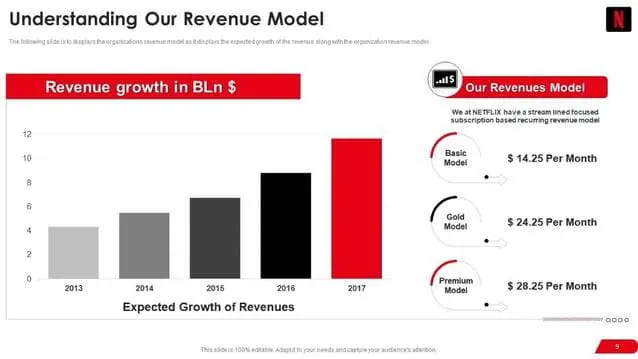
Netflix identifies their target customers as movie enthusiasts seeking convenience and broad selection without traditional retail hassles, demonstrating clear understanding of customer segmentation beyond simple demographics. This positioning targets high-value users who rent frequently enough to justify subscription pricing while valuing convenience over immediacy. The focus on “enthusiasts” signals customers with strong engagement levels and lower price sensitivity.
The customer definition reveals Netflix’s strategic insight that their primary competition isn’t just video stores, but consumer time and attention across all entertainment options. By targeting engaged viewers rather than casual renters, Netflix ensures their customer base has sufficient usage to justify the subscription economics. This segmentation also suggests customers willing to invest time in queue management and recommendation engagement.
What investors see: A clearly defined customer segment with high lifetime value potential and strong retention characteristics. Movie enthusiasts represent the ideal target for subscription services—frequent usage, price tolerance, and engagement with product features like recommendations. This customer focus suggests strong unit economics and natural expansion opportunities as the core segment validates the model for broader market adoption.
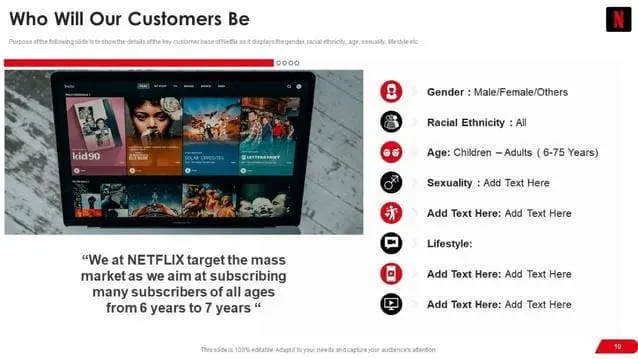
The competitive analysis positions Netflix against traditional video stores like Blockbuster, emphasising distinct advantages in selection breadth, elimination of late fees, and online accessibility. Rather than dismissing incumbents, Netflix acknowledges their market strength while highlighting structural limitations that create opportunity for disruption. The comparison framework demonstrates deep understanding of value proposition differentiation beyond simple feature lists.
Netflix strategically frames the competition around customer experience rather than operational metrics, recognising that superior convenience could overcome incumbent advantages in scale and brand recognition. By highlighting selection limitations and late fee policies as fundamental business model constraints rather than tactical choices, Netflix positions their approach as fundamentally superior rather than simply different.
What investors see: A startup that understands competitive dynamics without underestimating incumbent strengths, focusing on defensible advantages that improve with scale. The competitive framework suggests Netflix has identified sustainable differentiation that becomes stronger over time through network effects and operational efficiency. Most importantly, the analysis demonstrates strategic thinking that goes beyond features to business model innovation.
The team slide introduces co-founders Reed Hastings as CEO with prior software experience and Marc Randolph handling marketing, backed by 30 employees, establishing credibility through relevant domain expertise and operational scale. Hastings’ background in enterprise software signals understanding of technology scalability challenges, while Randolph’s marketing focus demonstrates appreciation for customer acquisition in competitive markets. The team size suggests serious operational commitment beyond typical startup experiments.
The combination of technology and marketing leadership reflects Netflix’s hybrid nature as both a logistics operation and customer experience company. Hastings’ software background would prove crucial for the recommendation algorithms and data analysis that differentiated Netflix, while Randolph’s marketing expertise enabled effective customer acquisition during the critical early adoption phase. The substantial employee count demonstrates ability to execute complex operations from launch.
What investors see: A founding team with complementary skills matching the business requirements—technology leadership for scalability and marketing expertise for customer acquisition. The significant headcount investment shows commitment to execution rather than just concept development. Most importantly, Hastings’ software background suggests the technical vision necessary to evolve beyond mail delivery toward the digital future that would ultimately define Netflix.
The final slide projects strong revenue growth trajectories while outlining a clear path to profitability, requesting $30M to scale operations and expand inventory to meet growing demand. The financial projections demonstrate understanding of subscription economics while the funding request shows appreciation for the capital intensity required to compete against established players. The emphasis on operational scaling rather than just customer acquisition reveals strategic maturity.
Netflix’s $30M ask was substantial for 1999, reflecting their recognition that market leadership required significant upfront investment in inventory and logistics infrastructure. The funding strategy demonstrates understanding that first-mover advantages in subscription businesses come from achieving operational efficiency and selection breadth before competitors can respond. This capital requirement also serves as a barrier to entry, protecting market position once established.
What investors see: A capital-efficient growth opportunity with clear unit economics and scalable operational leverage, backed by specific funding requirements tied to measurable business outcomes. The substantial raise request signals serious market ambitions while the financial projections demonstrate analytical rigor about business model viability. Most appealingly, the funding enables competitive moats through operational scale that would be difficult for competitors to replicate quickly.
From insight to investor-ready, in weeks not months.
Apply these lessons to your raise — we’ll build your deck, financial model, and IM together.
While this deck secured one of the most consequential Series B rounds in startup history and provided the foundation for Netflix’s transformation into a global entertainment powerhouse worth $350 billion today, it reflects the presentation standards and investor expectations of 1999. Modern pitch decks require significantly more data-driven validation, visual sophistication, and strategic detail to meet today’s due diligence standards and competitive fundraising environment, often necessitating the guidance of expert pitch deck consultants.
Lacks specific user growth, retention rates, or early revenue figures; modern decks require data proof like MAU or churn to validate product-market fit and reduce perceived risk.
No detailed customer acquisition plan or marketing roadmap; today’s investors expect scalable growth tactics like partnerships or viral loops.
Plain text-heavy slides without charts, images, or branding; contemporary decks use visuals for 10x engagement and quicker comprehension.
High-level market opportunity without TAM/SAM/SOM breakdown or sources; precise sizing with citations builds credibility.
Omits potential risks like logistics failures or competition escalation; addressing them proactively shows realism and preparedness.
No future features like recommendations or streaming hints; investors want a vision beyond current MVP.
Missing ownership structure and dilution details; transparency on prior funding aids diligence.
These gaps reflect the dramatically different fundraising environment of 1999 versus today’s data-driven, metrics-obsessed venture capital landscape. At Projects RH, we help founders address these modern requirements while maintaining the clarity and strategic focus that made Netflix’s original deck so compelling to investors who recognised its transformational potential.
Netflix led with late fees and store hassles everyone understood; founders should identify universal problems, use simple before-after slides to hook investors emotionally before diving into details.
Plain slides forced idea clarity without distractions; apply by prioritising content over design—test by explaining slides in 30 seconds each.
No late fees and infinite selection were repeated; craft 2-3 defensible moats (e.g., network effects) and weave them throughout the deck.
Emphasised DVD boom despite low adoption; quantify your TAM with growth drivers, positioning as ‘early bet on inevitable trend’.
10 slides kept momentum; aim for 10-15 max, cut filler—every slide must advance the story toward the ask.
Co-founders’ bios built trust; showcase relevant experience, advisors—investors bet on people over ideas.
Explicit $30M request tied to milestones; always specify amount, milestones, and runway for accountability.
Ready to raise? Let’s talk.
We’ve helped founders secure $2B+ in investor interest. Your round could be next.
The distance between the Netflix that presented this deck and the Netflix that exists today is one of the most remarkable growth stories in business history. From a DVD-by-mail startup with 140,000 subscribers and $5 million in annual revenue to a global streaming giant with 300 million subscribers generating $42 billion annually, Netflix’s transformation demonstrates how breakthrough business models can evolve far beyond their original conception while maintaining their core innovation in customer experience and convenience.
For investors who recognised the scalable subscription model and technology foundation behind Netflix’s seemingly simple mail-delivery proposition, this $30 million investment delivered extraordinary returns. The company that went public in 2002 at $1.2 billion now trades at over $350 billion, representing one of the most successful venture investments ever made. The pitch deck that secured Series B funding ultimately enabled Netflix to build the customer base and cash flow necessary to pioneer streaming video and fundamentally reshape global entertainment consumption.
The transformation from DVD rental to streaming platform to content producer illustrates how visionary founders can leverage initial success to pursue even larger opportunities, turning a logistics innovation into one of the world’s most valuable media companies. Netflix’s journey from this humble pitch deck to entertainment giant proves that the greatest venture returns come from identifying scalable business models positioned at the intersection of technology trends and fundamental human needs.
At Projects RH, we help companies across all industries create investor-ready materials that close deals. Our integrated capital raising package ensures consistency across all your investor documentation.
Built in-house for accuracy and investor confidence.
Comprehensive investor documentation following global best practices.
12-slide investor-ready presentation with supporting materials.
High-impact snapshot to capture investor attention fast.
Browse our collection of real pitch deck breakdowns from the world’s most successful companies.
Netflix's 1999 pitch deck consisted of 10 simple, text-focused slides covering problem, solution, model, market, product, customers, competition, team, and financials/ask. Brevity kept investor focus sharp.
The deck secured $30 million in Series B funding in 1999 from Institutional Venture Partners and Tech Crossover Ventures, plus Reed Hastings' personal $2.5 million, enabling massive inventory and logistics scaling.
Success stemmed from crystal-clear problem-solution narrative (late fees pain), relatable convenience pitch, no-filler structure, and timely DVD market bet. Plain design amplified the idea without distractions.
Yes for structure—inspiration from its simplicity, pain-point focus, and brevity—but adapt to modern standards: add traction data, visuals, TAM details, and roadmap. Era-specific (DVD mail) elements won't fit today's SaaS/AI pitches.
Series B in 1999, post-initial seed and modest traction (140K subscribers), using the raise to dominate DVD-by-mail before streaming pivot.
Creating an effective pitch deck requires more than following a template — it demands strategic clarity about your value proposition, a deep understanding of your target investors, and rigorous financial modelling to support your narrative. At Projects RH, we combine financial expertise with strategic storytelling to build pitch decks, information memorandums, and financial models that meet the standards of institutional investors worldwide. Our team has generated over USD 2.0 billion in expressions of interest across mining, energy, technology, medtech, and financial services sectors. Schedule a consultation to discuss how we can help position your company for successful capital raising.