
Dive into a detailed analysis of the 10-slide pitch deck YouTube used to raise $3.5 million in Series A funding from Sequoia Capital in 2005.
Building your own pitch deck?
Get expert guidance from the team behind $2B+ in investor interest.
YouTube emerged from the frustrations of three PayPal veterans who couldn’t easily share personal videos online. Steve Chen, Chad Hurley, and Jawed Karim recognised that whilst digital cameras were becoming ubiquitous, the internet infrastructure for video sharing remained woefully inadequate—files were too large to email, hosting was complex, and playback required technical expertise. Their solution was elegantly simple: create a platform where anyone could upload, share, and view videos with just a few clicks, encapsulated in the prescient tagline “Broadcast Yourself.” This innovative approach highlights the importance of seeking expert pitch deck guidance when navigating complex challenges.
Founded in February 2005 and launched publicly in April, YouTube’s growth trajectory was nothing short of meteoric. Within months, the platform was processing 8 terabytes of data daily—equivalent to moving the entire inventory of a Blockbuster store every 24 hours. This explosive traction occurred organically, driven by viral content and word-of-mouth sharing, proving immediate product-market fit without significant marketing spend or user acquisition efforts.
By November 2005, just nine months after founding, the trio approached Sequoia Capital with a remarkably concise 10-slide presentation. The timing was fortuitous—broadband adoption was accelerating, digital video creation was democratising, and investors were hungry for the next consumer internet breakthrough. The PayPal pedigree provided immediate credibility, whilst early metrics demonstrated undeniable momentum in an enormous untapped market.
The pitch’s success was swift and decisive. Sequoia invested $3.5 million, fueling YouTube’s path to becoming the world’s dominant video platform and ultimately enabling Google’s $1.65 billion acquisition just 20 months later. This remarkable journey from pitch deck to billion-dollar exit represents one of the most successful early-stage investments in internet history, validating both the founders’ vision and their ability to execute against seemingly impossible odds.

YouTube’s cover slide masterfully distils their entire value proposition into three words: “Broadcast Yourself.” This tagline transcends simple product description to capture a cultural moment—the democratisation of media creation and distribution. The clean, minimalist design reflects the platform’s core promise of simplicity, avoiding the cluttered aesthetics that plagued early web services and immediately signalling professional execution to sophisticated investors.
The strategic brilliance lies in positioning YouTube not as a technology company, but as an enabler of human expression and connection. By framing the service around user empowerment rather than technical capabilities, the founders immediately communicate massive market potential whilst differentiating from infrastructure-focused competitors. This consumer-centric messaging suggests an intuitive understanding of viral growth mechanics and network effects.
What investors see: A team that understands brand building and viral marketing from day one, essential for consumer internet success. The tagline’s prescience—predicting the creator economy years before it emerged—demonstrates strategic vision beyond immediate product features. For Sequoia, this cover slide likely triggered recognition of YouTube’s potential to become a cultural platform rather than merely a hosting service, justifying premium valuations for market-defining opportunities.
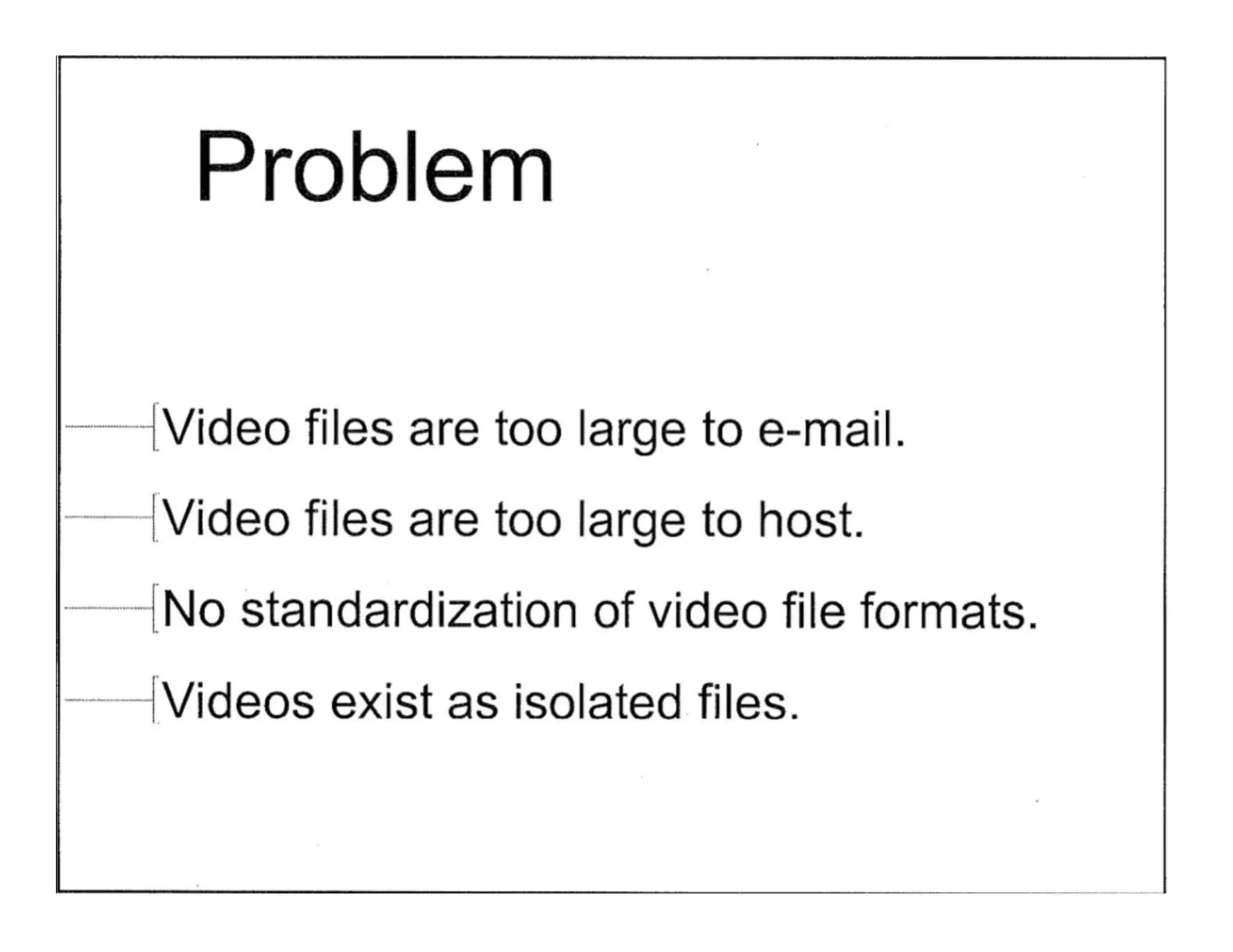
The problem slide brilliantly articulates a universal frustration that every investor would have personally experienced—the impossibility of sharing large video files through conventional means. By highlighting specific pain points like email attachment limits and complex hosting requirements, YouTube demonstrates intimate understanding of user friction whilst establishing clear market demand. The timing was perfect, as digital cameras were proliferating but sharing solutions remained archaic.
This slide’s effectiveness stems from its relatability and specificity—rather than abstract market research, it presents tangible obstacles that resonated with anyone who had attempted video sharing in 2005. The implicit message is that whilst content creation was becoming democratised through affordable recording devices, distribution remained the exclusive domain of technical experts and media companies. This gap represented a massive opportunity for disruption.
What investors see: A massive, underserved market where existing solutions create significant user friction and limit adoption. The founders’ ability to articulate this problem with such clarity suggests deep empathy for user needs and strong product instincts. For VCs, this slide validates the founders’ thesis that removing technical barriers could unlock enormous latent demand for video sharing, justifying investment in infrastructure and user acquisition to capture this whitespace opportunity.
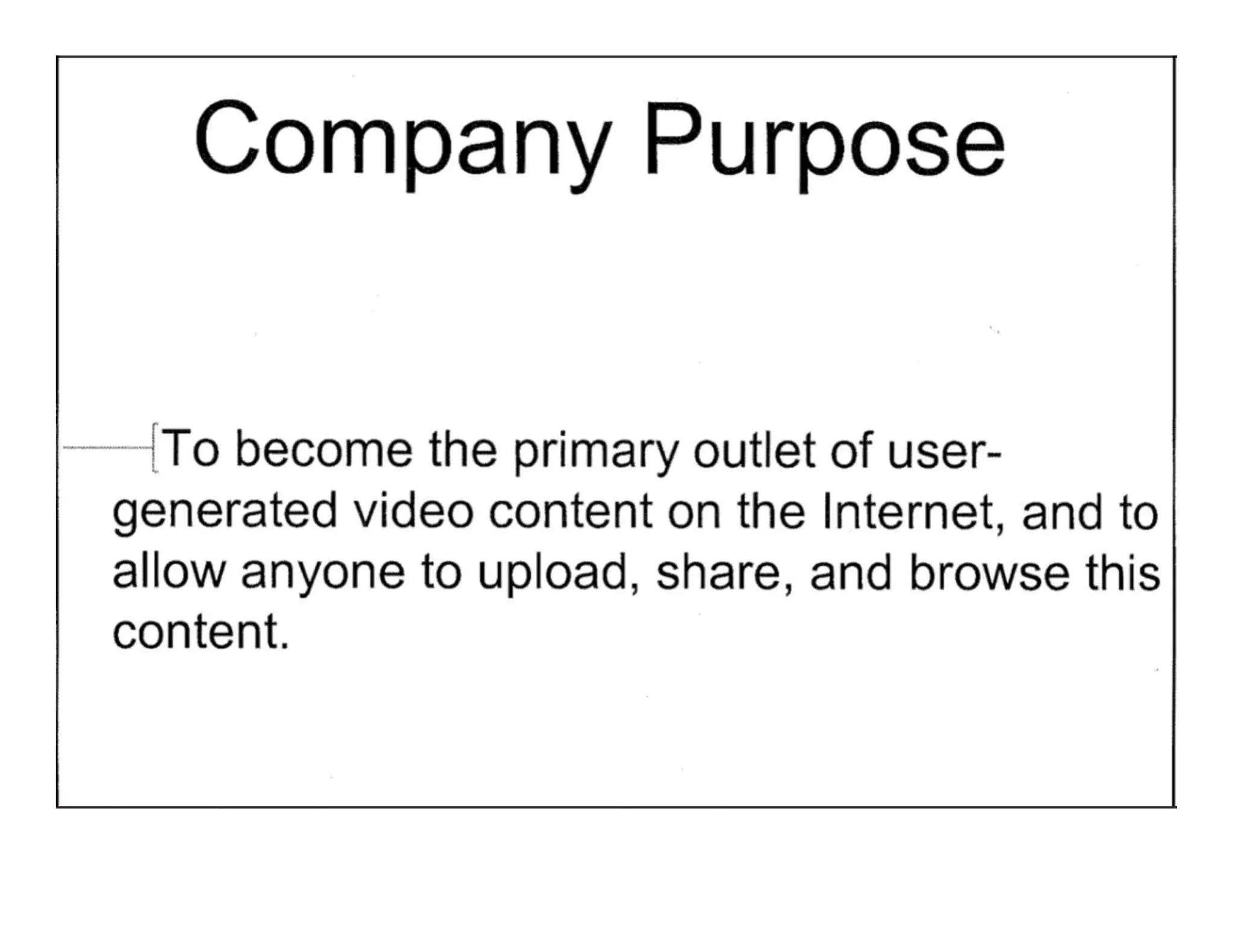
YouTube’s solution slide transforms complex technical challenges into a simple value proposition: upload, convert, and share videos with zero technical expertise required. The elegance lies in abstracting away the infrastructure complexity—format conversion, bandwidth optimization, and cross-platform playback—whilst delivering immediate user value. This approach mirrors successful consumer internet companies that make sophisticated technology invisible to end users.
The strategic positioning emphasises accessibility and democratisation, suggesting YouTube understood that market size would be determined by the lowest common denominator of technical skill rather than the highest. By promising to eliminate all friction from video sharing, they positioned themselves to capture not just early adopters but eventually mainstream consumers who had been excluded from digital video sharing entirely.
What investors see: A solution that directly addresses every pain point identified in the problem slide, with clear product-market fit potential. The focus on simplicity suggests the founders understand that user experience, not technical sophistication, drives consumer internet adoption. Investors recognise this as the classic “10x better” improvement that enables new market creation rather than mere competition, justifying significant investment in what could become a platform-scale opportunity.
The market opportunity slide employs a brilliant analogy, comparing YouTube’s daily data throughput to the inventory turnover of physical video rental stores like Blockbuster. This comparison serves multiple strategic purposes: it grounds the abstract concept of “terabytes” in familiar business terms, demonstrates massive scale potential, and subtly positions YouTube as the digital successor to traditional video distribution. The analogy makes the enormous market opportunity tangible and relatable to investors.
Beyond the clever framing, this slide reveals sophisticated thinking about market dynamics and competitive positioning. By referencing Blockbuster—then at its peak—YouTube subtly suggests they’re not just building a better mousetrap, but potentially disrupting an entire industry worth billions in revenue. The implication is that online video sharing could eventually supplant traditional video rental and distribution models entirely.
What investors see: A massive addressable market with clear precedents for video consumption monetisation. The Blockbuster analogy demonstrates the founders’ ability to think at platform scale and understand macro industry trends. For VCs, this slide validates YouTube’s potential to capture not just current online video activity but eventually the entire video entertainment market, justifying investments based on total addressable market expansion rather than market share gains alone.
The product demo slide transforms abstract promises into tangible reality by showcasing the working YouTube interface with real user-generated content. Screenshots demonstrate key functionality—video upload, search capabilities, user profiles, and community engagement features—proving that YouTube isn’t just a concept but a functioning platform with genuine user adoption. This evidence-based approach removes execution risk from investor evaluation.
The strategic value extends beyond feature demonstration to showcase early viral content and community formation. By highlighting videos that were gaining traction and generating engagement, YouTube proves that their platform creates value for both content creators and consumers. This dual-sided marketplace dynamic suggests natural network effects and sustainable competitive advantages once critical mass is achieved.
What investors see: De-risked execution with proven product-market fit and early evidence of viral mechanics. The demo validates that technical challenges have been solved and users are genuinely engaging with the platform. For VCs, seeing real user-generated content and community interaction provides confidence that YouTube has achieved the most difficult milestone for consumer internet companies—creating sustained user engagement and organic growth momentum.
YouTube’s traction slide presents compelling evidence of explosive early growth, processing 8 terabytes of data daily with fewer than 10,000 registered users—an extraordinary engagement ratio that demonstrates both product stickiness and viral coefficient. The metrics reveal that each user was generating substantial content consumption and sharing, validating the platform’s ability to create genuine value for its community. This data-driven approach provides concrete evidence of product-market fit achievement.
The strategic presentation of traction metrics emphasises organic growth over paid acquisition, suggesting that YouTube had discovered sustainable viral mechanics without significant marketing spend. The rapid scaling of infrastructure usage indicates both technical competence and market demand validation. Most importantly, the metrics suggest that YouTube was capturing value from network effects—each new user increased platform utility for existing users through content creation and consumption.
What investors see: Exceptional unit economics and viral growth dynamics that suggest massive scalability potential. The high data throughput per user indicates deep engagement and platform stickiness, whilst organic growth demonstrates sustainable competitive advantages. For VCs, these metrics validate that YouTube has achieved the holy grail of consumer internet—organic viral growth with high user engagement, justifying aggressive investment to capture market leadership before competitors can replicate their success.
The team slide leverages the incredible credibility of the PayPal mafia, positioning Steve Chen, Chad Hurley, and Jawed Karim as proven executives from one of the era’s most successful fintech companies. This pedigree immediately addresses investor concerns about execution capability and provides instant validation of their ability to build, scale, and monetise consumer internet platforms. The PayPal experience suggests deep understanding of viral growth mechanics, technical infrastructure challenges, and platform business models.
Beyond individual credentials, the team slide demonstrates complementary skill sets essential for platform companies—technical expertise, product vision, and business development capabilities. The founding team’s experience with payment systems and user-generated content platforms provides relevant background for understanding YouTube’s unique challenges around content moderation, international scaling, and eventual monetisation strategies.
What investors see: Exceptional founder-market fit with proven track records in building and scaling consumer internet platforms. The PayPal connection provides immediate credibility and suggests access to the broader PayPal mafia network for advice, talent, and follow-on funding. For VCs, investing in ex-PayPal executives represented a significantly de-risked bet, as this cohort had already demonstrated the ability to navigate from startup to billion-dollar exit, making YouTube an obvious portfolio addition for tier-one venture capital firms.
YouTube’s business model slide outlines multiple revenue streams including pre-roll and in-stream advertising, premium content fees, branded upload charges, and paid user features, demonstrating sophisticated thinking about platform monetisation. This diversified approach reduces investor concerns about single-point-of-failure revenue models whilst suggesting multiple paths to profitability. The emphasis on advertising revenue aligns with proven internet business models like Google’s AdWords, providing familiar benchmarks for investor evaluation.
The strategic brilliance lies in balancing user growth with monetisation potential—advertising revenue scales with viewership whilst premium features provide direct monetisation without constraining organic growth. The model suggests understanding of two-sided marketplace dynamics, where YouTube can monetise both content creators (through premium features) and content consumers (through advertising), creating multiple value capture mechanisms as the platform matures.
What investors see: A robust monetisation strategy with multiple revenue vectors and clear scalability potential. The advertising-focused model provides massive upside as video advertising was nascent but obviously valuable to brand marketers. For VCs, this slide validates that YouTube’s founders understand platform economics and have identified sustainable paths to profitability that align with, rather than conflict with, user growth objectives, suggesting strong potential for venture-scale returns.
The competition slide positions YouTube against a fragmented landscape of technically complex and user-unfriendly alternatives, emphasising their superiority in ease of use and seamless video handling. Rather than dismissing competitors, YouTube acknowledges the competitive landscape whilst clearly articulating their differentiation through superior user experience and technical execution. This balanced approach demonstrates market awareness whilst building confidence in their sustainable competitive advantages.
The strategic positioning emphasises that YouTube’s competitive moat lies not in proprietary technology but in user experience and network effects. By highlighting competitors’ complexity and technical barriers, YouTube suggests that their simplification represents a fundamental innovation that creates defensible market position. The implication is that first-mover advantage in user-friendly video sharing could translate into lasting market dominance through viral growth and community formation.
What investors see: A clear competitive differentiation strategy focused on user experience rather than features, suggesting sustainable advantages through network effects and brand recognition. The emphasis on simplicity indicates understanding that consumer internet success depends on adoption barriers, not technical sophistication. For VCs, this positioning validates YouTube’s potential to capture market share through superior product execution and suggests that early investment could secure market leadership in the emerging online video category.
YouTube’s closing slide articulates their vision of becoming the definitive platform for video sharing and consumption whilst making the funding ask to fuel this ambitious goal. The vision extends beyond current functionality to position YouTube as the infrastructure layer for all online video activity—from personal sharing to professional content distribution. This platform-scale thinking demonstrates the founders’ understanding of winner-take-all dynamics in internet markets and their commitment to building lasting competitive advantages.
The implicit funding request of $3.5 million is positioned as fuel for growth rather than survival capital, suggesting confidence in the business model and market opportunity. By framing the investment as acceleration capital for market capture rather than product development funding, YouTube demonstrates both traction validation and aggressive growth ambitions. This positioning appeals to venture investors seeking maximum return potential through market leadership achievement.
What investors see: A compelling vision that extends far beyond current product capabilities to platform-scale market opportunity with clear network effects and defensible positioning. The funding ask represents reasonable capital efficiency for achieving market leadership in a massive, underserved market. For VCs, this slide crystallises YouTube’s potential to become the dominant platform in online video, justifying significant investment to capture what could become one of the internet’s most valuable properties and validating the entire pitch deck’s promise of venture-scale returns.
From insight to investor-ready, in weeks not months.
Apply these lessons to your raise — we’ll build your deck, financial model, and IM together.
While YouTube’s pitch deck successfully secured $3.5 million from Sequoia Capital and ultimately enabled one of the most successful exits in internet history, it reflects the less demanding expectations of 2005 venture funding. By today’s standards, the presentation lacks several critical elements that modern investors routinely expect, particularly around financial planning, competitive defensibility, and operational execution details that have become standard components of institutional fundraising presentations. For startups looking to enhance their presentations, collaborating with a pitch deck consulting firm can provide valuable insights and improvements.
No detailed revenue forecasts, burn rate, or runway projections; modern decks require these to demonstrate fiscal responsibility and scalability, helping investors model returns.
Lacks specifics on user acquisition channels or growth hacks beyond virality; today’s investors expect data-driven plans like CAC/LTV ratios for sustainable expansion.
Minimal defence against copycats via network effects or tech IP; current decks must articulate defensible advantages like proprietary algorithms to justify valuations.
No quotes from early users or partners; including these builds social proof and emotional buy-in, crucial in data-skeptical pitches.
Absent ownership structure and dilution details; transparency here reassures investors on alignment and future rounds.
Ignores legal/content moderation risks inherent to UGC video; addressing these proactively shows maturity in regulated industries.
Vague on future features beyond revenue ideas; timed milestones signal execution capability to VCs.
These gaps reflect the different expectations and due diligence standards of 2005 versus today’s institutional venture environment. Modern founders must address these missing elements to meet current investor requirements, though YouTube’s ultimate success proves that exceptional team pedigree, demonstrated traction, and massive market opportunity can overcome presentation deficiencies. At Projects RH, we help founders bridge these gaps by developing comprehensive financial models, competitive analysis, and risk mitigation strategies that satisfy today’s more rigorous investment criteria whilst maintaining the narrative clarity that made YouTube’s original deck so compelling.
YouTube’s concise deck focused on essentials—problem, solution, traction, team—avoiding fluff; founders should ruthlessly prioritise to respect investor time and maintain momentum.
Highlighting PayPal mafia credentials built instant trust; apply by front-loading relevant exits or expertise to de-risk execution in investors’ minds.
Early metrics like 8TB/day trumped financial models; demonstrate real PMF with user growth or engagement data before seeking funds.
‘Broadcast Yourself’ created an emotional, viral vision; craft a memorable tagline tying problem to cultural shift for stickiness.
Listing ads, premiums, etc., showed flexibility; outline 2-3 viable models to prove you’re not one-trick, even pre-revenue.
Product screenshots proved it worked; always include live demos or visuals to let the product sell itself.
Pitching amid broadband boom amplified appeal; founders should align decks with macro trends like AI or Web3 for tailwinds.
Ready to raise? Let’s talk.
We’ve helped founders secure $2B+ in investor interest. Your round could be next.
The distance between the YouTube that presented this deck in November 2005 and the YouTube that exists today represents one of the most extraordinary value creation stories in technology history. What began as a simple video sharing platform processing 8 terabytes daily with fewer than 10,000 users has evolved into the world’s second-largest search engine, generating over $40 billion in annual revenue and commanding a valuation exceeding $500 billion as part of Google’s empire. This transformation illustrates both the power of platform-scale network effects and the venture capital model’s ability to identify and nurture companies that can reshape entire industries.
For Sequoia Capital, the YouTube investment represents one of the most successful venture bets in history, generating returns of over 100,000x from pitch deck to Google acquisition in just 20 months. The $3.5 million investment in November 2005 translated to approximately $2 billion in proceeds when Google acquired YouTube for $1.65 billion—a return that validated Sequoia’s thesis about platform-scale opportunities and network effect businesses. This extraordinary outcome demonstrates how exceptional founders, massive markets, and perfect timing can combine to create venture returns that exceed even the most optimistic projections.
Perhaps most remarkably, YouTube’s evolution from startup to cultural platform proves that the founders’ original vision—captured in that simple tagline “Broadcast Yourself”—was not just prescient but fundamentally transformative. They didn’t merely solve a technical problem; they democratised media creation and enabled the creator economy that now employs millions globally. This progression from pitch deck to cultural phenomenon illustrates why investors pay premium valuations for companies that can reshape human behaviour at scale, validating the entire venture capital model’s focus on identifying and funding transformative technology platforms.
At Projects RH, we help companies across all industries create investor-ready materials that close deals. Our integrated capital raising package ensures consistency across all your investor documentation.
Built in-house for accuracy and investor confidence.
Comprehensive investor documentation following global best practices.
12-slide investor-ready presentation with supporting materials.
High-impact snapshot to capture investor attention fast.
Browse our collection of real pitch deck breakdowns from the world’s most successful companies.
YouTube used a straightforward 10-slide deck, focusing on problem, solution, market, traction, team, business model, competition, and vision, proving brevity wins with elite VCs like Sequoia.
The deck secured $3.5M in Series A funding from Sequoia Capital in November 2005, representing about 30% equity at a low valuation, fueling path to $1.65B Google acquisition.
Success stemmed from elite founder pedigrees (PayPal mafia), explosive early traction (8TB/day), simple narrative ('Broadcast Yourself'), working product demo, and perfect timing in video internet era.
Use as inspiration for simplicity and traction focus, but adapt for modern expectations like financials, GTM, and moats; its 2005 context lacked today's data demands.
Series A in November 2005, just 9 months post-founding with <10K users, treating it as near-seed given pre-revenue status and rapid validation.
Creating an effective pitch deck requires more than following a template — it demands strategic clarity about your value proposition, a deep understanding of your target investors, and rigorous financial modelling to support your narrative. At Projects RH, we combine financial expertise with strategic storytelling to build pitch decks, information memorandums, and financial models that meet the standards of institutional investors worldwide. Our team has generated over USD 2.0 billion in expressions of interest across mining, energy, technology, medtech, and financial services sectors. Schedule a consultation to discuss how we can help position your company for successful capital raising.