
A slide-by-slide analysis of the 11-slide pitch deck Robinhood used to secure $3,000,000 in seed funding from Andreessen Horowitz, K9 Ventures, and First Round Capital in 2013.
Building your own pitch deck?
Get expert guidance from the team behind $2B+ in investor interest.
Robinhood’s origin story begins in 2008, when two Stanford PhD students, Vlad Tenev and Baiju Bhatt, watched the financial crisis unfold while building high-frequency trading systems for Wall Street firms. Witnessing firsthand how the financial system favoured institutional players whilst excluding ordinary Americans, they became determined to level the playing field. After graduation, the duo spent several years in the trenches of quantitative trading, accumulating deep expertise in market microstructure and regulatory frameworks that would prove invaluable in their entrepreneurial journey, highlighting the importance of seeking pitch deck consulting services to navigate complex challenges.
By 2013, armed with trading expertise and a revolutionary vision, Tenev and Bhatt began developing what would become Robinhood. Their breakthrough insight was recognising that payment for order flow (PFOF) could subsidise commission-free trading for retail investors—a model that established brokers had overlooked. The early development phase was gruelling, involving countless nights coding a trading platform from scratch whilst navigating the labyrinthine world of financial regulations. They bootstrapped the initial development, taking odd jobs and living frugally whilst building their minimum viable product.
The validation came faster than expected. Before launching publicly, Robinhood’s beta waitlist exploded to over 500,000 signups, demonstrating massive pent-up demand for accessible, commission-free trading. This traction became their secret weapon during fundraising, as they pitched over 50 venture capital firms throughout 2013. Many investors were sceptical of the business model and concerned about regulatory risks, but the founders persisted. Their 11-slide pitch deck distilled their vision into a compelling narrative that balanced bold disruption with concrete market data.
The persistence paid off when Andreessen Horowitz led their $3 million seed round in late 2013, joined by K9 Ventures and First Round Capital. This funding provided the runway to complete regulatory approvals, refine the product, and prepare for public launch. When Robinhood finally went live in March 2015, it ignited the retail trading revolution that would reshape the entire brokerage industry, proving that sometimes the most disruptive ideas come from the most unlikely sources.
The Robinhood cover slide immediately establishes the company’s revolutionary mission with the bold tagline “Democratising Finance for All.” The clean, minimalist design reflects the mobile-first aesthetic that would define their product, whilst the prominent display of both founders’ names signals serious leadership commitment. The simple green and white colour scheme evokes growth and trust, essential attributes for a financial services startup seeking to challenge established institutions.
This opening slide serves as more than mere introduction—it’s a mission statement that frames the entire investment opportunity around disruption and social impact. The word “democratising” positions Robinhood as a force for financial inclusion rather than just another trading app, appealing to investors’ desire to back companies with meaningful societal impact. The professional presentation date and founder credentials lend credibility whilst the overall design promises a user experience that breaks from traditional financial services complexity.
What investors see: A startup that understands branding and narrative construction from day one, with founders confident enough to attach their names prominently to a disruptive vision. The mission-driven positioning suggests potential for viral growth and strong user loyalty, whilst the clean design aesthetic indicates product market fit potential with younger demographics traditionally underserved by existing brokers.
The problem slide hits investors with stark statistics about brokerage fees creating barriers to entry, particularly the industry-standard $10 commission per trade that effectively excludes young and small investors. By quantifying the pain point with concrete data, Robinhood transforms an abstract concern about financial access into a measurable market inefficiency. The slide cleverly shows how these fees compound to make small investments economically irrational, creating a massive underserved segment of potential traders.
This problem framing is strategically brilliant because it positions traditional brokers as gatekeepers rather than service providers, making disruption feel inevitable rather than aspirational. The focus on young investors being “excluded” taps into generational frustration whilst highlighting a demographic trend that forward-thinking VCs would recognise as a massive opportunity. The statistical approach validates the founders’ quantitative backgrounds whilst making the business case for zero-commission trading undeniably compelling.
What investors see: A precisely defined market failure with clear financial quantification that validates disruption potential. The problem resonates particularly with younger investors and fund partners, creating emotional buy-in alongside rational analysis. Most importantly, the fee structure critique implies a sustainable competitive moat once eliminated, as traditional brokers would face significant revenue model challenges in matching zero-commission offerings.
The solution slide elegantly presents Robinhood as a commission-free mobile trading app designed for simplicity and accessibility, directly addressing every pain point outlined in the problem slide. The app interface mockups demonstrate a clean, intuitive design that contrasts sharply with traditional brokers’ cluttered platforms, whilst the “commission-free” promise provides immediate differentiation. The emphasis on mobile-first design recognises the smartphone revolution’s impact on how younger demographics expect to interact with financial services.
What makes this solution particularly compelling is how it transforms trading from a complex, expensive activity into something as simple as using a social media app. The focus on “empowering everyday users” positions Robinhood as democratising rather than disrupting, which carries positive connotations for investors concerned about regulatory backlash. The visual design choices—clean typography, intuitive navigation, minimal barriers to action—signal deep understanding of user experience principles that traditional financial firms consistently struggle to master.
What investors see: A solution that directly maps to the identified problem whilst leveraging technological and user experience advantages that incumbents cannot easily replicate. The mobile-first approach indicates understanding of demographic trends and platform shifts, whilst the commission-free model suggests a fundamentally different approach to monetisation that could reshape industry dynamics. The simplicity of the interface implies potential for rapid user onboarding and viral growth.
The timing slide masterfully connects three converging trends: smartphone adoption reaching critical mass, millennials entering their prime wealth-building years, and the broader shift toward mobile-first financial services. By 2013, smartphone penetration had reached the tipping point where mobile apps could deliver sophisticated financial functionality, whilst millennials were beginning to accumulate disposable income despite being shut out of traditional investing due to high fees. The slide demonstrates that Robinhood isn’t just solving a problem—it’s riding a demographic and technological wave.
The strategic brilliance of this timing argument lies in how it positions Robinhood at the intersection of inevitable trends rather than as creators of demand from scratch. Millennials’ frustration with traditional financial institutions post-2008 created cultural momentum for disruption, whilst smartphone capabilities finally enabled the user experience necessary to compete with desktop platforms. The slide also subtly implies that waiting longer would mean missing the demographic window as millennials establish investing habits elsewhere.
What investors see: A startup positioned to capture multiple secular trends simultaneously, reducing execution risk whilst amplifying potential returns. The millennial demographic timing is particularly compelling for VCs, as this generation represents decades of future wealth accumulation and platform loyalty. The mobile-first approach demonstrates foresight about platform shifts that traditional brokers would struggle to match given their legacy infrastructure investments.
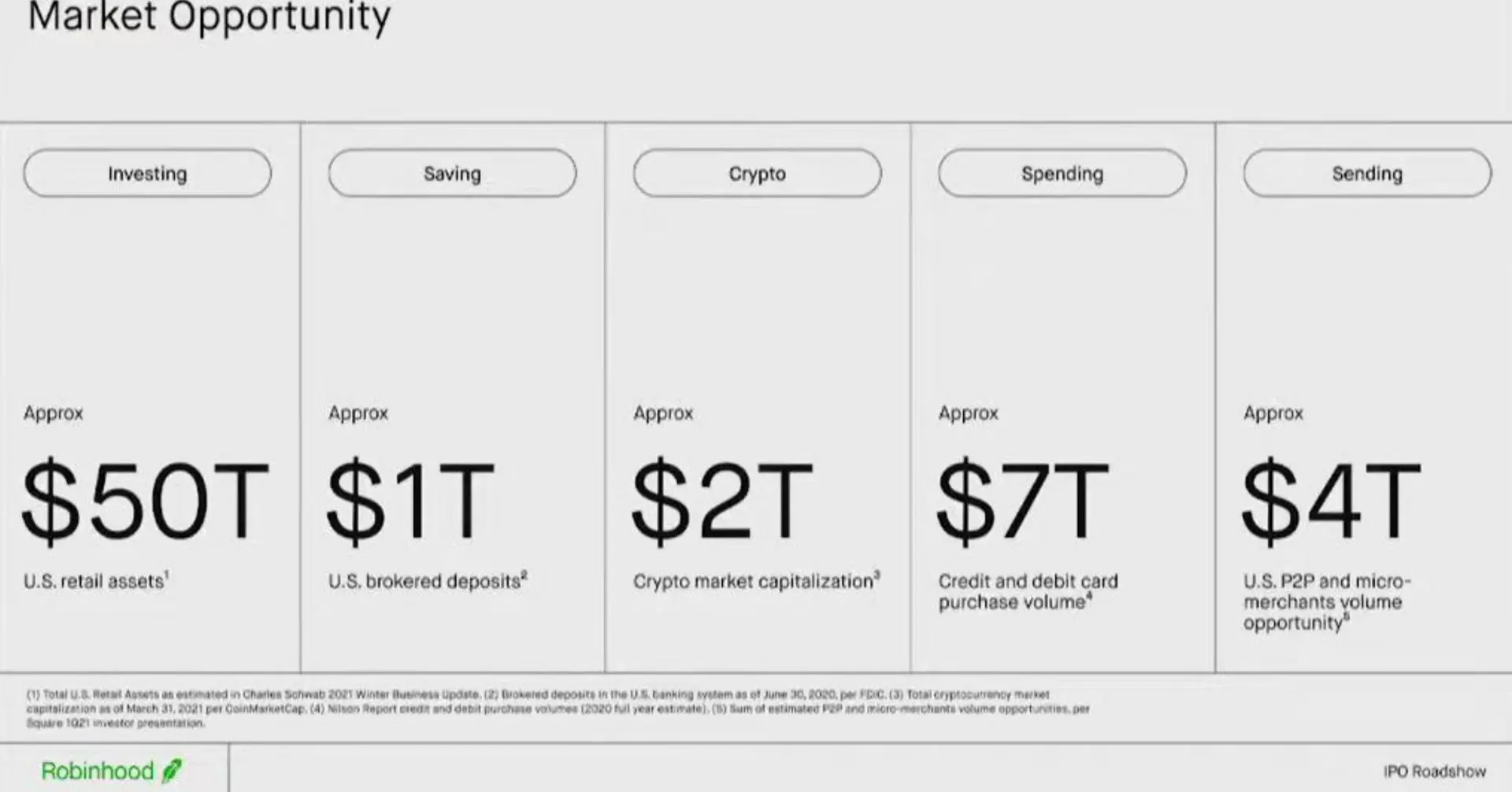
The market opportunity slide presents compelling data about the $100+ billion US retail brokerage market, with particular emphasis on the 50 million potential users under 35 who remain largely untapped by existing players. The slide effectively breaks down total addressable market (TAM) whilst highlighting the serviceable addressable market (SAM) of younger demographics who would be most receptive to mobile-first, commission-free trading. The numbers are substantial enough to justify venture-scale returns whilst remaining credible given supporting demographic and market research.
What makes this market sizing particularly persuasive is how it segments opportunity by demographic characteristics that align with Robinhood’s solution advantages. Rather than claiming they can capture the entire retail brokerage market, the slide focuses on the portion most likely to adopt mobile-first platforms and benefit from commission-free trading. The emphasis on “untapped growth” suggests that traditional brokers have left money on the table by not serving younger investors, creating a market gap that Robinhood can exploit without direct competition.
What investors see: A market size that justifies significant venture investment whilst being segmented thoughtfully to demonstrate realistic capture potential. The focus on underserved demographics suggests defensible positioning and growth runway that extends beyond initial market penetration. The retail brokerage market’s historical resilience provides confidence in long-term sustainability, whilst the commission-free angle implies potential for rapid market share gains.
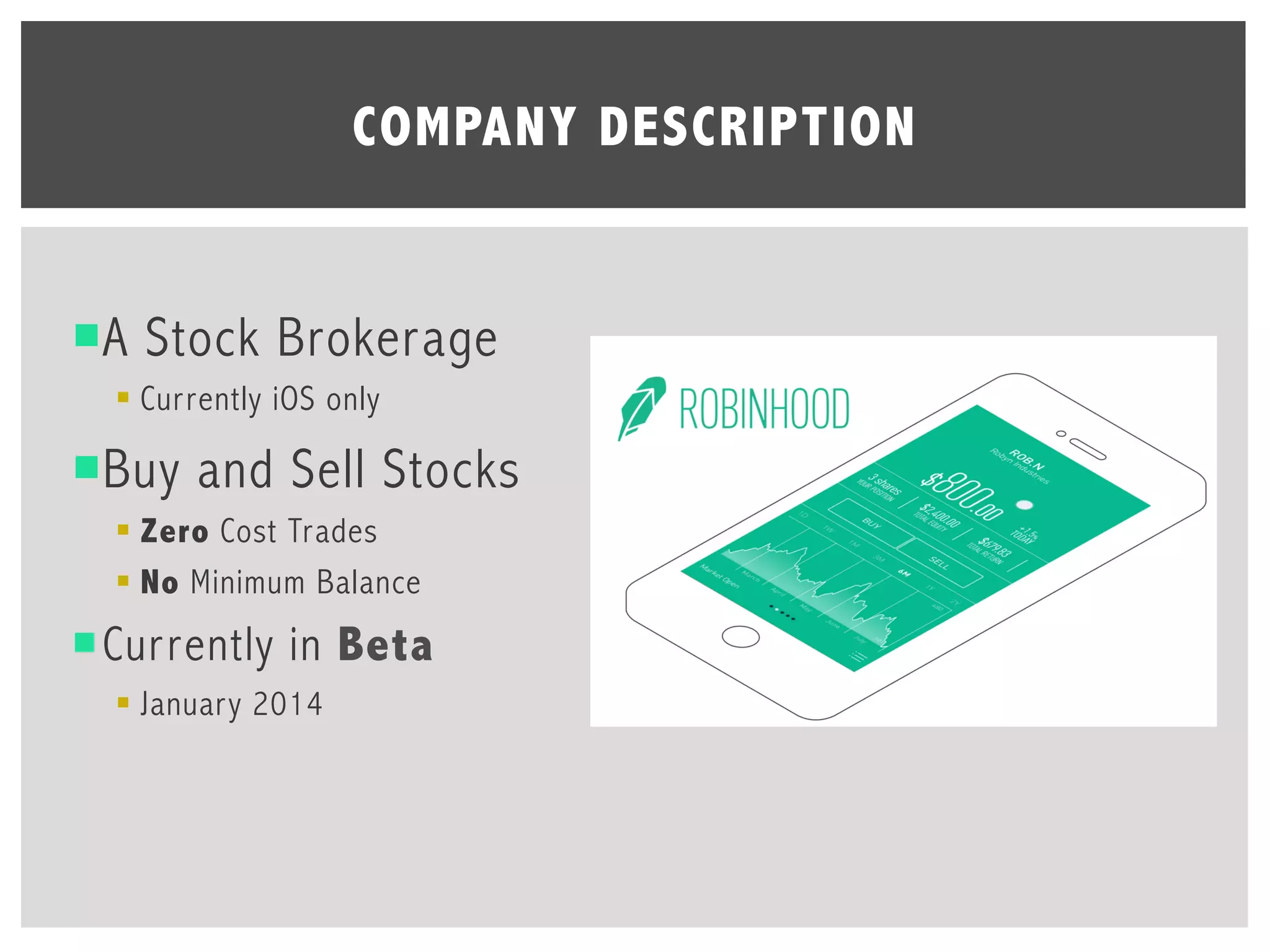
The product slide showcases actual app screenshots that demonstrate Robinhood’s revolutionary approach to mobile trading interface design, featuring one-tap trading, real-time quotes, and educational tools specifically designed for novice investors. The visual presentation immediately communicates how dramatically different this user experience is from traditional brokerage platforms, with clean typography, intuitive navigation, and minimalist design that makes complex financial operations feel approachable. The screenshots prove that this isn’t just a concept—it’s a functional product ready for market deployment.
The strategic choice to include educational tools alongside trading functionality demonstrates Robinhood’s understanding that their target demographic needs guidance, not just access. This positions the app as an onboarding platform for new investors rather than simply a cheaper alternative for existing traders, dramatically expanding the addressable market. The one-tap trading feature represents a fundamental reimagining of how trading should work on mobile devices, prioritising speed and simplicity over the feature-heavy complexity that characterises desktop platforms.
What investors see: A product that has progressed beyond mockups to functional screens, reducing execution risk whilst demonstrating superior user experience design capabilities. The educational component suggests sustainable user engagement beyond transaction revenue, whilst the simplified interface indicates potential for rapid user onboarding and viral growth through improved user experience. The mobile-native design provides competitive advantages that desktop-focused incumbents cannot easily replicate.
The business model slide reveals Robinhood’s sophisticated approach to monetisation through multiple revenue streams including interest on cash balances, margin lending, premium services, and payment for order flow (PFOF), all whilst maintaining zero commissions for users. This multi-faceted approach demonstrates that eliminating commissions doesn’t mean eliminating profitability—rather, it shifts the revenue model to capture value through user engagement and platform scale. The inclusion of PFOF, though controversial, provides a legitimate path to subsidising free trading that established brokers had overlooked for retail customers.
What makes this business model particularly compelling is how it aligns user growth with revenue potential—more active users generate more interest income, margin lending opportunities, and PFOF revenue without requiring direct fees. The premium services tier suggests opportunity for user monetisation expansion over time, whilst interest on cash balances provides defensive revenue that doesn’t depend on trading frequency. This diversified approach reduces dependence on any single revenue source whilst creating multiple paths to profitability as the user base scales.
What investors see: A revenue model that eliminates the primary barrier to user acquisition whilst maintaining multiple monetisation vectors that scale with user engagement. The alignment between user benefit (free trading) and business benefit (more active users generating more revenue) suggests sustainable unit economics and viral growth potential. The diversified revenue streams provide downside protection whilst the zero-commission positioning creates a competitive moat that traditional brokers cannot easily match.
The traction slide delivers the most powerful validation possible for a pre-revenue startup: over 500,000 beta waitlist signups demonstrating massive organic demand for their solution. This extraordinary number proves that Robinhood identified a genuine market need and validates their product-market fit hypothesis before significant capital investment. The growth curve and user acquisition metrics shown here represent the kind of viral demand that every investor hopes to see, particularly impressive given the lack of paid marketing during this beta phase.
Beyond the sheer scale of signups, this traction demonstrates Robinhood’s ability to generate buzz and word-of-mouth growth in the traditionally conservative financial services sector. The waitlist model itself proved strategic, creating scarcity and exclusivity that amplified demand whilst giving the founders time to complete regulatory requirements and product refinement. The partnerships in development mentioned alongside user metrics suggest that early traction is translating into business development opportunities that will accelerate growth post-launch.
What investors see: Exceptional product-market fit validation that significantly reduces investment risk whilst demonstrating viral growth potential. The 500K+ waitlist represents a built-in user base for launch, providing immediate path to revenue generation and proof of sustainable customer acquisition. The organic nature of this growth suggests strong word-of-mouth dynamics and market timing that could translate into explosive growth once regulatory approvals and funding enable full market launch.
The competition slide strategically positions Robinhood against traditional brokers (high fees, poor mobile experience) and discount brokers (still charging commissions, inadequate user experience) on a matrix that highlights their unique value proposition of zero fees combined with superior mobile UX. Rather than ignoring competition, this slide acknowledges existing players whilst demonstrating why current solutions fail to serve the mobile-first, cost-conscious demographic that Robinhood targets. The matrix format clearly shows Robinhood occupying white space that competitors have left unaddressed.
The competitive analysis reveals strategic insight by focusing on the intersection of pricing and user experience rather than just feature comparison. Traditional brokers like Charles Schwab and E*TRADE are positioned as legacy players constrained by existing revenue models and technical infrastructure, whilst newer discount brokers are shown as partial solutions that haven’t fully committed to mobile-first design or zero-fee models. This positioning suggests that Robinhood isn’t just offering incremental improvement—they’re creating a new category that combines the best aspects of pricing and experience.
What investors see: A startup that understands competitive dynamics whilst identifying uncontested market space that existing players cannot easily defend. The focus on mobile UX and zero fees represents sustainable differentiation that would require significant business model changes for incumbents to match. The matrix positioning suggests that Robinhood has identified a strategic gap rather than attempting head-to-head competition with established players, reducing competitive risk whilst maximising growth potential.
The team slide showcases founders Baiju Bhatt and Vlad Tenev, both Stanford PhDs with deep quantitative trading experience and systems expertise, providing exceptional credibility for tackling the technical and regulatory challenges of building a brokerage platform. Their academic credentials combined with hands-on experience in high-frequency trading systems demonstrate the rare combination of theoretical knowledge and practical implementation skills necessary for this venture. The inclusion of key advisors further strengthens the team’s credibility and suggests strong network support for navigating regulatory and business challenges.
What makes this team particularly compelling is how their backgrounds directly address the primary risks investors would identify in a fintech startup: technical execution capability and regulatory compliance expertise. Their experience building trading systems provides confidence in their ability to handle the complex infrastructure requirements of a brokerage platform, whilst their quantitative backgrounds suggest deep understanding of market microstructure and risk management. The Stanford connection also provides access to world-class talent networks for future hiring as the company scales.
What investors see: Domain expertise that directly addresses the highest-risk aspects of building a financial services platform, with proven technical capabilities and regulatory understanding. The PhD-level education suggests analytical rigor and problem-solving capabilities essential for navigating complex fintech challenges, whilst their trading systems experience provides confidence in execution ability. The advisor network implies strong industry connections that could accelerate partnership development and regulatory approval processes.
The funding ask slide requests $3 million in seed funding with a clear breakdown of use cases including product launch, user acquisition, and regulatory compliance, demonstrating thoughtful capital planning and milestone-driven deployment. The allocation pie chart shows the majority of funds directed toward essential growth activities rather than overhead, whilst the regulatory compliance allocation acknowledges one of the primary risks investors would identify in a fintech startup. The funding amount is sized appropriately for a seed round whilst being substantial enough to achieve meaningful milestones toward Series A readiness.
The strategic framing around “product launch” rather than “product development” reinforces that Robinhood has already achieved significant progress and needs funding for go-to-market rather than basic development. The user acquisition allocation demonstrates understanding that growth will require marketing investment despite strong organic traction, whilst the compliance focus shows sophisticated appreciation for regulatory requirements in financial services. The overall funding request strikes the right balance between ambition and pragmatism for a seed-stage startup.
What investors see: A realistic funding request with thoughtful allocation toward growth-critical activities and appropriate risk mitigation through regulatory compliance investment. The emphasis on launch and acquisition suggests the product is ready for market, reducing execution risk whilst the compliance allocation shows sophisticated understanding of fintech regulatory requirements. The funding amount provides sufficient runway to achieve meaningful milestones whilst maintaining reasonable dilution expectations for founders and early employees.
From insight to investor-ready, in weeks not months.
Apply these lessons to your raise — we’ll build your deck, financial model, and IM together.
While this deck secured funding from top-tier venture capital firms and launched a retail trading revolution that would reshape the entire brokerage industry, it reflects the simpler expectations of seed-stage fundraising in 2013. By today’s standards, even exceptional early-stage decks must address investor concerns that weren’t standard practice a decade ago, particularly around financial projections, go-to-market strategy, and regulatory risk management. For those seeking to elevate their presentations, engaging in fundraising-grade pitch deck consulting can be invaluable.
Lacks 3-5 year revenue forecasts, burn rate, or unit economics; modern decks require these to demonstrate path to profitability and ROI potential.
No detailed customer acquisition plan, channels, or CAC/LTV metrics; essential today for showing scalable growth in competitive markets.
Minimal discussion of FINRA/SEC compliance plans; fintech investors now demand explicit risk mitigation for approvals and operations.
Basic matrix without patents, network effects, or defensibility; current decks emphasise barriers against copycats.
Absent post-funding timeline; VCs expect clear OKRs for product launches, user growth, and expansion.
No mention of potential IPO or acquisition paths; helps investors visualise returns in today’s data-driven pitches.
No team diversity or sustainability focus; modern standards include these for broader appeal and risk assessment.
These gaps reflect the evolving standards of venture capital due diligence, particularly in heavily regulated sectors like financial services. At Projects RH, we help founders anticipate and address these expectations before they enter fundraising conversations, ensuring their decks meet current investor standards whilst maintaining the compelling narrative that drives investment decisions.
Robinhood opened with visceral pain points like $10 fees excluding youth; founders should use data/anecdotes to make problems relatable and urgent for instant investor buy-in.
Mixed storytelling (democratising finance) with metrics (market size, waitlist); apply by weaving narrative around hard numbers to build emotional and rational appeal.
11 tight slides focused on essentials; founders can trim fluff, prioritise problem-solution-market-traction-ask for 10-20 minute pitches.
Emphasised PhDs with trading expertise; showcase domain-specific credentials early to build execution credibility.
500K waitlist proved demand pre-launch; gather beta metrics, LOIs, or pilots to de-risk pre-revenue stages.
Clean, mobile-first aesthetics mirrored product; use minimal text, high-quality mockups, and charts for memorability.
Tied to smartphones/millennials; align trends like AI or crypto to position your startup at market inflection.
Ready to raise? Let’s talk.
We’ve helped founders secure $2B+ in investor interest. Your round could be next.
The distance between the Robinhood that presented this deck and the Robinhood that exists today represents one of the most remarkable value creation stories in modern venture capital history. From a $3 million seed round valuation to a public company worth over $25 billion at its peak, the trajectory demonstrates how exceptional execution can transform early-stage potential into market-defining success whilst fundamentally reshaping an entire industry.
For early investors, particularly Andreessen Horowitz who led the seed round, Robinhood represents one of the most successful venture investments of the 2010s. A $3 million investment at seed stage would have generated returns exceeding 1000x at the company’s IPO peak, demonstrating the extraordinary value creation potential when venture capital meets exceptional execution and market timing. Even accounting for market volatility and regulatory challenges, the investment represents generational returns that validate the risk-taking inherent in backing unproven but visionary founders.
The transformation from 11-slide seed deck to public company worth tens of billions illustrates why investors continue to seek the next generation-defining startup, despite the inherent risks. Robinhood’s journey proves that with the right combination of market insight, execution capability, and strategic vision, even modest seed investments can generate the outsized returns that define successful venture portfolios and reshape entire industries in the process.
At Projects RH, we help companies across all industries create investor-ready materials that close deals. Our integrated capital raising package ensures consistency across all your investor documentation.
Built in-house for accuracy and investor confidence.
Comprehensive investor documentation following global best practices.
12-slide investor-ready presentation with supporting materials.
High-impact snapshot to capture investor attention fast.
Browse our collection of real pitch deck breakdowns from the world’s most successful companies.
The Robinhood seed pitch deck consists of 11 focused slides, covering essentials from problem to funding ask without unnecessary detail.
They raised $3 million in their 2013 seed round using this deck, from investors including Andreessen Horowitz.
Its success stemmed from bold disruption narrative, massive waitlist traction, clean design, strong founder creds, and precise focus on zero-commission mobile trading in a ripe market.
Yes, as a starting point for seed-stage fintech, but adapt by adding financials, GTM, and roadmap—essential in post-2020 decks amid higher scrutiny.
Seed round stage in 2013, pre-product launch with strong validation via waitlist but no revenue.
Creating an effective pitch deck requires more than following a template — it demands strategic clarity about your value proposition, a deep understanding of your target investors, and rigorous financial modelling to support your narrative. At Projects RH, we combine financial expertise with strategic storytelling to build pitch decks, information memorandums, and financial models that meet the standards of institutional investors worldwide. Our team has generated over USD 2.0 billion in expressions of interest across mining, energy, technology, medtech, and financial services sectors. Schedule a consultation to discuss how we can help position your company for successful capital raising.