
Dive into the 9-slide pitch deck that helped Amazon secure $8 million in seed funding from Kleiner Perkins Caufield & Byers and John Doerr in 1995.
Building your own pitch deck?
Get expert guidance from the team behind $2B+ in investor interest.
Jeff Bezos founded Amazon in 1994 while working in finance on Wall Street, identifying the Internet’s potential after noticing its 2,300% annual growth rate. Quitting his job at age 30, he drove cross-country to Seattle to start an online bookstore called Cadabra, later renamed Amazon.com to evoke the vast Amazon River and appear early in alphabetical listings. Operating from his garage with a small team, Bezos focused on customer obsession, secure ordering, and an expansive catalogue far beyond physical stores, demonstrating the need for expert pitch deck guidance in navigating such ambitious ventures.
Early challenges included building scalable technology from scratch, managing logistics without warehouses, and competing with retail giants amid the dot-com scepticism. The team hand-packed books initially, pivoted to emphasise reviews and personalisation, and bootstrapped until proving traction with 100,000 customers and $600k monthly revenue run rate by mid-1995. Technical hurdles like inventory tracking were overcome through innovative software development.
In 1995, Bezos crafted a concise 9-slide pitch deck targeting top VCs. After rejections, Kleiner Perkins partner John Doerr invested $8M in a seed round, impressed by the clear vision, market maths, and Bezos’ conviction. This funding enabled warehouse buildout and team expansion.
The pitch’s outcome was transformative, fueling hypergrowth and setting the stage for Amazon’s evolution into a global e-commerce leader, proving the power of a simple, data-driven story in early-stage fundraising.

Amazon’s opening slide establishes immediate credibility with the bold tagline “Earth’s Biggest Bookstore”, positioning the company not as a startup but as already achieving scale supremacy. The bookshelf imagery reinforces the vast selection promise whilst maintaining the familiar retail metaphor that investors could readily understand. This visual anchoring strategy eliminates confusion about the business model from the outset.
The clean, professional design signals operational maturity despite being a garage-stage company, whilst the superlative “biggest” creates an aspirational hook that positions Amazon as the category winner before explaining how. This confidence-building opener is critical when pitching revolutionary business models to risk-averse institutional investors. The URL inclusion subtly suggests the platform is already operational and accessible.
What investors see: A founder who understands the power of positioning and isn’t afraid to make bold claims backed by substance. The cover telegraphs ambition whilst remaining grounded in a comprehensible retail analogy, reducing perceived execution risk. This balance of audacity and familiarity is precisely what separates funded startups from unfunded ones in competitive pitch processes.

The mission statement brilliantly weaves together three critical investor concerns: customer obsession, technological disruption, and economic value creation through disintermediation. By leading with “customer-centric”, Bezos signals that all decisions flow from user needs rather than internal metrics, a philosophy that would become Amazon’s defining characteristic. The Internet is positioned as an enabler rather than the core value proposition itself.
The strategic use of “disintermediate middlemen” demonstrates sophisticated understanding of how technology creates value by eliminating inefficient layers in traditional supply chains. This language reassures investors that the founders grasp fundamental business economics rather than pursuing technology for its own sake. The twin promises of “wider selection” and “lower prices” establish the consumer value proposition that drives sustainable competitive advantage.
What investors see: A mission built on timeless business principles rather than ephemeral technology trends, suggesting durability and scalability beyond the initial product. The focus on customer-centricity over profit maximisation indicates long-term thinking that builds sustainable moats. This philosophical framework provides intellectual coherence that sophisticated investors seek when evaluating transformative opportunities.

The stark visual contrast between a tiny bookstore shelf and Amazon’s massive warehouse creates an instantly compelling problem-solution narrative that transcends industry jargon. The 150,000 versus 1.5 million title comparison provides concrete quantification of the selection limitation that physical retail cannot overcome due to real estate and inventory constraints. This visceral representation makes the problem feel urgent and solvable through technology.
By choosing books as the entry point, Amazon demonstrates strategic market selection—books are perfect for online retail due to standardisation, high value-to-weight ratios, and the importance of selection over tactile evaluation. The slide implicitly addresses investor concerns about why physical retail giants like Barnes & Noble couldn’t simply replicate this model, highlighting the fundamental physics and economics constraints of brick-and-mortar operations.
What investors see: A founder who understands that compelling problems require emotional resonance, not just rational argument, and can communicate complex market dynamics through simple visuals. The 10x improvement in selection represents the kind of step-function advantage that creates defensible market positions. This problem formulation suggests systematic thinking about barriers to entry and competitive moats.
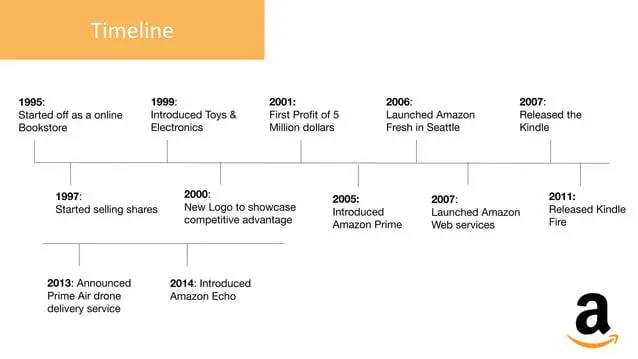
The solution slide systematically addresses each component of customer value: selection, convenience, pricing, and trust through reviews and security. The inclusion of “1-ClickSM shopping” demonstrates early recognition that user experience friction creates competitive barriers, whilst the trademark symbol shows intellectual property awareness. Customer reviews represent an innovative trust-building mechanism that traditional retail couldn’t easily replicate.
The “direct from publishers” positioning reveals sophisticated understanding of supply chain economics, eliminating multiple margin layers whilst providing publisher benefits through expanded reach. This disintermediation strategy creates win-win scenarios that traditional competitors struggle to match without cannibalising existing relationships. The secure payment emphasis addresses the primary consumer barrier to online purchasing in 1995.
What investors see: A comprehensive value proposition that creates multiple switching costs and network effects, suggesting sustainable competitive advantages. The combination of operational excellence (selection, pricing) and innovation (reviews, 1-Click) indicates both execution capability and strategic vision. This multi-faceted approach reduces single-point-of-failure risk that plagues many technology startups.

The market sizing demonstrates exemplary analytical rigor with the $80+ billion U.S. book market providing a concrete foundation for revenue projections. The Internet penetration forecast to 20% by 2000 shows prescient understanding of technology adoption curves, whilst the conservative 2-4% market share target suggests realistic expectations rather than hockey-stick fantasies. This measured approach builds credibility with institutional investors who evaluate numerous over-optimistic projections.
The $640M-$1.28B revenue range provides concrete scale targets that justify the $8M investment request whilst remaining grounded in addressable market realities. The timing convergence of market size, Internet adoption, and Amazon’s first-mover advantage creates a compelling investment thesis around capturing disproportionate value during a transformative technology shift. This market analysis framework became a template for technology startup pitches.
What investors see: Sophisticated market analysis that balances optimism with realism, crucial for establishing investment return potential without triggering scepticism about execution capability. The conservative market share assumptions demonstrate awareness of competitive dynamics and execution challenges. This analytical framework suggests the kind of strategic thinking required to build category-defining companies.
The revenue breakdown reveals a straightforward business model with books generating 94% of revenues, shipping costs passed through at 4%, and emerging ancillary streams at 2%. This transparency about current reality whilst hinting at future diversification demonstrates honesty about the present whilst suggesting expansion opportunities. The pro forma projections to 2001 showing $1.2B revenue and $16M net income provide specific profitability targets with intermediate milestones.
The emphasis on “low overhead” addresses investor concerns about operational leverage and capital efficiency, critical factors for achieving venture-scale returns. The multi-year financial model demonstrates systematic planning beyond immediate tactical needs, showing progression through growth phases toward sustainable profitability. This long-term visibility reduces perceived execution risk whilst establishing measurable success metrics.
What investors see: A business model built on unit economics fundamentals rather than speculative monetisation strategies, providing confidence in cash generation capability. The clear path to profitability with specific timeline and margins demonstrates financial discipline essential for institutional investment. This transparency about both current limitations and future potential creates the trust foundation required for venture partnerships.
The competitive matrices systematically position Amazon as superior across all key customer value dimensions: selection, convenience, prices, and reviews. Rather than dismissing competition, this analysis acknowledges Barnes & Noble’s strength whilst highlighting structural advantages that cannot be easily replicated through incremental improvements. The matrix format provides clear visual hierarchy that simplifies complex competitive dynamics for time-constrained investors.
The inclusion of multiple competitive scenarios demonstrates thorough market analysis and strategic thinking about defensive positioning. By focusing on customer-facing benefits rather than internal capabilities, the slide reinforces the customer-centric mission whilst highlighting differentiation. This competitive framework suggests Amazon has identified sustainable competitive moats rather than temporary first-mover advantages.
What investors see: Analytical rigor about competitive threats combined with confidence in differentiated positioning, essential for evaluating long-term defensibility. The systematic approach to competitive analysis suggests strategic thinking capability required for category leadership. This competitive intelligence demonstrates awareness of market dynamics whilst maintaining focus on customer value creation as the primary defensive strategy.

The team slide strategically positions Jeff Bezos’s Wall Street background as providing financial markets expertise whilst highlighting technical leadership through Shel Kaphan’s engineering credentials. The combination of photos and targeted biographical information creates personal connection whilst establishing relevant domain expertise. The emphasis on both financial and technical capabilities addresses investor concerns about execution across critical business functions.
The inclusion of specific retail and technology experience demonstrates systematic talent acquisition rather than opportunistic hiring, suggesting strategic thinking about capability building. The team composition balances entrepreneurial vision with operational expertise, addressing the classic founder-versus-operator tension that concerns institutional investors. The professional presentation format reinforces credibility through attention to stakeholder communication details.
What investors see: A founding team with complementary skills addressing the primary execution risks of technology development, financial management, and operational scaling. The combination of industry experience and entrepreneurial drive suggests both vision and pragmatic execution capability. This team profile reduces key person risk whilst establishing confidence in systematic business building beyond initial product development.
The final slide demonstrates substantial early traction with concrete metrics: site operational since April 1995, 100,000 registered customers, and $600,000 monthly revenue run rate. These achievements provide validation of market demand and execution capability, transforming the investment from pure vision bet to growth capital opportunity. The timeline specificity demonstrates systematic progress tracking and milestone achievement.
The $8M funding request includes specific allocation plans: distribution centre construction, staff expansion, and inventory investment. This detailed capital deployment strategy demonstrates financial discipline and operational planning rather than vague growth aspirations. The infrastructure focus signals preparation for systematic scaling rather than continued bootstrapping, justifying the investment magnitude through operational necessity.
What investors see: Proof of concept validation through real customer adoption and revenue generation, reducing market risk and focusing attention on execution scaling. The specific funding deployment plan demonstrates thoughtful capital allocation and operational readiness for accelerated growth. This progress documentation transforms pitch evaluation from speculative to evidence-based investment analysis.
From insight to investor-ready, in weeks not months.
Apply these lessons to your raise — we’ll build your deck, financial model, and IM together.
Whilst Amazon’s 1995 pitch deck secured one of the most transformative investments in venture capital history, launching a company now worth over $2 trillion, the presentation reflects its era’s expectations and would benefit from modern enhancements that today’s sophisticated investors routinely demand when evaluating early-stage opportunities, which is why consulting a pitch deck consulting firm can be invaluable.
Lacks a dedicated slide with quantifiable KPIs like MAU, retention rates, or cohort analysis; modern decks require this to validate product-market fit beyond basic revenue run rates, helping investors assess scalability quickly.
No explicit slide on customer acquisition channels, marketing spend, or CAC/LTV ratios; today’s VCs expect detailed plans on scaling users cost-effectively in competitive markets.
Pro forma is high-level without unit economics, burn rate, or sensitivity analysis; contemporary decks include detailed models to demonstrate path to profitability and capital efficiency.
Absent a visual timeline of upcoming features or expansions (e.g., beyond books); modern pitches use this to show vision and execution roadmap, building investor confidence in iteration.
No acknowledgment of risks like tech failures or competition; current best practices proactively address downsides with contingency plans to demonstrate realism and preparedness.
Team slide focuses solely on founders/execs without advisors or board; inclusive decks highlight diverse talent and networks, signalling strong governance for growth-stage rounds.
Omits potential liquidity paths like IPO or acquisition; whilst early-stage, modern decks hint at these to align on long-term value creation for investors.
These omissions reflect the venture capital landscape of 1995, when due diligence processes were less systematic and growth metrics less standardised. Modern founders must address these elements proactively, and Projects RH specialises in helping startups develop comprehensive pitch narratives that meet contemporary investor expectations whilst maintaining the clarity and conviction that made Amazon’s original deck so compelling.
Use stark visuals like tiny vs. massive bookshelves to make the problem visceral and solution obvious; founders should craft one iconic image per core idea to hook investors emotionally and memorably.
Back claims with simple, credible maths ($80B market x 2% share = $1.6B opportunity); apply by sizing TAM/SAM/SOM conservatively with sources, showing realistic capture paths without overhyping.
9 slides proved brevity wins—cover essentials only; modern founders should aim for 10-12 slides max, ruthlessly editing to fit 10-minute pitches, forcing clarity.
Mission centred on customers, not tech; emulate by framing every slide around user benefits, using testimonials or metrics to prove delight over features.
Last slide recaps real traction before the ask; always front-load achievements (revenue, users) to build credibility, answering ‘Why now?’ implicitly.
Bios tied experience to e-commerce uniquely; tailor team slides to the problem, quantifying past wins (e.g., ‘Built $X systems’) to convey execution capability.
Detailed pro forma to profitability built trust; include honest projections with assumptions, avoiding hockey-sticks—VCs value grounded optimism.
Ready to raise? Let’s talk.
We’ve helped founders secure $2B+ in investor interest. Your round could be next.
The distance between the Amazon that presented this 9-slide deck in 1995 and the trillion-dollar global infrastructure that exists today represents one of the most extraordinary value creation stories in business history, transforming a $8 million seed investment into returns that redefined venture capital success metrics.
Kleiner Perkins’ $8 million investment in Amazon’s 1995 seed round generated returns exceeding 10,000x based on the company’s peak market capitalisation, making it one of the most successful venture investments in history. The transformation from a garage-based online bookstore with 100,000 customers to a global technology conglomerate with 1.5 billion users demonstrates the exponential value creation possible when exceptional founders meet transformative market opportunities.
This extraordinary outcome validates the power of investing in foundational technology shifts during their early phases, whilst highlighting how a concise, well-structured pitch deck can unlock capital for world-changing companies. For modern founders, Amazon’s deck remains a masterclass in communicating vision with clarity, grounding ambition in market reality, and building investor confidence through systematic analysis rather than speculative promises.
At Projects RH, we help companies across all industries create investor-ready materials that close deals. Our integrated capital raising package ensures consistency across all your investor documentation.
Built in-house for accuracy and investor confidence.
Comprehensive investor documentation following global best practices.
12-slide investor-ready presentation with supporting materials.
High-impact snapshot to capture investor attention fast.
Browse our collection of real pitch deck breakdowns from the world’s most successful companies.
Amazon's 1995 seed pitch deck consisted of exactly 9 slides, covering mission, problem, solution, market, model, competition, team, and ask—proving brevity can secure $8M from top VCs.
The deck facilitated raising $8 million in seed funding from Kleiner Perkins, used for warehouse development, hiring, and inventory expansion, fueling early hypergrowth.
Success stemmed from vivid visuals (bookshelf contrast), crisp market math, customer-centric mission, real traction ($600k/month revenue), and concise storytelling that addressed investor concerns upfront.
Yes, as a foundational template for its structure and clarity, but adapt for modern expectations like traction dashboards, unit economics, and roadmaps—its principles endure across eras.
Seed stage in 1995, post-bootstrapping with initial revenue traction but pre-warehouse scale; it was their first institutional round after proving basic product-market fit.
Creating an effective pitch deck requires more than following a template — it demands strategic clarity about your value proposition, a deep understanding of your target investors, and rigorous financial modelling to support your narrative. At Projects RH, we combine financial expertise with strategic storytelling to build pitch decks, information memorandums, and financial models that meet the standards of institutional investors worldwide. Our team has generated over USD 2.0 billion in expressions of interest across mining, energy, technology, medtech, and financial services sectors. Schedule a consultation to discuss how we can help position your company for successful capital raising.