
Dive into the 13-slide pitch deck that helped Buffer secure $500,000 in seed funding in 2011, backed by investors including Leo Widrich and Hiten Shah.
Building your own pitch deck?
Get expert guidance from the team behind $2B+ in investor interest.
Buffer’s origin story exemplifies the power of lean validation and bootstrapped execution. In 2010, Joel Gascoigne was grappling with the same social media management pain point that millions of users faced: the complexity of scheduling posts across multiple platforms. Rather than diving straight into development, he employed a masterclass in customer validation by creating a simple landing page that tested demand for social media scheduling. The response was immediate and overwhelming, with early signups validating the core hypothesis before a single line of product code was written. This approach highlights the importance of expert guidance, similar to what a specialized pitch deck consultancy can offer in refining business ideas.
The early days were defined by resourceful bootstrapping and strategic partnership building. Gascoigne funded the initial development through personal savings and credit card debt, whilst Leo Widrich joined as co-founder to drive marketing growth through content strategy. Their lean remote team approach wasn’t just a cost-saving measure—it became central to their company culture and operational efficiency. By 2011, they had achieved the holy grail of early-stage SaaS: 55,000 users with 800 paying customers generating $150,000 in annual recurring revenue, all with 97% gross margins.
The fundraising approach was as transparent as their company values. Rather than pursuing traditional VC channels, Gascoigne published their pitch deck on the company blog, turning fundraising into a public case study. This radical transparency attracted exactly the right type of investors—those who valued data over hype and execution over promises. The deck’s emphasis on hard metrics rather than inflated projections resonated with angel investors including Guy Kawasaki and Hiten Shah, who brought not just capital but credible social proof and strategic guidance.
The $500,000 seed round secured in 2011 provided the foundation for rapid scaling, leading to a $3.5 million Series A shortly thereafter. What made this fundraising successful wasn’t just the traction metrics—though 40% month-over-month growth certainly helped—but the clarity of their narrative and the credibility of their execution. Buffer had proven they could build, monetise, and scale a freemium SaaS business in one of the fastest-growing markets in tech, setting the stage for their evolution into a social media management leader known as much for their transparency as their product excellence.

Buffer opens with a masterclass in understated confidence—just their logo against a clean white background. This isn’t minimalism for the sake of aesthetics; it’s strategic positioning that signals a mature product and confident founders. The absence of taglines, mission statements, or overwrought explanations suggests Buffer doesn’t need to oversell itself—the subsequent slides will do the talking through data and traction.
The professional polish of this cover slide immediately establishes Buffer as a serious player rather than a prototype or concept. In 2011, when many startups were still presenting rough mockups and aspirational visions, Buffer’s clean branding suggested they had moved beyond MVP into a scalable product. This visual credibility is particularly important for B2B SaaS companies, where professional appearance directly correlates with customer trust and willingness to pay.
What investors see: A company that has progressed beyond the “two guys in a garage” stage into professional execution. The simplicity suggests focus and clarity of vision—critical qualities investors seek in early-stage companies that must execute flawlessly with limited resources. This cover telegraphs that Buffer understands the power of clear communication, a skill essential for customer acquisition, team building, and investor relations.
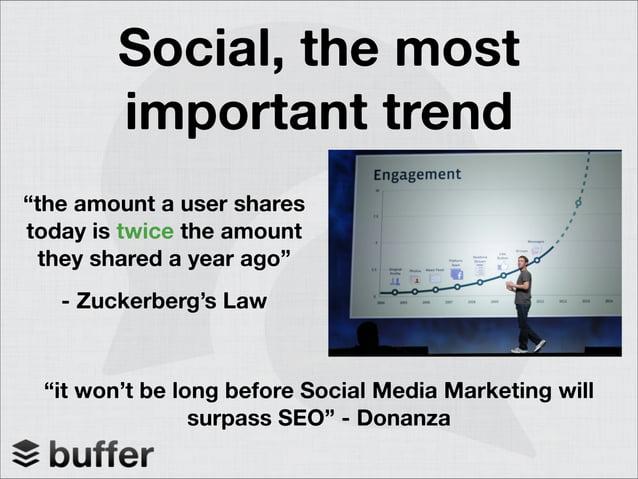
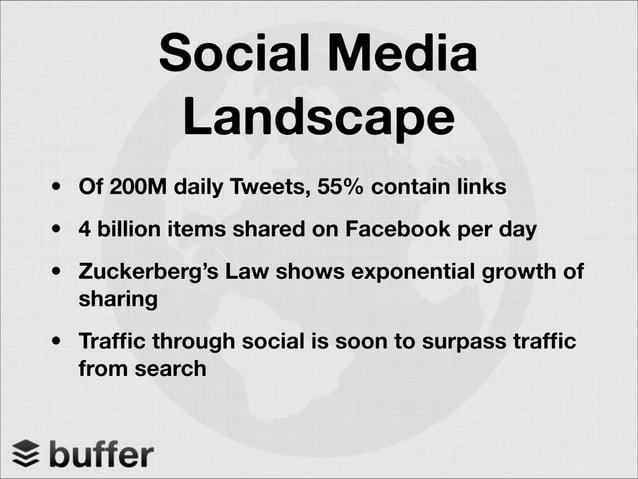
This slide demonstrates sophisticated market positioning by leading with explosive social media growth data and a Mark Zuckerberg quote. Rather than making unsubstantiated claims about market opportunity, Buffer anchors their thesis in hard external data—showing social media’s trajectory from emerging trend to mainstream behaviour. The inclusion of Zuckerberg’s perspective adds authoritative third-party validation that investors can’t dismiss as founder bias.
The strategic genius lies in positioning Buffer not as creating demand, but as riding an unstoppable macro trend. This removes the burden of market education and customer behaviour change—two of the highest risks in early-stage investing. By 2011, social media adoption was accelerating exponentially, making the timing argument almost self-evident. Buffer positions itself as the infrastructure play for this new reality, where businesses must participate in social media or risk irrelevance.
What investors see: Perfect market timing backed by credible data sources. The use of external validation rather than internal projections demonstrates intellectual honesty and reduces perceived execution risk. Investors recognise that riding a massive secular trend is far superior to creating new market categories, especially for resource-constrained startups. This slide essentially argues that Buffer’s success is inevitable given social media’s growth trajectory—a compelling investment thesis.

Buffer’s problem statement is brilliant in its simplicity and universality. Rather than overwhelming investors with feature comparisons or technical complexity, they pose a single, relatable question that immediately resonates with anyone who has managed social media. The framing around “missed opportunities” creates urgency—this isn’t just about convenience, but about business impact and competitive disadvantage.
The elegance lies in making the problem feel both widespread and solvable. Every business person in the room has experienced the frustration of managing multiple social accounts, remembering to post consistently, or feeling overwhelmed by the complexity of social media management. By keeping the problem statement focused on scheduling and sharing rather than broader social media strategy, Buffer defines a specific, addressable pain point rather than a nebulous market need.
What investors see: A problem that scales with social media adoption—as more businesses join social platforms, the scheduling complexity compounds exponentially. The focus on “missed opportunities” reframes this from a nice-to-have productivity tool to a must-have business capability. Investors recognise that problems experienced by the founders and their immediate network often represent massive market opportunities, especially when tied to irreversible trends like social media proliferation.

The solution slide showcases Buffer’s product philosophy: elegant integration rather than disruptive replacement. By showing a phone mockup within existing sharing flows, they demonstrate how Buffer enhances familiar workflows rather than requiring behavioural change. This reduces adoption friction—a critical consideration for any B2B SaaS tool seeking rapid user growth and retention.
The visual presentation emphasises benefits over features, focusing on “seamless sharing” rather than technical specifications. This customer-centric framing helps investors understand the value proposition from an end-user perspective. The mobile-first presentation was particularly prescient in 2011, when many competitors were still desktop-focused, showing Buffer’s forward-thinking approach to user behaviour trends.
What investors see: A solution that integrates into existing user workflows rather than requiring platform switching—a key advantage for achieving viral growth and reducing churn. The emphasis on user experience over technical complexity suggests founders who understand that distribution and adoption matter more than feature sophistication in early-stage SaaS. This approach dramatically reduces customer acquisition costs and accelerates time-to-value for new users.
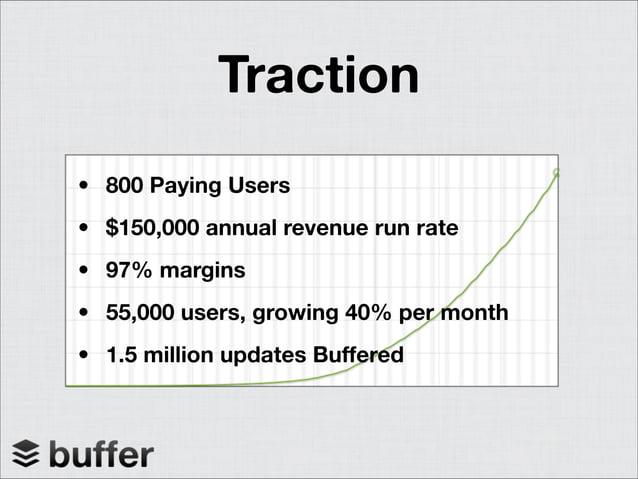
This is arguably the most important slide in Buffer’s deck, leading with hard revenue metrics that immediately de-risk the investment. The progression from 800 paying users to $150,000 ARR with 97% gross margins tells a complete story of product-market fit, monetisation capability, and scalable unit economics. The inclusion of 1.5 million updates sent provides usage validation without relying solely on vanity metrics.
The 97% gross margin figure is particularly compelling for SaaS investors, demonstrating that Buffer has achieved the operational efficiency expected of software businesses. Combined with proven ability to convert free users to paid subscribers, these metrics suggest a business model that can scale profitably without requiring massive capital injection for customer acquisition. The focus on recurring revenue rather than one-time metrics shows sophisticated understanding of SaaS valuation drivers.
What investors see: A business that has moved beyond hypothesis into proven execution, with the key metrics that matter for Series A readiness. The combination of paying users, ARR, and margins answers the three critical questions: Can they acquire customers? Can they monetise effectively? Can they scale profitably? This traction significantly reduces execution risk and provides a foundation for projecting future growth with confidence.
Buffer’s market slide takes a refreshingly grounded approach, using demand indicators rather than inflated Total Addressable Market calculations. By focusing on real usage data and behavioural trends, they build a credible case for market opportunity without the typical “trillion-dollar market” hyperbole that often undermines founder credibility. This approach suggests analytical sophistication and honest assessment of genuine opportunity size.
The bullet-point validation through actual market behaviour provides more compelling evidence than theoretical market sizing. Rather than claiming they can capture a percentage of all marketing spend, Buffer demonstrates growing demand through concrete examples and usage patterns. This bottom-up market analysis is more credible and actionable than top-down TAM calculations that often feel disconnected from reality.
What investors see: Founders who understand their market through data rather than assumptions, reducing the risk of pursuing an illusory opportunity. The focus on demand validation rather than market size projections suggests Buffer can identify and serve real customer needs rather than theoretical segments. This analytical approach increases confidence in the team’s ability to navigate market dynamics and capture genuine demand as it emerges.
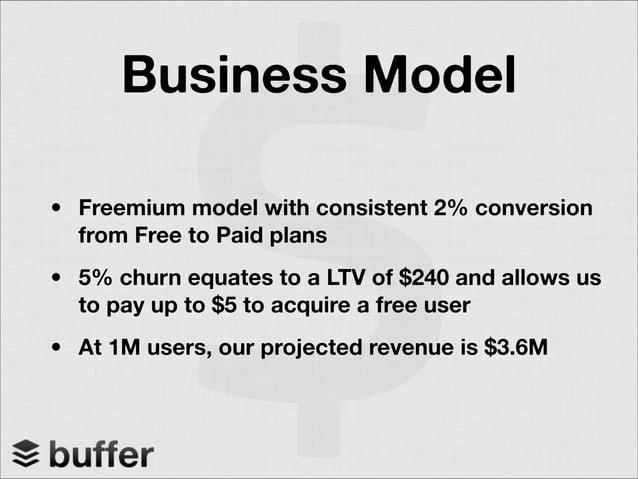
The business model slide demonstrates exactly what investors want to see: clear pricing tiers, proven conversion rates, and sustainable unit economics. Buffer’s freemium approach with defined upgrade paths shows they understand how to monetise users progressively whilst maintaining low customer acquisition costs. The inclusion of CAC limits and LTV projections reveals sophisticated thinking about scalable growth economics.
The transparency around conversion rates and revenue projections builds credibility whilst providing investors with the metrics they need for valuation models. By showing actual data rather than aspirational targets, Buffer demonstrates they’ve moved beyond theoretical business models into operational reality. This level of detail suggests strong financial discipline and understanding of the key drivers that will determine long-term success.
What investors see: A monetisation strategy that has been tested and proven at early scale, with clear paths to profitability as growth accelerates. The freemium model reduces customer acquisition costs whilst the tiered pricing captures value from power users—a sustainable approach that can scale without proportional increases in sales investment. The detailed economics suggest founders who understand the financial mechanics of their business and can optimise for profitability.
Buffer’s vision slide strikes the perfect balance between ambition and credibility by anchoring future aspirations to current traction. Rather than presenting grandiose claims about transforming industries, they offer a concise headline supported by three focused lines of text and a product mockup. This approach shows they can think strategically about the future whilst remaining grounded in execution realities.
The inclusion of actual product screenshots reinforces that this vision builds incrementally from existing capabilities rather than requiring fundamental pivots or unproven technology leaps. By connecting vision to demonstrated product development capability, Buffer reduces execution risk whilst maintaining investor excitement about future potential. This measured approach to vision communication reflects mature startup thinking.
What investors see: A team that can balance strategic thinking with tactical execution, avoiding the common pitfall of over-promising on future capabilities. The product-anchored vision suggests Buffer understands how to evolve their offering systematically rather than through disruptive changes that could alienate existing users. This approach increases confidence in the team’s ability to execute on growth plans whilst maintaining product-market fit.

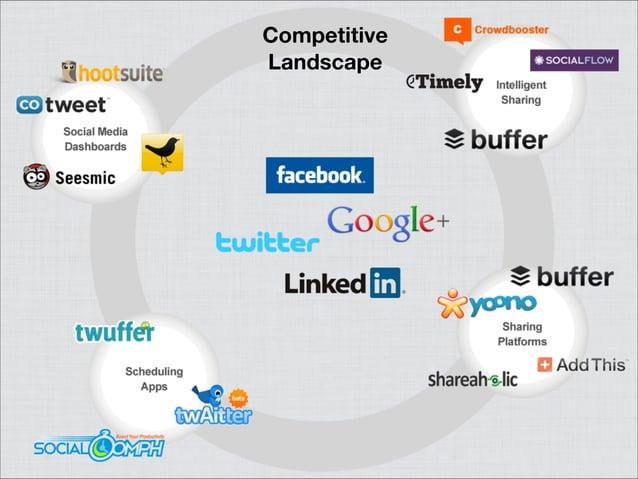
The competitive landscape slide demonstrates Buffer’s sophisticated understanding of market positioning through visual differentiation rather than dismissive competitor analysis. By using a thoughtful visual layout to position themselves against alternatives, they acknowledge competitive realities whilst highlighting their unique value proposition. This approach builds credibility by showing market awareness without appearing naive or defensive.
The focus on differentiation rather than competition suggests Buffer understands they don’t need to eliminate competitors to succeed—they need to carve out a defendable position within the broader social media management ecosystem. This mature competitive thinking reflects an understanding that growing markets can support multiple successful players, especially when they serve different customer segments or use cases.
What investors see: A team that understands competitive dynamics without being paralysed by them, focusing on unique value creation rather than defensive positioning. The visual approach to competitive analysis suggests clarity of thought about market positioning and customer targeting. This competitive awareness combined with clear differentiation reduces the risk of being commoditised or outmanoeuvred by larger players with more resources.
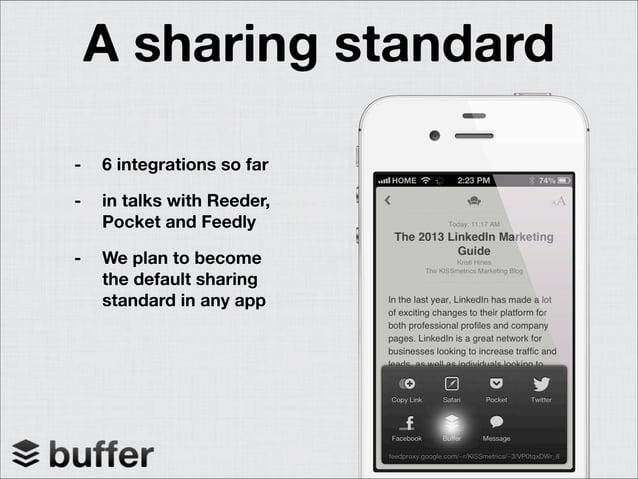
The integrations slide showcases Buffer’s platform strategy and network effects potential through comprehensive social platform coverage. By listing key integrations with major social networks, they demonstrate both technical capability and strategic thinking about ecosystem positioning. This approach positions Buffer as infrastructure rather than a standalone tool, increasing switching costs and customer stickiness.
The emphasis on platform extensibility suggests Buffer understands that their long-term success depends on maintaining relevance as social media platforms evolve and new channels emerge. Rather than being locked into specific platforms, Buffer’s integration-first approach provides defensibility through adaptability—a crucial advantage in the rapidly changing social media landscape where platforms rise and fall regularly.
What investors see: A scalable technology architecture that can adapt to platform changes and new social networks without fundamental rebuilding. The integration focus reduces platform risk whilst increasing customer value through consolidated workflows. This strategic approach suggests Buffer can maintain competitive advantages even as the social media ecosystem evolves, protecting investor returns through sustainable differentiation.
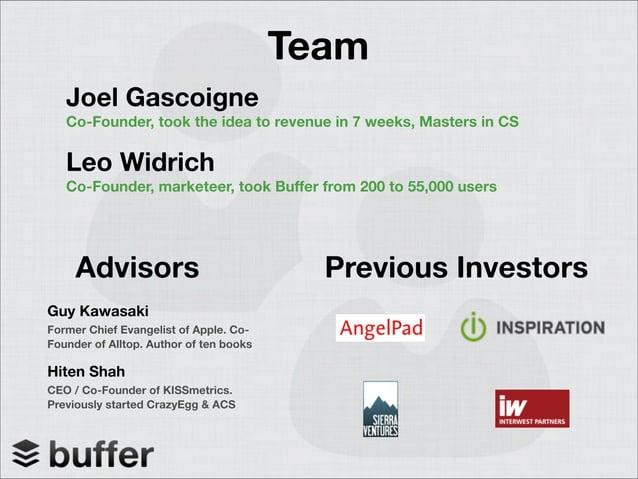
Buffer’s team slide demonstrates the power of complementary founder skills through Joel Gascoigne’s product execution expertise paired with Leo Widrich’s marketing growth capability. This combination addresses two critical early-stage challenges: building a product people want and finding efficient ways to reach them. The clear delineation of roles and responsibilities shows mature founder dynamics and reduces execution risk through specialisation.
The inclusion of advisors Guy Kawasaki and Hiten Shah provides significant credibility enhancement and strategic guidance in critical areas. Kawasaki brings marketing and evangelism expertise from his Apple and venture capital background, whilst Shah offers SaaS and customer development insights from his successful startup exits. These advisor relationships suggest Buffer can attract high-quality mentorship and has access to networks crucial for scaling.
What investors see: A founding team with proven complementary skills and access to experienced advisors who can help navigate scaling challenges. The combination of technical execution, marketing expertise, and strategic guidance reduces key person risk whilst increasing the likelihood of successful growth execution. Quality advisor relationships also signal that industry veterans believe in Buffer’s potential, providing third-party validation of the opportunity.
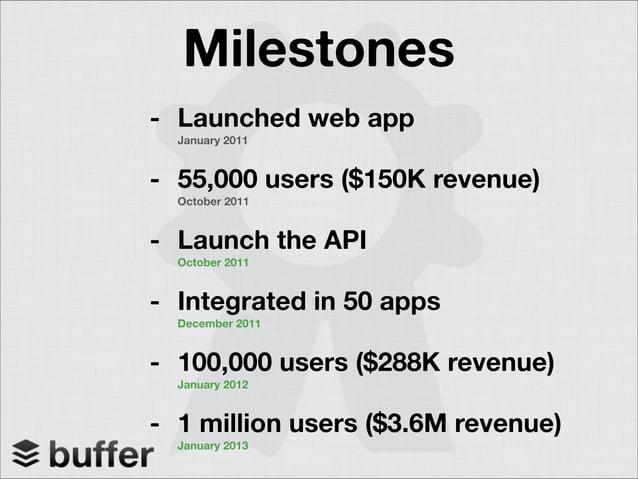
The milestones slide provides concrete evidence of execution capability through a timeline of key achievements including 55,000 users, $150,000 ARR, and consistent 40% month-over-month growth. This historical performance data allows investors to assess the team’s ability to set and achieve ambitious targets whilst maintaining sustainable growth rates. The progression from launch to significant traction within a short timeframe demonstrates exceptional execution velocity.
The emphasis on consistent growth metrics rather than sporadic achievements suggests Buffer has identified repeatable growth engines rather than relying on one-time marketing successes. The 40% month-over-month growth rate is particularly impressive for a bootstrapped startup, indicating strong product-market fit and efficient customer acquisition strategies. This track record provides confidence in future milestone achievement and goal execution.
What investors see: A team that consistently delivers on ambitious targets with limited resources, suggesting they can accelerate growth with additional capital injection. The milestone progression shows disciplined goal-setting and systematic execution rather than ad-hoc achievements. This execution track record reduces investor concerns about the team’s ability to deploy capital effectively and achieve the aggressive growth targets required for venture scale returns.

Buffer’s closing slide exemplifies their transparency philosophy by providing a simple shared founder email address rather than generic contact information. This approach reinforces their commitment to open communication and accessibility—values that extend beyond investor relations into customer relationships and company culture. The clean presentation maintains consistency with their minimalist design philosophy whilst facilitating immediate follow-up.
The choice to use a shared email address rather than individual contacts suggests collaborative founder dynamics and unified decision-making processes. This approach can accelerate investor communications by ensuring both founders receive enquiries simultaneously, whilst reinforcing the partnership’s strength and cohesion. The transparency extends their brand promise into practical investor interaction protocols.
What investors see: Founders who practice their transparency values consistently, from company operations to investor relations. The accessible contact approach suggests responsive communication and collaborative founder relationships—crucial factors for successful investor-founder partnerships. This practical transparency builds trust whilst facilitating efficient due diligence and negotiation processes that can accelerate investment decisions.
From insight to investor-ready, in weeks not months.
Apply these lessons to your raise — we’ll build your deck, financial model, and IM together.
While Buffer’s pitch deck successfully secured $500,000 in seed funding and established the foundation for their remarkable growth trajectory, it reflects the fundraising standards of 2011 rather than today’s more rigorous investor expectations. The deck’s strength lies in its traction-focused narrative and execution credibility, but it lacks several elements that modern investors consider essential for thorough due diligence and investment decision-making. These gaps don’t diminish the deck’s historical effectiveness, but they highlight how fundraising requirements have evolved as the startup ecosystem has matured and become more sophisticated. For those looking to enhance their own presentations, seeking pitch deck strategy consulting can provide valuable insights.
Lacks detailed 3-5 year revenue forecasts, cash flow, and burn rate; modern decks require these to show scalable path to profitability and investor ROI expectations.
No quantified Total Addressable Market breakdown; investors now demand this early to assess opportunity scale beyond qualitative trends.
Missing specific customer acquisition channels, sales funnel, and growth playbook; essential for proving how to hit next traction milestones.
No timeline of upcoming features or iterations; modern VCs want visibility into innovation pipeline and defensibility.
Omits discussion of key risks like competition or churn; addressing these proactively builds trust in execution foresight.
No specifics on use of funds, valuation, or terms; clear ask slide is standard to guide term sheet discussions.
Relies on metrics without direct quotes or case studies; real user voices add emotional proof and social proof.
These missing elements reflect the evolution of investor sophistication and due diligence requirements over the past decade. Today’s competitive funding environment demands more comprehensive documentation of business fundamentals, risk assessment, and growth planning. At Projects RH, we help founders bridge these gaps by developing investor-ready materials that combine Buffer’s storytelling strengths with the analytical rigour that modern investors expect, ensuring founders can compete effectively in today’s fundraising landscape.
Place revenue, users, and margins early to answer ‘Can you make money?’ immediately; founders should prioritise quantifiable proof over vision to de-risk the opportunity.
Use 13 focused slides with clean design and narrative arc from problem to team; apply by ensuring each slide builds logically, avoiding fluff for investor momentum.
Pair technical execution with business growth skills, plus advisors; founders can showcase specific past wins to address execution risks.
Incorporate quotes, graphs, and trends like Zuckerberg’s for credibility; back claims with third-party data to prove timing without self-promotion.
Detail freemium pricing, LTV, CAC simply; founders should tie assumptions to real data for scalable unit economics confidence.
Simple contact fosters follow-up; use shared emails to reinforce brand values like transparency.
Use matrices to differentiate; clearly show unique value to preempt objections.
Ready to raise? Let’s talk.
We’ve helped founders secure $2B+ in investor interest. Your round could be next.
The distance between the Buffer that presented this deck and the Buffer that exists today represents one of the most successful transformations in SaaS history. In 2011, Buffer was a promising but unproven startup with 55,000 users and $150,000 in annual recurring revenue, seeking validation and capital to prove their freemium model could scale. Today, Buffer stands as a mature SaaS company with over 100 million users, $45 million in annual revenue, and a team of 85 employees distributed across the globe. This evolution from seed-stage startup to established market leader illustrates both the power of exceptional execution and the transformative potential that early-stage investors seek when evaluating investment opportunities.
The investment returns generated by Buffer’s growth trajectory demonstrate the exceptional value creation potential of well-executed SaaS businesses with strong product-market fit. Early investors who participated in the $500,000 seed round at a $3.5 million pre-money valuation have seen their investment appreciate by an estimated 50-60x based on Buffer’s current $200+ million valuation. This level of return exemplifies why investors seek companies with Buffer’s combination of proven traction, scalable business models, and exceptional founding teams.
Perhaps most remarkably, Buffer achieved this transformation whilst maintaining their core values of transparency and remote-first culture, proving that sustainable growth and principled business practices can coexist. The company’s evolution from a simple social media scheduling tool to a comprehensive social media management platform demonstrates the power of strategic product development anchored to genuine customer needs. For investors and founders alike, Buffer’s journey from pitch deck to market leadership offers a masterclass in building enduring value through consistent execution, customer obsession, and cultural integrity.
At Projects RH, we help companies across all industries create investor-ready materials that close deals. Our integrated capital raising package ensures consistency across all your investor documentation.
Built in-house for accuracy and investor confidence.
Comprehensive investor documentation following global best practices.
12-slide investor-ready presentation with supporting materials.
High-impact snapshot to capture investor attention fast.
Browse our collection of real pitch deck breakdowns from the world’s most successful companies.
Buffer's pitch deck consisted of 13 focused slides, delivering a concise narrative from problem to contact without fluff, proving simplicity drives investor engagement.
The deck secured $500,000 in seed funding in 2011, followed by $3.5M in Series A, by emphasizing traction like $150K ARR and 800 paying users.
Success stemmed from leading with hard traction metrics, a clear story arc, team credibility via complementary founders and advisors, and data-backed business model, building immediate trust.
Yes, adapt its structure for traction-heavy decks, but update with modern elements like TAM, projections, and GTM; its 13-slide simplicity remains timeless for seed stages.
Buffer was in the seed round stage in 2011, with proven PMF via 55K users and $150K ARR, seeking $500K to scale a working freemium SaaS model.
Creating an effective pitch deck requires more than following a template — it demands strategic clarity about your value proposition, a deep understanding of your target investors, and rigorous financial modelling to support your narrative. At Projects RH, we combine financial expertise with strategic storytelling to build pitch decks, information memorandums, and financial models that meet the standards of institutional investors worldwide. Our team has generated over USD 2.0 billion in expressions of interest across mining, energy, technology, medtech, and financial services sectors. Schedule a consultation to discuss how we can help position your company for successful capital raising.