
A detailed analysis of the 28-slide pitch deck Glovo used to secure $1.2 billion in Series F funding from top investors including Rakuten and Delivery Hero in 2018.
Building your own pitch deck?
Get expert guidance from the team behind $2B+ in investor interest.
Glovo was born from Oscar Pierre’s frustration with urban inefficiency in Barcelona. In 2015, after witnessing the success of Uber and Postmates, Pierre recognised that European cities lacked a comprehensive on-demand delivery solution. With just €10,000, he outsourced development to a Siberian team and launched an MVP that promised to deliver “anything” within an hour. The early days were challenging—a buggy product, minimal traction, and dwindling cash reserves nearly killed the company within four months. This experience highlights the importance of expert guidance, such as pitch deck advisory services, in navigating the complexities of startup growth.
The turning point came when Pierre’s relentless LinkedIn outreach secured €140,000 from angel investors, despite operating at under €0.5M valuation. Strategic co-founder Sacha Michaud, former Betfair Managing Director, joined to complement Pierre’s technical vision with operational expertise. Together, they executed a bold pivot that transformed their struggling startup into a multi-category delivery platform, differentiating from food-only competitors by embracing groceries, pharmacy items, and anything else urban dwellers needed.
By 2017, Glovo had raised €25M in Series B funding from Rakuten, Cathay Capital, and Seaya Ventures, scaling to 20+ cities across Europe through organic growth and strategic acquisitions like Foodinha and Foodora Italy. Despite burning cash and struggling with unit economics, the company’s vision of becoming Europe’s super app for urban logistics attracted serious investor attention. The team grew from a handful of engineers to over 200 employees, setting the stage for their ambitious Series F pitch.
The 2018 NOAH Conference presentation represented the culmination of this journey—a company that had evolved from a desperate startup to a serious contender for European delivery dominance. Oscar Pierre took the stage with a deck that would secure $1.2 billion in funding, positioning Glovo for hypergrowth that would eventually lead to its acquisition by Delivery Hero in 2022 at a valuation exceeding €7 billion.
The cover slide immediately establishes Glovo’s bold positioning with the tagline “We deliver anything,” signalling ambitions beyond traditional food delivery. Oscar Pierre’s name appears prominently as CEO, lending personal credibility to the pitch, while the NOAH Conference branding adds prestige and context. The clean design reflects the simplicity of Glovo’s core value proposition—removing complexity from urban life through a single app.
This slide’s strategic power lies in its immediate differentiation from competitors who were still focused on narrow verticals like food-only delivery. By leading with “anything,” Glovo positions itself as a category creator rather than a category participant. The professional presentation at Europe’s premier tech conference suggests a company ready for institutional capital and serious growth acceleration.
What investors see: A company with the confidence to make bold claims backed by a founder willing to put his reputation on the line at a high-stakes venue. The “anything” positioning suggests massive TAM expansion potential beyond food delivery, while the professional presentation indicates operational maturity ready for scale-up capital.
This problem slide brilliantly quantifies urban frustration by showing how city dwellers waste precious hours on routine errands—queuing for groceries, waiting for prescriptions, and hunting for last-minute necessities. The visual likely depicts busy professionals surrounded by clocks and errands, making the pain point visceral and relatable. Rather than focusing on restaurant delivery specifically, Glovo frames the problem as comprehensive time scarcity affecting all aspects of urban consumption.
The strategic brilliance here is positioning Glovo not as a luxury convenience service, but as a solution to a genuine productivity crisis facing millions of Europeans. By emphasising time waste across multiple categories—food, groceries, pharmacy, retail—the slide sets up justification for Glovo’s multi-vertical approach. This problem framing also suggests high willingness-to-pay among time-pressed urban professionals.
What investors see: A massive, underserved market experiencing genuine pain that creates pricing power and customer stickiness. The multi-category problem setup justifies platform economics and suggests network effects across verticals, while the urban focus aligns with demographic trends favouring high-density, high-income markets where unit economics work best.
Glovo’s solution slide showcases their app as the single interface for accessing anything within an hour, from restaurant meals to pharmacy prescriptions to grocery staples. The emphasis on “under an hour” delivery sets aggressive service expectations while the “single app” messaging reinforces platform consolidation benefits. Screenshots likely demonstrate the intuitive category selection and seamless checkout process that makes ordering anything as simple as ordering pizza.
This slide’s power comes from its elegant simplicity—rather than building separate apps for different verticals, Glovo created one platform that handles complexity behind the scenes. The solution directly addresses every pain point from the previous slide while introducing the concept of courier networks as scalable infrastructure. By positioning delivery as a utility rather than a luxury, Glovo justifies recurring usage patterns essential for platform economics.
What investors see: A platform with potential for massive customer lifetime value through cross-category engagement and high-frequency usage patterns. The single-app approach suggests economies of scale in customer acquisition and retention, while the hour delivery promise indicates operational sophistication that creates competitive moats around speed and reliability.

The product demo slide brings Glovo’s technology to life through live app demonstrations or detailed screenshots showcasing real-time courier tracking, merchant integration, and order management systems. Visual elements likely include map interfaces showing courier locations, delivery progress updates, and seamless transitions between different product categories. This demonstrates that Glovo has moved beyond MVP stage into sophisticated logistics orchestration.
The strategic value of this demo lies in proving technical execution capability—investors can see that complex multi-party coordination actually works in practice. By showing real courier movements and actual order fulfillment, Glovo demonstrates operational maturity that justifies their premium valuation versus pure-play food delivery competitors. The real-time tracking also suggests data collection capabilities that enable ongoing optimization and customer satisfaction improvements.
What investors see: A technology platform with genuine intellectual property around logistics optimization and real-time coordination, not just another delivery app. The working demo provides confidence in execution risk mitigation while the sophisticated tracking suggests data moats that improve with scale, creating defensive advantages in a competitive market.
This market opportunity slide presents the massive Total Addressable Market for European on-demand delivery, likely projecting multi-billion dollar market size driven by smartphone penetration, urbanisation trends, and changing consumer behaviour. Charts probably show market size across different categories—food delivery, grocery delivery, pharmacy delivery, and retail delivery—demonstrating how Glovo’s multi-vertical approach captures value across multiple expanding markets simultaneously.
The slide’s strategic power comes from showing how European markets remain significantly under-penetrated compared to Asian markets like China, where super-apps dominate urban commerce. By positioning Europe as following proven playbooks from more mature markets, Glovo suggests inevitable growth rather than speculative opportunity. The multi-category approach also demonstrates how market size expands exponentially when moving beyond food delivery’s narrow TAM.
What investors see: A massive market opportunity with proven precedents in other geographies, suggesting predictable penetration curves and growth trajectories. The multi-billion dollar TAM justifies aggressive investment while the under-penetration versus Asian markets provides confidence in sustainable growth runway lasting years, not months.
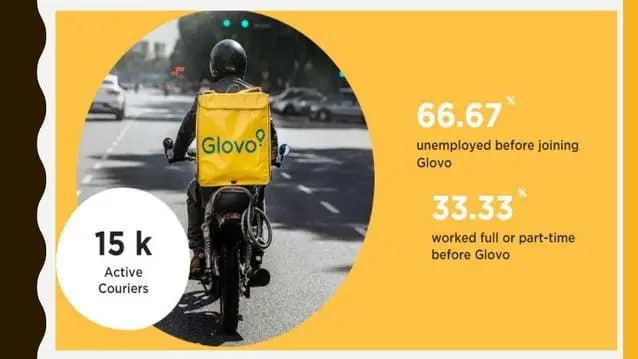
Glovo’s business model slide breaks down their diversified revenue streams: commission fees from merchants (typically 20-30%), delivery fees paid by customers, and premium subscription services offering unlimited delivery. The model emphasises how network effects improve economics—more couriers reduce delivery times, attracting more customers, which attracts more merchants, creating a virtuous cycle. Visual elements likely include revenue split pie charts and growth trajectory projections.
The strategic brilliance lies in demonstrating multiple monetisation levers that compound rather than compete with each other. Unlike pure-play food delivery services with single revenue streams, Glovo’s multi-category approach enables premium pricing for urgent deliveries while maintaining competitive rates for routine orders. The subscription model also provides predictable recurring revenue that improves unit economics and customer lifetime value calculations.
What investors see: A business model with multiple expanding revenue streams and clear network effects that improve with scale, suggesting sustainable competitive advantages. The combination of transaction-based and subscription revenue provides both growth upside and predictable baseline income, while commission structures align Glovo’s success with merchant success.
The traction slide showcases Glovo’s explosive growth trajectory with key metrics including monthly orders exceeding 1 million, rapid expansion to 20+ cities across Europe, and GMV approaching $200 million annually. Hockey-stick growth charts demonstrate consistent month-over-month improvements in user acquisition, order frequency, and average order values. The data proves that Glovo has achieved product-market fit and scaled beyond local Barcelona success into a genuine European platform.
These metrics strategically demonstrate that Glovo has moved beyond startup uncertainty into predictable growth patterns that justify institutional investment. The geographic expansion proves replicable playbooks while increasing order frequency suggests habit formation among users. Combined with rising average order values, the data indicates both market expansion and deepening customer engagement across multiple use cases.
What investors see: A company that has achieved the holy grail of consistent, predictable, exponential growth across all key metrics, reducing execution risk while demonstrating massive market opportunity. The traction validates both the business model and the team’s ability to execute at scale, justifying premium valuations and aggressive expansion capital.
This expansion timeline chronicles Glovo’s methodical conquest of European markets from its 2015 Barcelona launch through 2018’s presence in 15+ major cities across Spain, Italy, and France. The visual likely combines geographical maps with chronological milestones, showing both organic expansion and strategic acquisitions like Foodinha and Foodora Italy. Each market entry demonstrates increasing speed and efficiency, suggesting refined playbooks and operational maturity.
The strategic narrative shows how Glovo learned to balance organic growth with targeted acquisitions to accelerate market penetration and talent acquisition. Rather than spreading thinly across many countries, the focused approach on high-GDP European markets demonstrates capital efficiency and market prioritisation sophistication. The timeline also proves that Glovo can successfully integrate acquisitions while maintaining growth momentum.
What investors see: A management team with proven ability to execute complex international expansion while maintaining quality and growth rates, reducing geographic expansion risk for future investment. The combination of organic and inorganic growth demonstrates strategic sophistication and suggests accelerated path to European market leadership with additional capital.
The unit economics slide addresses the elephant in the room—Glovo’s path from current losses to sustainable profitability through improving LTV:CAC ratios and contribution margins approaching break-even. Detailed charts likely show how technology optimisations, route efficiency improvements, and increasing order frequency drive down per-delivery costs while subscription models and cross-selling increase customer lifetime value. The trajectory demonstrates clear progress toward positive unit economics within 12-18 months.
This slide’s critical importance lies in proving that Glovo’s growth is not just revenue expansion but genuine value creation approaching sustainability. By showing how scale effects improve economics—courier utilisation, delivery density, customer retention—the data suggests that current losses are strategic investments in market position rather than structural business model flaws. The improving trends validate the growth-first strategy while providing comfort on future profitability.
What investors see: A business approaching the critical inflection point where scale economies overcome customer acquisition costs, suggesting that additional capital will drive both growth and margin expansion rather than just growth alone. The improving unit economics validate the platform thesis and provide confidence in long-term return potential.
The competitive analysis positions Glovo as the only true multi-category platform versus food-focused competitors like Deliveroo, Uber Eats, and Just Eat. A competitive matrix likely shows how traditional players remain locked in narrow verticals while Glovo captures cross-category synergies and higher customer lifetime values. The “anything” delivery positioning creates differentiation that’s difficult for food-only platforms to replicate without significant strategic pivots and operational complexity.
This competitive framing strategically demonstrates how Glovo has created a different game rather than competing in the existing food delivery race. By establishing multi-category leadership early, Glovo built operational capabilities and customer expectations that create switching costs and network effects unavailable to single-vertical competitors. The positioning suggests that competitive threats come from expansion rather than displacement.
What investors see: A company that has successfully created category-defining differentiation with meaningful competitive moats, reducing competitive risk while creating multiple expansion opportunities. The multi-category approach suggests sustainable advantages that compound over time rather than erode through competition.
Glovo’s go-to-market strategy outlines their systematic approach to rapid city launches through local courier recruitment, merchant partnership programmes, and growth hacking via targeted promotions and strategic partnerships. The playbook likely details how Glovo achieves operational density within 90-120 days of market entry, leveraging data from successful launches to optimise resource allocation and reduce time-to-profitability in new cities.
The strategic value of this systematic approach lies in proving that Glovo’s expansion is process-driven rather than opportunistic, reducing execution risk for international growth plans. By codifying successful launch strategies into replicable playbooks, Glovo demonstrates operational maturity that enables efficient capital deployment across multiple simultaneous market entries. The approach also shows how lessons from early markets compound into competitive advantages in newer markets.
What investors see: A management team with sophisticated operational capabilities and proven systems for predictable market entry success, reducing geographic expansion risk while enabling aggressive growth acceleration with additional capital. The systematic approach suggests that funding will drive predictable expansion rather than experimental growth.
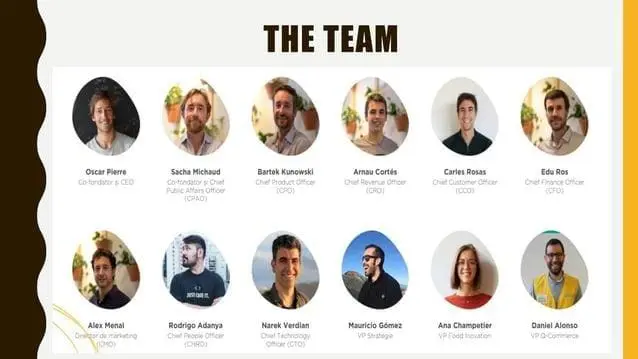
The team slide highlights the powerful complementary partnership between CEO Oscar Pierre’s technical vision and co-founder Sacha Michaud’s operational expertise from his Betfair Managing Director background. Additional key executives showcase relevant scaling experience from other high-growth technology companies, demonstrating that Glovo has assembled leadership capable of managing hypergrowth challenges. The team composition suggests both startup agility and corporate sophistication.
This founder-market fit narrative addresses one of investors’ primary concerns—can this team execute on their ambitious vision? Pierre’s technical background combined with Michaud’s operational track record creates confidence in both product development and business execution capabilities. The addition of experienced executives from scaled technology companies suggests proactive preparation for the management challenges that come with rapid international expansion.
What investors see: A leadership team with the perfect combination of startup entrepreneurial drive and corporate scaling experience, reducing execution risk while providing confidence in the team’s ability to manage the complexities of international expansion and eventual exit opportunities.
Glovo’s vision slide articulates their aspiration to become Europe’s leading super app for urban logistics, expanding beyond delivery into quick commerce, last-mile logistics, and integrated urban services. The vision encompasses not just delivering products but creating the infrastructure that powers city living—from instant grocery fulfillment through dark stores to same-day retail delivery and potentially financial services integration.
This expansive vision strategically positions Glovo’s current delivery platform as just the beginning of a comprehensive urban commerce ecosystem. By referencing super app success in Asia, the vision suggests massive expansion opportunity while providing context for the significant capital requirements needed to build continent-scale infrastructure. The scope also justifies premium valuations by framing Glovo as infrastructure rather than just a delivery service.
What investors see: A management team thinking at the scale necessary to create generational technology companies, with vision that justifies massive investment while providing multiple expansion pathways for sustained growth. The super app positioning suggests potential for platform economics and ecosystem creation that could support IPO-scale outcomes.
The financial projections showcase Glovo’s path to massive scale with 3-5 year forecasts projecting hockey-stick revenue growth reaching multiple hundreds of millions in annual GMV, EBITDA positivity by year 3, and clear trajectory toward IPO readiness. Conservative scenarios likely show how market expansion and operational leverage drive both top-line growth and margin expansion, while aggressive scenarios demonstrate the potential for super app economics.
These projections strategically balance ambition with credibility by grounding assumptions in current traction metrics and proven market comparables. The timeline to profitability provides comfort on capital efficiency while the long-term growth projections justify current valuation multiples. Multiple scenarios also demonstrate management sophistication and realistic planning around various market conditions and competitive responses.
What investors see: A clear pathway to generating returns that justify current valuation multiples and provide multiple expansion opportunities, with financial modeling sophistication that suggests disciplined capital allocation and realistic planning around growth investments versus profitability trade-offs.
Glovo’s funding ask requests $1.2 billion in Series F investment with clear use-of-proceeds allocation: engineering team expansion from 20 to 300+ developers, aggressive international market expansion across 10+ new European cities, and dark store infrastructure pilots to enable quick commerce capabilities. The ask includes specific valuation expectations and timeline for deployment, demonstrating disciplined capital planning rather than opportunistic fundraising.
The strategic positioning of this massive ask leverages the entire narrative built throughout the presentation—the market opportunity justifies the scale, the traction proves execution capability, and the team demonstrates ability to deploy capital efficiently. By requesting growth capital rather than rescue funding, Glovo signals strength and positions the investment as opportunity-driven rather than necessity-driven, improving negotiating position and investor perception.
What investors see: A company with clear capital deployment strategy and realistic timeline expectations that suggest disciplined growth planning, while the substantial ask signals both ambition and confidence that aligns with the market opportunity presented throughout the deck.
From insight to investor-ready, in weeks not months.
Apply these lessons to your raise — we’ll build your deck, financial model, and IM together.
While this deck secured one of Europe’s largest growth rounds and positioned Glovo for eventual acquisition by Delivery Hero at a multi-billion valuation, it reflects 2018 presentation standards that would feel incomplete by today’s institutional investor expectations. The fundamental narrative remains compelling, but several elements considered essential in contemporary pitch decks are notably absent, potentially leaving investors with unanswered questions that could slow decision-making or reduce valuation confidence. To enhance future presentations, engaging in investor pitch deck consulting could provide valuable insights.
Lacks granular spreadsheets or cohort analysis breakdowns; modern decks include interactive financial models to allow investors to stress-test assumptions, building credibility and enabling sophisticated due diligence conversations during the investment process.
No quotes from users or merchants; including real voices humanises the product and provides social proof, essential for proving retention in competitive markets where customer switching costs remain low and churn rates can quickly erode unit economics.
Omits explicit risks like regulatory hurdles or courier churn; addressing them proactively shows maturity and differentiates thoughtful founders from those who appear unprepared for inevitable scaling challenges that could derail growth momentum.
No mention of team diversity or sustainability practices; 2020s investors prioritise ESG data to assess long-term viability and cultural fit, particularly for companies managing large contractor workforces and urban environmental impact.
Absent specific feature timelines post-pitch; clear roadmaps demonstrate execution focus and alignment with market trends like AI personalisation, autonomous delivery, and sustainability initiatives that investors expect in competitive mobility markets.
No overview of current shareholders or dilution paths; transparency here reassures investors on governance structures and management alignment while providing context for negotiating new investment terms and board composition.
Missing comparables or M&A pathways; outlining realistic exits contextualises returns for LPs in late-stage rounds, particularly important given the eventual Delivery Hero acquisition that validated investor returns expectations.
At Projects RH, we help founders strengthen their pitch narratives by identifying and addressing these gaps before they reach investor meetings. While Glovo’s core story was compelling enough to secure massive funding, incorporating these missing elements could have accelerated the fundraising timeline, improved valuation negotiations, and provided additional competitive advantages during due diligence processes against other European mobility investments.
Glovo’s ‘deliver anything’ positioned it beyond food delivery; founders should craft a category-defining mission that excites investors about untapped potential and creates differentiation that’s difficult for competitors to replicate without significant strategic pivots.
Deck emphasised growth from MVP to multi-city scale with metrics; track and visualise key milestones chronologically to prove momentum and provide confidence that current success can be replicated across new markets with additional capital deployment.
Oscar’s tech vision complemented Sacha’s ops experience; showcase team complementarity to mitigate solo-founder risks and demonstrate that the leadership team possesses all necessary skills for executing complex international expansion strategies.
Despite current negatives, improving unit economics built confidence; transparently share path to positivity via technology leverage and demonstrate how scale effects will compound to create sustainable competitive advantages through operational efficiency.
Foodinha/Foodora acquisitions accelerated expansion; demonstrate inorganic growth strategies for rapid market share gains while proving management capability to successfully integrate acquisitions and maintain growth momentum during complex transactions.
Post-pitch focus on 20-to-300 engineers; prioritise technology bottlenecks early to sustain scaling and demonstrate how engineering investment will create platform capabilities that support multi-category expansion and operational efficiency improvements.
NOAH Conference visibility drove $1.2B funding; target industry events to amplify reach and credibility while leveraging the competitive dynamics of public presentations to accelerate investor decision-making and improve negotiation positioning.
Ready to raise? Let’s talk.
We’ve helped founders secure $2B+ in investor interest. Your round could be next.
The distance between the Glovo that presented this deck and the Glovo that exists today as part of Delivery Hero’s €10+ billion enterprise represents one of the most successful European growth investment outcomes of the past decade. The 2018 pitch showcased a company with €200M+ GMV and presence in 20+ cities; today’s Glovo operates across 25+ countries with €2.5B annual revenue and over 500M annual orders, validating every ambitious projection made during that NOAH Conference presentation.
For investors who participated in Glovo’s $1.2 billion Series F, the returns have been exceptional. Delivery Hero’s 2022 acquisition valued the combined entity at over €7 billion, representing a multiple that justified the aggressive growth investment thesis presented in this deck. The path from 20 engineers to 3,700+ employees, from 20 cities to 25 countries, and from experimental dark stores to 1,000+ quick commerce locations proves that the vision Oscar Pierre articulated was not just ambitious—it was achievable.
The Glovo story demonstrates how exceptional execution can transform a regional delivery startup into continental infrastructure that powers urban commerce. Today’s 20M+ monthly active users and integration within one of Europe’s largest technology platforms validates every bold claim made in this presentation, proving that sometimes the most ambitious pitch decks are actually the most realistic about the opportunities that disciplined capital deployment can unlock.
At Projects RH, we help companies across all industries create investor-ready materials that close deals. Our integrated capital raising package ensures consistency across all your investor documentation.
Built in-house for accuracy and investor confidence.
Comprehensive investor documentation following global best practices.
12-slide investor-ready presentation with supporting materials.
High-impact snapshot to capture investor attention fast.
Browse our collection of real pitch deck breakdowns from the world’s most successful companies.
The 2018 Series F deck presented at NOAH London featured 28 slides, balancing vision, traction, and financials without overwhelming investors.
Glovo raised $1.2 billion in Series F funding, primarily driven by the compelling NOAH pitch showcasing explosive growth and expansion plans.
Success stemmed from clear problem-solution fit for urban delivery, strong traction metrics, founder credibility, and a massive European market opportunity, resonating at a high-profile conference.
Yes, as inspiration for late-stage growth stories emphasizing multi-category differentiation and unit economics, but adapt for your stage—add modern elements like ESG and detailed financials.
Series F, following prior rounds totaling over $115M, focused on hyper-scaling engineering and international dominance in on-demand delivery.
Creating an effective pitch deck requires more than following a template — it demands strategic clarity about your value proposition, a deep understanding of your target investors, and rigorous financial modelling to support your narrative. At Projects RH, we combine financial expertise with strategic storytelling to build pitch decks, information memorandums, and financial models that meet the standards of institutional investors worldwide. Our team has generated over USD 2.0 billion in expressions of interest across mining, energy, technology, medtech, and financial services sectors. Schedule a consultation to discuss how we can help position your company for successful capital raising.