
A detailed analysis of the 12-slide pitch deck Pinterest used to secure $10 million in Series A funding from Bessemer Venture Partners, FirstMark Capital, and Highline Ventures in 2011.
Building your own pitch deck?
Get expert guidance from the team behind $2B+ in investor interest.
Pinterest’s journey began with a pivot that would define the company’s future. In 2009, Ben Silbermann, Evan Sharp, and Paul Sciarra launched Tote, a mobile shopping app that allowed users to browse and purchase products directly. However, user behaviour revealed an unexpected insight: people weren’t using Tote to buy things—they were collecting and sharing images of products they found inspiring, creating wish lists and mood boards rather than making immediate purchases. This shift underscores the importance of understanding user needs, a lesson that can be crucial in professional pitch deck development.
Recognising this pattern, the team made a decisive pivot in 2010, launching Pinterest as a closed beta platform focused entirely on visual curation and discovery. The concept was elegantly simple: digital pinboards where users could organise images and links by theme, whether planning a wedding, redecorating a home, or collecting recipe ideas. This pivot from commerce to curation addressed a fundamental human need that existing platforms—traditional bookmarks, text-heavy social networks, and e-commerce sites—simply weren’t serving effectively.
The early traction was remarkable for a closed beta product. By February 2011, Pinterest had attracted 1 million unique visitors generating 20 million page views monthly, with users spending extraordinary amounts of time organising and browsing visual content. This organic growth, driven entirely by word-of-mouth and user enthusiasm, validated the founders’ hypothesis that there was massive latent demand for visual discovery and curation tools.
Armed with compelling user testimonials—including endorsements from brands like Kate Spade—and meteoric growth metrics despite limited access, the team approached Series A fundraising in 2011. Their pitch deck would need to convey not just the current traction, but the massive market opportunity for visual search and the unique position Pinterest held at the intersection of social media, e-commerce, and content discovery.
Pinterest’s cover slide embodies the minimalist, visual-first philosophy that would become the platform’s defining characteristic. The clean white background and simple typography reflect the uncluttered user experience that sets Pinterest apart from the busy, text-heavy interfaces dominating social media in 2011. The tagline “Collect and organize the ideas you love” immediately communicates the core value proposition without technical jargon or complex positioning statements.
This design choice demonstrates sophisticated understanding of brand-product alignment—the slide itself serves as a preview of the Pinterest experience. The restraint shown here was particularly powerful in 2011, when most pitch decks were dense with information and competing visual elements. By leading with simplicity, the founders signal confidence that their product’s value would be immediately apparent rather than requiring extensive explanation.
What investors see: A team that understands the power of visual branding and user experience design. The cover slide functions as both introduction and product demonstration, showing that Pinterest’s founders grasp the importance of first impressions in both fundraising and user acquisition. This attention to design detail suggests the product team has the aesthetic sensibility necessary to compete in the increasingly visual digital landscape.
The problem slide grounds Pinterest’s opportunity in genuine user pain points discovered during their Tote experiment, lending credibility through real-world validation rather than theoretical market research. The founders highlight the fundamental inadequacy of existing tools for visual curation and sharing—bookmarks were private and text-based, social networks prioritised conversation over collection, and e-commerce sites focused on immediate transactions rather than long-term inspiration gathering.
This approach demonstrates sophisticated problem-solution fit methodology, showing that Pinterest emerged from observed user behaviour rather than founder assumptions. The timing was particularly astute—2011 represented a convergence of increased mobile usage, growing e-commerce adoption, and the rise of visual content across the web, creating ideal conditions for a platform dedicated to visual discovery and curation.
What investors see: Founders who have moved beyond the idea stage to develop deep user empathy through direct experimentation. The reference to Tote provides crucial context about the team’s learning process and ability to pivot based on data rather than stubbornly pursuing an initial hypothesis. This evidence-based approach to problem identification suggests the team will continue to prioritise user feedback in product development, a critical factor in achieving product-market fit.
Pinterest’s solution slide showcases the power of metaphorical thinking in product design—digital pinboards that mirror the physical bulletin boards and inspiration walls that people naturally create. This familiar mental model makes the platform immediately intuitive, reducing onboarding friction while enabling complex behaviours around discovery, curation, and sharing. The visual presentation of sample pinboards provides instant comprehension of the platform’s value without requiring lengthy explanations.
The solution’s elegance lies in its ability to serve multiple user motivations simultaneously—personal organisation, creative inspiration, shopping research, and social sharing—while maintaining a coherent, simple interface. This multi-purpose utility creates natural viral loops as users share boards publicly, invite others to collaborate, and discover new content through social browsing, driving organic growth without requiring aggressive acquisition spending.
What investors see: A product with inherent virality built into its core functionality, suggesting strong unit economics and organic growth potential. The visual-first approach positions Pinterest uniquely in the social media landscape, potentially capturing value from the shift toward image and video content that would accelerate throughout the 2010s. The simplicity of the solution also implies lower development costs and faster iteration cycles compared to complex feature-heavy platforms.
Ben Silbermann’s personal “Things for my future kitchen” pinboard serves as both product demonstration and founder authenticity signal, showing genuine usage of the platform for real personal needs. This approach transforms what could be a sterile product tour into an intimate glimpse of how Pinterest integrates into daily life for aspirational planning and inspiration gathering. The kitchen theme resonates particularly well with the female-skewed user base that was driving early Pinterest adoption.
The demo showcases Pinterest’s ability to aggregate content from diverse sources—retailers, blogs, magazines—into cohesive thematic collections, demonstrating the platform’s role as a discovery layer across the entire web. This positioning as infrastructure for inspiration rather than just another social network highlights Pinterest’s potential to capture value from the broader ecosystem of content and commerce without requiring users to abandon their existing browsing habits.
What investors see: Founder-market fit demonstrated through authentic personal use, suggesting deep understanding of user motivations and long-term vision for product evolution. The demo reveals Pinterest’s potential to sit at the intersection of social media, e-commerce, and content discovery—a strategic position that could capture significant value as these markets converge. The personal nature of the example also shows how Pinterest creates emotional attachment, leading to higher engagement and retention rates.
The traction slide presents compelling evidence of product-market fit through remarkable growth metrics achieved entirely through organic, word-of-mouth adoption despite closed beta restrictions. Reaching 1 million unique visitors and 20 million page views monthly while access was still limited by invitation demonstrates extraordinary user enthusiasm and suggests massive pent-up demand for the platform. These numbers were particularly impressive in 2011, when achieving viral growth required significantly more effort than in today’s social media landscape.
The presentation of these metrics without extensive context or caveats reflects the founders’ confidence in the underlying user behaviour driving growth. The month-over-month acceleration shown in the charts suggests that Pinterest was capturing network effects and viral loops that would continue to compound as access expanded. This organic growth trajectory implies strong unit economics and reduced customer acquisition costs compared to platforms requiring paid marketing for user acquisition.
What investors see: A rare combination of exceptional growth metrics and sustainable acquisition dynamics, suggesting the potential for massive scale without proportional increases in marketing spend. The closed beta constraint actually strengthens the investment thesis by demonstrating that current growth represents a lower bound rather than peak performance. These numbers indicate Pinterest could achieve significant market penetration once access restrictions are removed, positioning it for rapid scaling with Series A capital.
The testimonial from Katie Evans at Kate Spade represents both individual user enthusiasm and implicit brand endorsement, demonstrating Pinterest’s appeal across consumer and business contexts. Evans’s comment about keeping Pinterest “up on screen all day long” reveals the platform’s success in creating habit-forming behaviour and becoming integral to daily workflows, particularly for creative and retail professionals. This level of engagement suggests high lifetime value and strong retention characteristics.
The choice to feature a Kate Spade employee specifically signals Pinterest’s potential to bridge consumer and business use cases, positioning the platform as valuable for both personal inspiration and professional trend research. This dual-purpose utility expands the total addressable market while creating multiple potential monetisation pathways through both consumer advertising and business solutions.
What investors see: Evidence of deep user engagement that goes beyond casual browsing to become integrated into professional workflows, suggesting strong switching costs and pricing power for future business products. The Kate Spade connection also validates Pinterest’s position in the fashion and lifestyle verticals, which represent massive advertising markets with high commercial intent. This testimonial indicates Pinterest could capture significant value from brands seeking to reach highly engaged, purchase-intent audiences.
Pinterest’s market opportunity slide positions the platform at the convergence of several massive trends: the shift toward visual content consumption, the growth of e-commerce and online shopping research, and the increasing importance of social influence in purchase decisions. Rather than competing directly with existing social networks or e-commerce platforms, Pinterest carves out a unique position in the pre-purchase inspiration and discovery phase, where users have high commercial intent but extended consideration timelines.
The timing advantage is particularly compelling—Pinterest launched just as smartphone adoption was accelerating, high-speed internet was becoming ubiquitous, and digital photography was shifting from text-accompanied posts to standalone visual content. This positioning allows Pinterest to capture value from the broader digitization of traditionally offline activities like window shopping, magazine browsing, and inspiration gathering.
What investors see: A platform positioned to benefit from multiple secular trends without being dependent on any single market dynamic, suggesting resilient growth potential across various economic conditions. The focus on visual search and discovery anticipates the shift toward image and video content that would dominate the 2010s, positioning Pinterest as infrastructure for the visual web. The market timing suggests Pinterest could capture significant first-mover advantages in visual discovery before larger platforms adapt their offerings.
Pinterest’s business model slide outlines a sophisticated monetisation strategy built around high-intent user behaviour and native advertising integration. The focus on promoted pins and affiliate partnerships recognises that Pinterest users are actively researching purchases and gathering inspiration, creating valuable commercial intent that justifies premium advertising rates. This approach avoids the banner ad model that was struggling across the web in favour of content-native monetisation that enhances rather than interrupts the user experience.
The multiple revenue streams—promoted content, affiliate commissions, and targeted advertising—provide diversification and flexibility while leveraging Pinterest’s unique position in the customer journey. Unlike social networks monetising attention or e-commerce platforms taking transaction fees, Pinterest can capture value from the inspiration and research phase that precedes purchases across the entire web, potentially creating a more sustainable and defensible business model.
What investors see: A clear path to monetisation that aligns platform incentives with user value, suggesting sustainable unit economics and pricing power with advertisers. The focus on high-intent users positions Pinterest to command premium advertising rates compared to platforms with lower commercial intent, potentially achieving superior revenue per user metrics. The business model also creates natural barriers to entry by building valuable data assets around user preferences and purchase intent.
The team slide highlights Ben Silbermann and Evan Sharp’s complementary backgrounds in product development and design, emphasising credentials from Google and IDEO that directly relate to Pinterest’s visual-first platform requirements. This focus on design expertise was particularly relevant in 2011, when many successful technology companies were still primarily engineering-led and user experience was becoming a key differentiator in consumer products.
The presentation emphasises the founders’ understanding of both consumer behaviour and technical implementation, crucial for building a platform that bridges content discovery and commerce. Their experience at established technology companies provides credibility while their decision to leave those positions to pursue Pinterest demonstrates commitment and belief in the opportunity.
What investors see: A founding team with the specific skill sets necessary to execute on Pinterest’s vision, particularly the design and user experience capabilities essential for a visual platform. The combination of established company experience and entrepreneurial drive suggests the team can scale operations while maintaining product quality and user focus. The design-centric backgrounds indicate understanding of the aesthetic and usability requirements that drive engagement in visual platforms.
Pinterest’s competitive analysis demonstrates sophisticated market positioning by showing how the platform combines elements from multiple categories—social networking, bookmarking, and e-commerce—without direct competition from any single player. The comparison matrix reveals Pinterest’s unique focus on visual curation as a distinct use case that existing platforms serve poorly or not at all, creating an opportunity to build a new category rather than fight for share in established markets.
The competitive landscape in 2011 was particularly favourable for Pinterest’s positioning—Facebook was still primarily text and photo sharing, Twitter was focused on real-time conversation, and e-commerce sites lacked social discovery features. This gap in the market provided Pinterest with room to establish a unique position before larger platforms could adapt their offerings to compete directly.
What investors see: A clear competitive moat based on product positioning and user behaviour rather than just technology, suggesting defensibility through network effects and user habit formation. The lack of direct competitors indicates Pinterest could achieve significant market penetration before facing serious competitive pressure, providing time to build scale and refine the product. The cross-category positioning also suggests potential for market expansion as Pinterest captures users from multiple adjacent use cases.
The financial projections slide presents growth forecasts grounded in current user traction and clear monetisation pathways, avoiding the hockey stick projections that characterised many pitch decks of the era. The conservative assumptions around user growth, engagement rates, and advertising revenue ramp demonstrate financial discipline and realistic expectations about the time required to build sustainable monetisation, particularly important for a pre-revenue company seeking Series A funding.
The projections connect directly to the business model slide, showing how promoted pins and affiliate revenue will scale with user growth and engagement. This connection between user metrics and financial outcomes provides investors with clear visibility into the key drivers of business performance and validates the founders’ understanding of unit economics and monetisation timing.
What investors see: Financial projections that reflect realistic assumptions and conservative growth expectations, building credibility for the funding ask and future milestone achievement. The connection between current traction metrics and projected revenue growth provides a clear framework for measuring progress and validates the investment thesis. The conservative approach suggests management discipline and understanding of the challenges involved in scaling a consumer platform to profitability.
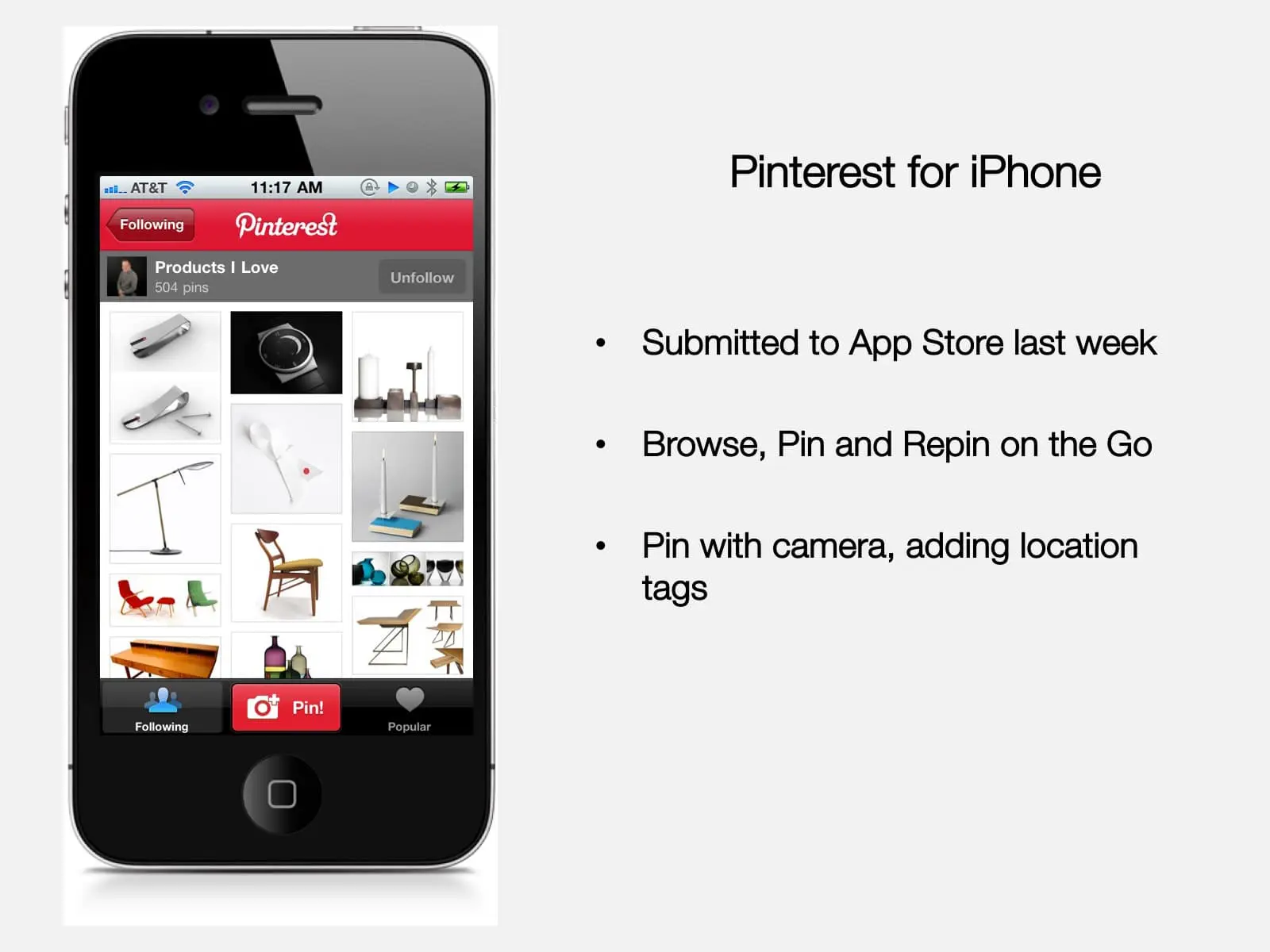
The appendix slide demonstrates Pinterest’s forward-thinking approach to mobile platform strategy, showcasing the first iPhone app that was pending Apple approval at the time of the presentation. This mobile-first vision was particularly prescient in 2011, when many web platforms were still treating mobile as an afterthought, positioning Pinterest to capture the massive shift toward mobile content consumption that would define the following decade.
The inclusion of brand evolution details, including the signature red colour palette, shows attention to visual identity development and long-term brand strategy. This design focus reinforces the team’s understanding that Pinterest’s success depends heavily on aesthetic appeal and visual consistency, crucial factors for a platform built around image discovery and curation.
What investors see: Strategic thinking about platform evolution and distribution channel expansion, suggesting the team understands the importance of multi-platform presence for user acquisition and engagement. The mobile app development indicates Pinterest is positioned to capitalize on the smartphone adoption curve and changing user behaviour patterns. The brand evolution discussion demonstrates sophisticated understanding of visual identity as a competitive advantage in the consumer attention economy.
From insight to investor-ready, in weeks not months.
Apply these lessons to your raise — we’ll build your deck, financial model, and IM together.
While this deck secured Pinterest’s crucial Series A funding and launched one of the most successful social commerce platforms in history, it reflects the fundraising conventions of 2011 and lacks several elements that modern investors consider essential for thorough due diligence and risk assessment, which is why consulting pitch deck experts for fundraising can be invaluable.
While the deck includes basic revenue projections, it lacks comprehensive financial modelling showing multi-year income statements, cash flow analysis, and scenario planning. Modern investors require detailed assumptions around customer acquisition costs, lifetime value, burn rates, and path to profitability to evaluate investment returns and capital efficiency.
The presentation demonstrates impressive organic traction but provides limited detail on systematic user acquisition strategies, sales funnels, or scaling plans beyond opening the beta. Contemporary pitch decks include specific channel strategies, customer acquisition cost targets, and systematic approaches to converting awareness into active usage and retention.
While the competitive analysis shows Pinterest’s unique positioning, it lacks discussion of sustainable competitive advantages and defences against replication by larger platforms. Modern investors seek clarity on network effects, data moats, switching costs, and other barriers that will prevent competitors from copying successful features and capturing market share.
The deck omits current ownership structure, previous investor details, and specific allocation of the Series A funds across hiring, technology development, marketing, and operational scaling. This transparency around governance and capital deployment has become standard practice for building investor confidence and demonstrating strategic thinking about resource allocation.
The team presentation focuses exclusively on the two primary founders without showcasing broader team composition, advisor networks, or diversity initiatives. Contemporary standards include full team profiles, advisory board credentials, and demonstration of diverse perspectives that enhance decision-making and market understanding, particularly relevant for consumer-facing platforms.
The presentation maintains consistently optimistic framing without acknowledging potential risks around mobile transition challenges, platform dependency, competitive threats from larger networks, or monetisation execution difficulties. Modern pitch decks proactively address risk factors to demonstrate management awareness and mitigation planning, building credibility through balanced assessment.
At Projects RH, we help founders address these contemporary requirements while maintaining the authentic storytelling and compelling vision that made Pinterest’s original pitch so effective. The goal is not to dilute the core narrative but to provide investors with the comprehensive information they need to make confident investment decisions in today’s more rigorous due diligence environment.
Ben’s personal “future kitchen” pinboard conveyed both product functionality and genuine passion more effectively than any feature list or technical specification could achieve. Founders should demonstrate their product through authentic personal use cases that evoke emotional connection and immediate comprehension rather than relying on abstract descriptions or hypothetical scenarios.
Pinterest’s 1 million users and 20 million page views during closed beta provided irrefutable evidence of product-market fit and organic demand. Prioritise real user metrics, testimonials, and behavioural data over theoretical projections or industry comparisons to build credibility with investors who have seen countless unfounded growth assumptions fail to materialise.
Pinterest’s 12-slide deck with clean design and minimal text matched their product’s visual-first philosophy while maintaining investor engagement throughout the presentation. Resist the temptation to include exhaustive detail that dilutes key messages—use visuals strategically and save comprehensive information for follow-up materials and due diligence processes.
Ben’s authentic use of Pinterest for personal planning demonstrated deep understanding of user motivations and long-term commitment to solving the problem. Showcase your personal connection to the market opportunity and genuine empathy for user pain points—investors fund founders who live and breathe their target customer’s experience.
Pinterest’s successful transition from Tote to visual curation platform demonstrated data-driven decision-making and flexibility in response to user feedback. Validate core assumptions early through real user interaction, and be prepared to adapt your business model based on observed behaviour rather than original hypotheses—investor confidence grows when founders show they can evolve based on market learning.
Pinterest wisely placed mobile app development and branding evolution in appendix slides to avoid distracting from current strengths and proven traction. Structure your presentation to lead with validated success before introducing forward-looking bets—investors need confidence in your ability to execute on current opportunities before evaluating future expansion potential.
The Kate Spade testimonial provided immediate credibility and demonstrated Pinterest’s appeal across consumer and business contexts through authentic user voice rather than founder claims. Collect and feature genuine testimonials from real users, customers, or partners—third-party validation carries exponentially more weight than self-reported value propositions in building investor confidence.
Ready to raise? Let’s talk.
We’ve helped founders secure $2B+ in investor interest. Your round could be next.
The distance between the Pinterest that presented this deck in 2011 and the public company that trades today represents one of the most successful transformations from startup vision to scaled platform in the social media era, validating the founders’ early insights about visual discovery and commercial intent while exceeding even optimistic projections for user growth and revenue generation.
For Bessemer Venture Partners and other Series A investors, Pinterest’s evolution represents extraordinary investment returns—the $40 million pre-money valuation in 2011 grew to a peak market capitalisation exceeding $50 billion during the 2021 IPO period, generating returns of over 1,000x on their initial investment. Even at current valuations around $28 billion, the investment delivered exceptional performance that validates the thesis around visual search and social commerce.
The transformation also demonstrates how platforms with authentic user engagement and clear monetisation pathways can achieve sustainable scale even in competitive social media markets. Pinterest’s ability to maintain growth while building a profitable advertising business proves that focused execution on a well-defined value proposition can create lasting competitive advantages, making it a compelling case study for founders seeking to build category-defining platforms in crowded markets.
At Projects RH, we help companies across all industries create investor-ready materials that close deals. Our integrated capital raising package ensures consistency across all your investor documentation.
Built in-house for accuracy and investor confidence.
Comprehensive investor documentation following global best practices.
12-slide investor-ready presentation with supporting materials.
High-impact snapshot to capture investor attention fast.
Browse our collection of real pitch deck breakdowns from the world’s most successful companies.
The original Series A pitch deck had 12 simple, visual slides, focusing on problem, solution, traction, and team without overwhelming details.
Pinterest raised $10M in Series A funding at a $40M pre-money valuation, led by Bessemer Venture Partners following the 2011 deck presentation.
Success came from authentic demos like the founder's pinboard, real user quotes, early traction metrics, and a clear pivot story, building investor excitement for visual discovery.
Yes, as inspiration for simplicity and product focus, but adapt to include modern must-haves like financials, GTM strategy, and risks absent in this early deck.
Series A, post-seed ($2M raised), seeking $10M to scale after proving traction in closed beta with 1M monthly users.
Creating an effective pitch deck requires more than following a template — it demands strategic clarity about your value proposition, a deep understanding of your target investors, and rigorous financial modelling to support your narrative. At Projects RH, we combine financial expertise with strategic storytelling to build pitch decks, information memorandums, and financial models that meet the standards of institutional investors worldwide. Our team has generated over USD 2.0 billion in expressions of interest across mining, energy, technology, medtech, and financial services sectors. Schedule a consultation to discuss how we can help position your company for successful capital raising.