
Dive into the 25-slide pitch deck that helped Uber secure $200,000 in seed funding in 2008. Uncover the strategies that fueled their success.
Building your own pitch deck?
Get expert guidance from the team behind $2B+ in investor interest.
Uber’s origin story began with Garrett Camp’s personal frustration with San Francisco’s taxi system in 2008. As smartphones were becoming mainstream but the transportation industry remained stubbornly analogue, Camp recognised an obvious market opportunity that seemed almost too simple to overlook. The inefficiency was everywhere: antiquated radio dispatch systems, unreliable service, and the primitive ritual of standing on street corners hoping to flag down an available cab. For a tech entrepreneur who had already built and sold StumbleUpon, this represented the perfect intersection of a clear problem, emerging technology, and a massive addressable market, highlighting the importance of expert guidance, such as pitch deck consulting services, in navigating such opportunities.
The initial vision was far more capital-intensive than the platform model Uber eventually became. Camp’s original concept involved operating a fleet of company-owned luxury vehicles—primarily Mercedes—that would be optimised through advanced dispatching algorithms and GPS technology. This approach would have required significant upfront investment in vehicles, drivers, and infrastructure, positioning Uber as a premium car service rather than the marketplace platform it later evolved into. The target demographic was clear: business professionals in major metropolitan areas who valued convenience and were willing to pay premium prices for a superior experience.
By August 2008, Camp had developed a comprehensive 25-slide pitch deck that methodically laid out the case for revolutionising urban transportation. The presentation followed classical venture capital pitch structure: problem identification, solution articulation, product demonstration, and market opportunity quantification. What made this deck particularly compelling was its focus on an immediately recognisable problem—every investor had experienced the frustration of unreliable taxi service—combined with a technology-enabled solution that leveraged the emerging smartphone ecosystem.
The successful $200,000 seed raise marked the beginning of what would become one of the most dramatic business model pivots in startup history. While the original pitch emphasised owned assets and premium positioning, the founders would soon discover that an independent contractor model offered superior unit economics and scalability. This willingness to evolve the business model while maintaining focus on the core problem—inefficient urban transportation—ultimately enabled Uber to expand globally and achieve a valuation exceeding $100 billion.
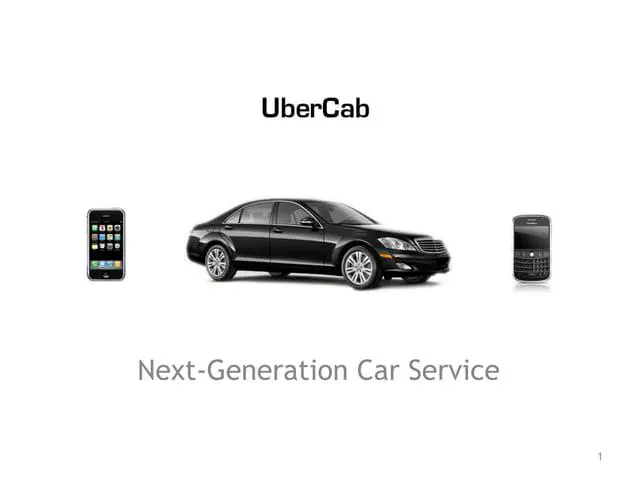
Uber’s opening slide immediately establishes premium positioning through carefully chosen visual elements: a sleek black Mercedes flanked by an iPhone and BlackBerry. This imagery communicates luxury, technology integration, and professional targeting without requiring lengthy explanation. The tagline “Next-Generation Car Service” signals innovation while the UberCab branding shows the founders’ initial focus on premium taxi replacement rather than broader transportation marketplace.
The visual composition reveals sophisticated understanding of brand positioning for investor audiences. By featuring both iPhone and BlackBerry devices, the founders acknowledged the dual smartphone ecosystem of 2008 while emphasising mobile-first approach. The Mercedes choice specifically targets business professionals who value status and reliability—a demographic with both purchasing power and acute frustration with existing taxi services.
What investors see: A founders’ team that understands premium market positioning and has identified a clear demographic with demonstrated purchasing power. The visual storytelling approach suggests marketing sophistication and brand awareness that extends beyond pure technology development. Most importantly, the slide positions Uber as evolutionary rather than disruptive, making the concept feel less risky and more inevitable to potential investors.
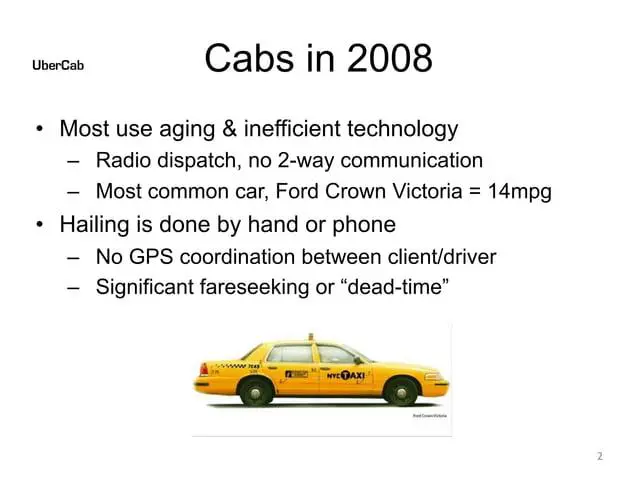
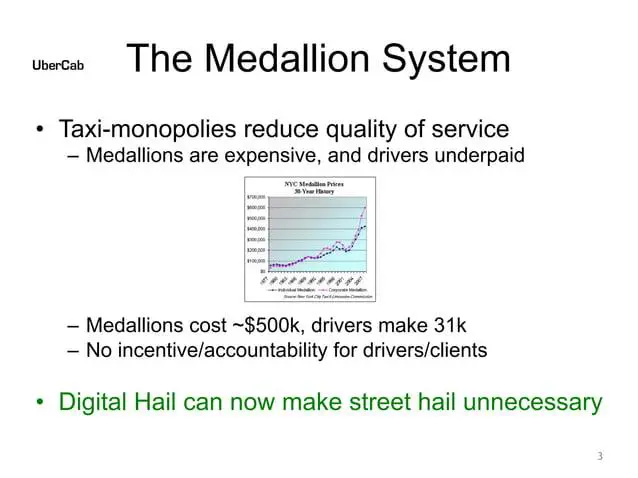
The problem articulation demonstrates textbook venture capital pitch methodology by identifying universally experienced pain points that create immediate investor empathy. Uber catalogues specific taxi industry failures: aging vehicle fleets, inefficient radio dispatch technology, and the fundamental inconvenience of hailing cabs through phone calls or street-side flagging. Each problem point represents a concrete user experience failure that investors have personally encountered, creating instant problem validation.
The strategic presentation of these problems reveals sophisticated market analysis beyond surface-level complaints. By highlighting technological obsolescence—radio dispatch systems in a smartphone era—the founders position their solution as inevitable technological progression rather than speculative innovation. The emphasis on professional inconvenience (phone booking, unpredictable wait times) specifically targets the demographic most likely to pay premium prices for convenience.
What investors see: A massive, obviously inefficient market that has been protected by regulatory barriers rather than genuine innovation. The problem presentation suggests that customer acquisition will be straightforward because the alternative (existing taxi service) provides such poor user experience. Investors recognise that when incumbent industries fail to adopt available technology, massive displacement opportunities emerge for well-funded startups.
Uber’s solution presentation follows the critical venture capital principle of directly addressing each identified problem with specific technological capabilities. The founders position their service as “fast & efficient on-demand car service” targeting professionals in San Francisco and New York—immediately establishing geographic focus and demographic clarity. By emphasising shorter wait times and incentivised driver compensation, they demonstrate understanding that supply-side improvements drive demand-side satisfaction.
The solution architecture reveals sophisticated platform thinking despite the 2008 technology landscape limitations. Rather than simply digitising existing taxi dispatch, Uber proposes fundamental service improvement through technology-enabled efficiency and premium positioning. The focus on major metropolitan areas shows realistic market entry strategy—targeting cities where taxi problems are most acute and professional populations most concentrated.
What investors see: A solution that creates value for both supply and demand sides of the marketplace through technology arbitrage. The geographic focus demonstrates realistic scaling ambitions rather than unrealistic national launch plans. Most critically, the premium positioning suggests higher unit economics and less price competition than traditional transportation services, indicating sustainable competitive advantages.
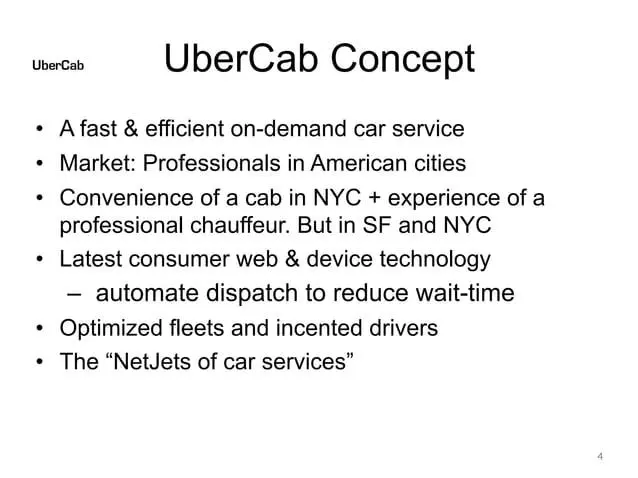
This slide expands the solution narrative by emphasising experiential benefits that justify premium pricing—specifically the combination of chauffeur-like luxury with on-demand convenience. Uber positions itself as delivering traditional luxury car service benefits (professional drivers, quality vehicles) while eliminating traditional luxury service limitations (advance booking requirements, schedule inflexibility). This benefits articulation shows deep understanding of customer psychology and willingness to pay for convenience.
The strategic emphasis on technology-enabled efficiency rather than just technology features demonstrates sophisticated product marketing understanding. Rather than focusing on mobile app capabilities or GPS features, the founders emphasise outcome benefits: shorter waits, better vehicles, more professional service. This benefit-focused messaging resonates more effectively with investors who care about customer acquisition and retention rather than technical specifications.
What investors see: A clear value proposition that justifies premium pricing through superior customer experience rather than cost competition. The luxury positioning suggests defensible market position and higher customer lifetime value compared to traditional transportation services. Investors recognise that businesses competing on experience and convenience rather than price typically achieve better unit economics and market expansion opportunities.
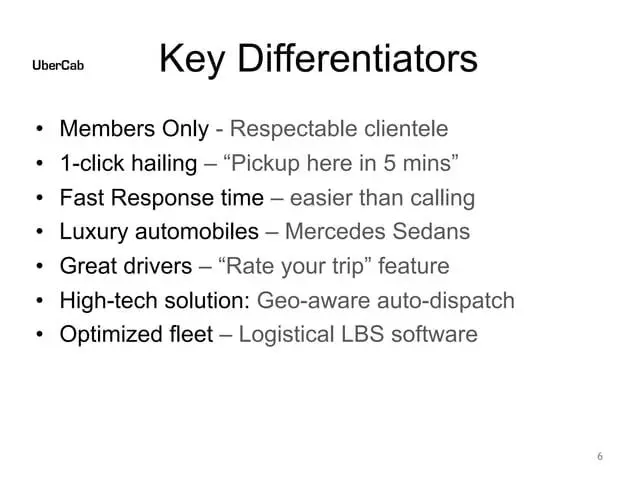
The differentiators slide employs scannable bullet-point format that allows investors to quickly grasp competitive advantages without cognitive overload. This presentation methodology demonstrates understanding that venture capital pitch environments require rapid information processing and clear value proposition articulation. The bullet-point approach also creates natural conversation anchors, allowing presenters to elaborate on specific differentiators based on investor questions and interests.
The competitive positioning reveals strategic thinking about sustainable advantages rather than temporary features. By focusing on structural improvements (technology platform, service quality, user experience) rather than marginal enhancements, Uber establishes differentiators that would be difficult for traditional taxi companies to replicate quickly. This competitive analysis suggests the founders understand that successful startups need defensible market positions, not just innovative features.
What investors see: A management team that understands competitive dynamics and has identified structural advantages rather than easily replicated features. The clear differentiation framework suggests the company can maintain market position even as competitors attempt to enter the space. Investors appreciate startups that can articulate why their approach will remain superior as the market evolves and competition intensifies.
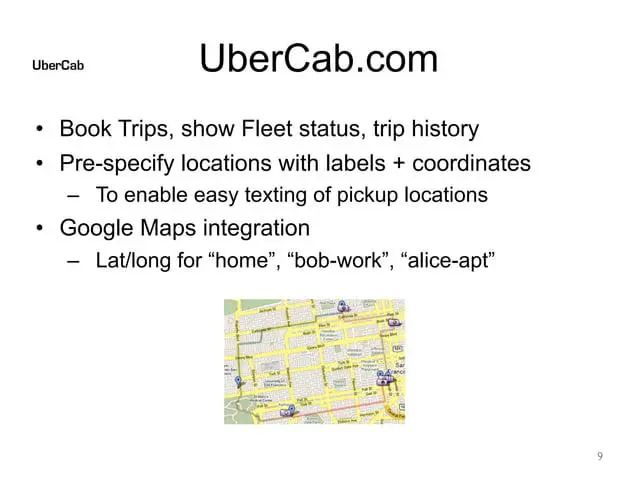
The product features presentation demonstrates forward-thinking user experience design that was genuinely innovative for 2008. The ability to book pre-scheduled trips and establish default pickup locations like ‘home’ and ‘work’ represented significant convenience improvements over existing transportation booking methods. These GPS-enabled location memory features showed the founders understood that repeated-use patterns would drive customer loyalty and reduce friction in the booking process.
The emphasis on both website and mobile app functionality reveals strategic platform thinking that anticipated the mobile-first transition. While most services in 2008 focused primarily on web interfaces, Uber’s dual-platform approach showed understanding that location-based services would ultimately require mobile optimization. The feature set also suggests the founders had thought through actual usage scenarios rather than just technical capabilities.
What investors see: A product vision that extends beyond basic functionality to create genuine user experience improvements that drive customer retention. The location memory and scheduling features suggest network effects and switching costs that would make customer acquisition more valuable over time. Investors recognise that startups with thoughtful user experience design typically achieve better customer lifetime value and organic growth rates.
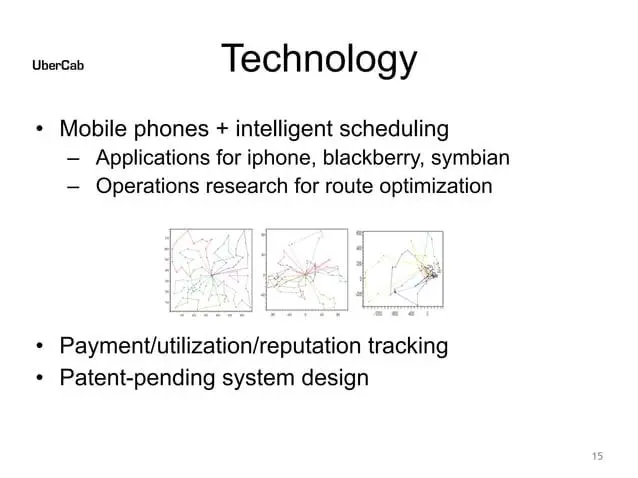
The technology slide provides architectural overview through bullet-point descriptions that serve as presentation talking points rather than comprehensive technical documentation. This approach suggests the founders understood that seed-stage investors care more about technical feasibility and competitive advantages than detailed implementation specifics. The bullet-point format allows presenters to elaborate on technical differentiators based on audience expertise and interest levels.
While the slide content appears somewhat vague from a pure technical perspective, this reflects appropriate pitch deck methodology for pre-revenue startups. The focus on dispatch optimization algorithms and platform infrastructure suggests understanding that technology serves operational efficiency rather than existing as an end goal. This systems-thinking approach indicates the founders viewed technology as a means to solve transportation problems rather than a product category itself.
What investors see: A founding team with sufficient technical sophistication to build the proposed platform while maintaining focus on business outcomes rather than technology for its own sake. The infrastructure emphasis suggests scalability thinking and understanding that successful marketplace platforms require robust backend systems. Investors value startups that can articulate technical advantages without getting lost in implementation details.
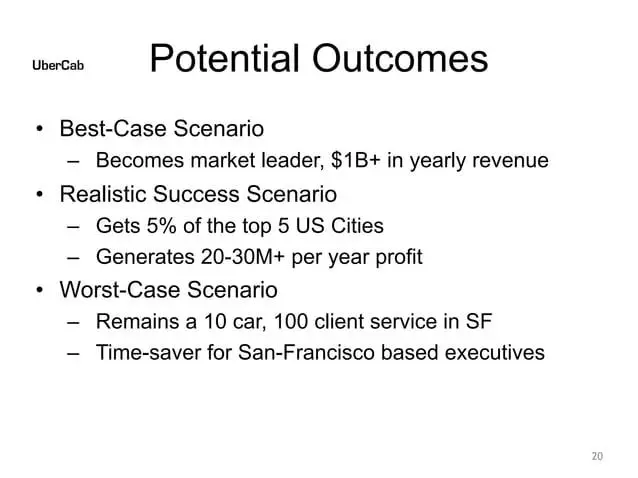
This slide represents unusual but strategically sound venture capital pitch methodology by explicitly presenting both optimistic and pessimistic outcome scenarios. The best case projects market leadership with $1 billion+ annual revenue, while the worst case acknowledges potential limitation to San Francisco as a boutique executive service. This balanced scenario planning demonstrates intellectual honesty and realistic risk assessment that builds investor confidence through transparency rather than unconstrained optimism.
The scenario framework reveals sophisticated understanding of venture capital return mathematics and market expansion risks. By acknowledging that the business might remain geographically limited, the founders show awareness of regulatory, operational, and competitive challenges that could constrain growth. Simultaneously, the billion-dollar revenue projection establishes sufficiently ambitious upside potential to justify venture capital investment thesis and return expectations.
What investors see: Management team maturity and realistic business planning that increases confidence in execution capabilities. The scenario analysis suggests the founders have thought through multiple pathways and challenges rather than assuming inevitable success. Investors appreciate startups that acknowledge risks while maintaining compelling upside potential, as this indicates better preparation for actual market challenges and pivoting decisions.

The market sizing approach demonstrates strategic insight by linking smartphone adoption trends to addressable market expansion rather than simply citing transportation industry statistics. This methodology shows understanding that Uber’s opportunity depends on mobile technology penetration rather than just existing taxi market size. By presenting smartphone growth data, the founders establish that their market opportunity would expand significantly as mobile adoption increased across target demographics.
The market validation framework reveals sophisticated understanding of technology adoption curves and their impact on business model viability. Rather than assuming immediate market penetration, the presentation acknowledges that Uber’s success depends on smartphone ubiquity among professional populations. This analysis suggests the founders viewed their business as beneficiary of broader technology trends rather than standalone innovation, indicating realistic growth timeline expectations.
What investors see: A business model that benefits from inevitable technology adoption trends rather than requiring behaviour change alone. The smartphone growth trajectory suggests Uber’s market opportunity would compound over time as mobile adoption increased, creating expanding addressable market rather than static opportunity. Investors value startups positioned to benefit from technology tailwinds that increase market size and customer accessibility.
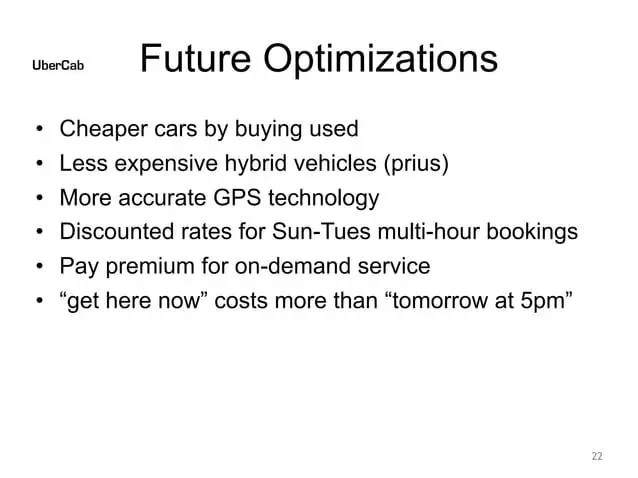
The future roadmap presentation shows forward-thinking product development planning but potentially represents strategic messaging error for seed-stage pitch deck context. While demonstrating vision for app optimization and service expansion capabilities, this slide may have distracted from core value proposition when the initial application remained under development. The roadmap content suggests ambitious feature development that could have raised questions about focus and resource allocation priorities.
Despite potential timing issues, the roadmap reveals sophisticated understanding of platform evolution and customer experience enhancement opportunities. The optimization ideas suggest the founders viewed the initial product as foundation for broader service capabilities rather than final destination. This systems thinking approach indicates understanding that successful platforms require continuous improvement and feature expansion to maintain competitive advantages.
What investors see: Management team with long-term vision and product development sophistication, though potentially concerning focus dispersion for early-stage company. The roadmap suggests understanding of platform dynamics and customer experience improvement opportunities, which indicates scalability thinking. However, investors might question whether the team can execute core functionality before pursuing feature expansion, highlighting importance of slide sequencing and context in pitch presentations.
From insight to investor-ready, in weeks not months.
Apply these lessons to your raise — we’ll build your deck, financial model, and IM together.
While Uber’s 2008 pitch deck successfully secured the initial funding that launched one of history’s most valuable startups, the presentation contains several notable gaps that modern investors would expect to see addressed. These omissions reflect both the different fundraising standards of 2008 and the founders’ focus on product concept rather than comprehensive business planning. Understanding what’s missing provides valuable insight into how startup pitch requirements have evolved and what contemporary founders must address to meet current investor expectations, potentially benefiting from fundraising-grade pitch deck consulting.
The search results do not indicate whether Uber’s 2008 deck included information about founder backgrounds, team members, relevant experience, or advisory board members. Modern pitch decks emphasise the founding team’s credentials heavily, as investors often say ‘they invest in the team’. A dedicated slide showing Garrett Camp’s background, any co-founders, and key hires would strengthen investor confidence.
While the deck mentions potential outcomes like $1B+ revenue in the best case, the search results don’t mention detailed financial projections, customer acquisition cost, lifetime value calculations, or unit economics. Modern seed-stage decks typically include 3-5 year revenue projections and key unit economic metrics to demonstrate financial viability.
The deck briefly mentions targeting professionals in San Francisco and New York but lacks detailed explanation of customer acquisition channels, marketing strategy, or specific launch tactics. A more comprehensive go-to-market strategy slide would address how Uber planned to acquire riders and drivers at scale.
While the deck positions Uber against traditional taxi companies, it doesn’t appear to include analysis of other potential competitors or emerging ridesharing models. A more detailed competitive matrix showing how Uber compares to existing transportation services would provide important market context.
The pitch deck lacks a slide addressing regulatory challenges, operational risks, or competitive threats. A modern pitch deck would include discussion of potential obstacles such as regulatory approval, driver recruitment challenges, and how the company plans to mitigate these risks.
The search results do not mention whether the deck explained how the $200K seed funding would be allocated across product development, operations, marketing, and team building. A clear breakdown of fund usage is essential for investor confidence in capital efficiency.
These gaps reflect the evolution of venture capital due diligence standards and the increasing sophistication of early-stage investors. At Projects RH, we work with founders to ensure their pitch decks address these modern investor expectations while maintaining the narrative clarity and problem-solution focus that made Uber’s original deck compelling. The key is balancing comprehensive coverage with concise presentation—addressing investor concerns without losing the story that drives investment decisions.
Uber’s greatest strength was identifying a universally understood problem that existed right in front of investors. The taxi experience in 2008 was broken in obvious ways—inefficient dispatch, aging vehicles, inconvenient hailing methods. The key lesson is to spend time articulating why the problem matters and why the status quo is unsustainable. Use concrete examples and specific pain points rather than abstract problems. Investors connect with obvious problems because they can immediately understand the market opportunity.
The deck’s structure—problem first, then solution, then product details—follows a logical progression that builds investor confidence. By presenting the problem early and thoroughly before introducing the solution, Uber made investors understand why the business needed to exist. This narrative structure works better than jumping directly to features. Start with ‘why the world needs this’, then explain ‘how we’ll deliver it’, then detail ‘what we built’.
Despite being 25 slides total, each individual slide contained minimal text with focused messaging on a single topic. This approach prevents information overload and allows presenters to speak to each slide rather than have investors reading walls of text. The lesson is not to cram all information onto slides, but to use slides as visual anchors while the founder does the heavy lifting in verbal explanation. This works especially well when raising seed funding where founder storytelling is critical.
The opening slide’s use of a Mercedes, iPhone, and Blackberry communicated Uber’s positioning as a luxury service without lengthy explanation. Visual metaphors and relevant imagery are more memorable than bullet points. Founders should invest in deck design and imagery selection that reinforces the narrative. Choose images and visual elements that immediately communicate the brand positioning and solve the problem visually.
While not explicitly shown in this original deck, Uber’s willingness to pivot from an owned-fleet model to an independent-driver marketplace demonstrates that great ideas evolve. The lesson for founders is that the original plan in the pitch deck may not be the final path—and that’s okay. What matters is having clarity on the core problem being solved and flexibility on the solution. Don’t become so attached to your first business model that you miss better opportunities.
Uber’s decision to launch in San Francisco and New York—both cities with large business professional populations and notoriously inefficient taxi services—was strategically sound. Rather than claiming national ambitions, the deck focused on specific cities where the problem was acute and the target market was concentrated. The lesson is that geographic focus demonstrates realism and allows for better unit economics and word-of-mouth growth within a concentrated market.
The ‘Potential Outcomes’ slide showing best-case scenario of $1B+ annual revenue paired with a worst-case scenario of remaining a small San Francisco service demonstrates balanced narrative. The founders showed ambition while maintaining credibility—an important balance in seed-stage pitches. If projections seem unrealistic, investors dismiss them entirely. By including conservative and aggressive scenarios, Uber made both seem plausible and grounded the narrative in reality.
Ready to raise? Let’s talk.
We’ve helped founders secure $2B+ in investor interest. Your round could be next.
The distance between the Uber that presented this deck and the Uber that exists today represents one of the most remarkable value creation stories in startup history. In 2008, Garrett Camp was seeking $200,000 to launch a luxury car service in San Francisco targeting business professionals. Today, Uber operates across 73 countries with over $31 billion in annual revenue, having fundamentally transformed global urban transportation and created an entirely new economic category. This transformation illustrates both the power of venture capital when deployed against massive market opportunities and the importance of business model evolution in startup success.
The investment mathematics surrounding Uber’s seed round represent perhaps the most extraordinary return generation in venture capital history. Assuming the early investors maintained their positions through subsequent funding rounds and public offering, the $200,000 seed investment would have generated returns exceeding 500,000x based on Uber’s peak public market valuation. Even accounting for dilution through multiple funding rounds, early investors likely achieved returns in the tens of thousands of times their original investment—returns that justify the entire venture capital asset class and demonstrate why investors continue seeking the next transformative startup.
More importantly, Uber’s journey from this 25-slide pitch deck to global transportation platform illustrates the fundamental venture capital thesis: that small investments in exceptional founders addressing massive markets can generate world-changing outcomes. The deck’s success lay not in predicting Uber’s exact evolution, but in identifying a clear problem, articulating a compelling solution, and demonstrating the market opportunity that would eventually support a $100+ billion enterprise. For contemporary founders, Uber’s story reinforces that while the specific business model may evolve, the core elements of problem identification, market sizing, and solution articulation remain the foundation of successful fundraising narratives.
At Projects RH, we help companies across all industries create investor-ready materials that close deals. Our integrated capital raising package ensures consistency across all your investor documentation.
Built in-house for accuracy and investor confidence.
Comprehensive investor documentation following global best practices.
12-slide investor-ready presentation with supporting materials.
High-impact snapshot to capture investor attention fast.
Browse our collection of real pitch deck breakdowns from the world’s most successful companies.
Uber's original 2008 pitch deck contained 25 slides. This length was actually longer than ideal—industry experts recommend 12-14 slides for startup pitch decks. The founders could have condensed the product and solution sections, which took up 6+ slides, into 2-3 slides instead. However, given how novel the concept was in 2008, the additional slides may have been necessary for investors to grasp the full vision.
Uber raised $200,000 in seed funding using this pitch deck in 2008. This initial capital was crucial for development and launch, setting the stage for the company's first operational phase in San Francisco. This seed funding represented a significant achievement at the time and validated the founders' vision enough to attract early-stage investors.
The deck succeeded by clearly identifying an obvious, universal problem with taxi services (inefficient dispatch, aging fleets, inconvenient hailing) and presenting a compelling technology-enabled solution. The narrative structure was logical, moving from problem to solution to product details. Key differentiators were articulated clearly, and the presentation used minimal text with focused messaging on each slide. The original business concept—a luxury on-demand car service—was compelling and innovative for 2008 when no alternatives existed.
Yes, Uber's deck serves as an excellent structural template. The problem-solution-product-market structure is timeless and highly effective. However, modern pitch decks should be shorter (12-14 slides instead of 25) and should include additional elements Uber's 2008 deck lacked: detailed team credentials, comprehensive financial projections, customer acquisition strategy, risk analysis, and use of funds breakdown. The core lesson about clear narrative structure and minimal text per slide remains universally applicable.
Uber was at the seed stage when Garrett Camp created this pitch deck in August 2008. The company had not yet launched or generated revenue; it was still in the concept and product development phase. The $200,000 raised from this pitch deck was used to build the initial product and prepare for launch. This makes Uber's deck particularly valuable as a template for other pre-revenue, seed-stage startups seeking their first institutional funding.
Creating an effective pitch deck requires more than following a template — it demands strategic clarity about your value proposition, a deep understanding of your target investors, and rigorous financial modelling to support your narrative. At Projects RH, we combine financial expertise with strategic storytelling to build pitch decks, information memorandums, and financial models that meet the standards of institutional investors worldwide. Our team has generated over USD 2.0 billion in expressions of interest across mining, energy, technology, medtech, and financial services sectors. Schedule a consultation to discuss how we can help position your company for successful capital raising.