
Explore the pitch deck analysis of Canva, which raised $6.6M in seed funding from Elevation Capital in 2013. Learn the strategies behind their success!
Building your own pitch deck?
Get expert guidance from the team behind $2B+ in investor interest.
Canva was born from Melanie Perkins’ frustration with the gatekeeping nature of the design industry. As a young Australian entrepreneur, Perkins recognised that professional design was trapped behind walls of expensive software, specialised training, and costly freelancers. This exclusivity meant that small businesses, individuals, and non-designers were locked out of creating professional-quality visual content, forced to either accept amateur results or pay premium prices for basic design work. To navigate these challenges, many turn to pitch deck advisory services for expert guidance.
Before launching Canva, Perkins spent considerable time understanding the intricate workflows and structural barriers within the design ecosystem. She identified that the problem wasn’t just complexity—it was systematic exclusion. Design tools were deliberately sophisticated, design professionals were artificially scarce, and the entire process was unnecessarily time-consuming. This insight became Canva’s foundational thesis: by democratising design through simplification and accessibility, they could unlock a massive untapped market of everyday creators.
The founding team’s approach to building their pitch deck reflected their product philosophy—simplicity over sophistication. Their original deck was intentionally basic, featuring minimal visual flourish and straightforward slides, yet the narrative was compelling enough to cut through investor skepticism. The deck clearly articulated the problem space, demonstrated deep understanding of industry inefficiencies, and presented a solution that addressed genuine pain points experienced by millions of potential users worldwide.
Canva’s pitch deck successfully secured $6.6M in seed funding from Elevation Capital in March 2013, though the founders acknowledge they endured many iterations and rejection cycles before achieving this breakthrough. During the fundraising process, the team continuously refined their deck by directly addressing investor concerns, particularly around market comprehension of the design industry. This adaptive approach to pitching eventually led to one of the most successful fundraising journeys in startup history, with Canva ultimately raising over $572.6M across 16+ funding rounds from elite investors including Sequoia Capital and Felicis Ventures.
Canva’s opening slide establishes the company’s ambitious vision through clean, accessible branding that mirrors their product philosophy. The cover introduces both the Canva name and the founding team’s commitment to making design simple and intuitive for non-professionals. This first impression signals to investors that the company practices what it preaches—their presentation design reflects the same accessibility principles they’re building into their platform.
The strategic choice to keep the cover slide minimal yet professional demonstrates confidence in substance over style. Rather than overwhelming viewers with complex graphics or flashy animations, the founders allow their vision statement to take centre stage. This approach builds credibility with investors who might otherwise be distracted by over-designed presentations that mask weak underlying business fundamentals.
What investors see: A team that understands their target market intimately enough to reflect their product values in their presentation style. The cover slide’s simplicity suggests the founders have thought deeply about user experience and are building a product that genuinely serves non-designers rather than impressing design professionals. This alignment between presentation and product philosophy indicates strong product-market fit potential.
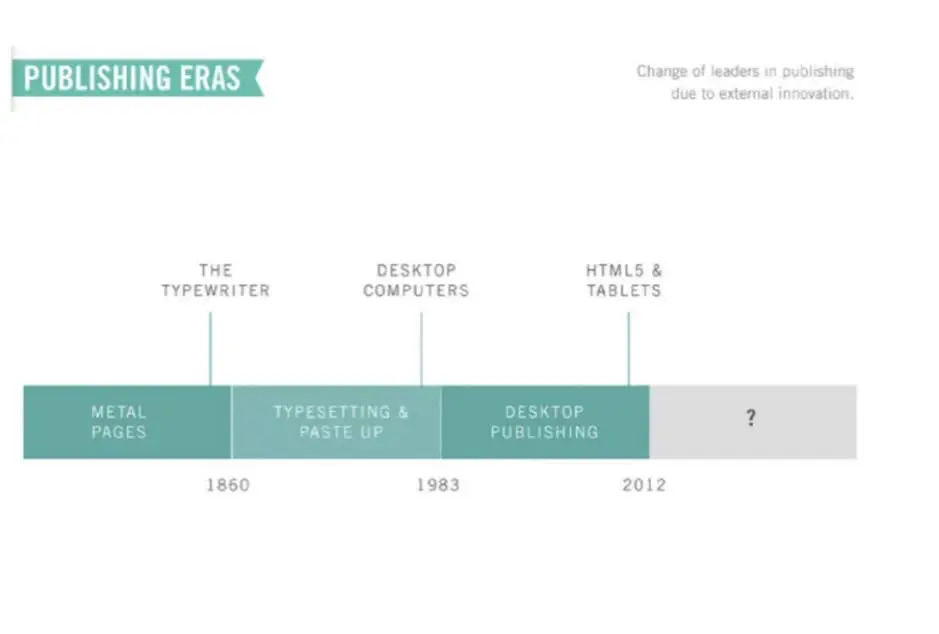
This motivation slide serves as the emotional foundation for Canva’s entire investment thesis, establishing why this particular team is uniquely positioned to solve the design accessibility problem. By leading with personal motivation rather than market statistics, the founders create an emotional connection with investors while demonstrating their deep, personal understanding of the pain points they’re addressing. This storytelling approach transforms what could be a dry market analysis into a compelling narrative about democratising creativity.
The strategic placement of motivation before problem definition shows sophisticated pitch construction—the founders are priming investors to understand not just what they’re building, but why they’re uniquely motivated to see it through. This approach helps investors evaluate founder-market fit, which is often more predictive of success than pure market opportunity. By establishing personal connection to the problem space, the team differentiates themselves from competitors who might be approaching design tools as a purely opportunistic market play.
What investors see: Founders with intrinsic motivation who will persist through the inevitable challenges of building a platform business. The motivation slide signals that this isn’t a trend-chasing venture but a mission-driven company with staying power. Investors recognise that founder motivation is often the differentiating factor in competitive markets, and this slide establishes Canva’s team as operators who will continue iterating and pushing forward even when growth becomes difficult.
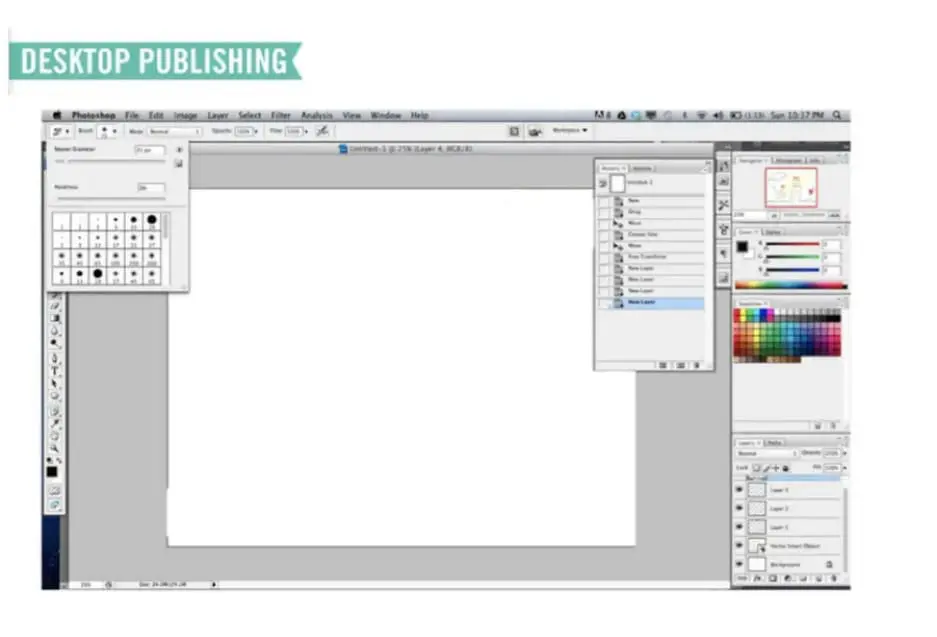
Canva’s problem statement articulates the systematic barriers that prevent ordinary people from creating professional-quality visual content. The slide identifies three core inefficiencies: design tools require specialised training, professional designers are expensive and often inaccessible, and the design process itself is unnecessarily complex for basic tasks. By framing these as industry-wide structural problems rather than user limitations, Canva positions their solution as addressing market failure rather than user education.
The problem slide strategically avoids technical jargon and instead focuses on relatable pain points that any investor can understand—small business owners struggling with marketing materials, individuals frustrated by complicated software, and the universal need for visual communication in an increasingly digital world. This approach broadens the perceived market opportunity beyond professional designers to include the vast population of everyday content creators who currently have no viable solution.
What investors see: A massive untapped market of users who have been systematically excluded from professional design tools. The problem framing suggests that success doesn’t require converting existing design tool users—instead, Canva can create an entirely new category of users who were previously non-participants in the design ecosystem. This represents a classic “expand the market” opportunity that investors find particularly compelling for venture-scale returns.
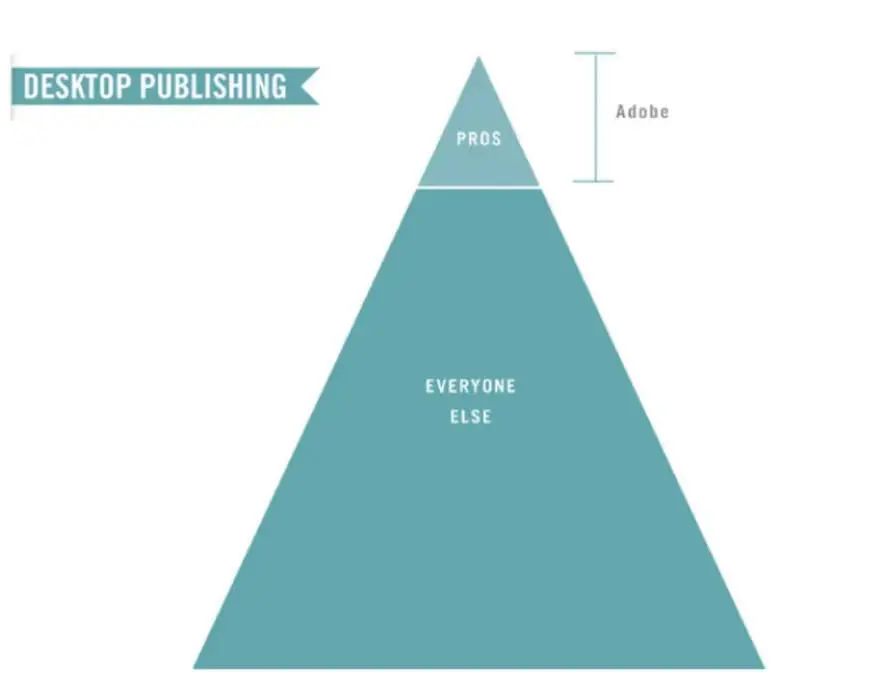
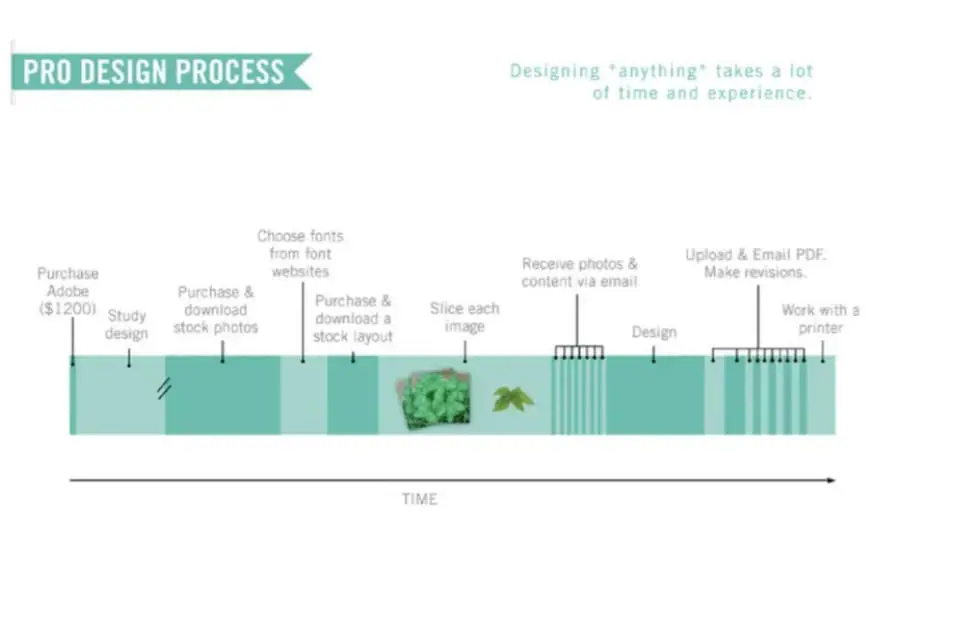
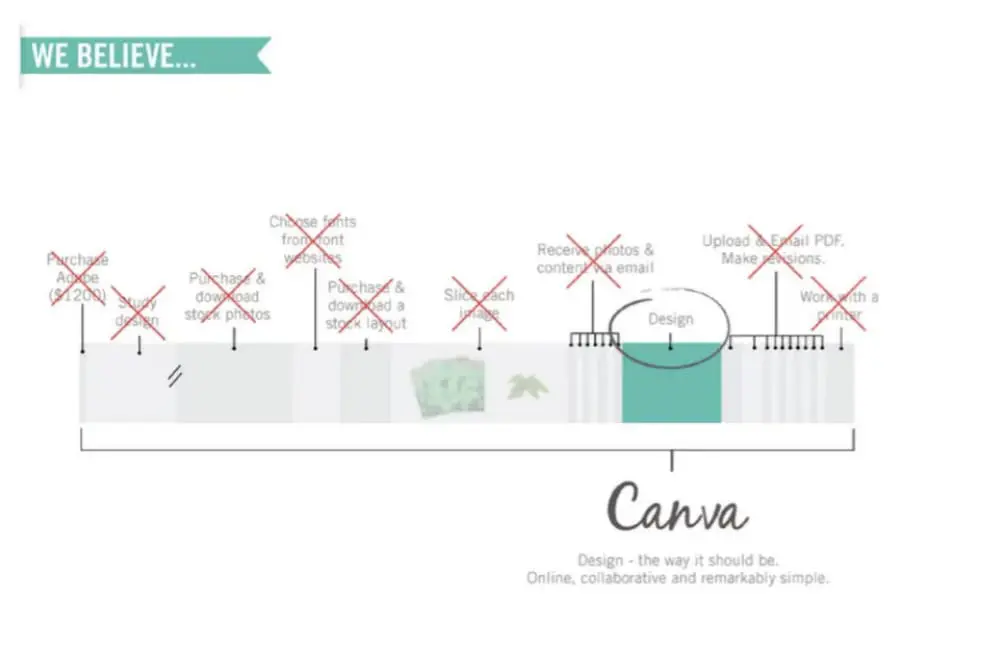
This explanatory slide demonstrates Canva’s responsiveness to investor feedback during their fundraising process. When early investors expressed confusion about the design industry’s structure and workflows, the founders added this educational component to help investors understand the complexity they were seeking to simplify. The slide breaks down the traditional design process, showing multiple stakeholders, lengthy timelines, and various friction points that create opportunities for disruption.
By including an industry explanation slide, Canva shows sophisticated pitch deck iteration—they recognised that investor comprehension was a barrier to funding and proactively addressed it. This slide serves dual purposes: educating investors about market dynamics while demonstrating the founders’ deep industry expertise. The detailed workflow analysis proves that the team understands the incumbents’ business models well enough to identify specific points of intervention.
What investors see: Founders who listen to feedback and adapt their presentation to address investor concerns, suggesting they’ll bring the same adaptability to product development and market response. The industry expertise demonstrated in this slide builds confidence that the team can navigate competitive dynamics and anticipate industry changes. Most importantly, it shows that Canva’s solution isn’t based on superficial market observation but deep structural understanding of inefficiencies.
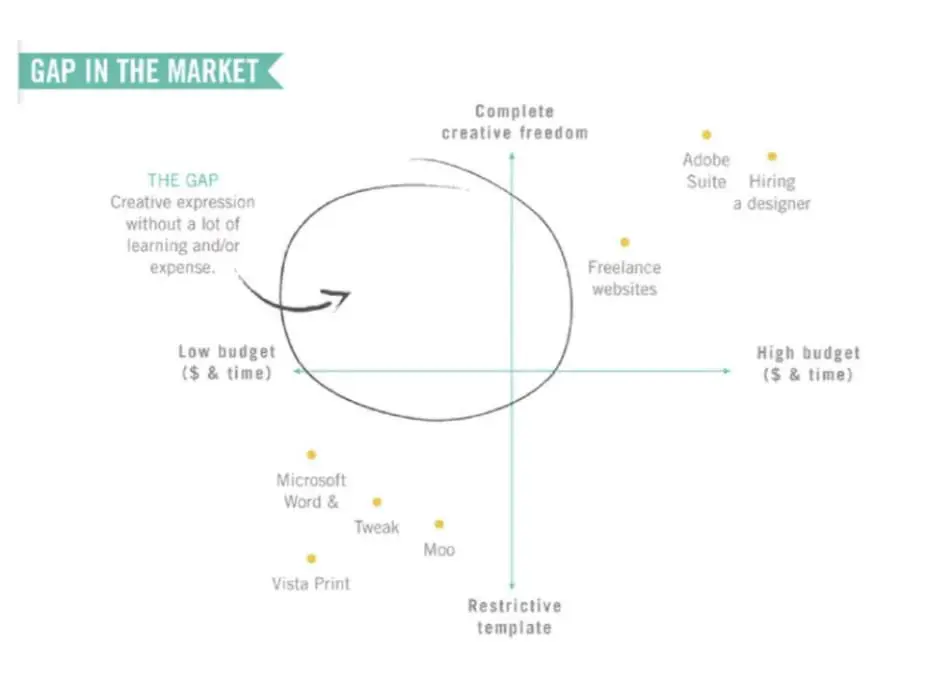
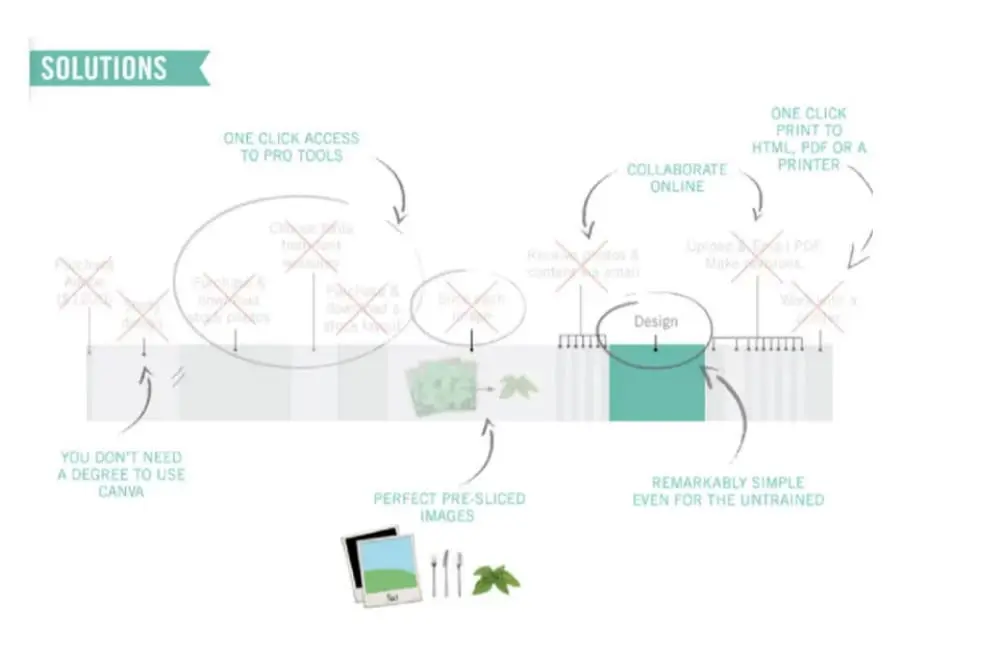
Canva’s solution slide presents a comprehensive platform that addresses each problem identified earlier through specific features: drag-and-drop simplicity eliminates the need for design training, template libraries reduce creation time, and micropayment access to professional elements makes quality design affordable. The solution emphasises collaboration features and one-click access to professional tools, positioning Canva not just as a simplified design tool but as a complete creative ecosystem for non-designers.
The strategic framing of features as direct responses to market inefficiencies shows sophisticated product thinking—each capability isn’t presented as a technical achievement but as a solution to specific user friction points. The emphasis on collaboration and sharing features indicates the founders’ understanding that design is increasingly social and distributed, not just individual creative work. This forward-thinking approach suggests Canva is building for emerging workplace trends rather than just current market needs.
What investors see: A platform solution that can scale across multiple user segments and use cases rather than a point solution for a single problem. The combination of simplicity and professional capability suggests Canva can capture both individual users and business customers, providing multiple paths to monetisation. The collaboration features indicate network effects potential, where user engagement increases as more people join the platform, creating natural viral growth mechanics.
The market opportunity slide establishes Canva’s total addressable market by combining traditional design spending with the broader visual communication needs of businesses, individuals, and educational institutions. Rather than limiting their market analysis to existing design tool users, the slide expands the definition to include anyone who creates visual content, from social media posts to business presentations. This broader market definition supports Canva’s positioning as creating a new category rather than competing for existing market share.
The market sizing approach demonstrates sophisticated thinking about platform businesses—Canva isn’t just targeting the professional design market but the much larger market of visual communication needs. By identifying adjacent markets like presentations, social media content, and marketing materials, the slide shows how Canva can expand beyond its initial use cases. This multi-market approach reduces investor concerns about market size limitations and suggests multiple expansion vectors for future growth.
What investors see: A venture-scale market opportunity that extends far beyond traditional design tools into the broader trend of visual communication becoming essential for businesses and individuals. The market analysis suggests Canva is positioned to benefit from secular trends like social media growth, remote work adoption, and small business digitalisation. This positioning indicates the potential for sustained growth across multiple market cycles rather than dependence on a single market dynamic.
Canva’s business model slide presents a diversified revenue strategy combining freemium subscriptions, micropayments for premium templates and features, and strategic partnerships with printers and stock image providers. This multi-pronged approach demonstrates that the founders have thought through various monetisation vectors rather than betting everything on a single revenue stream. The freemium model allows for viral user acquisition while micropayments provide immediate monetisation of engaged users.
The inclusion of partnership revenue from printing services and stock imagery shows sophisticated platform thinking—Canva isn’t just building a design tool but an ecosystem that captures value from the entire creative workflow. These partnerships provide additional revenue while enhancing user experience through integrated services. The business model also demonstrates defensibility through network effects: more users attract more content partners, which improves the platform and attracts more users.
What investors see: A business model designed for capital efficiency and sustainable unit economics rather than pure growth-at-all-costs mentality. The diversified revenue streams reduce dependence on any single monetisation method and provide resilience against market changes. The combination of subscription predictability with transaction-based upside suggests strong potential for both steady revenue and explosive growth as usage scales.
The traction slide provides concrete evidence of market validation through the impressive metric of over 3 million users, demonstrating that Canva had achieved significant scale even before their public launch. This user growth validates the problem-solution fit and shows organic adoption without major marketing spend. The slide combines quantitative metrics with qualitative validation through partnerships with established industry players, creating a comprehensive picture of market acceptance.
The strategic inclusion of partnership logos from printers and stock image providers serves as social proof that industry incumbents view Canva as a legitimate platform worth integrating with rather than competing against. These partnerships also demonstrate business development capabilities and suggest that Canva can scale through both direct user acquisition and strategic alliances. The combination of user metrics and partnership validation provides multiple forms of evidence for investor confidence.
What investors see: Clear evidence that the market wants this product, reducing the primary risk factor for early-stage investments. The 3 million user milestone suggests organic virality and strong word-of-mouth growth, indicating low customer acquisition costs and high user satisfaction. The industry partnerships demonstrate that Canva isn’t just building a consumer tool but a platform that can integrate with existing business ecosystems, expanding monetisation opportunities.

The team slide showcases the founding members’ complementary skills and relevant experience, establishing credibility for executing on Canva’s ambitious vision. The presentation emphasises both technical capabilities and industry understanding, showing that the founders combine the engineering skills necessary to build a scalable platform with the design expertise needed to understand user needs. This balance between technical execution and market insight addresses investor concerns about founder-market fit.
The team composition demonstrates thoughtful role distribution with clear responsibilities for product development, business strategy, and market expansion. By highlighting relevant experience and achievements, the slide builds investor confidence that this team can navigate the challenges of scaling a platform business across multiple markets. The founders’ background suggests they understand both the technical challenges of building design tools and the business challenges of creating sustainable competitive advantages.
What investors see: A balanced founding team with the skills necessary to execute on both product vision and business strategy, reducing execution risk significantly. The combination of technical depth and industry expertise suggests the team can build a product that truly serves user needs while creating sustainable competitive moats. This team composition indicates strong potential for successful fundraising in later rounds and eventual successful exit scenarios.

The financials slide presents revenue projections, growth trajectory, and unit economics that demonstrate a clear path to profitability and venture-scale returns. The projections likely incorporate multiple revenue streams from the business model, showing how freemium subscriptions, micropayments, and partnerships contribute to overall revenue growth. The financial model demonstrates that Canva can achieve sustainable unit economics while maintaining rapid growth rates attractive to venture investors.
The inclusion of unit economics and customer lifetime value projections shows sophisticated thinking about platform business fundamentals—the founders understand that investor returns depend on profitable customer acquisition and retention rather than just user growth. The financial projections likely demonstrate how network effects and platform dynamics can drive improving unit economics over time, creating sustainable competitive advantages and margin expansion opportunities.
What investors see: Evidence that the founders understand the financial mechanics required to build a venture-scale business, not just an impressive product. The financial projections indicate potential for strong investor returns through either strategic acquisition or public market exit. Most importantly, the unit economics demonstrate that growth can be capital efficient, suggesting the business can scale without requiring excessive additional investment rounds.

The milestones slide outlines a comprehensive 12-18 month roadmap that transforms the investment from an abstract opportunity into a concrete execution plan. The timeline includes specific markers for product beta launch, public release, user growth targets, and revenue milestones, showing investors exactly how their capital will drive measurable progress. This structured approach demonstrates that the founders have thought through the operational challenges of scaling and can articulate clear success metrics for each phase of growth.
The milestone structure shows sophisticated project management thinking with dependencies and parallel workstreams that maximise capital efficiency. By including both product milestones and business milestones, the roadmap demonstrates that the team understands success requires coordinated execution across multiple functions rather than just product development. The timeline also provides natural checkpoints for investor updates and future fundraising conversations.
What investors see: A team that has moved beyond vision to practical execution planning, reducing the risk that investment capital will be deployed without clear direction or measurement. The specific milestones provide accountability mechanisms and success metrics that can be tracked throughout the investment period. This level of planning suggests the founders can successfully navigate the transition from startup to scale-up operations.
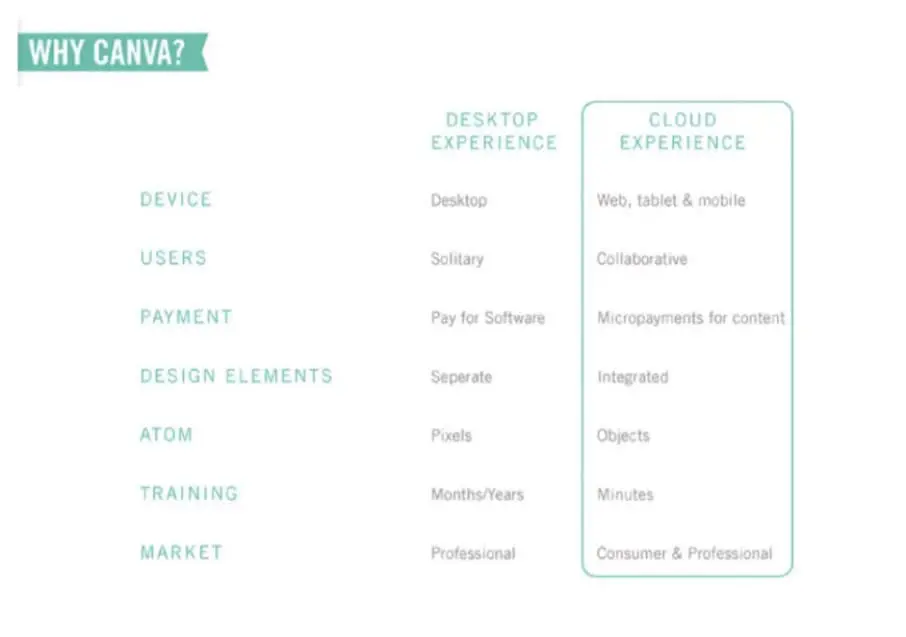
The use of funds slide provides a detailed breakdown of how the $6.6M investment will be allocated across product development, marketing, hiring, and operations, demonstrating thoughtful capital deployment planning. The allocation shows balanced investment in both product capabilities and market expansion, suggesting the founders understand that scaling requires simultaneous investment in technology infrastructure and customer acquisition. This strategic approach to capital allocation indicates mature business thinking beyond just building features.
The specific allocation percentages demonstrate that the founders have analysed the relative importance of different growth drivers and prioritised spending accordingly. The inclusion of operational expenses and hiring plans shows recognition that scaling requires building organisational capacity alongside product capacity. This comprehensive approach to fund utilisation suggests the investment will drive systematic progress across all aspects of business development rather than just product features.
What investors see: Evidence that the founders have carefully considered how to maximise investor return through strategic capital deployment rather than just burning cash on growth experiments. The balanced allocation suggests the team understands the interconnected nature of product development, marketing, and operations in building a sustainable business. This level of financial planning indicates the founders can be trusted with investor capital and will deploy it efficiently toward measurable outcomes.
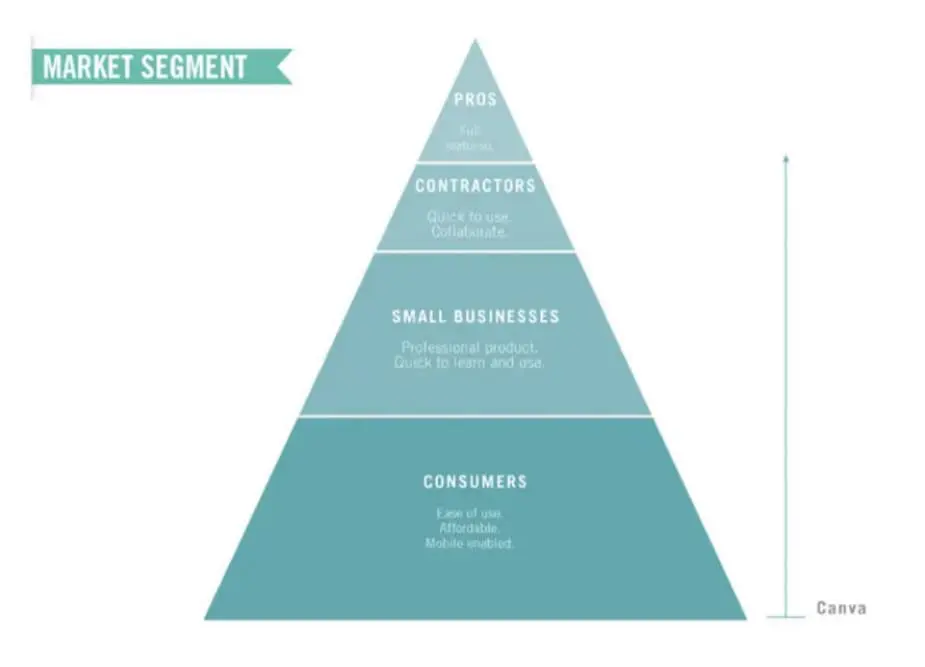
The final slide presents a clear call-to-action with the specific investment amount of $6.6M and contact information for interested investors, providing a concrete next step for the fundraising process. The ask slide concludes the presentation with confidence and directness, avoiding ambiguity about the founders’ expectations or the investment opportunity. This straightforward approach reflects the same simplicity principle that guides Canva’s product design—making the path forward as clear as possible.
The specific dollar amount demonstrates that the founders have calculated their funding needs based on the milestones and use of funds outlined earlier, creating consistency throughout the pitch narrative. The inclusion of contact information and clear next steps shows professional fundraising process management, making it easy for interested investors to move forward. This attention to process details suggests the founders can manage complex negotiations and due diligence processes effectively.
What investors see: A team that has prepared thoroughly for fundraising and can articulate clear investment terms without confusion or ambiguity. The specific ask amount suggests the founders have done their homework on valuation and market terms rather than fishing for any available capital. The professional presentation closing indicates the team can manage investor relationships effectively throughout the funding process and beyond.
From insight to investor-ready, in weeks not months.
Apply these lessons to your raise — we’ll build your deck, financial model, and IM together.
While Canva’s pitch deck successfully secured one of the most transformative seed investments in design technology history, launching a company that would eventually reach a $26B+ valuation, the original 2013 presentation is not without notable gaps. Several elements that have become standard in contemporary fundraising could have strengthened their investment case and potentially accelerated their path to market leadership. These missing components represent opportunities that today’s founders should consider when crafting their own pitch narratives, particularly in competitive markets where investor pitch deck consulting matters significantly.
While the deck addressed the problem and solution, search results do not indicate a dedicated slide analysing direct competitors or articulating clear competitive differentiation. Modern pitch decks typically include a competitive matrix or slide explaining why Canva would win against existing design tools and potential future competitors. This is critical for investors to understand market positioning.
The traction slide mentions 3M users and partnerships but lacks specific customer testimonials, case studies, or user success stories. Contemporary pitch decks leverage customer quotes and detailed use cases to build credibility and emotional resonance. Without these, investors miss the human impact and real-world validation of the product.
The deck does not appear to include detailed unit economics, customer acquisition cost (CAC), or lifetime value (LTV) metrics. Search results suggest these were not emphasised in the original 2013 pitch. Modern SaaS pitch decks highlight these metrics to demonstrate business model sustainability and capital efficiency.
There is no evidence of a slide addressing potential risks or competitive threats. Early-stage founders should anticipate scepticism and address risks (market timing, execution, competition, regulatory changes) with concrete mitigation strategies. This demonstrates mature thinking and risk awareness.
While the deck mentions marketing in the use of funds, there is limited detail on customer acquisition channels, marketing strategy, partnerships for distribution, or sales approach. A comprehensive GTM slide helps investors understand the path to profitability and scalability beyond product-market fit.
The original pitch deck does not emphasise an international expansion strategy or multi-market scaling approach. For a platform business targeting global markets, articulating geographic expansion plans and localisation strategies strengthens the investment case and demonstrates founder ambition for building a multi-billion dollar company.
These gaps represent opportunities for modern founders to differentiate their pitches and provide additional confidence to investors evaluating competitive markets. At Projects RH, we work with founders to identify and address these potential weaknesses before they enter fundraising conversations, ensuring their decks anticipate investor concerns and demonstrate comprehensive strategic thinking across all aspects of business development and market expansion.
Canva’s original pitch deck was intentionally basic—no slick design, no animations, and minimal visual flourish. Investors appreciated this approach because it made the pitch feel honest and focused on substance over style. The lesson: don’t let design distract from your core message. Use clean layouts and clear language. Investors are evaluating your business, not your design skills (unless you’re a design tool company). Focus on clarity, logic, and compelling storytelling rather than impressing with visual aesthetics.
Canva’s founders discovered early in their pitch roadshow that many investors didn’t understand the design industry. Rather than accept this as a roadblock, they added a dedicated slide explaining the design industry structure and processes. This demonstrates the lesson: actively listen to investor feedback during pitching and iterate your deck to directly address the hardest questions before they’re asked. Make your deck a preemptive defence against scepticism by anticipating concerns and answering them upfront.
Instead of immediately jumping to the product or market size, Canva’s deck took time to explain the personal and professional motivation behind the company. This gave the entire pitch more weight and emotional resonance. The lesson: establish the ‘why’ before the ‘what.’ By starting with motivation and clearly defining the problem, investors connect emotionally with your vision and understand why the team is uniquely positioned to solve it. A compelling problem statement justifies why a new company needs to exist.
Canva’s traction slide featured a specific metric: over 3 million users. This concrete number provided undeniable validation that a market existed and that the solution resonated. Combined with partnerships from industry players (printers, stock image providers), the deck demonstrated social proof from multiple angles. The lesson: prioritise quantifiable metrics (user growth, revenue, partnerships) over qualitative claims. Hard data is infinitely more persuasive than assertions of potential. Show, don’t tell.
Canva presented multiple revenue streams: freemium subscriptions, micropayments for templates and features, and partnerships with printers and stock image providers. This diversification signalled to investors that the company wasn’t betting everything on a single monetisation strategy. The lesson: present a business model with multiple revenue levers. This demonstrates that you’ve thought through sustainability and reduces investor perception of risk. A diversified revenue model also increases resilience against market changes.
Canva’s milestones slide outlined a 12-18 month roadmap with specific markers: product beta launch, public launch, user growth targets, and revenue milestones. This demonstrated that the team had an execution plan and forethought about how funding would drive specific outcomes. The lesson: always include a timeline of next steps in your pitch deck. A clear roadmap shows investors that you’ve thought through the journey and can articulate how capital will be deployed to hit concrete milestones. This transforms the investment from an abstract bet into a measurable commitment.
Canva positioned features like ‘One-Click Access to Pro Tools’ not as technical achievements but as direct benefits that solved the core problem. This value proposition didn’t just offer a cheaper alternative to competitors; it fundamentally redefined the design process for a new audience. The lesson: don’t list product features; translate them into investor value. Every feature should answer the implicit question: ‘Why does this matter for revenue and growth?’ Frame your narrative around benefits (ease of use, affordability, accessibility) rather than technical implementation details.
Ready to raise? Let’s talk.
We’ve helped founders secure $2B+ in investor interest. Your round could be next.
The distance between the Canva that presented this deck and the Canva that exists today represents one of the most remarkable growth stories in platform business history. From a $6.6M seed investment to a $26B+ valuation, Canva has fundamentally transformed not just their business metrics but the entire design industry landscape. This transformation demonstrates the explosive potential that exists when strong foundational thinking meets exceptional execution, market timing, and strategic capital deployment across multiple growth phases.
The mathematics of Canva’s journey from their 2013 seed round to today’s valuation represents one of the most extraordinary returns in venture capital history. Elevation Capital’s initial $6.6M investment, if maintained through subsequent rounds, would theoretically be worth over $700M today—representing a return multiple of more than 100x over approximately 11 years. This level of return validates not just the founders’ execution but also the power of identifying genuinely transformative market opportunities before they become obvious to broader investor communities.
For contemporary founders, Canva’s trajectory offers both inspiration and practical guidance: simplicity in presentation combined with sophistication in strategic thinking can unlock extraordinary investor returns. The company’s evolution from 3 million users to hundreds of millions demonstrates that when founders correctly identify massive underserved markets and execute with consistent focus, the resulting business outcomes can exceed even the most optimistic venture projections. This represents the venture capital model working exactly as intended—backing exceptional teams with large market visions and providing the capital needed to achieve global scale impact.
At Projects RH, we help companies across all industries create investor-ready materials that close deals. Our integrated capital raising package ensures consistency across all your investor documentation.
Built in-house for accuracy and investor confidence.
Comprehensive investor documentation following global best practices.
12-slide investor-ready presentation with supporting materials.
High-impact snapshot to capture investor attention fast.
Browse our collection of real pitch deck breakdowns from the world’s most successful companies.
While search results reference analyzing the original pitch deck, the exact number of slides is not definitively stated. However, one source mentions a 13-slide layout as a best-practice template covering Vision, Market Opportunity, Problem, Solution, Business Model, Financials, Team, and Ask. The Canva original deck likely followed a similar structure, though the precise count may have varied across different versions used during the fundraising roadshow.
Canva raised $6.6M in seed funding with their original pitch deck in March 2013. However, the founders noted that this came after many pitching attempts and iterations. The deck was described as 'terrible' initially but effective once refined. It's important to note that Canva went on to raise significantly more capital in subsequent rounds—ultimately accumulating over $572.6M across 16+ funding rounds from major investors like Sequoia Capital and Felicis Ventures.
Several factors contributed to the deck's ultimate success: (1) It clearly articulated a relatable problem in the design industry; (2) It addressed investor concerns proactively by adding explanatory slides about the design ecosystem; (3) It presented concrete traction metrics (3M+ users) and partnerships for social proof; (4) It outlined a diversified business model with multiple revenue streams; (5) It included a clear 12-18 month roadmap showing how capital would be deployed; (6) It was deliberately simple and honest rather than over-designed, allowing substance to shine through. The founders also demonstrated learning agility by iterating their pitch based on tough investor questions.
Yes, Canva's pitch deck serves as a valuable reference for early-stage founders. The key lessons remain timeless: start with motivation and problem definition, address investor skepticism proactively, quantify traction with hard metrics, diversify revenue models, and include a clear roadmap. However, adapt the structure to your specific business. Canva's 2013 approach was intentionally basic; modern pitch decks may benefit from enhanced visuals while maintaining clarity. Canva itself provides pitch deck templates through its platform, and multiple sources analyze the original deck to extract frameworks that founders can customize for their own fundraising efforts.
Canva was at the seed stage when they created this pitch deck, raising their initial $6.6M seed round in March 2013. At this stage, the company had significant early user traction (over 3M users) but was pre-launch as a public product. This was their first major institutional capital raise, and the successful pitch opened doors to subsequent Series A, Series B, and beyond, eventually leading to 16+ funding rounds totaling $572.6M.
Creating an effective pitch deck requires more than following a template — it demands strategic clarity about your value proposition, a deep understanding of your target investors, and rigorous financial modelling to support your narrative. At Projects RH, we combine financial expertise with strategic storytelling to build pitch decks, information memorandums, and financial models that meet the standards of institutional investors worldwide. Our team has generated over USD 2.0 billion in expressions of interest across mining, energy, technology, medtech, and financial services sectors. Schedule a consultation to discuss how we can help position your company for successful capital raising.