
A slide-by-slide analysis of the 14-slide pitch deck Airbnb used to secure $600,000 in seed funding from Sequoia Capital and Andreessen Horowitz in 2008.
Airbnb’s origin story begins with a simple problem: two unemployed designers in San Francisco couldn’t afford their rent. In 2007, Joe Gebbia and Brian Chesky noticed that a major design conference was coming to town, with all the hotels booked solid. Rather than see this as someone else’s problem, they saw an opportunity. They purchased three air mattresses, created a simple website called “AirBed & Breakfast,” and rented out floor space in their apartment for $80 per night, including breakfast. This innovative approach highlights the importance of a strong pitch, which is where pitch deck consulting can play a crucial role in helping entrepreneurs effectively convey their ideas.
What started as a desperate attempt to make rent evolved into something much larger when they realised they had tapped into a fundamental shift in how people wanted to travel. The three guests who stayed on those air mattresses weren’t just looking for cheap accommodation—they wanted authentic, local experiences that traditional hotels couldn’t provide. This insight became the foundation for what would eventually become a global marketplace connecting millions of hosts and guests.
After recruiting Nathan Blecharczyk as their technical co-founder and CTO, the trio joined Y Combinator in early 2008. During their time in the accelerator, they refined their business model, built a proper web platform, and began to attract early users. However, growth was initially slow, and many investors dismissed the idea as a niche solution for budget travelers who would never scale to meaningful revenue.
By late 2008, armed with early traction data and a clearer vision of the massive market opportunity, the founders began pitching investors with this 14-slide deck. Despite its simple design and pre-revenue status, the deck successfully communicated the transformational potential of democratising hospitality, ultimately securing $600,000 in seed funding from some of Silicon Valley’s most prestigious investors, including Sequoia Capital and Andreessen Horowitz.
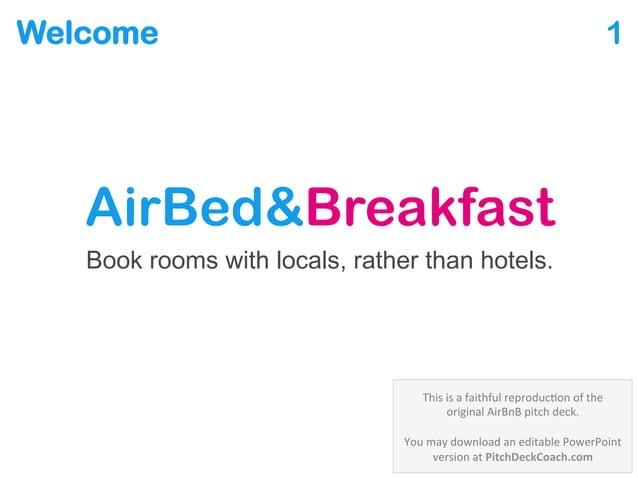
Airbnb’s opening slide demonstrates the power of crystalline simplicity with its tagline “Book rooms with locals, rather than hotels.” This single sentence encapsulates the entire value proposition without requiring any industry jargon or complex explanation. The cover establishes an immediate contrast between the sterile, corporate world of traditional hospitality and the warm, personal experience of staying with locals.
The strategic brilliance lies in framing the solution before presenting the problem—investors immediately understand what Airbnb does and why it matters. By positioning locals as the alternative to hotels, the slide suggests both cost savings and cultural authenticity, two powerful motivators for travelers. The visual simplicity also reflects the company’s design-first approach, which would become a key competitive advantage.
What investors see: A company that understands the fundamental principle that complex businesses must be explained simply. The tagline’s emphasis on “locals rather than hotels” signals a market disruption strategy that doesn’t just offer cheaper accommodation, but an entirely different category of travel experience that could command premium pricing while still undercutting traditional hospitality.
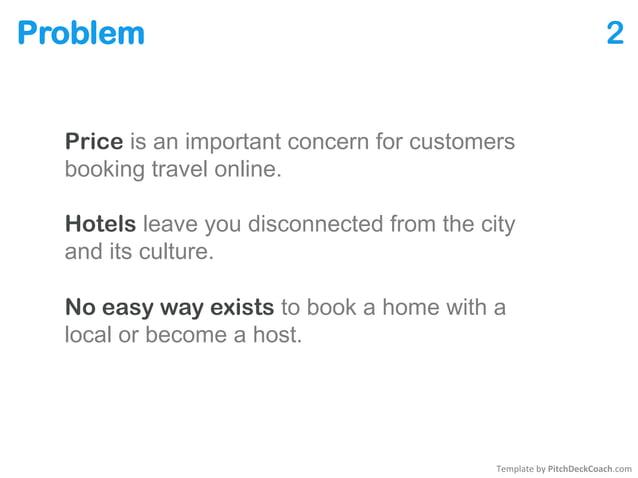
The problem slide identifies three critical pain points that every traveler can immediately recognise: price sensitivity, cultural disconnection, and the impersonal nature of hotel stays. Rather than focusing on niche complaints, Airbnb chose universal frustrations that cross demographic and psychographic boundaries. The slide establishes that traditional hospitality fails on both functional dimensions (cost) and emotional ones (authentic local experience).
By highlighting that hotels are “disconnected from the city culture,” Airbnb positions itself as more than a cost-saving alternative—it’s selling cultural immersion and authentic experiences. This framing is strategically crucial because it suggests customers will pay for the unique value Airbnb provides, not just choose it as a budget option. The problem statement also implies a large addressable market since these issues affect all types of travelers.
What investors see: A market opportunity that addresses both price-sensitive segments and experience-seeking premium travelers. The cultural disconnection problem suggests room for premium pricing and customer loyalty, while the universal nature of these pain points indicates massive scalability potential across global markets and diverse customer segments.
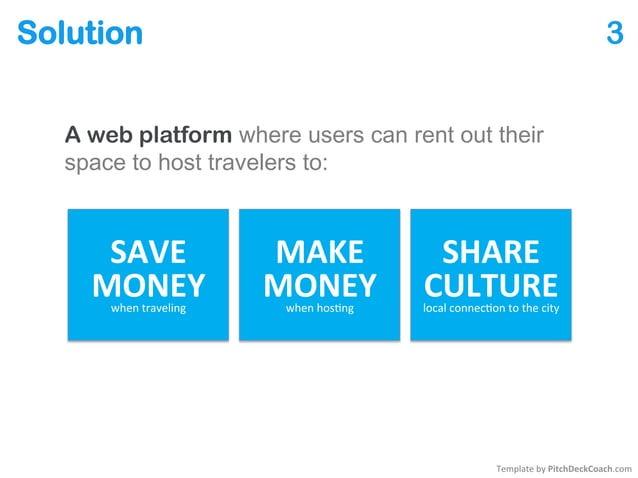
Airbnb’s solution slide presents three key value propositions that directly address the identified problems: staying with locals for cultural connection, accessing unique spaces unavailable through traditional channels, and expanding accommodation options beyond the hotel paradigm. The solution elegantly transforms unused residential capacity into a distributed hospitality network, creating value for both hosts and guests.
The strategic insight here is positioning Airbnb as an enabler of authentic local experiences rather than just a booking platform. By emphasising “unique spaces” and local hosts, the slide suggests inventory differentiation that traditional hospitality cannot replicate. This creates a defensible competitive moat—hotels cannot easily transform their standardised, corporate-owned properties into authentic local experiences.
What investors see: A scalable marketplace model that creates value through network effects rather than asset ownership. The solution suggests both immediate revenue potential (commission on transactions) and long-term defensibility (unique inventory and local expertise that competitors cannot easily replicate). The emphasis on “extending” rather than “replacing” hospitality indicates market expansion rather than just substitution.
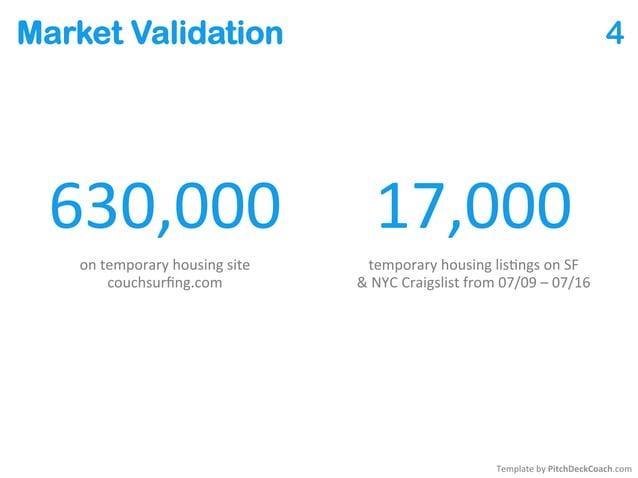
The market validation slide strategically uses existing player data to prove market demand without relying on hypothetical customer surveys or founder assumptions. By referencing Craigslist’s housing sections and Couchsurfing’s membership base, Airbnb demonstrates that millions of people are already seeking and providing alternative accommodation through suboptimal channels. This validation approach is particularly compelling because it shows unmet demand in adjacent markets.
The slide’s inclusion of budget travel statistics reinforces the market size while the competitor examples prove the solution category already exists—Airbnb is simply providing a better execution. This positioning reduces investor risk perception by showing they’re not betting on unproven consumer behaviour, but rather on superior product-market fit within a validated category.
What investors see: De-risked market entry with proven demand signals and clear competitive gaps to exploit. The validation through existing inadequate solutions suggests immediate customer acquisition potential and demonstrates that Airbnb won’t need to educate the market about the concept—just execute better than current alternatives.
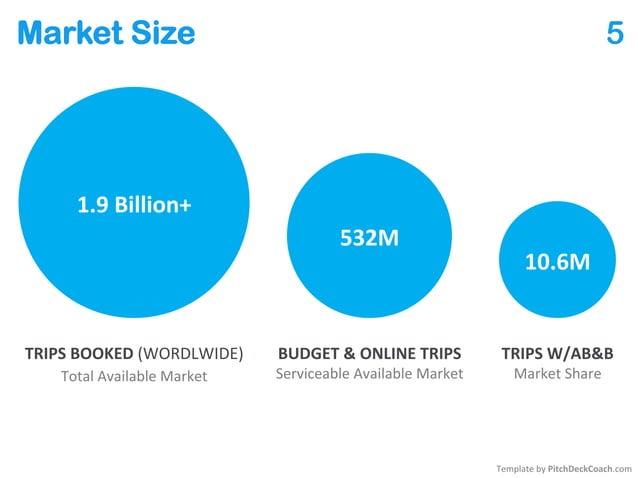
Airbnb’s market size slide projects a $20 billion serviceable addressable market (SAM) for budget travel accommodation, grounded in credible travel industry data and spending patterns. The slide demonstrates sophisticated market analysis by focusing on the addressable segment rather than claiming the entire hospitality market, which shows realistic understanding of customer targeting and competitive positioning.
The $20B figure strikes an optimal balance for early-stage fundraising—large enough to justify venture-scale returns but specific enough to demonstrate market research rigour. By focusing on budget travel, the slide avoids the trap of overclaiming while still presenting a massive opportunity that could support a multi-billion dollar company at scale.
What investors see: A venture-scale market opportunity with defensible assumptions and clear path to significant market share. The focus on budget travel suggests high price sensitivity and customer acquisition efficiency, while the $20B total indicates room for multiple successful companies and sustained growth even with competition.
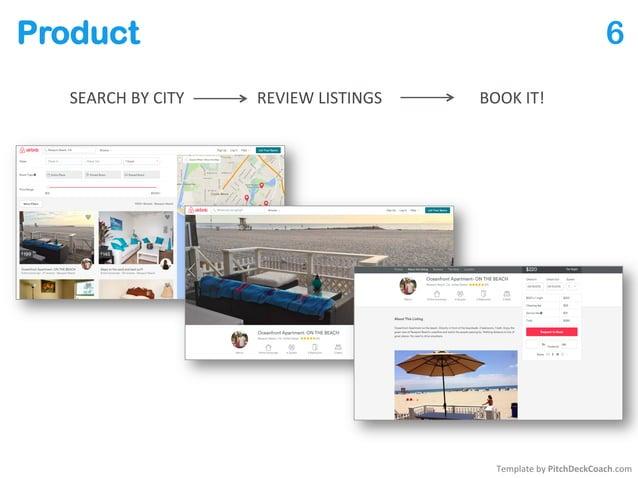
The product slide showcases Airbnb’s web platform with actual screenshots, proving they have moved beyond concept to functional MVP. The interface demonstrates core marketplace functionality—property listings, pricing, booking capabilities—while maintaining the design simplicity that characterises the entire deck. This tangible product proof is crucial for early-stage fundraising as it shows execution capability beyond just vision.
The slide’s emphasis on “renting space to travelers” reinforces the two-sided marketplace model while the visual interface suggests user-friendly design that could drive adoption. The platform’s web-based nature in 2008 positioned Airbnb ahead of mobile-first competitors, giving them time to build network effects before mobile disrupted user behaviour patterns.
What investors see: Proof of execution and technical competence, reducing technology risk while demonstrating product-market fit potential. The functional platform suggests immediate revenue capability and validates the team’s ability to build and iterate on complex marketplace dynamics including trust, payments, and user experience optimisation.
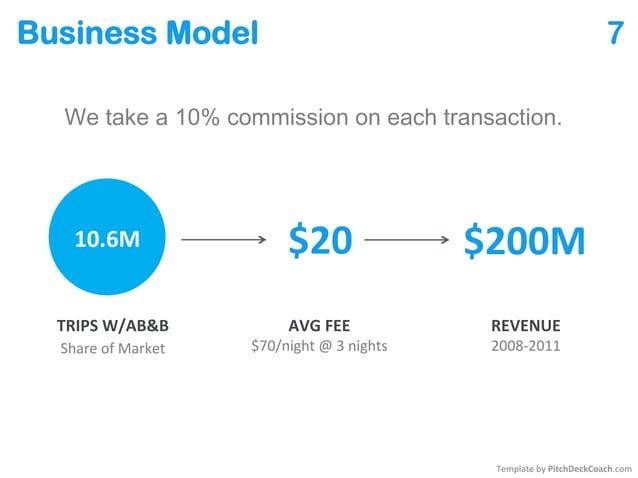
Airbnb’s business model slide presents a straightforward 10% commission structure with real pricing data from their MVP, demonstrating both simplicity and proof of early revenue generation. The slide shows average room rates around $80/night, positioning Airbnb in the mid-market segment rather than competing solely on lowest price. This pricing strategy suggests healthy unit economics and scalable revenue potential.
The commission model’s elegance lies in its alignment with marketplace growth—Airbnb only succeeds when hosts and guests successfully transact, creating natural incentives for platform optimisation. The 10% rate appears reasonable enough to avoid significant resistance while generating meaningful revenue per transaction. Real pricing data proves the model works in practice, not just in theory.
What investors see: A proven revenue model with immediate monetisation capability and clear path to scale economics. The commission structure suggests high gross margins and variable cost scaling, while the demonstrated pricing power at $80/night indicates potential for premium market expansion beyond pure budget accommodation.
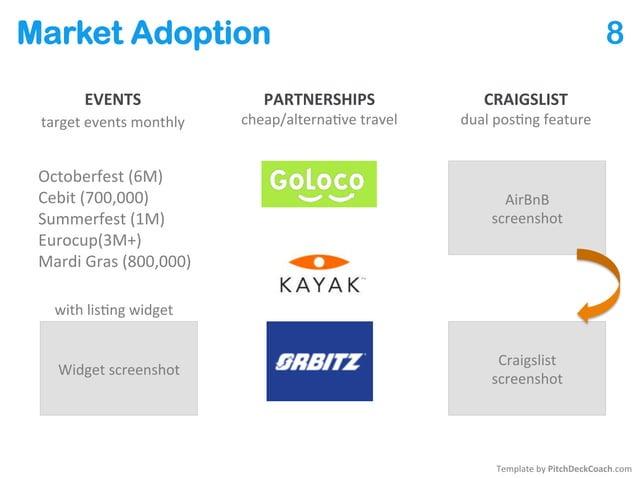
The market adoption slide outlines Airbnb’s go-to-market strategy centred on growth hacking techniques that leverage existing user behaviour patterns. The Craigslist cross-posting strategy is particularly brilliant—it allows Airbnb to tap into an established marketplace with proven demand while offering superior user experience. This approach provides immediate customer acquisition without requiring massive marketing spend.
The focus on national events and discount partnerships demonstrates sophisticated understanding of demand drivers and customer acquisition timing. Events create temporary accommodation scarcity, making alternative solutions more attractive, while partnerships provide credible third-party validation. These strategies show scrappy execution and capital-efficient growth, crucial for early-stage credibility.
What investors see: A team that understands customer acquisition economics and has proven ability to execute creative growth strategies. The integration with existing platforms suggests potential for rapid user acquisition, while event-based targeting demonstrates market timing sophistication that could drive efficient customer acquisition costs.
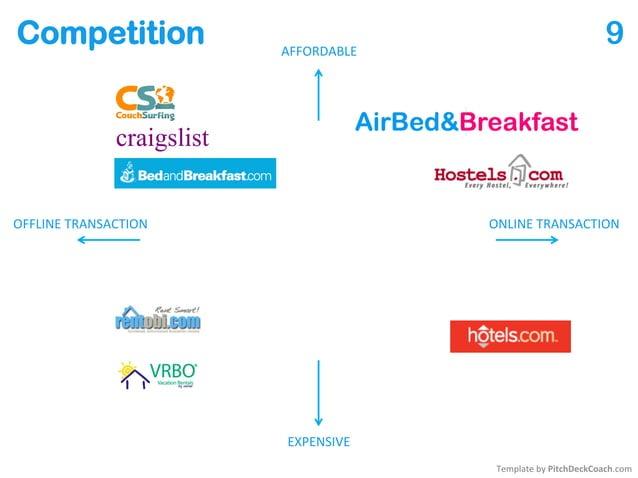
Airbnb’s competition slide strategically maps competitors across different threat levels, with logo sizing indicating relative competitive concern. The inclusion of both direct competitors (Couchsurfing) and adjacent ones (Craigslist, hotels) demonstrates comprehensive market understanding while positioning Airbnb in a unique competitive space. The visual approach makes complex competitive dynamics immediately digestible for investors.
The slide’s treatment of hotels as competition rather than a separate market validates Airbnb’s disruptive potential while acknowledging the scale of incumbent advantage. By including Craigslist and Couchsurfing, the slide shows awareness of existing solutions while implicitly suggesting their limitations create opportunity for purpose-built platforms with superior user experience.
What investors see: A market with validated demand but fragmented, suboptimal solutions, creating clear opportunity for a superior product. The competitive mapping suggests the team understands both direct threats and potential market expansion, while the visual hierarchy indicates strategic prioritisation of competitive concerns.
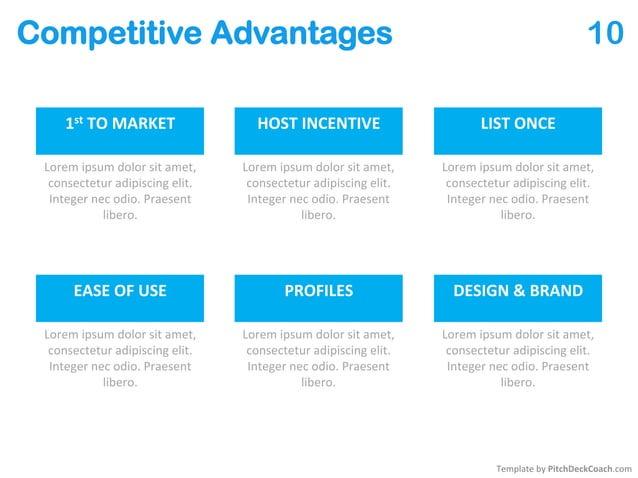
The competitive advantages slide highlights four key differentiators: first-mover advantage, host incentives, cross-platform listing efficiency, and superior user experience. These advantages span timing (first to market), economics (host incentives), operational efficiency (list once, use everywhere), and product quality (ease of use). This comprehensive approach suggests multiple defensive moats rather than reliance on a single competitive edge.
The emphasis on host incentives is particularly strategic—by creating economic value for suppliers, Airbnb builds network effects that become self-reinforcing as more hosts attract more guests, which attracts more hosts. The “list once, use everywhere” advantage suggests operational efficiency that competitors cannot easily replicate without significant platform integration investments.
What investors see: Multiple layers of competitive protection that compound over time, particularly the network effects from host incentives and first-mover advantages. The combination of timing, economics, and execution advantages suggests sustainable competitive positioning that becomes stronger with scale rather than more vulnerable to competition.

The team slide introduces the three founders with their complementary skill sets: Joe Gebbia (designer), Brian Chesky (CEO/designer), and Nathan Blecharczyk (CTO). This combination of design-heavy leadership and technical execution capability reflects the product’s emphasis on user experience and marketplace functionality. The dual design background suggests strong product intuition, while the technical founder ensures execution capability.
The team composition is strategically optimal for a marketplace business requiring both exceptional user experience (design expertise) and complex technical infrastructure (CTO capability). Their Y Combinator background adds credibility and suggests they’ve received validation from experienced startup mentors. The founder-market fit appears strong given their personal experience with the core problem.
What investors see: A balanced founding team with proven ability to identify market opportunities (they lived the problem), execute technically (functional platform), and prioritise user experience (design background). The team’s composition suggests they can build, iterate, and scale a consumer-facing technology platform while maintaining product quality and user satisfaction.
The press slide showcases early media mentions to establish third-party credibility and market validation beyond founder claims. Media coverage, particularly from recognised technology and business publications, suggests the concept has attracted attention from industry observers and validates the market opportunity. For early-stage companies, press coverage can substitute for extensive customer traction when building investor confidence.
The inclusion of press coverage also demonstrates the team’s ability to generate publicity and build brand awareness—crucial capabilities for consumer marketplace businesses that require broad market education and trust-building. Early media coverage can accelerate customer acquisition by providing credible third-party endorsement of the concept and execution.
What investors see: Market validation through independent media recognition, suggesting broader market interest beyond the founders’ personal networks. Press coverage indicates potential for viral growth and brand building, while media attention demonstrates the team’s ability to communicate their vision effectively to diverse audiences including customers, partners, and future employees.
[Insert image: airbnb-pitch-deck-slide-13-user-testimonials.webp]
The user testimonials slide provides powerful social proof through authentic customer voices validating the product experience and value proposition. Real user feedback demonstrates that Airbnb delivers on its promise of connecting travelers with authentic local experiences while providing practical value. The testimonials likely emphasise both functional benefits (cost, convenience) and emotional ones (cultural connection, unique experiences).
Customer testimonials are particularly valuable for marketplace businesses because they validate both sides of the transaction—hosts and guests must both find value for the platform to succeed. Positive feedback suggests early product-market fit and indicates potential for word-of-mouth growth, crucial for consumer platforms requiring trust and social acceptance.
What investors see: Evidence of product-market fit through customer satisfaction, reducing execution risk and validating market demand. Testimonials suggest potential for organic growth through referrals and repeat usage, indicating unit economics improvement over time as customer acquisition costs decline through word-of-mouth marketing.
[Insert image: airbnb-pitch-deck-slide-14-financial.webp]
The financial slide presents revenue projections and positions the $500K-$600K funding ask as an investment in billion-dollar potential rather than a plea for capital. The projections likely show hockey-stick growth driven by network effects and market expansion, while the funding amount appears calibrated to achieve specific milestones that derisk the next funding round. The slide frames investment as opportunity rather than necessity.
By leading with financial projections, Airbnb demonstrates confidence in their business model and market opportunity while providing investors with concrete return expectations. The funding ask appears reasonable relative to the projected opportunity, suggesting efficient capital deployment and realistic milestone achievement. The positioning emphasises growth acceleration rather than survival funding.
What investors see: A scalable financial model with clear path to venture-scale returns and efficient capital requirements for next-stage validation. The funding ask suggests disciplined capital allocation and realistic milestone planning, while the revenue projections indicate understanding of marketplace dynamics and growth drivers that could support significant valuation expansion.
While this deck secured one of the most consequential seed investments in startup history, launching a company now valued at over $110 billion, it is not without gaps when measured against modern fundraising standards. The 2008 fundraising environment was markedly different—investors placed greater emphasis on vision and market opportunity rather than detailed metrics and operational sophistication. Several elements that are now considered essential for institutional fundraising are notably absent from this presentation, reflecting both the era’s norms and the founders’ focus on simplicity over comprehensiveness.
Modern pitch decks invariably include a dedicated contact slide with founder email addresses, company location, website, and clear next steps for interested investors. This facilitates immediate follow-up and provides context about operational base and communication preferences, elements that improve investor experience and signal professional preparation.
Beyond basic pricing data, contemporary investors expect comprehensive traction metrics including user growth rates, booking volumes, retention cohorts, and geographic expansion data. These metrics prove product-market fit quantitatively rather than relying primarily on testimonials and press coverage, providing investors with concrete evidence of business momentum and market validation.
The deck’s visual design reflects 2008 standards with inconsistent fonts, low-resolution imagery, and basic formatting that would appear unprofessional by today’s expectations. Modern pitch decks require cohesive branding, high-quality visuals, consistent typography, and often animation or interactive elements that demonstrate design sophistication and attention to detail that investors interpret as operational excellence indicators.
The sharing economy’s regulatory complexities, safety concerns, and trust mechanisms are entirely unaddressed, despite these being fundamental challenges for the business model. Today’s investors expect frank discussion of key risks including regulatory compliance, insurance liability, quality control, and competitive responses, along with specific strategies for risk mitigation and crisis management.
Contemporary fundraising standards require detailed capitalisation table showing existing ownership, option pool allocation, and post-investment dilution, alongside specific use-of-funds breakdown detailing how investment capital will be deployed across hiring, marketing, product development, and operational scaling to achieve defined milestones and next-round readiness.
Modern investors expect clear product development roadmap showing planned features, mobile strategy, international expansion timeline, and technology infrastructure scaling plans. This demonstrates strategic thinking beyond current MVP and provides confidence in the team’s ability to execute complex product development while maintaining competitive advantages through continuous innovation.
The team slide exclusively features the three male founders without acknowledgment of advisors, diversity initiatives, or planned team expansion across different demographics and expertise areas. Current investor expectations include advisor showcase, diversity and inclusion commitments, and plans for building inclusive leadership teams that reflect global customer demographics and varied expertise requirements.
These omissions don’t diminish the deck’s historical effectiveness, but they do highlight how fundraising expectations have evolved toward greater transparency, operational sophistication, and comprehensive risk assessment. At Projects RH, we work with founders to address these modern requirements while maintaining the clarity and compelling narrative that made Airbnb’s original presentation so successful.
Airbnb’s tagline “Book rooms with locals, rather than hotels” distills a complex marketplace into seven words that anyone can immediately understand. Test your value proposition on people outside your industry—if they require explanation, keep simplifying until the concept becomes instantly clear.
Lead with customer pain points that investors can personally relate to—expensive hotels, cultural disconnection, and impersonal experiences resonate universally. Build emotional connection to the problem before presenting your solution to ensure investors feel the urgency you’re addressing.
Validate market demand using competitor data, industry statistics, and existing user behaviour rather than hypothetical projections. Airbnb proved demand through Craigslist usage and travel spending data, providing credible evidence that reduced investor risk perception about market acceptance.
Position your funding ask as an investment in billion-dollar potential rather than capital necessity. Airbnb’s financial slide emphasised massive return opportunity rather than survival needs, shifting investor psychology from risk assessment to FOMO about missing a transformational investment.
Use visual competitive analysis to demonstrate specific advantages over alternatives, particularly those that strengthen with scale like network effects and first-mover benefits. Quantify your competitive moats wherever possible rather than making generic claims about superior execution.
Airbnb’s 14 slides prove that brevity drives impact—every slide serves a specific purpose without redundancy or filler content. Ruthlessly cut anything that doesn’t directly support your investment thesis or answer fundamental investor questions about market, product, team, and returns.
Detail creative customer acquisition strategies like Airbnb’s Craigslist integration to prove scrappy execution capability and capital-efficient growth potential. Investors want evidence that you can acquire customers cost-effectively through innovative approaches rather than expensive traditional marketing.
The distance between the Airbnb that presented this deck and the Airbnb that exists today represents one of the most remarkable value creation stories in venture capital history. In 2008, three founders were seeking $600,000 to scale what many investors dismissed as a niche solution for budget travelers. Today, Airbnb operates as a $110 billion global platform that has fundamentally transformed travel behaviour and created an entirely new category of hospitality infrastructure.
For the investors who backed this seed round, the returns have been extraordinary by any measure. Sequoia Capital’s investment, for example, has generated returns exceeding 100x the original investment amount, representing one of the highest-performing seed investments in the firm’s history. The $600,000 raised has facilitated the creation of over $100 billion in market value, demonstrating how venture capital can amplify innovative ideas into global transformational businesses.
This transformation validates the fundamental venture capital thesis: that exceptional founders with transformational ideas can create value far exceeding initial investment requirements when provided with appropriate capital and strategic support. Airbnb’s journey from air mattresses to global platform exemplifies how seed-stage investments in marketplace businesses can generate venture-scale returns through network effects, international expansion, and continuous product innovation that compounds value creation over time.
At Projects RH, we help companies across all industries create investor-ready materials that close deals. Our integrated capital raising package ensures consistency across all your investor documentation.
Built in-house for accuracy and investor confidence.
Comprehensive investor documentation following global best practices.
12-slide investor-ready presentation with supporting materials.
High-impact snapshot to capture investor attention fast.
Browse our collection of real pitch deck breakdowns from the world’s most successful companies.
The Airbnb pitch deck had 14 slides, covering essentials from problem to financials without fluff, proving brevity drives clarity and investor buy-in.
Airbnb raised $600,000 in seed funding using this 2008 deck from Sequoia, a16z, Founders Fund, post-Y Combinator.
Success came from crystal-clear problem/solution framing, data-backed market size, simple visuals, and positioning funding as a high-ROI opportunity despite unpolished design.
Yes, emulate its structure, simplicity, and focus on market validation, but modernize with traction metrics, visuals, and use-of-funds for today's standards.
Early seed stage post-Y Combinator in 2008, pre-significant revenue but with validated MVP and scrappy growth tactics.
Creating an effective pitch deck requires more than following a template — it demands strategic clarity about your value proposition, a deep understanding of your target investors, and rigorous financial modelling to support your narrative. At Projects RH, we combine financial expertise with strategic storytelling to build pitch decks, information memorandums, and financial models that meet the standards of institutional investors worldwide. Our team has generated over USD 2.0 billion in expressions of interest across mining, energy, technology, medtech, and financial services sectors. Schedule a consultation to discuss how we can help position your company for successful capital raising.

CEO, Projects RH Business and financial expert. Paul Raftery is a seasoned financial executive with extensive expertise in business management, finance, and accounting. He has held significant governance roles, including Group Treasurer at Shell Coal & Power International and Executive Manager – Finance & Investment at Thiess.
Successful capital raising starts long before the first investor meeting — it begins with a story that inspires confidence. That’s why professional pitch deck consulting is one of the most critical investments a founder can make.