
Dive into our detailed analysis of the 11-slide pitch deck that helped Booking.com secure $500,000 in seed funding from Houtex in 1999.
Booking.com was founded in 1996 in Amsterdam by Gillian Tans and a small team of entrepreneurs who recognised the untapped potential of the internet to revolutionise travel bookings. Initially launched as Bookings.nl, it targeted the Dutch market with a simple online hotel reservation system, capitalising on the early web boom when most bookings were still conducted via telephone or through traditional travel agents. The founders understood that the internet could eliminate the friction and inefficiencies that plagued the travel industry, creating a direct connection between travellers and accommodation providers. This innovative approach is akin to the principles of pitch deck consulting, where identifying market gaps can lead to transformative solutions.
The early years were marked by significant challenges, including building consumer trust in online payments, securing hotel partnerships from establishments sceptical of internet commerce, and competing against well-established offline travel agencies. Rather than remain constrained by these obstacles, the team executed a strategic pivot from their initial local focus to aggressive international expansion. They systematically signed up hotels across Europe and beyond, whilst continuously iterating on their platform to improve usability and deliver real-time inventory management—a revolutionary concept at the time.
By 1999, with demonstrable traction evidenced by thousands of completed bookings and partnerships spanning 5,000+ hotels across 50 countries, they prepared this pitch deck for seed funding. They approached Houtex, presenting a compelling narrative around the massive global opportunity in online travel. The deck’s clear storytelling, backed by early validation data, successfully convinced investors of the company’s potential to capture significant market share in the emerging digital travel ecosystem.
This $500,000 seed investment proved catalytic, propelling Booking.com into hyper-growth mode as they expanded their global footprint, refined their technology platform, and built the foundation for what would become the world’s leading online travel agency. The company went public in 2005 via NASDAQ and was subsequently acquired by Priceline (now Booking Holdings) later that year for $133 million—a remarkable 266x return on the initial seed investment that validated the founders’ original vision of democratising global travel through technology.

The cover slide immediately establishes ambitious intent with the tagline “The world’s leading hotel reservation service”—a bold claim for a company seeking seed funding. The visual approach combines the clean Booking.com logo with imagery of global destinations, instantly communicating both the travel focus and international scope of the opportunity. This design choice demonstrates confidence and vision, suggesting the founders weren’t thinking locally but globally from day one.
The strategic positioning as “the world’s leading” service, despite being a seed-stage company, reflects the winner-takes-all dynamics of internet marketplaces that were becoming apparent in 1999. This wasn’t mere hyperbole but a recognition that network effects and first-mover advantages could enable rapid domination of fragmented markets. The imagery of diverse global destinations reinforces the universal nature of travel demand and the platform’s potential to serve any traveller, anywhere.
What investors see: A management team with global ambitions and clear market positioning in a massive, underserved opportunity. The confidence to claim leadership position suggests founders who understand market dynamics and are thinking beyond incremental improvements to fundamental industry transformation. This signals the type of bold vision that can generate venture-scale returns.
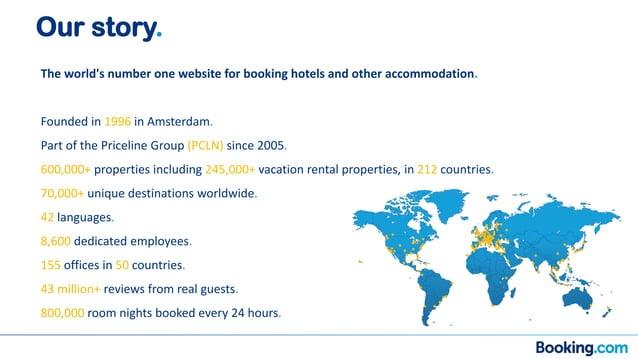
“Enable everyone in the world to experience the world” represents one of the most compelling mission statements in startup history, encapsulating both democratic ideals and massive market opportunity. This vision goes beyond mere hotel bookings to position the company as a facilitator of human connection and cultural exchange. The aspiration is both emotionally resonant and commercially expansive, suggesting multiple product lines and geographic markets.
The emphasis on “everyone” and “the world” reflects the founders’ understanding of internet scalability and the potential to serve previously underserved customer segments. Traditional travel booking through agencies was often expensive and complex, limiting travel to affluent customers with time and resources to navigate fragmented booking processes. By democratising access through technology, Booking.com positioned itself to expand the total addressable market rather than simply capturing share from existing players.
What investors see: A company with mission-driven leadership and a vision that extends far beyond their current product offering. This type of expansive thinking suggests strong founder-market fit and the potential for multiple waves of product innovation. The global scope implies venture-scale market opportunity with meaningful barriers to entry once network effects take hold.
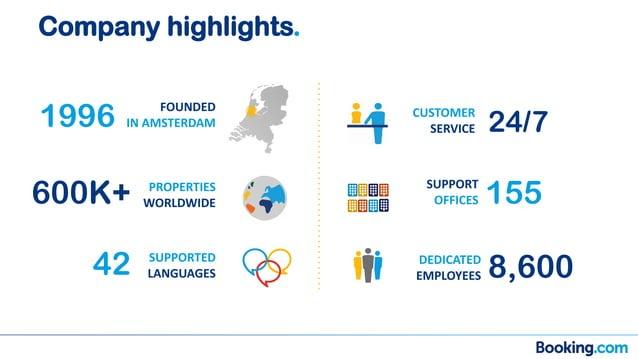
The problem slide effectively articulates the pain points that plagued travel booking in the late 1990s: fragmented information sources, complex multi-step processes, high costs due to intermediary markups, and lack of real-time availability across global hotel inventories. These weren’t minor inconveniences but fundamental barriers that limited travel frequency and accessibility. The visual representation likely includes icons depicting frustrated phone calls, unavailable rooms, and time-consuming research processes that resonated with every business traveller and holidaymaker.
By framing these issues as systemic rather than isolated incidents, Booking.com positioned itself to address market-wide inefficiencies rather than competing for existing demand. The emphasis on global scale challenges highlighted the complexity that only technology could solve—no human-powered travel agency could maintain real-time inventory across thousands of hotels worldwide. This problem definition naturally led to an internet-based solution whilst establishing significant barriers to entry for traditional competitors.
What investors see: A large, well-defined problem with clear economic impact that affects millions of potential customers. The systematic nature of these issues suggests that solving them creates sustainable competitive advantages and high switching costs. This type of infrastructure problem, once solved, tends to generate winner-takes-all dynamics and recurring revenue streams.
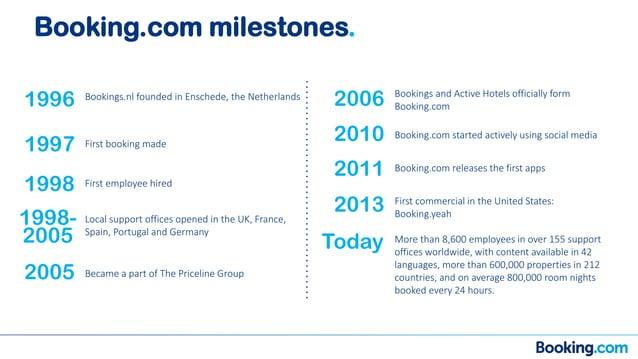
The solution slide presents Booking.com as a comprehensive online platform that aggregates global hotel inventories with real-time rates and availability, secure payment processing, and seamless booking confirmation. The screenshot of their early website interface demonstrates the radical simplification they brought to travel booking—what previously required multiple phone calls and manual coordination could now be accomplished in minutes. This visual proof of concept was crucial in 1999 when many investors were still sceptical about e-commerce adoption.
The platform approach addressed each pain point systematically: fragmented information became centralised search, complex processes became intuitive user flows, high costs were reduced through direct hotel relationships, and availability uncertainty was eliminated through real-time connectivity. The solution’s elegance lay in its simplicity—users could search, compare, and book accommodations globally from a single interface. This represented a fundamental shift from travel booking as a service to travel booking as a product.
What investors see: A technology solution with clear differentiation and immediate user value that addresses genuine market need. The platform’s network effects become apparent—more hotels attract more users, more users attract more hotels, creating a virtuous cycle that competitors struggle to replicate. This type of two-sided marketplace with strong network effects typically generates sustainable competitive moats and high margins.
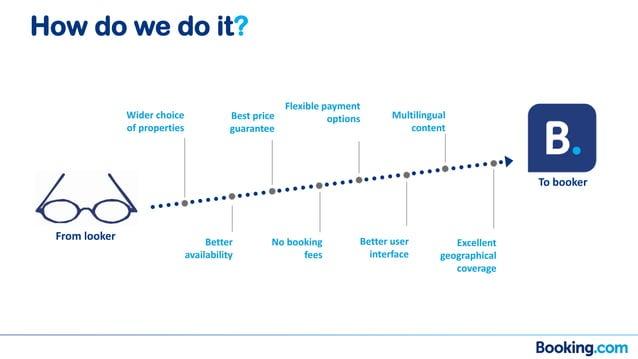
The market opportunity slide quantifies the massive Total Addressable Market with the global hotel industry valued in the billions, supported by compelling charts showing explosive growth in internet penetration and the inevitable shift from offline travel agencies to online platforms. The data presentation likely includes projections of online booking penetration rates across different geographic markets, demonstrating the early-stage nature of digital adoption in travel. This positioning was prescient, as the founders correctly identified that travel would become one of e-commerce’s largest categories.
The timing argument was particularly compelling in 1999, as internet adoption was accelerating globally but online travel booking remained nascent. By establishing first-mover advantage in key markets, Booking.com could build network effects and customer loyalty before larger competitors recognised the opportunity. The slide likely emphasised the fragmented nature of global hotel inventory, requiring a technology solution that traditional travel agencies couldn’t match due to scale and operational complexity.
What investors see: A massive, growing market in the early stages of digital disruption with clear timing advantages for early entrants. The combination of large TAM, secular growth trends, and technological enablement suggests significant venture-scale opportunity with potential for market leadership. This type of macro-trend alignment often produces the highest-returning investments in venture capital.

The business model slide articulates a elegant commission-based approach: no upfront fees to hotels, earning 10-15% commission per completed booking, creating a scalable revenue engine with powerful network effects. This model was revolutionary because it aligned Booking.com’s interests with both hotels (who only pay for actual bookings) and travellers (who get competitive rates). The diagram likely shows the two-sided marketplace connecting travellers and hotels through commission-based transactions, emphasising the win-win-win nature of the platform.
The commission model’s brilliance lies in its scalability and risk alignment—Booking.com only earns when customers complete bookings, ensuring quality service whilst generating recurring revenue from successful transactions. Unlike traditional travel agencies that required significant working capital and physical infrastructure, this digital model could scale globally with minimal incremental costs. The network effects become self-reinforcing: more hotels increase consumer choice, more consumers increase booking volume, higher volume attracts more hotels.
What investors see: A proven business model with strong unit economics, natural scalability, and risk-aligned revenue streams that generate increasing returns as the network grows. Commission-based marketplaces often exhibit venture-scale characteristics with high gross margins, recurring revenue, and winner-takes-all dynamics. This model structure suggests sustainable competitive advantages and attractive long-term profitability.
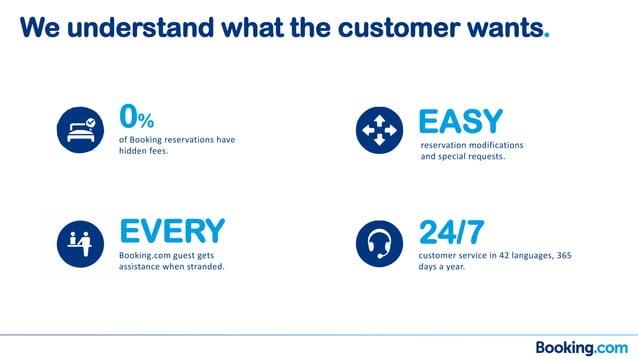
The traction slide presents compelling early metrics: partnerships with over 5,000 hotels across 50 countries, thousands of monthly bookings, and rapid user acquisition growth curves. These numbers were impressive for a seed-stage company in 1999, demonstrating genuine product-market fit in a large addressable market. The geographic spread across 50 countries validated the global scalability thesis whilst the growing booking volume proved consumer adoption of online travel booking. Visual graphs likely show exponential growth curves that were characteristic of successful internet companies during this period.
The hotel partnership metrics were particularly significant because they demonstrated supply-side adoption—convincing hotels to integrate their inventory with an unknown internet startup required substantial relationship-building and trust establishment. The thousands of monthly bookings proved demand-side validation whilst the rapid user growth indicated strong organic adoption and potentially viral characteristics. This combination of supply and demand traction suggested the platform was achieving the network effects critical to marketplace success.
What investors see: Strong early validation with both supply and demand sides of the marketplace showing adoption, suggesting product-market fit and scalable growth potential. The geographic diversity demonstrates international expansion capability whilst the growth trajectory indicates the possibility of achieving market leadership. This type of early traction typically correlates with successful venture outcomes and suggests management execution capability.
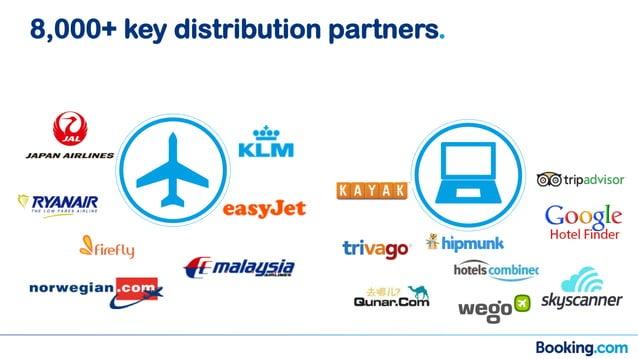
The team slide showcases founders with complementary expertise in technology and travel: CEO Gillian Tans with her strategic vision and operational experience, and CTO Geert-Jan Bruinsma bringing technical depth and system architecture capability. Their Amsterdam base provided strategic advantages in the European market whilst their serial entrepreneur background suggested experience navigating the challenges of building and scaling technology companies. The team composition balanced business leadership with technical execution, essential for a platform business requiring both market development and complex system integration.
The founding team’s domain expertise in both technology and travel positioned them to understand customer needs whilst building scalable solutions. Their track record of execution, evidenced by the early traction metrics, demonstrated capability to translate vision into operational reality. The lean team structure typical of successful startups showed capital efficiency whilst the leadership diversity suggested ability to handle both strategic and operational challenges as the company scaled globally.
What investors see: A balanced founding team with proven execution capability and relevant domain expertise that increases the probability of successful market capture. The combination of strategic leadership and technical depth suggests ability to navigate both business development and product scaling challenges. Investor confidence often depends heavily on management team credibility, particularly in complex marketplace businesses requiring multi-sided coordination.
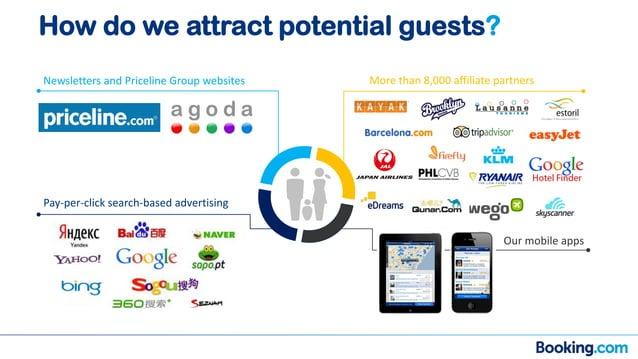
The financial projections demonstrate a clear path to significant revenue growth reaching millions within several years, with a credible break-even timeline supported by low customer acquisition costs driven by SEO optimization and strategic partnerships. The charts likely show the characteristic hockey-stick growth curve of successful internet businesses, with initial investment in platform development and market expansion followed by accelerating returns as network effects mature. The emphasis on low CAC was particularly important in 1999 when online customer acquisition was still nascent and companies were learning to leverage digital marketing channels.
The commission-based model naturally generated attractive unit economics with high gross margins and scaling operational leverage as booking volume increased. The financial model likely showed conservative growth assumptions whilst highlighting the potential for significant upside if market adoption accelerated or geographic expansion proceeded faster than projected. The break-even analysis demonstrated capital efficiency and reduced investor risk by showing a clear path to profitability without requiring multiple funding rounds.
What investors see: Well-structured financial projections showing realistic growth assumptions with attractive unit economics and clear path to profitability that reduces execution risk. The low CAC and high lifetime value characteristics of marketplace businesses often generate venture-scale returns with strong cash generation capabilities. Financial discipline combined with growth ambition suggests management team capable of scaling efficiently whilst maintaining profitability focus.
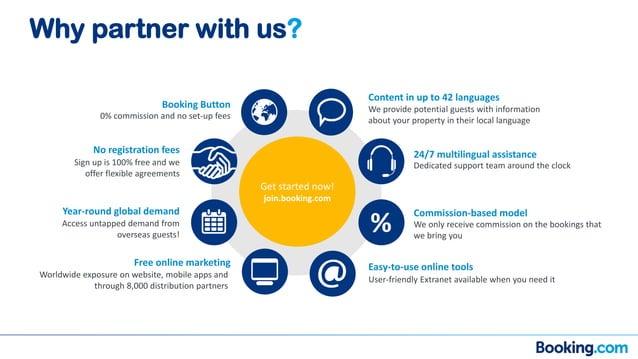
The competitive analysis positions Booking.com against emerging online travel agencies like Expedia and Hotels.com, differentiating through broader hotel inventory, more competitive pricing, and superior technology infrastructure. The competitive matrix likely highlights key advantages: deeper global hotel relationships, more intuitive user experience, and better real-time inventory management. This positioning was crucial in 1999 as the online travel market was consolidating around several major players, requiring clear differentiation to achieve sustainable competitive positioning.
The strategy of competing on inventory breadth and pricing rather than marketing spend was prescient, as it created sustainable competitive moats that were difficult for competitors to replicate quickly. By focusing on hotel relationships and technology excellence, Booking.com built advantages that compounded over time rather than relying on capital-intensive customer acquisition that larger competitors could outspend. The emphasis on superior technology positioned the company for long-term market leadership as user expectations for booking experience continued evolving.
What investors see: Clear competitive differentiation based on sustainable advantages rather than easily replicable features, suggesting potential for market leadership and pricing power. The focus on inventory and technology over marketing spend indicates capital-efficient growth strategy with compound competitive benefits. Understanding competitive dynamics and having a clear positioning strategy typically correlates with successful venture outcomes in crowded markets.

The funding request clearly articulates the $500,000 seed requirement with specific allocation across product development, marketing initiatives, and international expansion activities, accompanied by detailed milestones that would be achieved with this capital injection. The pie chart visualisation likely breaks down the use of funds into technology infrastructure, team expansion, marketing and partnerships, and working capital, providing transparency into capital deployment strategy. The milestone-based approach demonstrated disciplined capital allocation and provided investors with clear metrics for measuring progress and success.
The specific funding amount reflected the capital requirements for achieving key inflection points: enhancing platform functionality, expanding hotel partnerships, and scaling into additional geographic markets. The strategic use of funds emphasised growth acceleration rather than basic operations, suggesting the company had achieved early validation and was ready for scaling investment. The milestone framework provided accountability whilst the expected outcomes gave investors clear visibility into value creation potential from their capital contribution.
What investors see: Disciplined capital requirements with clear value creation milestones that reduce execution risk whilst providing measurable progress indicators. The specific use of funds and expected outcomes suggest management team with strong operational planning and accountability mindset. Well-structured funding requests often indicate higher probability of successful capital deployment and achieving projected growth milestones.
While this deck secured one of the most transformative investments in travel technology history, propelling Booking.com from a promising Dutch startup to the world’s dominant online travel platform, it reflects the fundraising standards and investor expectations of 1999 rather than today’s more rigorous requirements. Contemporary investors demand deeper validation metrics, more sophisticated financial modelling, and comprehensive risk analysis that weren’t standard practice during the early internet boom period.
Lacks detailed, quantifiable traction like MRR, user growth rates, or retention; modern decks require hard KPIs to prove product-market fit and reduce perceived risk.
No specific customer acquisition plan, CAC/LTV analysis, or marketing roadmap; investors today expect clarity on scalable growth engines.
High-level projections without unit economics, burn rate, or sensitivity analysis; contemporary decks include detailed spreadsheets to validate assumptions.
Brief team slide without prior exits, domain expertise metrics, or advisors; modern standards demand proof of execution capability.
Omits discussion of regulatory, competitive, or execution risks; transparency on challenges builds credibility in today’s discerning VC environment.
No mention of potential acquirers or IPO path; investors now seek alignment on liquidity events early.
Absent future feature plans or tech moats like AI personalisation; SaaS-era decks emphasise innovation pipeline.
These gaps reflect the evolving sophistication of venture capital and the higher barriers to investment that characterise today’s competitive fundraising environment. At Projects RH, we help founders address these modern requirements whilst maintaining the compelling narrative and strategic clarity that made the Booking.com deck successful, ensuring their pitch resonates with contemporary investor expectations and due diligence standards.
Start with an inspiring vision like ‘Enable everyone to experience the world’ to emotionally hook investors before diving into details; founders should craft one bold statement that encapsulates long-term impact.
Clearly articulate a scalable model (commission-only) early; test yours for 30-second explainability to ensure instant comprehension.
Quantify TAM aggressively but credibly with visuals; founders must research and visualise why their slice is worth billions.
Even modest metrics like hotel partnerships proved momentum; prioritise any real data over hypotheticals to demonstrate demand.
11 slides focused on essentials worked in 1999 and still do; ruthlessly cut to 10-15 slides, one idea per slide for investor attention.
Competitive positioning showed clear edges; map your moats visually against incumbents to answer ‘why you?’
Explicit funding amount and use builds trust; always specify dollar figure, milestones, and valuation to drive decisions.
The distance between the Booking.com that presented this deck and the Booking.com that exists today represents one of the most remarkable value creation stories in technology history, transforming a $500,000 seed investment into a position within the world’s largest online travel company worth over $140 billion in market capitalisation, demonstrating the extraordinary returns possible when venture capital meets exceptional execution and market timing.
The $500,000 seed investment that Houtex made based on this pitch deck generated returns that exemplify venture capital’s highest aspirations. When Priceline acquired Booking.com in 2005 for $133 million, the initial investors achieved a 266x return in just six years. However, this was merely the beginning—Booking.com’s integration into Booking Holdings and subsequent growth has created enterprise value exceeding $140 billion, making this one of the highest-returning venture investments in travel technology history.
The transformation from a Dutch startup processing thousands of monthly bookings to the world’s dominant online travel platform generating $22.5 billion in annual revenue validates the power of early-stage vision combined with exceptional execution. This deck demonstrates that the most successful venture investments often begin with simple presentations that capture massive market opportunities at inflection moments—when the right team meets the right market with the right technology at precisely the right time.
At Projects RH, we help companies across all industries create investor-ready materials that close deals. Our integrated capital raising package ensures consistency across all your investor documentation.
Built in-house for accuracy and investor confidence.
Comprehensive investor documentation following global best practices.
12-slide investor-ready presentation with supporting materials.
High-impact snapshot to capture investor attention fast.
Browse our collection of real pitch deck breakdowns from the world’s most successful companies.
The deck consisted of 11 concise slides, covering essentials from vision to the funding ask, proving brevity drives clarity even in early internet era pitches.
They raised $500,000 in seed funding from Houtex, used to scale hotel partnerships and tech infrastructure, catalyzing global expansion.
Success stemmed from a compelling vision, clear problem-solution fit, massive market emphasis, early traction proof, and simple commission model, resonating with investors seeking the next big internet play.
Yes, as a foundational template for its structure and storytelling, but adapt for modern expectations like traction metrics, financial models, and GTM plans; it's timeless for vision and simplicity.
Seed stage in 1999, post-initial product launch with early revenue and partnerships, positioning for acceleration into international markets.
Creating an effective pitch deck requires more than following a template — it demands strategic clarity about your value proposition, a deep understanding of your target investors, and rigorous financial modelling to support your narrative. At Projects RH, we combine financial expertise with strategic storytelling to build pitch decks, information memorandums, and financial models that meet the standards of institutional investors worldwide. Our team has generated over USD 2.0 billion in expressions of interest across mining, energy, technology, medtech, and financial services sectors. Schedule a consultation to discuss how we can help position your company for successful capital raising.

CEO, Projects RH Business and financial expert. Paul Raftery is a seasoned financial executive with extensive expertise in business management, finance, and accounting. He has held significant governance roles, including Group Treasurer at Shell Coal & Power International and Executive Manager – Finance & Investment at Thiess.
Scaling requires capital, and capital requires credibility. Growth-stage businesses benefit enormously from capital raising consulting that structures the deal and pitch deck consulting services that tell the growth story investors want to hear.