
Dive into the 7-slide analysis of the Coinbase pitch deck that secured $600,000 in seed funding from Y Combinator, Adam Draper, and Union Square Ventures in 2012.
“Coinbase was founded in 2012 by Brian Armstrong, who was seeking a co-founder via a blog post amid widespread scepticism toward a ‘PayPal for Bitcoin’ idea when Bitcoin traded at just $13. Armstrong, drawing from his Airbnb engineering experience, aimed to simplify Bitcoin’s notorious complexity for mainstream users through a hosted wallet service that would eliminate the technical barriers preventing mass adoption. For those looking to launch similar ventures, expert pitch deck guidance can be invaluable.”
Early challenges included explaining Bitcoin to investors who barely understood the technology and overcoming attacks on the concept’s viability from both traditional finance sceptics and Bitcoin purists. The team pivoted from pitching pure payment network volume to emphasising user-friendly wallet traction, focusing on early adopters in remittances and micro-transactions whilst navigating regulatory uncertainties that could have killed the business overnight.
Fundraising began with Y Combinator’s guidance for clear, concise narratives that could cut through the noise of a confusing new technology. Brian pitched this deck to investors like Adam Draper, articulating the vision in just 7 slides despite bare-bones design, securing seed capital by sparking curiosity rather than overwhelming with technical details.
The pitch succeeded spectacularly, raising $600K seed funding and validating the ‘grow first, monetise later’ model that would become a Silicon Valley staple. This launched Coinbase’s path from a simple hosted wallet to unicorn status, public listing, and eventual dominance in the crypto exchange landscape.
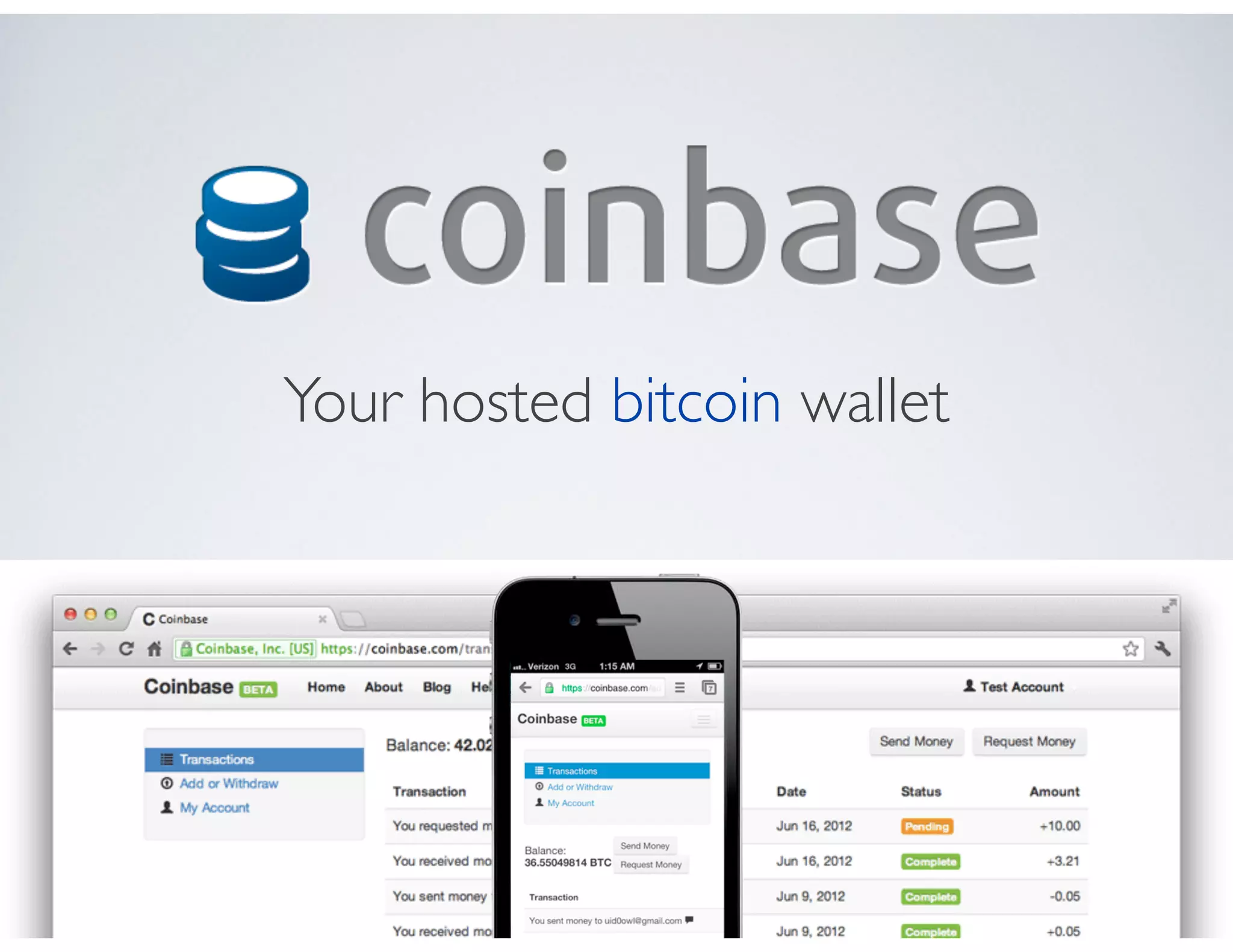
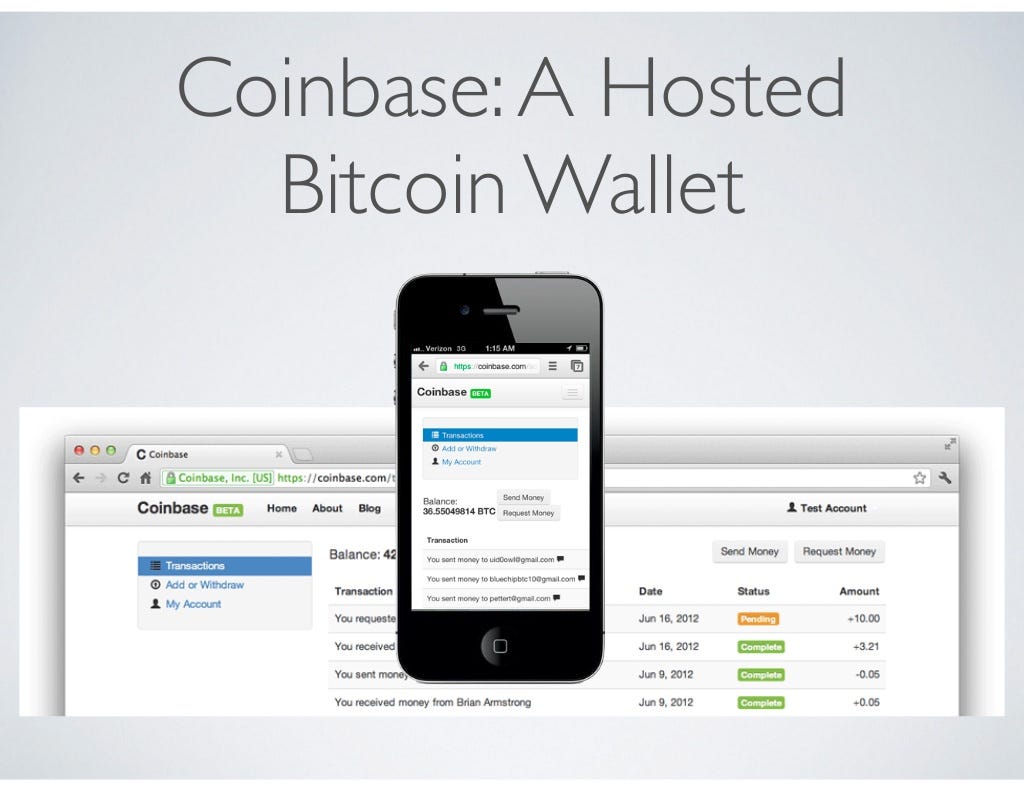
The opening slide features the Coinbase logo alongside the tagline ‘your hosted bitcoin wallet’ and product screenshots from both desktop and mobile versions to immediately convey the simple, accessible product offering. This direct approach eliminates confusion about what the company does—a critical consideration when introducing an entirely new technology category to investors. The visual emphasis on both web and mobile interfaces signals the founders’ understanding that Bitcoin adoption would require seamless cross-platform accessibility.
The choice to lead with product screenshots rather than abstract concepts demonstrates product-first thinking that resonates with practical investors. By showing actual interfaces, Coinbase proves they’ve moved beyond ideation to execution, a crucial differentiation in a space filled with theoretical Bitcoin projects. The clean, consumer-friendly design language visible in these screenshots immediately positions Coinbase as the user-experience leader in a notoriously complex technical field.
What investors see: A team that has already solved the primary barrier to Bitcoin adoption—usability—whilst competitors remain focused on technical architecture. The professional interface design suggests operational maturity beyond typical seed-stage companies, indicating founders who understand that consumer adoption drives network effects in two-sided marketplaces. This cover slide positions Coinbase as infrastructure rather than speculation, appealing to investors seeking sustainable business models in emerging technologies.
This slide lists target users and use cases including international payments, virtual goods, games, developing world applications, peer-to-peer transfers, micro-transactions, remittances, and e-commerce to show expanding market segments starting from early adopters. The strategic sequencing moves from niche applications to broader financial services, demonstrating the founders’ understanding of technology adoption curves. Each segment represents a distinct revenue opportunity whilst collectively painting a picture of Bitcoin’s transformative potential across multiple industries.
The inclusion of “developing world” signals sophisticated thinking about Bitcoin’s advantages in markets with limited banking infrastructure, whilst “virtual goods” and “games” target early monetisation opportunities with digital-native users. This diverse portfolio approach reduces single-market dependency whilst positioning Coinbase to capture value across the entire Bitcoin ecosystem. The emphasis on remittances and international payments directly challenges traditional financial services with superior speed and cost advantages.
What investors see: A total addressable market strategy that starts focused but scales massively, demonstrating the founders’ ability to think strategically about market expansion. The breadth of applications suggests platform potential rather than point solution thinking, indicating multiple monetisation pathways and reduced competitive vulnerability. This slide positions Coinbase as infrastructure for an entire digital economy rather than a niche Bitcoin wallet, fundamentally reframing the investment opportunity from crypto speculation to financial services disruption.
The problem slide contrasts complex traditional Bitcoin wallet interfaces with Coinbase’s simple solution through a powerful side-by-side visual comparison that immediately demonstrates user pain points in Bitcoin management. Traditional wallet software required users to understand private keys, blockchain synchronisation, and command-line interfaces—barriers that limited Bitcoin adoption to technical enthusiasts. The visual contrast makes the problem visceral and obvious, eliminating the need for lengthy explanations about user experience challenges.
This problem framing positions complexity as the primary barrier to Bitcoin adoption rather than regulatory concerns or volatility, focusing investor attention on a solvable technical challenge. The visual comparison validates Coinbase’s product-market fit by showing exactly what they’ve simplified and why it matters. By leading with user experience rather than technological capabilities, the founders demonstrate consumer-first thinking that appeals to mainstream adoption scenarios.
What investors see: A clearly defined problem with an obvious solution that the team has already built, reducing execution risk significantly. The visual proof demonstrates that user experience is the primary competitive moat in cryptocurrency services, not technical sophistication—a counterintuitive insight that suggests sustainable competitive advantage. This problem framing positions Coinbase as the bridge between early adopters and mainstream users, capturing the entire market expansion opportunity as Bitcoin grows beyond its technical origins.
[Insert image: coinbase-pitch-deck-slide-04-analogy.webp]
The powerful analogy “Coinbase: Bitcoin :: iTunes: MP3” positions Coinbase as the iTunes for Bitcoin, making it easy, legal, and accessible like iTunes did for MP3s, fundamentally reframing the niche product for mainstream appeal. This comparison leverages investors’ familiarity with Apple’s transformation of digital music consumption from technical complexity to consumer simplicity. The analogy suggests that Bitcoin, like MP3s before iTunes, has transformative potential constrained only by user experience barriers.
The iTunes comparison is particularly astute because it emphasises legitimacy and mainstream adoption rather than technical superiority, addressing investor concerns about Bitcoin’s regulatory and consumer acceptance challenges. Just as iTunes made digital music purchasing respectable and simple, Coinbase aims to make Bitcoin transactions trustworthy and accessible to non-technical users. This positions Coinbase as infrastructure for Bitcoin’s consumer adoption rather than a tool for cryptocurrency enthusiasts.
What investors see: A massive market opportunity disguised as a niche technology play, with clear precedent for how simplification drives mainstream adoption. The iTunes analogy suggests winner-take-all dynamics in consumer cryptocurrency services, implying significant market share concentration for the dominant platform. This framing transforms Bitcoin from speculative technology into inevitable infrastructure, positioning early Coinbase investment as capturing the iTunes of digital currency before mass market adoption begins.
[Insert image: coinbase-pitch-deck-slide-05-associations.webp]
This slide displays keywords including international payments, virtual goods, and industries Bitcoin could disrupt, capturing market potential and future applications through 13 strategically chosen words that paint the Bitcoin ecosystem’s breadth. Each term represents a distinct market segment where Bitcoin’s properties—borderless transfers, micropayment capability, programmable money—create competitive advantages over traditional payment systems. The visual word cloud format suggests interconnected opportunities rather than isolated use cases.
The strategic selection includes both immediate opportunities (remittances, virtual goods) and transformative applications (developing world banking, peer-to-peer commerce) that demonstrate Bitcoin’s potential to restructure multiple industries simultaneously. This associations approach allows investors to connect Bitcoin benefits to familiar market categories whilst suggesting entirely new business models enabled by programmable currency. The concise presentation respects investor attention whilst conveying massive scope.
What investors see: A technology platform with multiple expansion vectors rather than a single-purpose application, reducing business model risk through diversified market opportunities. The association mapping demonstrates the founders’ strategic thinking about Bitcoin’s broader implications beyond payments, suggesting vision alignment with transformative rather than incremental innovation. This slide positions Coinbase as infrastructure for an entire digital economy rather than one component, implying platform economics and network effects that drive sustainable competitive advantage.
[Insert image: coinbase-pitch-deck-slide-06-traction.webp]
The traction slide displays a graph showing rapidly increasing transaction volume culminating in ‘$65,000 USD transaction volume in the first 5 weeks’, providing concrete proof of early product-market fit and accelerating momentum. This metric demonstrates that users are not only signing up but actively transacting, validating the hosted wallet approach over technical Bitcoin solutions. The upward trajectory suggests sustainable growth rather than initial curiosity, critical for venture investment consideration.
Transaction volume is the perfect metric choice because it proves both user engagement and business model viability, showing that people trust Coinbase with real money rather than just creating accounts. The 5-week timeframe demonstrates rapid user adoption in a market where building trust typically requires extended periods, suggesting strong product-market fit. The visual presentation emphasises growth acceleration rather than absolute numbers, focusing investor attention on trajectory over current scale.
What investors see: Validated demand in an emerging market with clear growth acceleration that reduces technology adoption risk significantly. The transaction volume metric proves users are solving real problems with the product rather than experimenting with free features, indicating sustainable business model potential. This early traction in cryptocurrency services suggests Coinbase has achieved product-market fit ahead of mainstream Bitcoin adoption, positioning them to capture disproportionate market share as the category expands.
[Insert image: coinbase-pitch-deck-slide-07-market-opportunity.webp]
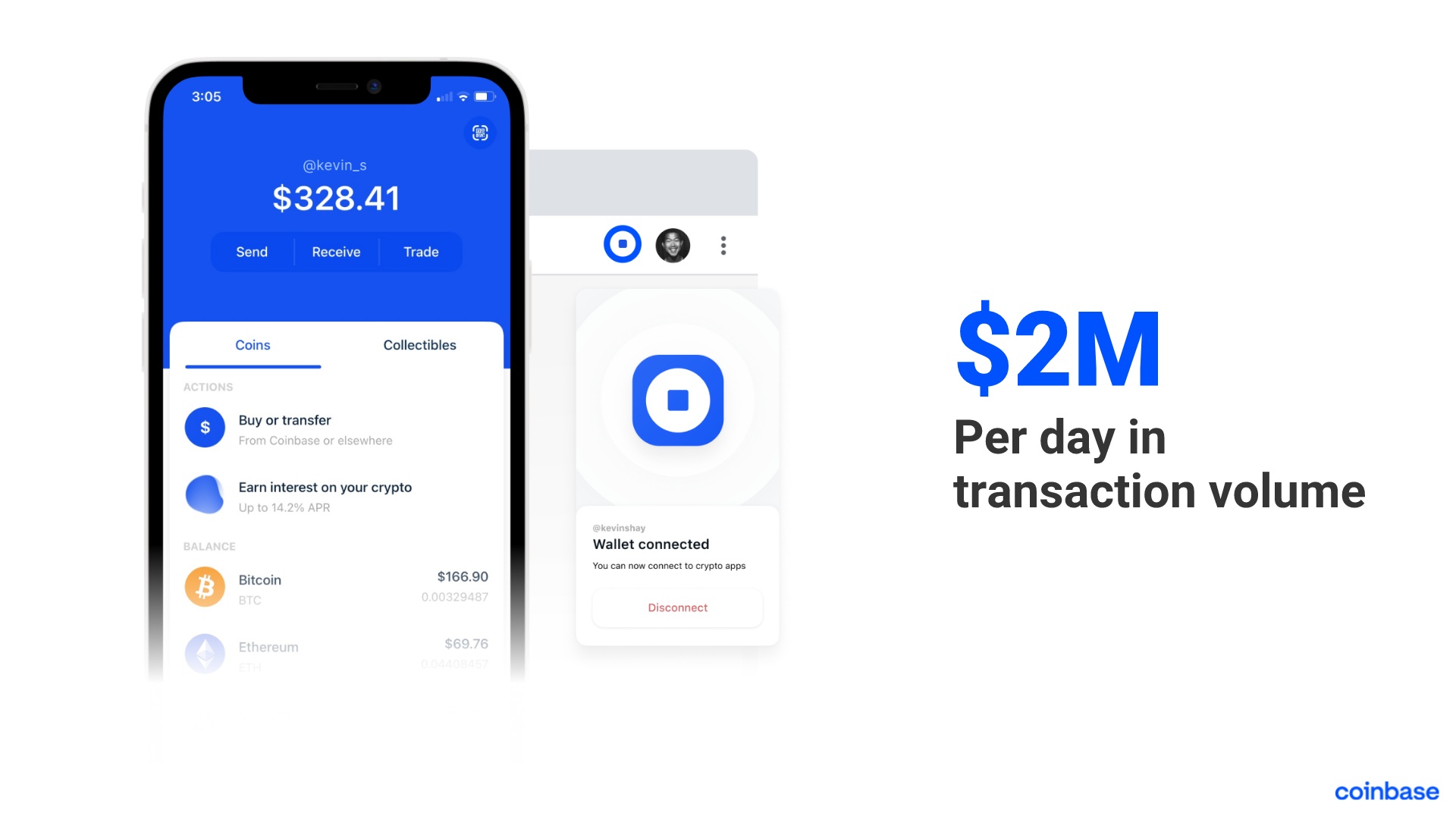
This closing slide highlights massive Bitcoin market potential, framing Coinbase as the bridge connecting niche Bitcoin wallets to global payment networks like remittances, with implied reference to $2M daily Bitcoin volume that could flow through their platform. The visual presentation connects Bitcoin’s technical infrastructure to real-world financial flows, demonstrating how Coinbase captures value from Bitcoin’s mainstream adoption. The global payment context positions Bitcoin competition against traditional financial services rather than other cryptocurrency companies.
The market opportunity framing emphasises Bitcoin’s role in disrupting international payments and remittances, markets worth hundreds of billions annually with significant inefficiencies that Bitcoin directly addresses. By connecting their hosted wallet service to global financial flows, Coinbase positions itself as infrastructure for Bitcoin’s integration into mainstream commerce. The slide suggests that Bitcoin adoption is inevitable and Coinbase will capture disproportionate value as the primary consumer interface.
What investors see: A platform positioned to capture significant percentage of Bitcoin’s growth into mainstream financial services, with network effects that strengthen competitive advantage over time. The market size presentation suggests venture-scale returns are achievable even with modest Bitcoin adoption rates, reducing technology risk concerns. This slide transforms Coinbase investment from cryptocurrency speculation into infrastructure investment for financial services disruption, appealing to investors seeking large, defensible market opportunities with clear monetisation pathways.
While this deck secured funding that launched one of the most valuable fintech companies in history, it reflects the bare-bones standards acceptable in 2012’s seed funding environment—standards that would struggle to meet today’s more sophisticated investor expectations. Modern seed rounds demand comprehensive business fundamentals that this deck omits entirely.
No dedicated slide showcases founders’ backgrounds or team expertise, despite modern decks requiring this to build credibility, as investors fundamentally bet on people over ideas in early stages. Brian Armstrong’s Airbnb engineering experience and fintech domain knowledge should have been prominently featured to establish execution capability in a highly technical, regulated industry.
The deck lacks revenue forecasts, burn rate analysis, or basic cap table information—elements essential today for demonstrating path to profitability and capital efficiency expectations. Modern investors require at least 3-year financial projections showing unit economics, customer acquisition costs, and monetisation strategy beyond vague references to value-added services.
No competitive matrix or differentiation analysis appears despite current VCs demanding clear competitive positioning against potential rivals in cryptocurrency services. Modern decks require comprehensive competitor analysis including indirect competition from traditional payment processors and emerging fintech platforms that could pivot into cryptocurrency services.
Missing comprehensive customer acquisition plan or detailed sales funnel analysis vital for proving scalable growth beyond demonstrated early traction. Modern investors require specific marketing strategies, conversion metrics, customer lifecycle management, and geographic expansion plans to assess sustainable competitive advantage and growth scalability.
Vague references to post-acquisition revenue beyond zero fees fail to specify concrete monetisation mechanisms, pricing models, or unit economics essential for sustainability analysis. Modern decks require detailed revenue stream breakdowns, pricing strategy rationale, and clear paths to profitability that demonstrate business model viability beyond growth-stage user acquisition.
Bare-bones layout lacks visual hierarchy, professional branding, and design sophistication that modern investors expect as signals of operational maturity and attention to detail. Contemporary pitch decks require professional design that reflects brand positioning, user experience capabilities, and overall execution quality that builds confidence in team capabilities.
Complete omission of regulatory, technological, or market risks fails to address obvious investor concerns about cryptocurrency business model sustainability. Modern funding environments demand transparent risk assessment covering regulatory compliance, technology security, market volatility, and competitive threats with specific mitigation strategies that demonstrate sophisticated business planning.
These gaps reflect how dramatically seed funding standards have evolved since Bitcoin’s early days. At Projects RH, we help founders modernise successful historical frameworks with contemporary investor expectations, ensuring breakthrough ideas receive the comprehensive presentation they deserve in today’s competitive funding landscape.
Seven slides hooked sophisticated investors by focusing exclusively on essentials, proving that conciseness beats comprehensiveness in initial presentations. Founders should ruthlessly cut decks to 10-15 slides maximum, forcing clarity of thought and respecting investor time constraints. Brevity demonstrates confidence in your core proposition and creates desire for deeper conversations.
The cover slide’s product screenshots built instant understanding of Coinbase’s value proposition, bypassing lengthy explanations about complex Bitcoin technology. Show, don’t tell, your MVP functionality through clear interface demonstrations that prove execution capability. Visual proof eliminates confusion and builds confidence in your ability to deliver consumer-ready solutions.
The iTunes:MP3 analogy instantly reframed Bitcoin from speculative technology to inevitable infrastructure by leveraging familiar success patterns. Find powerful parallels that connect your innovation to proven business models investors already understand and trust. Effective analogies accelerate comprehension while positioning your opportunity within established market categories that command venture-scale valuations.
$65,000 transaction volume in five weeks provided concrete proof of product-market fit that eliminated investor skepticism about Bitcoin adoption viability. Highlight meaningful engagement metrics like revenue, active users, or transaction volume that demonstrate real customer demand beyond vanity metrics. Early traction evidence transforms pitch conversations from theoretical potential to scaling proven demand.
Bitcoin wallet services expanded to global remittances and international payments, demonstrating how focused solutions can address massive market inefficiencies. Start with specific, winnable market segments then credibly scale to total addressable market that justifies venture investment. This progression from focused execution to broad vision appeals to investors seeking both near-term traction and long-term market expansion potential.
Ease of use, zero transaction fees, and global accessibility created sticky competitive advantages that differentiated Coinbase from complex Bitcoin alternatives. Distill your offering to three core benefits that customers value most and competitors struggle to replicate. Clear value proposition pillars enable consistent messaging across all stakeholder communications and create memorable differentiation in crowded markets.
Less information created stronger follow-up desire by leaving investors wanting deeper technical and financial details in subsequent meetings. Aim to intrigue qualified investors toward due diligence conversations rather than overwhelming them with comprehensive data in initial presentations. Strategic information gaps drive investor engagement whilst demonstrating confidence in your ability to defend the opportunity under scrutiny.
The distance between the Coinbase that presented this deck and the publicly traded cryptocurrency exchange dominating global digital asset markets today represents one of the most remarkable value creation stories in venture capital history, transforming a simple hosted wallet into financial infrastructure serving millions of users worldwide.
For investors who participated in this $600,000 seed round at a $5 million pre-money valuation, the returns have been extraordinary. Based on Coinbase’s 2021 public market peak valuation of over $100 billion, early seed investors achieved returns exceeding 20,000x on their initial investment—one of the highest documented returns in venture capital history. Even at more conservative current valuations around $55 billion, the investment represents a 11,000x multiple over the 12-year holding period.
This case study demonstrates how identifying infrastructure opportunities in emerging technology categories can generate venture capital’s most significant returns. The Coinbase investment exemplifies backing founders who simplify complex technologies for mainstream adoption, positioning platforms to capture disproportionate value as entire market categories mature from early adopter niches to global consumer markets.
At Projects RH, we help companies across all industries create investor-ready materials that close deals. Our integrated capital raising package ensures consistency across all your investor documentation.
Built in-house for accuracy and investor confidence.
Comprehensive investor documentation following global best practices.
12-slide investor-ready presentation with supporting materials.
High-impact snapshot to capture investor attention fast.
Browse our collection of real pitch deck breakdowns from the world’s most successful companies.
Coinbase's 2012 seed deck had exactly 7 slides, emphasizing brevity with cover, early adopters, problem, analogy, associations, traction, and market opportunity to hook investors quickly.
The deck raised $600,000 in seed funding in 2012 from investors including Y Combinator and Adam Draper, fueling early growth.
Success stemmed from clarity, powerful analogy (iTunes for Bitcoin), early traction proof ($65K volume), and framing niche to massive market, despite minimal design.
Use as inspiration for brevity and narrative, but adapt for modern needs like team, financials, and competition slides; crypto context has evolved since 2012.
Seed stage in 2012, pre-revenue with a small team, focusing on product-market fit via hosted wallet amid Bitcoin's infancy.
Creating an effective pitch deck requires more than following a template — it demands strategic clarity about your value proposition, a deep understanding of your target investors, and rigorous financial modelling to support your narrative. At Projects RH, we combine financial expertise with strategic storytelling to build pitch decks, information memorandums, and financial models that meet the standards of institutional investors worldwide. Our team has generated over USD 2.0 billion in expressions of interest across mining, energy, technology, medtech, and financial services sectors. Schedule a consultation to discuss how we can help position your company for successful capital raising.

CEO, Projects RH Business and financial expert. Paul Raftery is a seasoned financial executive with extensive expertise in business management, finance, and accounting. He has held significant governance roles, including Group Treasurer at Shell Coal & Power International and Executive Manager – Finance & Investment at Thiess.
Institutional investors demand rigor. A robust capital raising consulting framework combined with polished pitch deck consulting services demonstrates that your business meets the governance and presentation standards they require.