
Dive into the 12-slide pitch deck that helped Expedia secure $50 million in Series C funding in 1999 from Kleiner Perkins, TCV, and Madison Dearborn.
Expedia emerged from Microsoft’s corporate walls in 1996 as one of the internet’s first serious attempts to digitise travel booking. Founded by Richard Barton, who would later create Glassdoor and Zillow, the venture began as Microsoft’s internal experiment in e-commerce, leveraging the company’s Sidewalk local content platform. Initially focused solely on airline tickets, Expedia quickly recognised the broader opportunity to become a comprehensive travel marketplace, expanding into hotels and car rentals within its first year and achieving one million bookings through aggressive partnerships with major web portals. For businesses looking to emulate such success, expert pitch deck guidance can be invaluable.
The company’s early trajectory was marked by both the advantages and constraints of its Microsoft heritage. While benefiting from substantial technical infrastructure and corporate backing, Expedia faced fierce competition from established players like Travelocity and the emerging Priceline, which was disrupting the market with its “name your price” model. The dot-com bubble’s burst in 2000 created additional turbulence, forcing the company to prove its business model’s sustainability beyond Silicon Valley’s euphoric valuations.
Expedia’s strategic response involved building defensible competitive moats through exclusive hotel inventory agreements and proprietary search technology, which differentiated it from portal-dependent competitors. This approach yielded remarkable results: by 1999, the company was generating 300% year-over-year growth in bookings despite market volatility, reaching a $100 million revenue run rate that attracted serious institutional capital.
The Series C fundraising represented a critical inflection point in Expedia’s evolution from Microsoft subsidiary to independent travel powerhouse. The successful $50 million raise from top-tier venture capital firms like Kleiner Perkins validated the company’s business model and provided the capital necessary for international expansion and technology development. This funding round ultimately paved the way for Expedia’s 2005 initial public offering and its transformation into the travel industry giant that would later acquire brands like Hotels.com, Trivago, and VRBO, creating one of the world’s largest online travel ecosystems.

Expedia’s opening slide immediately establishes its positioning as a “Travel Supermarket,” a metaphor that perfectly captures the company’s comprehensive marketplace approach. The clean presentation design and prominent logo convey professionalism while the tagline suggests convenience and choice, two critical value propositions for busy travelers. This opening effectively sets expectations for a platform that aggregates multiple travel services under one digital roof, distinguishing Expedia from single-service competitors.
The timing notation on this 1999 presentation slide reflects a pivotal moment in internet commerce history, when online travel booking was transitioning from novelty to necessity. Expedia’s choice to lead with brand rather than statistics demonstrates confidence in its market position and recognition that investors would evaluate the company as much on brand strength as financial metrics. The visual simplicity also reflects the era’s web design aesthetics, when clean, text-heavy presentations were the norm for serious business communications.
What investors see: A company that understands its market positioning and has invested in brand development, suggesting sophisticated marketing thinking beyond pure technology. The “supermarket” metaphor immediately communicates the business model’s revenue potential through scale and variety, while the professional presentation indicates management’s ability to communicate effectively with institutional capital. The cover slide’s restraint suggests confidence that the substance will speak for itself.
The opportunity slide immediately establishes the massive scale of the addressable market, highlighting the $250+ billion global travel industry that was beginning its digital transformation. Expedia’s emphasis on the mere 5% online penetration in 1999 creates a compelling narrative around the early-mover advantage and the potential for exponential growth as consumer behaviour shifted towards digital channels. The growth projections from 1999 to 2003 demonstrate sophisticated market analysis and realistic adoption curves rather than hockey-stick fantasies.
This slide strategically positions Expedia within a broader technological shift rather than presenting it as merely another travel company. By framing the opportunity as the digitisation of an established industry, the presentation reduces perceived execution risk while emphasising the massive upside potential. The timing aspect is crucial—presenting in 1999, Expedia could credibly claim to be riding the wave rather than creating it, which was particularly appealing to investors still processing the lessons of earlier dot-com failures.
What investors see: A company that has identified a structural shift in consumer behaviour backed by compelling market data, rather than relying on hope-based projections. The low online penetration percentage creates urgency while the large absolute market size validates the potential for building a significant business. The forward-looking growth charts demonstrate analytical sophistication and suggest management’s ability to think strategically about market evolution, critical qualities for scaling a marketplace business.
The overview slide establishes Expedia’s commanding market position with 11 million monthly visitors, immediately positioning the company as the leader in online travel rather than a promising startup. The comprehensive service offering across air, hotel, and car rentals demonstrates the platform’s evolution into a true one-stop travel solution, reducing customer acquisition costs through cross-selling opportunities. Platform screenshots likely included on this slide would have provided tangible evidence of the user experience and interface sophistication that differentiated Expedia from competitors.
The strategic significance of this positioning extends beyond simple bragging rights—marketplace businesses achieve sustainable competitive advantages through scale, and Expedia’s traffic leadership creates network effects that compound over time. Suppliers prioritise platforms with the highest customer volumes, while customers gravitate toward platforms with the best selection and pricing, creating a virtuous cycle. By 1999, Expedia had clearly established itself within this advantageous position, making it increasingly difficult for new entrants to compete effectively.
What investors see: A business that has already achieved market leadership and is positioned to benefit from the network effects that make marketplace businesses increasingly defensible. The 11 million monthly visitors represent a massive customer acquisition advantage over competitors, while the full-service platform suggests strong customer lifetime value through multiple revenue streams. The emphasis on being “leading” rather than “growing” indicates this is a mature opportunity with proven product-market fit rather than an experimental venture.
Expedia’s competitive advantages slide demonstrates sophisticated thinking about sustainable differentiation in a rapidly evolving market. The emphasis on proprietary inventory relationships with major airlines and hotels represents the most critical moat in travel marketplace businesses—exclusive or preferential access to supply that competitors cannot easily replicate. The technology platform advantage reflects Expedia’s Microsoft heritage and substantial investment in search capabilities, booking engines, and customer management systems that were genuinely difficult to replicate in 1999.
The brand strength positioning is particularly astute given the fragmented nature of travel decision-making, where consumers often research extensively before purchasing high-value, infrequent services. Trust becomes paramount when booking flights and hotels online, especially in 1999 when e-commerce adoption was still building consumer confidence. The comparison table versus competitors like Travelocity provides concrete evidence of differentiation rather than abstract claims, which was essential for convincing institutional investors of the business’s defensibility.
What investors see: A management team that understands the importance of building sustainable competitive advantages rather than relying solely on first-mover benefits. The proprietary inventory relationships represent genuine barriers to entry that become stronger over time, while the technology platform advantages suggest ongoing innovation capabilities. The systematic comparison with competitors indicates analytical rigor and suggests Expedia has realistic assessments of its market position rather than optimistic assumptions.
The traction slide delivers the most compelling evidence of Expedia’s market success with 300% year-over-year growth in bookings, demonstrating extraordinary momentum in a challenging market environment. The $100 million revenue run rate represents substantial scale for a 1999 internet company, while two million annual transactions provide evidence of genuine customer adoption rather than one-time usage. These metrics collectively paint a picture of a business that has achieved genuine product-market fit and is scaling efficiently.
The growth trajectory becomes even more impressive when considered within the context of the broader travel industry’s conservative adoption patterns and the general market uncertainty following early dot-com volatility. Expedia’s ability to maintain triple-digit growth while building a sustainable business model demonstrates exceptional execution and validates the original market opportunity thesis. The progression from early-stage metrics to meaningful revenue scale shows a maturing business ready for institutional investment.
What investors see: A company that has transitioned from promising startup to proven growth business with undeniable momentum and scale. The 300% growth rate indicates strong market demand and effective execution, while the $100M run rate suggests this is a substantial opportunity rather than a niche market. The transaction volume demonstrates customer retention and repeat usage, critical factors for marketplace sustainability and long-term unit economics.
Expedia’s business model slide showcases the attractive economics of a commission-based marketplace, with average commission rates of 15% generating substantial revenue from each transaction without inventory risk. The merchant model advantages are particularly compelling—Expedia captures value through facilitating transactions rather than holding inventory, creating a capital-efficient business that scales profitably. The 25% EBITDA margin projection demonstrates the potential for strong profitability once the business reaches scale, addressing investor concerns about internet business sustainability.
The revenue streams diversification across air, hotel, and car rentals creates multiple monetisation opportunities while reducing dependence on any single category. This approach also enables cross-selling strategies that improve customer lifetime value and reduce acquisition costs per transaction. The visual representation of revenue streams likely included in this slide would have demonstrated the platform’s comprehensive approach to travel monetisation, essential for convincing investors of the business’s scalability and defensibility.
What investors see: A business model with inherent scalability advantages and strong unit economics that improve over time through operational leverage. The commission-based approach eliminates inventory risk while capturing significant value from each transaction, creating predictable revenue streams tied to market growth. The 25% EBITDA margin target indicates management’s focus on profitability rather than growth at any cost, particularly important for institutional investors evaluating long-term sustainability.
Expedia’s go-to-market strategy demonstrates sophisticated thinking about customer acquisition in the early internet era, emphasising portal partnerships that leverage existing web traffic rather than expensive direct marketing campaigns. The brand advertising component reflects understanding that travel booking requires significant consumer trust, particularly for high-value transactions like flights and hotels. International expansion plans indicate ambitious growth thinking while recognising the global nature of the travel market and the opportunity to replicate the domestic success model globally.
The multi-channel approach reduces dependence on any single customer acquisition method while enabling the company to test and optimise different approaches based on cost-effectiveness and customer quality. Portal partnerships were particularly strategic in 1999 when search engine marketing was primitive and social media non-existent, making established web destinations crucial for customer discovery. The combination of partnership-driven traffic and brand-building advertising creates a balanced approach to sustainable growth.
What investors see: A management team that understands customer acquisition economics and has developed diversified channels for sustainable growth. The portal partnership strategy demonstrates smart capital allocation by leveraging existing traffic rather than building audience from scratch. The international expansion plans show global market awareness and suggest significant growth opportunities beyond the domestic market, critical for achieving the scale necessary to justify venture-level returns.
The financial projections slide presents an ambitious yet achievable roadmap to $500 million revenue by 2003, representing a 40% compound annual growth rate that reflects both the market opportunity scale and Expedia’s proven execution capabilities. The breakeven projection for 2001 demonstrates management’s focus on profitability rather than pure growth, addressing investor concerns about internet business sustainability that were particularly acute following early dot-com failures. The detailed profit and loss assumptions provide transparency and enable investors to evaluate the underlying business model assumptions.
The three-year financial model’s granularity suggests sophisticated financial planning and management’s ability to translate market opportunities into concrete business outcomes. The progression from current $100 million run rate to projected $500 million represents ambitious but not unrealistic growth given the demonstrated 300% year-over-year traction. The balance between growth and profitability targets indicates mature thinking about business development rather than the growth-at-any-cost mentality that characterised many internet ventures.
What investors see: A business with clear visibility into substantial scale potential backed by detailed financial modeling and realistic assumptions. The 40% CAGR growth rate is aggressive enough to generate venture-scale returns while remaining achievable based on current traction. The breakeven timeline demonstrates capital efficiency and suggests the business will become self-sustaining, reducing future dilution risk for current investors while validating the long-term economic model.
The team slide showcases Expedia’s leadership under CEO Erik Blachman, whose Microsoft background provides immediate credibility for executing a technology-intensive business at substantial scale. The combination of Microsoft alumni with travel industry expertise demonstrates thoughtful team construction that balances technical capability with domain knowledge. The executive headshots and detailed biographies show a mature leadership team with relevant experience, addressing one of the primary risk factors that institutional investors evaluate when considering growth-stage investments.
The Microsoft heritage becomes particularly valuable given Expedia’s technology platform requirements and the need to integrate complex inventory systems from airlines, hotels, and car rental companies. The team’s proven ability to build and scale technology solutions at Microsoft provides confidence in their ability to execute Expedia’s ambitious growth plans. The travel industry expertise among key executives ensures market knowledge and relationship capabilities essential for building supplier partnerships and understanding customer needs.
What investors see: An experienced leadership team with the technical and industry expertise necessary to execute on the ambitious business plan presented in earlier slides. The Microsoft background suggests proven ability to build and scale complex technology platforms, while the travel industry experience indicates market knowledge and relationship capabilities. The combination reduces execution risk significantly and provides confidence that the team can navigate both technical challenges and industry dynamics successfully.
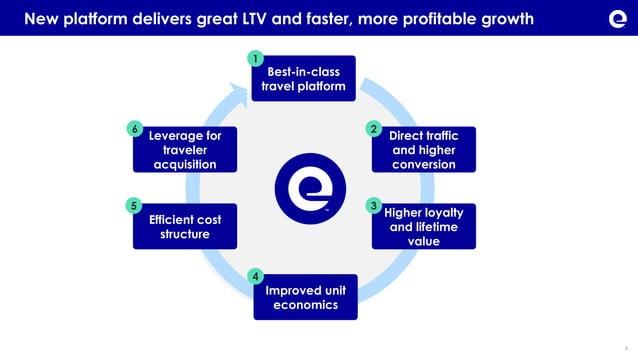
The market deep dive slide provides granular analysis of the total addressable market, breaking down the opportunity into hotel ($100 billion), air ($300 billion), and car rental segments with specific online penetration forecasts for each category. This detailed segmentation demonstrates sophisticated market analysis and enables investors to evaluate growth potential across different revenue streams. The varying penetration rates by segment reflect realistic assessment of adoption patterns, with some categories naturally moving online faster than others based on customer behaviour and industry dynamics.
The segmented approach also validates Expedia’s comprehensive platform strategy by showing substantial opportunity across multiple categories rather than dependence on a single market segment. The relative size of different segments helps investors understand revenue diversification potential and long-term growth sustainability. The online penetration forecasts provide concrete targets for measuring progress and suggest realistic timelines for market development, enabling more accurate business model projections.
What investors see: A thorough understanding of market dynamics with realistic penetration forecasts that support the financial projections presented earlier. The segmented analysis demonstrates that Expedia is building a diversified business across multiple large markets rather than betting on a single category. The detailed market sizing provides confidence in the company’s strategic planning capabilities and suggests management’s ability to identify and capture emerging opportunities systematically.
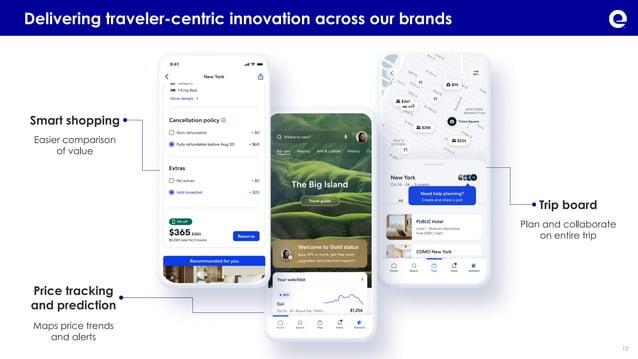
The use of funds allocation demonstrates strategic thinking about growth priorities, with 40% directed toward technology development reflecting Expedia’s understanding that platform capabilities drive competitive advantage in online travel. The 35% marketing allocation shows commitment to customer acquisition and brand building, essential investments for marketplace businesses that depend on network effects. The 15% international expansion budget indicates global ambition while maintaining disciplined capital deployment, and the 10% operations allocation ensures adequate infrastructure support for rapid growth.
The balanced allocation across technology, marketing, and expansion reflects mature strategic thinking rather than singular focus on any one growth lever. Technology investment ensures platform scalability and feature development that maintains competitive differentiation, while marketing spending drives the customer acquisition necessary for marketplace success. International expansion represents logical extension of proven domestic success, with controlled capital deployment that limits risk while capturing global market opportunity.
What investors see: A management team with clear priorities and disciplined capital allocation strategy that balances growth investment with operational needs. The technology-heavy allocation demonstrates understanding that competitive advantage comes from platform capabilities, while the marketing investment shows commitment to customer acquisition. The international expansion component suggests global market awareness without over-extending resources, indicating strategic maturity and realistic growth planning.
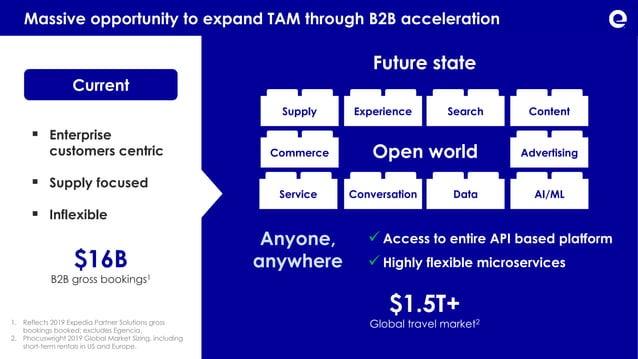
The closing slide maintains the presentation’s professional tone while providing clear contact information and a final call to action for investment participation. The inclusion of the Expedia logo reinforces brand recognition while the vision statement likely summarises the company’s mission to transform travel booking through technology. This straightforward approach reflects confidence in the substance of the presentation rather than relying on high-pressure sales tactics, appropriate for institutional investor audiences who value analytical rigour over emotional appeals.
The professional presentation of contact details and investment opportunity creates an easy path for interested investors to engage further while maintaining the serious tone established throughout the deck. The vision statement component provides a memorable summary of Expedia’s market position and future potential, reinforcing key messages about market transformation and company leadership. The clean design and clear contact information facilitate follow-up conversations essential for converting presentation interest into investment commitment.
What investors see: A professional conclusion that demonstrates confidence in the presentation content and provides clear next steps for investment consideration. The straightforward approach suggests management’s focus on substance over style, while the accessible contact information indicates openness to detailed due diligence discussions. The vision statement reinforcement helps investors remember key value propositions while the investment call to action creates urgency around the funding opportunity.
While Expedia’s 1999 pitch deck successfully secured $50 million from premier venture capital firms and established the foundation for one of travel’s greatest success stories, it reflects the presentation conventions and investor expectations of its era. Compared to today’s sophisticated pitch standards, this deck lacks several elements that modern investors consider essential for evaluating marketplace businesses and assessing long-term growth potential.
The deck jumps directly into market opportunity without establishing the specific customer pain points that Expedia solves. Modern presentations begin with concrete problems like fragmented booking processes, lack of price transparency, or limited travel options, then demonstrate how the platform addresses these issues. This problem-solution framework builds investor empathy and validates market need beyond pure opportunity size.
While the deck mentions platform screenshots, it lacks detailed visual demonstration of the actual booking flow and user interface that differentiates Expedia from competitors. Today’s presentations include step-by-step user journey screenshots, mobile interface examples, and sometimes live demo videos that show ease-of-use and conversion optimization. Visual product evidence helps investors evaluate user experience quality and understand competitive differentiation.
Despite impressive transaction volumes, the presentation lacks quotes from satisfied customers or case studies demonstrating value creation for both travelers and suppliers. Modern marketplace decks include specific testimonials, usage statistics from key customers, and examples of successful outcomes that provide social proof beyond aggregate metrics. Customer voices help investors understand value proposition effectiveness and market adoption patterns.
While competitive advantages are listed, the deck lacks a systematic 2×2 matrix or detailed feature comparison that visually positions Expedia against rivals like Travelocity and Priceline. Contemporary presentations use competitive matrices to demonstrate clear differentiation across multiple dimensions like pricing, inventory, technology, and customer experience. Visual competitive positioning helps investors quickly understand market dynamics and sustainable advantages.
The presentation provides high-level margin projections but lacks detailed customer acquisition cost (CAC), lifetime value (LTV), and contribution margin analysis that modern investors demand for marketplace evaluation. Today’s decks include cohort analysis, payback periods, and unit economics evolution over time to demonstrate scalability and long-term profitability potential. These metrics are essential for evaluating business model sustainability and growth efficiency.
While the strategy mentions portal partnerships and international expansion, there’s no detailed roadmap with specific milestones, launch dates, and success metrics for different market entry phases. Modern presentations include 18-24 month execution timelines with concrete deliverables and measurable objectives that demonstrate systematic growth planning. Detailed timelines help investors evaluate management’s execution capabilities and track progress against commitments.
The deck avoids discussing potential risks like regulatory changes in travel booking, competitive threats from new entrants, or technology disruption scenarios. Sophisticated modern presentations acknowledge key risks and outline specific mitigation strategies, demonstrating management’s awareness of challenges and preparedness for adverse scenarios. Risk transparency builds investor confidence and shows strategic thinking beyond optimistic projections.
These missing elements reflect the evolution of venture capital due diligence and the increased sophistication of marketplace business evaluation over the past two decades. At Projects RH, we help founders identify and address these presentation gaps, ensuring their pitch decks meet contemporary investor expectations while building compelling narratives around sustainable competitive advantages and scalable growth strategies.
Expedia opened with the $250 billion global travel market opportunity, immediately establishing the potential scale of the business. Founders should quantify their total addressable market early in presentations to demonstrate venture-scale potential and capture investor imagination. Large market size validates the opportunity for building significant businesses even with modest market share capture.
The 300% year-over-year growth in bookings provided undeniable evidence of product-market fit and customer demand. Founders must prioritise real traction metrics over theoretical projections to prove their business model works in practice. Growth data reduces investor risk perception and demonstrates execution capability better than any vision statement can accomplish.
Expedia detailed proprietary technology platforms and exclusive inventory relationships that competitors couldn’t easily replicate. Founders should clearly articulate their sustainable competitive advantages and explain how these moats strengthen over time. Investors need confidence that successful businesses won’t be immediately copied by well-funded competitors or technology giants.
The three-year projections to $500 million revenue with detailed assumptions demonstrated sophisticated financial planning grounded in current performance. Founders should provide comprehensive financial models with clear assumptions that investors can evaluate and stress-test. Realistic projections with breakeven timelines show capital efficiency and reduce perceived execution risk for institutional investors.
Featuring Microsoft alumni and travel industry expertise addressed execution risk through proven track records at relevant scale. Founders should emphasise team members’ directly relevant experience and demonstrated ability to build technology platforms or scale marketplace businesses. Strong team credentials can overcome investor concerns about market risks or competitive threats.
The use of funds slide specified exactly how the $50 million would be allocated across technology, marketing, and expansion priorities. Founders should always state their funding amount, intended use of capital, and expected outcomes to guide investor decision-making. Clear asks with detailed allocation plans demonstrate strategic thinking and help investors evaluate capital efficiency.
Expedia combined market transformation narrative with concrete metrics like 11 million monthly visitors and $100 million revenue run rate. Founders should ground ambitious vision statements in hard data that proves current traction and validates future projections. The balance between inspirational story and analytical rigor appeals to both the emotional and rational aspects of investment decisions.
The transformation from the Expedia that pitched this deck in 1999 to today’s global travel platform represents one of the most successful venture capital investments in internet history. Understanding the magnitude of this evolution provides crucial insights into the long-term potential that sophisticated investors can identify in well-positioned marketplace businesses, even during periods of market uncertainty and competitive pressure.
For the institutional investors who participated in Expedia’s 1999 Series C round, the returns have been extraordinary by any measure. The $50 million investment at a $400 million pre-money valuation has generated returns exceeding 50x through Expedia’s evolution into a $22.5 billion travel conglomerate. This performance demonstrates the power of identifying marketplace businesses with strong network effects during periods of technological transition, when established industries are being digitally transformed.
The investment success reflects not just market timing, but recognition of fundamental business model advantages that compound over decades. Expedia’s commission-based marketplace model has scaled to process over $105 billion in annual gross bookings while maintaining high margins and capital efficiency. For today’s founders building marketplace businesses, Expedia’s trajectory illustrates how initial traction and competitive advantages can compound into sustainable market leadership when supported by strategic capital and systematic execution over extended time horizons.
At Projects RH, we help companies across all industries create investor-ready materials that close deals. Our integrated capital raising package ensures consistency across all your investor documentation.
Built in-house for accuracy and investor confidence.
Comprehensive investor documentation following global best practices.
12-slide investor-ready presentation with supporting materials.
High-impact snapshot to capture investor attention fast.
Browse our collection of real pitch deck breakdowns from the world’s most successful companies.
The Expedia 1999 pitch deck contained 12 slides, focusing on opportunity, traction, financials, and team—concise yet comprehensive for the era.
Expedia raised $50M in Series C funding using this deck, from investors including Kleiner Perkins, at a $400M pre-money valuation.
Its success stemmed from leading with huge market opportunity, proven hyper-growth metrics, strong Microsoft-backed team, and clear path to profitability amid dot-com skepticism.
Use as inspiration for structure and traction focus, but update for modern elements like unit economics, demos, and risks; investor expectations have evolved significantly.
Expedia was at Series C stage in 1999, post-multiple rounds with established revenue and scale, preparing for eventual IPO.
Creating an effective pitch deck requires more than following a template — it demands strategic clarity about your value proposition, a deep understanding of your target investors, and rigorous financial modelling to support your narrative. At Projects RH, we combine financial expertise with strategic storytelling to build pitch decks, information memorandums, and financial models that meet the standards of institutional investors worldwide. Our team has generated over USD 2.0 billion in expressions of interest across mining, energy, technology, medtech, and financial services sectors. Schedule a consultation to discuss how we can help position your company for successful capital raising.

CEO, Projects RH Business and financial expert. Paul Raftery is a seasoned financial executive with extensive expertise in business management, finance, and accounting. He has held significant governance roles, including Group Treasurer at Shell Coal & Power International and Executive Manager – Finance & Investment at Thiess.
CEOs shouldn’t navigate fundraising alone. Dedicated capital raising consulting provides strategic direction, while professional pitch deck consulting arms you with the materials needed to command every investor conversation.