
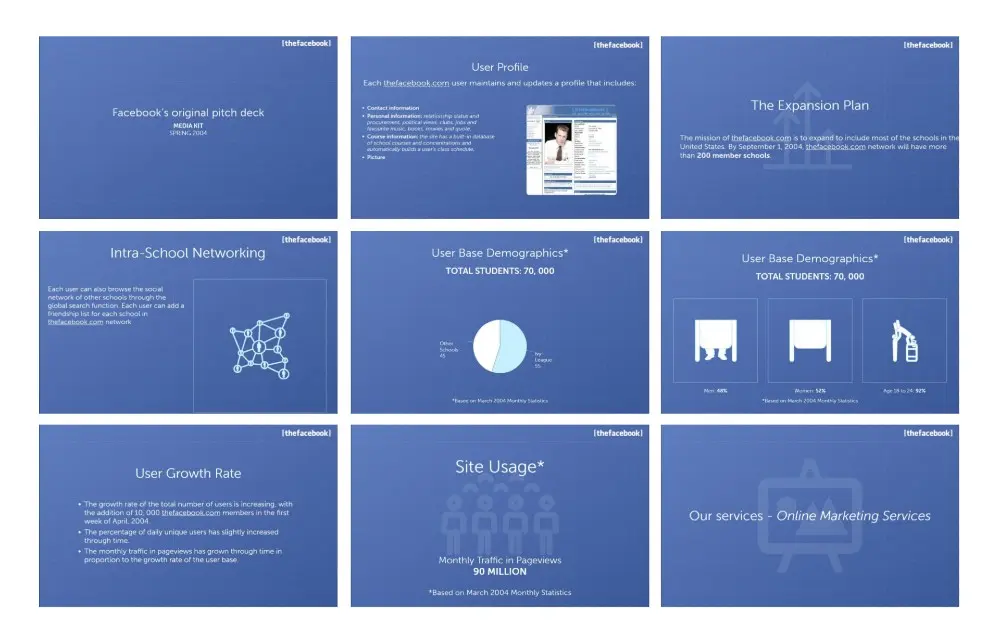
Dive into the 21-slide pitch deck that helped Facebook secure $500,000 in seed funding from notable investors Peter Thiel and Eduardo Saverin in 2004.
Facebook was founded by Mark Zuckerberg along with Eduardo Saverin, Andrew McCollum, Dustin Moskovitz, and Chris Hughes in February 2004 while they were students at Harvard University. Initially launched as ‘Thefacebook.com’ exclusively for Harvard students, it quickly expanded to other Ivy League schools amid massive campus buzz, as students skipped classes to use the platform for connecting via profiles, friends, and shared interests. The platform’s viral growth was so intense that it began generating media coverage within weeks of launch, with campus newspapers documenting the phenomenon of students abandoning traditional activities to build their online social networks. This remarkable success story could serve as an inspiration for those seeking expert pitch deck guidance in their own ventures.
Early challenges included server overloads from rapid growth and figuring out a sustainable business model, pivoting from pure social networking to advertising. The team bootstrapped initially with Eduardo Saverin providing seed capital, but faced scaling issues as adoption spread to Stanford and beyond, requiring more robust infrastructure and a clearer path to monetisation. The founders quickly realised that their organic growth trajectory would require significant external capital to maintain momentum and capture the expanding market opportunity.
Fundraising began informally through existing networks, but as user metrics exploded across multiple campuses, the team sought venture capital to fuel nationwide expansion. Peter Thiel invested $500,000 in seed funding in summer 2004 after seeing the platform’s unprecedented traction metrics and recognising the potential for a new category of social interaction. This investment would prove to be one of the most consequential seed rounds in technology history, providing the capital needed to scale beyond the initial college market.
The 2004 pitch deck, originally created as a media kit for advertising sales, was strategically adapted for investors to showcase both user growth and advertising potential. While unconventional in structure compared to today’s pitch decks, it effectively demonstrated the platform’s viral adoption and the founders’ vision for monetising social connections through targeted advertising. This deck secured the seed round that enabled nationwide expansion and laid the foundation for Facebook’s evolution into one of the world’s most valuable companies.
Facebook opens with a powerful quote from the Stanford Daily highlighting how “Classes are being skipped” and the “Thefacebook.com craze has swept through campus.” This strategic choice immediately establishes third-party validation and demonstrates the platform’s organic viral growth through credible media coverage. The quote serves as social proof that this isn’t just another student project, but a phenomenon generating genuine media attention and disrupting traditional campus life.
By leading with external validation rather than company messaging, Facebook positions itself as a movement rather than merely a product. The choice to highlight behavioural change (“classes being skipped”) is particularly astute, as it demonstrates deep user engagement and addiction-level usage patterns. This approach creates intrigue and credibility before diving into product details or metrics, setting a tone that suggests investors are looking at something genuinely transformative.
What investors see: A company with organic PR coverage and users so engaged they’re changing fundamental behaviours. The media quote suggests viral growth without paid marketing, indicating strong product-market fit and the potential for massive scale with minimal customer acquisition costs. This opening positions Facebook as a cultural phenomenon rather than just a technology platform, hinting at network effects and sticky user engagement that are critical for marketplace valuations.
This slide provides a high-level description of Thefacebook as an online directory that enables college students to connect based on friendships, courses, and social networks, with built-in messaging functionality. The positioning as a “directory” was strategically chosen to make the concept immediately understandable, while the emphasis on connections “based on friendship, courses, and social networks” highlights the platform’s multi-dimensional networking capabilities. The mention of integrated messaging demonstrates that Facebook isn’t just about discovery but about facilitating ongoing communication.
The simplicity of this explanation is deceptive—it captures the essence of social networking without overwhelming readers with technical details or complex feature lists. By framing the platform around familiar concepts like directories and messaging, Facebook makes the value proposition accessible while hinting at the deeper social graph that would become its competitive moat. The focus on college students as the target demographic was prescient, as this group represented early adopters with high lifetime value and strong network effects.
What investors see: A clear, defensible value proposition targeting a well-defined demographic with high engagement potential. The combination of discovery and communication suggests potential for high user retention and frequent usage, while the directory concept implies scalable network effects as more users join. The college focus demonstrates market discipline and suggests a launch-and-expand strategy that could eventually address broader demographics with proven product-market fit.
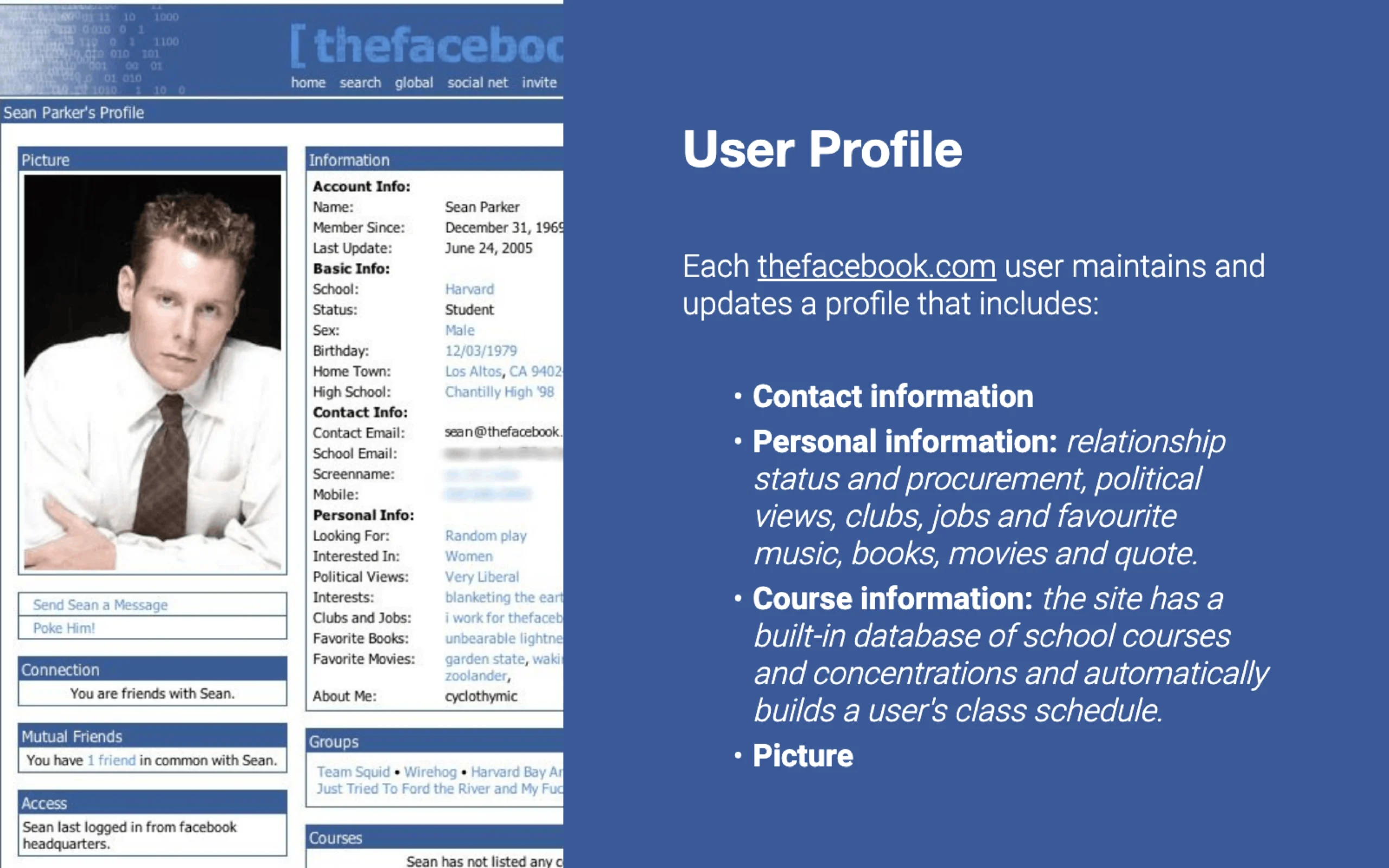
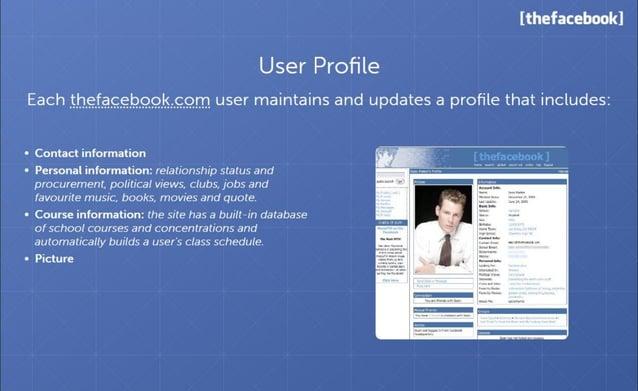
The profile screenshot shows a sample user interface with fields for personal information, courses, interests, and photos, providing concrete visual context for what was previously described in abstract terms. This tangible demonstration helps investors understand exactly how students would interact with the platform and what data Facebook would collect to enable connections. The interface appears clean and intuitive, suggesting thoughtful design that prioritises user experience over complex features.
By showing actual profile fields like courses and interests, Facebook demonstrates how the platform captures structured data that goes beyond basic demographics, enabling more sophisticated matching and targeting capabilities. The inclusion of photos was revolutionary for 2004 web applications and signals Facebook’s early understanding that visual identity would be crucial for social networking. This structured approach to user data collection would later become the foundation for Facebook’s advertising targeting capabilities.
What investors see: A product that’s actually built and functional, not just a concept, with thoughtful UX design that facilitates data collection for future monetisation. The rich profile data suggests multiple revenue opportunities through targeted advertising, while the clean interface indicates a team that understands user experience design. The screenshot proves execution capability and provides tangible evidence that the product exists and is being used by real students.
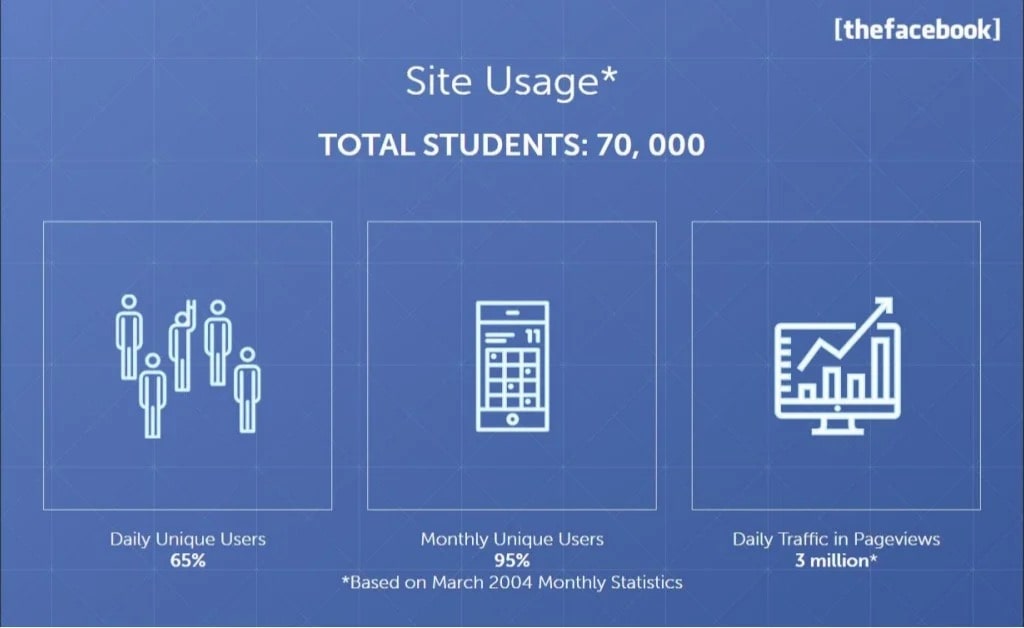
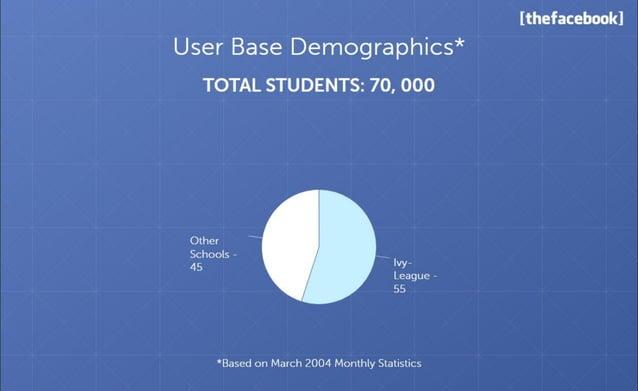
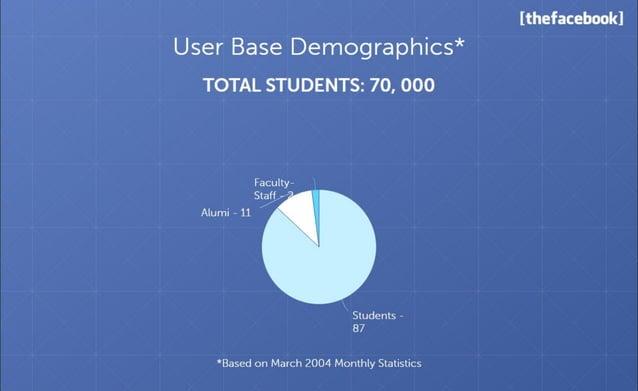
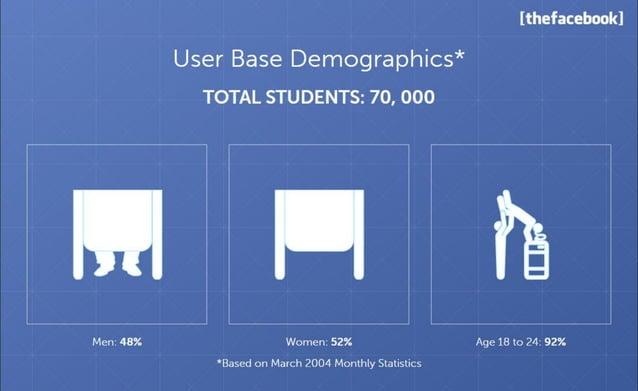
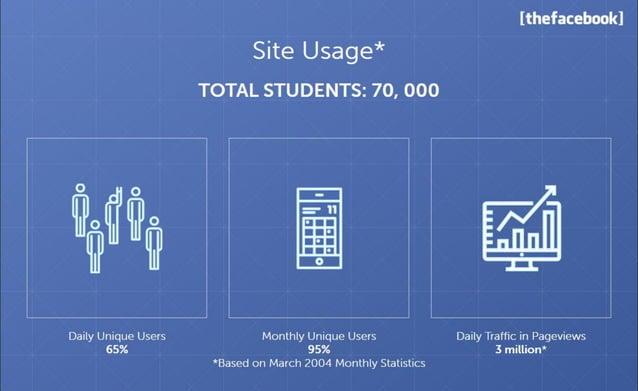
This slide presents key metrics on user growth, engagement, and demographics at launch, emphasising the rapid adoption that distinguished Facebook from typical startup launches. The statistics demonstrate not just user acquisition but sustained engagement, suggesting strong product-market fit rather than curiosity-driven initial signups. These metrics provide quantitative backing for the media coverage mentioned in the opening slide, showing that the buzz translates into measurable traction.
The presentation of multiple metric types—growth, engagement, and demographics—shows analytical sophistication and suggests the team understands what drives value in social platforms. By including demographic breakdowns, Facebook demonstrates market understanding and hints at advertising potential by showing they can reach specific audience segments. The metrics timeline likely shows exponential growth curves that would be particularly compelling to investors familiar with network effect businesses.
What investors see: Explosive early traction with metrics that suggest viral growth and strong network effects, indicating scalability without proportional marketing spend increases. The engagement data implies sticky user behaviour that could support advertising monetisation, while demographic insights demonstrate market understanding crucial for scaling. These numbers position Facebook as a rapidly growing platform with quantifiable proof of concept rather than just another social networking experiment.
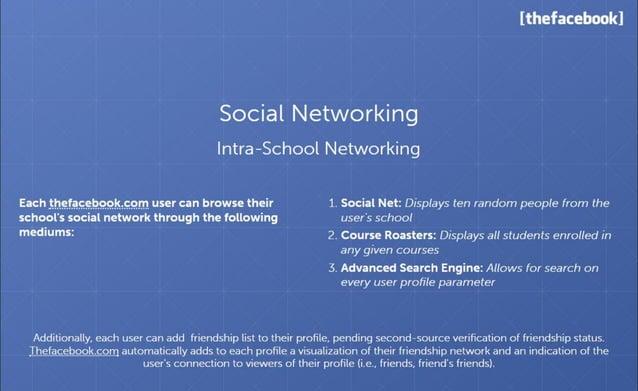
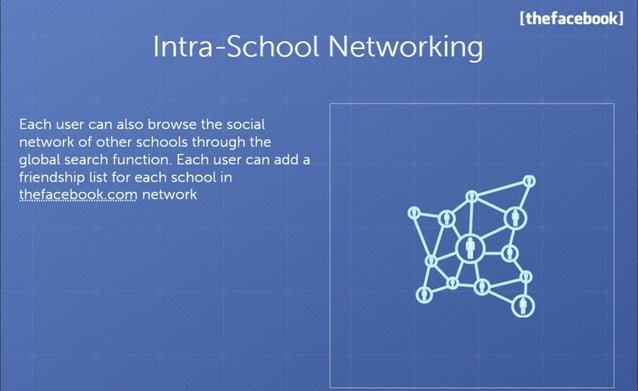
This slide explains the core user flow of browsing school networks, finding and adding friends, and visualising friendship networks on profiles, demonstrating how Facebook facilitates organic relationship discovery and mapping. The emphasis on school-based networks shows Facebook’s understanding that natural social boundaries create more meaningful connections than open platforms. The friend visualisation feature was particularly innovative, allowing users to see their social graph and discover mutual connections.
By walking through the browsing and connection process, Facebook demonstrates how network effects compound as each new user makes the platform more valuable for existing users through expanded connection possibilities. The structured approach to network navigation suggests thoughtful product design that maximises engagement while creating natural growth loops. The friend network visualisation adds a gamification element that encourages users to expand their connections, driving platform stickiness.
What investors see: A product architecture designed around network effects, where each new user increases value for all existing users, creating natural moats against competition. The school-based segmentation demonstrates strategic thinking about building dense networks before expanding, while the friend discovery features suggest high engagement potential. This slide shows Facebook understands the mechanics of social platforms and has built features that naturally drive user retention and growth.
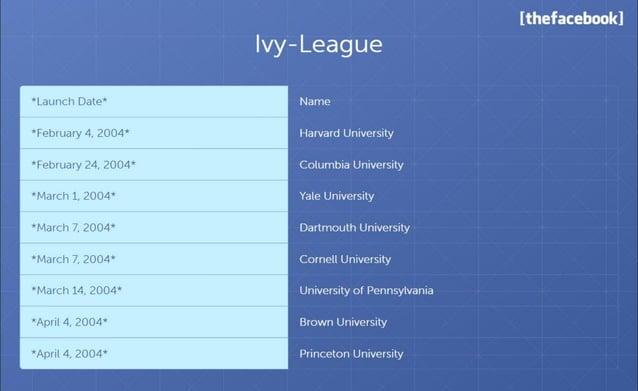
The list of initial Ivy League and select schools where Facebook launched demonstrates strategic market selection, targeting prestigious institutions that would provide both credibility and high-value users. Starting with Harvard, Stanford, and other elite universities wasn’t just about proximity to the founders—it was a calculated move to establish the platform among influential early adopters. These schools represented concentrated networks of ambitious, connected individuals who could drive viral adoption and provide social proof for expansion.
The selective school launch strategy created exclusivity and scarcity, making Facebook membership desirable rather than just available, which accelerated adoption rates at each institution. By focusing on elite schools first, Facebook ensured high engagement rates and positive user experiences before expanding to broader markets. This approach also generated PR coverage and word-of-mouth recommendations that extended beyond individual campuses, creating anticipation for Facebook’s arrival at other schools.
What investors see: A thoughtful go-to-market strategy that prioritises quality over quantity, building strong network density at prestigious institutions before expansion. The school selection demonstrates market sophistication and suggests the team understands how to build sustainable competitive advantages through strategic rollout. This exclusive launch approach indicates scalable expansion methodology that could maintain engagement rates as the platform grows to new demographics.
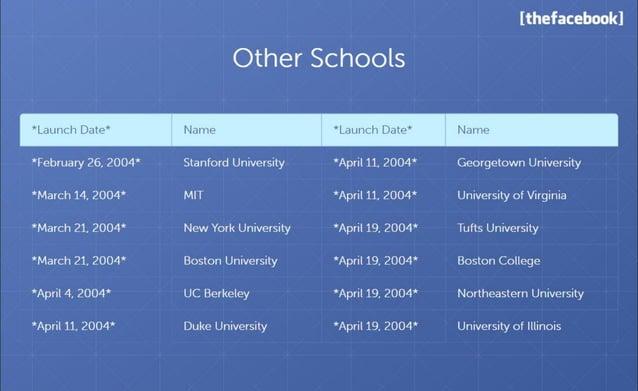
The continuation of the schools list demonstrates Facebook’s methodical expansion beyond initial Ivy League institutions, showing progress toward broader market coverage without overwhelming the previous slide’s messaging. This segmentation approach keeps the presentation focused while documenting comprehensive market penetration across different university tiers. The extended list proves that Facebook’s appeal transcends elite institutions and works across diverse campus cultures and student demographics.
By dividing the school list across multiple slides, Facebook demonstrates the scale of their expansion while maintaining visual clarity and preventing information overload. The growing list suggests momentum and systematic rollout capabilities, indicating the team can execute expansion plans effectively. Each new school represents both market validation and network effects amplification, as inter-school connections would drive cross-platform engagement and create barriers to competitive platforms.
What investors see: Systematic expansion execution with growing market coverage across diverse institution types, demonstrating scalable rollout capabilities and broad market appeal. The extensive school list indicates significant operational capacity and suggests the platform works across different student demographics and campus cultures. This expansion trajectory shows Facebook moving toward market leadership in the college social networking space with clear competitive positioning.
Facebook articulates their mission to expand to most U.S. schools by September 1, 2004, with a specific goal of over 200 member schools, demonstrating both ambition and concrete planning with measurable milestones. The September deadline creates urgency and shows the team operates with startup velocity, while the 200-school target provides a specific, trackable objective that investors can evaluate. This aggressive timeline suggests confidence in their expansion model and ability to execute rapid growth.
The specificity of the expansion plan—both timeline and numerical targets—indicates sophisticated planning and operational capabilities beyond typical student projects. By setting public goals, Facebook demonstrates accountability and creates measurable benchmarks for investor evaluation. The focus on U.S. market saturation before international expansion shows strategic discipline and market understanding, suggesting the team recognises the importance of building domestic market leadership before diversifying geographically.
What investors see: Clear, time-bound execution plans with measurable milestones that demonstrate operational sophistication and ambitious but achievable growth targets. The September deadline suggests urgency and startup velocity, while the 200-school goal provides concrete metrics for evaluating management execution. This planning approach indicates a team that understands market capture timing and has the operational capacity to execute rapid geographic expansion.

This slide provides detailed user growth, pageviews, and traffic statistics across schools, offering granular metrics that demonstrate not just user acquisition but sustained engagement patterns. The inclusion of multiple metric types suggests analytical sophistication and shows Facebook tracks the health metrics that matter for social platforms—growth, engagement, and retention. The school-by-school breakdown demonstrates how Facebook measures success at a micro level while building toward macro objectives.
The granular reporting approach indicates operational maturity and suggests the team understands which metrics correlate with platform health and monetisation potential. By showing traffic and engagement data alongside user counts, Facebook demonstrates that growth isn’t just vanity metrics but translates into valuable user behaviour. These detailed metrics would be particularly compelling to investors familiar with online platform dynamics and the importance of engagement depth over breadth.
What investors see: Deep analytical capabilities and metrics that prove sustainable engagement rather than just initial curiosity, indicating strong product-market fit and monetisation potential. The detailed tracking suggests a data-driven team that understands platform dynamics and can optimise for key performance indicators. This level of metric granularity implies scalable growth patterns and the ability to identify successful expansion factors for replication across new markets.
Facebook highlights monthly pageviews nearing 90 million and emphasises user-generated content driving high engagement levels, demonstrating the platform has reached significant scale with organic, sticky user behaviour. The 90 million monthly pageview figure was extraordinary for a college-only platform in 2004, indicating both broad adoption and deep engagement across the user base. The emphasis on user-generated content shows Facebook understood early that social platforms succeed through user creativity rather than company-produced content.
The traffic metrics demonstrate that Facebook has achieved the scale necessary to attract advertiser attention while maintaining engagement levels that justify premium advertising rates. User-generated content creates a virtuous cycle where content creation drives further engagement and platform stickiness, reducing churn and increasing lifetime value. This engagement model would be particularly compelling to investors familiar with media and advertising businesses, as it suggests sustainable traffic growth without proportional content creation costs.
What investors see: Massive scale with engagement metrics that demonstrate advertising viability and platform stickiness, indicating near-term revenue potential and long-term user retention. The user-generated content model suggests scalable growth without proportional content costs, while traffic levels approaching traditional media sites prove market readiness for monetisation. These numbers position Facebook as having achieved the critical mass necessary for significant advertising revenue and market leadership in social networking.
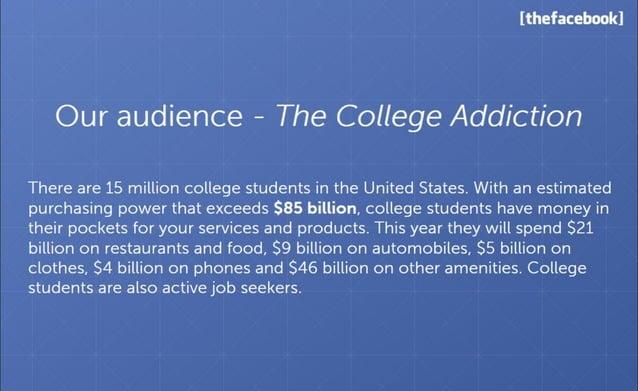
This slide provides a breakdown of college student purchasing power and demographics that would be highly attractive to advertisers, positioning Facebook’s user base as a premium target audience with significant spending capacity and brand influence. College students represent a unique demographic sweet spot—they have disposable income, are forming lifelong brand preferences, and influence peers through social networks. The demographic analysis shows Facebook understands the advertising market and can articulate why their audience commands premium rates.
By quantifying student purchasing power and highlighting relevant demographic characteristics, Facebook demonstrates market research capabilities and advertising market understanding beyond typical startup pitches. The focus on purchasing behaviour and brand receptivity shows the team recognises that successful advertising platforms must prove audience value, not just audience size. This demographic positioning would be particularly compelling to investors with experience in traditional media or advertising businesses.
What investors see: A highly valuable target demographic with strong purchasing power and brand influence potential, indicating premium advertising revenue opportunities and sustainable monetisation paths. The detailed demographic analysis demonstrates market understanding and suggests the team can effectively pitch advertisers on audience value. This audience positioning implies pricing power and advertiser demand that could drive significant revenue growth as the platform scales.

This slide introduces advertising opportunities on the platform, serving as a transition from user metrics to monetisation strategy and signalling that Facebook has moved beyond pure growth to revenue generation planning. The title slide approach creates anticipation and separates the audience/traction story from the business model explanation, allowing investors to first appreciate the scale before evaluating monetisation potential. This structural choice demonstrates presentation sophistication and helps investors follow the logical progression from user value to business value.
By positioning advertising as “marketing services,” Facebook frames their offering around advertiser value rather than just inventory sale, suggesting a sophisticated understanding of the advertising market. The introduction slide approach indicates that Facebook has developed a comprehensive advertising strategy worthy of detailed explanation, rather than just basic banner ad placement. This positioning implies premium service offerings and hands-on advertiser relationships that could command higher rates than programmatic advertising.
What investors see: A systematic approach to monetisation with dedicated focus on advertiser service rather than just ad inventory, suggesting premium revenue potential and sustainable business model development. The structured presentation implies comprehensive advertising strategy development and market understanding beyond typical startup monetisation approaches. This introduction positions Facebook as building an advertising business rather than just experimenting with revenue, indicating serious commercial planning and execution capabilities.
Facebook presents various advertising formats available for brands targeting students, demonstrating product development sophistication and market understanding of advertiser needs across different campaign objectives. The multiple ad format options suggest Facebook has moved beyond simple banner advertising to comprehensive advertising solutions that can accommodate various brand strategies and budgets. This variety indicates both technical capability and market research into what advertisers actually want from social platform advertising.
By offering multiple advertising options, Facebook demonstrates understanding that different advertisers have different objectives—brand awareness, direct response, engagement, and lead generation—and positions itself as a comprehensive advertising solution rather than just another website selling banner space. The format variety also suggests revenue diversification opportunities and the ability to serve both large brand advertisers and smaller local businesses with appropriate solutions. This flexibility would be particularly attractive to investors familiar with advertising market dynamics and revenue potential.
What investors see: Comprehensive advertising product development that demonstrates market sophistication and revenue diversification potential across different advertiser types and campaign objectives. The multiple format options suggest technical capabilities and market understanding that could support premium pricing and broad advertiser appeal. This product portfolio approach indicates scalable advertising revenue with multiple growth vectors rather than dependence on single ad format success.
Facebook showcases granular targeting capabilities by school, courses, interests, and geography for precise ad delivery, demonstrating the competitive advantage of structured user data collection over traditional online advertising. The ability to target by specific schools, academic interests, and even dormitories represents unprecedented precision in digital advertising for 2004, when most online advertising relied on basic demographics or keyword targeting. This granularity would allow advertisers to create highly relevant campaigns with better conversion rates and ROI than traditional web advertising.
The targeting sophistication reveals Facebook’s early understanding that social platform value comes from user data richness rather than just audience size, positioning the platform for premium advertising rates and advertiser loyalty. By highlighting targeting options like course enrollment and geographic location within campuses, Facebook demonstrates data collection that would be impossible for traditional websites to replicate. This targeting capability creates both advertiser value and competitive moats, as replicating this data depth would require comparable social platform scale and engagement.
What investors see: Unprecedented targeting precision that creates sustainable competitive advantages and justifies premium advertising rates, indicating both immediate revenue potential and long-term market positioning. The granular targeting demonstrates valuable data assets that become more powerful as the user base grows, creating network effects in advertising effectiveness. This capability suggests Facebook can command higher rates than traditional online advertising while delivering better results for advertisers, indicating sustainable competitive moats and pricing power.
Facebook displays early partnerships with major brands like MasterCard and Apple, providing concrete evidence of platform commercial viability and advertiser validation from recognised companies. These early brand partnerships demonstrate that Facebook has successfully moved from concept to commercial execution, securing advertising relationships with companies that have sophisticated marketing teams and high standards for advertising placement. The inclusion of premium brands like Apple suggests Facebook can attract high-value advertisers willing to pay premium rates for access to the college demographic.
The advertiser logos serve as powerful social proof that Facebook’s advertising value proposition has been validated by marketing professionals at major corporations, not just small local businesses or direct-response advertisers. These partnerships likely required formal sales processes and campaign performance validation, indicating Facebook has developed professional advertising sales capabilities and campaign management systems. The brand quality also suggests Facebook commands respectable advertising rates and provides advertiser service levels that meet enterprise expectations.
What investors see: Major brand validation that proves commercial viability and suggests premium advertising revenue potential with established corporate advertising budgets. The presence of sophisticated advertisers like Apple indicates Facebook can compete for high-value advertising dollars and has developed professional sales and campaign management capabilities. These partnerships demonstrate immediate revenue traction while suggesting significant upside potential as more major brands recognise the platform’s advertising value.
Facebook presents their advertising pricing structure with a target of $15,000 per advertiser, demonstrating premium pricing strategy and revenue predictability that would be attractive to investors evaluating monetisation potential. The $15,000 per advertiser figure represents substantial revenue per customer for 2004 online advertising, indicating Facebook commands premium rates compared to typical web advertising. This pricing level suggests advertisers perceive significant value from Facebook’s targeting capabilities and audience engagement levels.
The transparency in pricing strategy shows confidence in value proposition and suggests standardised sales processes that could scale efficiently as the advertiser base grows. By presenting specific pricing targets, Facebook demonstrates financial planning sophistication and provides investors with concrete data for revenue projections and valuation modeling. The premium pricing also indicates Facebook positions itself as a high-value advertising solution rather than competing primarily on cost, suggesting sustainable margins and pricing power.
What investors see: Premium pricing power that indicates strong value proposition and sustainable competitive advantages, with revenue predictability that enables accurate financial modeling and valuation. The $15,000 per advertiser target suggests high customer lifetime value and scalable revenue growth as the advertiser base expands. This pricing strategy demonstrates market positioning confidence and implies significant revenue potential even with modest advertiser acquisition success, providing downside protection and upside leverage for investment returns.
This slide presents projected reach and revenue potential from the college demographic, providing investors with quantitative analysis of the total addressable market and Facebook’s potential capture rate within that market. The revenue projections likely incorporate user growth assumptions, advertiser adoption rates, and pricing scenarios to demonstrate scalable business model potential. These market projections show Facebook thinks beyond current operations to the full opportunity size, indicating strategic vision and growth planning sophistication.
The focus on college demographic market sizing demonstrates discipline and market understanding, avoiding unrealistic claims about broader social networking markets while still showing substantial opportunity within the defined segment. By quantifying both user potential and revenue potential, Facebook provides investors with data for investment modeling and return calculations. The market potential analysis also suggests the team understands the difference between addressable market and realistic market capture, indicating operational and strategic maturity.
What investors see: Substantial market opportunity with realistic assumptions about market capture and revenue potential, providing quantitative foundation for investment thesis and return projections. The disciplined market sizing approach demonstrates strategic thinking and suggests management team credibility in execution planning. This analysis enables investors to evaluate investment opportunity size and potential returns while appreciating the team’s analytical capabilities and market understanding.

Facebook provides contact information for advertising sales inquiries, demonstrating operational readiness to handle advertiser relationships and suggesting established sales processes beyond informal outreach. The dedicated contact information indicates Facebook has moved beyond opportunistic advertising to systematic sales infrastructure development. Having specific contact details for ad sales shows organizational maturity and suggests dedicated personnel or processes for managing advertiser relationships professionally.
The inclusion of formal contact information transforms the presentation from theoretical opportunity to actionable business proposition, enabling immediate advertiser engagement and revenue generation. This operational detail demonstrates Facebook’s readiness to capitalize on advertising interest generated by the presentation, suggesting efficient sales process conversion from interest to revenue. The contact slide also reinforces the professional nature of Facebook’s advertising business rather than experimental or academic project positioning.
What investors see: Operational infrastructure for revenue generation with professional sales processes and dedicated resource allocation for advertiser relationship management. The contact information demonstrates immediate revenue potential and suggests systematic approach to sales conversion and customer service. This operational readiness indicates Facebook can efficiently monetize platform traction and scale advertising revenue through established business development processes.

This slide provides a recap of key selling points for advertisers, consolidating the most compelling value propositions into digestible bullet points that reinforce the advertising opportunity presented throughout the preceding slides. The summary format acknowledges that audiences need key message reinforcement and provides memorable takeaways from the detailed presentation. By focusing on advertiser benefits rather than platform features, the summary demonstrates market understanding and customer-centric thinking.
The strategic choice to summarise advertiser value rather than user metrics shows Facebook understands that business model validation is crucial for investment appeal, beyond just user traction. The bullet point format makes complex advertising opportunities accessible and memorable for both advertiser prospects and investor audiences. This summary approach also demonstrates presentation sophistication and respect for audience attention spans while ensuring key messages are retained and actionable.
What investors see: Clear value proposition articulation that demonstrates customer understanding and commercial readiness, with memorable messaging that supports both advertiser acquisition and investor confidence. The summary consolidation shows presentation sophistication and suggests the team can effectively communicate value to multiple stakeholder types. This messaging clarity indicates marketing and sales capability development that could accelerate both advertiser acquisition and additional fundraising success.

Facebook presents an overview of reaching students via targeted advertising with specific examples, synthesising the platform capabilities, advertiser benefits, and revenue model into a coherent business framework that demonstrates sustainable monetisation strategy. This business model explanation connects user engagement data with advertiser value creation and revenue generation, showing how Facebook creates value for multiple stakeholder groups while capturing economic returns. The examples provide concrete illustration of theoretical advertising benefits discussed in previous slides.
By presenting business model with examples rather than abstract frameworks, Facebook demonstrates practical understanding of how advertising value creation works in practice, not just theory. The student-focused positioning maintains consistent market discipline while showing scalable monetisation principles that could extend to broader demographics. This business model clarity would be essential for investor evaluation, as it shows how user growth translates into sustainable revenue growth through systematic advertiser value delivery.
What investors see: Coherent business model that connects user value with advertiser value and sustainable revenue generation, demonstrating scalable monetisation framework with proven examples. The business model clarity shows strategic thinking beyond user acquisition to sustainable competitive advantages and long-term value creation. This framework provides investors with confidence in revenue sustainability and growth potential while demonstrating management team business acumen and execution capability.

Facebook concludes with a quote from The Harvard Independent reinforcing the campus buzz and cultural phenomenon status, creating symmetry with the opening quote while demonstrating sustained media coverage and user fascination. The closing quote approach creates memorable bookends for the presentation while reinforcing that Facebook’s impact extends beyond metrics to genuine cultural change. This media validation continues to build third-party credibility while emphasizing organic growth and user engagement that drives advertising value.
The strategic repetition of media coverage demonstrates that Facebook’s initial buzz wasn’t temporary novelty but sustained cultural impact that continues generating organic publicity and user acquisition. By ending with external validation rather than internal messaging, Facebook reinforces that their success comes from user value creation rather than marketing hype. This approach leaves audiences with third-party credibility rather than company claims, strengthening overall presentation impact and memorability.
What investors see: Sustained cultural impact and media coverage that indicates lasting user engagement and organic growth potential, suggesting Facebook has achieved genuine product-market fit rather than temporary traction. The continued media fascination implies ongoing publicity value and user acquisition benefits that reduce marketing costs while building brand recognition. This closing reinforces Facebook’s position as a cultural phenomenon with business applications, rather than just another technology platform seeking monetisation.
While Facebook’s 2004 pitch deck secured one of the most consequential seed investments in technology history, it reflects its origins as an advertising sales kit rather than a traditional venture capital presentation. The deck successfully demonstrated explosive user growth and advertising potential, but lacks several elements that modern investors consider essential for evaluating startup investment opportunities. These gaps highlight the evolution of pitch deck standards and investor expectations over the past two decades.
Facebook’s deck lacks a clear problem statement explaining what issue students faced before the platform existed—limited online social directories, difficulty maintaining campus connections, or inefficient friend discovery. Modern pitch decks require explicit problem articulation to establish market need and create investor urgency around the ‘why now’ question. This foundation helps investors understand market pain points and validates the necessity of the solution.
The presentation completely omits founder biographies, relevant experience, and team expertise—critical elements for investor confidence, especially in seed-stage investments where investors primarily bet on people rather than proven business models. Today’s investors expect detailed team slides highlighting technical capabilities, market experience, and track records that demonstrate execution ability. The absence of team information made this investment purely thesis-driven rather than founder-driven.
Missing revenue forecasts, burn rate analysis, and capital efficiency metrics that modern investors require for investment sizing and valuation modeling. While Facebook showed advertiser pricing and market potential, they didn’t provide multi-year financial projections or demonstrate path to profitability with specific milestones. Contemporary pitch decks must include detailed financial models showing revenue growth, cost structure, and funding requirements to achieve key business objectives.
No analysis of existing competitors like Friendster or MySpace, despite social networking platforms already operating in 2004. Modern pitch decks require comprehensive competitive matrices highlighting differentiation, competitive advantages, and sustainable moats against both direct and indirect competition. This competitive analysis helps investors understand market dynamics, defensibility, and positioning strategies that justify market share capture and retention.
While Facebook presented impressive user growth and engagement statistics, they lacked qualitative traction indicators like customer testimonials, retention cohort analysis, or user satisfaction surveys that demonstrate product-market fit depth. Modern investors expect both quantitative metrics and qualitative validation showing users genuinely value the product enough to recommend it and remain engaged long-term, proving sustainable growth rather than initial curiosity.
Facebook mentioned school expansion plans but provided no detailed customer acquisition strategy, viral growth mechanisms, or systematic user onboarding processes. Contemporary pitch decks must articulate specific acquisition channels, user activation strategies, and scalable growth tactics with unit economics and customer lifetime value analysis. This strategic clarity helps investors evaluate execution feasibility and scalability potential across different market segments.
No acknowledgment of potential risks like privacy concerns, competitive threats, regulatory challenges, or technical scalability issues that could impact business development. Modern pitch decks include risk assessment and mitigation strategies to demonstrate management maturity and strategic thinking about potential obstacles. This transparency builds investor confidence by showing founders have considered downside scenarios and developed contingency plans for major business risks.
These missing
Opening and closing with media quotes built instant credibility; founders should lead with third-party validation like press or user stats to hook investors.
Profile and network demos clarified the vision; include screenshots or demos on slide 3-5 to make abstract ideas tangible.
Detailed growth, pageviews, and targeting options proved value; track and present 3-5 key metrics with charts for traction.
Specific goal of 200 schools by Sept 2004 set clear milestones; use timed, measurable goals to demonstrate execution plan.
21 slides worked due to focus, but avoid fluff like redundant titles; aim for 10-15 slides max for investor attention spans.
Early ad targeting foresight paid off; articulate revenue model simply, even pre-revenue, tied to user value.
Repurposed ad deck succeeded for funding; adapt sales materials for pitches if they showcase traction effectively.
At Projects RH, we help companies across all industries create investor-ready materials that close deals. Our integrated capital raising package ensures consistency across all your investor documentation.
Built in-house for accuracy and investor confidence.
Comprehensive investor documentation following global best practices.
12-slide investor-ready presentation with supporting materials.
High-impact snapshot to capture investor attention fast.
Browse our collection of real pitch deck breakdowns from the world’s most successful companies.
The original 2004 Facebook pitch deck had 21 slides, primarily focused on product demos, growth metrics, school expansion, and advertising opportunities rather than traditional VC elements.
While the deck was initially a media kit, it supported raising $500,000 in seed funding from Peter Thiel; overall, it contributed to early momentum leading to billions in later rounds.
Explosive user growth metrics (90M pageviews), visual product demos, concrete expansion plans, and visionary ad targeting showcased massive potential despite no revenue.
Partially; emulate metrics focus and visuals, but add modern must-haves like team, problem, and financials, as this was a pre-revenue media kit, not a standard VC deck.
Spring/Summer 2004 seed stage; launched Feb 2004 with bootstrapping, this deck helped secure first major VC from Peter Thiel shortly after.
Creating an effective pitch deck requires more than following a template — it demands strategic clarity about your value proposition, a deep understanding of your target investors, and rigorous financial modelling to support your narrative. At Projects RH, we combine financial expertise with strategic storytelling to build pitch decks, information memorandums, and financial models that meet the standards of institutional investors worldwide. Our team has generated over USD 2.0 billion in expressions of interest across mining, energy, technology, medtech, and financial services sectors. Schedule a consultation to discuss how we can help position your company for successful capital raising.

CEO, Projects RH Business and financial expert. Paul Raftery is a seasoned financial executive with extensive expertise in business management, finance, and accounting. He has held significant governance roles, including Group Treasurer at Shell Coal & Power International and Executive Manager – Finance & Investment at Thiess.
Your financial model tells the story — your deck sells it. Expert pitch deck consulting translates complex financials into compelling visuals, while strategic capital raising consulting ensures you reach the right audience at the right time.