
Dive into a detailed analysis of the 29-slide pitch deck LinkedIn used to secure $10M in Series B funding from Greylock Partners and David Sze in 2004.
LinkedIn’s origin story begins in December 2002, emerging from the ashes of the dot-com crash when Reid Hoffman, fresh from his PayPal success, recognised a fundamental gap in how professionals connected and advanced their careers. Alongside co-founders Allen Blue, Konstantin Guericke, Eric Ly, and Jean-Luc Vaillant, Hoffman envisioned a trusted platform where business relationships could flourish digitally—a concept that seemed almost revolutionary in an era where networking remained largely offline and fragmented. The timing, though appearing counterintuitive during the tech downturn, proved prescient as professionals increasingly sought new ways to rebuild their careers and companies looked for cost-effective recruitment solutions. This innovative approach is similar to the pitch deck consulting services that help businesses effectively communicate their value in a competitive landscape.
The early journey was marked by classic startup challenges: slow initial adoption, sceptical users hesitant to move professional networking online, and fierce competition from established job boards like Monster.com. After bootstrapping the initial development, LinkedIn secured a $4.7M Series A from Sequoia Capital in 2003, but the real test came in proving that network effects could drive sustainable growth. The team’s strategic pivot towards viral growth mechanisms—encouraging users to connect with classmates, colleagues, and industry contacts—began showing promise as user engagement metrics exceeded their conservative projections.
By 2004, with over one million registered users and clear evidence of network effects taking hold, LinkedIn was ready for its Series B round. The pitch to David Sze at Greylock Partners wasn’t just about the numbers—it was about articulating a vision where every professional relationship could be digitised, searchable, and monetisable. Hoffman’s approach emphasised transparency, showing exactly how the Series A funds had been deployed and how the company had exceeded its growth targets, building the credibility necessary for a $10M investment despite having zero revenue.
The Series B funding proved to be one of venture capital’s most prescient investments. LinkedIn went on to raise $154.8M across multiple rounds, completed a successful IPO in 2011 that valued the company at over $4B, and was ultimately acquired by Microsoft for $26.2B in 2016. This extraordinary outcome—representing a return of over 2,600x on Greylock’s initial investment—validated Hoffman’s thesis that professional networking could become one of the internet’s most valuable and enduring platforms.
LinkedIn opens with a masterclass in narrative structure, presenting 3-8 core beliefs that investors must accept for the company to succeed. This isn’t merely a statement of vision—it’s a strategic framework that guides every subsequent slide, ensuring the entire presentation builds towards validating these fundamental assumptions. The thesis likely centres on the inevitability of professional relationships moving online, the power of network effects in career advancement, and the monetisation potential of professional data and connections.
By establishing this foundation upfront, Hoffman demonstrates the strategic thinking that made him one of Silicon Valley’s most successful entrepreneurs. Each bullet point represents years of market observation and user research, distilled into actionable insights that frame the investment opportunity. This approach transforms the pitch from a funding request into an intellectual exploration of how professional networking would evolve—a much more compelling proposition for sophisticated investors.
What investors see: A founder who understands that venture capital is ultimately about betting on major shifts in human behaviour and market structure. The thesis format immediately signals intellectual rigour and strategic depth, while the bullet point structure makes complex concepts digestible during a high-pressure pitch meeting. This opening creates psychological alignment between founder and investor, establishing a shared framework for evaluating the opportunity.
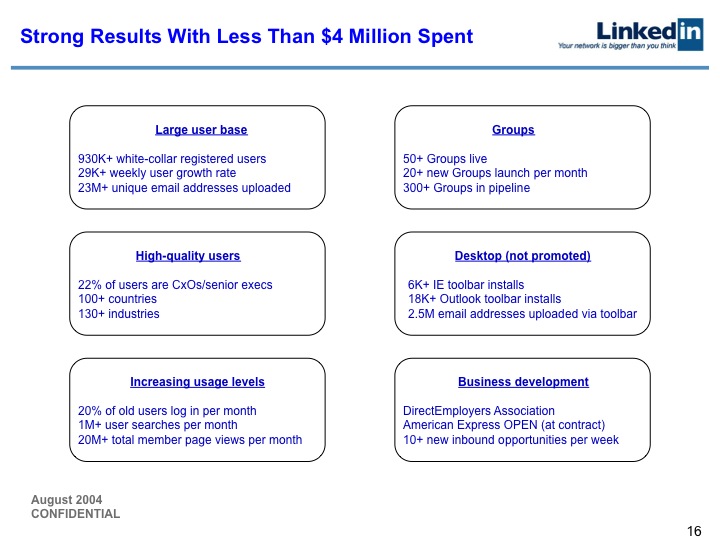
This slide serves as LinkedIn’s credibility cornerstone, demonstrating that the team not only achieved their post-Series A goals but exceeded them significantly. The focus on network growth metrics—likely showing user registrations, connections formed, and engagement levels—provides concrete evidence that the professional networking thesis is gaining real-world validation. Exceeding projections by substantial margins (reportedly 2x in several key areas) transforms this from a progress report into a momentum story.
The strategic brilliance lies in leading with execution proof before diving into future projections or market opportunity. For repeat entrepreneurs like Hoffman, past performance becomes the strongest predictor of future results, and this approach leverages that credibility effectively. The specific metrics chosen likely demonstrate not just growth in absolute numbers but improvements in key quality indicators like user engagement and network density—the early signals of sustainable competitive advantage.
What investors see: A management team that under-promises and over-delivers, arguably the most valuable trait in venture-backed companies. This slide immediately reduces execution risk in investors’ minds, shifting the focus from “can they build it?” to “how big can it get?” The specific mention of exceeding projections also demonstrates sophisticated goal-setting and measurement capabilities—crucial for companies approaching monetisation and rapid scaling phases.
LinkedIn’s market opportunity presentation likely draws parallels to established network platforms like eBay and Google, positioning professional networking as equally foundational to the internet economy. This comparison strategy is particularly powerful because it helps investors conceptualise the scale potential without getting lost in abstract market sizing exercises. By anchoring to familiar success stories, the slide makes a compelling case that professional relationships represent an untapped category of comparable magnitude.
The timing of this slide—after establishing credibility but before diving into competitive analysis—reflects sophisticated pitch architecture. Investors are now primed to believe in the team’s execution capabilities and ready to consider the broader opportunity without immediately jumping to concerns about market saturation or competitive threats. The comparison approach also implicitly addresses the “why now?” question by suggesting that professional networking is simply the next logical evolution of internet-enabled connections.
What investors see: A category-defining opportunity that could create a new pillar of internet infrastructure, rather than just another social networking site. The analogies to Google and eBay signal potential for platform-level network effects and multiple revenue streams, appealing to VCs looking for companies that can achieve market-making scale. This framing elevates LinkedIn from a startup seeking funding to a company building foundational internet infrastructure.

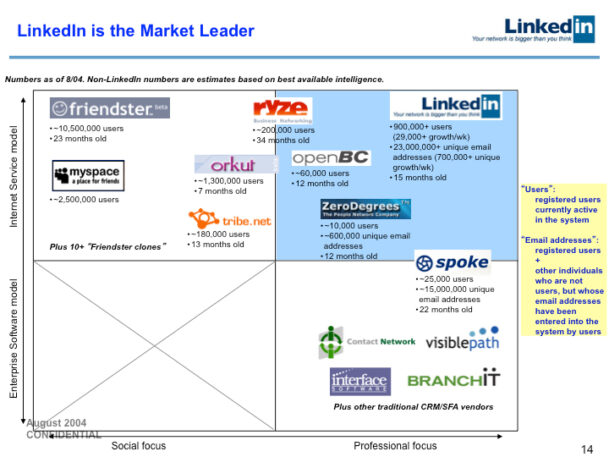
The competitive analysis demonstrates LinkedIn’s strategic positioning against both direct competitors in professional networking and indirect competitors like general social networks and job boards. Rather than dismissing competition, this slide likely acknowledges the landscape while articulating clear differentiation based on professional focus, network effects, and user intent. The analysis probably includes emerging threats like Friendster or early Facebook, showing awareness of broader social networking trends while maintaining focus on professional use cases.
LinkedIn’s competitive advantage thesis likely centres on the fundamental difference between professional and personal relationships—professional networks require trust, verification, and context that general social platforms cannot provide. The slide probably emphasises network effects specific to career advancement, showing how professional connections create value loops that strengthen with scale. This focus on network quality over quantity becomes crucial for defending against larger, general-purpose platforms.
What investors see: A team that understands competitive dynamics while maintaining clear strategic focus. The professional networking angle provides natural barriers against broader social networks, while the network effects create potential moats that strengthen over time. Investors recognise that focused platforms often outlast general-purpose ones in specific use cases, making LinkedIn’s specialisation a strategic asset rather than a limitation.
Reid Hoffman’s PayPal pedigree takes centre stage, leveraging one of Silicon Valley’s most respected entrepreneurial networks to establish immediate credibility. The team slide likely highlights not just Hoffman’s success at PayPal but the broader founding team’s experience at companies like SocialNet and various Sequoia-backed ventures. This emphasis on proven execution becomes crucial when presenting a pre-revenue company—the team’s track record serves as the primary risk mitigation factor for investors evaluating the opportunity.
The strategic presentation of team credentials likely goes beyond simple résumé highlights, focusing on specific experiences that directly relate to LinkedIn’s challenges. Hoffman’s understanding of network effects from PayPal, combined with the team’s collective experience in online platforms and user acquisition, creates a compelling narrative about why this particular group can execute on the professional networking vision. The slide probably emphasises complementary skill sets across product, engineering, and business development.
What investors see: The single most important factor in early-stage investment decisions—a proven team with relevant experience tackling a massive opportunity. The PayPal connection provides instant Silicon Valley credibility, while the Sequoia backing suggests sophisticated investors have already validated the team’s potential. For zero-revenue companies, team quality often outweighs every other factor in investment decisions.
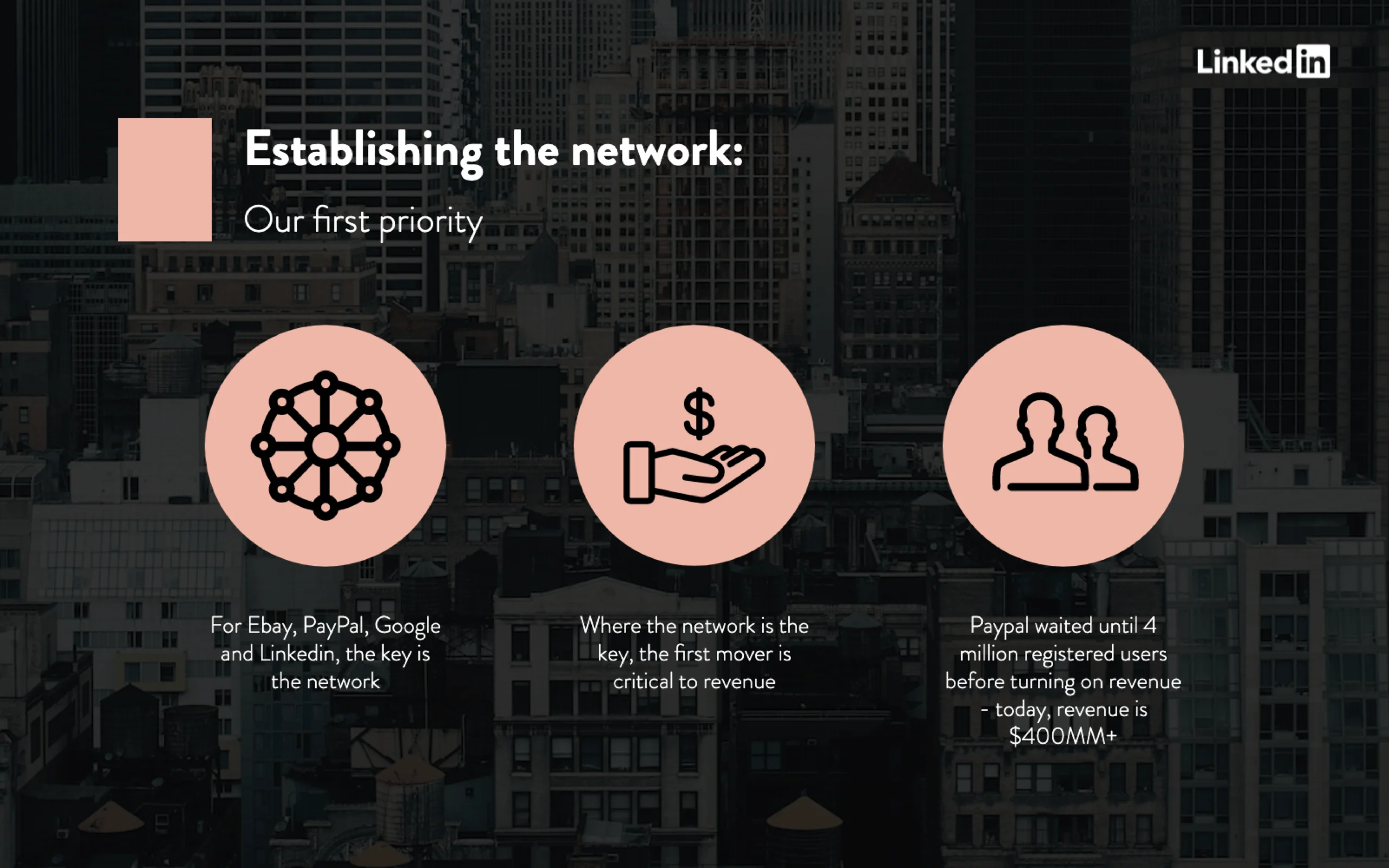
This slide expands LinkedIn’s credibility network beyond the core team, showcasing the broader constellation of advisors and early investors who’ve endorsed the vision. The inclusion likely features recognisable names from the PayPal network, Sequoia partners, and domain experts in networking and recruiting technologies. This approach leverages the principle of social proof in venture capital, where association with respected industry figures can significantly influence investment decisions and validate strategic direction.
Beyond mere name-dropping, the advisor selection demonstrates strategic thinking about LinkedIn’s growth challenges and market positioning. The mix probably includes experts in viral marketing, enterprise sales, and network effects—the key capabilities needed to scale a professional networking platform. The diversity of backgrounds and expertise signals comprehensive thinking about the business challenges ahead while providing investors confidence that critical knowledge gaps can be addressed through the advisor network.
What investors see: A management team that understands the importance of surrounding themselves with domain expertise and industry connections. The quality of advisors often reflects both the founders’ networking abilities and the opportunity’s attractiveness to seasoned professionals. For VCs, strong advisors reduce execution risk and provide potential exit facilitation, making the investment more attractive from multiple angles.
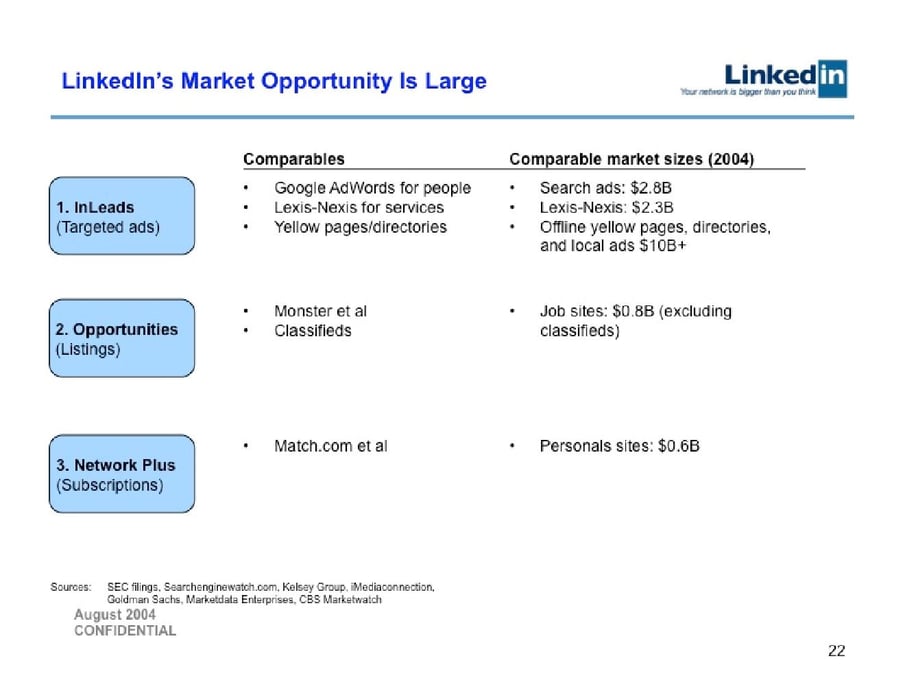
LinkedIn’s first revenue model targets the massive recruitment market, positioning the platform as a superior alternative to traditional job boards through network-driven job discovery. The model likely emphasises how professional connections can surface opportunities that never reach public job postings, creating value for both job seekers and employers through improved matching and reduced hiring costs. This approach transforms LinkedIn’s network from a social tool into a economic engine for career advancement.
The strategic insight behind this model recognises that recruitment is one of the few professional services where users willingly pay for access, creating immediate monetisation opportunities without disrupting the free networking experience. The slide probably includes market sizing for recruitment spending and demonstrates how network effects improve job matching quality over time. This virtuous cycle—better connections lead to better job matches lead to more engagement—provides sustainable competitive advantage against traditional recruiting models.
What investors see: A clear path to revenue that leverages existing user behaviour rather than forcing artificial monetisation. The job search market represents billions in annual spending with proven willingness to pay for quality leads, making this a low-risk first revenue stream. The network effects inherent in job referrals create natural barriers against commoditisation, providing long-term pricing power and margin expansion potential.
[Insert image: linkedin-pitch-deck-slide-08-revenue-model-premium.webp]
The premium subscription model targets professionals seeking to enhance their networking capabilities and professional visibility through advanced features and analytics. This approach recognises that certain users derive significantly higher value from professional networking and are willing to pay for enhanced functionality like expanded connection limits, detailed profile analytics, and advanced search capabilities. The freemium model ensures broad adoption while capturing value from power users who depend on networking for business success.
The subscription model’s brilliance lies in its alignment with professional advancement—as users progress in their careers, their willingness to invest in networking tools typically increases proportionally. The slide likely outlines different subscription tiers targeting various professional segments, from individual contributors seeking better job opportunities to executives managing large networks and business relationships. This creates natural upgrade paths that grow with user success, generating predictable recurring revenue.
What investors see: Recurring revenue streams with high lifetime value potential and natural expansion characteristics. Premium subscriptions typically exhibit strong retention rates in professional contexts, providing predictable cash flow for scaling operations. The model also creates data advantages, as premium users often engage more deeply, generating insights that improve the platform for all users while justifying continued subscription investment.
[Insert image: linkedin-pitch-deck-slide-09-revenue-model-enterprise.webp]
The enterprise revenue model positions LinkedIn as a business intelligence and recruitment platform for companies seeking to leverage professional network data for strategic advantage. This approach transforms the consumer network into an enterprise asset, offering companies tools for talent acquisition, competitive intelligence, and business development through professional relationship mapping. The enterprise focus provides higher average contract values and longer sales cycles that justify dedicated sales teams and custom development.
The strategic insight recognises that professional networks generate valuable aggregate data about industry trends, talent flows, and business relationships that companies will pay premium prices to access. The slide likely outlines tools for corporate recruiters, sales teams tracking prospect networks, and executives monitoring industry movements. This B2B focus provides natural expansion opportunities as enterprise clients typically increase usage and spending over time, creating predictable revenue growth patterns.
What investors see: High-value enterprise revenue streams that leverage platform network effects for B2B applications. Enterprise software typically commands higher multiples due to recurring revenue, customer stickiness, and expansion potential. The combination of consumer scale with enterprise monetisation creates a unique business model that can support premium valuations while providing multiple growth vectors.
[Insert image: linkedin-pitch-deck-slide-10-investor-objections.webp]
This slide demonstrates exceptional strategic thinking by addressing 1-3 key investor concerns head-on during peak attention, rather than waiting for questions that might derail momentum. The objections likely include concerns about market timing (competing with established job boards), scalability challenges (maintaining network quality during rapid growth), and monetisation risks (whether professionals will pay for networking tools). By surfacing these concerns proactively, LinkedIn controls the narrative and demonstrates sophisticated understanding of investor psychology.
The approach transforms potential weaknesses into discussion points that actually strengthen the investment thesis through thoughtful analysis and mitigation strategies. Each objection probably includes specific evidence or analogies that neutralise the concern while reinforcing LinkedIn’s unique advantages. This technique requires deep self-awareness and genuine solutions to real risks, building investor confidence through intellectual honesty rather than overselling.
What investors see: A management team with sophisticated risk assessment capabilities and proactive problem-solving mindsets. The willingness to surface and address concerns directly indicates intellectual maturity and builds trust through transparency. Investors recognise that all investments carry risks—founders who acknowledge and mitigate them proactively are much more likely to navigate future challenges successfully.
[Insert image: linkedin-pitch-deck-slide-11-traction-metrics.webp]
The traction metrics provide concrete evidence of network effects taking hold, likely showcasing user growth acceleration, connection formation rates, and engagement metrics that demonstrate increasing platform value. Key indicators probably include user registration growth, average connections per user, time spent on platform, and viral coefficients from invitation systems. These metrics validate the investment thesis by showing that professional networking is indeed moving online and creating sustainable user engagement patterns.
The strategic presentation of metrics likely emphasises quality indicators alongside growth numbers—demonstrating that network density and user engagement are improving as the platform scales. This addresses critical questions about whether LinkedIn can maintain high-value connections while growing rapidly, providing evidence that network effects create virtuous cycles rather than dilution problems. The metrics probably show improving unit economics as network effects begin generating organic growth.
What investors see: Quantitative validation of network effects theories and sustainable growth mechanics. Strong traction metrics in networked businesses often predict exponential rather than linear growth, making timing crucial for investors seeking maximum returns. The combination of user growth with engagement depth suggests platform stickiness that will support multiple monetisation strategies and competitive defensibility.
[Insert image: linkedin-pitch-deck-slide-12-growth-projections.webp]
Growth projections build on established traction metrics to paint an ambitious yet achievable picture of LinkedIn’s expansion potential across user acquisition, network density, and revenue generation. The projections likely model network effects acceleration, showing how user value increases exponentially as professional connections multiply across industries and geographies. These forecasts probably demonstrate conservative, base case, and optimistic scenarios that bracket potential outcomes while emphasising upside leverage from network effects.
The credibility of projections rests on the foundation of exceeding Series A targets, allowing LinkedIn to use proven growth rates as baseline assumptions for future expansion. The slide likely shows how different revenue models activate at various network scale milestones, creating multiple value inflection points as the user base grows. This approach demonstrates how network effects create accelerating returns rather than linear scaling, justifying premium valuations for successful execution.
What investors see: A mathematical framework for understanding how network effects translate into business value and investment returns. Growth projections that tie to proven metrics and established user behaviours carry much more weight than hypothetical models, giving investors confidence in the underlying assumptions. The network effect amplification suggests potential for venture-scale returns if execution continues at current levels.
[Insert image: linkedin-pitch-deck-slide-13-use-of-funds.webp]
The $10M fund allocation likely emphasises product development, user acquisition, and team expansion—the critical investments needed to capitalise on early network effects momentum. The breakdown probably prioritises engineering resources for platform scalability, marketing spend for viral growth acceleration, and key hires in sales and business development to begin monetisation. This allocation reflects the transition from proof-of-concept to scalable business, requiring different capabilities and investments than the initial development phase.
The strategic emphasis likely centres on network effects acceleration rather than traditional user acquisition, showing sophisticated understanding of viral growth mechanics and compound returns on product investment. The fund usage probably includes significant allocation for international expansion, recognising that professional networks benefit from global scale and cross-border business relationships. This global perspective demonstrates ambition while requiring substantial operational capabilities and cultural adaptation skills.
What investors see: Capital efficiency and strategic prioritisation that maximises network effect leverage rather than burning cash on inefficient acquisition. The allocation balance between product, marketing, and team building suggests mature thinking about growth stage requirements and scaling challenges. Investors appreciate fund usage that creates compounding returns and sustainable competitive advantages rather than short-term metrics inflation.
[Insert image: linkedin-pitch-deck-slide-14-roadmap.webp]
The product roadmap outlines key development milestones and feature launches that drive towards profitability through enhanced user value and monetisation capabilities. The timeline likely includes premium feature rollouts, enterprise tool development, and platform enhancements that improve network effects and user engagement. Each milestone probably ties to specific user growth targets and revenue activation points, creating a clear progression from current capabilities to sustainable business model execution.
The strategic sequencing probably emphasises user experience improvements before aggressive monetisation, maintaining the network growth that creates long-term value while gradually introducing revenue generation features. The roadmap likely balances technical infrastructure scaling with user-facing improvements, ensuring the platform can handle projected growth while delivering increasing value to justify premium features and enterprise sales. This approach demonstrates sophisticated product strategy and market timing awareness.
What investors see: A clear pathway from current position to profitability with measurable milestones and logical feature progression. The roadmap demonstrates product thinking that balances user growth with revenue generation, crucial for platform businesses that must maintain network effects while monetising effectively. Investors value roadmaps that show awareness of scaling challenges and competitive threats while maintaining strategic focus.
[Insert image: linkedin-pitch-deck-slide-15-financial-projections.webp]
The financial projections likely model multiple revenue streams converging over 3-5 years to create significant scale and profitability, demonstrating how network effects translate into sustainable business economics. The forecasts probably show job search revenue activating first as network density reaches critical mass, followed by premium subscriptions and enterprise tools contributing increasingly larger portions of total revenue. These projections build credibility through conservative assumptions while showing substantial upside potential from successful execution.
The financial model likely demonstrates improving unit economics as network effects reduce customer acquisition costs while increasing lifetime value through enhanced user engagement and premium feature adoption. The projections probably include sensitivity analysis showing how different growth scenarios impact profitability timelines and investment returns, providing investors with frameworks for evaluating risk-adjusted returns. This analytical depth reflects sophisticated financial planning and investor-grade business modeling capabilities.
What investors see: A path to venture-scale returns through multiple monetisation vectors and improving economics rather than single-point-of-failure business models. The financial projections demonstrate how network effects create accelerating returns and sustainable competitive advantages that justify premium valuations. Investors particularly value models that show multiple revenue streams reducing single-vector risk while creating cross-selling and expansion opportunities.
[Insert image: linkedin-pitch-deck-slide-16-risks-mitigations.webp]
This slide demonstrates mature risk management thinking by identifying key vulnerabilities and corresponding mitigation strategies across competitive threats, execution challenges, and market dynamics. The risks likely include major competitors entering professional networking, user growth stagnation, monetisation difficulties, and technical scaling challenges. Each risk probably includes specific mitigation strategies that leverage LinkedIn’s current advantages and strategic positioning to minimise impact and maintain competitive differentiation.
The mitigation strategies probably emphasise network effects as the primary competitive moat, showing how early user acquisition and engagement create barriers that become stronger over time. The risk analysis likely addresses technical scaling challenges through infrastructure planning and team hiring strategies that anticipate growth requirements. This comprehensive approach demonstrates sophisticated business planning and increases investor confidence through transparent acknowledgment of potential obstacles and thoughtful preparation.
What investors see: Management awareness of potential failure modes and proactive planning to address them before they become critical issues. The risk mitigation framework suggests mature thinking about competitive dynamics and operational challenges that early-stage companies often underestimate. Investors appreciate founders who acknowledge risks honestly while demonstrating concrete strategies for managing them effectively.
[Insert image: linkedin-pitch-deck-slide-17-case-studies.webp]
The case studies provide concrete examples of LinkedIn creating tangible value for early users through successful job placements, business relationships, and professional opportunities facilitated by the platform. These success stories probably highlight diverse use cases across different industries and career levels, demonstrating broad applicability rather than niche appeal. The examples likely include quantifiable outcomes like salary improvements, business deals closed, and career advancement achieved through LinkedIn connections.
The strategic presentation of case studies transforms abstract networking value into concrete business outcomes that resonate with investor experience and validate willingness-to-pay assumptions. The examples probably emphasise quality of connections over quantity, showing how LinkedIn facilitates meaningful professional relationships rather than superficial networking. This focus on outcome quality supports premium pricing strategies and demonstrates sustainable value proposition that justifies continued user engagement and subscription conversion.
What investors see: Proof of concept for the entire professional networking thesis through real user outcomes and measurable value creation. Case studies provide social proof and validation that the platform creates genuine business value rather than just social engagement, supporting monetisation strategies and user retention assumptions. The diversity of success stories suggests broad market applicability and scalable value proposition across professional segments.
[Insert image: linkedin-pitch-deck-slide-18-network-effects.webp]
This slide articulates the fundamental economics of LinkedIn’s competitive advantage through network effects, drawing explicit parallels to PayPal’s success to provide familiar context for investors. The explanation likely demonstrates how each new professional user increases the platform’s value for existing members through expanded connection opportunities, industry insights, and job market access. The PayPal analogy helps investors understand how network effects create winner-take-all dynamics in professional networking, similar to payment networks.
The network effects analysis probably shows how professional relationships differ from consumer social networks, creating stronger barriers to switching and higher user lifetime value through career-critical applications. The slide likely illustrates acceleration thresholds where network density reaches critical mass and user acquisition becomes increasingly viral and cost-efficient. This framework explains how LinkedIn can achieve sustainable competitive advantages and premium valuations through network effect amplification rather than traditional business model execution.
What investors see: The primary investment thesis validation through proven network effect mechanics that create sustainable competitive moats and accelerating returns. The PayPal parallel provides credible analogies for understanding how professional networks can achieve platform-level scale and defensibility. Investors recognise network effects as one of the few business models that can generate venture-scale returns while creating lasting competitive advantages.
[Insert image: linkedin-pitch-deck-slide-19-go-to-market.webp]
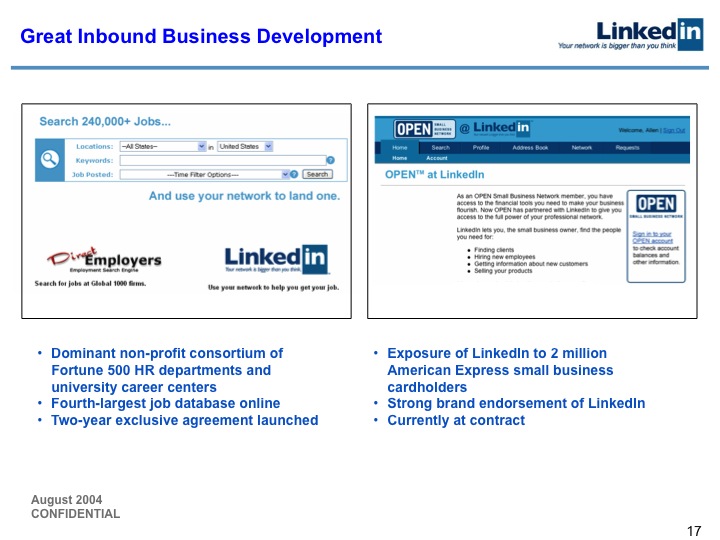
The go-to-market strategy likely emphasises viral mechanisms and targeted professional community acquisition rather than broad consumer marketing, reflecting sophisticated understanding of professional networking adoption patterns. The approach probably includes partnerships with universities, professional associations, and industry groups to seed networks with high-value early adopters who can drive organic expansion through their existing relationships. This strategy leverages existing professional hierarchies and trust networks to accelerate adoption.
The enterprise sales component likely targets HR departments and recruiting firms as early revenue customers who can benefit immediately from network access while driving additional user acquisition through their hiring activities. The dual-sided market approach creates reinforcing growth loops where enterprise customers improve the platform for individual users while individual users generate value for enterprise customers. This strategy demonstrates understanding of how to monetise network effects while maintaining user growth momentum.
What investors see: A sophisticated acquisition strategy that leverages existing professional networks for cost-efficient viral growth rather than expensive mass marketing. The enterprise component provides immediate revenue opportunities while supporting user acquisition, creating sustainable unit economics from early stages. Investors appreciate go-to-market strategies that create reinforcing loops between user growth and revenue generation rather than treating them as separate challenges.
[Insert image: linkedin-pitch-deck-slide-20-technology-overview.webp]
The technology overview likely emphasises scalability and reliability requirements for professional networking, where downtime or performance issues could damage career-critical user activities and business relationships. The architecture probably highlights database design for complex relationship mapping, search capabilities for professional discovery, and privacy controls for sensitive business information. These technical considerations reflect understanding that professional networks require higher reliability and security standards than consumer social platforms.
The platform design likely addresses international expansion requirements and multi-language support, recognising that professional networks benefit from global reach and cross-border business relationships. The technical roadmap probably includes machine learning capabilities for connection recommendations and content relevance, demonstrating forward-thinking about how data advantages can improve user experience while creating competitive differentiation. This approach shows awareness of how technology becomes a strategic asset in network effect businesses.
What investors see: Technical architecture that can support venture-scale growth while maintaining professional-grade reliability and security standards. The technology strategy demonstrates understanding of how platform capabilities become competitive advantages through data network effects and user experience improvements. Investors appreciate technical roadmaps that show scalability planning and strategic technology development rather than just current functionality.
[Insert image: linkedin-pitch-deck-slide-21-cac.webp]
The customer acquisition cost analysis likely demonstrates improving unit economics as network effects reduce acquisition costs while increasing user lifetime value through enhanced platform utility and premium feature adoption. The metrics probably show how viral coefficients improve as network density increases, creating sustainable competitive advantages through organic growth rather than paid acquisition dependency. This economic framework explains how LinkedIn can achieve profitability while maintaining rapid growth rates.
The lifetime value calculations likely incorporate professional networking’s long-term nature, where users maintain connections throughout entire careers rather than short engagement cycles typical in consumer applications. The analysis probably shows how professional users justify higher subscription prices through career advancement value, creating sustainable revenue streams with strong retention characteristics. This long-term value perspective supports premium pricing strategies and validates significant upfront investment in user acquisition.
What investors see: Unit economics that improve over time through network effects rather than requiring continuous efficiency improvements or price increases. The CAC/LTV metrics demonstrate sustainable business model characteristics with natural expansion revenue and viral growth mechanisms. Investors particularly value businesses where unit economics improve through scale rather than requiring constant optimisation to maintain profitability.
[Insert image: linkedin-pitch-deck-slide-22-partnerships.webp]
The partnerships slide likely showcases strategic alliances with universities, professional associations, and recruiting firms that can accelerate user acquisition while providing immediate value validation for the professional networking concept. These partnerships probably include alumni network integrations, professional certification programmes, and enterprise recruiting partnerships that create natural user onboarding while demonstrating tangible value propositions. The strategic approach focuses on partnerships that enhance network effects rather than simple user acquisition deals.
The partnership strategy likely emphasises complementary rather than competitive relationships, showing understanding of how professional networking can enhance existing business relationships rather than threatening established players. The alliances probably include integration opportunities with HR systems, business development tools, and professional development platforms that expand LinkedIn’s utility while creating multiple touchpoints for user engagement. This comprehensive approach demonstrates market development thinking beyond standalone platform growth.
What investors see: Strategic thinking about ecosystem development and network effect acceleration through established professional relationships and trusted institutions. The partnership approach reduces user acquisition costs while building credibility through association with respected organisations in professional development and recruiting. Investors appreciate partnerships that create sustainable competitive advantages rather than short-term growth boosts.
[Insert image: linkedin-pitch-deck-slide-23-market-validation.webp]
Market validation provides evidence from pilot programmes, beta tests, and early customer feedback that professional networking creates measurable business value across diverse industries and user segments. The validation probably includes quantitative metrics from test markets, qualitative feedback from power users, and adoption patterns that demonstrate sustainable engagement rather than novelty usage. These proof points address fundamental questions about market timing and user behaviour that determine long-term viability.
The validation data likely demonstrates professional networking’s differentiation from consumer social networking through higher engagement per session, longer user retention, and willingness to pay for premium features. The evidence probably shows how professional applications create stickier user behaviour and more sustainable monetisation opportunities than entertainment-focused platforms. This distinction becomes crucial for justifying premium valuations and venture-scale growth projections in competitive social networking markets.
What investors see: Market evidence that professional networking represents a distinct and valuable category rather than a niche subset of social networking. The validation data reduces market risk by demonstrating sustainable user demand and monetisation potential through real usage patterns rather than hypothetical assumptions. Investors value validation that shows category-creating potential rather than incremental improvements to existing solutions.
[Insert image: linkedin-pitch-deck-slide-24-exit-strategy.webp]
The exit strategy outlines multiple paths to investor liquidity including IPO potential and strategic acquisition opportunities with technology companies, media organisations, and professional services firms that could benefit from professional network integration. The analysis likely includes comparable company valuations and market precedents for network effect businesses, demonstrating how LinkedIn’s scale and network effects could justify premium exit valuations. This comprehensive approach reduces investor concerns about liquidity constraints while showing strategic value beyond financial metrics.
The strategic acquisition thesis probably emphasises how professional networking data and relationships could enhance existing business models for enterprise software companies, recruitment firms, and business development platforms. The IPO pathway likely references comparable public companies in recruiting, social networking, and enterprise software that provide valuation benchmarks for public market potential. This dual-path approach demonstrates flexibility while showing substantial value creation potential through multiple exit scenarios.
What investors see: Multiple paths to significant returns through both strategic value and public market potential, reducing single-point-of-failure exit risk that concerns institutional investors. The exit analysis demonstrates understanding of how network effects create strategic value for potential acquirers while building standalone business value for IPO consideration. Investors appreciate exit strategies that show multiple paths to venture-scale returns rather than dependence on single exit scenarios.
[Insert image: linkedin-pitch-deck-slide-25-ask.webp]
The ask slide presents a clear $10M Series B request with specific valuation expectations and terms, building on the comprehensive case developed throughout the presentation for why this investment represents exceptional opportunity and risk-adjusted returns. The ask likely includes board composition, investor rights, and use of proceeds that align investor and founder incentives while providing appropriate governance and transparency for institutional capital. This direct approach demonstrates confidence in the investment thesis and readiness for immediate decision-making.
The investment terms probably emphasise partnership rather than purely financial transaction, highlighting how the right investor can provide strategic value through network connections, operational expertise, and market credibility beyond capital provision. The ask likely includes timeline expectations and next steps that facilitate rapid decision-making while allowing for proper due diligence processes. This professional approach respects investor requirements while maintaining momentum towards funding closure.
What investors see: Professional funding request with clear terms and expectations that facilitate decision-making without unnecessary complexity or negotiation overhead. The ask demonstrates confidence in valuation while showing flexibility for partnership-oriented investors who can add strategic value beyond capital. Investors appreciate clear asks that respect their evaluation processes while providing sufficient urgency to drive timely decisions.
[Insert image: linkedin-pitch-deck-slide-26-thank-you.webp]
The closing slide maintains professional tone while providing clear contact information and next steps for continued dialogue, reflecting LinkedIn’s focus on building lasting business relationships rather than transactional interactions. The thank you approach likely emphasises partnership opportunity and mutual value creation rather than simply requesting investment consideration. This relationship-focused approach aligns with LinkedIn’s core value proposition while demonstrating authentic appreciation for investor time and attention.
The contact approach probably includes multiple team members and communication preferences that accommodate different investor styles and due diligence requirements. The next steps likely outline timeline expectations and additional information availability while respecting investor decision-making processes and requirements for internal discussions. This professional approach demonstrates respect for institutional investment practices while maintaining accessibility for continued engagement.
What investors see: Professional presentation closure that facilitates continued engagement without pressure tactics or artificial urgency that might suggest desperation or poor market dynamics. The thank you approach demonstrates confidence in the opportunity while showing respect for investor evaluation processes and timeline requirements. Investors appreciate closings that maintain relationship focus while providing clear paths for continued dialogue and due diligence.
[Insert image: linkedin-pitch-deck-slide-27-appendix-financials.webp]
The detailed financial appendix provides comprehensive modeling that supports the high-level projections presented earlier, including detailed assumptions about user growth, revenue per user, customer acquisition costs, and operational scaling requirements. These backup materials demonstrate sophisticated financial planning and provide investors with the detailed analysis needed for thorough due diligence and investment committee presentations. The models probably include sensitivity analysis and scenario planning that show outcomes under various growth and market conditions.
The financial detail likely includes unit economics breakdowns, cohort analysis, and international expansion cost modeling that demonstrate deep understanding of business drivers and scaling requirements. The appendix probably provides month-by-month projections for the immediate investment period with quarterly projections for longer-term planning, showing cash flow timing and milestone achievement that justify funding amounts and timing. This level of detail reflects institutional-grade financial planning and investor-ready preparation.
What investors see: Professional-grade financial modeling that supports investment thesis with detailed assumptions and scenario analysis rather than optimistic projections without supporting logic. The comprehensive appendix demonstrates management’s understanding of key business drivers and scaling requirements, building confidence in execution capabilities and financial discipline. Investors value detailed financial models that show thorough planning and realistic assumptions about growth trajectories and operational requirements.
[Insert image: linkedin-pitch-deck-slide-28-appendix-demographics.webp]
The user demographics analysis provides detailed breakdown of LinkedIn’s network composition across industries, seniority levels, geographic regions, and professional functions that demonstrate broad appeal and balanced growth rather than concentration in single segments. The demographic data likely shows healthy distribution across key professional categories with particular strength in technology, finance, and consulting—the high-value professional segments most likely to drive premium subscription adoption and enterprise sales opportunities.
The demographic analysis probably includes user engagement patterns by segment, showing how different professional categories use the platform and generate value through connections and content sharing. The data likely demonstrates network effects acceleration through diverse professional representation, showing how cross-industry connections create unique value that cannot be replicated by niche professional networks or industry-specific platforms. This diversity becomes crucial for defending against focused competitors while supporting multiple revenue streams.
What investors see: Network composition that supports sustainable growth and multiple monetisation strategies rather than dependence on single professional segments or geographic markets. The demographic diversity demonstrates broad market appeal while showing concentration in high-value professional categories that justify premium pricing and enterprise sales potential. Investors value user base composition that creates natural expansion opportunities and reduces single-segment concentration risk.
[Insert image: linkedin-pitch-deck-slide-29-appendix-competition.webp]
The competitive deep dive provides comprehensive analysis of direct and indirect competitors across professional networking, social networking, recruiting platforms, and enterprise software categories that could impact LinkedIn’s growth and market position. The analysis likely includes detailed feature comparisons, user acquisition strategies, monetisation approaches, and strategic positioning that demonstrate LinkedIn’s differentiated approach and competitive advantages. This thorough competitive intelligence shows market awareness and strategic thinking beyond immediate threats.
The competitive framework probably emphasises LinkedIn’s unique position at the intersection of professional networking and business intelligence, creating barriers against single-purpose competitors while building strategic value for potential partners and acquirers. The analysis likely addresses potential competitive threats from larger technology companies while showing how professional focus creates natural defensibility and expansion opportunities. This strategic positioning demonstrates sophisticated market understanding and competitive strategy development.
What investors see: Comprehensive market intelligence that demonstrates strategic awareness and competitive positioning rather than isolated focus on immediate threats. The competitive analysis shows understanding of market dynamics and potential disruption while articulating clear differentiation and defensive strategies. Investors value competitive analysis that shows both market awareness and confident strategic positioning rather than defensive reactions to competitive threats.
While LinkedIn’s 2004 Series B deck secured what would become one of venture capital’s most extraordinary returns, it reflects the presentation standards and investor expectations of its era. Modern founders examining this deck will notice significant gaps that today’s data-driven, visually-oriented venture capital environment demands. The deck’s text-heavy approach and comprehensive 29-slide structure, though effective for Hoffman’s strategic storytelling, would struggle against contemporary attention spans and presentation best practices that favour concise, visual narratives built around single compelling metrics.
Lacks a dedicated early slide framing the core problem in professional networking and how LinkedIn solves it crisply; modern decks use this to hook investors immediately with relatable pain points.
No screenshots or live demo visuals of the platform; today’s decks include visuals to make the product tangible and showcase UX.
Missing granular Total Addressable Market, Serviceable Addressable Market, and Serviceable Obtainable Market analysis; essential for quantifying opportunity in data-driven pitches.
No explicit CAC, LTV, or payback period metrics; modern VCs demand these to assess scalability and profitability potential early.
Start with 3-8 bullets on what investors must believe; backs every slide with evidence, guiding the narrative and aligning audience from slide 1—founders should tailor to specific VC theses.
Steer into 1-3 key concerns early when attention peaks; demonstrates self-awareness and builds trust—anticipate VCs’ doubts via research and neutralize them directly.
Detail prior milestones beating projections to earn future trust; for repeat raises, reference past decks to prove delivery—always over-deliver on promises.
Especially pre-revenue, dedicate slides to team and advisors; PayPal mafia credibility was key—founders should quantify experience in exits, scales, or domain wins.
For growth-stage with strong team, outline 3 focused models without diluting focus; shows resilience—prioritize but flex based on market feedback.
Research firm fit, partner expertise, and partnership dynamics; Hoffman chose Sze for network vision—warm intros and thesis alignment boost close rates.
Design decks for future scrutiny; exceeding public projections builds compounding credibility across rounds—transparency pays long-term.
At Projects RH, we help companies across all industries create investor-ready materials that close deals. Our integrated capital raising package ensures consistency across all your investor documentation.
Built in-house for accuracy and investor confidence.
Comprehensive investor documentation following global best practices.
12-slide investor-ready presentation with supporting materials.
High-impact snapshot to capture investor attention fast.
Browse our collection of real pitch deck breakdowns from the world’s most successful companies.
LinkedIn's Series B deck had 29 slides, longer than modern 10-15 slide norms but effective due to detailed storytelling, traction proof, and Hoffman's commentary on each section.
The deck secured $10M in Series B funding from Greylock Partners in 2004, following a $4.7M Series A, enabling scaling from 1M+ users toward revenue generation.
Success stemmed from leading with investment thesis, proactively addressing objections, proving Series A execution, showcasing elite team/advisors, and outlining clear revenue paths—building unshakeable investor confidence despite zero revenue.
Use as inspiration for structure like thesis-first and objection-handling, but adapt to modern standards: shorten to 12-15 slides, add visuals/unit economics/customer proof; 2004 context (pre-social era) differs from today's data-heavy expectations.
Series B in 2004, post-$4.7M Series A from Sequoia; focus shifted from concept/network build to revenue execution, with proven traction in user growth.
Creating an effective pitch deck requires more than following a template — it demands strategic clarity about your value proposition, a deep understanding of your target investors, and rigorous financial modelling to support your narrative. At Projects RH, we combine financial expertise with strategic storytelling to build pitch decks, information memorandums, and financial models that meet the standards of institutional investors worldwide. Our team has generated over USD 2.0 billion in expressions of interest across mining, energy, technology, medtech, and financial services sectors. Schedule a consultation to discuss how we can help position your company for successful capital raising.