
A detailed analysis of the 12-slide pitch deck from Sequoia Capital, showcasing strategies and insights that define successful funding approaches.
Sequoia Capital was founded in 1972 by Don Valentine in Menlo Park, California, during the nascent days of Silicon Valley’s venture capital ecosystem. Valentine, a semiconductor industry veteran from Fairchild and National Semiconductor, recognised the transformative potential of funding innovative technology startups amid the emerging personal computing revolution. His early investments included Atari, positioning Sequoia at the forefront of what would become the modern tech investment landscape, making it a prime example for those seeking pitch deck consulting.
The firm’s evolution from hardware-focused investments to software and internet companies required strategic pivots through multiple economic cycles. Early challenges included proving the venture capital model in an unproven ecosystem whilst navigating market downturns and investor scepticism. By the 1990s, partners like Mike Moritz had joined the firm, scaling operations during the dot-com boom and establishing Sequoia’s reputation through legendary investments in Apple, Cisco, and later Google.
What makes this particular pitch deck analysis unique is that it represents not a company’s fundraising effort, but rather Sequoia’s codification of the perfect investor pitch. In the 2010s, Sequoia formalised their investment evaluation criteria through a blog post on business plans, which evolved into the widely adopted 12-slide template. This framework has since influenced thousands of startup presentations, streamlining founder-investor communications across Silicon Valley and beyond.
Today, Sequoia Capital manages over $85 billion in assets under management, having backed more than 300 unicorns and generated over $1 trillion in realised returns. Their template has become the gold standard for startup presentations, representing decades of investment wisdom distilled into a framework that prioritises clarity, strategic thinking, and investor psychology. This analysis examines not just a pitch deck, but the DNA of how Silicon Valley’s most successful venture capital firm evaluates and structures investment opportunities.
The title slide in Sequoia’s template serves as the critical first touchpoint, designed to immediately establish credibility and professionalism. This slide requires company name, logo, contact information, and a compelling tagline that captures the essence of the business in seconds. The strategic importance lies in creating instant recognition and trust, as investors often make initial judgements within the first 30 seconds of a presentation.
Sequoia’s approach emphasises visual clarity and brand consistency, recognising that the title slide often circulates independently as investors share decks internally. The inclusion of contact information isn’t merely functional—it signals accessibility and confidence from founders who are ready for immediate follow-up discussions. This slide sets expectations for the entire presentation’s quality and attention to detail.
What investors see: A professional title slide immediately signals whether founders understand investor expectations and have invested in proper presentation materials. Sequoia partners evaluate visual design, brand maturity, and contact accessibility as early indicators of execution quality. A polished title slide suggests founders who respect investor time and understand the importance of first impressions in building trust for subsequent funding rounds.
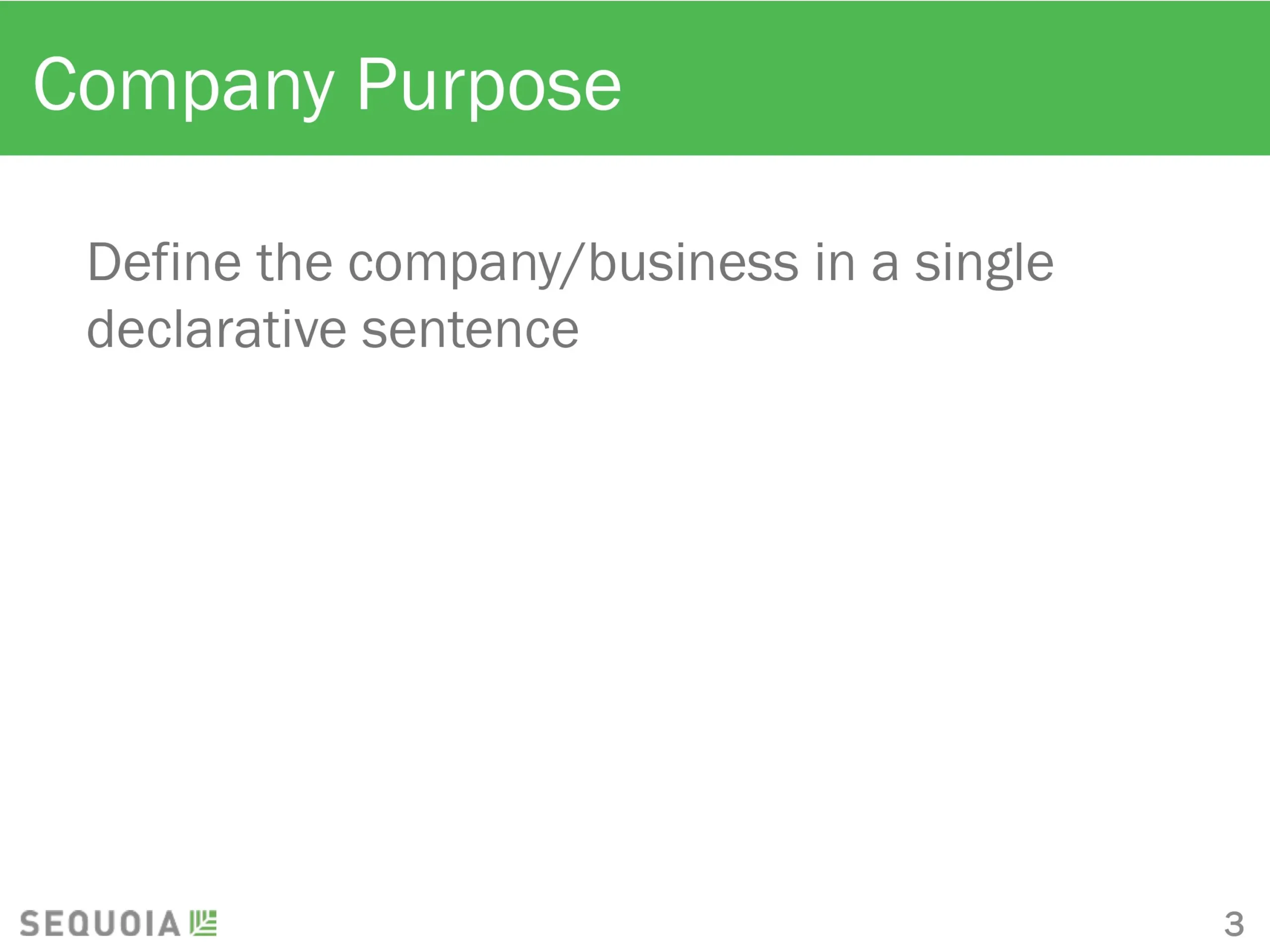
The Company Purpose slide represents Sequoia’s most challenging requirement: distilling an entire business concept into a single, memorable sentence. This exercise forces founders to achieve absolute clarity about their core value proposition, eliminating jargon and complex explanations that often obscure rather than illuminate. The constraint of one sentence ensures that even non-expert investors can immediately grasp what the company does and why it matters.
This slide reflects Sequoia’s investment philosophy that the best businesses can be explained simply, regardless of their underlying complexity. Companies that struggle with this exercise often reveal fundamental issues with market positioning or strategic focus. The discipline required to craft this sentence typically improves founders’ ability to communicate their vision to customers, employees, and subsequent investors throughout their growth journey.
What investors see: A clear, compelling company purpose signals strategic thinking and market clarity that correlates with execution success. Investors use this slide to quickly assess whether they can easily explain the investment opportunity to their own partners and limited partners. Sequoia looks for purpose statements that create immediate understanding and generate natural follow-up questions rather than confusion or the need for clarification.
The Problem slide forms the foundation of Sequoia’s investment thesis by clearly articulating the customer pain point that drives market demand. This slide must demonstrate not just that a problem exists, but that it’s significant, widespread, and urgent enough to motivate customers to change their behaviour and spend money on solutions. Effective problem statements use relatable examples, compelling data, and emotional resonance to build investor conviction about market opportunity.
Sequoia’s approach emphasises problems that are either growing worse over time or becoming newly addressable through technological or regulatory changes. The best problem slides connect macroeconomic trends, demographic shifts, or technological evolution to specific customer frustrations. This creates a compelling narrative about why now is the right time to solve this particular problem and why the market will reward successful solutions with significant returns.
What investors see: A well-defined problem validates market demand and suggests a clear path to product-market fit, reducing investment risk significantly. Sequoia evaluates whether the problem resonates personally with the investment team and whether it’s substantial enough to support a venture-scale business. Strong problem articulation indicates founders who deeply understand their customers and have identified genuine market inefficiencies rather than solutions searching for problems.
[Insert image: sequoia-capital-pitch-deck-slide-04-solution.webp]
The Solution slide must create the “eureka moment” where investors immediately understand how the product elegantly addresses the problem presented in the previous slide. This slide goes beyond feature descriptions to highlight the unique value proposition and core insights that differentiate the approach from existing alternatives. Sequoia emphasises solutions that are not just better, but fundamentally different in ways that create sustainable competitive advantages.
The most compelling solution slides demonstrate deep customer insight and technical innovation working together to solve previously intractable problems. Sequoia looks for solutions that seem obvious in retrospect but required significant insight or technology development to conceive and execute. This slide should make investors wonder why no one has built this solution before, while simultaneously convincing them that this team is uniquely positioned to execute it successfully.
What investors see: A compelling solution indicates strong product-market fit potential and suggests founders have discovered genuine market insights that others have missed. Sequoia evaluates whether the solution is technically feasible, commercially viable, and defensible against future competition. The quality of solution thinking often predicts a team’s ability to iterate and adapt their product as market conditions and customer needs evolve over time.
[Insert image: sequoia-capital-pitch-deck-slide-05-why-now.webp]
The “Why Now?” slide addresses one of the most critical questions in venture investing: market timing. This slide must explain why this solution is possible and necessary at this specific moment in time, supported by technological shifts, regulatory changes, demographic trends, or behavioural changes that create new opportunities. Sequoia recognises that even great solutions can fail if introduced too early or too late in market cycles.
Effective timing arguments combine multiple converging trends that create a perfect storm of opportunity rather than relying on single factors. The best “Why Now?” slides demonstrate how recent changes make the problem more urgent, the solution more feasible, or the market more receptive than ever before. This creates urgency for investors to act quickly rather than waiting to see how the market develops over the next few years.
What investors see: Strong timing arguments indicate founders who understand macro trends and can position their companies to ride secular waves rather than fighting against market currents. Sequoia uses this slide to evaluate whether the investment opportunity is likely to expand or contract over their typical investment horizon. Compelling timing creates competitive urgency and suggests the potential for rapid market adoption and growth.
[Insert image: sequoia-capital-pitch-deck-slide-06-market-size.webp]
The Market Size slide presents the Total Addressable Market (TAM), Serviceable Addressable Market (SAM), and Serviceable Obtainable Market (SOM) to demonstrate the scale of opportunity and growth potential. Sequoia emphasises bottom-up market analysis that builds from specific customer segments and unit economics rather than top-down industry reports that may not reflect actual buying behaviour. This slide must convince investors that successful execution could generate venture-scale returns.
Beyond static market size, this slide should demonstrate how the addressable market is expanding through the trends identified in “Why Now?” The most compelling presentations show markets that are not only large today but growing rapidly due to technological adoption, demographic shifts, or regulatory changes. Sequoia particularly values markets where early successful companies can expand their addressable market through product innovation and geographic expansion.
What investors see: Market size analysis reveals whether founders understand their competitive landscape and have realistic expectations about growth potential and market share requirements. Sequoia evaluates whether the market is large enough to support multiple successful companies and whether barriers to entry will allow market leaders to capture disproportionate value. Strong market analysis indicates strategic thinking about expansion opportunities and competitive positioning.
[Insert image: sequoia-capital-pitch-deck-slide-07-competitors.webp]
The Competitors slide requires honest analysis of both direct and indirect competitors, acknowledging their strengths whilst clearly articulating sustainable competitive advantages. Sequoia values founders who demonstrate deep market knowledge and realistic assessment of competitive threats rather than claiming no competition exists. This slide should position the company within the competitive landscape whilst highlighting unique capabilities and strategic moats.
Effective competitive analysis extends beyond feature comparisons to examine different business models, go-to-market strategies, and customer segments that create sustainable differentiation. The best presentations identify why existing solutions fail to address the problem adequately and how their approach exploits specific market or technology gaps. This analysis should demonstrate strategic thinking about long-term competitive positioning and barriers to entry.
What investors see: Competitive analysis reveals market maturity, founder sophistication, and the likelihood of sustainable differentiation in increasingly crowded markets. Sequoia evaluates whether competitive advantages are defensible over time and whether the market structure supports winner-take-all dynamics or commoditisation. Strong competitive positioning indicates founders who can adapt strategy as markets evolve and new entrants emerge.
[Insert image: sequoia-capital-pitch-deck-slide-08-product.webp]
The Product slide provides detailed visualization of the solution through screenshots, diagrams, or demonstrations that illustrate key features and functionality. This slide transforms abstract concepts from earlier slides into tangible user experiences that investors can evaluate for usability, differentiation, and market appeal. Sequoia emphasises showing rather than telling, using visuals that demonstrate product sophistication and user experience quality.
Beyond feature functionality, this slide should convey product vision and roadmap thinking that extends beyond current capabilities to future market expansion. The most effective product presentations demonstrate how current features solve immediate customer problems whilst revealing the platform potential for additional capabilities and market segments. This creates investor confidence in the team’s ability to build enduring product advantages over time.
What investors see: Product quality and vision indicate execution capabilities and technical sophistication that correlate with competitive success in technology markets. Sequoia evaluates whether the product demonstrates genuine innovation, user experience excellence, and technical barriers that competitors will struggle to replicate quickly. Strong product presentation suggests a team capable of continuous innovation and market leadership over multiple product cycles.
[Insert image: sequoia-capital-pitch-deck-slide-09-business-model.webp]
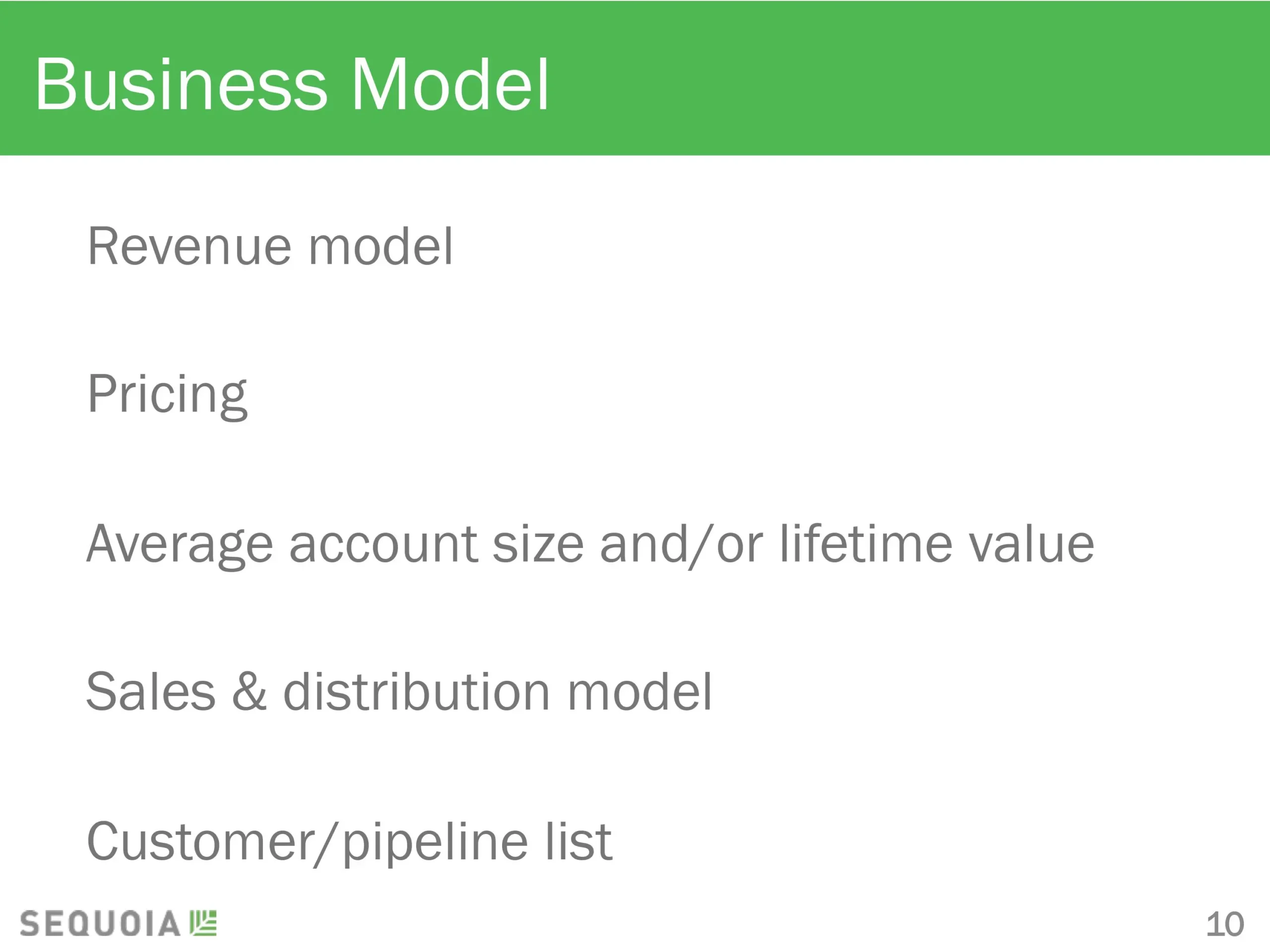
The Business Model slide outlines revenue streams, pricing strategies, and unit economics that demonstrate how the company will generate sustainable profits at scale. Sequoia emphasises clarity about who pays, how much they pay, and how frequently they pay, supported by customer validation and early traction data. This slide must show a clear path from current revenue experiments to scalable business model that can support venture-scale growth and returns.
Beyond basic monetisation mechanics, this slide should demonstrate business model innovation that creates competitive advantages through network effects, switching costs, or economies of scale. The most compelling business models show how successful customer acquisition creates sustainable moats through data, relationships, or infrastructure that become more valuable over time. This creates investor confidence in long-term profitability and market defensibility.
What investors see: Business model clarity indicates commercial viability and suggests founders who understand the difference between building great products and building great businesses. Sequoia evaluates whether unit economics support profitable growth at scale and whether the business model creates sustainable competitive advantages. Strong business model thinking demonstrates the strategic sophistication necessary for long-term market leadership and value creation.
[Insert image: sequoia-capital-pitch-deck-slide-10-team.webp]
The Team slide introduces founders and key team members, highlighting relevant experience, expertise, and unique qualifications that demonstrate why this specific team can execute the opportunity successfully. Sequoia emphasises founder-market fit over pure credentials, looking for deep domain expertise, previous startup experience, or unique insights that provide competitive advantages. This slide should tell a compelling story about why these individuals discovered this opportunity and why they’re uniquely positioned to succeed.
Beyond individual qualifications, this slide should demonstrate team chemistry, complementary skills, and shared vision that suggest long-term collaboration success under the pressure of startup growth. The most effective team presentations show how different backgrounds and expertise combine to create unique market insights and execution capabilities. This includes identifying key hires and advisor relationships that strengthen execution prospects in critical areas.
What investors see: Team quality often determines investment decisions more than market size or product features, as exceptional founders can navigate market changes and execution challenges that defeat weaker teams. Sequoia evaluates whether founders demonstrate the resilience, adaptability, and learning velocity necessary for venture-scale success. Strong teams indicate higher probability of successful execution and ability to attract top talent as the company scales.
[Insert image: sequoia-capital-pitch-deck-slide-11-financials.webp]
The Financials slide presents three to five-year projections including revenue growth, expense scaling, and path to profitability, supported by clear assumptions about customer acquisition, retention, and unit economics. Sequoia emphasises realistic projections that demonstrate understanding of business fundamentals rather than hockey-stick growth curves without underlying logic. This slide must show how investment capital translates into business growth and eventual investor returns.
Beyond revenue projections, this slide should demonstrate capital efficiency and scaling leverage that create attractive unit economics as the business grows. The most compelling financial models show how early investment in customer acquisition, product development, or market expansion creates sustainable competitive advantages and improving margins over time. This creates investor confidence in both growth potential and eventual profitability that supports venture-scale returns.
What investors see: Financial projections reveal founder sophistication about business fundamentals and realistic expectations about growth requirements for venture success. Sequoia evaluates whether assumptions underlying projections are achievable and whether the business model supports sustainable competitive advantages. Strong financial thinking indicates founders who can manage capital efficiently and make strategic decisions that optimize for long-term value creation rather than short-term growth metrics.
[Insert image: sequoia-capital-pitch-deck-slide-12-end-cover.webp]
The End Cover slide brings the presentation full circle with a compelling vision statement, specific fundraising ask, and clear call to action for next steps in the investment process. This slide should reinforce the key themes from throughout the presentation whilst creating urgency and excitement about the opportunity. Sequoia emphasises ending with inspiration about the company’s potential impact and growth trajectory rather than merely summarising previous slides.
Beyond vision, this slide must include practical details about the investment opportunity including funding amount, use of proceeds, and timeline for decision-making. The most effective closing slides create emotional connection with the company’s mission whilst providing specific next steps that make it easy for interested investors to move forward immediately. This combination of inspiration and practicality reflects the balance required for successful venture fundraising.
What investors see: A strong closing slide indicates strategic thinking about company vision and practical understanding of the fundraising process that suggests sophisticated founders ready for venture partnership. Sequoia evaluates whether the vision is ambitious yet achievable and whether the ask aligns with company needs and growth plans. Compelling closings create lasting impressions that distinguish memorable presentations from routine pitch deck reviews and generate follow-up interest from investment teams.
While this template represents decades of Sequoia Capital’s investment wisdom distilled into the perfect pitch framework, it reflects the VC mindset circa 2010-2015 and lacks several elements that modern investors expect in 2026. The template’s strength lies in its logical flow and strategic clarity, but founders using it today without modifications risk appearing outdated or missing critical proof points that sophisticated investors demand. These gaps represent opportunities for founders to differentiate their presentations whilst maintaining the template’s proven structural foundation.
Lacks a dedicated slide for user growth, revenue, or partnerships; modern decks require this early to prove product-market fit and de-risk investment.
No explicit GTM plan covering sales, marketing, and distribution; essential for showing scalable customer acquisition in competitive markets.
Missing clear terms like amount, valuation, and use of funds; investors need this to evaluate deal fit immediately.
End cover is vague without 5-10 year aspirations tied to market dominance; modern decks end with bold, achievable long-term impact.
No acknowledgment of risks or execution barriers; transparency builds trust in sophisticated 2026 investor audiences.
Absence of quotes or case studies; social proof from users validates claims in data-skeptical VC environments.
Static product slide without interactive demo; 2026 decks leverage video for engagement in remote pitching.
These gaps don’t diminish the template’s fundamental value but highlight how investor expectations have evolved toward more evidence-based decision-making and comprehensive risk assessment. At Projects RH, we help founders build upon Sequoia’s proven framework whilst incorporating these modern elements to create presentations that resonate with today’s sophisticated investor audience. The goal is maintaining the template’s clarity and logical flow whilst adding the proof points and strategic depth that distinguish exceptional fundraising presentations in 2026’s competitive venture landscape.
Company Purpose slide teaches boiling your business to a single, memorable line; founders apply by testing it on non-experts for instant clarity.
Use sharp trends like AI or policy shifts; apply by linking timing directly to your edge, avoiding generic claims.
Focus on who pays, how much/often; founders avoid listing multiple streams early, proving one scalable path first.
Narrate why this team wins; apply by highlighting founder journeys relevant to the problem, not just credentials.
Show 3-5 year projections with key drivers; founders back with unit economics, preparing for deep-dive questions.
Proves brevity wins investor scans; apply by ruthlessly cutting fluff, designing for 2-3 minute reads.
Tie closing to problem/solution/market; founders craft inevitable-feeling futures grounded in prior slides.
The evolution from Sequoia Capital’s 2010s pitch deck template to their current position as one of the world’s most successful venture capital firms represents one of the most influential transformations in startup fundraising methodology. What began as internal investment criteria has become the global standard for how founders communicate with investors, demonstrating how codifying excellence can create enduring competitive advantages. This template didn’t just help Sequoia evaluate deals more efficiently—it shaped an entire generation of entrepreneurs to think more clearly about their businesses and communicate more effectively with capital markets.
The template’s influence extends far beyond fundraising presentations to fundamental business strategy, as thousands of founders have used Sequoia’s framework to clarify their thinking about market opportunity, competitive positioning, and growth strategy. Companies that successfully applied this template have collectively generated trillions in market value, from early adopters like Airbnb and WhatsApp to modern unicorns like Stripe and OpenAI. This represents perhaps the highest return on investment for any business framework in history—a simple 12-slide structure that has shaped the entire venture capital ecosystem.
For Sequoia Capital, the template’s widespread adoption has created network effects that reinforce their market position, as startups worldwide aspire to meet their investment criteria and communication standards. This strategic insight—that sharing investment methodology could strengthen deal flow and selection quality—demonstrates the type of systems thinking that has made Sequoia one of the most successful venture capital firms in history. The template’s enduring influence proves that the most valuable intellectual property often becomes more powerful when shared freely, creating ecosystem-wide improvements that ultimately benefit the original innovator.
At Projects RH, we help companies across all industries create investor-ready materials that close deals. Our integrated capital raising package ensures consistency across all your investor documentation.
Built in-house for accuracy and investor confidence.
Comprehensive investor documentation following global best practices.
12-slide investor-ready presentation with supporting materials.
High-impact snapshot to capture investor attention fast.
Browse our collection of real pitch deck breakdowns from the world’s most successful companies.
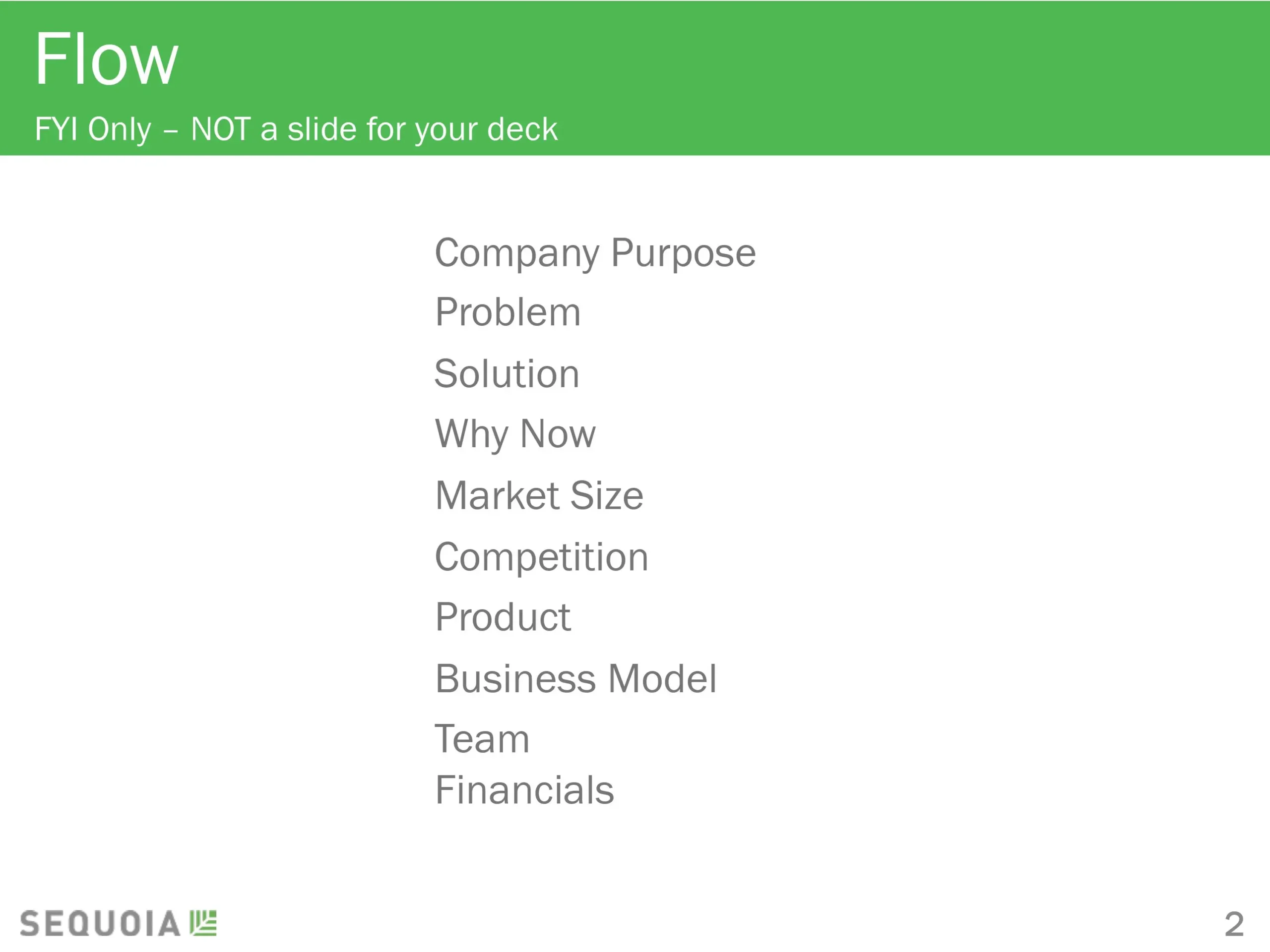
The Sequoia Capital pitch deck template consists of exactly 12 slides, from Title to End Cover, optimized for quick investor review.[1][3]
N/A, as this is a template provided by Sequoia for startups, not their own fundraising deck.[1][2]
Its success stems from simplicity, logical flow (problem-solution-market-team), and focus on investor priorities like timing and scalability, adopted globally by founders.[3][5]
Yes, it's designed for that—adapt the 12-slide structure but customize deeply to your story; avoid cookie-cutter looks by adding traction and GTM.[2][4]
N/A, as Sequoia is a VC firm providing this template for startups across seed to growth stages.[1][7]
Creating an effective pitch deck requires more than following a template — it demands strategic clarity about your value proposition, a deep understanding of your target investors, and rigorous financial modelling to support your narrative. At Projects RH, we combine financial expertise with strategic storytelling to build pitch decks, information memorandums, and financial models that meet the standards of institutional investors worldwide. Our team has generated over USD 2.0 billion in expressions of interest across mining, energy, technology, medtech, and financial services sectors. Schedule a consultation to discuss how we can help position your company for successful capital raising.