
A slide-by-slide analysis of the 14-slide pitch deck Square used to secure $100 million in Series C funding from Kleiner Perkins in 2011.
Square’s origin story begins with a lost sale in 2009. Jim McKelvey, a glassblower and entrepreneur, couldn’t accept payment for a $2,000 glass faucet because he lacked the ability to process credit cards. His friend Jack Dorsey, fresh from co-founding Twitter, saw this as symptomatic of a broader market failure: millions of small merchants were locked out of the digital payments revolution by expensive, complex traditional card readers that required lengthy approval processes and hefty fees. This challenge highlights the importance of effective pitch deck consulting for entrepreneurs looking to navigate similar market hurdles.
The duo’s solution was elegantly simple: a small white square that plugged into a smartphone’s headphone jack, transforming any mobile device into a point-of-sale system. This democratisation of payment processing addressed a massive underserved market of food trucks, farmers’ market vendors, independent retailers, and service providers who had been forced to operate cash-only or lose customers. Square launched in beta in 2010, offering free hardware and a flat 2.75% transaction fee with no monthly charges or contracts.
The company’s early traction was explosive. Within months of launch, Square was processing millions in transactions, attracting merchants through word-of-mouth and viral adoption at craft fairs and pop-up shops. By 2011, when they prepared their Series C deck, Square was processing $1 million daily and adding 100,000 new merchants monthly. This growth trajectory, combined with Dorsey’s proven track record at Twitter, positioned Square as one of the most compelling fintech investments of the era.
The 2011 Series C fundraising process culminated in a $100 million investment led by Kleiner Perkins, valuing the company at over $1 billion and setting the stage for Square’s evolution into Block, Inc.—a financial services empire encompassing point-of-sale systems, peer-to-peer payments, cryptocurrency, and small business lending. This pitch deck represents the pivotal moment when Square transitioned from promising startup to industry-defining platform.
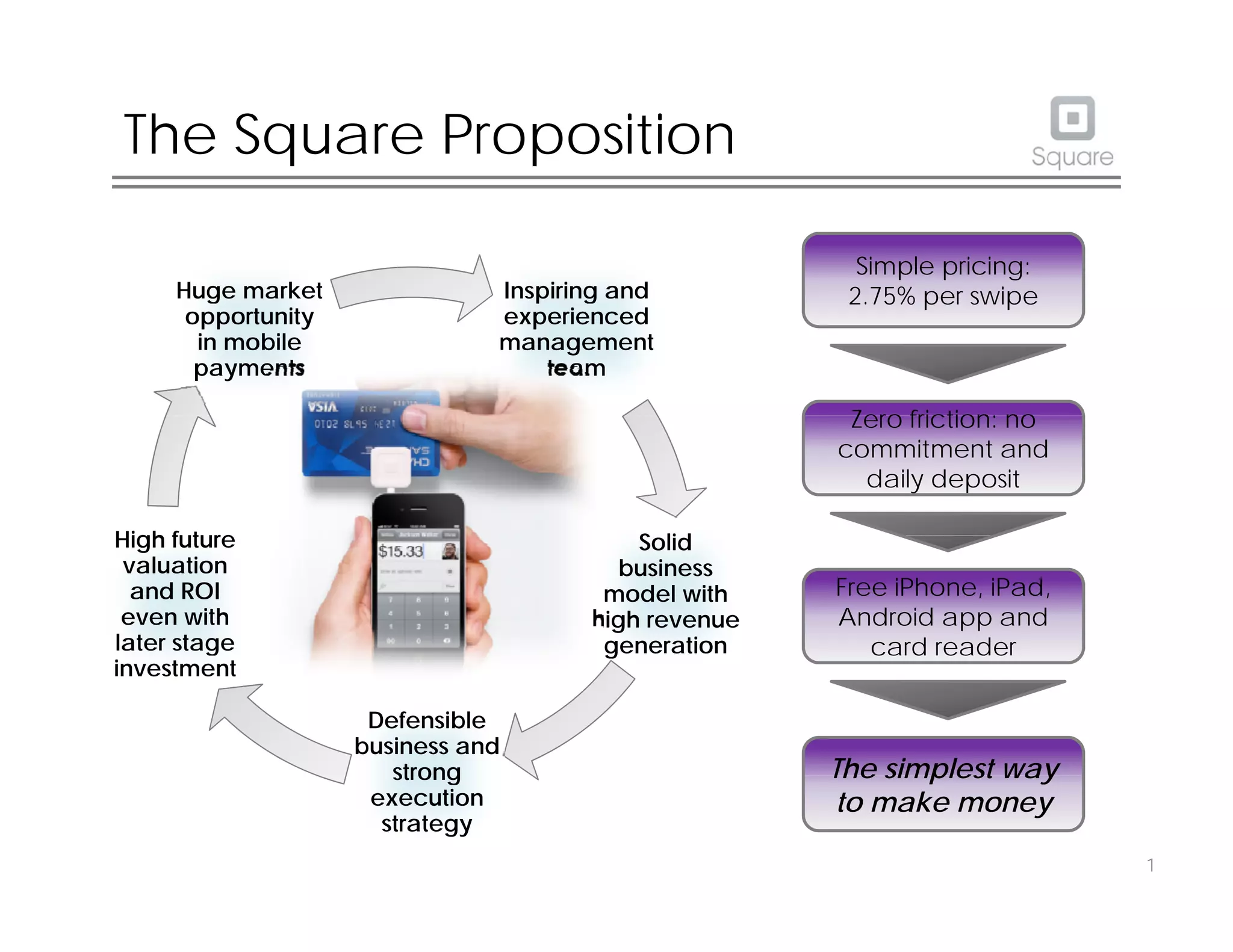
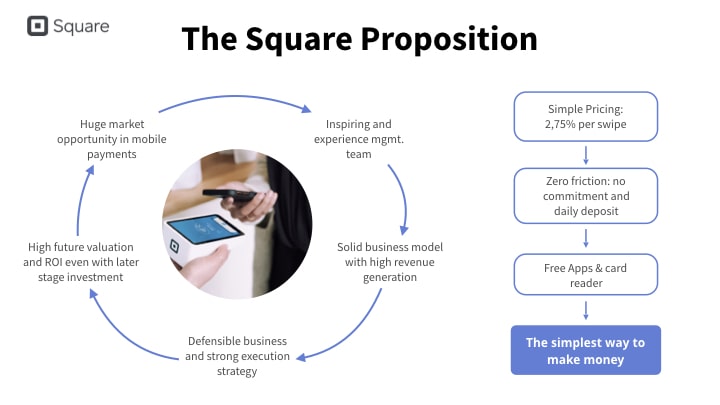
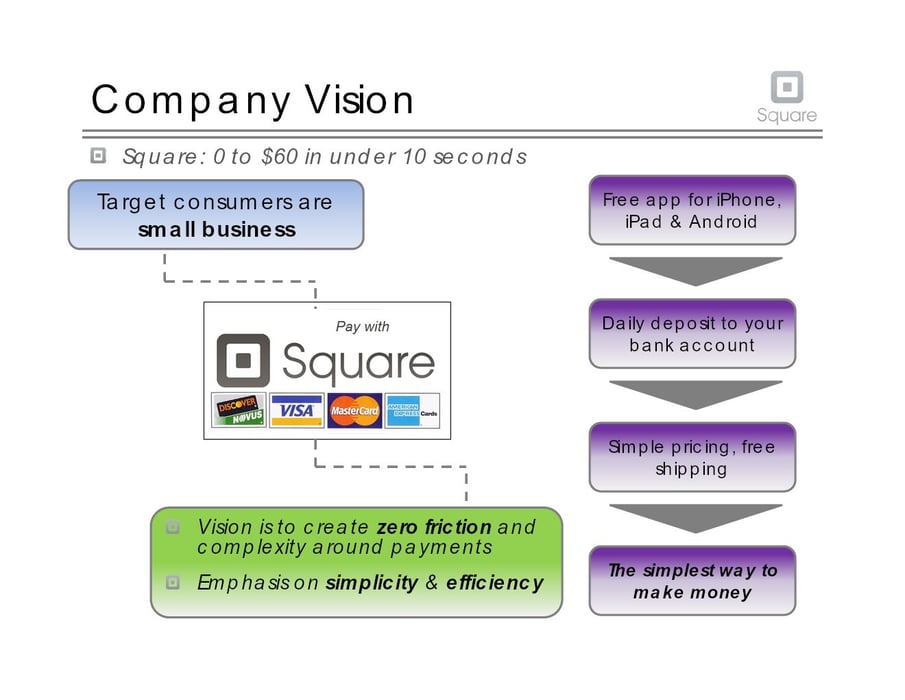
Square opens with a masterclass in value proposition clarity, immediately establishing the core problem-solution fit that drove their explosive growth. The slide positions Square not as a payments company, but as the democratiser of commerce—enabling any merchant to accept credit cards through a simple, elegant hardware solution. This framing is particularly powerful because it transforms a complex B2B payments infrastructure play into an accessible narrative about empowering small businesses.
The strategic brilliance lies in how Square positions the smartphone as the central computing platform rather than treating their dongle as the hero product. This insight—that merchants already carry powerful computers in their pockets—allowed Square to bypass the capital-intensive hardware distribution model that had constrained traditional POS companies. By leveraging existing smartphone penetration, Square could focus resources on software and user experience rather than hardware manufacturing and distribution.
What investors see: This opening slide demonstrates Square’s understanding of platform economics and network effects. Investors recognise that by building on top of the smartphone ecosystem, Square gains access to billions of potential merchant touchpoints without traditional distribution costs. The 2.75% fee structure signals a scalable, capital-efficient business model that grows with transaction volume rather than requiring ongoing hardware sales or subscription revenue.
Square’s pricing slide exemplifies the power of radical simplification in a notoriously complex industry. Traditional merchant services involved byzantine fee structures with monthly minimums, statement fees, early termination penalties, and tiered interchange rates that small merchants couldn’t navigate. By reducing this complexity to a single, memorable number—2.75% per swipe—Square eliminated the primary barrier to merchant adoption while creating a transparent pricing advantage over incumbents.
This pricing strategy reflects sophisticated understanding of the small merchant psychology. For businesses processing less than $10,000 monthly, the transparency and predictability of flat-rate pricing outweighs the potential savings of interchange-plus models. Square recognised that small merchants value simplicity over optimisation, creating a sustainable pricing moat against competitors who couldn’t match their cost structure due to legacy infrastructure and sales models.
What investors see: The flat-rate pricing model signals extremely strong unit economics and operational leverage. Investors understand that as Square’s processing volume grows, they benefit from improved interchange rates from card networks while maintaining the same price to merchants. This creates expanding margins at scale, a hallmark of exceptional SaaS and platform businesses. The simplicity also reduces sales costs and accelerates merchant onboarding, driving efficient customer acquisition.
Square’s team slide capitalises on Jack Dorsey’s emerging reputation as a serial entrepreneur capable of building category-defining platforms. Having co-founded Twitter and stewarded it through explosive user growth, Dorsey brings proven ability to scale consumer-facing products and navigate complex regulatory environments. Jim McKelvey’s background adds crucial domain expertise in payments and merchant services, creating a powerful combination of product vision and industry knowledge.
The team composition reflects Square’s understanding that payments is both a technology and relationship business. While Dorsey’s technical and product credentials attract top engineering talent, the broader team’s merchant services experience provides credibility with regulatory bodies, card networks, and banking partners essential for payments infrastructure. This combination of Silicon Valley product expertise and financial services domain knowledge differentiated Square from pure-play fintech startups.
What investors see: Dorsey’s involvement signals this isn’t just another payments startup—it’s a platform play with social and viral growth potential, evidenced by Twitter’s user acquisition playbook. Investors recognise that successful payments companies require both technical excellence and regulatory navigation skills, making the McKelvey-Dorsey partnership particularly compelling. The team’s track record suggests they can execute on the operational complexity required to scale payment processing infrastructure.
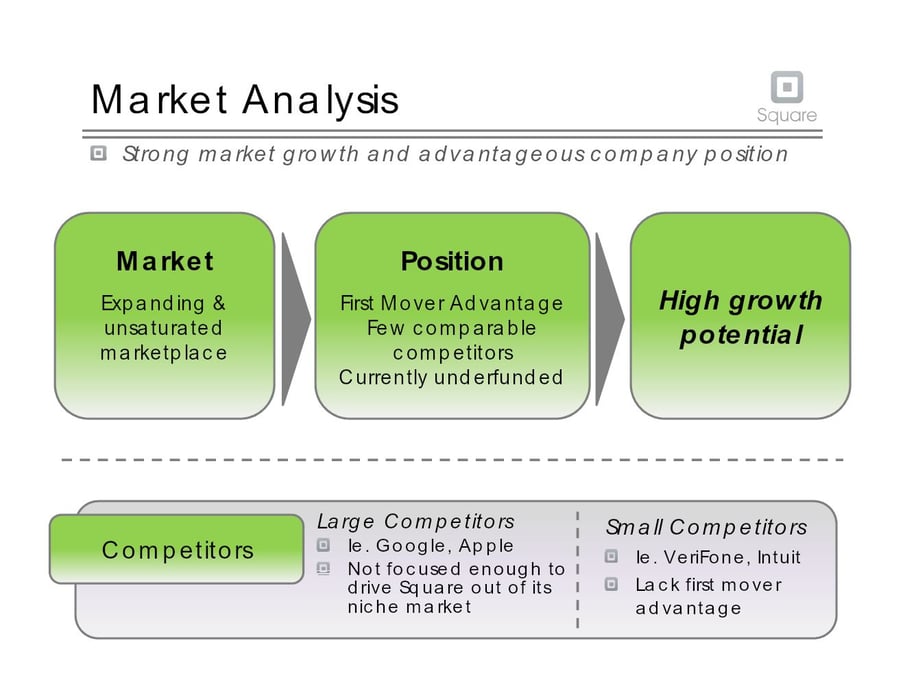
Square’s market analysis brilliantly reframes the massive payments industry through the lens of merchant exclusion rather than total addressable market size. Instead of competing for existing payment processing market share, Square identifies the millions of small merchants who had been systematically underserved by traditional providers due to low transaction volumes and high acquisition costs. This insight reveals an untapped market segment worth billions in processing fees.
The slide emphasises pain points that resonate with both investors and merchants: expensive traditional terminals, complex approval processes, lengthy contracts, and hidden fees that made card acceptance economically unfeasible for small businesses. By quantifying these barriers, Square demonstrates that their solution doesn’t just offer convenience—it expands the total addressable market by bringing previously cash-only merchants into the digital payments ecosystem.
What investors see: This market positioning reveals Square’s potential to create rather than capture market share, a hallmark of venture-scale opportunities. Investors understand that by enabling previously excluded merchants to accept cards, Square generates new transaction volume rather than competing for existing flows. The mobile payments trend convergence with small business digitisation creates a secular tailwind that could drive decades of growth.
[Insert image: square-pitch-deck-slide-05-the-product.webp]
Square’s product slide showcases the elegant hardware-software integration that became their signature differentiator. The iconic white square reader, designed for simplicity and ubiquity, represents just the tip of the iceberg—the real product is the comprehensive payments platform that transforms smartphones into sophisticated point-of-sale systems. This approach allowed Square to deliver enterprise-grade functionality through consumer-friendly interfaces.
The strategic insight behind giving away free hardware lies in Square’s understanding of platform economics. Unlike traditional POS companies that profit from hardware sales, Square recognised that the real value creation occurs in software and transaction processing. By subsidising hardware costs, they could maximise merchant adoption and benefit from the recurring revenue streams generated by payment processing volume.
What investors see: The free hardware model demonstrates sophisticated understanding of customer lifetime value and platform strategy. Investors recognise this mirrors successful models like razors and blades, printers and ink, or gaming consoles and software. Square’s ability to absorb upfront hardware costs while generating predictable transaction-based revenue creates powerful unit economics and merchant lock-in that traditional competitors cannot match.
[Insert image: square-pitch-deck-slide-06-customer-acquisition.webp]
Square’s customer acquisition strategy leverages the inherent visibility of their payment processing solution to create organic growth loops. Unlike traditional B2B sales processes, Square readers are visible to customers during every transaction, creating natural discovery moments and word-of-mouth marketing. This approach transforms every merchant into a potential sales representative, driving the 100,000 monthly merchant additions highlighted in the deck.
The genius of Square’s go-to-market lies in targeting high-visibility, socially connected merchant categories like food trucks, farmers’ markets, and craft fairs. These merchants operate in environments where other small business owners congregate and observe successful payment processing in action. The white square reader became a status symbol of business sophistication, driving aspiration-based adoption beyond pure utility considerations.
What investors see: This viral acquisition model represents the holy grail of customer acquisition: scalable growth with declining marginal costs. Investors understand that each new merchant becomes a distribution point for further growth, creating network effects and exponential user acquisition curves. The ability to add 100,000 merchants monthly through organic channels demonstrates product-market fit and sustainable competitive advantages.
[Insert image: square-pitch-deck-slide-07-competition-defensibility.webp]
Square’s competitive analysis demonstrates sophisticated understanding of how to build defensible positions in seemingly commoditised markets. Rather than competing solely on pricing or features, Square emphasises their first-mover advantage in mobile payments and the network effects created by their growing merchant ecosystem. The slide positions traditional competitors like PayPal and Intuit as focused on different customer segments, avoiding direct confrontation while establishing market leadership.
The defensibility argument centres on Square’s ability to continuously improve their offering through data and scale advantages. As merchant volume grows, Square gains negotiating power with card networks, enabling better economics while maintaining transparent pricing. Their brand recognition and trust among small merchants creates switching costs that go beyond economic considerations to encompass reliability and community belonging.
What investors see: Square’s moat strategy reveals understanding that sustainable competitive advantages in payments come from customer acquisition efficiency and platform network effects rather than technology barriers. Investors recognise that Square’s brand strength with small merchants, combined with their data advantages and operational scale, creates a virtuous cycle that becomes increasingly difficult for competitors to disrupt as the platform grows.
[Insert image: square-pitch-deck-slide-08-why-invest-now.webp]
Square’s urgency slide masterfully combines traction metrics with market timing to create compelling investment urgency. The $1 million daily processing volume represents a critical inflection point where Square has proven product-market fit but still has massive runway for growth. This timing creates optimal conditions for Series C investors: validated business model with exponential scaling potential ahead.
The slide emphasises converging trends—mobile adoption, small business digitisation, and consumer payment preference shifts—that create tailwinds for rapid expansion. By positioning this funding round as the last opportunity to invest before mainstream market adoption, Square frames the investment decision as a choice between market-rate returns and outsized venture returns.
What investors see: The urgency positioning signals that Square understands momentum-driven venture investing and has timed their fundraising to maximise leverage. Investors recognise that the combination of proven traction, expanding market opportunity, and competitive threats creates a narrow window for optimal entry. The daily processing metrics provide concrete validation that growth is accelerating, not just projected.
[Insert image: square-pitch-deck-slide-09-financial-model.webp]
Square’s financial projections demonstrate the power of predictable, recurring revenue streams generated by payment processing volume. The model shows how Square’s transparent pricing creates stable unit economics while their growing merchant base drives exponential revenue growth. This combination of predictability and growth potential represents the ideal venture investment profile—scalable business model with clear path to profitability.
The projections reflect sophisticated understanding of platform economics, where marginal costs decrease as volume increases while maintaining consistent pricing to customers. Square’s ability to improve interchange rates through scale while holding merchant pricing constant creates expanding margins that drive accelerating profitability growth. This operational leverage is key to generating venture-scale returns.
What investors see: The financial model reveals Square’s potential to generate both growth and profitability, avoiding the typical venture trade-off between scale and unit economics. Investors recognise that payment processing businesses with strong unit economics can invest heavily in growth while maintaining clear paths to profitability, creating opportunities for both revenue growth and multiple expansion at exit.
[Insert image: square-pitch-deck-slide-10-payments-processed.webp]
The daily payment volume chart provides concrete validation of Square’s explosive growth trajectory, transforming abstract market opportunity into tangible business momentum. By showcasing the journey from zero to $1 million daily processing in less than two years, Square demonstrates the viral adoption characteristics that define category-creating companies. This metric is particularly powerful because it directly correlates to revenue generation.
The exponential growth curve shown in this slide is characteristic of network effect businesses where each additional user increases the platform’s value for all participants. As more merchants adopt Square, the visibility and social proof drives accelerated adoption among their peers, creating the compound growth patterns that venture investors seek. The consistency of this growth validates the sustainability of Square’s business model.
What investors see: Daily processing volume represents the purest measure of product-market fit in the payments industry, as it reflects both merchant adoption and customer transaction behaviour. Investors understand that consistent growth in this metric indicates strong unit economics, customer satisfaction, and market expansion potential. The trajectory suggests Square is approaching an inflection point where growth could accelerate further.
[Insert image: square-pitch-deck-slide-11-growth-prospects.webp]
Square’s growth prospects slide reveals the platform expansion opportunities that extend far beyond basic payment processing. The company positions itself not just as a payments facilitator but as a comprehensive small business operating system, with potential revenue streams including analytics, lending, inventory management, and customer relationship tools. This vision demonstrates understanding of how to build billion-dollar businesses through platform network effects.
The four-year growth trajectory outlined in this slide shows how Square can leverage their merchant relationships and transaction data to build increasingly valuable services. Each additional service increases merchant lifetime value and switching costs while providing new revenue streams that complement the core payment processing business. This multi-product strategy creates defensive moats and expansion revenue opportunities.
What investors see: The expansion roadmap transforms Square from a payment processing investment into a platform business with multiple monetisation vectors. Investors recognise that successful platforms can generate returns that exceed sum-of-parts valuations by capturing more value from existing customer relationships. This positions Square for both revenue growth and multiple expansion as they evolve from fintech to comprehensive small business platform.
[Insert image: square-pitch-deck-slide-12-exit-strategy.webp]
Square’s exit strategy slide addresses investor liquidity concerns by outlining multiple potential paths to realising returns, including IPO and strategic acquisition scenarios. The company positions itself as attractive to both public markets through its scalable, profitable growth model and to strategic acquirers seeking mobile payments capabilities or small business customer relationships. This optionality reduces investor risk while maximising potential return scenarios.
The projected return multiples reflect Square’s confidence in their ability to scale into a multi-billion dollar business worthy of public market valuations. By 2011, few payments companies had achieved successful IPOs, making Square’s public market ambitions both bold and differentiated. The slide demonstrates management’s understanding that Series C investors need visibility into exit timing and return magnitude to justify their investment.
What investors see: Exit optionality signals mature management thinking about investor return requirements and market positioning. Investors appreciate companies that proactively address liquidity paths rather than assuming indefinite private growth. The IPO positioning suggests Square has the revenue scale, growth trajectory, and market opportunity to support public company valuations, which typically generate higher return multiples than strategic acquisitions.
[Insert image: square-pitch-deck-slide-13-the-ask.webp]
Square’s funding ask specifies the $20M-$100M range while clearly articulating how capital will accelerate growth rather than merely sustain operations. The range approach allows investors to self-select their participation level while giving Square flexibility to optimise valuation and strategic investor mix. At the $240M post-money valuation referenced, Series C investors would capture significant upside if Square achieved their projected growth trajectory.
The ask emphasises using funds for market expansion, product development, and team building rather than working capital or founder liquidity, demonstrating growth-oriented capital allocation. This positioning reassures investors that their capital will generate measurable returns through business expansion rather than reducing execution risk or providing personal returns to founders.
What investors see: The funding request demonstrates sophisticated understanding of growth capital requirements and investor return expectations. By clearly linking capital deployment to specific growth initiatives, Square shows they can efficiently convert investment into measurable business expansion. The valuation metrics suggest Series C investors can achieve meaningful ownership stakes in a rapidly scaling business with clear paths to significant returns.
[Insert image: square-pitch-deck-slide-14-thank-you.webp]
Square’s closing slide maintains professional simplicity while providing clear pathways for investor engagement. The clean design and straightforward contact information reflect the same simplicity principle that drives their product design, reinforcing brand consistency throughout the investor presentation. This attention to detail demonstrates the professionalism and execution capability that investors evaluate beyond just business metrics.
The thank you slide serves as a transition point from presentation to discussion, creating space for investors to ask detailed questions about financials, competition, or execution risks. By ending with contact information rather than aggressive calls to action, Square demonstrates confidence in their value proposition while respecting investor decision-making processes.
What investors see: A professional closing reinforces positive impressions created throughout the presentation and provides clear next steps for interested investors. The simplicity reflects Square’s overall brand positioning around removing complexity from business processes, while the accessible contact information suggests management team accessibility and responsiveness to investor inquiries.
While Square’s 2011 Series C deck successfully secured $100 million from Kleiner Perkins and positioned the company for its eventual transformation into Block, Inc., the presentation reflects the fundraising conventions of its era and is not without gaps when measured against today’s investor expectations. Modern venture capital due diligence has evolved to demand greater transparency around unit economics, competitive differentiation, and execution risk mitigation—areas where Square’s deck, though effective for its time, would benefit from contemporary best practices that address the sophisticated analytical frameworks employed by today’s institutional investors.
Lacks a dedicated vivid problem slide with customer stories or stats on small business payment pains; modern decks use this early to build empathy and urgency, as seen in Airbnb’s deck.
No comprehensive dashboard of key metrics like monthly active users, churn, or cohort retention; today’s VCs expect data-rich slides proving product-market fit beyond just payment volume.
Vague on detailed customer acquisition costs (CAC), lifetime value (LTV), or channel experiments; modern decks include funnel metrics to show scalable growth playbook.
Absent future feature pipeline or R&D plans; investors now demand visibility into iteration beyond hardware, like software expansions or AI integrations.
No mention of board, advisors, or key hires planned; current best practices highlight full team ecosystem for execution credibility.
Omits proactive discussion of regulatory, fraud, or competition risks with counters; transparent risk slides build trust in sophisticated late-stage pitches.
No pie chart allocating raise to engineering, marketing, etc.; modern decks specify capital efficiency to assure disciplined spending.
These gaps reflect the evolution of venture capital due diligence standards rather than fundamental weaknesses in Square’s investment thesis. Today’s institutional investors operate with more sophisticated analytical frameworks and have access to benchmarking data across thousands of investments, raising the bar for documentation and transparency. At Projects RH, we help founders bridge these gaps by incorporating contemporary best practices while maintaining the narrative clarity and strategic insight that made Square’s original deck so compelling, ensuring modern founders can meet today’s heightened investor expectations without losing the simplicity and focus that drive successful fundraising outcomes.
Start with a one-slide hook solving a painful, relatable problem like Square’s ‘accept cards anywhere’; founders should craft this to instantly convey value prop and grab attention in 30 seconds.
Address monetization head-on with clear, memorable fees as Square did; test pricing slides for instant comprehension to preempt objections.
Highlight founders’ pedigrees like Dorsey’s Twitter success; quantify past exits or domain expertise to shortcut credibility building.
Pair TAM with defensibility via first-mover, network effects; use visuals to depict barriers competitors can’t easily cross.
Tie traction to realistic 3-5 year models sourced from market data; include sensitivity analysis for robustness.
Explicit ‘Why Now’ slide with growth inflection points; founders should time decks around milestones like viral spikes.
Specify amount, valuation, and exit math; model investor ROI explicitly to close the deal.
The distance between the Square that presented this deck and the Block, Inc. that exists today represents one of the most remarkable scaling stories in fintech history. In 2011, Square was processing $1 million daily with ambitious projections; today, Block processes over $650 million daily through its ecosystem of Square merchant services, Cash App peer-to-peer payments, and cryptocurrency trading platforms. This transformation from a simple card reader company into a comprehensive financial services platform demonstrates both the prescience of Square’s original vision and the execution excellence that justified investor confidence.
For Kleiner Perkins and other Series C investors who backed Square’s $100 million round at a $1+ billion valuation, the returns have been extraordinary. Block’s peak market capitalisation exceeded $100 billion, representing a 100x return on the Series C investment within a decade. Even at today’s more modest $45 billion valuation, Series C investors have realised returns that place this among the most successful fintech investments in venture capital history.
This investment outcome validates the core venture capital thesis that exceptional teams with differentiated technology can create entirely new markets rather than simply capturing existing ones. Square didn’t just build a better payment processor—they democratised commerce by enabling millions of small businesses to participate in the digital economy, creating value that extends far beyond their direct revenue capture and establishing the blueprint for platform-based fintech businesses that continue to reshape financial services today.
At Projects RH, we help companies across all industries create investor-ready materials that close deals. Our integrated capital raising package ensures consistency across all your investor documentation.
Built in-house for accuracy and investor confidence.
Comprehensive investor documentation following global best practices.
12-slide investor-ready presentation with supporting materials.
High-impact snapshot to capture investor attention fast.
Browse our collection of real pitch deck breakdowns from the world’s most successful companies.
The Square Series C pitch deck from 2011 consists of 14 concise slides, focusing on proposition, team, market, product, financials, and the ask, making it scannable for busy VCs.
This deck supported their 2011 Series C, raising $100M led by Kleiner Perkins at a valuation north of $240M post-prior rounds, part of $601M total early funding before IPO.
Success stemmed from Jack Dorsey's credibility, simple problem-solution framing, hard traction metrics ($1M daily volume), aggressive projections, and urgency around explosive growth in mobile payments.
Yes, as a template for FinTech/hardware pitches—emulate its structure, simplicity, and metrics focus—but adapt to 2026 norms like adding traction dashboards, risks, and roadmaps; it's not plug-and-play due to era differences.
Series C in mid-2011, post-seed ($10M, 2009) and Series A ($27.5M, Jan 2011), with proven product-market fit via rapid merchant growth and payment volume.
Creating an effective pitch deck requires more than following a template — it demands strategic clarity about your value proposition, a deep understanding of your target investors, and rigorous financial modelling to support your narrative. At Projects RH, we combine financial expertise with strategic storytelling to build pitch decks, information memorandums, and financial models that meet the standards of institutional investors worldwide. Our team has generated over USD 2.0 billion in expressions of interest across mining, energy, technology, medtech, and financial services sectors. Schedule a consultation to discuss how we can help position your company for successful capital raising.