
A detailed analysis of the 38-slide pitch deck WeWork used to secure $355M in Series D funding from Goldman Sachs, JP Morgan Chase, and others in 2014.
WeWork was founded in 2010 in New York City by Adam Neumann and Miguel McKelvey, two entrepreneurs who met whilst working on a construction project and recognised the profound shift happening in how people approached work. They observed the rise of freelancers, startups, and remote workers who were increasingly dissatisfied with rigid traditional leases and sterile corporate environments. Their vision was to create flexible, community-driven workspaces that would serve not just as offices, but as ecosystems where entrepreneurs and creatives could thrive together, much like the approach taken in pitch deck consulting.
The early years were fraught with challenges as the founders grappled with scaling operations whilst managing substantial long-term lease obligations during economic uncertainty. However, they pivoted their strategy by emphasising premium design, curated events, and comprehensive services that differentiated WeWork from basic coworking competitors. This focus on creating genuine community and lifestyle experiences, rather than merely providing desks and wifi, helped them achieve product-market fit with rapid membership growth across their initial locations.
By 2014, WeWork had expanded to 23 cities with over 40,000 members and had already raised approximately $4.45 billion in prior funding rounds, establishing itself as the dominant player in the flexible workspace market. The company’s aggressive growth trajectory and charismatic leadership had captured the attention of the world’s most prestigious investors, setting the stage for their ambitious Series D fundraising effort.
This pitch deck was crafted to secure the next phase of capital needed for global expansion, ultimately succeeding in raising $355 million at a $5 billion valuation from investors including Goldman Sachs and Benchmark Capital. However, the overly optimistic projections that helped secure this funding would later contribute to the company’s dramatic challenges, including the failed 2019 IPO attempt that became a cautionary tale about growth-at-all-costs mentality in venture capital.
WeWork’s cover slide immediately establishes the company’s bold vision with their distinctive logo prominently displayed against a dark, sophisticated background. The tagline emphasises community and the transformation of work culture, setting an aspirational tone that positions WeWork not merely as a real estate company, but as a movement reshaping how humans interact with work. This opening creates an emotional foundation that primes investors to think beyond traditional office metrics toward lifestyle and cultural transformation.
The visual design reflects WeWork’s premium brand positioning with clean typography and professional aesthetics that mirror their actual workspace design philosophy. This consistency between brand presentation and product experience demonstrates the founders’ understanding that their pitch deck itself must embody the quality and attention to detail that members experience in WeWork locations. The cover establishes credibility through design excellence whilst building anticipation for the transformational story that follows.
What investors see: A company that has mastered brand positioning and understands that they’re selling an experience, not just square footage. The sophisticated presentation suggests operational maturity and marketing sophistication that will be essential for scaling a consumer-facing business model. Investors recognise that companies capable of this level of brand consistency often have the discipline to execute complex expansion strategies effectively.
The mission slide delivers WeWork’s philosophical foundation with bold typography declaring “To create a world where people work to make a life, not just a living.” This powerful statement is accompanied by full-bleed inspirational imagery of diverse professionals collaborating in beautifully designed spaces. The slide establishes WeWork’s positioning as a lifestyle brand rather than a traditional real estate company, tapping into the growing cultural shift toward work-life integration that millennials and Gen Z professionals increasingly demand.
By leading with mission rather than product features, WeWork demonstrates sophisticated understanding of how transformational companies build emotional connections with both customers and investors. The visual storytelling creates an aspirational narrative that positions the company as aligned with broader societal trends toward meaningful work and community connection. This approach transforms a simple office rental proposition into participation in a cultural movement.
What investors see: A management team that understands the power of purpose-driven branding and has identified a genuine cultural shift they can monetise. The mission statement suggests total addressable market expansion beyond traditional office space into lifestyle services, events, and community experiences. Investors recognise that companies with compelling missions often achieve premium pricing and stronger customer loyalty, both crucial for defending market position.
WeWork’s problem slide effectively contrasts the outdated traditional office model with the emerging needs of modern professionals through compelling visuals and statistics. The slide highlights key pain points including rigid long-term leases that don’t match the flexibility requirements of startups and freelancers, sterile corporate environments that stifle creativity, and the rising dissatisfaction with traditional employment structures. By quantifying these trends with data on freelancing growth and workplace dissatisfaction surveys, WeWork transforms anecdotal observations into a compelling market opportunity.
The visual presentation uses stark before-and-after imagery to emphasise the dramatic difference between soul-crushing cubicle farms and vibrant collaborative spaces. This emotional storytelling technique helps investors viscerally understand why the traditional model is failing and creates urgency around the need for transformation. The slide establishes WeWork as responding to genuine market demand rather than creating artificial need.
What investors see: A massive market disruption opportunity where existing incumbents are structurally unable to adapt due to legacy business models and asset bases. The problem framing suggests WeWork has identified fundamental shifts in work culture that will only accelerate, creating sustainable competitive advantages. Investors recognise that companies solving genuine pain points often achieve rapid adoption and can command premium pricing during market transitions.
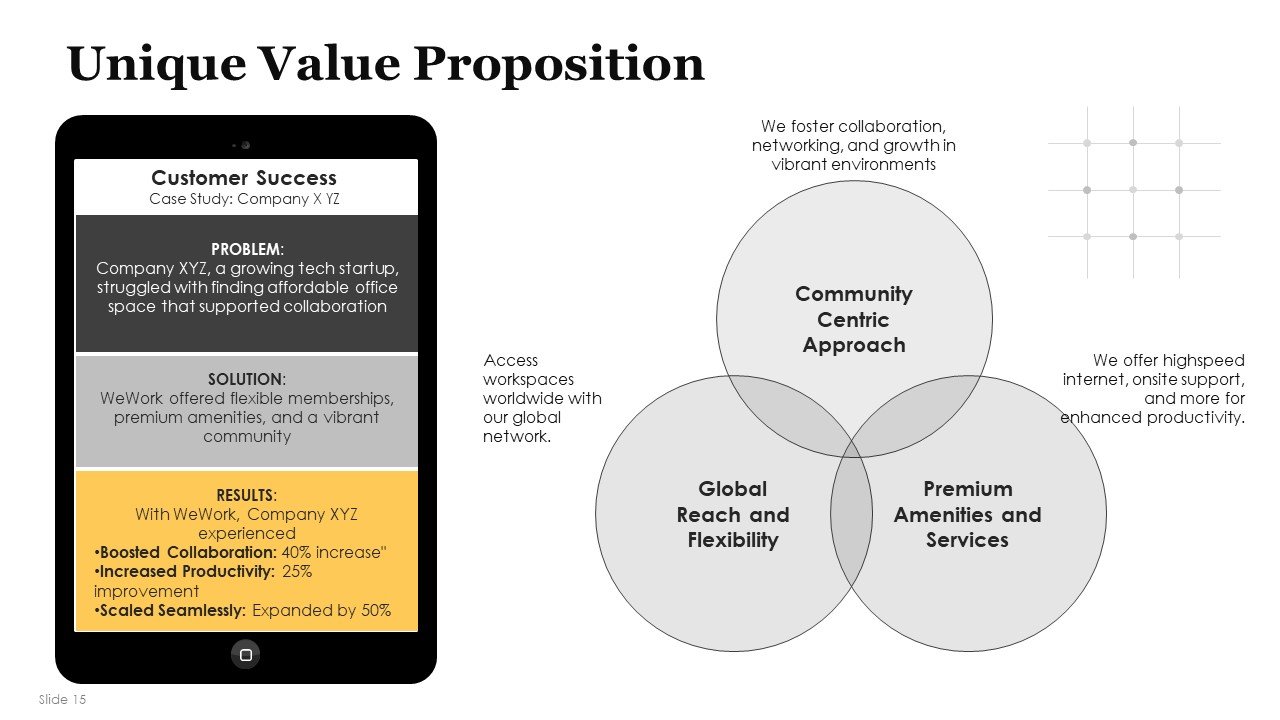
The solution slide showcases WeWork’s three-pillar approach through stunning photography of actual locations, detailed floorplans, and comprehensive amenity lists that demonstrate the company’s execution capability. The visual presentation emphasises flexible membership options ranging from hot desks to private offices, whilst highlighting premium amenities like craft coffee, wellness rooms, and professional event spaces. By showing real spaces rather than conceptual renderings, WeWork proves they have moved beyond vision to operational excellence.
The slide strategically emphasises community programming and networking events that create additional value beyond physical space, demonstrating how WeWork differentiates from traditional executive suites or basic coworking facilities. This community focus suggests recurring engagement that increases member retention and justifies premium pricing. The presentation shows sophisticated understanding of how to transform commodity office space into a branded lifestyle experience.
What investors see: A scalable solution that creates defensible competitive moats through brand experience and community network effects rather than just real estate assets. The emphasis on service and community suggests opportunities for additional revenue streams and higher customer lifetime value compared to traditional office leasing. Investors recognise that this multi-dimensional value proposition will be difficult for competitors to replicate quickly.
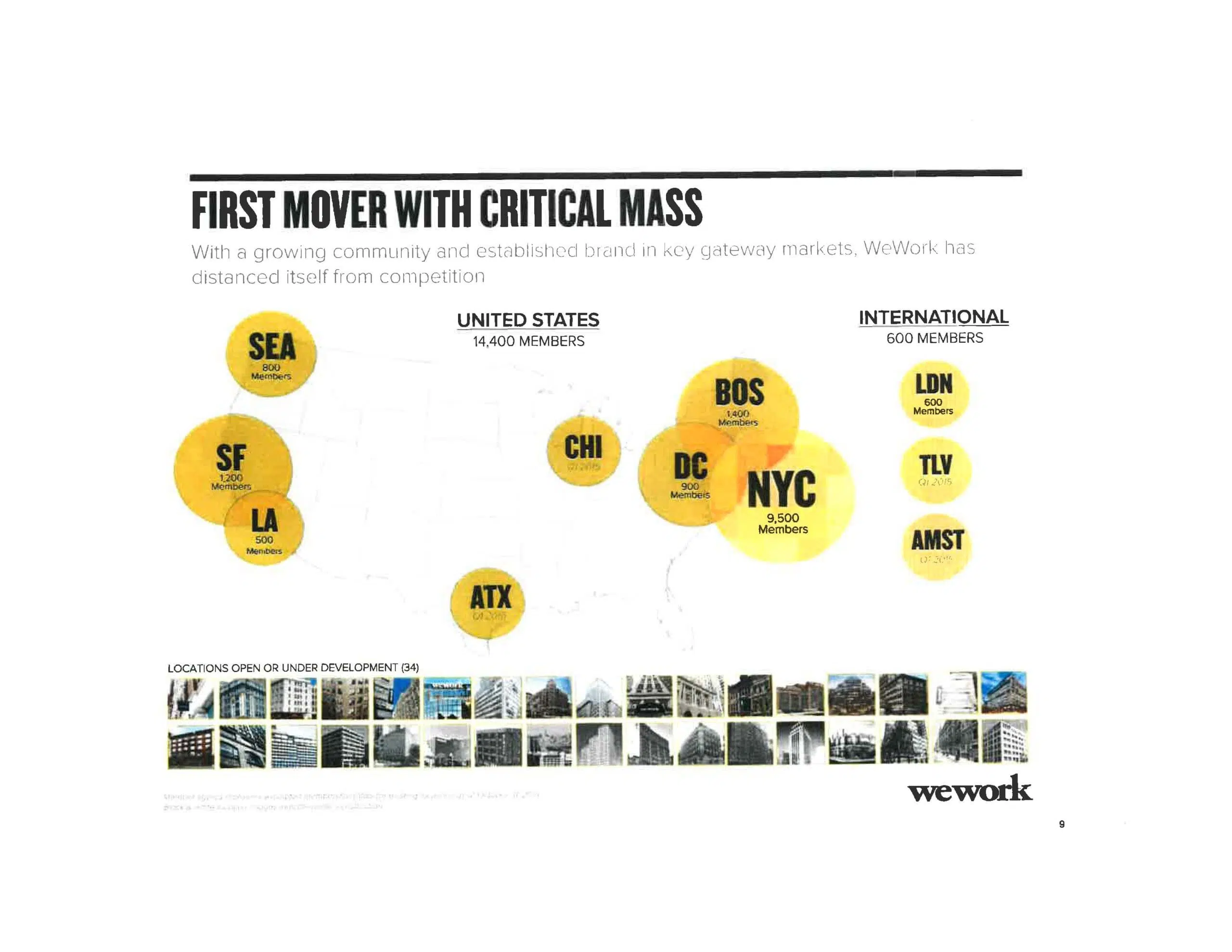
WeWork’s market opportunity slide presents staggering numbers that frame flexible workspace as a massive total addressable market opportunity within the broader commercial real estate sector. The slide uses compelling bar charts and infographics to show that even capturing a small percentage of the global office market could generate billions in revenue. By referencing the entire commercial real estate market rather than just existing coworking space, WeWork positions itself as creating a new category rather than competing in a niche segment.
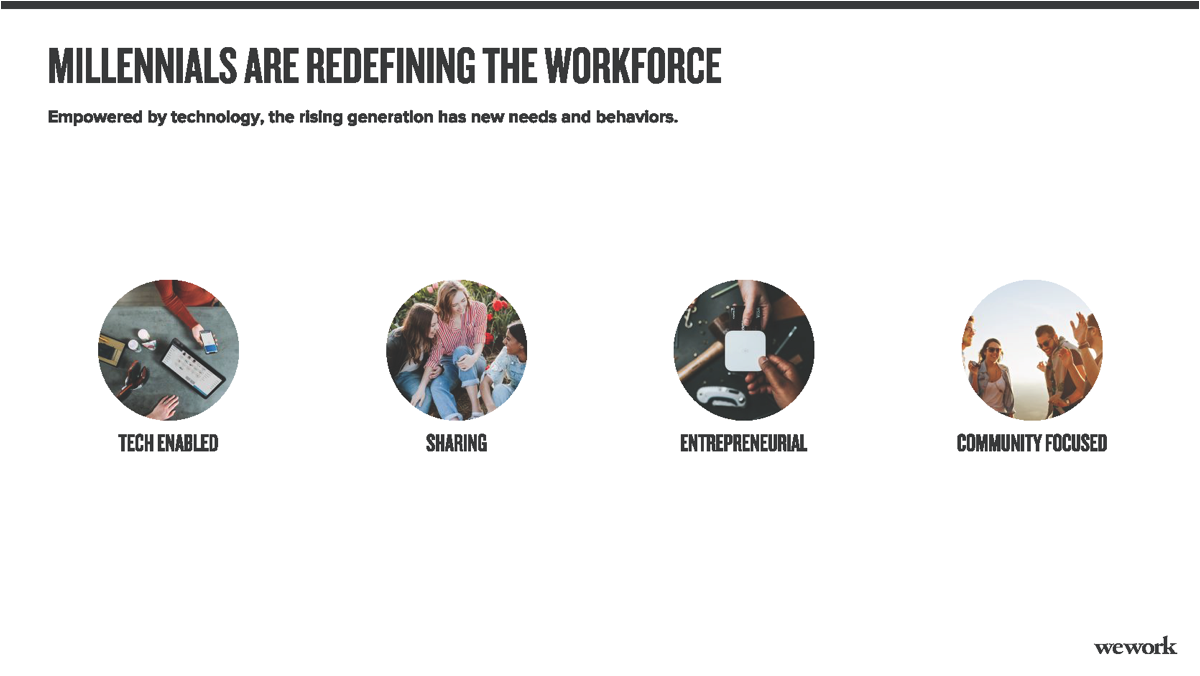
The presentation cleverly shows how demographic and cultural trends will drive market expansion, with millennials and Gen Z entering the workforce with fundamentally different expectations about work environments and employment structures. By quantifying the shift toward freelancing and startup culture, WeWork demonstrates that their target market is growing rapidly regardless of their own marketing efforts. This positions the company as riding inevitable waves rather than trying to create artificial demand.
What investors see: A market opportunity large enough to justify unicorn valuations and support multiple successful competitors, reducing single-company risk whilst maintaining massive upside potential. The demographic trends suggest sustained demand growth that will persist through economic cycles. Investors recognise that companies positioned at the intersection of cultural shifts and massive existing markets often generate extraordinary returns.
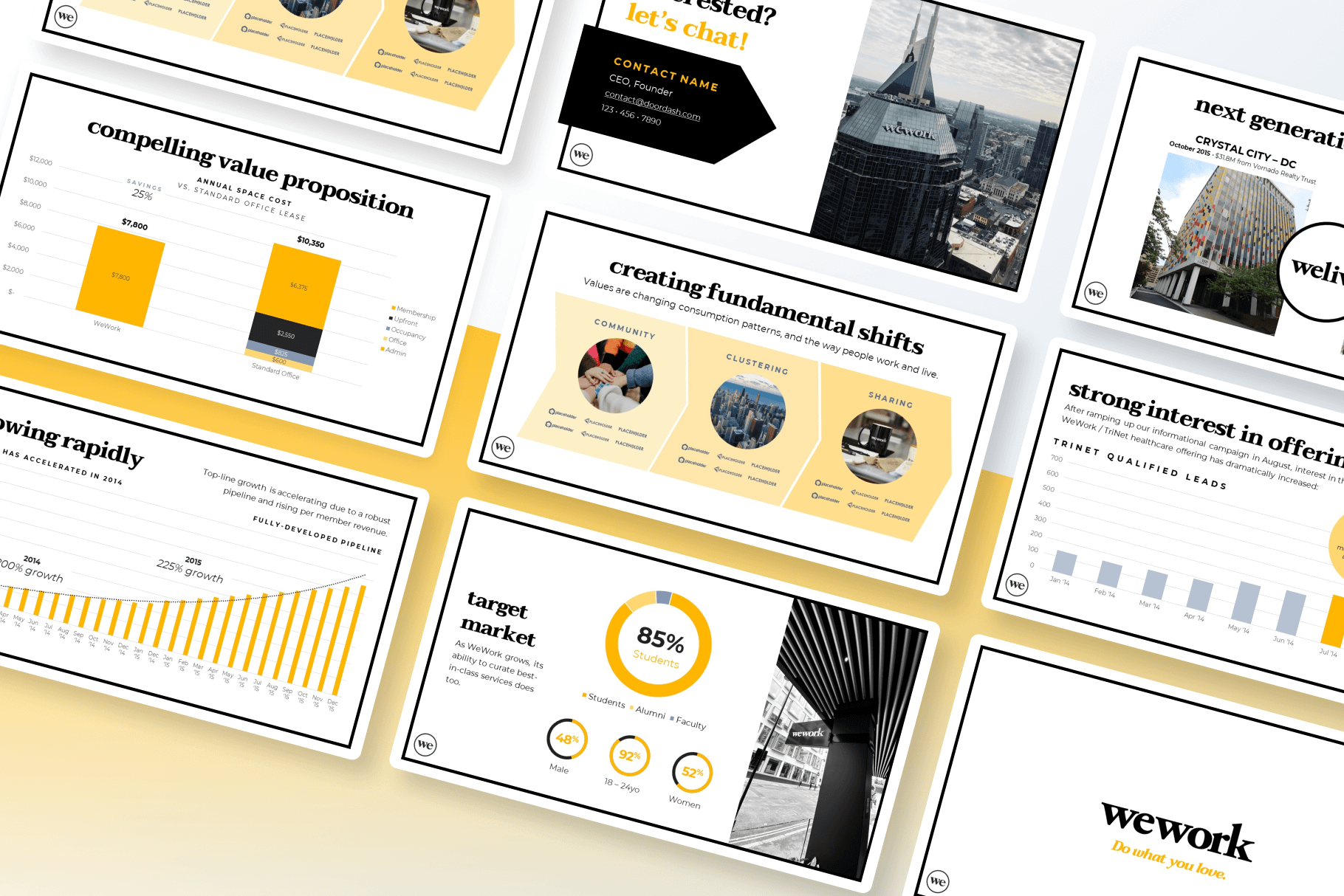
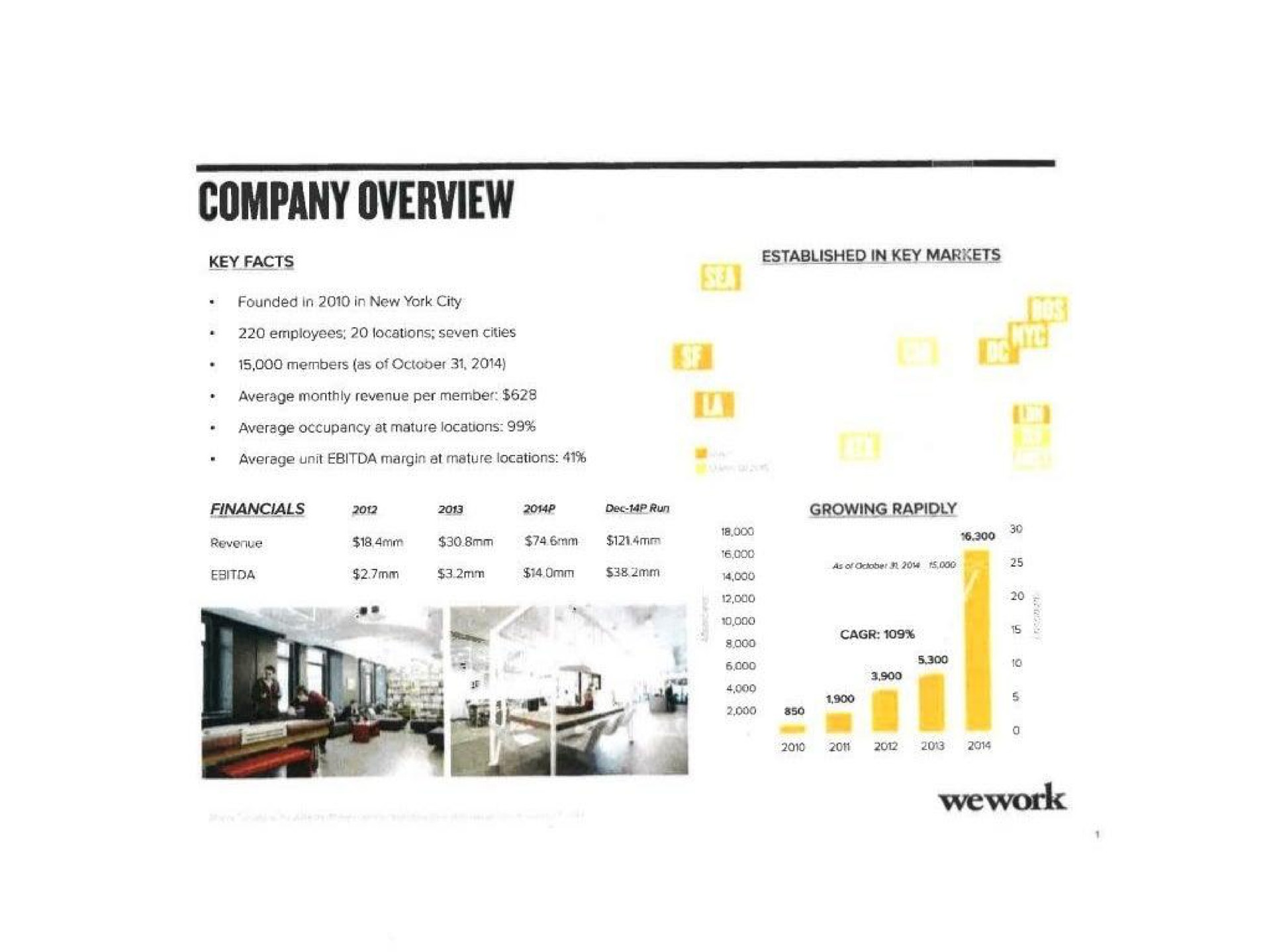
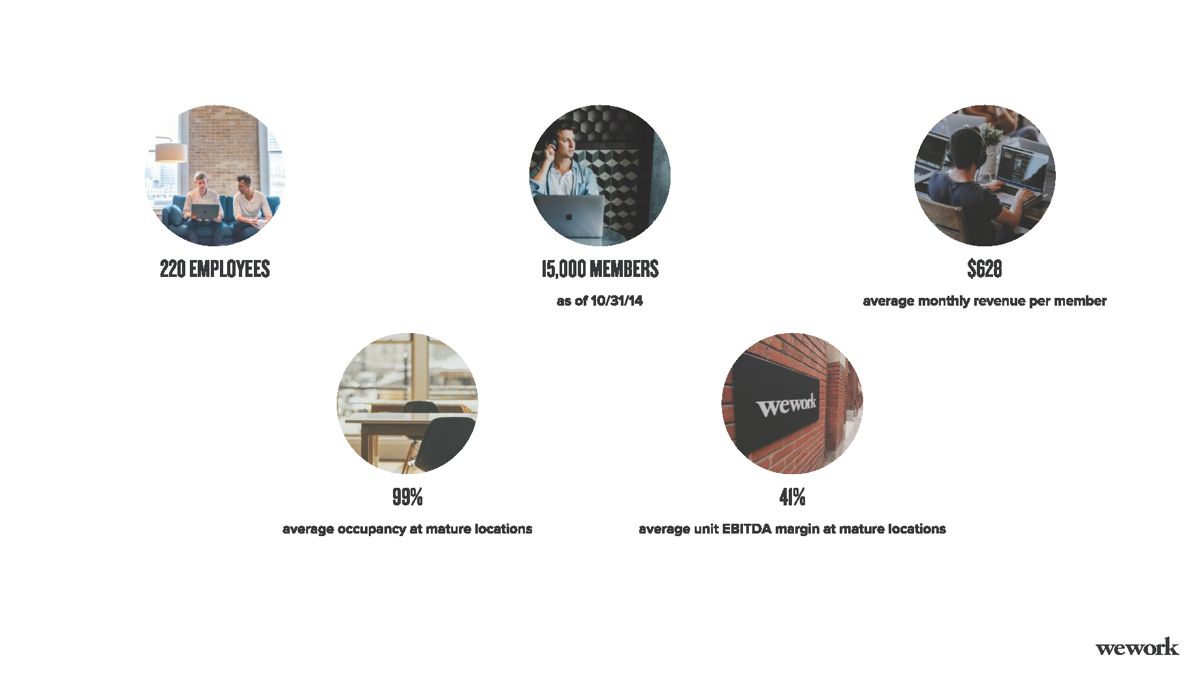
The traction slide delivers impressive growth metrics through clean, professional charts that showcase 40,000+ members across 23 cities with strong revenue growth trajectories. Each key performance indicator is presented with a single, focused visual that makes the data immediately digestible for time-constrained investors. The slide demonstrates that WeWork has achieved significant scale whilst maintaining growth momentum, suggesting the business model is both proven and scalable.
By presenting multiple growth vectors simultaneously—membership, geographic expansion, and revenue—WeWork shows that success is broad-based rather than dependent on a single metric that might be artificially inflated. The geographic diversity across 23 cities demonstrates market validation beyond single-location success and suggests the model can be replicated across different urban markets with varying economic conditions and cultural contexts.
What investors see: A company that has moved well beyond product-market fit into scalable growth phase with demonstrated ability to replicate success across diverse markets. The multi-dimensional traction reduces execution risk and suggests the management team has developed systematic processes for expansion. Investors recognise that companies showing this level of consistent growth often have discovered sustainable competitive advantages that will persist through scaling.
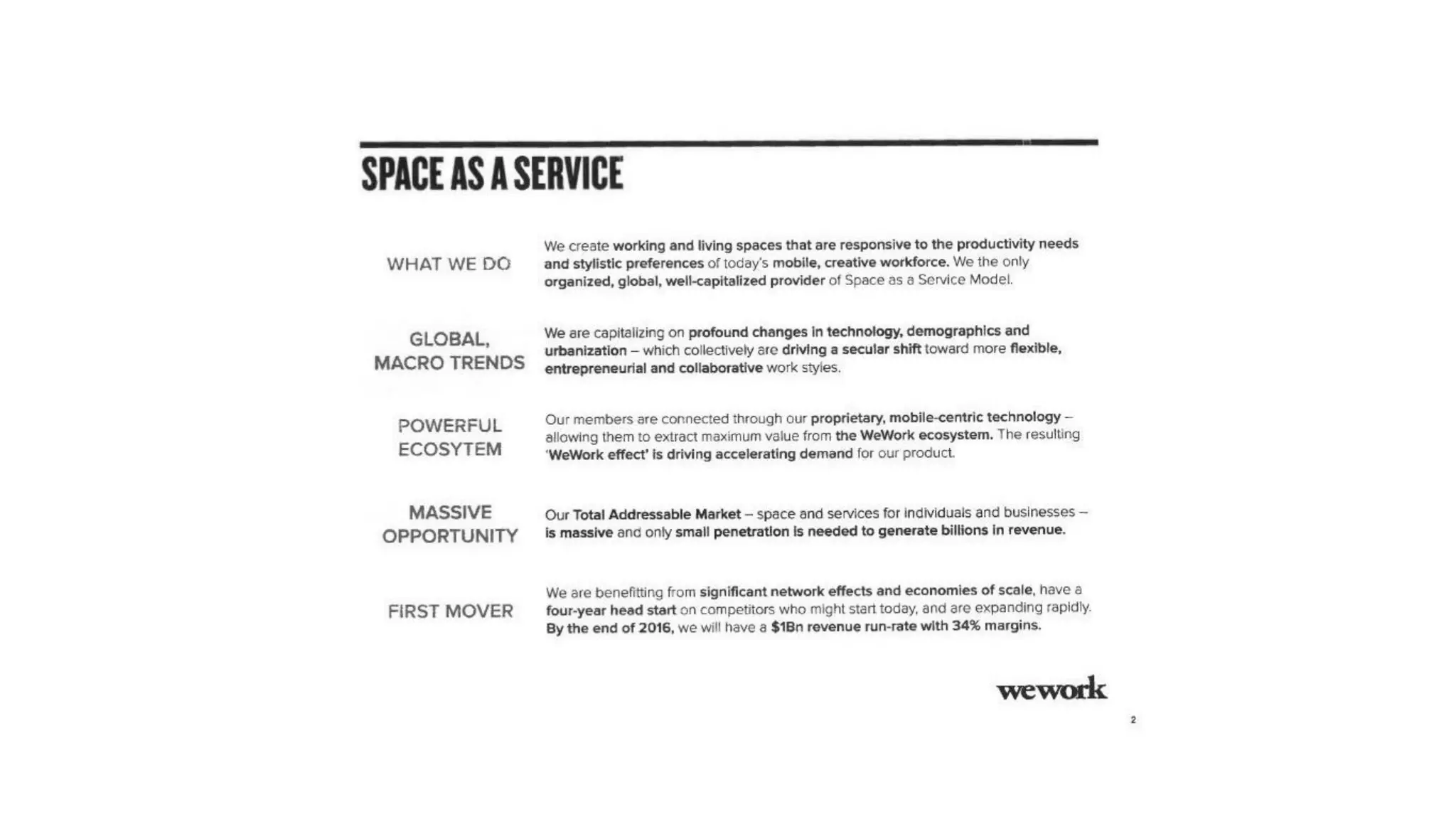
The business model slide clearly explains WeWork’s lease arbitrage strategy through visual diagrams showing how they sign long-term leases at wholesale rates, then sublease to members at premium flexible terms. The presentation includes detailed pricing tiers from hot desks to private floors, demonstrating sophisticated revenue optimisation and customer segmentation strategies. By showing actual pricing examples rather than theoretical frameworks, WeWork proves they have developed repeatable processes for generating consistent unit economics.
The slide emphasises network effects and economies of scale that improve with size, showing how additional locations create cross-selling opportunities and shared service efficiencies. This strategic framing positions WeWork’s expansion as creating compounding value rather than simply linear growth. The presentation demonstrates understanding of how to build sustainable competitive moats through operational excellence and scale advantages.
What investors see: A business model that becomes more profitable and defensible with scale, justifying aggressive expansion investments and premium valuation multiples. The lease arbitrage structure provides predictable cash flows whilst the premium positioning suggests pricing power during economic cycles. Investors recognise that companies with improving unit economics and network effects often deliver exceptional returns during growth phases.
WeWork’s growth projections slide presents ambitious five-year forecasts with exponential revenue growth curves and global expansion maps that showcase the company’s vision for worldwide dominance. The projections include specific targets for locations, members, and revenue that demonstrate systematic planning rather than aspirational hoping. However, the aggressive nature of these forecasts, whilst exciting for investors seeking massive returns, would later prove to be overly optimistic and contribute to credibility challenges during the failed IPO attempt.
The visual presentation uses compelling bar graphs and geographic heat maps that make the expansion story feel inevitable and methodical. The slide shows detailed market-by-market expansion plans with specific timing and investment requirements, suggesting the management team has developed sophisticated operational playbooks for international scaling. This level of detail creates confidence in execution capability whilst building excitement about the global opportunity.
What investors see: A management team with global ambitions and systematic expansion methodology that could create a dominant worldwide platform in flexible workspace. The projections suggest potential for extraordinary returns that justify high-risk, high-reward investment strategies. However, experienced investors also recognise that such aggressive forecasts require exceptional execution and favourable market conditions that may not materialise, creating both tremendous upside and significant downside risk.
[Insert image: wework-pitch-deck-slide-09-team.webp]
The team slide features professional portraits and detailed biographies of founders Adam Neumann and Miguel McKelvey, highlighting their complementary backgrounds in real estate development and startup operations. Neumann’s charismatic leadership and vision-casting abilities are balanced by McKelvey’s operational expertise and design sensibilities, creating a founding partnership that combines inspirational leadership with execution capability. The slide establishes credibility through specific achievements and previous entrepreneurial experiences that demonstrate relevant skills for scaling WeWork globally.
By focusing on the founding team rather than expanding to include broader management, the slide maintains focus on the visionary leadership that will drive WeWork’s cultural transformation mission. The presentation emphasises how the founders’ personal stories and motivations align with the company’s mission, creating authentic leadership that members and employees can rally behind. This personal connection between leadership and mission becomes particularly important for lifestyle brands that depend on authentic community building.
What investors see: Founder-market fit with leaders who have both the domain expertise and personal passion necessary to execute on WeWork’s ambitious global expansion plans. The complementary skill sets suggest a balanced leadership team capable of handling both visionary strategy and operational complexity. However, investors also recognise that founder-dependent companies can face significant risks if leadership dynamics change or if charismatic leaders struggle with professional management transitions required for scaling.
[Insert image: wework-pitch-deck-slide-10-the-ask.webp]
WeWork’s closing slide presents a clear and specific funding request with detailed allocation charts showing exactly how the capital will be deployed across geographic expansion, technology development, and operational scaling. The presentation connects the funding amount directly to projected outcomes, including specific targets for new locations, member growth, and revenue milestones. This concrete approach demonstrates financial discipline and strategic planning that gives investors confidence in capital deployment efficiency.
The slide emphasises immediate deployment opportunities with specific markets identified for expansion, suggesting WeWork has already completed preliminary market research and site selection processes. By showing ready-to-execute expansion plans rather than vague growth intentions, the presentation creates urgency and demonstrates that the funding will generate immediate traction rather than being absorbed by planning and preparation activities.
What investors see: A mature company with systematic capital deployment capabilities and clear growth catalysts that will drive immediate returns on investment. The specific use of funds demonstrates financial sophistication and operational readiness that reduces execution risk. Investors recognise that companies capable of articulating precise capital requirements and deployment timelines often deliver superior returns compared to those with vague growth strategies.
While WeWork’s 2014 pitch deck successfully raised $355 million and established the company as the global leader in flexible workspace, it contains several critical omissions that would prove problematic during later fundraising efforts and the infamous failed IPO attempt. The deck’s focus on vision and growth metrics, whilst compelling for Series D investors, lacks the financial transparency and risk assessment that modern investors increasingly demand. These gaps highlight important lessons for contemporary founders about balancing aspirational storytelling with rigorous financial discipline.
The deck’s aggressive growth forecasts lack conservative stress-tested scenarios that could build investor confidence in management’s financial discipline. Overly optimistic projections that later proved unattainable significantly eroded credibility during subsequent fundraising efforts. Modern pitch decks must include realistic base-case scenarios alongside optimistic projections to demonstrate sophisticated financial planning and risk management.
The absence of detailed customer acquisition costs, lifetime value calculations, and location-level profitability analysis leaves investors unable to assess the true scalability and sustainability of WeWork’s business model. Contemporary investors now demand comprehensive unit economics that demonstrate path to profitability and sustainable competitive advantages. This includes cohort analysis, churn rates, and margin progression as locations mature.
While the deck mentions network effects, it provides insufficient detail about sustainable competitive advantages beyond scale and brand recognition. Modern investors require clear articulation of defensibility through proprietary technology, exclusive partnerships, regulatory moats, or switching costs. The lack of intellectual property discussion or unique operational advantages that would prevent commoditisation became increasingly problematic as competitors entered the market.
The deck omits discussion of substantial lease obligations, economic downturn vulnerability, and operational complexity of managing long-term commitments with short-term revenue. Transparency about risks demonstrates management maturity and allows investors to make informed decisions about portfolio allocation. Contemporary decks must address potential challenges including regulatory changes, economic sensitivity, and operational scaling difficulties.
The presentation provides insufficient detail about systematic customer acquisition processes, marketing channels, and sales funnel optimisation that would be required for predictable growth. Modern investors expect comprehensive go-to-market strategies including digital marketing attribution, partnership channels, and customer segmentation approaches. This includes specific tactics for reducing customer acquisition costs and improving conversion rates across different market segments.
The deck lacks discussion of team diversity, environmental sustainability, and social governance practices that have become critical evaluation criteria for institutional investors. Contemporary investors increasingly prioritise companies with diverse leadership teams and clear environmental, social, and governance commitments. This includes board composition, sustainability initiatives, and community impact metrics that demonstrate responsible business practices.
At Projects RH, we work with founders to address these critical gaps whilst preserving the compelling narrative elements that made WeWork’s deck successful. Our approach combines visionary storytelling with rigorous financial analysis, helping entrepreneurs build investor confidence through transparency and realistic planning. By learning from both WeWork’s successes and oversights, modern founders can create pitch decks that inspire investors whilst demonstrating the operational sophistication required for sustainable scaling.
Structure your entire deck as a compelling story arc—problem, hero’s journey, transformation, and outcome—rather than disconnected slides. This narrative approach creates emotional engagement that helps investors remember and champion your company internally. Founders should map each slide to advance the central question of “why now” and build conviction that your solution represents an inevitable market transformation.
Utilise huge typography, full-bleed imagery, and single statistics per slide to create immediately scannable presentations that work in three-minute investor reviews. Avoid cluttered slides that dilute your key messages—every visual element should reinforce your central narrative. Apply this by ruthlessly editing content to make complex business models feel obvious and inevitable to time-constrained partners.
Combine inspirational mission statements with concrete traction metrics and realistic financial projections that demonstrate grounded execution capability. Big visions must be anchored in evidence-based growth trajectories and proven business fundamentals. Implement this by pairing every aspirational slide with corresponding data that shows measurable progress toward your transformational goals without overwhelming the narrative flow.
Ensure each slide answers the investor’s next logical question and builds toward an inevitable conclusion that investment is essential for capturing the opportunity. Audit your deck by asking “what does the audience need to believe next?” after each slide and eliminate any content that doesn’t advance that conviction. This creates a conversational flow that feels natural and compelling rather than mechanical or scattered.
Highlight cultural and technological shifts that create urgent market timing for your solution, such as WeWork’s focus on the rise of remote work and millennial workplace expectations. Connect your product launch to specific macro trends with compelling data that shows market conditions are uniquely favourable. Founders should research and present timely statistics that demonstrate why this opportunity exists now rather than five years ago or five years from now.
Emphasise intangible value creation through community building, events, and network effects that competitors cannot easily replicate or commoditise. Show how customer relationships extend beyond transactional interactions to create sticky, high-value experiences. Replicate this approach by quantifying community engagement through metrics like event attendance, member referrals, and cross-collaboration rates that demonstrate sustainable competitive moats.
End with crystal-clear funding requirements, specific use of capital allocation, and measurable outcomes that demonstrate strategic thinking about growth catalyst deployment. Avoid vague requests by showing exactly how investment dollars translate into market expansion, product development, or operational scaling. Make your funding ask feel inevitable by connecting capital needs directly to the growth opportunity you’ve established throughout the presentation.
The transformation between the WeWork that presented this 2014 pitch deck and the company that exists today represents one of the most dramatic journeys in startup history. From the ambitious unicorn valued at $5 billion to the restructured public company valued at $2.5 billion in 2025, WeWork’s evolution provides crucial lessons about sustainable growth, financial discipline, and the importance of operational fundamentals beneath inspirational narratives. Understanding this transformation reveals both the power and the perils of venture capital’s growth-at-all-costs mentality.
For investors who maintained conviction through WeWork’s tumultuous journey, the ultimate outcome demonstrates both the risks and rewards of backing transformational companies during periods of market exuberance. Those who invested in the 2014 Series D at a $5 billion valuation faced significant paper losses during the company’s restructuring, yet the current stabilised business generating $3.5 billion in annual revenue with positive EBITDA suggests the core thesis about flexible workspace demand was ultimately correct, even if the execution timeline and financial projections proved overly aggressive.
The WeWork story illustrates why successful venture investing requires balancing visionary conviction with rigorous financial analysis, supporting founders who can adapt their strategies based on market feedback whilst maintaining focus on sustainable unit economics. For contemporary investors evaluating high-growth companies, WeWork’s journey emphasises the importance of stress-testing financial projections, understanding downside scenarios, and ensuring management teams possess both inspirational leadership capabilities and operational discipline necessary for scaling through various economic cycles.
At Projects RH, we help companies across all industries create investor-ready materials that close deals. Our integrated capital raising package ensures consistency across all your investor documentation.
Built in-house for accuracy and investor confidence.
Comprehensive investor documentation following global best practices.
12-slide investor-ready presentation with supporting materials.
High-impact snapshot to capture investor attention fast.
Browse our collection of real pitch deck breakdowns from the world’s most successful companies.
The 2014 Series D WeWork pitch deck contained 38 slides, providing detailed narrative, visuals, and analysis while maintaining momentum.
WeWork raised $355M in Series D funding at a $5B valuation using this 2014 deck from investors including Goldman Sachs and Benchmark.
Its narrative storytelling, visual clarity, balanced vision with traction data, and 'why now' emphasis built investor belief despite later challenges.
Use for inspiration on narrative and design, but update with realistic financials, unit economics, and risks; avoid over-optimistic projections that hindsight showed as flaws.
Series D in 2014, after prior rounds totaling $4.45B, with established traction of 40K members across 23 cities.
Creating an effective pitch deck requires more than following a template — it demands strategic clarity about your value proposition, a deep understanding of your target investors, and rigorous financial modelling to support your narrative. At Projects RH, we combine financial expertise with strategic storytelling to build pitch decks, information memorandums, and financial models that meet the standards of institutional investors worldwide. Our team has generated over USD 2.0 billion in expressions of interest across mining, energy, technology, medtech, and financial services sectors. Schedule a consultation to discuss how we can help position your company for successful capital raising.