
Capital Raising: Why Most Projects Fail
Capital raising often fails before investor outreach begins. Here are the project readiness, financial and execution gaps that serious capital providers identify first.
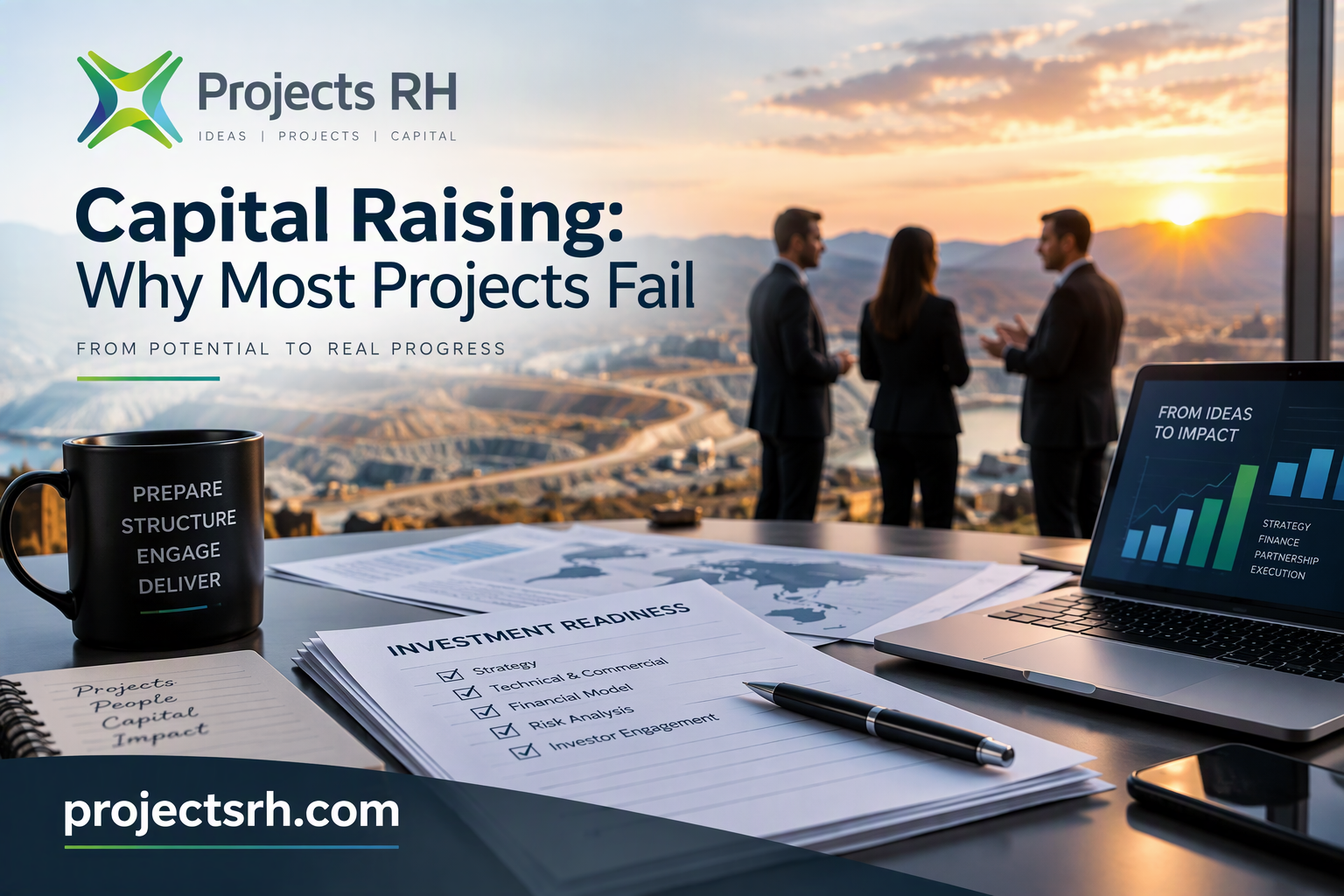
Capital raising fails more often because a project is not ready for capital than because capital is unavailable. In my experience, sponsors frequently begin investor outreach before the financial model, risk allocation, documentation, funding structure and investment proposition are strong enough to withstand serious scrutiny.
That creates a frustrating situation. The project may be technically attractive, the market opportunity may be real and the management team may be experienced, yet investor conversations go nowhere.
The problem is often not the investor.
The problem is project preparation.
Successful capital raising begins well before the first investor meeting. It starts by understanding what institutional capital will test, resolving the weaknesses that can be resolved, presenting the remaining risks honestly and approaching the sources of capital whose mandate genuinely fits the project.
Capital raising is not primarily an investor search. It is a project-readiness exercise followed by a carefully targeted financing process.
Why Capital Raising Fails Before Investor Outreach Begins
When a capital raise struggles, sponsors often conclude that investors are not interested, markets are difficult or the project needs access to a larger investor network.
Sometimes that is true.
Often it is not.
The first question I would ask is much simpler:
Was the project genuinely ready when it went to market?
An investor may initially like the sector, jurisdiction, technology or underlying asset. But interest changes quickly when basic questions do not have credible answers.
For example:
- How much capital is actually required?
- What exactly will that capital fund?
- Is the requested amount supported by a credible cost estimate?
- What milestones will the capital achieve?
- What happens if CAPEX increases?
- What are the downside assumptions?
- How much equity has already been invested?
- What risks remain unresolved?
- Is the proposed capital structure realistic?
- What is the investor being offered?
- How and when does the investor get paid?
If those answers are unclear, capital raising becomes difficult regardless of how attractive the headline opportunity may appear.
Capital Raising Is Not an Investor Search
One of the biggest mistakes I see is treating capital raising as a numbers exercise:
"If we approach enough investors, somebody will eventually invest."
That is not an effective financing strategy.
A project requiring USD 50 million of development capital is not naturally relevant to every investor capable of writing a USD 50 million cheque.
Different capital providers have very different mandates.
A commercial bank may focus on predictable cash flows, security, completion risk and debt-service capacity.
A private equity fund may focus on entry valuation, governance, control rights and exit potential.
A development finance institution may place additional weight on environmental and social standards, development impact and jurisdiction.
An export credit agency may focus on procurement eligibility and national exports.
A strategic investor may place greater value on access to production, technology, infrastructure or geographical positioning.
The question therefore is not:
"Who has money?"
The better question is:
"Whose capital is genuinely compatible with this project's stage, risks, economics and strategic value?"
That distinction can save months of poorly targeted investor outreach.
1. The Project Is Not Investor-Ready
A project can be commercially interesting without being investor-ready.
Investor readiness means that the project has reached a level of technical, financial, commercial, legal and organisational maturity that allows a serious capital provider to assess the opportunity efficiently.
This does not mean every risk has disappeared.
Investors know projects contain risk.
What they need is sufficient information to understand:
- what the risks are;
- how material they are;
- who carries them;
- how they are being mitigated;
- what remains unresolved; and
- whether the potential return appropriately compensates for them.
The difference is important.
Trying to conceal weaknesses generally damages credibility.
Identifying weaknesses and presenting a credible plan for resolving them can strengthen it.
Before starting a serious capital raising process, I would want a project sponsor to complete an investment readiness assessment covering the major technical, financial, commercial and transaction risks.
2. The Financial Model Does Not Survive Scrutiny
A financial model should not exist simply because an investor asked for one.
It should be one of the principal decision-making tools for the project.
A credible financial model for capital raising needs to explain how technical and commercial assumptions translate into cash flow, financing requirements and investor returns.
Depending on the project, I would expect the model to address:
- Development CAPEX
- Construction CAPEX
- Operating expenditure
- Production or utilisation assumptions
- Ramp-up
- Revenue
- Working capital
- Taxes
- Financing costs
- Construction schedule
- Contingency
- Debt drawdown
- Debt repayment
- Interest
- Cash available for debt service
- Equity requirements
- Returns to investors
- Downside scenarios
For project finance transactions, lenders may also focus heavily on debt-service metrics such as DSCR and, where relevant, LLCR and PLCR.
But the most important characteristic of the model is not complexity.
It is credibility.
A beautifully formatted model containing unrealistic assumptions remains a weak financial model.
The Downside Case Matters
Sponsors naturally concentrate on the base case.
Investors usually spend considerable time considering what happens when the base case is wrong.
I would want to know what happens if:
- construction costs increase by 10%;
- construction is delayed by six months;
- revenue begins later than anticipated;
- operating costs rise;
- interest rates increase;
- commodity prices or tariffs decline;
- utilisation is lower;
- working-capital requirements increase; or
- operational ramp-up takes longer than expected.
A robust model should allow the project team to answer those questions before an investor asks them.
A financial model should reveal the weaknesses of a project, not hide them.
3. The Funding Ask Is Not Properly Structured
"We need USD 100 million" is not a financing strategy.
Investors need to understand what the money will do.
A credible funding request should explain:
- Total project cost
- Capital already invested
- Remaining funding requirement
- Use of proceeds
- Timing of each draw
- Contingency
- Sponsor contribution
- Proposed debt/equity mix
- Milestones achieved with each funding stage
- Expected future financing requirements
Consider a hypothetical USD 150 million project.
One approach is:
"We are raising USD 150 million."
A more sophisticated approach might determine that the requirement should be structured as:
- USD 15 million sponsor and development equity
- USD 25 million strategic equity
- USD 30 million ECA-supported equipment financing
- USD 65 million senior project debt
- USD 15 million contingency and working-capital facility
The numbers are illustrative, but the principle is important.
Different project risks may be better financed by different forms of capital.
This is where project finance becomes capital architecture rather than simple fundraising.
4. Risk Allocation Has Not Been Resolved
Every material project risk sits somewhere.
Someone carries it.
That includes:
- Development risk
- Construction risk
- Completion risk
- Technology risk
- Operating risk
- Revenue risk
- Commodity-price risk
- Interest-rate risk
- Currency risk
- Political risk
- Regulatory risk
- Environmental risk
- Offtake risk
- Counterparty risk
When sponsors cannot explain where these risks sit, sophisticated investors immediately recognise that the transaction structure is incomplete.
A construction contract may transfer certain risks to an EPC contractor.
An offtake agreement may reduce revenue uncertainty.
Insurance may mitigate defined operational risks.
A government guarantee may address a specific sovereign exposure.
Hedging may reduce certain market risks.
Sponsor support may cover completion.
But risk allocation only creates value when the counterparty accepting the risk actually has the contractual and financial capacity to carry it.
That is why a project-finance transaction cannot be assessed simply by looking at projected returns.
The contractual structure matters.
5. The Information Memorandum Does Not Answer Investor Questions
An information memorandum should not be an extended marketing brochure.
Its purpose is to allow a sophisticated capital provider to understand the transaction.
That means presenting both opportunity and risk.
A serious information memorandum will generally need to address:
- Executive investment proposition
- Sponsor and management team
- Project description
- Market
- Commercial model
- Technical status
- Development programme
- Revenue assumptions
- CAPEX and OPEX
- Financial performance
- Funding requirement
- Use of proceeds
- Proposed transaction structure
- Material risks
- Risk mitigation
- ESG considerations
- Legal and regulatory position
- Implementation timetable
The exact structure will vary according to the sector and stage of the project.
But one principle should remain constant:
Documentation should answer the questions investors are likely to ask, not merely communicate the messages sponsors would like investors to hear.
Good investment documentation does not eliminate difficult questions.
It demonstrates that the project team understands them.
6. Sponsors Approach the Wrong Capital
Not every legitimate investor is the right investor for a particular project.
This sounds obvious, yet poorly targeted outreach remains one of the most common causes of wasted time in capital raising.
Before contacting an investor, I would want to understand:
- Typical ticket size
- Geography
- Sector mandate
- Project stage
- Debt or equity preference
- Return requirements
- Risk tolerance
- ESG criteria
- Investment horizon
- Control requirements
- Previous comparable investments
There is little value in approaching a USD 2 billion infrastructure fund with a USD 3 million early-stage development requirement if that investor normally writes USD 100 million equity cheques into operating assets.
Likewise, presenting an unpermitted development-stage project to a lender whose mandate requires operating cash flow is unlikely to produce a financing solution.
This is where professional capital raising advisory and project finance advisory should add value.
The objective should not be to create the longest investor list.
It should be to create the most relevant investor universe.
7. Investor Outreach Starts Too Early
There is understandable pressure to approach investors quickly.
Projects need money.
Development costs continue.
Management teams want momentum.
But approaching institutional capital prematurely can be expensive.
A weak first approach may expose:
- An incomplete financial model
- Inconsistent CAPEX assumptions
- An unclear funding request
- Missing permits
- Poor transaction documentation
- Unresolved technical issues
- Weak governance
- Unrealistic valuation expectations
The immediate problem is that the investor says no.
The bigger problem is that the project may need to return to the same market later after improving.
You do not always get a completely fresh first impression.
That is why project preparation should precede broad investor outreach.
What Institutional Investors Actually Test
Different investors use different investment processes, but the underlying questions are remarkably consistent.
Is the Project Technically Credible?
Investors need confidence that the underlying project can actually be developed and operated substantially as represented.
Is the Market Real?
Who buys the product or service?
How large is the addressable market?
What evidence supports demand, pricing and growth?
Are the Economics Defensible?
Can CAPEX, OPEX, revenue and margin assumptions withstand scrutiny?
Is Management Capable of Delivering?
Capital does not execute projects.
People do.
Investors will assess whether the management team has the experience and resources necessary to move from the current stage to execution.
Is There a Clear Use of Funds?
Every dollar raised should have a purpose connected to measurable development outcomes.
Is the Capital Structure Sustainable?
Too much debt can undermine a project.
Too much equity can unnecessarily dilute sponsors.
The right answer depends on project risk and cash generation.
Are the Risks Understood?
Investors do not expect a risk-free project.
They expect credible risk identification and allocation.
Is There a Realistic Return?
Expected returns have to reflect risk, duration, liquidity and the investor's mandate.
The Sequence of Capital Raising Matters
The order in which financing activities occur can materially affect the outcome.
For example, a project may become substantially more financeable after:
- Technical work confirms the development case.
- Permitting reaches an appropriate stage.
- The financial model is independently challenged.
- A credible offtake agreement is negotiated.
- Sponsor equity is committed.
- Strategic capital enters.
- Senior lenders begin due diligence.
Attempting step seven before steps one through five may create an unnecessarily difficult financing process.
This is why a successful capital raise should be treated as a sequence of de-risking events.
Each milestone should increase confidence and, ideally, reduce the cost of the next layer of capital.
Investor Readiness Before Capital Raising
Investor readiness is the process of preparing a project so that potential investors can assess its technical, financial, commercial and transaction case efficiently and credibly.
It should happen before large-scale investor outreach.
For me, investor readiness can be tested through five questions.
1. Can We Explain the Project in Two Minutes?
If the investment proposition takes 30 minutes before an investor understands what is being financed, the positioning probably needs work.
2. Can We Defend the Numbers?
Every important assumption in the financial model should have a credible basis.
3. Can We Explain the Risks?
"We do not see any significant risks" is rarely a credible answer.
Serious projects identify risks.
4. Can We Explain the Capital Structure?
Sponsors should understand why the proposed structure uses debt, equity or other instruments in the proportions presented.
5. Can an Investor Conduct Due Diligence Efficiently?
Important information should be organised, consistent and available.
A structured investment readiness assessment can help identify these gaps before formal capital raising begins.
Project Preparation Creates Financing Leverage
Good project preparation does more than make documentation look professional.
It can materially change the financing discussion.
Resolving a permitting issue may remove a major condition precedent.
Obtaining credible offtake may improve revenue visibility.
Validating CAPEX may strengthen the financial model.
Improving governance may make the project acceptable to institutional capital.
Completing technical work may allow lenders to move from preliminary interest toward formal due diligence.
Each of these actions can reduce uncertainty.
Reducing uncertainty can improve financing leverage.
This is why I regard project preparation as part of the financing strategy, not an administrative stage before it.
Capital Raising Versus Project Finance
The terms are related but not identical.
Capital raising is the broader process of obtaining funding from investors or lenders.
Project finance generally refers to financing structures where capital is primarily repaid from project cash flows, with lenders placing significant emphasis on the project's contracts, risk allocation and financial performance.
A project may raise:
- Development equity
- Strategic equity
- Corporate debt
- Project debt
- Mezzanine capital
- Government-backed finance
- Export credit
- Offtake-linked finance
- Royalties or streams
The appropriate solution depends on the stage and characteristics of the project.
Trying to impose a project-finance structure on an asset that is not sufficiently mature can fail.
Equally, funding an infrastructure-style asset entirely with expensive equity may destroy sponsor value when appropriately structured debt could eventually become available.
Capital strategy should evolve as the project de-risks.
What Should Be Ready Before Investor Outreach?
Before launching a substantial capital raising process, I would normally expect the sponsor to have clarity across the following areas.
Project
- Development scope
- Current stage
- Technical status
- Permits
- Development schedule
- Critical dependencies
Financial
- CAPEX
- OPEX
- Revenue assumptions
- Financial model
- Funding requirement
- Use of proceeds
- Sensitivity analysis
Commercial
- Target market
- Customers or offtakers
- Pricing methodology
- Contracts or commercial pipeline
- Competitive positioning
Transaction
- Proposed instrument
- Amount sought
- Sponsor contribution
- Capital structure
- Investor proposition
- Governance implications
Risk
- Principal risks
- Mitigation strategies
- Contractual allocation
- Insurance
- Contingencies
Documentation
- Investor presentation
- Financial model
- Information memorandum where appropriate
- Technical information
- Corporate information
- Due-diligence materials
The answer does not have to be perfect in every category.
But material gaps should be known before investors discover them.
A Practical Capital Raising Readiness Test
Before sending another investor email, I would ask the project team to answer these 10 questions:
- What exactly are we financing?
- How much capital do we need and why?
- What milestones will that capital achieve?
- What evidence supports our CAPEX and OPEX?
- What does the downside case look like?
- What are the three risks an investor is most likely to challenge?
- Why is our proposed capital structure appropriate?
- Which categories of investors genuinely fit the project?
- Is our documentation consistent with the financial model?
- Are we ready to support serious due diligence?
If those questions cannot be answered clearly, I would not expand investor outreach.
I would return to project preparation.
Frequently Asked Questions About Capital Raising
What is capital raising?
Capital raising is the process of securing debt, equity or other forms of financing to fund the development, construction, acquisition, expansion or operation of a business or project.
For major projects, successful capital raising normally requires technical preparation, credible financial modelling, appropriate documentation, risk analysis and targeted investor engagement.
Why do capital raises fail?
Capital raises can fail because the project is insufficiently prepared, financial assumptions are not credible, risks remain unresolved, the funding request is poorly structured, documentation is weak or the sponsors approach capital providers whose mandates do not fit the opportunity.
What is investor readiness?
Investor readiness is the level of preparation required for a project or business to withstand meaningful investor scrutiny.
It includes financial, technical, commercial, legal, governance and transaction readiness.
What should be completed before approaching investors?
Sponsors should at minimum understand the funding requirement, use of proceeds, project economics, material risks, development programme, proposed capital structure and investor proposition.
The level of supporting documentation should increase as the project moves toward institutional capital and formal due diligence.
Why is a financial model important for capital raising?
A financial model translates technical and commercial assumptions into projected financial performance, funding requirements and investor returns.
It also allows investors to test downside cases including CAPEX increases, delays, weaker revenue and higher operating costs.
Is an information memorandum necessary for capital raising?
Not every transaction requires the same level of documentation.
However, institutional investors will generally require sufficient information to evaluate the project, sponsors, market, financial model, funding requirement, transaction structure and principal risks.
What is the difference between capital raising and project finance?
Capital raising describes the wider process of obtaining funding.
Project finance is a specific approach where financing is substantially supported by project cash flows, contracts, assets and risk allocation.
When should a project begin investor outreach?
Investor outreach should begin when the project is sufficiently developed for the targeted type of capital to assess it meaningfully.
Beginning too early can waste time and weaken credibility.
Sources
- World Bank Group: Infrastructure
- International Finance Corporation: What We Do
- International Finance Corporation: Environmental and Social Performance Standards
- Equator Principles: The Equator Principles
Final Perspective: Capital Raising Starts Before the Investor Meeting
The projects that struggle to raise capital are not always bad projects.
Frequently, they are projects that entered the market before the investment case was ready.
That is an important distinction.
Investors cannot solve fundamental project-preparation problems during an introductory meeting.
A larger investor database cannot repair an unreliable financial model.
A stronger presentation cannot compensate for unresolved technical risk.
And an information memorandum cannot manufacture bankability.
Capital raising works best when project preparation, investor readiness, financial modelling, risk allocation, documentation and investor targeting are treated as one integrated process.
In practical terms, I would ask sponsors to stop measuring progress by the number of investors contacted.
Measure instead:
- how many material risks have been resolved;
- how much stronger the financial case has become;
- whether the funding requirement is clearly structured;
- whether the documentation withstands scrutiny; and
- whether the investors being approached genuinely fit the transaction.
The objective is not to generate investor conversations. The objective is to create a project that can survive them.
If you are preparing a project for capital raising, the next practical step is to identify the gaps investors and lenders are likely to challenge before formal outreach begins. /intake.html.

What to do next
Projects RH prepares the company and the project first, then takes them to investors. The fastest way to find out where you stand is a short call.
Keep reading
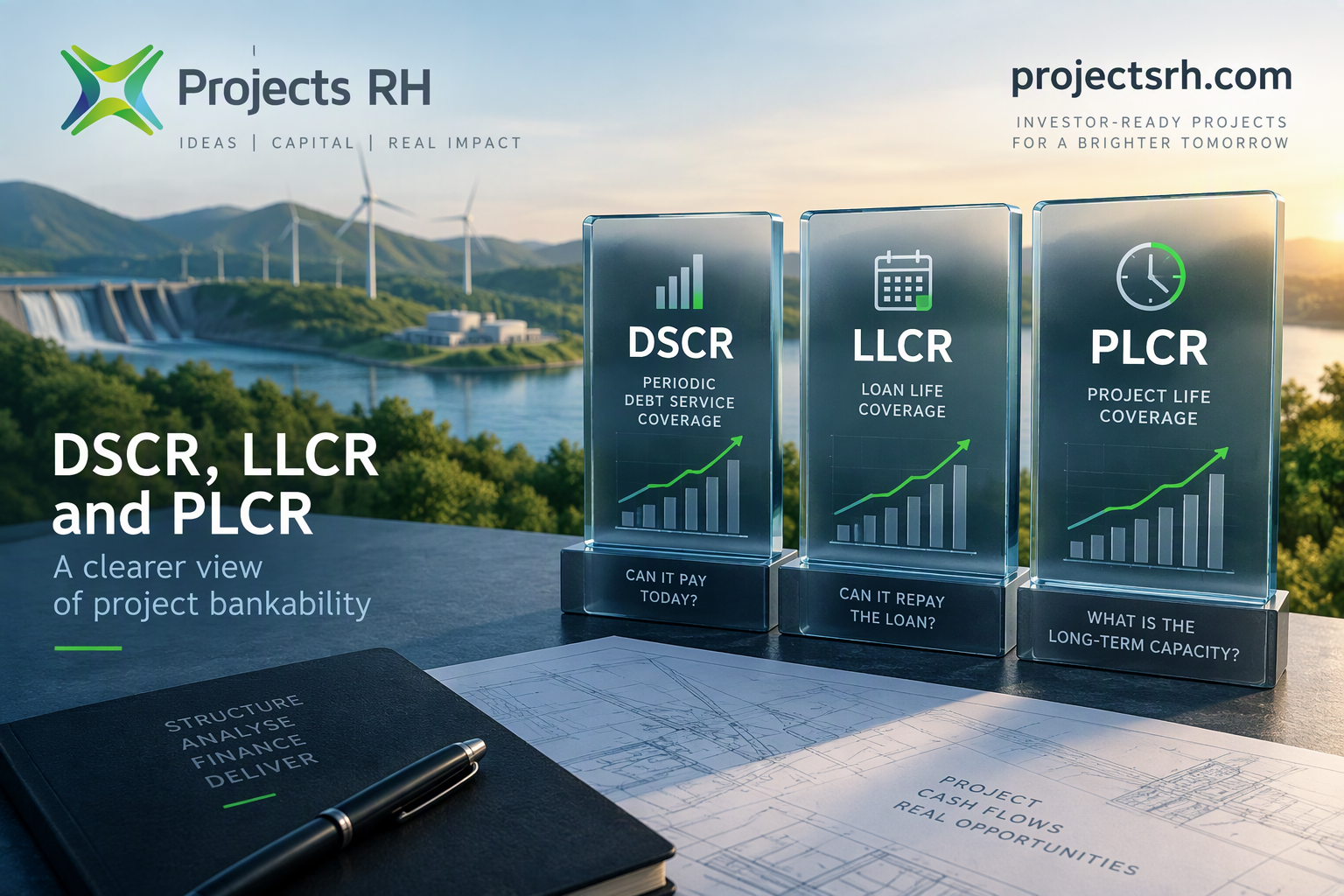
DSCR in Project Finance: How Lenders Use LLCR and PLCR
How do lenders use DSCR, LLCR and PLCR? Learn how these project finance ratios influence debt sizing, repayment, covenants and lender decisions.
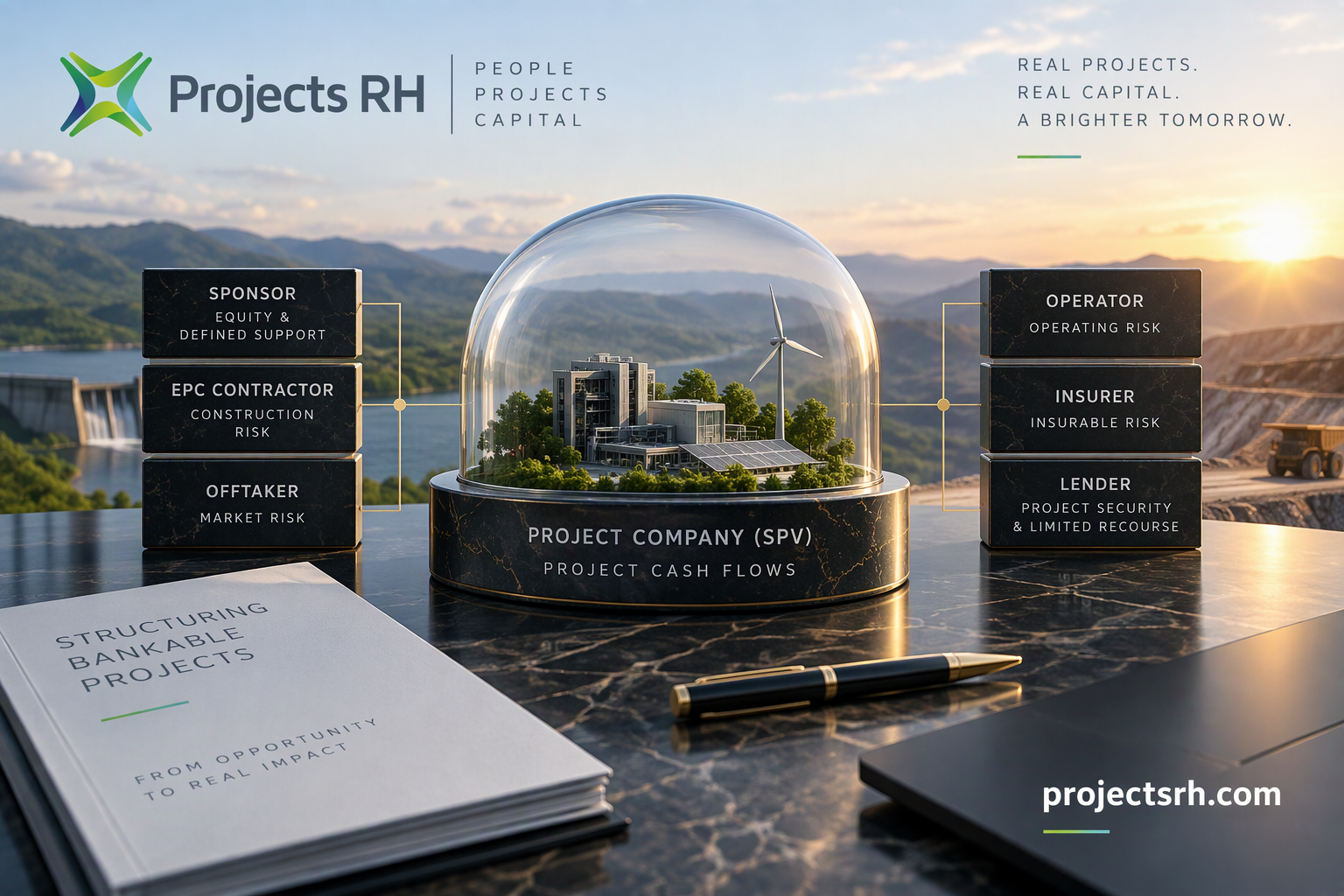
Limited-Recourse Project Finance: Sponsors and Lenders
What is Limited-Recourse Project Finance? Learn how project cash flows, SPVs, security and sponsor support define risk for sponsors and lenders.
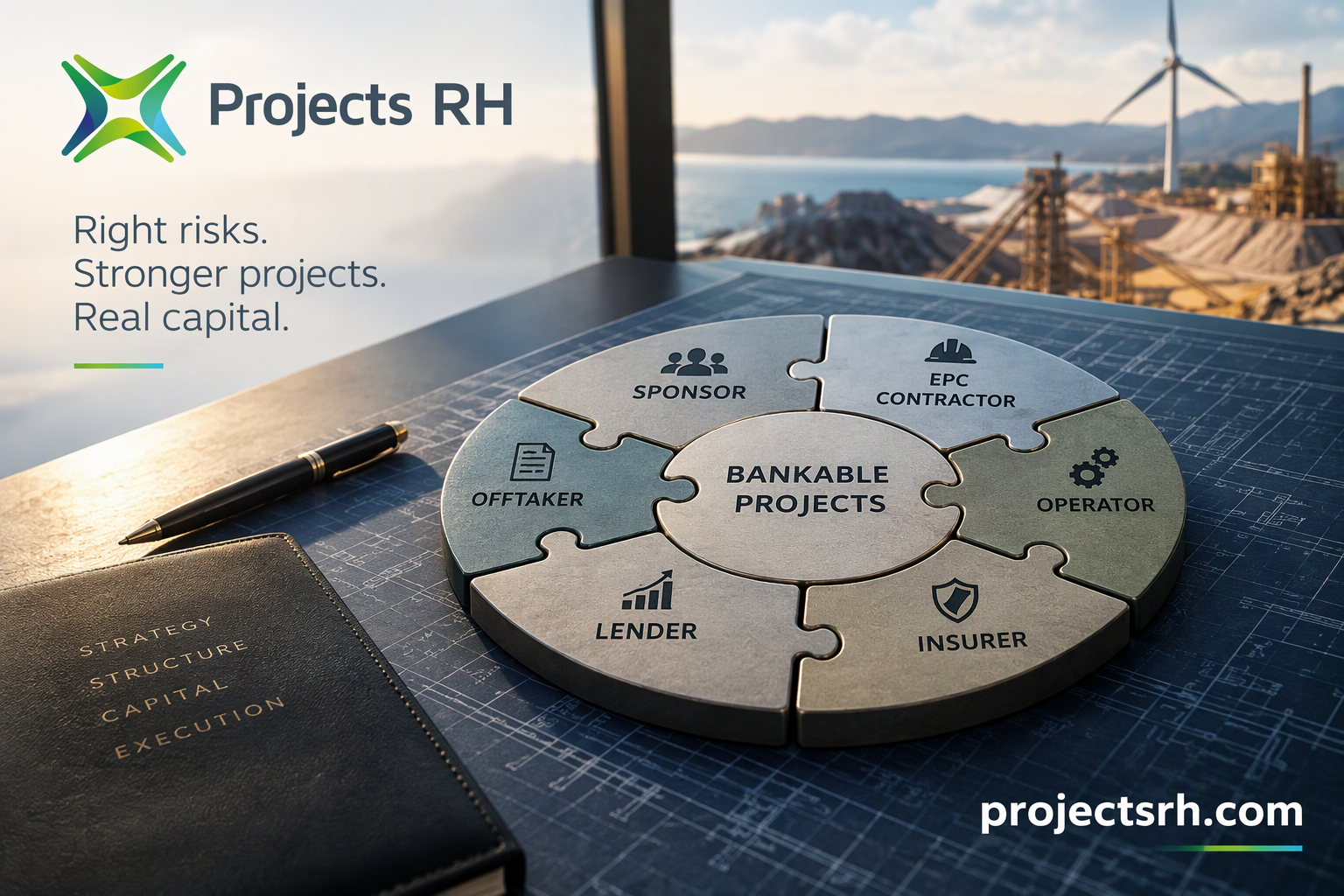
Project Finance Risk Allocation: Who Carries the Risk?
Who carries construction, market and operating risk? Learn how Project Finance Risk Allocation shapes contracts, bankability and lender confidence.