
Debt vs Equity in Project Finance: Building the Right Mix
Debt vs Equity in Project Finance explained: how sponsors balance leverage, dilution, DSCR, risk and investor returns to build a bankable capital structure.

Debt vs Equity in Project Finance is not simply a choice between two sources of money. It is a decision about how risk, control, returns and repayment obligations will be distributed throughout the life of a project.
Throughout my career in finance, resources, energy and project development, I have seen projects with strong underlying economics become difficult to finance because the proposed capital structure did not reflect the project's stage, cash flows or risk profile.
Too much equity can unnecessarily dilute sponsors and increase the overall cost of capital.
Too much debt can create repayment obligations that the project cannot safely support.
The objective is not necessarily to maximise debt or minimise equity.
The objective is to build a capital structure that the project's cash flows can support, investors can understand and lenders can finance.
That is where Debt vs Equity in Project Finance becomes a question of bankability rather than simply funding.
What Does Debt vs Equity Mean in Project Finance?
Debt vs Equity in Project Finance refers to the balance between capital that must be repaid according to agreed financing terms and capital invested by shareholders who accept greater risk in exchange for potential returns and ownership.
In a typical project finance structure:
- Equity is contributed by project sponsors, strategic investors or other shareholders.
- Senior debt may be provided by commercial banks, development finance institutions, institutional lenders or bond investors.
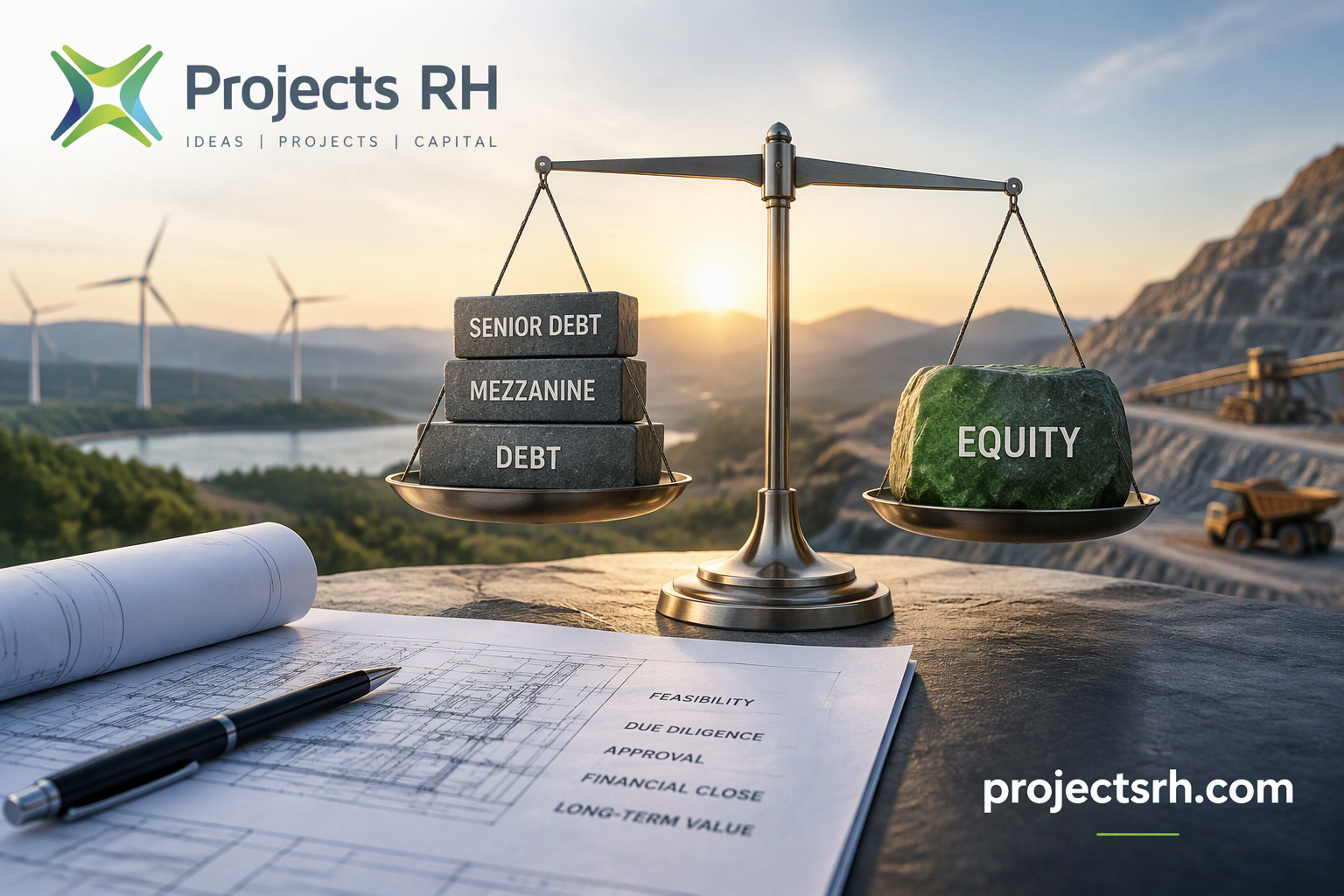
- Mezzanine or subordinated capital can sit between senior debt and common equity.
- Additional structures may include shareholder loans, preferred equity, guarantees, equipment finance, export credit or blended finance.
The World Bank's guidance on finance structures explains that project companies typically raise finance through a combination of shareholder equity and debt from banks, bonds or other financial instruments.
The same guidance describes equity as effectively “first in, last out”: project losses are borne first by equity investors, while lenders generally have higher repayment priority.
That difference in risk explains an important principle:
Equity usually carries greater risk and therefore expects a higher return. Debt generally accepts lower upside in exchange for contractual repayment priority and stronger protections.
Why Does the Debt-to-Equity Mix Matter?
Capital structure affects almost every aspect of a project investment.
It influences:
- sponsor dilution;
- lender risk;
- debt service;
- shareholder returns;
- project cash flow;
- financial flexibility;
- reserve requirements;
- refinancing risk;
- distribution capacity;
- bankability; and
- the overall weighted cost of capital.
The right structure therefore cannot be determined by saying:
“Debt is cheaper, so we should maximise debt.”
Debt may have a lower expected financial return than equity, but it also creates mandatory financial obligations.
That distinction becomes critical when project revenues begin later than expected or fall below forecast.
How Does Equity Work in Project Finance?
Equity represents ownership capital committed to the project.
Depending on the structure, equity may come from:
- original project sponsors;
- strategic investors;
- infrastructure funds;
- private equity funds;
- industrial partners;
- family offices;
- institutional investors;
- governments or sovereign investment vehicles; and
- development finance institutions.
Equity investors generally accept a subordinate position to lenders.
Senior debt will normally have priority over shareholder distributions.
For the sponsor, the primary advantage of equity is flexibility. Equity does not normally require scheduled principal and interest payments in the same way as senior debt.
The disadvantage is economic.
New equity can dilute existing shareholders and typically requires a higher expected return because equity absorbs more project risk.
Sponsor Equity vs Strategic Equity
Not all equity investors bring the same value.
Sponsor equity demonstrates the commitment of the project owners.
Strategic equity may bring additional capabilities such as:
- technical expertise;
- market access;
- offtake relationships;
- supply-chain support;
- operational experience;
- customer relationships; or
- credibility with lenders.
A sponsor should therefore evaluate an equity partner on more than valuation alone.
The best equity may be capital that improves the project as well as funding it.
How Does Debt Work in Project Finance?
Project finance debt is typically assessed against the project's ability to generate sufficient and resilient cash flow to service its obligations.
The World Bank's Project Finance Key Concepts explains that project finance commonly uses a special purpose vehicle, with lenders looking primarily to project revenues and contractual arrangements rather than relying entirely on the sponsor's corporate balance sheet.
This is particularly important during construction.
A new project may generate no operating revenue while construction is underway, yet capital is already being deployed.
Debt therefore introduces questions that equity alone does not:
- When does debt service start?
- Is interest capitalised during construction?
- How long is the debt tenor?
- What is the repayment profile?
- What security is available?
- What cash reserves are required?
- Are financial covenants appropriate?
- What happens after a construction delay?
- Can the project refinance?
- What happens if revenues underperform?
Debt is therefore not simply capital at a stated interest rate.
It is a contractual claim on future project cash flows.
What Is Senior Debt?
Senior debt is financing that has priority over subordinated debt and equity in the project's payment structure.
A typical project cash waterfall may prioritise:
- Operating expenses
- Taxes and essential project obligations
- Senior debt interest
- Senior debt principal
- Required reserve accounts
- Subordinated or mezzanine obligations
- Permitted distributions to equity
The precise order depends on the project agreements.
For lenders, repayment priority provides protection.
For sponsors, that same priority restricts when cash can be distributed to shareholders.
This is why a project that appears highly profitable at the EBITDA level can still face distribution constraints if debt service and reserve requirements consume too much cash.
What Is Mezzanine Finance?
Mezzanine finance is capital positioned between senior debt and common equity in terms of risk and repayment priority.
The World Bank's infrastructure finance guidance describes mezzanine or subordinated contributions as sitting between equity and senior debt, with lower priority than senior lenders but higher priority than equity.
Mezzanine finance may include:
- subordinated loans;
- preferred shares;
- convertible instruments;
- shareholder loans; or
- structures combining interest with equity participation.
Because mezzanine investors take more risk than senior lenders, they usually require a higher return.
Mezzanine capital can help close a financing gap, but it can also materially increase the cost and complexity of the capital stack.
Why Not Finance the Entire Project With Debt?
Debt can improve equity returns when a project performs well because shareholders commit less capital while retaining the residual upside.
But leverage works in both directions.
If revenue falls while debt obligations remain fixed, the pressure on equity can increase quickly.
For a project to be bankable, lenders need sufficient confidence that operating cash flows will cover debt service with an appropriate margin. The World Bank notes that lenders examine both cash-flow resilience and risk allocation; where risks are too high, lenders may reduce the amount of debt they are prepared to provide, meaning additional equity is required.
This produces an important relationship:
The amount of debt a project wants is not necessarily the amount of debt a project can support.
What Is DSCR and Why Does It Matter?
One of the most important measures used in project finance is the Debt Service Coverage Ratio, or DSCR.
In simplified form:
DSCR = Cash Flow Available for Debt Service ÷ Debt Service
If a project generates $15 million of cash flow available for debt service and annual principal plus interest payments are $10 million:
DSCR = 1.50x
That means the project generates 1.5 times the cash required for that period's debt service.
A DSCR of 1.00x would mean there is theoretically just enough cash to service debt, leaving essentially no margin for adverse performance.
The appropriate minimum DSCR depends on the sector, revenue structure, jurisdiction, contractual protections and lender appetite.
A contracted infrastructure asset with highly predictable revenues may support different leverage from a merchant energy project, early-stage mining project or AI infrastructure development exposed to customer concentration and technology risk.
There is no universal debt-to-equity ratio or DSCR that makes every project bankable.
How Much Debt Should a Project Use?
The correct amount of debt depends on the project's ability to service it under realistic assumptions, not merely the sponsor's preferred capital structure.
Key factors include:
- expected operating cash flow;
- revenue predictability;
- construction risk;
- operating risk;
- customer or offtaker credit quality;
- asset life;
- debt tenor;
- interest rates;
- currency exposure;
- commodity-price exposure;
- reserve requirements;
- security package;
- downside sensitivities; and
- lender requirements.
The financial model must therefore examine more than the base case.
It should test what happens if:
- construction costs increase;
- commissioning is delayed;
- production underperforms;
- utilisation is lower than forecast;
- commodity prices fall;
- customer payments are delayed;
- interest rates rise; or
- operating costs increase.
Debt sizing should be driven by resilient cash flow, not optimistic valuation.
Debt vs Equity: How Risk Changes the Capital Structure
Consider two projects seeking the same amount of capital.
Project A has long-term contracted revenue, proven technology, established counterparties and predictable operating costs.
Project B has substantial market potential but remains exposed to uncertain demand, construction complexity, volatile pricing and unproven operating assumptions.
The two projects should not automatically have the same capital structure.
Project A may potentially sustain more senior debt because lenders can assess cash flows with greater confidence.
Project B may require more equity or subordinated capital because investors must absorb greater uncertainty before senior lenders are comfortable.
This illustrates a fundamental project finance principle:
Capital structure follows risk allocation.
Debt vs Equity in Mining Projects
Mining projects create particular capital-structure challenges.
Lenders and investors may examine:
- resource confidence;
- metallurgy;
- recovery assumptions;
- mine plan;
- construction cost;
- processing strategy;
- infrastructure;
- commodity-price assumptions;
- jurisdictional risk;
- permitting;
- environmental requirements;
- offtake; and
- operating cost.
An early-stage mining project will generally present a very different financing profile from a producing mine with established reserves, operating history and contracted sales.
Projects may also consider alternatives such as:
- royalties;
- streaming;
- commodity-linked finance;
- equipment finance;
- offtake prepayments; and
- strategic investment.
The correct comparison is therefore not always simply debt versus common equity.
It is the entire capital stack.
Debt vs Equity in Energy and Infrastructure Projects
Energy and infrastructure assets may benefit from long-duration contracted revenues, particularly where credible power purchase agreements, availability payments or concession arrangements exist.
However, lenders will still examine:
- construction risk;
- EPC arrangements;
- operating performance;
- grid connection;
- curtailment;
- counterparty credit;
- regulatory risk;
- termination provisions;
- insurance;
- reserve accounts; and
- revenue resilience.
The strength of these contracts can materially influence how much debt the project is capable of supporting.
The World Bank notes that finance structures for infrastructure commonly combine sponsor equity with bank debt, bonds or other instruments, while lenders closely assess risk allocation and the project's capacity to service debt. Read the World Bank's infrastructure finance guidance.
Debt vs Equity in AI Infrastructure and Data Centres
AI infrastructure introduces another set of capital-structure considerations.
An AI data centre may require significant upfront investment in:
- land;
- grid connection;
- power generation;
- transformers;
- cooling;
- buildings;
- networking;
- GPUs and servers;
- energy storage; and
- redundancy.
But different components may have different useful lives and risk profiles.
A long-life site and power infrastructure asset may support financing differently from GPUs that face comparatively rapid technology obsolescence.
Investors may also examine:
- customer concentration;
- contract term;
- compute utilisation;
- equipment residual value;
- power-price exposure;
- replacement CapEx;
- deployment schedule; and
- technology refresh requirements.
This makes careful matching of capital tenor to asset life especially important.
The Projects RH Capital Structure Test
Before deciding how much debt or equity a project should raise, I would ask ten questions:
- What is the total capital requirement?
- What development milestones will the capital finance?
- When does the project begin generating cash?
- How predictable are those cash flows?
- How much downside can the financial model absorb?
- What debt service can the project support under stress?
- How much dilution are existing sponsors prepared to accept?
- Could a strategic investor reduce project risk?
- Should subordinated or mezzanine capital fill part of the gap?
- Does the proposed capital structure remain financeable after realistic downside testing?
These questions should be answered before presenting a capital structure to institutional investors or lenders.
Common Capital Structure Mistakes
In my experience, sponsors should be particularly careful about several recurring mistakes.
Maximising Debt Rather Than Bankability
More debt is not automatically better.
Excess leverage can reduce financial flexibility and make a project considerably more vulnerable to delays or revenue underperformance.
Treating Equity Only as Dilution
Equity is expensive in economic terms, but adequate equity can strengthen lender confidence and provide the project with resilience.
Strategic equity may also add capabilities that capital alone cannot provide.
Using Short-Term Capital for Long-Term Assets
Capital tenor should reflect the underlying asset, project cash flows and refinancing risk.
A project can have attractive economics and still fail if debt becomes due before the asset produces sufficient cash.
Ignoring the Repayment Waterfall
Headline returns do not tell equity investors when distributions can actually occur.
Sponsors need to understand how operating costs, taxes, debt service, reserve accounts and subordinated obligations affect distributable cash.
Building the Capital Structure Before Testing the Financial Model
The capital structure should be an output of rigorous financial analysis, not an assumption imposed on the model because it creates the preferred IRR.
Frequently Asked Questions About Debt vs Equity in Project Finance
What is the difference between debt and equity in project finance?
Debt must generally be repaid according to contractual terms and has priority in the payment structure. Equity represents ownership capital, assumes greater project risk and normally receives distributions only after senior obligations have been satisfied.
Is debt cheaper than equity in project finance?
Debt generally requires a lower return than equity because lenders have contractual repayment rights and higher priority. Equity investors take greater risk and therefore normally expect higher returns.
However, excessive debt can increase financial risk and undermine bankability.
What is a typical debt-to-equity ratio in project finance?
There is no universal project finance debt-to-equity ratio.
The appropriate leverage depends on project risk, revenue predictability, sector, development stage, cash-flow resilience, debt tenor and lender requirements.
A ratio that is workable for a contracted infrastructure asset may be inappropriate for an early-stage mining project or merchant energy development.
What is the role of equity in project finance?
Equity absorbs first-loss risk, demonstrates sponsor commitment and provides financial flexibility before distributions are made.
Equity can also reduce leverage and make a project more acceptable to lenders.
What is mezzanine finance?
Mezzanine finance is subordinated capital positioned between senior debt and common equity in risk and repayment priority.
It can fill financing gaps but normally carries a higher cost than senior debt.
How do lenders determine how much debt a project can support?
Lenders assess projected cash flows, DSCR, revenue stability, construction and operating risks, contract strength, security, reserves and downside scenarios.
The amount of debt ultimately available is therefore linked to bankability, not simply project valuation.
Does more debt increase equity returns?
Debt can amplify equity returns when a project performs strongly because shareholders commit less capital.
However, leverage also amplifies financial pressure when cash flows underperform.
Should a project raise debt or equity first?
There is no universal answer.
The sequence depends on project stage, risk reduction, sponsor resources, lender requirements and the role strategic investors can play.
In many development-stage projects, sufficient equity or sponsor capital is needed before senior debt becomes available.
Debt vs Equity in Project Finance in One Sentence
Debt vs Equity in Project Finance is the process of balancing repayment obligations, ownership, risk, dilution and investor returns so that the capital structure remains both commercially attractive and financially bankable.
The Objective Is Not Maximum Leverage
A successful project finance structure is not necessarily the one with the highest debt percentage.
It is the one that remains credible when circumstances become less favourable.
Debt, equity and mezzanine capital each have a role.
The task is to determine which combination best matches:
Project Stage → Risk Profile → Cash Flow → Asset Life → Investor Return → Lender Requirements
At Projects RH, we believe capital structure should be developed alongside the financial model, project preparation and investor-readiness process rather than treated as a separate fundraising decision.
Building the Right Capital Structure
If you are preparing a project in mining, critical minerals, energy, infrastructure, technology or AI data centres, the important question is not simply how much money you can raise.
It is:
What capital structure gives this project the strongest credible path to financing and execution?
Projects RH works with project sponsors to assess investment economics, financial models, capital requirements, project finance structures and investor-readiness gaps before approaching institutional capital.
Explore our Project Finance and Capital Raising Services and learn How Projects RH Works.
Ready to Review Your Project's Capital Structure?
If your project is preparing for institutional capital, the next step is to determine whether its debt, equity and overall capital structure are aligned with its cash flows, development stage and risk profile.
Ready to Review Your Project's Capital Structure?
If your project is preparing for institutional capital, the next step is to determine whether its debt, equity and overall capital structure are aligned with its cash flows, development stage and risk profile.
Book a confidential introductory conversation with Projects RH to discuss your financing strategy, or submit your project information so we can understand your project and capital requirements.
You can also explore our Project Finance and Capital Raising Services and learn How Projects RH Works.
Projects RH | We Make Projects Investor-Ready and Connect Them with the Right Capital
You can also explore our /services.html and learn /how-we-work.html.
Projects RH | We Make Projects Investor-Ready and Connect Them with the Right Capital
Sources

What to do next
Projects RH prepares the company and the project first, then takes them to investors. The fastest way to find out where you stand is a short call.
Keep reading
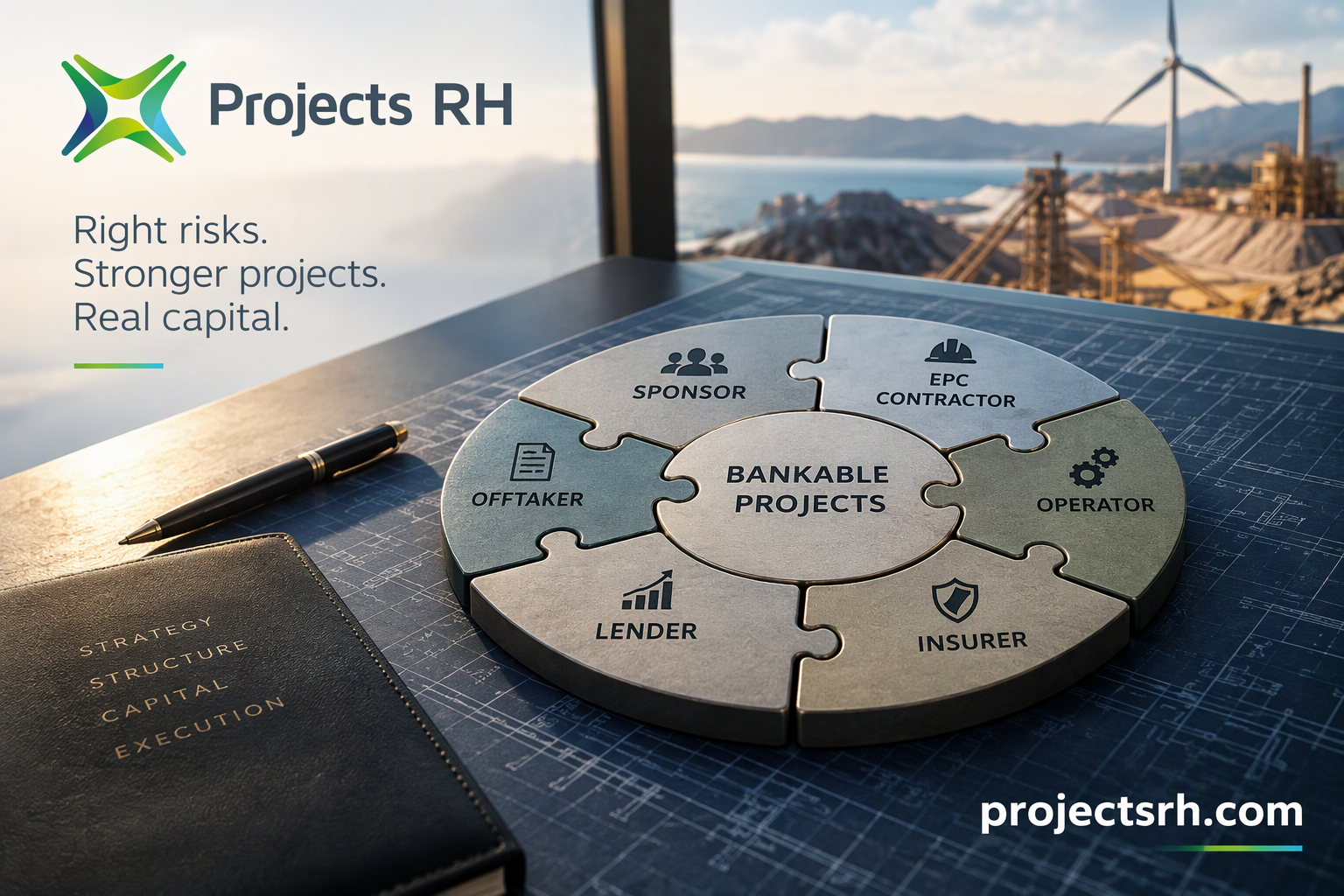
Project Finance Risk Allocation: Who Carries the Risk?
Who carries construction, market and operating risk? Learn how Project Finance Risk Allocation shapes contracts, bankability and lender confidence.
Conditions Precedent in Project Finance: Before Drawdown
What must happen before lenders release funds? Learn how Conditions Precedent in Project Finance affect financial close, drawdown and execution.
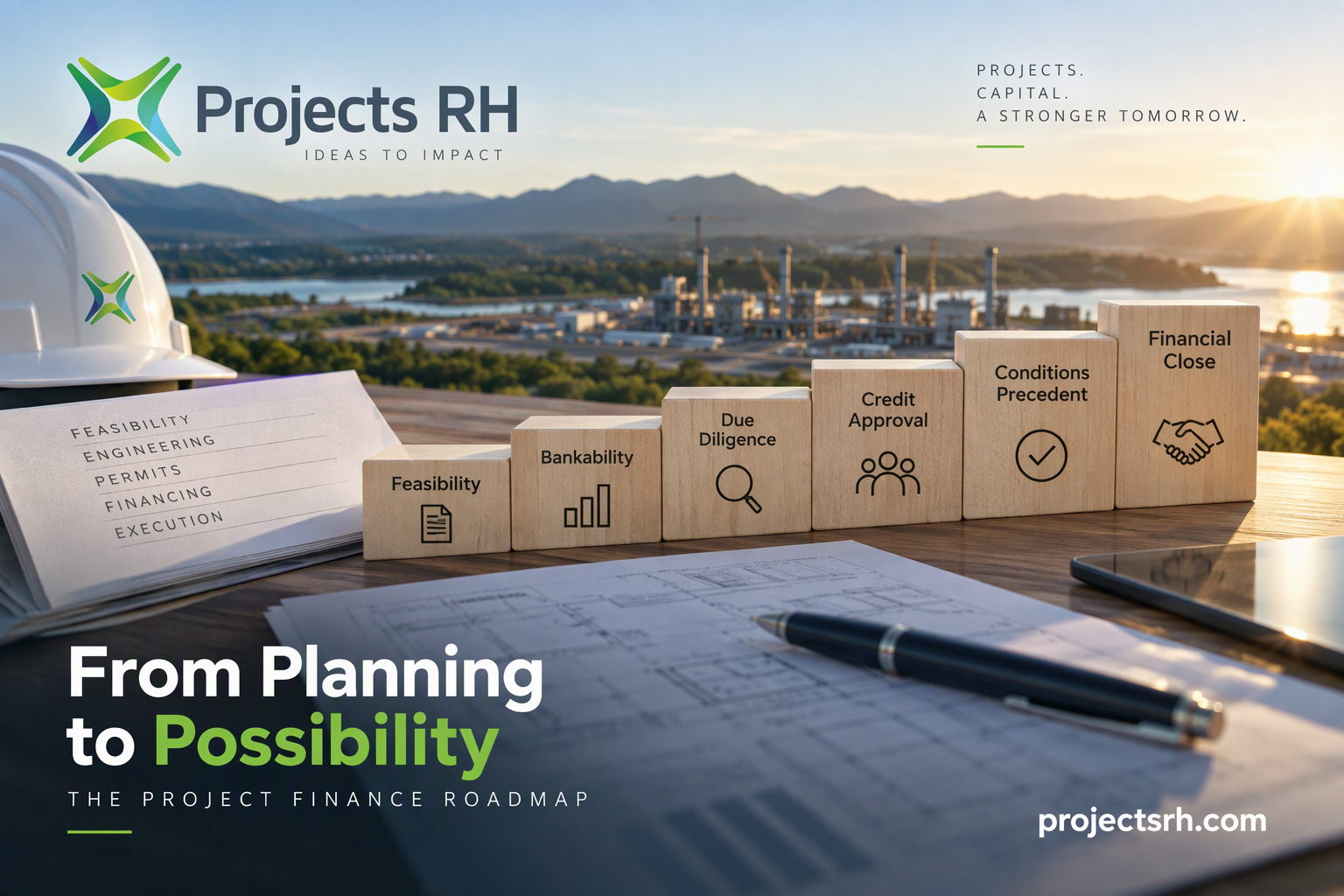
Project Finance Roadmap: Feasibility to Financial Close
Follow the Project Finance Roadmap from feasibility and bankability through due diligence, credit approval, conditions precedent and financial close.