
How a Gold Royalty Company Funds a Mining Project
What a gold royalty company or streaming financier provides, what it takes in return, and what a mine developer should have ready before discussing royalty or stream finance.

For the developer of a gold project, a gold royalty company can be a source of capital that is neither a bank loan nor a new share issue. It pays money into the project now. In return, it takes a contracted share of what the mine produces or earns for years to come. This article explains what that financier provides, what it takes in return, and what you should have ready before the conversation begins. It describes the structures in general terms only. The right choice for any project depends on its own facts and on advice from your legal, tax and technical advisers.
What a gold royalty company provides
A gold royalty company is a specialised financier, not a miner. It does not run the pit, employ the workforce or operate the processing plant. It provides capital to the owner of a mining project. In exchange, it receives a contractual right to a share of the mine's future revenue or output.
For a developer, the appeal usually depends on the stage the project has reached. Between a resource estimate and first gold come drilling, studies, permitting and construction, and each stage needs money. Lenders may want a completed feasibility study, agreed offtake and security before they commit. Raising equity at that stage can mean issuing shares at a price the existing owners consider too low. Royalty and streaming finance can sit alongside some of that debt and equity, or replace part of it.
The money is not free. The financier is buying a long-term claim on the mine, and the project pays for that claim out of its future revenue. Whether the trade suits your project is a question of numbers, and those numbers live in your financial model.
Royalties and streams are not the same thing
The two words are often used as if they meant the same thing. For a developer they lead to different obligations, so it is worth being clear about each.
- A royalty gives the holder a percentage of the mine's revenue or production, usually calculated after certain defined deductions. The holder pays upfront and then receives its share for as long as the agreement runs. It does not buy the metal. It is paid a portion of the metal, or of the money the metal earns.
- A stream gives the financier the right to buy an agreed share of the metal the mine produces. It pays a deposit upfront, then pays an agreed price for each ounce delivered, usually well below the market price. The gap between that price and the market price is how the financier recovers its money and earns its return.
Some agreements cover a by-product rather than the gold itself, which can matter for a project with silver or copper in the ore. Others step down after a set quantity has been delivered. The detail sits in the contract, and it changes how the arrangement affects your cash flow from one year to the next.
What the financier takes in return
The most important point for a developer is that a royalty or stream generally attaches to the mine for its life, or for a long and defined period. It is not repaid and closed in the way a loan usually is. It also reduces the revenue available to every other party in the capital structure, including future lenders and shareholders.
Agreements commonly deal with matters such as:
- the share of revenue or metal, and how it is calculated
- the area of land the agreement covers, which may extend beyond the current deposit
- any security the financier takes over the project
- what happens if production is delayed, interrupted or stopped
- whether the owner can buy back part of the royalty, and on what terms
- what happens if the project or the company is sold
Each of these affects how a bank, an equity investor or a future buyer will view the project later. A royalty agreed in a hurry at an early stage can make the next round of mining project finance harder to arrange. The arrangement therefore belongs inside a wider plan for the project's capital, not as a separate deal next to it.
What royalty and streaming finance will examine
A royalty or streaming financier does not take on the operation, but it is betting on it. If the mine is late, produces less than planned or closes early, the financier receives less. Expect it to examine the project in much the same depth as a lender would, and sometimes more.
It will want to see the following:
- the resource and reserve estimates, and who prepared them
- the mine plan and production schedule
- the capital and operating cost estimates, and their basis
- the permits and land tenure
- the jurisdiction and its rules on mining and taxation
- the people who will build and run the mine
- the rest of the funding plan
It will also want to know that the project can be completed. A stream on a mine that is never built pays nothing.
All of this comes together in the financial model. A financier will test how large a share of revenue or metal it can take while still leaving the project able to meet its other obligations. If your model cannot answer that question cleanly, the conversation tends to stall.
Capital raising preparation for a gold project
Projects RH works on a simple principle: preparation comes before capital. We establish the facts, test the financial foundations, identify material gaps and develop a coherent investment case before any capital raising process begins. For a gold project weighing royalty and streaming finance, that means a set of documents that agree with each other:
- Financial model: the single point of truth for every figure the other documents use. A financial model for capital raising should show how a royalty or stream, at different levels, affects the project's cash flow alongside its debt and equity.
- Information memorandum: the written investment case, covering the business, the plan, the structure and the risks.
- Investor deck: the short form of the same case, for the first meeting.
- Teaser: the summary that goes out before identity does.
- Data room: contracts, permits, financials and diligence materials, organised before the first investor asks.
Investor readiness is not about polish. When a financier tests a figure, the answer should be the same in the model, the memorandum and the deck, and the evidence behind it should already be in the data room. Each document we prepare is reviewed by a professional before it reaches you.
Capital raising is a separate mandate, and it is never guaranteed. Once a project is properly prepared and considered suitable for the market, Projects RH may support investor engagement under that separate mandate, which can be declined.
What you can do next with Projects RH
If you are developing a gold project and considering a royalty, a stream or any other form of project finance, start by finding out what an institutional reader would mark.
- Book a FREE 20-Minute Discovery Call. It is complimentary, and there is nothing to prepare.
- Send what already exists. Email your documents, upload them or connect your document system through our intake page. Nothing new is prepared, and a person at the firm replies in writing within 3 business days. No confidentiality agreement is in place at that point, so if your documents are confidential, ask for the firm's agreement first and send them once it is accepted.
- See how the process runs. How we work sets out the five steps from first call to capital, with a decision at the end of each.
From there, the Investment Readiness Assessment gives you a Preliminary Readiness Profile in words, a gap analysis and a recommended package. Sending documents does not create an advisory, investment, mandate or funding relationship.

What to do next
Projects RH prepares the company and the project first, then takes them to investors. The fastest way to find out where you stand is a short call.
Keep reading
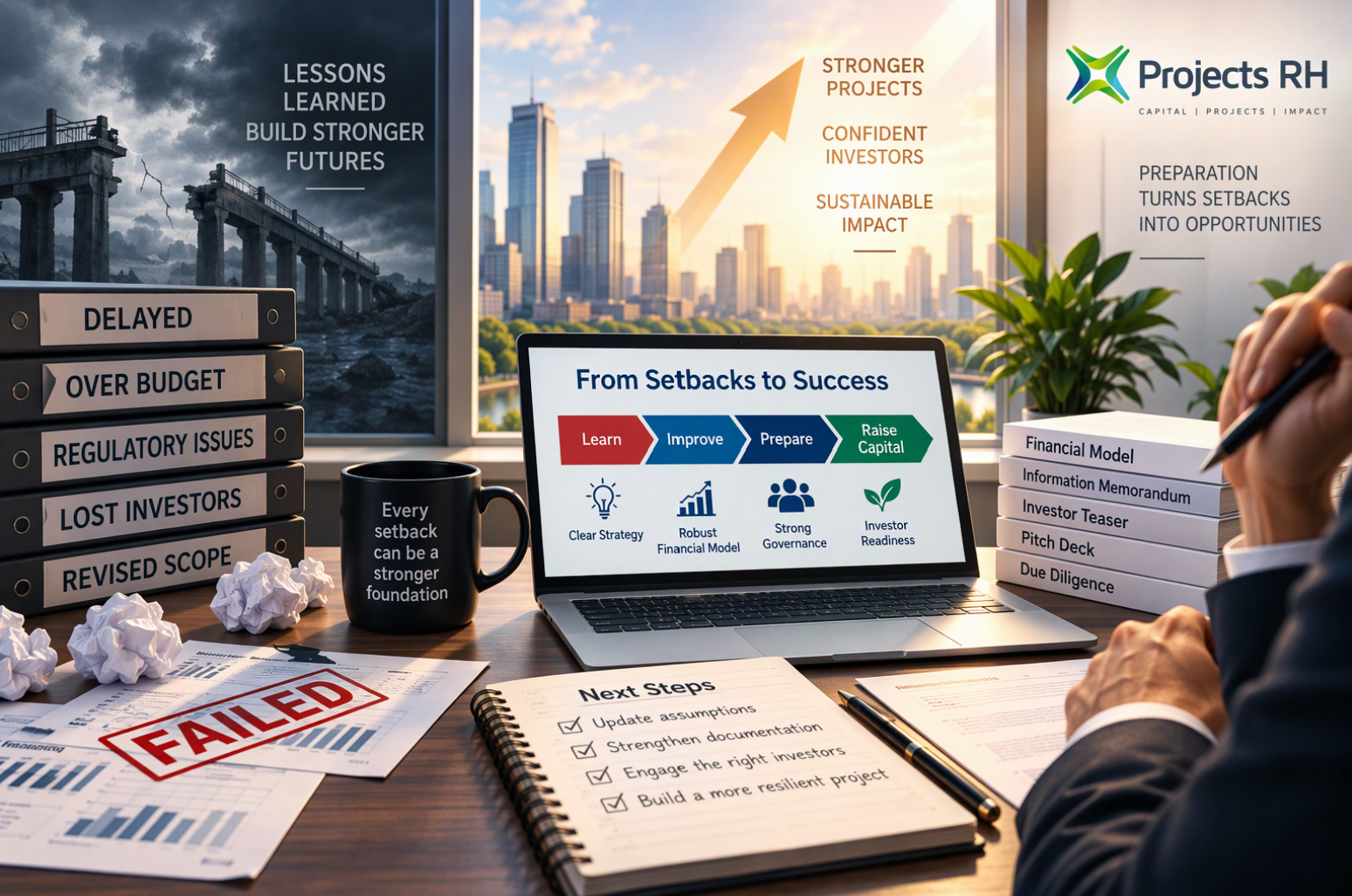
Lessons Learned from Failed Projects: Before You Raise Again
A setback need not end a project. What investors ask after one, and how to carry its lessons into a tested model and documents that agree before approaching capital again.

Investor Readiness: What to Prepare Before Raising Capital
Before you approach investors or lenders: what they examine, which documents must agree, how debt and equity differ, and what to resolve first.
Capital Raising Partners: Why One Coordinated Case Matters
Capital raising draws on many disciplines. How Projects RH works with strategic partners on one coordinated investment case, and the two rules every referral follows.