
Investor Readiness: What Makes a Project Ready for Institutional Capital?
What makes a project investor-ready? Learn how project preparation, bankability, financial modelling and capital strategy support institutional funding.
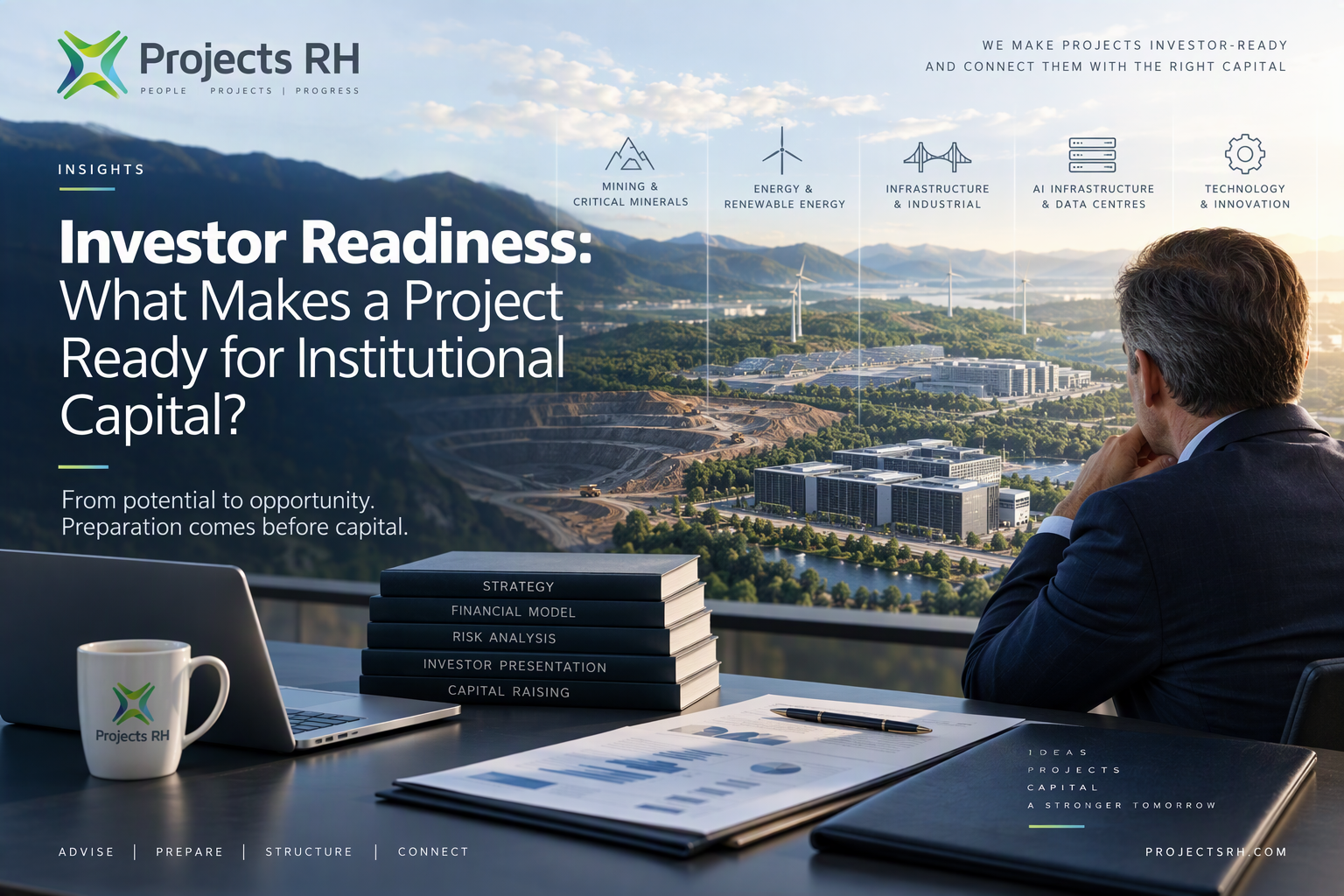
Investor Readiness is what separates a promising project from one that is genuinely prepared for institutional capital.
A project can be technically strong, commercially attractive and strategically important, yet still be unready for professional investor and lender scrutiny.
Throughout my career in finance, resources, energy and project development, I have seen project sponsors spend considerable time searching for investors when the more important question should have been:
Is the project genuinely ready for investor scrutiny?
At Projects RH, we call this Investor Readiness.
Investor Readiness is not simply having a pitch deck, financial model or compelling story. It means developing the commercial, financial, technical and organisational substance required for serious investors and lenders to assess the opportunity, test its assumptions and understand its risks.
Put simply:
Investor Readiness is the bridge between having a promising project and having a financeable investment opportunity.
In my experience, that bridge needs to be built before serious capital raising begins.
What Is Investor Readiness?
Investor Readiness is the process of converting a promising project into a structured, evidence-based and financeable investment opportunity that professional investors and lenders can evaluate through due diligence.
An investor-ready project should clearly demonstrate:
- What is being financed
- Why the opportunity is commercially credible
- How much capital is required and when
- How the capital will be used
- What measurable milestones that capital will achieve
- Whether the financial assumptions are defensible
- What risks could affect delivery or returns
- How those risks are being managed
- Who is responsible for executing the project
- Which type of capital best fits the project's stage and risk profile
This is broadly consistent with the way institutional investors approach project assessment. The International Finance Corporation's Project Cycle, for example, considers business potential, financial and economic soundness, risks, environmental and social requirements and investment approval.
Investor Readiness is investment preparation.
What Is an Investor-Ready Project?
An investor-ready project has a clearly defined investment proposition, defensible economics, credible management, coherent documentation, understood risks, a precise funding requirement and a capital strategy aligned with its development stage.
Professional investors understand risk. They need sufficient evidence to identify it, understand how it is allocated and determine whether the expected return justifies taking it.
A Good Project Is Not Necessarily an Investor-Ready Project
An excellent mineral resource is not automatically a financeable mine.
A site with excellent irradiation is not automatically a bankable solar project.
Land, grid access and GPUs do not automatically create an investable AI data centre.
Promising technology does not automatically create an institutional investment opportunity.
The World Bank's guidance on project preparation emphasises systematic preparation in developing bankable, investment-ready projects capable of attracting private finance.
Investors assess bankability. Project sponsors must help create it.
What Is Project Bankability?
Project bankability is the degree to which a project's economics, expected cash flows, risk allocation, contractual structure and financial fundamentals are sufficiently credible to support financing on acceptable terms.
Investor Readiness and bankability are related but different:
Investor Readiness asks whether a project is sufficiently prepared for professional capital to evaluate it. Bankability asks whether its economics, risks, contracts and cash flows can ultimately support financing.
Investor Readiness vs Capital Raising
Investor Readiness prepares the opportunity for capital. Capital raising takes that prepared opportunity to appropriate investors and lenders.
At Projects RH, the progression is:
Assess → Prepare → Structure → Position → Engage Capital
Learn more about How Projects RH Works.
Preparation comes before capital.
The Seven Foundations of Investor Readiness
1. A Clearly Defined Investment Proposition
Investors should quickly understand:
What is the opportunity, why does it matter, and why is capital required now?
A strong investment proposition explains the project, market, development stage, competitive position, funding requirement and path to value creation.
Clarity matters.
2. Defensible Commercial Fundamentals
Institutional capital needs evidence of a credible economic opportunity, including where relevant:
- Market size and growth
- Customers and counterparties
- Pricing assumptions
- Demand forecasts
- Offtake arrangements
- Competitive positioning
- Production or utilisation assumptions
- Supply-chain considerations
- Sensitivity to changing market conditions
The IFC's financing guidance illustrates the commercial and financial information sophisticated capital providers may require.
Revenue assumptions need evidence, not optimism.
3. A Financial Model That Can Survive Scrutiny
A financial model should explain economically how the project works, including:
- CapEx
- OpEx
- Revenue
- Pricing
- Production or utilisation
- Working capital
- Construction schedules
- Financing costs
- Taxation
- Foreign exchange where relevant
- Debt servicing
- Cash generation
- Investor returns
It should also test downside scenarios such as higher construction costs, delayed commissioning, lower commodity prices, weaker utilisation, higher power costs or increasing financing costs.
A financial model that works only under management's preferred scenario is not a robust investment case.
4. A Precise Capital Requirement and Use of Funds
How much capital do you need, and precisely what will it achieve?
“We need $100 million” is not a capital strategy.
Funding should connect directly to milestones:
Development → Validation → Permitting → Engineering → Construction → Commissioning → Operations → Expansion
Capital should be associated with defined milestones, risk reduction and value creation.
5. Coherent Investment Documentation
Investor-ready documentation should tell one investment story supported by one internally consistent set of facts.
Depending on the project, this may include:
- Executive Summary or Teaser
- Investor Pitch Deck
- Business Plan
- Information Memorandum
- Financial Model
- Sources and Uses of Funds
- Capitalisation Table
- Market Analysis
- Feasibility or Technical Studies
- Corporate documentation
- Material contracts
- Licences and permits
- Risk register
- Due diligence materials
- Structured data room
Consistency, evidence and accessibility matter more than volume.
Explore our Services or learn How Projects RH Works.
6. Risk Identification and Mitigation
Professional investors do not expect risk-free projects. They expect credible risk management.
Relevant risks may include:
- Technical risk
- Construction risk
- Market risk
- Commodity-price risk
- Regulatory risk
- Environmental and social risk
- Permitting risk
- Counterparty risk
- Management risk
- Infrastructure risk
- Foreign-exchange risk
- Financing risk
Investor Readiness does not mean risk has disappeared. It means material risks have been identified, understood and addressed credibly.
7. The Right Capital Strategy
Depending on development stage, cash flows and risk profile, a project may require:
- Sponsor equity
- Strategic equity
- Private equity
- Project finance debt
- Corporate debt
- Mezzanine finance
- Equipment finance
- Development finance
- Infrastructure funds
- Strategic partners
- Offtake-linked financing
The right question is not simply:
“Who has money?”
It is:
“Which form of capital is appropriate for this project, at this stage, with this risk profile?”
Why Project Preparation Matters
The importance of preparation is not theoretical.
The World Bank's analysis of the project preparation gap highlights the shortage of bankable projects as a constraint on private infrastructure investment and discusses project-development mechanisms designed to improve preparation.
Preparation has economic value because better-prepared projects create better conditions for credible capital decisions.
Investor Readiness in Mining and Critical Minerals
A mining or critical minerals project may possess an excellent resource while still needing to establish resource quality, metallurgy, mine planning, processing, CapEx, OpEx, commodity assumptions, permits, infrastructure, energy, logistics, management capability and offtake.
A good resource is the beginning of the investment case. It is not the end of it.
Investor Readiness in Energy and Infrastructure
Energy and infrastructure investors may need evidence around:
- Land rights
- Permits
- Grid connection
- Technology selection
- EPC strategy
- Energy yield
- PPA or revenue arrangements
- Construction schedule
- Counterparty quality
- Operating assumptions
- Financing structure
- Risk allocation
The IEA's World Energy Investment 2026 provides broader context on global energy investment and financing.
Large amounts of capital exist.
That does not mean individual projects automatically qualify for it.
Investor Readiness for AI Infrastructure and Data Centres
A proposed AI data centre can have customers, GPUs and land and still lack a financeable investment proposition.
Institutional investors may need to understand:
- Power availability
- Grid connectivity
- Power costs
- Generation strategy
- Energy storage
- Redundancy
- Cooling
- Water requirements
- Compute deployment
- Utilisation assumptions
- Customer contracts
- Long-lead equipment
- Construction schedules
- Technology obsolescence risk
- Capital intensity
AI infrastructure is increasingly an energy, infrastructure and project finance challenge, not simply a technology opportunity.
The Projects RH Investor Readiness Test
Before approaching institutional capital, ask:
- Can we explain the investment opportunity clearly in two minutes?
- Can we demonstrate credible demand?
- Are our financial assumptions defensible?
- Does our model withstand reasonable downside scenarios?
- Do we know exactly how much capital we require and why?
- Will that capital achieve clearly defined milestones?
- Do all our investment documents tell the same story?
- Do we understand our material risks and mitigation strategies?
- Are we seeking the right type of capital for our current stage?
- Are we approaching investors whose mandates genuinely match our opportunity?
If several answers are “no”, the project may still be excellent.
It simply may not yet be ready for institutional capital.
Frequently Asked Questions About Investor Readiness
What makes a project investor-ready?
A project becomes investor-ready when its commercial proposition, financial model, technical basis, management capability, risks, documentation, funding requirement and capital structure are sufficiently developed and internally consistent for professional investor due diligence.
How do I know if my project is ready for institutional capital?
You should be able to explain how much capital is required, what it will finance, what milestones it will achieve, the project's principal risks and why the proposed financing structure fits the project's current stage.
What do institutional investors look for?
Institutional investors typically assess commercial viability, financial returns, technical feasibility, management capability, risk allocation, documentation, capital structure and execution capability.
What documents are needed for Investor Readiness?
Depending on the stage, the package may include an Executive Summary, Investor Pitch Deck, Business Plan, Information Memorandum, Financial Model, Sources and Uses of Funds, technical studies, licences, contracts, ownership information, risk analysis and a structured data room.
Does a good financial model make a project investor-ready?
No. Financial modelling is important, but Investor Readiness also requires credible commercial assumptions, technical foundations, documentation, management capability and execution strategy.
Returns attract attention. Evidence supports conviction.
Why do good projects fail to raise capital?
Good projects can struggle because they approach investors with unsupported assumptions, unclear uses of funds, inconsistent documentation, incomplete technical work, unresolved development risks or an inappropriate capital strategy.
Sometimes the answer is not more investors.
It is better project preparation.
Should Investor Readiness come before capital raising?
In most institutional financing situations, yes.
Preparation allows investors and lenders to evaluate a coherent opportunity rather than trying to resolve fundamental project-development gaps during fundraising.
Does Investor Readiness guarantee funding?
No. Investor Readiness does not guarantee investment, financing terms or financial close.
It improves the quality, credibility and efficiency of engagement with appropriate capital providers.
Investor Readiness in One Sentence
A project is investor-ready when professional investors or lenders can evaluate its commercial opportunity, financial model, technical foundations, management capability, risks, documentation, funding requirements and proposed capital structure through credible evidence rather than unsupported assumptions.
Preparation Comes Before Capital
Throughout my career, one principle has repeatedly proven true:
Preparation comes before capital.
Projects do not become investor-ready because they have contacted enough investors.
They become investor-ready because the underlying opportunity has been transformed into a credible, structured and defensible investment proposition.
At Projects RH, we establish the facts, test the financial and commercial foundations, identify material gaps, structure the investment proposition and prepare consistent documentation before engaging appropriate sources of capital.
Is Your Project Ready for Institutional Capital?
If you are preparing a project in mining, critical minerals, energy, infrastructure, technology or AI data centres, do not begin only by asking:
“Where can I find investors?”
Ask:
“What will a serious investor find when they examine our project?”
At /, we help project sponsors identify the financial, commercial, technical and documentation gaps between a promising project and an investor-ready opportunity.
Explore our /services.html or learn /how-we-work.html.
Ready to Take the Next Step?
If your project is preparing for institutional capital, the right first step is to determine whether it is genuinely investor-ready.
Book a confidential introductory conversation with Projects RH to discuss your project, or submit your project information so we can begin understanding its Investor Readiness requirements.
You can also explore our Investor Readiness and Project Preparation services and learn How Projects RH Works.
Projects RH | We Make Projects Investor-Ready and Connect Them with the Right Capital
Sources

What to do next
Projects RH prepares the company and the project first, then takes them to investors. The fastest way to find out where you stand is a short call.
Keep reading
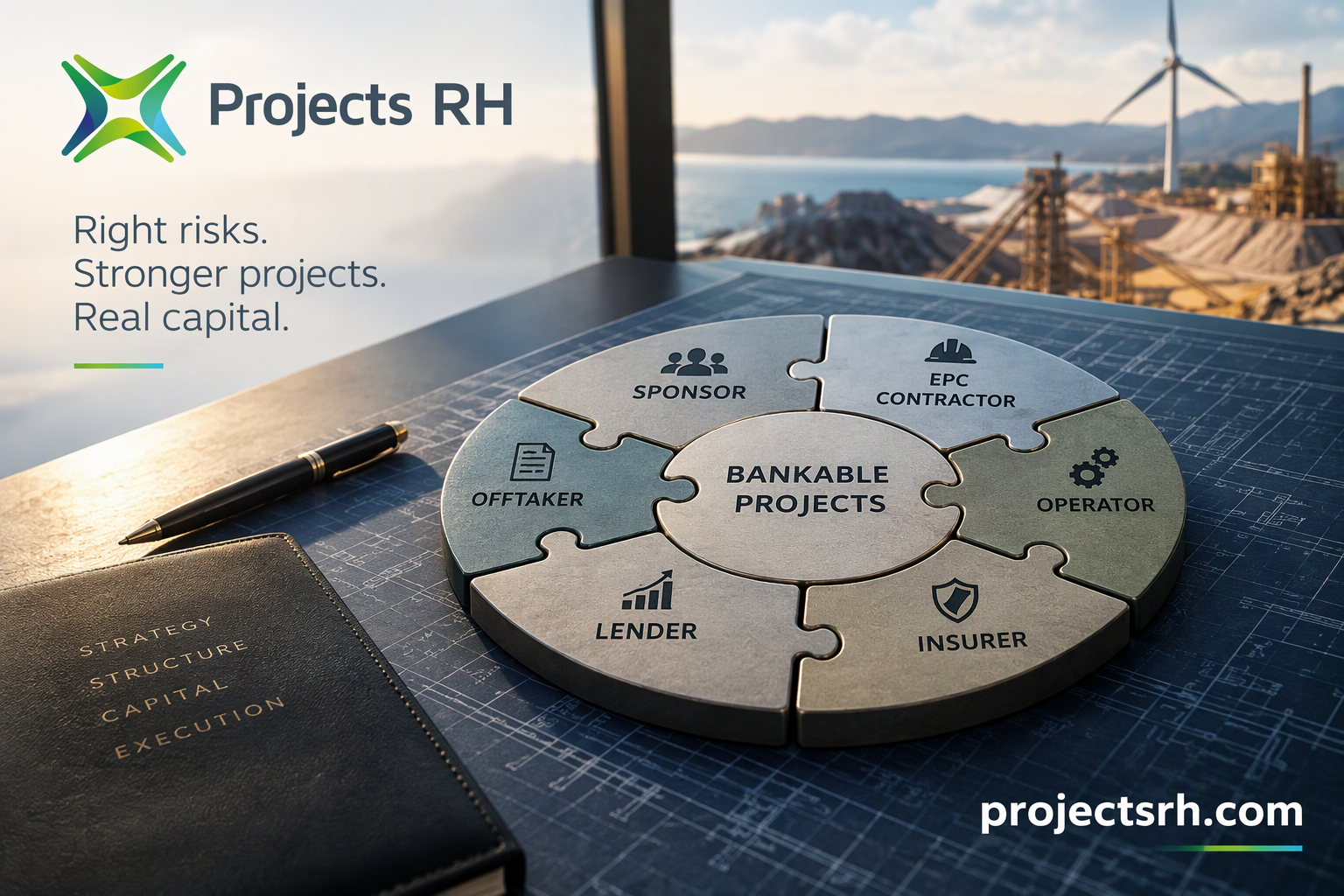
Project Finance Risk Allocation: Who Carries the Risk?
Who carries construction, market and operating risk? Learn how Project Finance Risk Allocation shapes contracts, bankability and lender confidence.
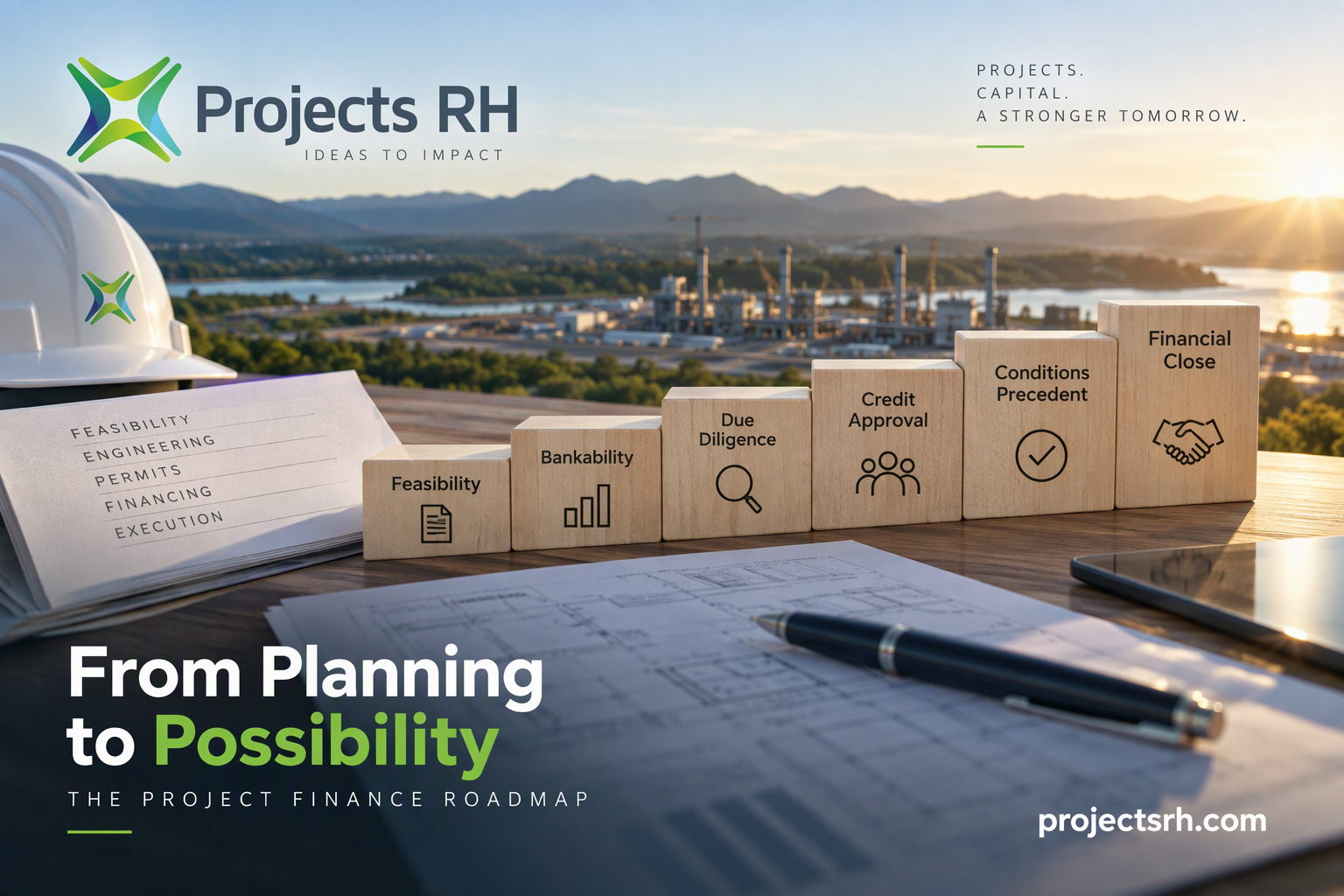
Conditions Precedent in Project Finance: Before Drawdown
What must happen before lenders release funds? Learn how Conditions Precedent in Project Finance affect financial close, drawdown and execution.
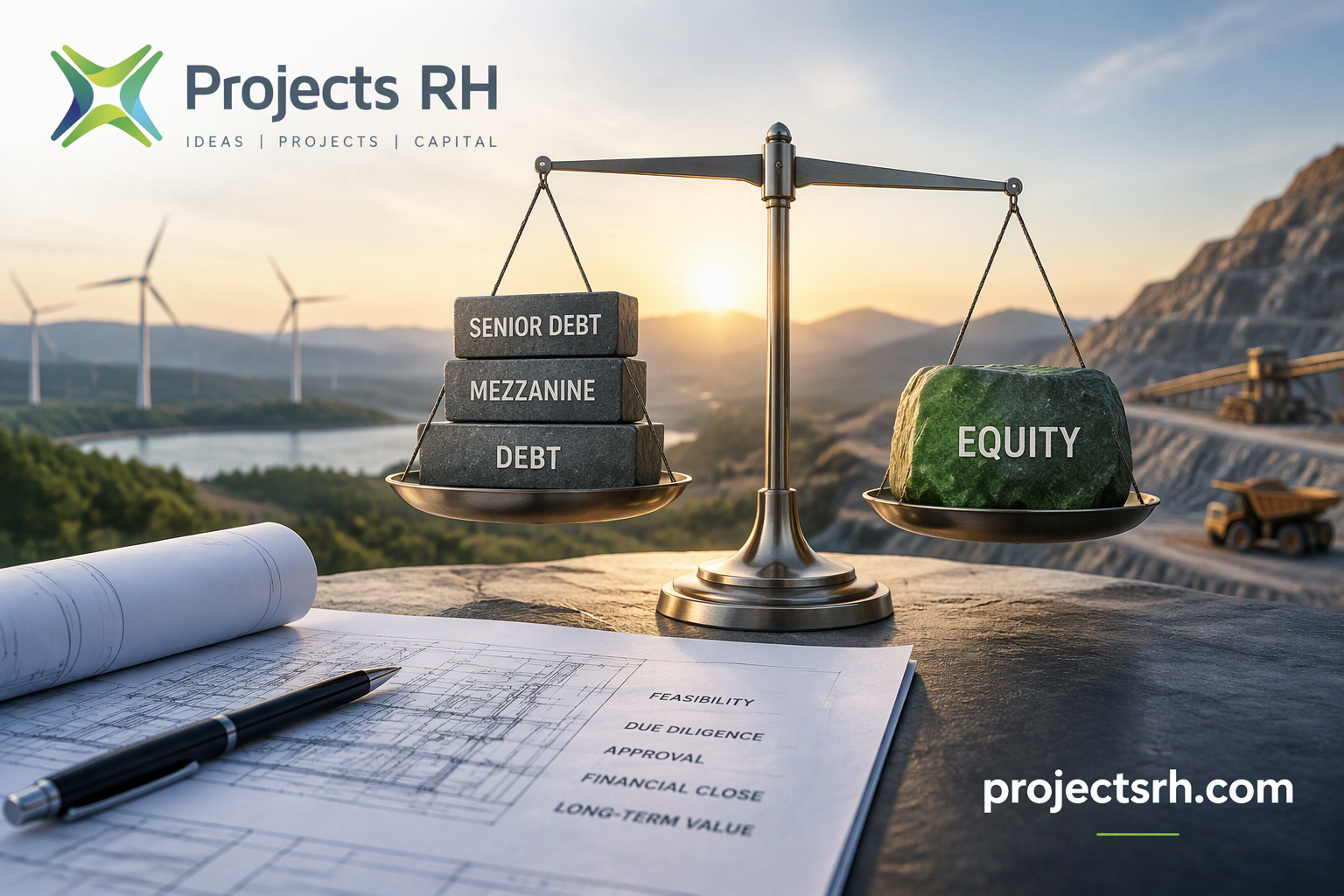
Project Finance Roadmap: Feasibility to Financial Close
Follow the Project Finance Roadmap from feasibility and bankability through due diligence, credit approval, conditions precedent and financial close.