
Investor Readiness: What to Prepare Before Raising Capital
Before you approach investors or lenders: what they examine, which documents must agree, how debt and equity differ, and what to resolve first.

Investor readiness is where a credible capital-raising process begins. Most projects do not need investor introductions first. They need to establish the facts, test the financial model, organise the evidence, define the capital requirement and prepare documentation that professional investors and lenders can test. This guide sets out what that means in practice and what to resolve before you approach the market.
Why investor readiness comes before capital raising
Many project owners start with one question: where can I find investors? A more useful question is: what will an investor find when they examine my project?
Professional investors and lenders do not decide on ambition, technology or projected returns alone. They want to know whether the investment case can be understood and tested. That usually means clarity on:
- who owns the project, and who has authority to approve a transaction
- the stage the project or business has reached
- how much capital is required, and what it will fund
- the revenue and cost assumptions, and the evidence behind them
- the material risks, and how they are managed
- the management team, its governance and its plan for execution
Investor readiness does not guarantee capital. Its purpose is to give the right capital providers a credible basis on which to decide whether further evaluation is warranted.
Projects RH works on the same principle: preparation comes before capital. The firm establishes the facts, builds or tests the model and prepares institutional documentation. Capital raising follows only under a separate mandate, and nothing in it is promised. You can see how Projects RH works: five steps, with a decision at the end of each.
Why capital raises stall before they start
The problems are usually practical. A project reaches investors with an unclear funding requirement, a model that does not hold together, inconsistent materials, or a proposition aimed at the wrong type of capital. Common causes include:
- approaching the market before the project is prepared
- no clear ask, with the amount, currency, timing or use of funds left vague
- assumptions that cannot be traced to evidence
- hard-coded or internally inconsistent financial models
- different figures in the model, the memorandum and the deck
- missing permits, technical reports, contracts or corporate records
- a debt opportunity presented to equity investors, or the reverse
- owners who have not agreed what kind of capital, and what loss of control, they would accept
Each of these is easier to resolve before outreach begins than after an investor has found it.
The capital raising documents, and why they must agree
There is no universal rule for every transaction. Investors, sectors, jurisdictions and financing structures all differ. Even so, preparation at Projects RH produces five documents that agree with each other, each reviewed by a professional:
- Financial model: the single point of truth for every figure the other documents use.
- Information memorandum: the written investment case, covering the business, the plan, the structure and the risks.
- Investor deck: the short form of the same case, for the first meeting.
- Teaser: the summary that goes out before identity does.
- Data room: contracts, permits, financials and diligence materials, organised before the first investor asks.
A financial model for capital raising is not judged on how sophisticated the spreadsheet looks. What matters is whether an independent reader can see where each assumption comes from, test it through sensitivities, and reconcile it with everything else in the pack.
The information memorandum should help an investor evaluate the opportunity. It is not a longer marketing brochure.
Consistency is where many investment cases weaken. Imagine a memorandum stating one funding requirement while the model shows a larger gap. Or imagine a deck showing a 24-month construction period while the model starts revenue at month 15. Each discrepancy may have an explanation, but the investor should not be the one to find it. The aim is one project, one set of assumptions and one consistent story.
Matching the project to the right type of capital
Capital is not interchangeable. Debt, equity and strategic investors look at the same project through different lenses.
Lenders tend to focus on cash-flow visibility, debt service capacity, security and covenants, construction and completion risk, and the sources of repayment. In project finance, repayment depends on the project's own cash flows, so these questions carry particular weight.
Equity investors tend to look at value creation, growth, ownership and governance rights, dilution, management capability and the route to exit.
Strategic investors may weigh financial return alongside supply security, offtake, access to technology or markets, and operational fit.
So the question is not 'who has money?' It is 'what type of capital fits this project, at this stage, with this risk profile?' Answering it early shapes the model, the structure and the documents.
An investor readiness checklist
Before approaching professional capital, you should be able to answer these questions plainly.
Ownership and governance. Is ownership documented, with a current cap table and known beneficial owners? Who can approve a transaction?
Project definition. What exactly is being financed? What stage has been reached, and which milestones remain?
Capital requirement. How much is needed, in which currency, by when and for what? Is further financing expected later?
Financial foundation. Is the model driver-based, traceable and tested with sensitivities? Does it identify funding gaps, and does it agree with the documents?
Evidence. What supports demand and pricing? Are permits, technical studies, contracts, letters of intent or offtake agreements current and available? Which assumptions are still management estimates?
Risk. Are the material risks set out honestly, with their mitigants? Professional investors expect risk. Leaving out a credible risk discussion does not make a project safer, and it makes the material less credible.
Documentation. Are there a teaser, a memorandum and a deck that agree with the model? Is the data room organised?
Transaction preparation. Has the right type of capital been identified? Has a structure been considered, and has confidentiality been planned for?
Gaps are normal. What matters is knowing where they are and closing the material ones before investors see them.
What you can do next with Projects RH
You may be unsure how your project would read to an institutional investor. You do not need to prepare anything new to find out.
- Book a complimentary 20-minute discovery call. There is nothing to prepare.
- Send what already exists. You can email your documents, upload them or connect your document system through the intake page. A person at the firm reads what you send and replies in writing within 3 business days. No confidentiality agreement is in place at that point, so if your documents are confidential, ask for the firm's agreement first.
- Move to an Investment Readiness Assessment. This is AI-assisted research on the project and its sponsor, reviewed and approved by a professional before release. It sets out a preliminary readiness profile in words, a gap analysis and a recommended package of preparation.
Sending documents does not create an advisory, investment, mandate or funding relationship. If capital raising follows preparation, it is undertaken only under a separately accepted mandate, which can be declined. Investor interest, terms, funding and completion are not guaranteed.

What to do next
Projects RH prepares the company and the project first, then takes them to investors. The fastest way to find out where you stand is a short call.
Keep reading
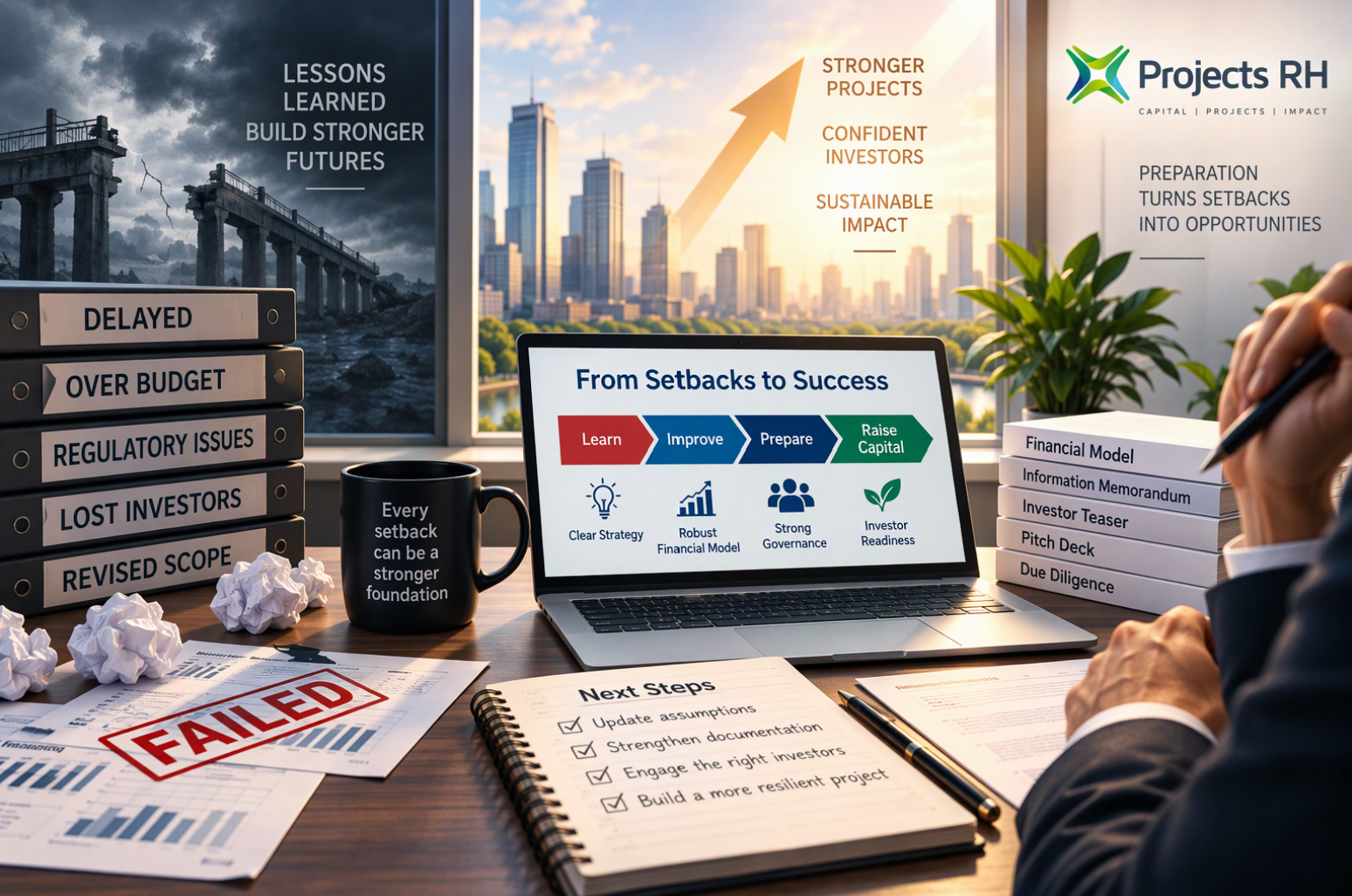
Lessons Learned from Failed Projects: Before You Raise Again
A setback need not end a project. What investors ask after one, and how to carry its lessons into a tested model and documents that agree before approaching capital again.
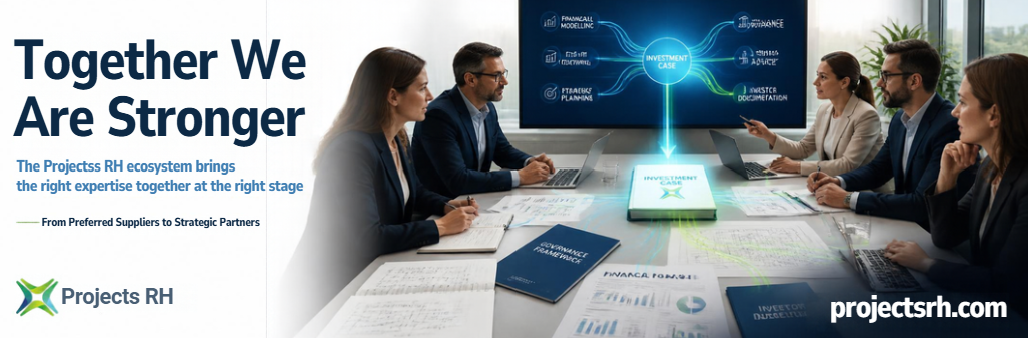
Capital Raising Partners: Why One Coordinated Case Matters
Capital raising draws on many disciplines. How Projects RH works with strategic partners on one coordinated investment case, and the two rules every referral follows.
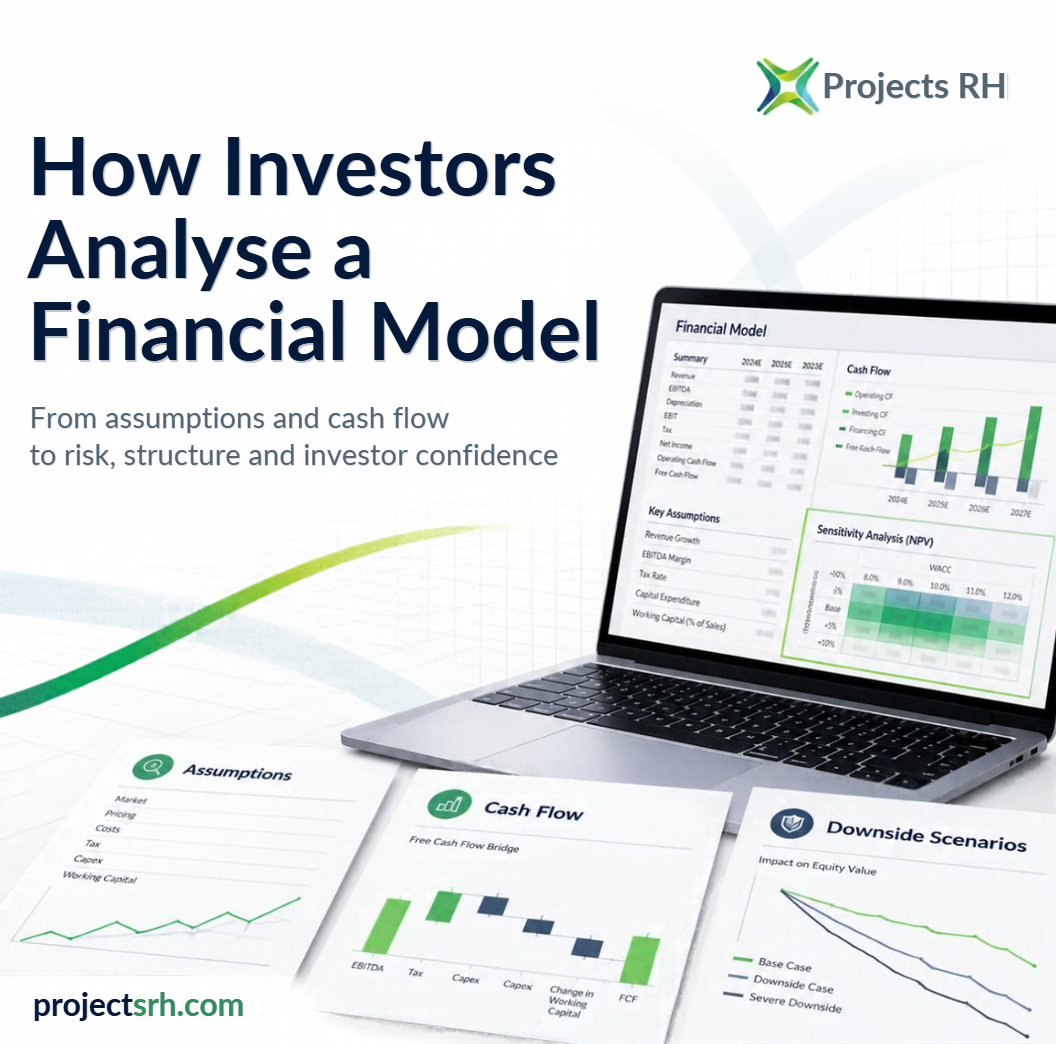
How Investors Analyse a Financial Model, and What They Test
Investors test assumptions, cash flow, mechanics and capital structure before returns. What they look for in a financial model, and what an investor-ready model must show.