
Lessons Learned from Failed Projects: Before You Raise Again
A setback need not end a project. What investors ask after one, and how to carry its lessons into a tested model and documents that agree before approaching capital again.
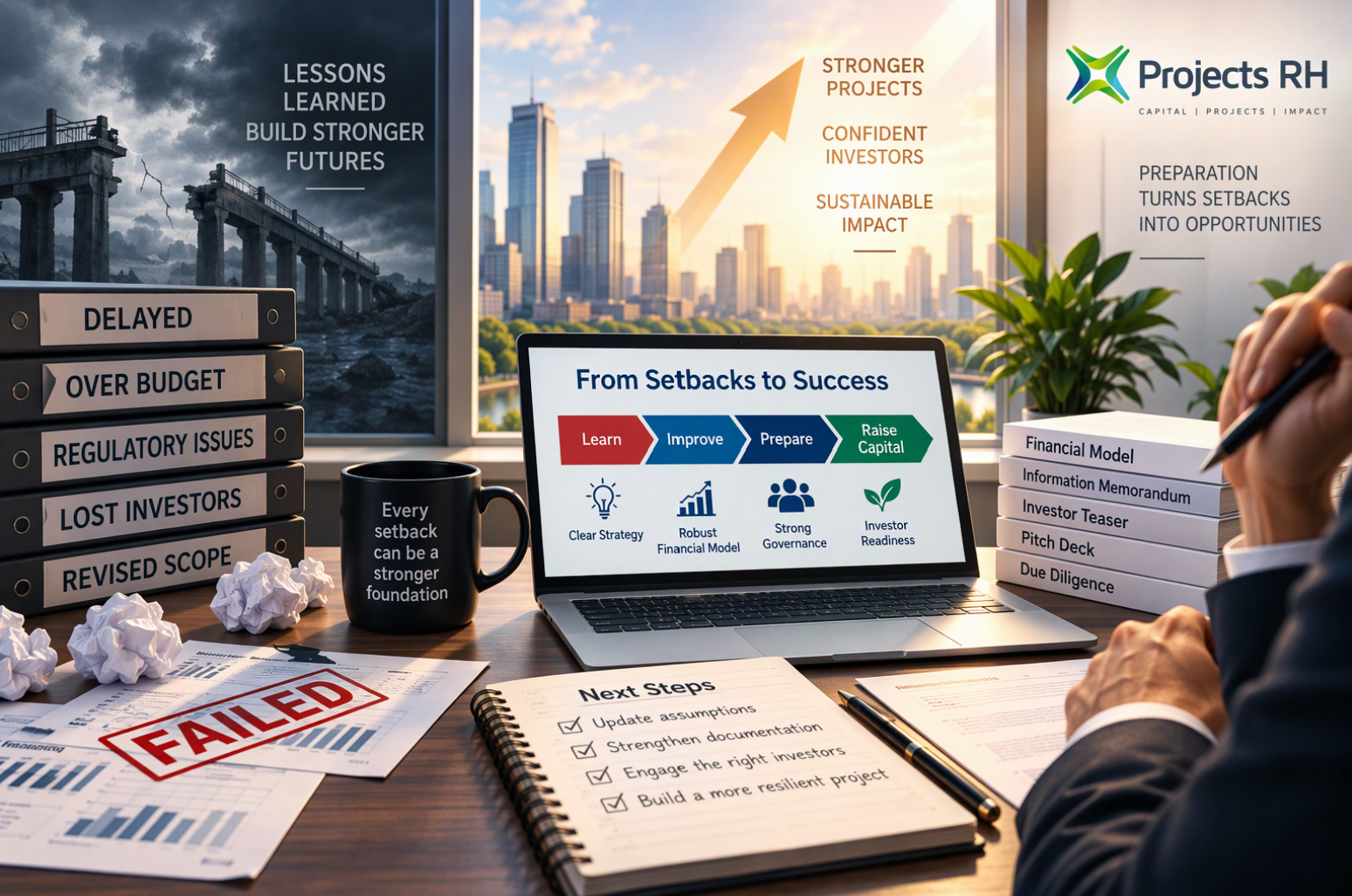
Lessons Learned from Failed Projects can strengthen a company or project that is preparing to approach professional investors.
A missed milestone, a cost overrun or an unsuccessful raise does not, on its own, mean an opportunity has no future.
What matters is whether management understands what happened, can support its conclusions with evidence, and has carried those conclusions into the strategy, the governance, the financial model and the execution plan.
Investors do not finance lessons learned by themselves. They look at whether those lessons have produced a stronger, more credible investment proposition.
Lessons Learned from Failed Projects: What Investors Need to See
Projects stumble for many reasons. A project may miss a development milestone, exceed its capital budget, lose a key customer or offtaker, face permitting delays, or reach investors before its documentation is ready. None of these automatically makes a project uninvestable. How management responds is what counts.
Expect professional investors to ask:
- What happened, and why?
- What was the financial impact?
- Which assumptions proved wrong?
- What corrective action has been taken, and what evidence supports the revised plan?
- What risks remain, and could the same problem recur?
- What does the downside case now show?
The strongest answer does not minimise a material setback. It shows that the setback has been understood, documented and built into a more credible investment case. Technological change, regulatory uncertainty and wider stakeholder networks make complexity a fact of life for capital-intensive projects.
Investors are less interested in whether you faced it than in how you responded.
Where Projects Go Wrong Before They Reach Investors
There is rarely one explanation for an underperforming project, but three issues recur.
Unstable scope. When scope, priorities or commercial objectives keep changing, the capital requirement, schedule, model, transaction structure and investor documents all need to change too.
A project cannot present a stable investment case while the underlying proposition is still moving. Old assumptions should not stay in the model simply because they produce more attractive returns.
Unsupported assumptions. A financial model can show attractive returns and still be weak. Common problems include revenue growth or pricing without evidence, missing working capital, thin contingency, unrealistic construction schedules, missing financing costs and no downside sensitivities.
Projected IRR, NPV or valuation should follow from credible assumptions, not be the starting point used to reverse-engineer a desired outcome.
Weak governance. Some setbacks start in governance rather than technology or markets. Investors become cautious when decision-making authority is unclear, shareholders disagree on strategy, major decisions go undocumented, conflicts of interest are unresolved, or too much rests on one individual.
Before outside capital enters, a project needs clarity on who owns what, who can approve a transaction, who controls expenditure, how investors will receive information, and what happens when a milestone is missed.
Risk itself is not the problem. Professional investors expect construction, market, permitting, counterparty, currency and execution risk, among others. The aim is not to present a project as risk-free; it is to show that management understands the risks it is asking investors to take. Past setbacks help here, because you now have evidence of how certain risks behaved in practice.
Turning Experience into a Stronger Financial Model
One benefit of a setback is better information. Actual experience can replace assumptions. A revised financial model for capital raising may draw on:
- actual construction or development costs
- updated supplier quotations
- real customer conversion rates and production performance
- verified operating expenditure and working-capital needs
- more realistic permitting timelines and financing costs
That evidence can make the revised case more credible than the original. The model should reflect the project that exists today, not the one management first expected to have.
The model should also test what happens when reality departs from the base case. What if revenue starts six months later? What if capital expenditure rises, prices fall, or output stays below design capacity?
What if a material incentive disappears or more capital is needed? Sensitivity analysis does not predict the future. It shows how the economics respond when important assumptions change, which is exactly what an investor who knows about a past setback will want to understand.
What a Failed Capital Raise Can Teach
An unsuccessful raise does not necessarily mean the underlying project failed. Often the process itself was poorly prepared, in one of three ways.
The project went out too early. It may have approached investors before the model, information memorandum, deck, teaser, technical studies, commercial validation or data room were complete. In that position, more introductions rarely fix the weakness. Better preparation may.
The wrong capital was approached. Capital is not interchangeable. Project finance lenders, private equity, family offices and strategic investors can look at the same opportunity very differently.
A strategic investor may weigh offtake, supply security or market access; a financial investor may focus on returns, governance, capital structure, downside protection and exit. The lesson may be that the project was presented to investors whose mandates did not fit it.
The capital requirement was unclear. Capital providers need to know how much is required, in which currency, when, what it will fund, which milestones it should reach, and whether further financing will follow.
An unclear requirement weakens the case before anyone reaches the economics.
Investor Readiness After a Setback
A project returning to the market should not simply refresh its pitch deck. It should reassess the whole investment case. In practice, capital raising preparation after a setback means:
- Establishing the facts. Separate verified facts and contracted positions from management estimates, forecasts, assumptions and potential upside.
- Rebuilding or testing the model. Let historical experience shape future assumptions where it is relevant.
- Reassessing the full capital requirement. Delays and cost increases may mean the original amount is no longer enough. The model should show the complete requirement, not the amount management would prefer to raise.
- Revisiting the capital raising strategy. Equity, debt, project finance, strategic investment, a joint venture or offtake-linked financing may fit differently now, depending on the project's economics, jurisdiction, stage, risk profile and available security.
- Updating every document. The model, information memorandum, deck, teaser and data room should all reflect one current case.
That last point matters more than it seems. Investors should not find obsolete figures in one document that contradict another. Projects RH treats the financial model as the single point of truth for every figure the other documents use, so that the five documents agree with each other.
What You Can Do Next with Projects RH
Projects RH works on a simple principle: preparation comes before capital. The firm establishes the facts, builds or tests the model and prepares institutional documentation. Capital raising is a separate mandate, never guaranteed.
If your project has had a setback and you want to find out what an institutional reader would mark, there are three practical steps:
- Book a 20-minute discovery call. There is nothing to prepare.
- Send what already exists. Use the document intake page to upload, email or connect your files. A person at the firm reads what you send and replies in writing within 3 business days. No confidentiality agreement is in place at that point, so if your documents are confidential, ask for the firm's agreement first.
- Consider an Investment Readiness Assessment. It provides a written readiness profile, a gap analysis and a recommended package, reviewed and approved by a professional before release.
You can see each stage, and the decision at the end of each one, on the page explaining how we work.
Sending documents does not create an advisory, investment, mandate or funding relationship, and nothing in a later capital raising process is promised.

What to do next
Projects RH prepares the company and the project first, then takes them to investors. The fastest way to find out where you stand is a short call.
Keep reading

Investor Readiness: What to Prepare Before Raising Capital
Before you approach investors or lenders: what they examine, which documents must agree, how debt and equity differ, and what to resolve first.

Capital Raising Partners: Why One Coordinated Case Matters
Capital raising draws on many disciplines. How Projects RH works with strategic partners on one coordinated investment case, and the two rules every referral follows.
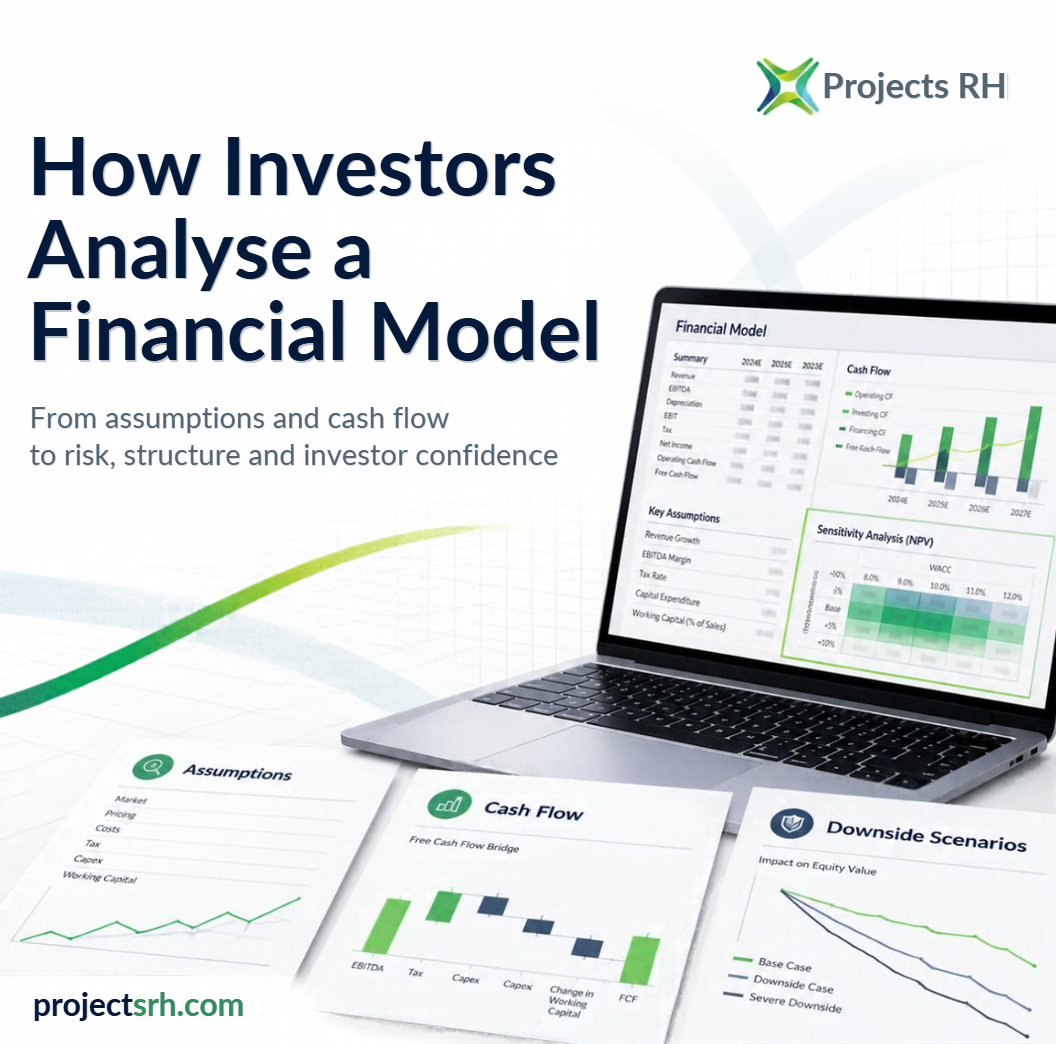
How Investors Analyse a Financial Model, and What They Test
Investors test assumptions, cash flow, mechanics and capital structure before returns. What they look for in a financial model, and what an investor-ready model must show.