
Project Finance Risk Allocation: Who Carries the Risk?
Who carries construction, market and operating risk? Learn how Project Finance Risk Allocation shapes contracts, bankability and lender confidence.
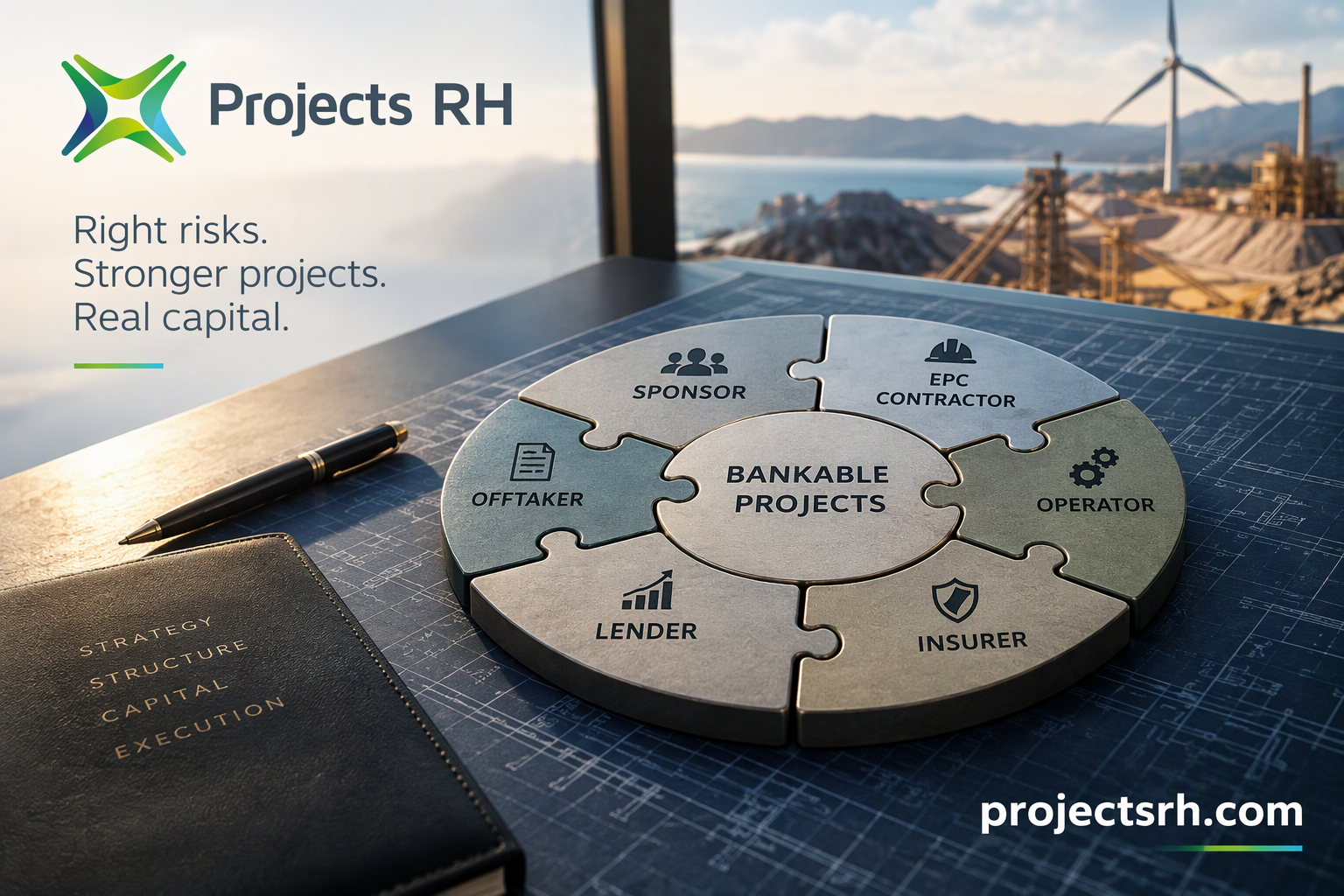
Project Finance Risk Allocation is not about eliminating risk. It is about identifying each material risk, understanding who can control it and allocating its consequences to the party best positioned to manage it.
That distinction sits at the heart of project finance.
A lender does not finance an infrastructure, mining, energy or data centre project because the project is risk-free.
No serious project is.
Capital becomes possible when risks can be identified, quantified where possible, allocated contractually and supported by credible mitigation.
Throughout my career in finance, resources, energy and project development, I have seen sponsors focus heavily on projected returns while underestimating one of the questions lenders will ultimately ask:
Who carries the risk when something does not go according to plan?
Who pays if construction runs over budget?
Who absorbs the financial consequences of a six-month delay?
What happens if an asset does not achieve its guaranteed performance?
Who carries demand or commodity-price exposure?
What happens when operating costs rise?
Who bears the loss after an insured event?
Which risks remain with the project company?
And which risks ultimately come back to equity?
These questions are fundamental to Project Finance Risk Allocation.
What Is Project Finance Risk Allocation?
Project Finance Risk Allocation is the process of identifying material project risks and assigning each risk contractually to the party best able to control, manage, mitigate or absorb its financial consequences.
The World Bank's guidance on risk allocation expresses the underlying principle clearly: project risks should generally be allocated to the party best placed to manage them cost-effectively.
That party is not always the private sector.
And it is not necessarily the party most willing to accept the risk during negotiations.
| Risk | Primary party | Main mitigation | |---|---|---| | Construction cost | EPC contractor / project company | Fixed-price EPC and contingency | | Completion delay | EPC contractor | Date-certain contract and delay LDs | | Performance | EPC contractor / operator | Performance guarantees and testing | | Demand | Project company / offtaker | Long-term offtake and minimum volumes | | Operating cost | Operator / project company | O&M contract and indexed pricing | | Input supply | Supplier / project company | Long-term supply agreement | | Insurable events | Insurer / project company | Insurance programme | | Interest rate | Project company / hedge provider | Interest-rate hedge | | Currency | Project company / hedge provider | Hedging and matched currency | | Political risk | Government / project company / insurer | Contract protections and political-risk insurance | | Residual project risk | Sponsors / project company | Equity, reserves and contingency |
The objective is not to transfer every possible risk away from the sponsor.
The objective is to create an allocation that remains commercially realistic, contractually enforceable and financeable.
Why Risk Allocation Determines Bankability
Project finance lenders generally rely primarily on the project's expected cash flows and contractual framework for repayment.
That makes risk allocation particularly important.
If a material project risk is poorly allocated, its consequences can ultimately affect:
Revenue → Cash Flow → Debt Service → DSCR → Distributions → Investor Returns
A construction delay may postpone revenue.
A cost overrun may require additional equity.
Operational underperformance may reduce output.
Commodity-price movements may weaken project revenue.
Counterparty default may interrupt cash collection.
An uninsured event may require substantial unplanned expenditure.
The financial model may show the consequence.
The contracts determine who pays for it.
This is why bankability cannot be understood from a financial model alone.
The Core Principle: Allocate Risk to the Party Best Able to Manage It
The World Bank identifies the core principle of project risk allocation as assigning risks to the party best able to manage them cost-effectively.
This sounds straightforward.
In practice, it requires judgment.
A contractor may be well positioned to manage construction scheduling, productivity and procurement.
That does not necessarily mean the contractor can efficiently absorb every geological, political or regulatory event.
An operator may be positioned to manage day-to-day operating performance.
The operator may not be able to control commodity prices.
An offtaker may accept volume or price commitments.
But the value of that risk transfer depends on the offtaker's creditworthiness.
An insurer may absorb defined accidental losses.
Insurance will rarely cover every commercial or operating risk.
Risk transfer is valuable only when the counterparty receiving the risk has both the ability and financial capacity to perform when the risk materialises.
Who Carries Risk in a Typical Project Finance Structure?
A project finance transaction creates a network of contractual relationships.
Material risks can potentially sit with:
- the project company;
- project sponsors;
- EPC contractor;
- equipment suppliers;
- operator;
- offtaker or customer;
- feedstock supplier;
- government or contracting authority;
- insurer;
- hedge provider;
- lenders; or
- equity investors.
The allocation is project-specific.
But understanding the role of each participant provides a useful starting point.
The Project Company: The Centre of the Risk Structure
The Special Purpose Vehicle, or project company, normally sits at the centre of the transaction.
The project company enters into the principal:
- construction agreements;
- financing documents;
- operating agreements;
- offtake contracts;
- supply agreements;
- insurance arrangements;
- permits;
- land agreements; and
- other material project contracts.
Risks originate at the project company level and are then transferred, mitigated or retained through these contracts.
Not every risk can be transferred completely.
The residual risks often remain with the project company and therefore ultimately affect equity and lenders.
That is why a project finance structure should be evaluated as an interconnected contractual system rather than as individual agreements in isolation.
Construction Risk: Who Carries Cost and Completion Risk?
Construction risk is one of the most important categories in project finance.
The World Bank's risk-allocation guidance highlights construction cost, delay and performance as fundamental risks affecting project viability.
Typical construction risks include:
- cost overruns;
- schedule delays;
- design errors;
- procurement failures;
- contractor insolvency;
- equipment delays;
- labour shortages;
- interface problems;
- commissioning failure; and
- failure to achieve performance guarantees.
In a conventional structure, much of the controllable construction risk may be allocated to an EPC contractor.
How an EPC Contract Transfers Construction Risk
A lender will typically examine whether the Engineering, Procurement and Construction arrangement provides sufficient certainty over:
- scope;
- contract price;
- completion date;
- performance;
- change orders;
- warranties;
- liquidated damages;
- liability caps;
- security;
- guarantees; and
- termination rights.
A fixed-price, date-certain structure can transfer meaningful cost and schedule risk to the EPC contractor.
But the term “fixed price” does not mean every possible cost is transferred.
The contract will contain:
- exclusions;
- relief events;
- force majeure provisions;
- change mechanisms;
- owner-caused delay provisions;
- liability limitations; and
- other qualifications.
The risk allocation is therefore determined by the entire contract, not its label.
Why Liquidated Damages Matter
Delay liquidated damages, or LDs, can compensate the project company when contractor-caused delay postpones completion.
Performance LDs can address failure to achieve specified output or efficiency requirements.
Historical World Bank project-finance guidance illustrates how contractor liability under LD arrangements may be capped, meaning risk transfer is rarely unlimited.
Consider a simplified example.
A project loses $500,000 of expected cash flow for every week completion is delayed.
The EPC contractor may owe delay LDs.
But if aggregate contractor liability is capped, losses above that limit may return to the project company.
That creates residual construction risk.
Risk is not fully transferred merely because the contract contains a liquidated damages clause. The relevant question is whether the remedy is sufficient relative to the financial exposure.
Completion Risk
Lenders need a clear definition of when construction is genuinely complete.
Mechanical completion alone may not be sufficient.
The asset may need to pass:
- output tests;
- reliability tests;
- capacity tests;
- efficiency tests;
- environmental tests; or
- other technical acceptance requirements.
The World Bank notes that lenders want completion criteria linked to objective technical tests and performance capacity.
This prevents an unfinished or underperforming facility from being treated as though construction risk has ended.
Completion is therefore both an engineering milestone and a financing milestone.
Sponsor Risk: When Does Risk Return to Equity?
Sponsors often assume that an EPC contract transfers construction risk entirely to the contractor.
It may not.
Sponsors may remain exposed where:
- EPC liability caps are exhausted;
- contingency is insufficient;
- excluded events occur;
- the contractor becomes insolvent;
- permits are delayed;
- owner-supplied items fail;
- force majeure occurs;
- scope changes are required; or
- the contractor's guarantees do not cover the total economic loss.
Lenders may therefore require:
- minimum sponsor equity;
- contingency;
- cost-overrun support;
- completion guarantees;
- standby equity;
- subordinated funding; or
- other sponsor-support arrangements.
The more residual risk remains with the project, the more important the project's equity cushion can become.
Market Risk: Who Carries Revenue Uncertainty?
Market risk asks whether the project can sell its output at sufficient volume and price to support operating costs, debt service and investor returns.
Depending on the sector, this can include:
- commodity prices;
- electricity prices;
- traffic volumes;
- passenger demand;
- data-centre utilisation;
- capacity pricing;
- tariffs;
- product demand; or
- customer concentration.
Market risk can be among the most difficult risks to transfer completely.
Offtake Agreements and Revenue Risk
An offtake agreement can shift part of the project's revenue risk to a customer or buyer.
Examples include:
- power purchase agreements;
- take-or-pay contracts;
- capacity payments;
- mining offtake contracts;
- tolling agreements;
- long-term customer agreements; and
- availability-based structures.
A strong offtake contract can improve cash-flow predictability.
But contractual revenue is only as strong as the counterparty standing behind it.
Lenders therefore examine:
- offtaker creditworthiness;
- contract tenor;
- pricing;
- minimum volumes;
- termination rights;
- payment security;
- indexation;
- force majeure;
- change in law;
- currency;
- assignment rights; and
- lender step-in provisions.
An offtake agreement does not eliminate market risk if the offtaker cannot or will not perform. It converts part of the market risk into counterparty credit risk.
That distinction is fundamental.
Merchant Risk
Some projects operate partly or fully without long-term contracted revenues.
In these structures, the project company may retain substantial merchant risk.
Examples can include:
- merchant power;
- commodity exposure;
- uncontracted data-centre capacity;
- toll-road traffic risk;
- spot-market mineral sales; or
- market-based storage revenues.
Merchant exposure can increase:
- cash-flow volatility;
- downside sensitivity;
- equity requirements;
- lender conservatism; and
- return expectations.
The appropriate amount of merchant risk depends heavily on the sector and lender appetite.
Operating Risk: Who Keeps the Asset Performing?
Construction is temporary.
Operations can continue for decades.
Operating risk therefore deserves equal attention.
The World Bank notes that financial viability assumptions depend heavily on projected operating costs and that increases in key inputs can affect project revenue and debt-service capacity.
Operating risks can include:
- lower availability;
- higher maintenance costs;
- equipment failure;
- inefficient operations;
- staffing problems;
- lower production;
- higher energy costs;
- feedstock shortages;
- unexpected replacement CapEx; and
- environmental non-compliance.
The Role of the Operator
An O&M contractor may accept responsibility for specified operational performance.
A strong O&M agreement can include:
- performance standards;
- availability guarantees;
- cost responsibilities;
- reporting obligations;
- preventive maintenance;
- lifecycle maintenance;
- penalties;
- termination rights; and
- handback standards where relevant.
But operating risk is rarely transferred entirely.
If an operator's liability is capped at $10 million while a prolonged outage costs the project $30 million, the project company still carries substantial residual exposure.
Again, the important question is not:
“Has the risk been transferred?”
It is:
“How much of the economic consequence has actually been transferred?”
Feedstock and Supply Risk
Some projects depend heavily on reliable inputs.
Examples include:
- gas for power generation;
- biomass;
- ore;
- chemicals;
- water;
- electricity;
- replacement batteries;
- semiconductor equipment; or
- critical spare parts.
A supply agreement may transfer part of:
- availability risk;
- pricing risk;
- quality risk; or
- delivery risk.
Long-term supply arrangements can therefore be as important to bankability as customer contracts.
For a lender, a project with secure revenue but uncertain essential inputs can remain unfinanceable.
Insurance: Which Risks Can Be Transferred?
Insurance plays an important role in project-finance risk allocation, but insurance is not a substitute for good project structuring.
FMO describes insurance as an integral component of project finance and separates the insurance programme into construction and operational phases. Construction cover can include Construction All Risks, delay in start-up, marine risks and third-party liability, while operational programmes can include property and machinery risks.
Potential coverage can include:
- construction damage;
- machinery breakdown;
- property damage;
- business interruption;
- marine transit;
- third-party liability;
- political violence; and
- other defined events.
However, insurance policies contain:
- exclusions;
- deductibles;
- limits;
- waiting periods;
- conditions;
- sublimits; and
- coverage periods.
Insurance therefore transfers defined insurable risks, not all commercial risk.
Lenders will care about both coverage and claims reliability.
Lender Risk: What Do Banks Actually Retain?
Project finance lenders cannot contract away every risk.
Lenders ultimately retain the risk that project cash flows may become insufficient to service debt and that contractual remedies or security may not fully recover the outstanding exposure.
Lenders manage this through:
- due diligence;
- conservative assumptions;
- debt sizing;
- DSCR requirements;
- reserve accounts;
- security;
- covenants;
- conditions precedent;
- step-in rights;
- completion support;
- direct agreements;
- insurance;
- hedging; and
- sponsor requirements.
The lender's job is therefore not to eliminate every project risk.
It is to decide whether the remaining risk is acceptable for the proposed debt amount, pricing and structure.
What Does a Risk Allocation Matrix Do?
A Project Finance Risk Allocation Matrix maps each material risk against:
- the party controlling the risk;
- the party contractually bearing it;
- the mitigation;
- the financial consequence;
- relevant contractual provisions; and
- the residual risk remaining with the project.
The Global Infrastructure Hub risk-allocation framework contains matrices across 18 project types and 16 key risk categories, including energy, transport, water, social infrastructure, telecommunications and industrial projects.
A simplified matrix might look conceptually like this:
| Risk | Primary party | Main mitigation | |---|---|---| | Construction cost | EPC contractor / project company | Fixed-price EPC, contingency | | Completion delay | EPC contractor | Date-certain contract, delay LDs | | Performance | EPC contractor / operator | Performance guarantees, testing | | Demand | Project company / offtaker | Long-term offtake, minimum volumes | | Operating cost | Operator / project company | O&M contract, indexed pricing | | Input supply | Supplier / project company | Long-term supply agreement | | Insurable events | Insurer / project company | Insurance programme | | Interest rate | Project company / hedge provider | Interest-rate hedge | | Currency | Project company / hedge provider / counterparties | Hedging, matched currency | | Political risk | Government / project company / insurer | Contract protections, PRI | | Residual project risk | Sponsors / project company | Equity, reserves, contingency |
This matrix is not universal.
Every project needs its own allocation.
Political and Regulatory Risk
Some risks are difficult for ordinary commercial counterparties to control.
These may include:
- expropriation;
- political violence;
- currency convertibility;
- discriminatory regulation;
- adverse government action;
- permit withdrawal;
- change in law; or
- restrictions on transfer of funds.
Project structures can mitigate these risks through:
- concession agreements;
- government support agreements;
- political-risk insurance;
- guarantees;
- stabilization arrangements;
- termination compensation;
- international arbitration; or
- multilateral participation.
The allocation depends heavily on jurisdiction.
A developed-market solar project and a cross-border mining project in an emerging jurisdiction should not be expected to have identical risk structures.
Government and Public-Sector Risk
In PPP structures, government itself may accept specific risks.
Examples can include:
- land acquisition;
- permits within government control;
- discriminatory changes in law;
- availability payments;
- minimum revenue arrangements;
- specified political risks; or
- termination compensation.
The Global Infrastructure Hub notes that proper risk allocation is central to achieving financial viability and value for money in PPP transactions.
Transferring every possible risk to the private sector can be counterproductive.
The private party will either:
- price the risk;
- insure it where possible;
- demand additional return;
- seek contractual protection; or
- decline to participate.
Risk does not disappear because it has been placed in a contract. Someone ultimately prices it.
Environmental and Social Risk
Environmental and social risk has become an explicit part of international project-finance risk management.
The Equator Principles provide a global framework for identifying, assessing and managing environmental and social risks in project-related financing. They apply globally across industry sectors to qualifying Project Finance Advisory, Project Finance and other specified products; for Project Finance, the current scope includes projects with total capital costs of US$10 million or more.
Relevant risks can include:
- biodiversity;
- environmental impact;
- pollution;
- workers;
- community safety;
- land acquisition;
- resettlement;
- Indigenous Peoples;
- climate; and
- stakeholder engagement.
These risks cannot always be transferred through ordinary commercial contracts.
They require active project-level management.
Financial Risks and Hedging
Project finance can also involve:
- interest-rate risk;
- foreign-exchange risk;
- inflation;
- refinancing risk; and
- commodity-price exposure.
Hedging may transfer defined financial risk to a hedge provider.
But hedging itself introduces:
- counterparty exposure;
- collateral obligations;
- termination costs;
- tenor mismatches; and
- basis risk.
A hedge should therefore be viewed as another contract in the broader risk-allocation architecture.
Guarantees and Credit Enhancement
Some risks can be mitigated through guarantees rather than transferred through operating contracts.
IFC, for example, offers partial and full credit guarantees that can absorb an agreed portion of lender credit exposure, potentially enabling lenders to provide more financing than they could otherwise support.
IFC also uses credit insurance and unfunded risk participation to distribute portions of credit risk to private insurers.
The broader lesson is useful:
Risk mitigation can change who ultimately absorbs a loss, and that may change how much capital becomes available and on what terms.
Risk Allocation in Mining Project Finance
Mining produces an unusually broad risk set.
It can include:
- geology;
- resource confidence;
- metallurgy;
- recovery;
- construction;
- processing;
- commodity prices;
- power;
- water;
- infrastructure;
- environmental approvals;
- social licence;
- jurisdiction;
- logistics;
- offtake; and
- closure obligations.
Some risks can be transferred.
Construction may be partly allocated to contractors.
Offtake can reduce market exposure.
Insurance may cover defined physical risks.
Hedging can manage part of commodity or currency exposure.
But geology and reserve uncertainty cannot simply be contractually transferred away.
This is why technical quality and conservative financial assumptions remain fundamental to mining finance.
Risk Allocation in Energy Project Finance
Energy projects often create a more contract-driven framework.
Risks may be distributed among:
- EPC contractor;
- equipment supplier;
- O&M contractor;
- fuel supplier;
- grid operator;
- utility or offtaker;
- insurer;
- government;
- sponsors; and
- lenders.
A renewable-energy project with a long-term PPA may transfer substantial price and volume risk to the offtaker.
But if the grid curtails generation without adequate compensation, revenue risk can reappear.
Similarly, equipment warranties may protect selected technical risks but not compensate every form of generation underperformance.
The contracts need to work together.
Risk Allocation in AI Data Centres
AI data centres present a rapidly evolving risk profile.
Material risks can include:
- grid connection;
- power availability;
- energy pricing;
- equipment delivery;
- cooling;
- customer concentration;
- utilisation;
- GPU obsolescence;
- water;
- construction;
- network connectivity;
- cybersecurity; and
- technology-refresh CapEx.
For AI infrastructure, the distinction between long-life and short-life assets is particularly important.
Land, substations and buildings may have long economic lives.
GPUs may face much faster technological replacement.
Financing both with identical capital tenor can create asset-liability mismatch.
The Equator Principles also issued dedicated guidance for data centre projects in June 2026, illustrating how the sector's environmental and social footprint is receiving more formal attention from project-finance institutions.
What Happens When Risk Is Allocated Badly?
Bad allocation usually appears in one of three ways.
Risk Goes to a Party That Cannot Control It
The counterparty prices a contingency into its contract or refuses the risk entirely.
Risk Goes to a Party That Cannot Financially Absorb It
The contract may appear strong, but the counterparty cannot perform when the loss occurs.
The Contract Does Not Match the Financial Model
Management assumes risk is transferred.
The financial model therefore ignores the downside.
But contractual exclusions or liability caps leave the project exposed.
This is where supposed risk transfer becomes dangerous.
A financial model should reflect the contractual allocation of risk, not management's preferred interpretation of it.
The Risk Allocation Gap
I use the term Risk Allocation Gap to describe the difference between the risk a project believes it has transferred and the financial exposure that actually remains after contractual limitations, counterparty capacity, insurance exclusions and other residual risks are taken into account.
This gap may arise because:
- an EPC liability cap is too low;
- an offtaker lacks sufficient credit quality;
- insurance excludes the relevant event;
- guarantees expire too early;
- O&M penalties do not cover lost revenue;
- force majeure returns risk to the project;
- hedge duration is shorter than debt tenor; or
- residual risk was simply not modelled.
The Risk Allocation Gap is where projects can discover that contractual protection and economic protection are not the same thing.
The Projects RH Risk Allocation Test
Before presenting a project to institutional capital, I would ask:
- Have all material risks been identified?
- Who can actually control each risk?
- Who contractually carries each risk?
- What mitigation exists?
- Is the mitigation enforceable?
- Does the receiving counterparty have sufficient financial capacity?
- Are liability limits adequate relative to the exposure?
- Is the risk insurable?
- What exclusions remain?
- Does the financial model reflect the contractual allocation?
- What residual risk remains with the project company?
- Can the project's equity and debt structure absorb that residual risk?
If those questions cannot be answered clearly, the project may not yet have a financeable risk structure.
Frequently Asked Questions About Project Finance Risk Allocation
What is Project Finance Risk Allocation?
Project Finance Risk Allocation is the process of identifying material project risks and contractually assigning each risk to the party best positioned to control, manage, mitigate or absorb its financial consequences.
What is the main principle of project finance risk allocation?
A material risk should generally be allocated to the party best able to manage it cost-effectively.
This does not automatically mean allocating every risk to the private party or contractor.
Who carries construction risk in project finance?
The EPC contractor may carry substantial controllable construction risk through fixed-price, date-certain and performance obligations.
However, the project company and sponsors may retain residual risks arising from exclusions, liability caps, force majeure, owner changes, contractor insolvency and other matters.
Who carries market risk?
Market risk depends on the revenue model.
An offtake contract may transfer specified price or volume risk to an offtaker. Merchant projects retain greater revenue exposure within the project company.
Who carries operating risk?
An O&M contractor may accept defined performance and availability obligations, but liability caps and exclusions can leave residual operating risk with the project company.
What risk does an insurer carry?
An insurer carries specified insured risks subject to the policy's terms, limits, deductibles, exclusions and conditions.
Insurance does not transfer ordinary commercial risk.
What risk do project finance lenders carry?
Lenders ultimately carry credit risk: the possibility that project cash flows and available remedies will be insufficient to repay the debt.
They mitigate this through due diligence, debt sizing, security, covenants, reserves, contractual risk transfer and other protections.
What is residual risk?
Residual risk is the portion of a project risk that remains after contractual allocation, mitigation, insurance, hedging or guarantees have been applied.
Residual risk can ultimately affect the project company, sponsors and lenders.
What is a Project Finance Risk Allocation Matrix?
A Project Finance Risk Allocation Matrix identifies each material risk, who controls it, who contractually bears it, the mitigation mechanism and the residual exposure remaining with the project.
Why does risk allocation affect bankability?
Risk allocation affects the reliability of project cash flows.
If lenders cannot understand or accept who bears important risks, they may reduce leverage, require additional sponsor support, increase pricing or decline financing.
Can all project risks be transferred?
No.
Some risks can be transferred contractually or through insurance and hedging. Others remain partly or entirely with the project company or sponsors.
Trying to transfer risks to parties unable to control or absorb them may reduce rather than improve bankability.
Project Finance Risk Allocation in One Sentence
Project Finance Risk Allocation assigns each material project risk to the party best able to manage its financial consequences while making the residual exposure transparent to sponsors, investors and lenders.
Bankability Is Built Through Risk Allocation
Financial models matter.
Engineering matters.
Returns matter.
But behind every bankable project is an allocation of responsibility.
The EPC contractor knows what happens after a delay.
The operator knows what performance is required.
The offtaker knows what must be purchased.
The insurer knows which losses are covered.
Sponsors understand what remains with equity.
And lenders understand the residual risks against which they are lending.
That clarity is what good project finance structuring creates.
At Projects RH, we help sponsors prepare capital-intensive projects for institutional scrutiny, including financial modelling, project preparation, capital structuring and project finance readiness.
Explore our project preparation and project finance services and learn how Projects RH works.
Ready to Review Your Project's Risk Allocation?
If your project is preparing for institutional capital, a clear risk allocation matrix can reveal where contractual protections end and residual project exposure begins.
Book a confidential introductory conversation to discuss your project finance requirements, or submit your project information so Projects RH can understand the project's current stage, capital requirements and risk structure.
You can also explore our project preparation and project finance services and learn how Projects RH works.
Projects RH | We Make Projects Investor-Ready and Connect Them with the Right Capital
Sources
- World Bank: Risk Allocation in Public-Private Partnerships
- World Bank: Allocating Risks in PPP Contracts
- World Bank: PPP Risk Allocation Tool
- Global Infrastructure Hub: PPP Risk Allocation Tool
- World Bank Group: PPP Reference Guide
- Equator Principles: The Equator Principles
- FMO: Guide to Insurance for Project Finance Transactions
- IFC: Guarantees for Approved Exposures
- IFC: Credit Insurance

What to do next
Projects RH prepares the company and the project first, then takes them to investors. The fastest way to find out where you stand is a short call.
Keep reading
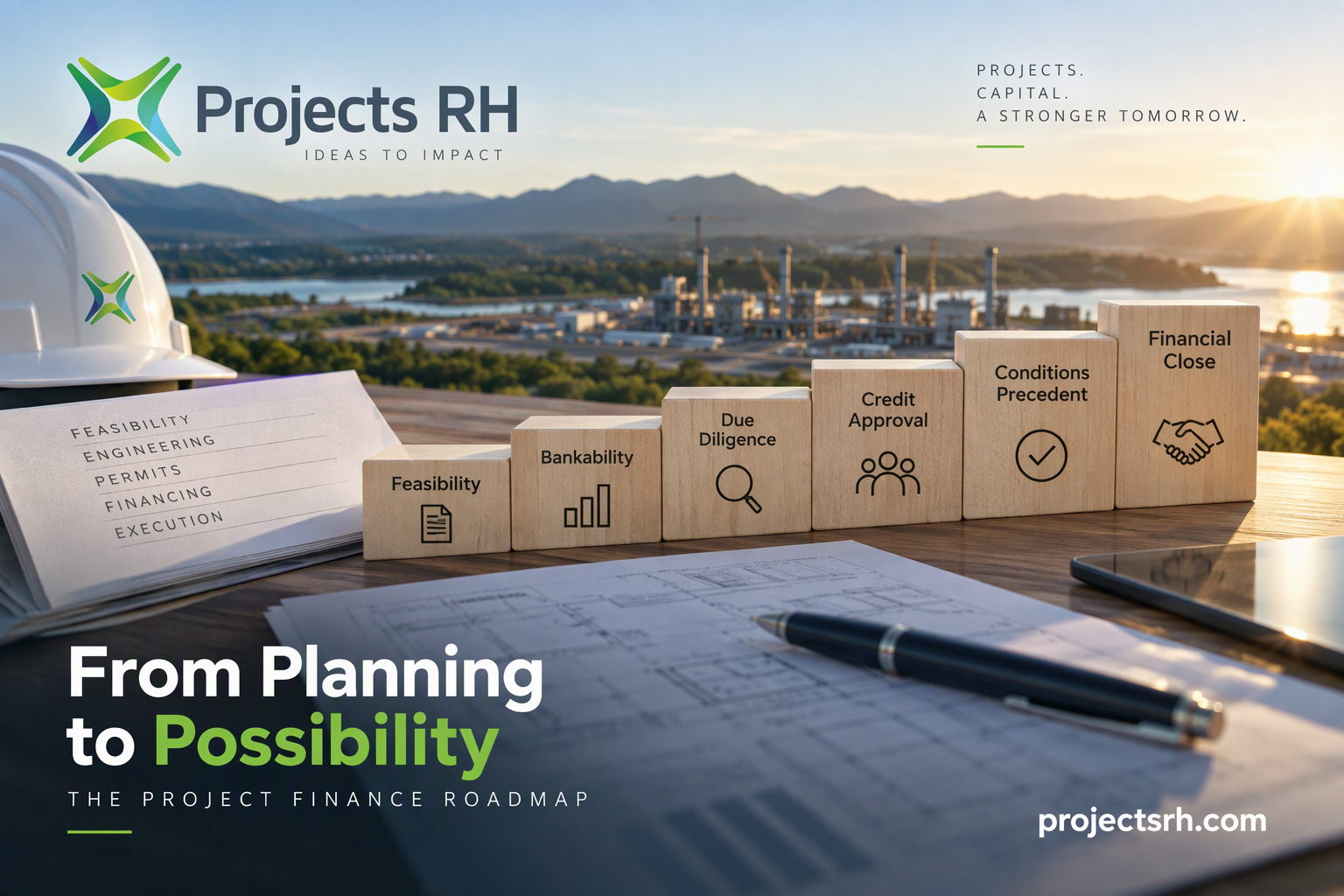
Conditions Precedent in Project Finance: Before Drawdown
What must happen before lenders release funds? Learn how Conditions Precedent in Project Finance affect financial close, drawdown and execution.
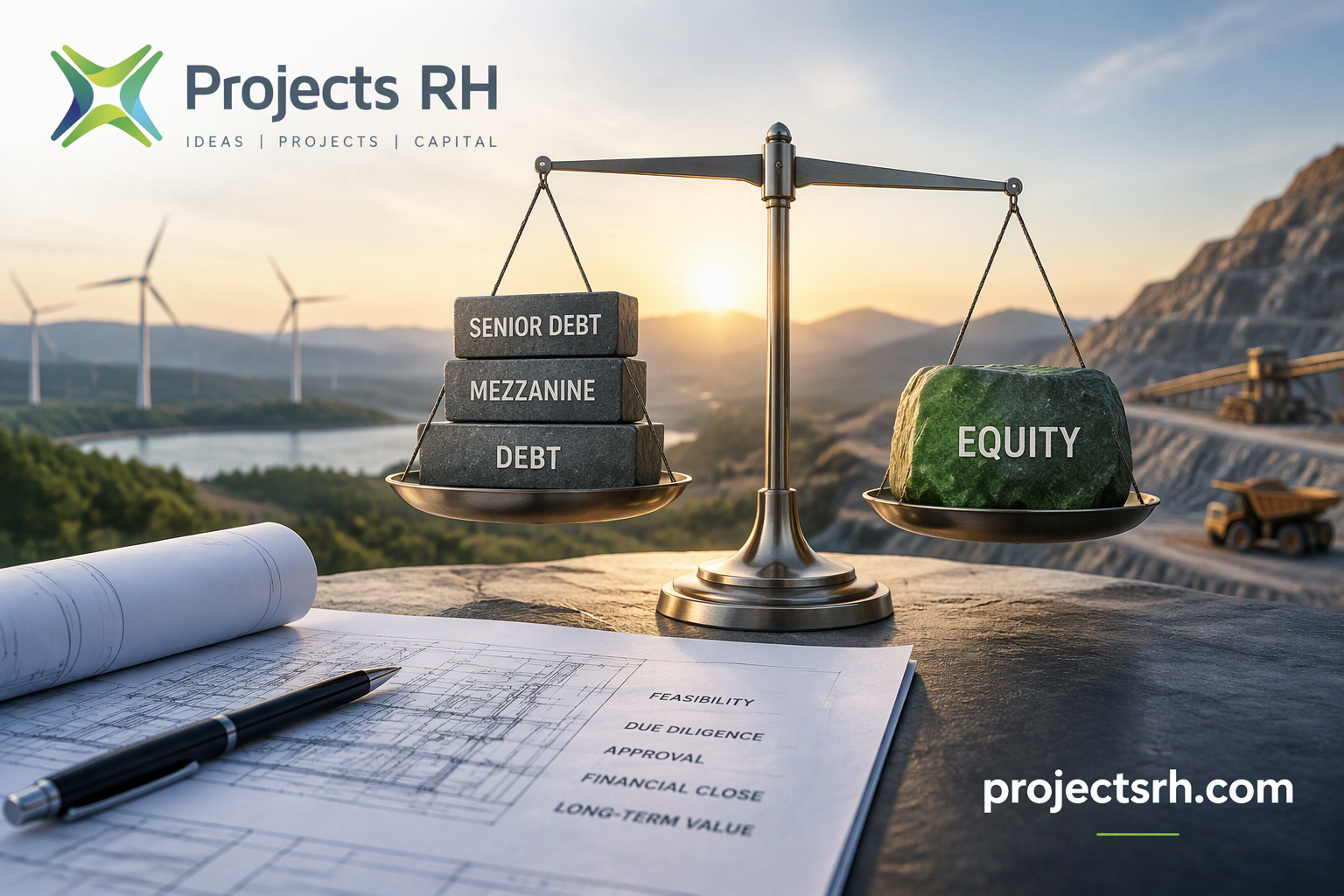
Project Finance Roadmap: Feasibility to Financial Close
Follow the Project Finance Roadmap from feasibility and bankability through due diligence, credit approval, conditions precedent and financial close.

Debt vs Equity in Project Finance: Building the Right Mix
Debt vs Equity in Project Finance explained: how sponsors balance leverage, dilution, DSCR, risk and investor returns to build a bankable capital structure.