
Project Finance Roadmap: Feasibility to Financial Close
Follow the Project Finance Roadmap from feasibility and bankability through due diligence, credit approval, conditions precedent and financial close.
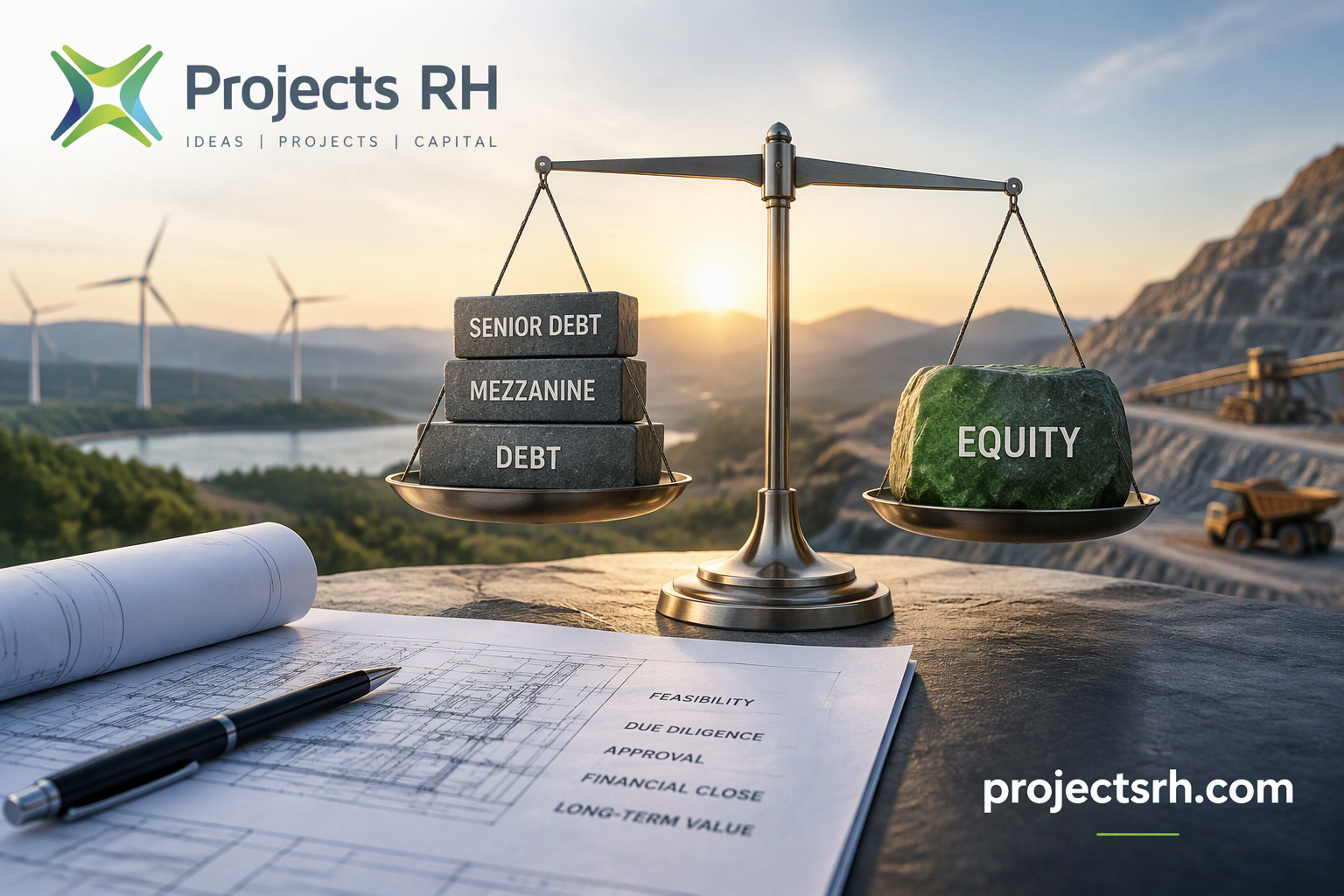
Project Finance Roadmap is the path that turns a technically credible project into a financeable transaction capable of reaching financial close.
That journey is rarely linear.
A strong feasibility study does not guarantee debt. An attractive financial model does not guarantee credit approval. A lender term sheet does not mean the money is available to draw.
Between feasibility and financial close sits a demanding sequence of technical validation, financial modelling, commercial structuring, risk allocation, environmental and social review, due diligence, credit approval, legal documentation and conditions precedent.
Throughout my career in finance, energy, resources and project development, I have seen one principle repeatedly confirmed:
Projects do not reach financial close simply because they need capital. They reach financial close when the risks, economics, contracts and evidence are sufficiently developed for capital providers to commit.
This Project Finance Roadmap explains that journey.
What Is the Project Finance Roadmap?
The Project Finance Roadmap is the structured progression from project feasibility and bankability through financial modelling, risk allocation, due diligence, financing negotiations, credit approval, documentation, conditions precedent and ultimately financial close.
Although individual transactions differ, a practical roadmap normally looks something like this:
Feasibility → Bankability → Financial Model → Capital Structure → Investor & Lender Preparation → Due Diligence → Term Sheet → Credit Approval → Financing Documents → Conditions Precedent → Financial Close → Drawdown
Each stage reduces uncertainty.
Each unresolved problem can also delay, reprice or stop the financing.
The IFC Project Cycle demonstrates a similar institutional discipline. IFC moves prospective investments through early review, appraisal, investment review, negotiations, disclosure, Board approval and ultimately commitment and disbursement.
The lesson for project sponsors is straightforward:
Capital should be the outcome of preparation, not a substitute for it.
Stage 1: Establish Project Feasibility
The first question is not:
Who will finance the project?
It is:
Should this project proceed on the assumptions currently available?
A serious feasibility process examines whether the opportunity is technically, commercially, financially and legally credible enough to justify moving forward.
Depending on the sector, a feasibility study may test:
- market demand;
- technical design;
- resource availability;
- site conditions;
- production assumptions;
- construction methodology;
- operating requirements;
- CapEx;
- OpEx;
- revenue assumptions;
- permitting;
- environmental requirements;
- infrastructure;
- implementation schedule;
- procurement strategy;
- financing assumptions; and
- material risks.
The World Bank's feasibility study framework includes demand, technical, compliance, financial, economic and risk analysis as well as commercial terms, market sounding and implementation planning.
That is an important distinction.
Feasibility is not merely a financial model.
It is the evidence base on which the financial model depends.
Stage 2: Move From Feasibility to Bankability
A project can be feasible without being bankable.
Feasibility asks whether the project can work.
Bankability asks whether capital providers can finance it under an acceptable allocation of risk.
A bankable project is one whose economics, cash flows, contractual structure, risk allocation and execution plan give lenders and investors a credible basis on which to commit capital.
This means asking harder questions.
Who carries construction risk?
Who absorbs cost overruns?
What happens if completion is delayed?
How secure is project revenue?
How strong is the customer or offtaker?
Can pricing change?
What happens if production underperforms?
Is adequate insurance available?
Which risks remain with the project company?
Which risks have been transferred contractually?
What happens if the contractor fails?
What happens if regulation changes?
These questions begin converting a project concept into a financing proposition.
Stage 3: Build a Financeable Financial Model
The financial model becomes one of the principal tools connecting technical assumptions to the financing structure.
A credible project finance model should normally address:
- construction expenditure;
- operating costs;
- revenue;
- pricing;
- production or utilisation;
- working capital;
- taxes;
- depreciation;
- financing costs;
- debt drawdown;
- interest during construction;
- debt repayment;
- reserve accounts;
- cash waterfall;
- shareholder distributions;
- IRR;
- NPV;
- DSCR;
- sensitivities; and
- downside scenarios.
More importantly, the financial model should reconcile with the technical and commercial evidence.
If the feasibility study assumes one construction schedule while the model assumes another, there is a problem.
If the operations team expects one level of production while the model uses a higher number, there is a problem.
If the investment memorandum describes one capital requirement while the model calculates another, there is a problem.
An institutional financial model should become the numerical expression of the investment case, not an independent spreadsheet designed to produce an attractive return.
That distinction matters during due diligence.
Stage 4: Define the Capital Requirement
Once the project economics are understood, sponsors can define the capital requirement more precisely.
The question is not simply:
How much money do we want to raise?
It is:
How much capital does the project require, when does it require it, and what does that capital achieve?
A Sources and Uses of Funds schedule should normally show where capital comes from and how it will be deployed.
Potential sources may include:
- sponsor equity;
- strategic equity;
- project finance debt;
- development finance;
- export credit;
- mezzanine finance;
- equipment finance;
- grants;
- guarantees;
- offtake-backed financing; or
- other sector-specific instruments.
Uses may include:
- development costs;
- land;
- engineering;
- permitting;
- equipment;
- construction;
- financing fees;
- interest during construction;
- contingency;
- working capital; and
- reserve accounts.
At this stage, the capital requirement begins becoming a capital structure.
Stage 5: Design the Capital Structure
The next question is how the project should be financed.
A project may be economically attractive but still have the wrong proposed mix of debt and equity.
Too much equity can create unnecessary dilution.
Too much debt can leave insufficient margin to absorb adverse performance.
The structure should therefore reflect:
Project Stage → Risk Profile → Cash Flow → Asset Life → Debt Capacity → Investor Returns
Senior debt generally requires strong repayment visibility.
Equity accepts greater risk in exchange for residual upside.
Mezzanine or subordinated capital can potentially fill the space between them.
The correct structure depends on the specific project.
There is no universal debt-to-equity ratio that automatically creates bankability.
Stage 6: Prepare the Institutional Investment Package
Before serious lender or investor engagement, the information presented across the project should be internally consistent.
Depending on the financing process, an institutional package may include:
- Executive Summary;
- Investor Teaser;
- Information Memorandum;
- Financial Model;
- Business Plan;
- Sources and Uses of Funds;
- proposed capital structure;
- technical reports;
- feasibility studies;
- market studies;
- material permits;
- corporate documents;
- key contracts;
- risk register; and
- a structured data room.
The objective is not to create more documents.
It is to create one investment case supported by consistent evidence.
Projects lose credibility quickly when the financial model, Information Memorandum, pitch materials and technical work tell different stories.
This is why document preparation is an important part of the Project Finance Roadmap rather than a marketing exercise at the end of it.
Explore our Project Preparation and Project Finance Services for more information on project preparation, financial modelling and institutional investment documentation.
Stage 7: Conduct Investor and Lender Market Sounding
A project should not approach every source of capital.
Different capital providers have different mandates covering:
- sectors;
- geographies;
- ticket sizes;
- development stages;
- return requirements;
- debt tenors;
- currencies;
- technologies;
- ESG criteria; and
- risk tolerance.
Market sounding helps determine whether the proposed financing structure is realistic before a sponsor spends significant time on a formal financing process.
It may also reveal that the project needs:
- more sponsor equity;
- different contracts;
- a stronger offtaker;
- additional guarantees;
- further technical work;
- reduced construction risk;
- different debt tenor; or
- another financing instrument.
The purpose of market sounding is not simply to generate investor contacts. It is to test whether the proposed transaction fits the market.
Stage 8: Secure an Indicative Term Sheet
Once a credible financing proposition is presented to suitable capital providers, the project may progress towards an indicative term sheet.
A lender term sheet can address matters such as:
- proposed facility amount;
- currency;
- tenor;
- interest rate or margin;
- amortisation;
- grace period;
- security;
- DSCR requirements;
- reserve accounts;
- covenants;
- representations;
- conditions precedent;
- fees;
- information undertakings; and
- events of default.
An equity term sheet may instead focus on:
- valuation;
- ownership;
- governance;
- board rights;
- reserved matters;
- dilution;
- information rights;
- distributions;
- transfer restrictions;
- exit rights; and
- investor protections.
But a term sheet is not financial close.
It is another step in the process.
Material assumptions still need to survive due diligence and credit approval.
Stage 9: Complete Technical Due Diligence
Institutional lenders frequently require independent assessment of the project's technical foundations.
Depending on the sector, technical due diligence may examine:
- engineering;
- site conditions;
- design maturity;
- construction budget;
- schedule;
- contingency;
- contractor capability;
- technology;
- performance assumptions;
- production;
- resource estimates;
- operating plans;
- maintenance;
- infrastructure;
- equipment life; and
- completion tests.
For mining projects, geology, metallurgy, recovery, mine planning and processing can be central.
For renewable energy, resource assessment, energy yield, grid connection, EPC arrangements and equipment performance may be critical.
For AI data centres, technical due diligence may focus on power availability, grid connection, redundancy, cooling, network architecture, equipment delivery and technology replacement cycles.
The technical report ultimately needs to connect back to the assumptions in the financial model.
Stage 10: Complete Commercial and Market Due Diligence
Capital providers also need to understand where project revenue comes from.
This can involve examining:
- customer demand;
- pricing;
- contracts;
- offtake;
- market share;
- competition;
- customer concentration;
- commodity exposure;
- tariffs;
- utilisation;
- concession arrangements; and
- termination provisions.
The stronger and more predictable the revenue framework, the easier it may be for lenders to assess debt capacity.
Merchant revenue generally produces a different financing profile from a long-term contract with a credible counterparty.
That difference is fundamental to project finance.
Stage 11: Complete Legal and Regulatory Due Diligence
Legal due diligence asks whether the contractual and ownership foundations required for the project actually exist and are enforceable.
Areas may include:
- project company ownership;
- licences;
- land rights;
- permits;
- concessions;
- EPC agreements;
- O&M agreements;
- customer or offtake contracts;
- financing agreements;
- security;
- insurance;
- intellectual property;
- tax;
- regulatory compliance; and
- dispute-resolution provisions.
Cross-border projects may need additional analysis of:
- foreign investment rules;
- currency convertibility;
- withholding taxes;
- political risk;
- governing law;
- enforceability of security;
- sanctions; and
- repatriation of distributions.
Legal documentation is not a final administrative step.
It is part of the project's risk allocation.
Stage 12: Environmental and Social Due Diligence
For many international project financings, environmental and social due diligence is a central credit consideration.
The Equator Principles provide a widely used financial-industry framework for identifying, assessing and managing environmental and social risks in qualifying project-related financing.
Depending on the project, review may cover:
- environmental impact;
- communities;
- biodiversity;
- land acquisition;
- labour;
- health and safety;
- Indigenous Peoples;
- climate risk;
- pollution;
- cultural heritage; and
- stakeholder engagement.
Environmental and social issues that are addressed too late can delay financing even where project economics are strong.
This is why ESG due diligence should not be treated as something to solve immediately before financial close.
Stage 13: Lender Credit Approval
Completing due diligence does not automatically mean financing has been approved.
The lender's transaction team typically needs to present the project through its internal credit process.
The credit case may consider:
- project economics;
- sponsor strength;
- technical conclusions;
- revenue resilience;
- financial ratios;
- construction risk;
- security;
- legal structure;
- environmental and social risk;
- downside sensitivities;
- debt tenor;
- repayment capacity; and
- proposed risk mitigants.
A project can therefore have a positive relationship with a lender and still fail to secure credit approval.
The financing decision rests on the institution's risk process, not simply the enthusiasm of the deal team.
Stage 14: Negotiate Financing Documents
Following the required approvals, parties move toward definitive documentation.
The IFC Project Cycle similarly places negotiation of terms, conditions, covenants, monitoring requirements and conditions of disbursement before final commitment and funding.
Documentation can include:
- facility agreements;
- intercreditor agreements;
- security documents;
- account agreements;
- sponsor-support agreements;
- direct agreements;
- guarantees;
- hedging documents; and
- fee letters.
At this point, seemingly small drafting issues can become material financing issues.
The objective is to convert the credit-approved commercial deal into enforceable contractual arrangements.
Stage 15: Satisfy Conditions Precedent
One of the final parts of the Project Finance Roadmap is satisfying the conditions that must be completed before financing becomes effective or available for drawdown.
Typical Conditions Precedent, or CPs, may include:
- execution of financing documents;
- required equity contribution;
- permits;
- legal opinions;
- insurance;
- security perfection;
- project accounts;
- material contracts;
- technical reports;
- environmental approvals;
- corporate authorisations;
- hedging arrangements; and
- evidence that specified project agreements remain effective.
The exact list varies from transaction to transaction.
A project can be credit approved and still fail to draw because its CPs remain incomplete.
That distinction is frequently underestimated.
What Is Financial Close?
Financial close is the point at which the required project and financing agreements have been executed, the applicable conditions for funding have been satisfied and committed finance becomes available for drawdown in accordance with the financing documents.
The World Bank's guidance on achieving financial close describes financial close as the point when project and financing agreements have been signed, the required conditions have been met and the private party can begin drawing financing to commence project work.
Financial close is therefore not:
- receiving an investor introduction;
- signing an NDA;
- receiving expressions of interest;
- obtaining an indicative term sheet; or
- completing due diligence.
Those may all be important milestones.
They are not financial close.
Stage 16: First Drawdown and Construction
Financial close does not mean the project's risks disappear.
It means the project moves into another risk phase.
After financial close, the focus can shift toward:
- drawdown;
- construction;
- cost control;
- schedule;
- covenant compliance;
- reporting;
- environmental and social obligations;
- completion testing;
- commissioning; and
- transition into operations.
Funding itself may be drawn in stages rather than in a single payment.
Capital must therefore remain aligned with the project's physical progress and financing conditions.
The Project Finance Roadmap does not end because documents have been signed.
Execution now matters.
How the Project Finance Roadmap Changes by Sector
The sequence is broadly similar, but individual risks change substantially by sector.
Mining and Critical Minerals
Capital providers may focus heavily on:
- resource confidence;
- geology;
- metallurgy;
- recovery;
- mine planning;
- processing;
- environmental approvals;
- infrastructure;
- energy;
- commodity assumptions;
- CapEx;
- OpEx; and
- offtake.
A world-class resource does not automatically produce a financeable mining project.
Energy and Renewables
Key considerations may include:
- land;
- generation resource;
- permits;
- interconnection;
- EPC;
- technology;
- PPA;
- merchant exposure;
- curtailment;
- operating assumptions;
- counterparty credit; and
- long-term asset performance.
Infrastructure
Infrastructure lenders may place particular emphasis on:
- concession terms;
- demand;
- tariffs;
- construction;
- availability regimes;
- government support;
- contractual risk allocation;
- political risk; and
- long-term maintenance.
AI Infrastructure and Data Centres
AI infrastructure increasingly combines technology and conventional infrastructure finance.
Key issues can include:
- speed to power;
- grid capacity;
- power procurement;
- customer contracts;
- utilisation;
- GPUs;
- cooling;
- redundancy;
- long-lead equipment;
- technology obsolescence;
- customer concentration;
- replacement CapEx; and
- power-price risk.
Different sectors therefore require different evidence.
The core financing principle remains the same:
Risk must be understood before capital can be priced.
Why Projects Stall Before Financial Close
Strong projects commonly lose momentum before closing because one or more elements were assumed rather than resolved.
Typical problems include:
- incomplete engineering;
- optimistic CapEx;
- unsupported revenue forecasts;
- weak contracts;
- outstanding permits;
- insufficient equity;
- unrealistic leverage;
- inconsistent financial models;
- unresolved environmental issues;
- inadequate risk allocation;
- incomplete legal documentation;
- weak counterparties; or
- conditions precedent that cannot be satisfied on schedule.
The financing process then exposes those gaps.
It does not create them.
This is why I believe preparation should begin well before a formal capital-raising mandate.
The Projects RH Project Finance Roadmap Test
Before a project enters a serious financing process, I would ask these twelve questions:
- Is the technical feasibility work sufficiently mature?
- Can the commercial assumptions be independently defended?
- Does the financial model reconcile with the technical evidence?
- Is the total capital requirement clearly defined?
- Is the proposed debt-equity structure realistic?
- Have major project risks been allocated to appropriate parties?
- Are material permits and approvals achievable within the financing timetable?
- Are key project contracts sufficiently advanced?
- Is the project data room complete and internally consistent?
- Can the project survive lender downside scenarios?
- Can the likely conditions precedent actually be satisfied?
- Is there a credible path from credit approval to financial close and drawdown?
If several answers are unclear, rushing into lender outreach is unlikely to solve the problem.
Better preparation usually comes first.
Frequently Asked Questions About the Project Finance Roadmap
What is a Project Finance Roadmap?
A Project Finance Roadmap is the sequence of technical, financial, commercial, legal and due-diligence stages that takes a project from feasibility through bankability, financing approval and financial close.
What comes after a feasibility study?
A feasibility study is generally followed by further work to establish bankability, strengthen the financial model, define the capital structure, complete investment documentation and prepare the project for investor and lender due diligence.
What is the difference between feasibility and bankability?
Feasibility asks whether a project can work. Bankability asks whether the project's economics, contracts, risks and expected cash flows are sufficiently robust for capital providers to finance it.
A project can therefore be feasible without yet being bankable.
What happens during project finance due diligence?
Project finance due diligence can include technical, commercial, financial, legal, tax, insurance, environmental and social review, depending on the transaction.
The purpose is to test assumptions, identify material risks and determine whether those risks have been acceptably allocated or mitigated.
What is lender credit approval?
Credit approval is the lender's internal decision to approve the proposed financing subject to agreed terms, documentation and conditions.
An interested relationship or deal team does not itself constitute credit approval.
What are conditions precedent in project finance?
Conditions precedent are requirements that must be satisfied or waived before specified financing obligations become effective or funds may be drawn.
They can include equity funding, permits, legal opinions, executed contracts, insurance, security and other project-specific requirements.
What is financial close in project finance?
Financial close is reached when the required financing and project agreements are executed, relevant funding conditions have been satisfied and committed finance is available for drawdown under the agreed financing documents.
Is a term sheet the same as financial close?
No.
A term sheet records proposed commercial financing terms. Due diligence, credit approval, documentation and conditions precedent may still remain before financial close.
How long does project finance take?
There is no universal timetable.
Timing depends on project complexity, development maturity, sector, jurisdiction, permitting, due diligence, lender requirements, documentation and the speed with which outstanding issues can be resolved.
The better question is not simply how fast capital can be raised.
It is:
How much work remains before this project can withstand a formal financing process?
Does financial close guarantee project success?
No.
Financial close confirms an important financing milestone, not successful construction or operations.
After financial close, the project still needs to manage construction, drawdowns, covenants, reporting, commissioning and operating performance.
Project Finance Roadmap in One Sentence
The Project Finance Roadmap takes a project from feasibility to financial close by progressively proving technical viability, commercial credibility, financial bankability, acceptable risk allocation and readiness for institutional capital.
From Feasibility to Financial Close
The temptation in project development is to focus on the capital.
I prefer to focus first on what must be true before the capital can responsibly arrive.
A credible feasibility study.
A financial model that reconciles with the facts.
A realistic capital structure.
Defensible contracts.
Clear risk allocation.
Institutional documentation.
Successful due diligence.
Credit approval.
Executable financing documents.
Conditions precedent that can actually be satisfied.
Then financial close becomes a credible objective rather than an aspiration.
At Projects RH, we help project sponsors prepare projects for institutional scrutiny by testing investment economics, financial models, documentation, capital requirements and project-finance readiness before serious capital engagement.
Explore our Project Preparation and Project Finance Services and learn How Projects RH Works.
Ready to Move Your Project Toward Financial Close?
If your project is moving from feasibility toward institutional financing, the next step is to determine what remains between the project today and a credible path to financial close.
Book a confidential introductory conversation with Projects RH to discuss your project finance requirements, or submit your project information so we can understand its current stage, capital requirements and preparation priorities.
You can also explore our Project Preparation and Project Finance Services and learn How Projects RH Works.
Projects RH | We Make Projects Investor-Ready and Connect Them with the Right Capital
Sources

What to do next
Projects RH prepares the company and the project first, then takes them to investors. The fastest way to find out where you stand is a short call.
Keep reading
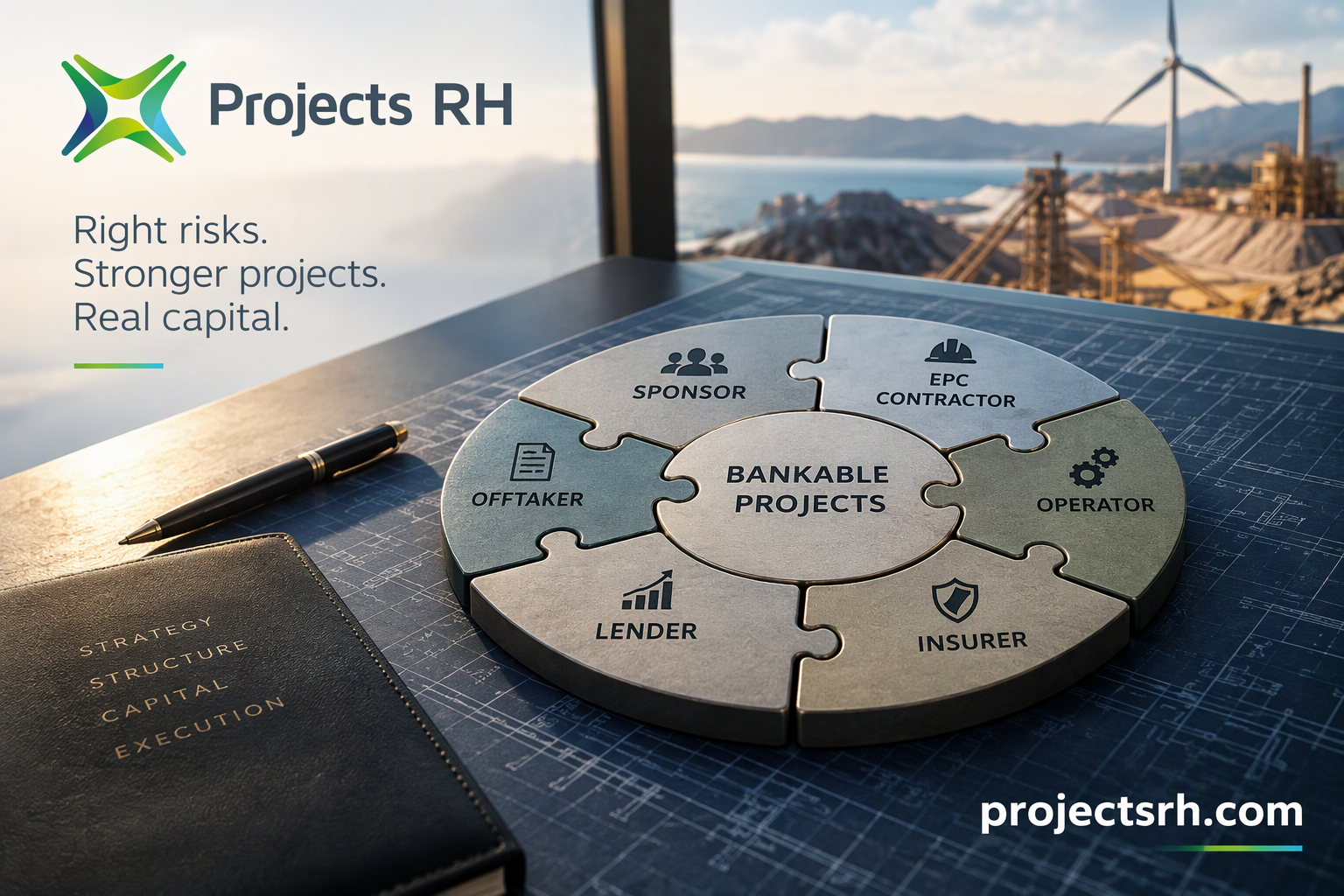
Project Finance Risk Allocation: Who Carries the Risk?
Who carries construction, market and operating risk? Learn how Project Finance Risk Allocation shapes contracts, bankability and lender confidence.
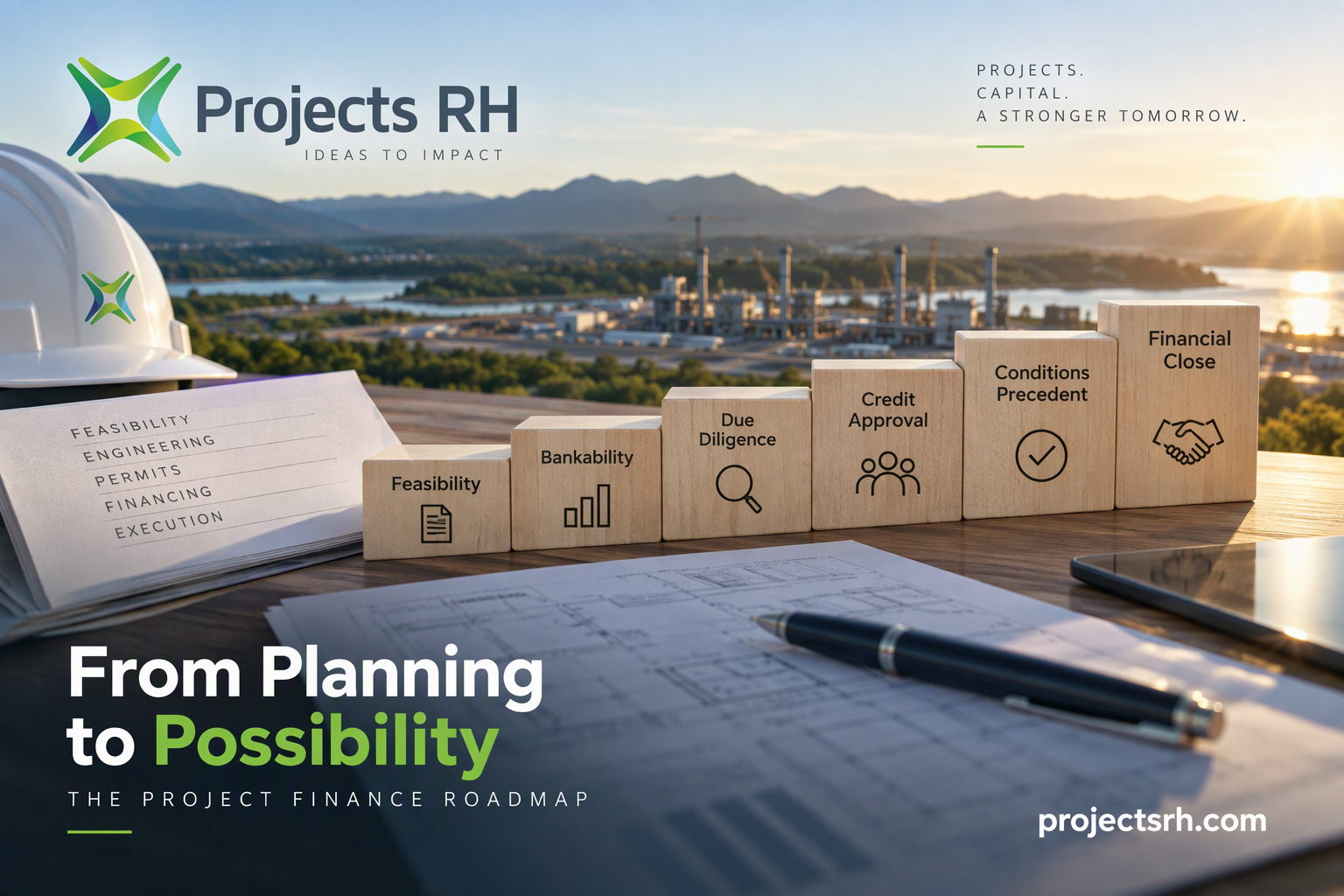
Conditions Precedent in Project Finance: Before Drawdown
What must happen before lenders release funds? Learn how Conditions Precedent in Project Finance affect financial close, drawdown and execution.

Debt vs Equity in Project Finance: Building the Right Mix
Debt vs Equity in Project Finance explained: how sponsors balance leverage, dilution, DSCR, risk and investor returns to build a bankable capital structure.