
Streaming and Royalty Financing: A Guide for Mining Sponsors
How streams and royalties differ, why mining sponsors use them alongside or instead of new equity and bank debt, the risks on both sides, and why the financial model carries the weight.

A mining sponsor with a project to build may see streaming and royalty financing as an answer to two problems at once. It raises money without issuing new shares, and it avoids much of the covenant package that comes with bank debt. Both claims are only partly true. This guide covers four things: how streams and royalties differ, why sponsors use them, what the financier is buying, and the risks on each side. It also explains why the financial model decides whether a conversation goes anywhere, and the pitch does not.
What streaming and royalty financing are
People often use the two words as if they mean the same thing. They do not. Confusing them leads to disputes over pricing and expectations in agreements that can last for the life of a mine.
A mining royalty is a contractual right to a share of a mine's revenue or production. After the initial payment, the holder buys nothing more. It simply receives its share. Common forms include:
- Net smelter return (NSR): a percentage of revenue from processed ore, after smelting and refining charges.
- Gross royalty: a percentage of value before deductions. This is more certain for the holder and costs the operator more.
- Net profit interest (NPI): a share of profit after operating costs. This ties the holder to how efficiently the mine runs.
- Sliding-scale royalty: a rate that moves with commodity prices.
A stream is a purchase agreement, and the practice is sometimes called metals streaming. The streaming company pays a large deposit upfront. In return it gains the right to buy an agreed share of the mine's output at a fixed or discounted price for the life of the agreement. The metal is often a by-product, such as gold or silver from a copper mine. The financier is buying future metal. It is not taking a percentage of revenue.
Both are forms of non-dilutive financing, because neither is equity. Neither is a loan in the ordinary sense either: there is usually no interest rate and no scheduled repayment. They still carry obligations. Agreements typically include:
- production reporting
- security over the asset
- conditions tied to construction and completion
They also stay in the capital structure for decades, which matters to every financier who comes later.
Why mining sponsors look at streaming and royalty financing
Mine development needs a lot of capital and takes a long time. Large sums are spent over years of permitting and construction before any metal is sold. The usual funding routes each carry a cost.
Bank project finance is available for well-prepared assets with the main risks reduced. It comes with debt service tests, limits on distributions and lender consent requirements, and these shape decisions for as long as the loan runs. New equity avoids covenants, but it dilutes existing shareholders. Raising it when share prices are weak can be expensive.
A stream or royalty offers a different trade. The sponsor sells a defined slice of future production or revenue for cash now. It keeps its shareholding and keeps running the mine. The sale can also be targeted. A company with more than one deposit may sell a stream or royalty over one asset, or over one metal, rather than tying up the whole business. Many sponsors use these deals alongside debt and equity, not instead of them.
The decision is not only financial. Selling part of your future production is a commitment that will outlast most management teams. It deserves the same scrutiny as any equity raise.
What the financier is buying
The financier gets long-term exposure to a real asset and to commodity prices. It does not take on the capital spending, operating costs or environmental liabilities of running the mine. In practice, what it is pricing is your mine plan.
The financier will therefore look closely at:
- the resource and reserve estimates, and whether they were prepared and reviewed independently under a recognised reporting code
- the mine plan and production schedule, year by year
- metallurgy and recoveries, especially for the metal being streamed
- the capital and operating cost estimates, and the construction schedule
- permits, land access and community agreements
- existing royalties, offtake agreements and security already granted
Where this evidence is thin, inconsistent or out of date, the price moves against the sponsor, or the conversation stops.
The risks on both sides
Many people assume these deals are low-risk because they avoid covenants. They are not. The risk is divided differently, not removed.
For the sponsor, the main risks are these:
- Selling too cheaply. The upfront payment rests on a view of future production and prices. If the mine performs better or prices rise, the holder keeps that upside for the life of the agreement.
- Making later financing harder. Senior lenders will ask how a stream or royalty ranks, what security it holds and what it does to the cash available to service debt. A badly structured early deal can make later project finance harder to arrange.
- Delivery obligations. Under a stream, the duty to deliver metal continues even when operations struggle.
- Scope over time. The agreement must state clearly whether it covers future discoveries or expansions on the same ground.
For the financier, the risks include:
- construction delays or failure
- production shortfalls and falling prices
- permitting risk and the risks of the country where the mine sits
- where it ranks if the operator fails
Both sides need the facts to be right before terms are set.
Why the financial model carries the weight
Every number in a stream or royalty negotiation has a source: tonnes, grades, recoveries, prices, costs and timing. If those figures sit in a model that cannot be traced, tested or explained, the financier will build its own. Its version will be more cautious than yours.
A financial model for capital raising should let a reader change a price, a recovery rate or a start date and see the effect on:
- the stream or royalty payments
- the cash available to service debt
- the value left for shareholders
It should also show how the proposed stream or royalty fits alongside any senior debt. It should agree with the memorandum, the deck and the teaser, so that no investor finds two versions of the same figure.
This is where investor readiness starts. Preparation comes before capital. That means:
- establishing the facts
- testing the financial foundations
- identifying the material gaps
- developing a coherent investment case before any process begins
What you can do next with Projects RH
Projects RH prepares capital-intensive companies and projects for investors. We establish the facts, build or test the model and prepare institutional documentation. That documentation comprises five documents that agree with each other:
- a financial model that is the single point of truth for every figure
- an information memorandum
- an investor deck
- a teaser
- an organised data room
If you are weighing a stream, a royalty or another route for a mining project, start with what already exists:
- Book a FREE 20-Minute Discovery Call. The call is complimentary, and there is nothing to prepare.
- Send your project documents. A person at the firm reads what you send and replies in writing within 3 business days. If your documents are confidential, ask for the firm's confidentiality agreement first and send them once it is accepted.
- Read how we work. It sets out five steps from first call to capital, with a decision at the end of each. The Investment Readiness Assessment gives you a Preliminary Readiness Profile in words, a gap analysis and a recommended package.
Preparation comes first. Capital raising follows only under a separately accepted mandate, and nothing in it is promised.

What to do next
Projects RH prepares the company and the project first, then takes them to investors. The fastest way to find out where you stand is a short call.
Keep reading
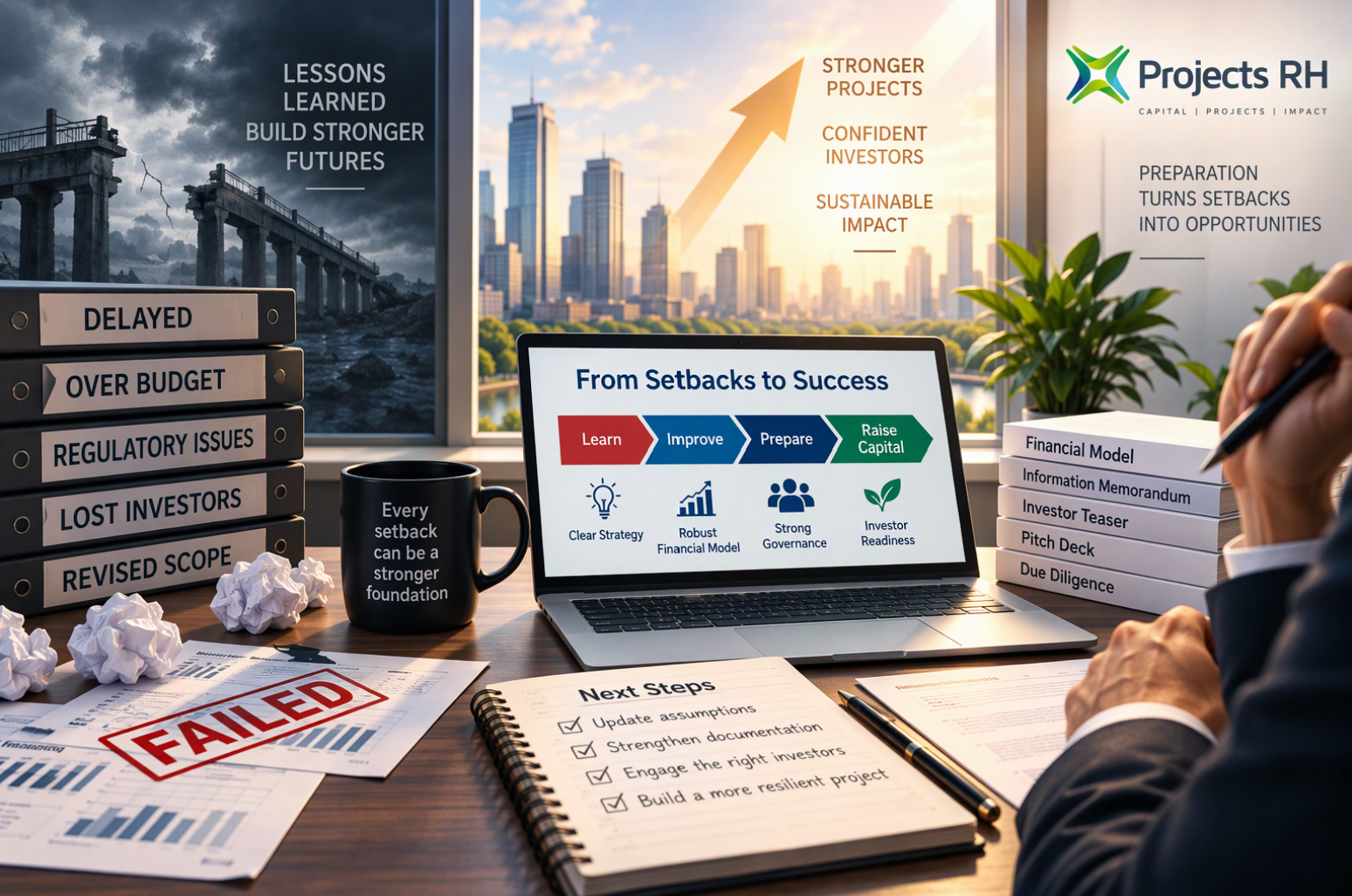
Lessons Learned from Failed Projects: Before You Raise Again
A setback need not end a project. What investors ask after one, and how to carry its lessons into a tested model and documents that agree before approaching capital again.

Investor Readiness: What to Prepare Before Raising Capital
Before you approach investors or lenders: what they examine, which documents must agree, how debt and equity differ, and what to resolve first.
Capital Raising Partners: Why One Coordinated Case Matters
Capital raising draws on many disciplines. How Projects RH works with strategic partners on one coordinated investment case, and the two rules every referral follows.