
Sydney 2050: Infrastructure Funding and Project Finance
Sydney 2050 explores how infrastructure funding, project finance and investor readiness can turn emerging urban ideas into investable projects.
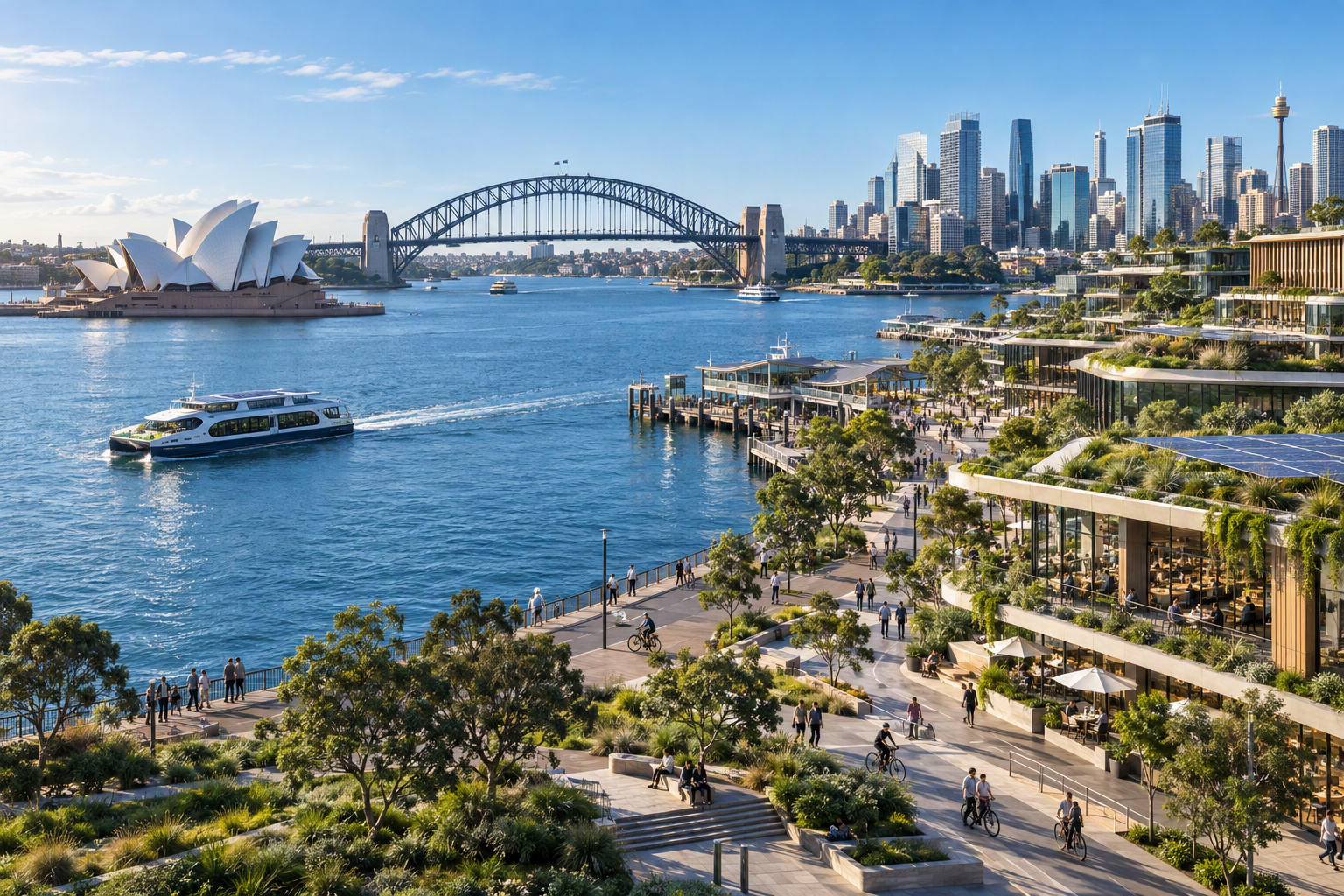
Infrastructure funding will play a decisive role in determining what Sydney looks like in 2050. Technology can transform how a city moves, generates energy, uses data and develops its built environment, but innovation alone cannot deliver the infrastructure required by a growing, connected and increasingly low-carbon economy.
That was one of the questions behind 2050 Emergent in Sydney in 2019. We walked through approximately 50 displays, attended several lightning talks and met innovators exploring ideas and technologies that could influence Sydney over the following three decades.
The experience offered a fascinating glimpse of what the future might hold. It also raised a question that remains highly relevant today: how do promising ideas become viable, financeable infrastructure projects?
Infrastructure Funding for Sydney 2050
A credible vision for Sydney in 2050 requires more than imagining new technologies. It requires understanding how infrastructure will be planned, funded, financed, delivered and operated.
The scale of that challenge is already visible.
Infrastructure NSW's current pipeline reflects projects supported by the NSW Government's 2026–27 Budget, including a $116.7 billion infrastructure commitment over four years. The pipeline covers major government infrastructure expected to come to market and includes projects with contract values above $50 million.
For developers, investors and policymakers, this illustrates an important point: infrastructure is not simply a design or construction challenge. It is also a capital allocation challenge.
The strongest projects must move beyond vision and demonstrate commercial viability, realistic capital requirements, measurable demand, credible delivery strategies and an appropriate allocation of risk.
What Could Sydney Look Like in 2050?
At 2050 Emergent, we encountered technologies and ideas that offered different perspectives on Sydney's future.
Could Sydney become a highly connected, low-carbon city supported by efficient public transport, renewable energy, better-designed buildings, intelligent infrastructure and attractive mixed-use precincts?
Could technology make transport networks more responsive, infrastructure more productive and urban services more accessible?
Or could population growth, congestion, infrastructure constraints, climate pressures and competing capital requirements make that transition significantly more difficult?
Many of the technologies capable of influencing that future were already emerging in 2019. Some were being developed in laboratories and innovation hubs. Others remained early concepts in the minds of entrepreneurs, engineers, researchers and future project developers.
The challenge was not a shortage of ideas.
The harder question was how to move those ideas from innovation to implementation.
From Innovation to Investable Infrastructure
A promising technology does not automatically create an investable project.
Investors and lenders need to understand much more than the technology itself. They need evidence that a proposal can become a viable commercial or infrastructure asset.
Before approaching external capital, project sponsors should typically be able to explain:
- what problem the project solves;
- why the infrastructure is needed;
- who will use or purchase its output;
- how the project will generate revenue or economic value;
- how much capital is required;
- how that capital will be deployed;
- what development milestones have already been achieved;
- which technical, commercial and regulatory risks remain;
- how material risks will be allocated or mitigated;
- what the proposed capital structure looks like; and
- what potential investors or lenders are being asked to finance.
For capital-intensive projects, these questions are fundamental.
An attractive concept may generate interest. A well-prepared project gives a capital provider something that can actually be evaluated.
Project Finance and Sydney's Infrastructure Future
Project finance can provide an important financing framework when the economics and contractual structure of a project can support an appropriate combination of debt and equity.
The structure of each transaction varies.
What remains consistent is the need for capital providers to understand the project's expected cash flows, commercial arrangements, counterparties, construction requirements, operational risks and downside scenarios.
The financial model therefore becomes more than a spreadsheet used to demonstrate an attractive return.
A strong model should connect technical and commercial assumptions with financial outcomes. It should help sponsors and investors understand what happens when construction costs increase, revenues are delayed, operating costs change, interest rates move or project timelines extend.
Sensitivity and scenario analysis become particularly important in long-duration infrastructure investments.
Projects RH supports sponsors through its project finance and investor readiness services, helping projects strengthen their financial positioning and transaction preparation before approaching potential capital providers.
Investor Readiness Comes Before Capital Raising
One of the most important distinctions in infrastructure development is the difference between an innovative idea and an investor-ready project.
A project may have substantial economic, environmental or social potential without yet being ready for an institutional investor, infrastructure fund, commercial lender, private capital provider or strategic investor.
Investor readiness requires evidence.
Depending on the asset, jurisdiction and development stage, potential capital providers may need to assess:
- the business and commercial model;
- capital expenditure assumptions;
- operating expenditure assumptions;
- financial forecasts and sensitivities;
- market demand or contracted revenue;
- technical feasibility;
- permits and regulatory approvals;
- contractual arrangements;
- management and governance;
- environmental and social considerations;
- development and construction risks;
- proposed financing structure; and
- investment documentation.
The objective is not to present a project as risk-free.
Serious infrastructure investment always involves risk.
The objective is to demonstrate that material risks have been identified, can be understood and, where possible, have been appropriately allocated or mitigated.
Sustainable Infrastructure and Sydney 2050
Sustainability will be another defining factor in Sydney's infrastructure future.
NSW has legislated targets to reduce emissions by 50% from 2005 levels by 2030, 70% by 2035 and achieve net zero emissions by 2050.
Transport is central to that transition. Transport for NSW has set a direction toward a net-zero transport sector by 2050, alongside greater renewable-energy use, electrification and lower-emission mobility.
The energy system is also undergoing substantial transformation as renewable generation, transmission and storage capacity expand.
For investors and developers, these changes create opportunities but also new requirements.
Environmental performance cannot simply be added to an investment memorandum as a separate narrative. It increasingly needs to form part of the project's underlying economics, risk assessment, design choices and long-term resilience strategy.
A sustainable project still needs sustainable economics.
Sydney's Changing Transport Infrastructure
Transport provides a clear example of how technology, infrastructure and investment intersect.
Transport for NSW's long-term strategy considers population growth, the energy transition, digitalisation, climate change and evolving technology in planning the future transport network.
Its strategy also identifies connected communities, public transport, active transport and more efficient network operation as important considerations in future investment.
That direction is significant for project developers.
New mobility technology cannot be considered independently of physical infrastructure, energy supply, digital connectivity, regulation and the behaviour of the people and businesses that will ultimately use it.
Sydney's future transport system will therefore depend not simply on introducing new vehicles or technologies, but on integrating them into an infrastructure network capable of supporting them.
This is precisely where project preparation and capital planning become essential.
Infrastructure Funding Requires the Right Capital Structure
Sydney's future infrastructure will not be financed from a single source.
Projects may involve combinations of:
- government expenditure;
- commercial debt;
- institutional investment;
- infrastructure funds;
- strategic investors;
- private equity;
- public-private partnerships; and
- project-specific financing structures.
The appropriate combination depends on the project.
Some assets provide important public services but may not produce cash flows capable of supporting conventional private project finance.
Others may have identifiable customers, contracted revenues, user charges or other predictable cash flows that make private capital participation more suitable.
Effective infrastructure funding starts by understanding those project fundamentals.
Capital structure should follow project economics, not the other way around.
Bankability Matters
A project can be technically feasible without being bankable.
This distinction becomes critical when a sponsor begins approaching lenders or investors.
The World Bank's infrastructure finance guidance emphasises financially viable, resilient and bankable projects and notes that infrastructure finance can combine public and private sources of capital.
For private financing, revenues need to be sufficiently resilient to support operating expenses, debt service and appropriate investor returns.
That principle applies well beyond traditional transport infrastructure.
Renewable energy, energy storage, digital infrastructure, data centres, water projects and other capital-intensive assets all need a credible relationship between the infrastructure being developed and the cash flows expected to support the investment.
Bankability therefore depends on much more than projected returns.
It depends on whether those returns can withstand serious due diligence.
Infrastructure Funding Starts With Project Preparation
This is why infrastructure funding should be considered well before a project's sponsors begin searching for investors.
The capital-raising process starts with the quality of the underlying project.
Sponsors should identify weaknesses in the investment proposition, financial model, documentation, development strategy and risk allocation before approaching the market.
Addressing those weaknesses early can make subsequent investor discussions substantially more productive.
It can also prevent a project from entering the market prematurely.
A poorly prepared capital raise can consume management time, weaken investor confidence and make it more difficult to re-engage potential capital providers later.
Strong preparation cannot guarantee financing.
What it can do is give serious investors the information required to make a serious assessment.
What 2050 Emergent Taught Us
2050 Emergent gave us an opportunity to meet local innovators, explore emerging technologies and consider how ideas being developed in 2019 might influence Sydney over the following three decades.
The ideas were exciting.
But there is an important distinction between imagining the future and financing it.
Cities change when innovation is combined with good planning, commercial discipline, credible financial structures and access to appropriate capital.
That requires collaboration between governments, infrastructure developers, investors, technology providers, advisers and communities.
The future of Sydney will not be defined by technology alone.
It will also be defined by which ideas can become viable projects and which viable projects can attract the resources required for implementation.
From Sydney 2050 Vision to Financeable Projects
The original question remains compelling: what will it really be like to live in Sydney in 2050?
No one can answer that with certainty.
We can, however, see the direction of travel.
NSW is investing heavily in infrastructure, planning for long-term transport transformation and working toward a legislated net-zero target. These priorities will create opportunities for technology providers, project developers and capital providers.
But opportunity is not the same as bankability.
For sponsors, the critical question before beginning a capital raise should be:
Is this simply an exciting idea, or is it a project that an investor can genuinely evaluate and finance?
That distinction matters.
Successful infrastructure funding depends not only on identifying capital. It depends on preparing projects that investors and lenders can understand, evaluate and finance.
Sources
- Infrastructure NSW - NSW Infrastructure Pipeline
- Infrastructure NSW - State Infrastructure Plan 2025-26
- [Transport for NSW - Future Transport Strategy](https://www.transport.nsw.gov.au/news-and-events/media-releases/new-future-transport NSW Climate and Energy Action - Reaching Net Zero Emissions
- World Bank - Infrastructure Finance
Prepare Your Project for Investment
If you are developing an infrastructure, energy or other capital-intensive project, the next step is to determine whether the opportunity is genuinely ready for investors and financing partners.
/intake.html or /services.html to review your project's financial positioning, documentation and capital strategy before approaching the market.
Paul Raftery
First published on ProjectsRH.com on 29 October 2019. Updated to reflect current infrastructure, project finance and investor-readiness considerations.

What to do next
Projects RH prepares the company and the project first, then takes them to investors. The fastest way to find out where you stand is a short call.
Keep reading

Active vs passive investing: Which strategy is right for you?
Curious about which investment strategy suits you best? Dive into our latest article on Active vs Passive Investing. Learn the pros, cons, and key differences

What is Investment Management? Understanding it’s role in wealth growth
Discover the key differences between investment management and asset management and find out which service is right for you.

Cyber is the new CBD: project finance advisory across hubs
Cyber is the new C in CBD. Remote work has made location matter less for high-quality work; flexible workflow, performance-based reward and courage now shape how project teams operate.