
How Investors Analyse a Financial Model, and What They Test
Investors test assumptions, cash flow, mechanics and capital structure before returns. What they look for in a financial model, and what an investor-ready model must show.
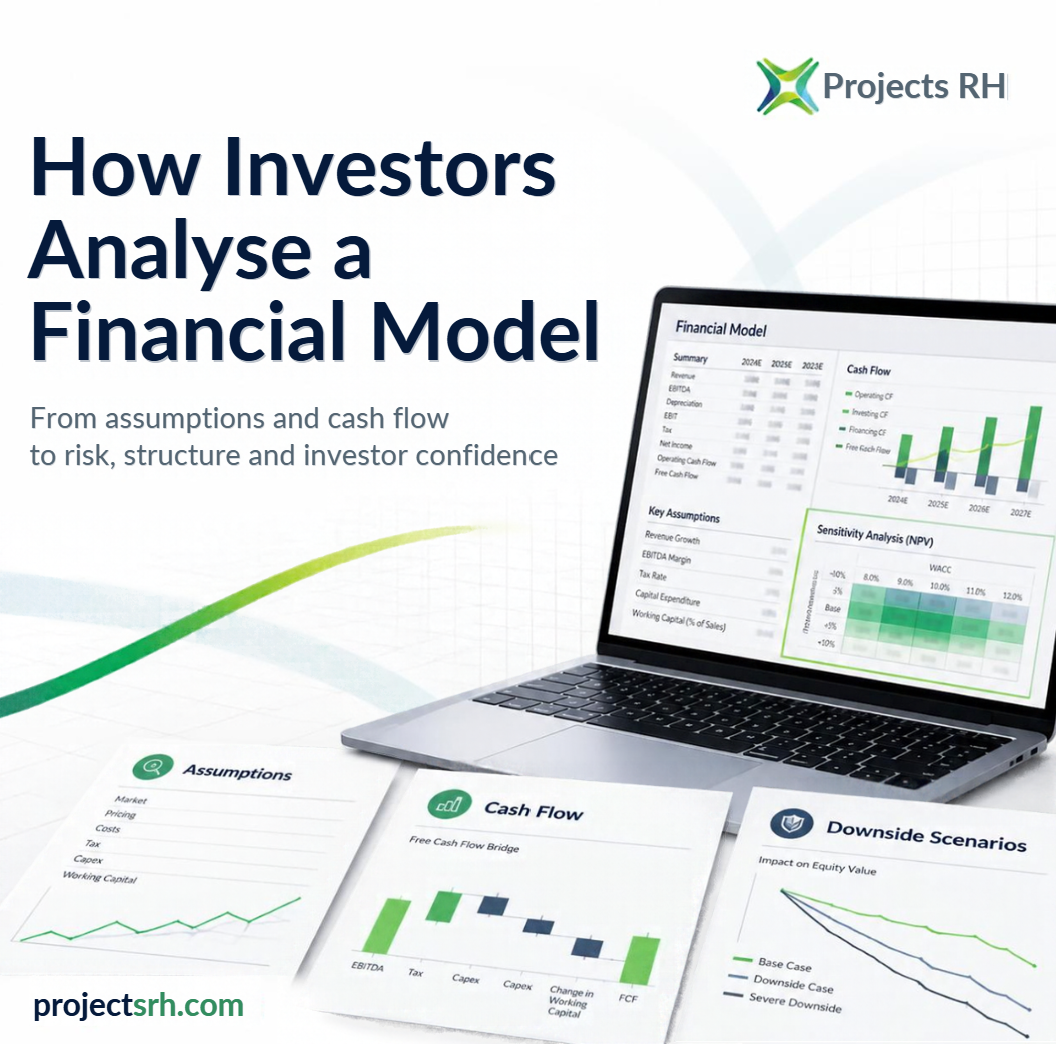
When a sponsor presents a financial model, the conversation often starts with projected returns. Investors usually start somewhere else. How investors analyse a financial model comes down to three questions. What produces the returns? Are the assumptions behind them credible? What happens when reality does not follow the forecast?
Investors do not read a model only to confirm a valuation or admire an internal rate of return. They read it to understand the economics, test the assumptions, find the risks and judge whether management understands the project it is presenting. A sound project can still stall at first review when its model raises more questions than it answers.
How Investors Analyse a Financial Model: Assumptions First
Many sponsors expect the discussion to open with the headline outputs: internal rate of return, net present value, EBITDA and payback. Experienced investors tend to open with the inputs that produce those outputs.
Revenue is usually tested first. An investor may ask:
- Is the revenue contracted or forecast?
- What evidence supports the proposed price?
- What market share and speed of adoption does the model assume?
- What happens if sales begin later than planned?
- Does revenue depend on one major counterparty?
Detailed forecasts can look precise, but precision is not evidence. Depending on the opportunity, investors may expect support from historical results, customer contracts, letters of intent, offtake agreements, pricing studies or industry benchmarks. They do not expect management to predict the future. They do expect the forecast to have a reasonable commercial basis.
Costs get the same scrutiny, and investors look hard at what has been left out. The usual gaps are working capital, development and financing costs, regulatory and professional costs, maintenance, replacement expenditure, contingency and cost escalation. A model can show attractive long-term economics and still hide a funding gap before the project reaches stable operations.
An attractive return does not make a model credible. A lower return supported by evidence can be more investable than an ambitious one built on optimism.
Cash Flow Matters More Than Accounting Profit
A company or project can report a profit and still run short of cash. Investors know this, so they follow the money. They look at operating cash flow, working-capital movements, capital expenditure, debt drawdowns, debt service, minimum cash balances and reserve requirements.
The essential question is simple: will the project have enough cash when its obligations fall due? In project finance, the project's own cash flow is often the main source of debt repayment, so the question carries particular weight.
Investors also want to see when capital is needed, which milestone each funding stage is meant to reach and what happens if costs rise. Underestimating the funding requirement is one of the quickest ways to lose an investor's confidence.
A credible model makes periods of pressure visible. It does not hide them behind a positive long-term valuation. Profitability shows whether value may be created. Cash flow decides whether the project survives long enough to create it.
Mechanics, Sensitivities and Capital Structure
Before accepting any commercial conclusion, an investor needs to trust the mechanics. A financial model review will often check whether:
- the income statement, balance sheet and cash-flow statement are properly integrated
- debt balances and interest flow from the financing schedule
- capital expenditure feeds fixed assets and depreciation correctly
- assumptions are kept separate from calculations, with checks that flag errors
A model can look polished and still be internally inconsistent. Structural integrity is an early credibility test, not a technicality.
No serious investor relies on a single forecast. Sensitivity analysis changes one assumption at a time, such as lower volumes, higher operating costs, a capital cost overrun, higher interest rates or a shift in exchange rates. Scenario analysis changes several assumptions together. For example, a lender may test whether the debt can still be serviced if construction costs rise and operations begin later than planned. The aim is not to prove the project is free of risk. It is to show that management knows where the project is most vulnerable.
The capital structure must also fit the economics. The options include sponsor equity, external equity, senior or project finance debt, mezzanine capital, private credit and a strategic partner. Each carries its own cost, conditions and timing. Investors ask whether repayment aligns with cash generation and whether the structure creates excessive leverage or dilution. The financing structure should emerge from the project's economics. It should not be imposed on a model that cannot carry it.
One Model Behind Every Document
Investor due diligence rarely looks at a model on its own. Investors compare it with the information memorandum, the pitch deck, the teaser, technical reports, commercial studies and the sources-and-uses schedule.
Suppose the model shows one funding requirement and the deck shows another. That is not an editing slip. It becomes a question of credibility: which figure is correct, which document is current and what else has not been reconciled?
The sensible discipline is to treat the model as the foundation for the memorandum, the deck and the teaser. Every investor-facing document then carries the same capital requirement, assumptions and transaction structure. Consistency builds confidence. Inconsistency creates doubt.
What the Model Says About Management
Investors are not only evaluating a spreadsheet. They are evaluating the people behind it. They want management to understand the main value drivers, explain the funding requirement and know which assumptions are most sensitive. They also want management to discuss the downside without referring every question to an adviser.
Nobody expects a chief executive to memorise formulas. But if a model looks as though it was built only for the fundraising, investors may wonder who really owns the numbers. An investor-ready financial model is one that management already uses to make decisions, before the investor meeting as well as during it.
Models most often lose investor confidence for familiar reasons. These include unsupported revenue, underestimated costs, an incomplete capital requirement, weak cash-flow planning, thin sensitivity analysis, an unsuitable capital structure, poor architecture and figures that do not match other documents. Each can be found and corrected before an investor sees the model.
What You Can Do Next with Projects RH
Projects RH works on investor readiness before any approach to capital. The firm establishes the facts, builds or tests the model and prepares documentation that an institution can test. If you want to know how your own model would read to an investor, there are three practical steps:
- Book a 20-minute discovery call. There is nothing to prepare.
- Send the documents you already have, including your current model. A person at the firm reads them and replies in writing within 3 business days.
- Commission an Investment Readiness Assessment. It gives you a Preliminary Readiness Profile in words, a gap analysis and a recommended preparation package.
Depending on what the assessment finds, preparation may mean optimising an existing model and memorandum. It may mean upgrading or rebuilding them, or developing the investment case from an earlier stage. Capital raising is a separate mandate that comes after preparation. The firm can decline it, and it is never guaranteed. You can read how we work, step by step before you decide.
Corporate Finance Institute (CFI) – Financial Modeling Best Practices https://corporatefinanceinstitute.com/resources/valuation/financial-modeling-best-practices/

What to do next
Projects RH prepares the company and the project first, then takes them to investors. The fastest way to find out where you stand is a short call.
Keep reading
Mining Finance: Why Investor Readiness Comes Before Funding
Capital for mining projects exists. What many projects lack is investor readiness: evidence an investor can test. Why preparation comes before any approach to funding.
Understanding Project Finance for Capital-Intensive Projects
Project finance is one way to fund a capital-intensive project. Here is how it differs from capital raising and M&A, and why each pathway sits under its own mandate.

Why Are Sophisticated Mining Investors Moving Toward Royalties Instead of Equity?
Learn why gold royalty companies offer diversified exposure, lower risk, and upside to gold prices. Compare royalties vs. mining stocks and streaming agreements.