
Understanding Project Finance for Capital-Intensive Projects
Project finance is one way to fund a capital-intensive project. Here is how it differs from capital raising and M&A, and why each pathway sits under its own mandate.
If you are sponsoring a capital-intensive project, one of the first questions is how it will be paid for. Project finance is one answer, but not the only one. Capital raising and M&A are pathways too. Each works differently and suits different projects, and at Projects RH each sits under its own separately assessed mandate. This article sets out the differences, so you can think about which might suit your project before you commit to one.
What project finance means
In broad terms, project finance is funding arranged for one defined project rather than for a company as a whole. The project is usually held in its own company. Lenders look mainly to the cash the project itself is expected to generate to repay what they lend, rather than to the sponsor's wider balance sheet.
The funding is normally a mix of debt and equity. The sponsor and any equity partners put in capital first. Lenders then provide debt against the project's expected cash flows. This approach is common for infrastructure funding and in renewable energy, where a single asset can carry long-term contracts and predictable revenue.
Because lenders rely on the project rather than on the sponsor, they test the project closely. They look at the contracts that underpin revenue, the construction and operating risks, the permits and land, and the assumptions in the financial model. A project that cannot show those things clearly will find project finance difficult, however good the underlying idea.
Project finance, capital raising and M&A: three different pathways
Sponsors often treat these as interchangeable. They are not. Each answers a different question about the project and its owners.
- Project finance funds a single defined project, with debt repaid mainly from that project's own cash flows.
- Capital raising brings new equity or debt into a company or project more broadly, for example a growth equity raise, a pre-Series A round or private credit.
- M&A changes ownership: selling all or part of a business, buying one, or bringing in a strategic owner. It can involve sell-side advisory work or acquisition finance.
The pathways can overlap. A sponsor might raise equity first to reach a stage where project debt becomes possible. Another might decide that bringing in a strategic owner is a better route than borrowing at all. The right choice depends on where the project stands, what contracts and permits are in place, what the sponsor wants to keep, and what the sponsor is prepared to give up.
None of these pathways is better in general. What matters is which one fits the facts of your project, and whether those facts are documented well enough for an institution to test them.
Why each pathway needs its own mandate
Projects RH separates preparing a project from taking it to capital. In the firm's words, preparation is paid professional work, and capital raising follows only under a separate mandate, in which nothing is promised.
The same applies across pathways. A project finance mandate, a capital raising mandate and an M&A mandate are each assessed on their own and accepted or declined on their own. A project that is well prepared for one route is not automatically suited to another. A mandate can be declined.
This matters for you as a sponsor. Before you choose, you get a clear view of which route the project can support. You also do not spend time and money pursuing a pathway the project is not yet ready for.
What an institutional reader tests first
The firm's starting point is simple: most projects do not need investors first. They need to become investor-ready.
Whichever pathway you choose, the people reading your material will ask the same broad questions. Projects RH describes its work in four stages: establish the facts, build the financial foundation, prepare the documentation, and define the transaction pathway. In practice, a lender or investor will want to see:
- The facts: what exists today, including land, permits, contracts and the sponsor's track record, stated plainly and supported by evidence.
- The model: a financial model that an institution can test, with assumptions it can follow and challenge.
- The documentation: a memorandum, a deck and a teaser that tell the same story as the model.
- The funding strategy: a clear view of how much is needed, in what form, and in what order.
For project finance in particular, the model and the contracts carry more weight than in many equity raises, because the lender's repayment depends on them. For M&A, the emphasis shifts towards the business's history and what a buyer would be acquiring. Project finance preparation is therefore not the same exercise as preparing for a sale, even if much of the underlying evidence is shared.
How preparation works with Projects RH
The firm works in five steps, with a decision at the end of each. You can read the full detail on how we work.
First, you book a 20-minute discovery call. There is nothing to prepare, and every project is asked the same questions.
Second, you send the documents that already exist. Nothing new needs to be prepared. A person at the firm reads what you send and replies in writing within 3 business days.
Third comes the Investment Readiness Assessment. This is AI-assisted research on the project and its sponsor, reviewed and approved by a professional before release. You receive a Preliminary Readiness Profile written in words, a gap analysis and a recommended package.
Fourth is preparation. Depending on what already exists, this can mean reviewing and optimising your model and investor materials, upgrading or rebuilding them, or developing the investment case for an earlier-stage project. Each deliverable is reviewed by a professional. You attend a workshop with the people who can make decisions, and you approve the output.
Fifth, and only under a separately accepted mandate, comes capital raising. This is where the choice between project finance, a broader capital raise or an M&A route becomes a formal engagement. It is never guaranteed.
What you can do next with Projects RH
If you are weighing project finance against other routes, the most useful next step is to let the firm see what you already have.
You can send your project documents by upload, by email or by connecting SharePoint or OneDrive. Send whatever exists. A person at the firm will read it and reply in writing within 3 business days. No confidentiality agreement is in place at this stage. If your documents are confidential, ask for the firm's agreement first and send them once it is accepted.
You can also book a 20-minute discovery call first if you would rather talk before sending anything.
Either way, sending documents does not create an advisory, investment, mandate or funding relationship. It does not guarantee acceptance or access to capital. It gives you a written response from people who prepare projects for institutional review. You can then decide, with better information, which pathway your project should take.

What to do next
Projects RH prepares the company and the project first, then takes them to investors. The fastest way to find out where you stand is a short call.
Keep reading
Mining Finance: Why Investor Readiness Comes Before Funding
Capital for mining projects exists. What many projects lack is investor readiness: evidence an investor can test. Why preparation comes before any approach to funding.
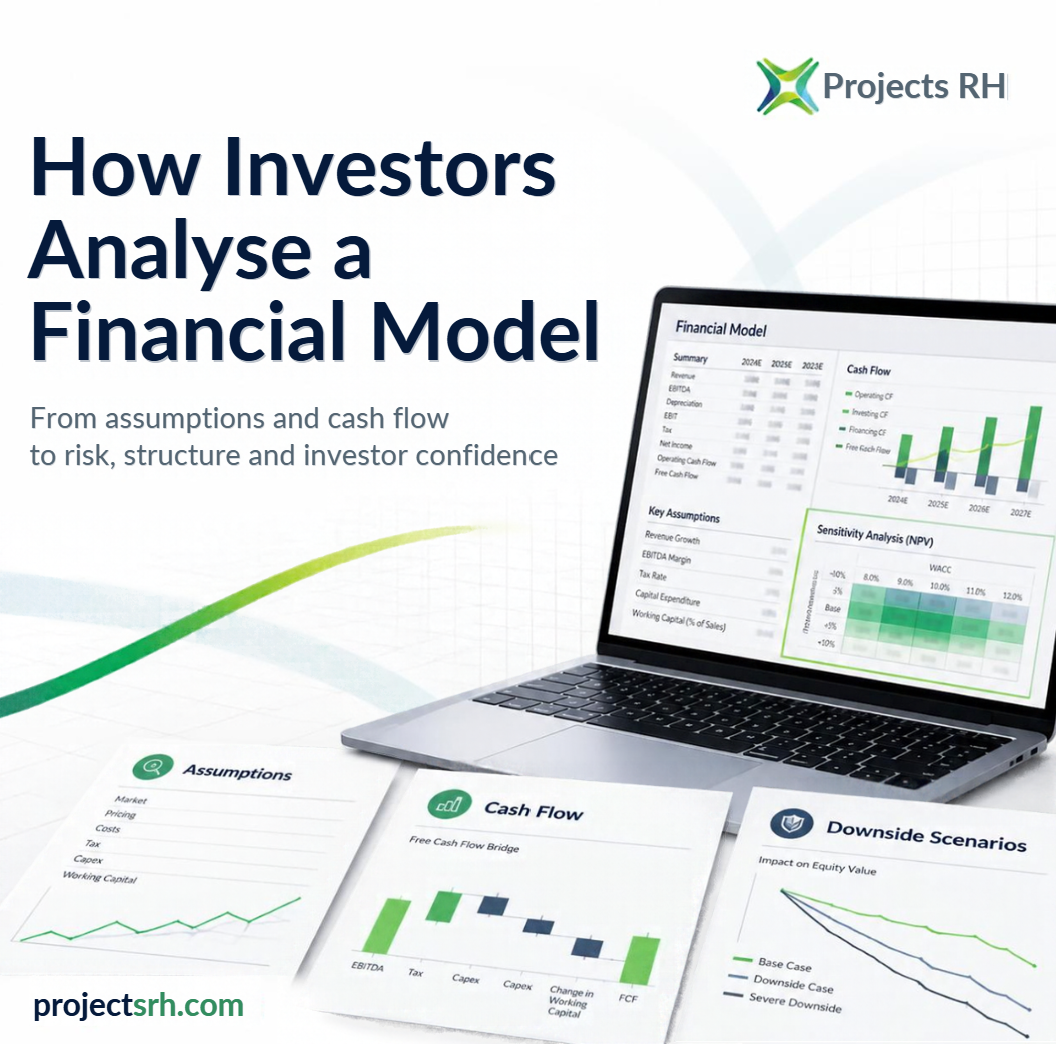
How Investors Analyse a Financial Model, and What They Test
Investors test assumptions, cash flow, mechanics and capital structure before returns. What they look for in a financial model, and what an investor-ready model must show.

Why Are Sophisticated Mining Investors Moving Toward Royalties Instead of Equity?
Learn why gold royalty companies offer diversified exposure, lower risk, and upside to gold prices. Compare royalties vs. mining stocks and streaming agreements.