
Capital Raising Partners: Why One Coordinated Case Matters
Capital raising draws on many disciplines. How Projects RH works with strategic partners on one coordinated investment case, and the two rules every referral follows.
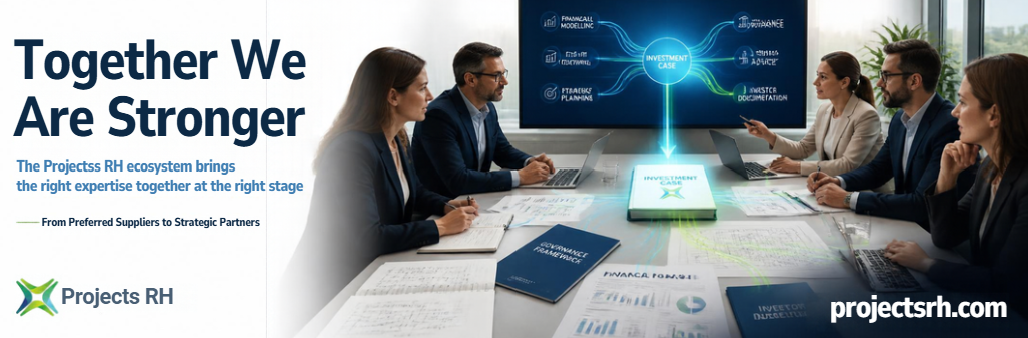
Capital raising partners bring together the specialist expertise a project may need before approaching institutional investors. In 2026, a credible investment case can require financial modelling, accounting, governance, commercial and technical input, specialist advice, digital capabilities and institutional-quality documentation. No single firm necessarily provides every capability best.
That is the thinking behind the Projects RH ecosystem: professional firms, specialists and advisers working alongside Projects RH's investor-readiness and project-preparation work. Each contributes within its area of expertise, while the project is prepared around a consistent investment case.
Together we are stronger.
From Preferred Suppliers to a Strategic Partner Ecosystem The origins of this approach go back to 2020.
In December of that year, looking back on a period that fundamentally changed the way organisations worked, one lesson stood out: people still deal with people, but professional collaboration no longer needs to be defined by geography.
The rapid adoption of video meetings demonstrated how specialists in different cities and countries could contribute effectively to the same project. Clients were also looking for increasingly coordinated solutions rather than a collection of disconnected services.
What Projects RH had once thought of as preferred suppliers gradually developed into something broader: strategic partners.
By 2026, that principle has evolved into an international partner ecosystem around project preparation and investor readiness. The objective is not to have one adviser attempt to perform every function. It is to bring the right expertise to the right issue at the appropriate stage, while maintaining a coherent investment case.
This approach is relevant in a market where institutional preparation continues to matter. The World Bank Group describes systematic preparation as crucial to developing bankable PPP projects and says Project Preparation Facilities can improve project-development quality and help projects become investment-ready. Why Capital Raising Partners Bring Multiple Disciplines Together Projects approaching institutional capital may need to withstand questions from several directions at once.
Are the financial assumptions supported? Is the development plan credible? Is appropriate governance in place? Does the management team have the capabilities required to execute the project? Are material claims supported by appropriate evidence? Do the financial model and investor documents tell the same story?
Those questions cross professional disciplines.
Within the Projects RH ecosystem, relevant specialist capabilities may include: • accounting and financial information • financial modelling and financial structuring • business and strategic planning • executive search and board or advisory board appointments • corporate and transaction advisory • business finance • specialist technical and professional advice • corporate communications • websites, digital marketing and brand development • technology and digital platforms
The value of the ecosystem is not measured by the number of specialists involved.
It comes from bringing in relevant expertise when a project requires it and coordinating those contributions around a consistent investment case. Coordination matters as much as expertise.
A strong financial model cannot compensate for investor materials built on different assumptions. Good corporate positioning cannot resolve unsupported financial or technical claims. Specialist work is most valuable when it strengthens the broader preparation of the project rather than operating in isolation.
That principle also aligns with the continuing institutional emphasis on governance. The International Finance Corporation states that good corporate governance can help companies operate more efficiently, improve access to capital, mitigate risk and strengthen accountability and transparency to investors.
How the Projects RH Partner Model Works in 2026
The Projects RH partner model brings together professional firms, specialists and advisers who may introduce an appropriate project, contribute relevant professional expertise, or work alongside the preparation process.
Two principles remain central.
First, a referral is attributed in writing before anything moves.
When a Strategic Ally introduces a project, the relationship is recorded so that the origin of the referral is clear from the beginning.
Second, a referred project must still go through the Projects RH assessment and preparation process.
An introduction does not mean that a project automatically progresses to preparation or capital raising. Referral and qualification are separate.
That distinction is important. The partner ecosystem is not simply an introduction network. Its purpose is to make appropriate specialist capabilities available around projects that are being assessed or prepared for institutional review.
Different partners can therefore have different roles. One may introduce a project. Another may contribute professional expertise required by that project.
Others may support specific elements outside Projects RH's own scope.
The role depends on the project, the expertise required and the agreed engagement. What Projects RH Does Within the Partner Ecosystem
Strategic partners provide complementary capabilities. Projects RH retains responsibility for its own investor-readiness and project-preparation work.
That work focuses on establishing the available facts, building or testing the financial foundation, identifying material gaps and preparing institutional investment documentation.
Depending on the project's starting point and the agreed scope, preparation may bring together five connected components: • Financial model. The numerical foundation supporting the investment case and its principal financial assumptions. • Information memorandum. The detailed investment case covering the project, development plan, structure, economics and material risks. • Investor deck. A concise presentation of the same underlying investment case for investor discussions. • Teaser. A short introduction to the opportunity for appropriate early-stage engagement. • Data room. An organised body of supporting corporate, financial, technical, contractual and other relevant information for review and due diligence.
The objective is not simply to produce documents. It is to create consistency between them.
The assumptions presented in the investor deck should reconcile with the financial model. The information memorandum should reflect the same investment case. Material claims should be traceable to appropriate supporting information.
The partner ecosystem adds specialist depth where required, while Projects RH's preparation work focuses on bringing the investment case together.
How Investor Readiness and Capital Raising Remain Separate Investor readiness and capital raising are connected, but they remain separate stages.
Investor readiness is preparation.
It involves understanding the available information, examining the financial foundation, identifying material gaps and developing a coherent investment case before a formal approach to potential capital providers.
Capital raising comes later.
At Projects RH, capital raising is considered under a separate mandate. Completing an assessment or preparation engagement does not automatically create a capital raising mandate.
The same principle applies when a project has been introduced by a Strategic Ally.
A referral does not guarantee acceptance of a mandate. Preparation does not guarantee investor interest. Participation in the Projects RH partner ecosystem does not guarantee financing, lender approval, transaction terms or completion.
The sequence is therefore deliberate: Project → Assessment → Preparation → Investor Readiness → Separate Mandate Decision
The objective is to identify and address material preparation issues before the project reaches the capital market, rather than relying on investors or lenders to identify those issues for the first time.
This emphasis on preparation remains highly relevant in 2026. Current World Bank Group resources continue to describe project-preparation support in terms of developing well-structured and investment-ready projects.
How to Start with Projects RH in 2026
There are two principal routes into the Projects RH ecosystem: as a project owner or as a professional firm, adviser or specialist.
For Project Owners
If you have a capital-intensive project and want to understand how prepared it is for institutional review, start with the information that already exists.
There is no need to create a new presentation or financial model simply for an initial conversation.
You can begin with a complimentary 20-minute discovery call and explain the project, its current stage, the capital objective and the documentation already available.
Where relevant documentation already exists, it can then form the starting point for the Projects RH intake and assessment process.
If information is confidential or commercially sensitive, an appropriate confidentiality agreement should be in place before material requiring contractual protection is provided.
If a Projects RH Strategic Ally introduced the opportunity, identify that Strategic Ally so the referral can be recorded appropriately.
The purpose of the initial process is not to promise capital. It is to understand the project, establish its current level of preparation and determine what work may be required before institutional engagement.
Book a 20-minute discovery call: https://projectsrh.com/book
For Professional Firms, Advisers and Strategic Partners
Professional firms, advisers and specialist practitioners can participate in the Projects RH ecosystem where their expertise or relationships are relevant.
A potential Strategic Ally may introduce a project that could benefit from investor-readiness preparation or provide specialist capabilities relevant to a project already being prepared.
The purpose is not to replace the professional role of each participant. Each specialist remains responsible for the work for which that specialist is engaged, while Projects RH remains responsible for its agreed investor-readiness and project-preparation scope.
In 2026, the principle remains simple:
The right project. The right preparation. The right expertise at the right stage. Together we are stronger.
Paul Raftery CEO Projects RH
Sources • World Bank Group – PPP Project Preparation. The World Bank Group states that a systematic process is important for preparing bankable PPP projects and describes Project Preparation Facilities as supporting project-development quality and investment readiness. PPP Project Preparation – World Bank Group • World Bank Group – Financial Solutions for Private Capital Mobilization and Project Preparation. Current World Bank Group material describes its Grant Facility for Project Preparation as supporting borrowers in overcoming project-preparation barriers and helping projects become well-structured and investment-ready. World Bank Group Financial Solutions • International Finance Corporation – Corporate Governance. IFC states that good corporate governance can improve access to capital, mitigate risk and strengthen accountability and transparency to investors. Corporate Governance – IFC

What to do next
Projects RH prepares the company and the project first, then takes them to investors. The fastest way to find out where you stand is a short call.
Keep reading
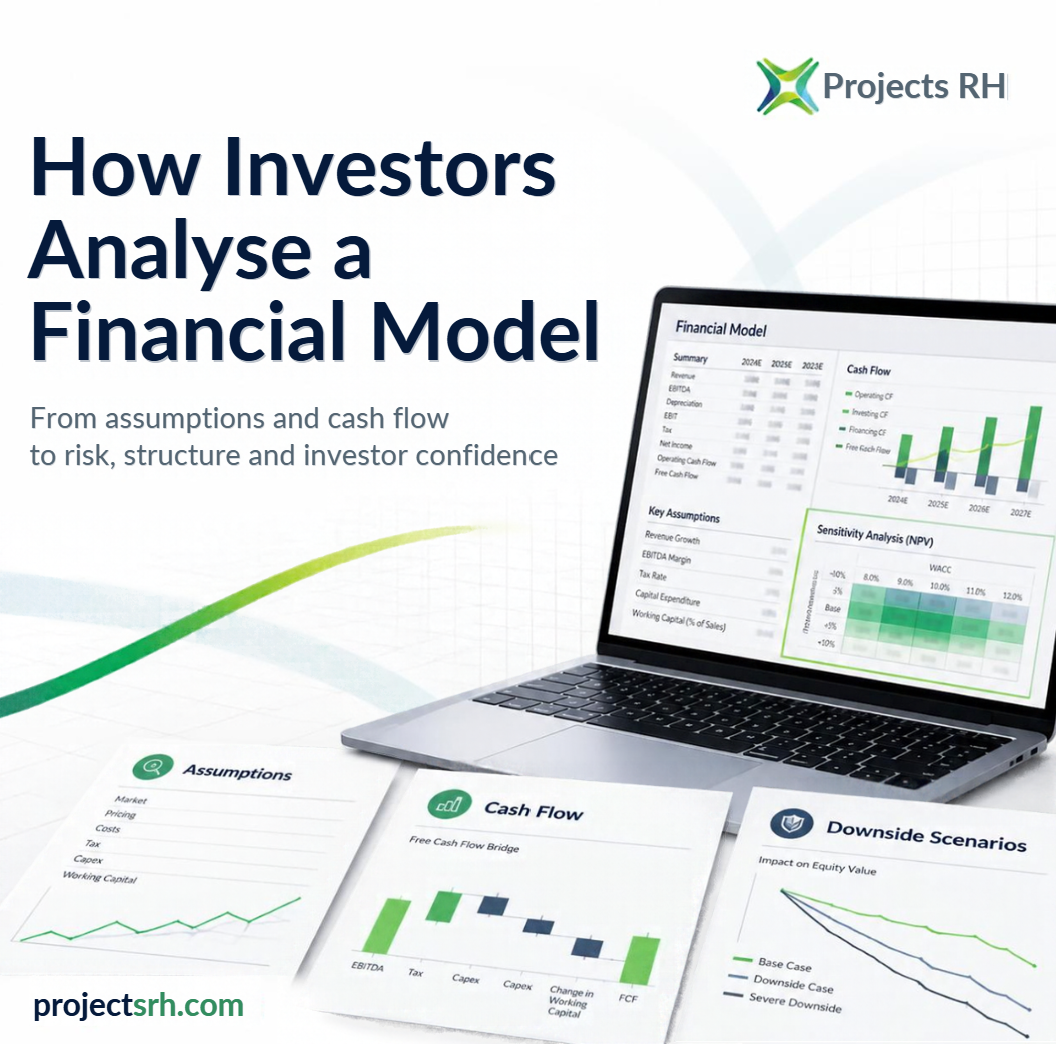
How Investors Analyse a Financial Model, and What They Test
Investors test assumptions, cash flow, mechanics and capital structure before returns. What they look for in a financial model, and what an investor-ready model must show.
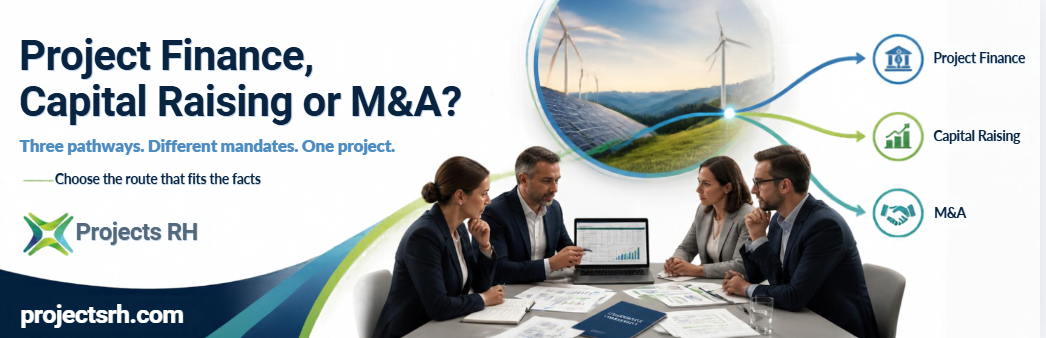
Understanding Project Finance for Capital-Intensive Projects
Project finance is one way to fund a capital-intensive project. Here is how it differs from capital raising and M&A, and why each pathway sits under its own mandate.
Project Preparation Comes Before Capital Raising
Why the file that reaches investors must be built and tested before any approach to the market, and who on a project team needs to be involved.