
Debt Sculpting in Project Finance: Matching Repayment to Cash Flow
Debt sculpting in project finance matches repayment to CFADS. Learn how DSCR, tenor, LLCR and lender assumptions determine sustainable debt capacity.
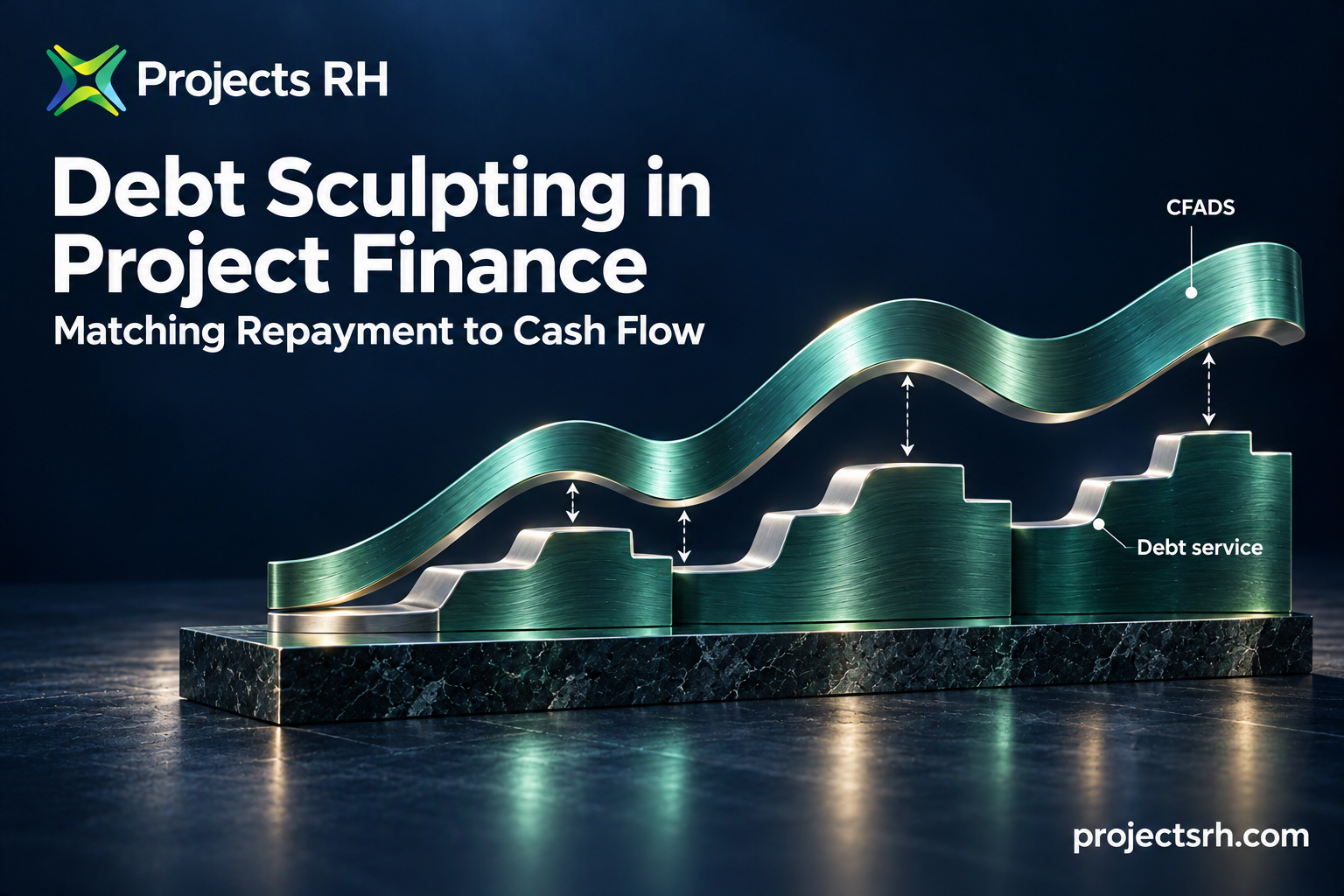
Debt sculpting in project finance matches scheduled debt repayment to the cash flow a project is expected to generate rather than forcing the project into equal principal payments.
For sponsors, developers and finance teams, debt sculpting answers one of the central questions in project finance:
How much debt can sustainable project cash flow support, over what period and with what margin of safety for lenders?
The answer sits inside the financial model.
Cash Flow Available for Debt Service, or CFADS, establishes the cash available to meet financing obligations. The lender's target Debt Service Coverage Ratio, or DSCR, determines how much of that cash can be used for debt service. Tenor defines how long the repayment period lasts.
Together, these variables can materially influence debt capacity.
Debt sculpting does not create cash flow. It structures debt service around the cash flow the project can credibly support.
That distinction is critical for sponsors preparing a project for institutional lenders.
What Debt Sculpting in Project Finance Means
A conventional loan may repay equal principal or maintain broadly level debt service.
That can work when cash flow is relatively stable.
Project cash flow often is not.
A renewable-energy project's output may change over time.
A toll road may require several years to reach mature traffic levels.
A mine may move through different grades, production volumes and operating costs across its mine plan.
An infrastructure concession may contain indexed tariffs, stepped pricing or major maintenance expenditure at specific intervals.
A fixed repayment schedule can therefore create unnecessarily high debt service during weak cash-flow periods and relatively low debt service during stronger periods.
Debt sculpting in project finance reverses this logic.
Instead of starting with a predetermined principal repayment schedule, sculpting starts with forecast CFADS and determines the debt service that the project can support while maintaining an agreed target DSCR.
Conceptually:
Debt Service = CFADS / Target DSCR
If cash flow increases, permitted debt service may increase.
If cash flow decreases, permitted debt service decreases.
The resulting amortisation profile follows the economics of the project more closely.
CFADS: The Cash Flow Supporting Project Debt
Everything begins with Cash Flow Available for Debt Service.
CFADS represents the cash available to pay interest and principal after relevant project operating costs, taxes, working-capital movements and other permitted items have been considered.
The precise definition depends on the financing documents and transaction.
A simplified conceptual calculation may look like:
Revenue
− Operating Costs
− Taxes
± Working Capital Movements
− Relevant Maintenance or Lifecycle Expenditure
± Permitted Adjustments
= CFADS
CFADS is not automatically the same as EBITDA.
That distinction matters.
A project can show attractive EBITDA while having substantially less cash available for debt service because of:
- Taxes
- Working capital
- Maintenance expenditure
- Reserve requirements
- Lifecycle costs
- Other cash obligations
Debt should therefore be sized against an appropriate cash-flow measure rather than accounting earnings alone.
Why CFADS Must Be Evidence-Based
Debt sculpting cannot compensate for weak cash-flow assumptions.
If CFADS is overstated, debt capacity will also be overstated.
Revenue assumptions should therefore trace to appropriate evidence such as:
- Offtake agreements
- Power purchase agreements
- Tolling agreements
- Capacity contracts
- Tariffs
- Customer contracts
- Independent market studies
- Resource assessments
- Production forecasts
- Historical operating data
Operating assumptions may need support from:
- O&M agreements
- Supplier quotations
- Technical studies
- Maintenance plans
- Insurance assumptions
- Labour costs
- Feedstock contracts
- Grid or transportation charges
The lender case may also differ from the sponsor's case.
A sponsor may model its expected operating outcome.
A lender may size debt using more conservative assumptions.
A robust project finance model should be able to show both.
DSCR: The Core Debt Sculpting Ratio
The Debt Service Coverage Ratio, or DSCR, compares CFADS with scheduled debt service.
Conceptually:
DSCR = CFADS / Debt Service
Consider a project with:
- CFADS: US$15 million
- Scheduled debt service: US$10 million
The resulting DSCR is:
US$15 million / US$10 million = 1.50x
This means the project generates 1.50 times the cash required for scheduled debt service in that period.
The difference provides a financial cushion.
If CFADS falls to US$12 million while debt service remains US$10 million:
DSCR = 1.20x
The margin protecting the lender has narrowed materially.
Target DSCR Determines Permitted Debt Service
In a sculpted repayment structure, the calculation can be reversed.
If:
CFADS = US$15 million
and:
Target DSCR = 1.50x
then permitted debt service is:
US$15 million / 1.50 = US$10 million
If CFADS rises to US$18 million:
US$18 million / 1.50 = US$12 million
The debt-service profile therefore follows available cash flow while maintaining the target coverage ratio.
That is the central logic behind debt sculpting.
The Target DSCR Is Not Arbitrary
The appropriate target DSCR depends on the risk characteristics of the project and lender requirements.
Factors can include:
- Revenue certainty
- Contract duration
- Counterparty creditworthiness
- Commodity-price exposure
- Demand risk
- Technology risk
- Operating history
- Construction risk
- Regulatory exposure
- Jurisdiction
- Financing structure
Cash flow supported by a long-term contract with a strong counterparty may be evaluated differently from merchant or volatile revenue.
The sponsor should therefore not simply select a DSCR that produces the preferred debt amount.
The target coverage needs to reflect the credit and risk characteristics of the transaction.
How Debt Sculpting Sizes Project Debt
Once permitted debt service has been established over the financing period, the debt model can determine the principal amount that those future payments can support.
Conceptually, the process is:
- Forecast CFADS for each debt-service period.
- Apply the target DSCR.
- Calculate permitted debt service.
- Determine interest.
- Calculate the principal repayment available within debt service.
- Repeat across the financing tenor.
- Determine the opening debt balance that can be amortised through those payments.
The resulting debt amount represents cash-flow-driven debt capacity.
But that does not necessarily mean the lender will provide that full amount.
Other financing constraints can apply.
Debt Sculpting Is Only One Constraint on Debt Capacity
DSCR-based sculpting should not be analysed in isolation.
A lender may also apply:
- Maximum leverage
- Debt-to-equity requirements
- Minimum equity contribution
- Loan Life Coverage Ratio
- Project Life Coverage Ratio
- Maximum tenor
- Minimum tail
- Reserve requirements
- Concentration limits
- Credit constraints
The final debt amount may therefore be the lowest amount permitted by several different tests.
For example:
DSCR-Based Capacity = US$125 million
Maximum Gearing Capacity = US$110 million
LLCR-Based Capacity = US$118 million
In this illustration, debt may be constrained to approximately US$110 million by gearing rather than DSCR.
A model that tests only DSCR can therefore overstate realistic debt capacity.
LLCR: Looking Across the Remaining Loan Life
The Loan Life Coverage Ratio, or LLCR, provides another view of debt capacity.
Conceptually, LLCR compares the present value of CFADS available during the remaining loan life with outstanding debt.
A simplified representation is:
LLCR = Present Value of CFADS During Loan Life / Outstanding Debt
While DSCR measures coverage in individual periods, LLCR considers cash flow across the remaining life of the loan.
This can help lenders understand overall repayment capacity rather than focusing exclusively on one year's coverage.
A project finance model should therefore be capable of calculating both periodic coverage and broader loan-life coverage where appropriate.
PLCR: Looking Beyond the Loan Tenor
The Project Life Coverage Ratio, or PLCR, considers CFADS across the remaining economic life of the project rather than only the remaining loan life.
Conceptually:
PLCR = Present Value of CFADS During Project Life / Outstanding Debt
The distinction between LLCR and PLCR matters when the project continues generating cash after scheduled debt maturity.
That period after final debt repayment can create additional lender protection.
The Debt Tail Matters
Project lenders frequently want debt to mature before the underlying revenue contract or project life ends.
The remaining period is commonly referred to as the tail.
For example:
- Revenue contract remaining life: 20 years
- Debt tenor: 17 years
The structure leaves a three-year tail.
The tail can provide additional flexibility if the project experiences weaker-than-expected performance during the scheduled debt period.
A model should therefore connect:
Contract Life → Project Life → Debt Tenor → Tail
A debt schedule that extends beyond the reliable revenue period can create significant refinancing or repayment risk.
Tenor Changes Debt Capacity
A longer debt tenor spreads scheduled repayment over more periods.
Everything else equal, that can increase the amount of debt supported by project cash flow.
But longer tenor also extends lender exposure.
Lenders may therefore consider:
- Remaining contract duration
- Asset life
- Technology life
- Major maintenance
- Resource life
- Concession expiry
- Counterparty exposure
- Refinancing risk
A financial model should make tenor an explicit assumption that can be tested.
Sponsors should be able to demonstrate what happens to debt capacity under:
- Shorter tenor
- Base tenor
- Longer tenor
This helps distinguish debt capacity created by underlying project economics from debt capacity created simply by extending repayment.
Sculpted Versus Level Debt Service
A project finance model should often be capable of comparing different amortisation profiles.
Level Debt Service
Total scheduled debt service remains broadly constant.
Straight-Line Principal
Principal repayments remain constant while total debt service generally declines as interest declines.
Sculpted Debt Service
Debt service changes according to CFADS and the target DSCR.
Where CFADS is uneven, sculpting can reduce pressure on weaker periods while using stronger periods to support higher repayment.
But no repayment structure can make an uneconomic project financeable.
Debt sculpting reallocates repayment.
It does not generate additional project cash.
Sculpting and Seasonal Cash Flow
Some projects generate strongly seasonal revenue.
Examples can include:
- Renewable energy
- Agriculture-related infrastructure
- Tourism infrastructure
- Seasonal transport
- Hydropower
If debt service occurs semi-annually while cash generation is highly seasonal, the model needs to consider cash timing carefully.
Annual DSCR alone may hide liquidity pressure inside the year.
The financial model should therefore align:
- Cash receipts
- Operating expenditure
- Reserve movements
- Debt-service dates
Timing matters as much as annual totals.
Debt Service Reserve Accounts
A project financing may require a Debt Service Reserve Account, or DSRA.
A DSRA provides additional liquidity for debt service when project cash flow is temporarily insufficient.
Depending on the transaction, the required reserve might be defined by reference to future debt service.
The important modelling questions are:
- How much reserve is required?
- When is the DSRA funded?
- Is it funded from equity?
- Is it funded from debt proceeds?
- Can it be funded through a letter of credit?
- When can excess reserves be released?
- How is the reserve replenished after use?
The DSRA can affect:
- Initial capital requirement
- Debt drawdown
- Sponsor equity
- Cash distributions
- Project returns
It should therefore be integrated into the complete financing model.
Sculpting Can Create Circularity
Debt sculpting can introduce circular calculations.
Debt size affects interest.
Interest affects debt service.
Debt service affects the repayment profile.
Financing fees may depend on debt size.
Interest during construction may also affect the project's funding requirement.
The model therefore needs a transparent and stable method for resolving circularity.
This is one reason project finance models are typically tested carefully before they are used for lender discussions.
A debt schedule that has been manually typed to reach a desired result is fundamentally different from one that recalculates dynamically when assumptions change.
Debt Sculpting and Construction Financing
Cash-flow sculpting primarily concerns operating-period repayment.
But the construction period affects the starting debt balance.
The model may need to account for:
- Construction drawdowns
- Equity drawdowns
- Interest during construction
- Commitment fees
- Financing fees
- Capitalised interest
- Contingency
- Delayed commercial operation
If construction costs rise, the required financing can increase.
If completion is delayed, interest during construction can increase.
If the lender limits the debt amount, additional cost may need to be funded by equity.
The operating debt schedule therefore cannot be separated completely from the construction financing plan.
Sponsor Case Versus Lender Case
A sponsor should not wait for a lender to create the first downside case.
Before approaching debt providers, the model should be capable of showing at least:
Sponsor Case
Management's evidence-based central assumptions.
Lender Case
A more conservative case using assumptions appropriate for credit analysis.
Downside Case
A scenario testing material adverse movements.
Differences might include:
- Revenue
- Production
- Utilisation
- Availability
- Operating costs
- Completion date
- Interest rate
- Foreign exchange
- Major maintenance
The important point is transparency.
Sponsors should understand how much debt disappears when assumptions become more conservative.
Stress Testing Debt Sculpting
A debt model should respond dynamically when project assumptions change.
Relevant stresses can include:
- 10% lower revenue
- 10% higher operating costs
- Construction delay
- Higher interest rates
- Lower production
- Reduced utilisation
- Lower availability
- Higher lifecycle CapEx
- Foreign-exchange movements
- Counterparty stress
The model should then show effects on:
- CFADS
- DSCR
- LLCR
- Debt capacity
- Repayment
- Closing debt
- Distributions
- Equity returns
A sponsor should understand these relationships before lender due diligence begins.
Balloon Repayments and Refinancing Risk
A balloon repayment leaves a material amount of principal outstanding at scheduled maturity.
This can lower scheduled amortisation during the operating period.
But the remaining balance still needs to be repaid.
That may depend on:
- Refinancing
- Asset sale
- Sponsor funding
- Accumulated cash
- Other financing
A balloon can therefore introduce refinancing risk.
A credible model should not simply assume that refinancing will always be available on attractive terms.
Sponsors should test:
- Lower refinancing proceeds
- Higher refinancing cost
- Delayed refinancing
- No refinancing
If the project cannot repay the balloon without favourable future financing, that risk should be visible.
Cash Sweeps Can Reduce Debt Faster
Some financing structures use cash sweeps.
A cash sweep directs an agreed portion of excess project cash toward accelerated debt repayment.
This can:
- Reduce outstanding principal
- Shorten effective debt life
- Reduce refinancing risk
- Reduce future interest
But it can also delay distributions to equity.
The sponsor should therefore evaluate both lender protection and shareholder economics.
Debt Sculpting Changes Equity Cash Flow
A project can generate the same underlying operating cash flow under different financing structures while producing significantly different equity distributions.
Why?
Because financing determines:
- Interest
- Principal repayment
- Reserve funding
- Cash sweeps
- Distribution lock-ups
- Refinancing obligations
This means sponsors should analyse both:
Project Economics
and:
Equity Economics
Debt structuring can influence Equity IRR even when underlying Project IRR remains unchanged.
The Model Must Match the Term Sheet
When a lender provides an indicative term sheet, the financing assumptions in the model should be updated.
Relevant terms may include:
- Facility amount
- Interest margin
- Reference rate
- Fees
- Tenor
- Grace period
- Target DSCR
- Amortisation
- DSRA
- Cash sweep
- Distribution tests
- Hedging
- Conditions precedent
The sponsor can then compare:
Original Financing Assumptions → Proposed Lender Terms → Revised Equity Outcomes
That is much more useful than evaluating a term sheet solely on the headline interest rate.
The Model Must Match the Information Memorandum
Debt assumptions appearing in investor documentation should reconcile with the project finance model.
That applies to:
- Capital requirement
- Sources & Uses
- Debt amount
- Equity requirement
- Interest
- Tenor
- Cash flow
- Investor returns
- Sensitivities
If the information memorandum states one funding requirement while the model produces another, the transaction materials immediately become harder to rely upon.
Projects RH treats the financial model and institutional documentation as parts of the same investment case.
Sponsors can explore Projects RH Services for financial modelling, investment economics and transaction preparation support.
Common Debt Sculpting Model Errors
Before approaching lenders, sponsors should check for common problems such as:
- Debt sized from EBITDA instead of appropriate CFADS
- CFADS not clearly defined
- Unsupported revenue assumptions
- Missing lifecycle CapEx
- Working capital omitted
- Incorrect tax treatment
- Target DSCR hard-coded inside formulas
- Tenor hard-coded
- Manually entered principal repayment
- No LLCR calculation
- DSRA missing
- Interest during construction understated
- Financing fees omitted
- No lender case
- No downside case
- Balloon repayment assumed refinanced automatically
- Model numbers differing from investor documents
These are not cosmetic modelling issues.
Each can affect real or perceived debt capacity.
Debt Sculpting in Project Finance Checklist
Before presenting a debt model to lenders, sponsors should be able to confirm:
- CFADS is clearly defined.
- Revenue assumptions are supported.
- Operating costs are supported.
- Taxes are correctly reflected.
- Working capital is incorporated where relevant.
- Lifecycle expenditure is included.
- Target DSCR is an explicit input.
- Tenor is an explicit input.
- Debt service is calculated dynamically.
- Principal repayment is not manually forced.
- DSCR is calculated for every relevant period.
- LLCR is calculated where appropriate.
- The debt tail is visible.
- Maximum gearing is tested.
- DSRA requirements are modelled.
- Interest during construction is included.
- Financing fees are incorporated.
- Sponsor and lender cases are separated.
- Downside scenarios have been tested.
- Balloon and refinancing risk are transparent.
- Cash sweeps are modelled where applicable.
- Debt assumptions reconcile with the information memorandum.
- Debt assumptions reconcile with the Sources & Uses.
- The current model version is clearly identified.
If several of these controls are unresolved, further model preparation may be appropriate before approaching institutional lenders.
Debt Sculpting in Project Finance and Investor Readiness
Debt sculpting in project finance is ultimately part of the wider investor-readiness process.
The sequence should be:
Project Facts → Operating Assumptions → CFADS → Target DSCR → Debt Capacity → Repayment Profile → Downside Testing → Equity Outcomes → Transaction Documentation
Starting from the debt amount and forcing the financial model to support it reverses the logic.
The project economics should determine sustainable financing capacity.
Sponsors can review How Projects RH Works to understand how financial modelling fits within project assessment, preparation and capital raising.
What Lenders Ultimately Need to Understand
Project finance lenders depend heavily on the project's ability to generate cash and on the contractual and security framework surrounding that cash flow.
The World Bank Group's project-finance resources highlight revenue certainty, financial ratios, financial covenants, lender protection, direct agreements and security as important issues in project-financed transactions.
That reinforces a fundamental modelling principle:
Debt capacity should be supported by defensible cash flow and risk allocation, not by the sponsor's preferred financing amount.
A sophisticated sculpting calculation cannot compensate for unsupported revenue, understated costs or unrealistic project assumptions.
Frequently Asked Questions About Debt Sculpting in Project Finance
What is debt sculpting in project finance?
Debt sculpting in project finance is the process of shaping scheduled debt service around forecast CFADS and a target DSCR so repayment better reflects the project's expected cash-generating capacity.
What is CFADS?
CFADS means Cash Flow Available for Debt Service. It represents the project cash flow available to meet scheduled interest and principal after relevant operating and other permitted cash-flow items.
What is DSCR?
Debt Service Coverage Ratio compares CFADS with scheduled debt service.
Conceptually:
DSCR = CFADS / Debt Service
How is debt service calculated when debt is sculpted?
A simplified sculpting relationship is:
Permitted Debt Service = CFADS / Target DSCR
Interest is then calculated and the remaining permitted debt service is used to repay principal.
Does a higher DSCR increase or reduce debt capacity?
All else equal, a higher target DSCR generally reduces the amount of debt service supported by a given level of CFADS and can therefore reduce debt capacity.
What is LLCR?
Loan Life Coverage Ratio compares the present value of CFADS over the remaining loan life with outstanding debt.
What is the debt tail?
The debt tail is the period between final scheduled debt repayment and the end of the relevant contracted revenue period or economic project life.
Does a longer tenor increase debt capacity?
Potentially. A longer tenor spreads repayment across more periods and can increase debt capacity, but lenders may restrict tenor according to project life, contract duration and risk.
What is a balloon repayment?
A balloon is a material amount of debt remaining at scheduled maturity. Repayment may depend on refinancing, asset sale, available cash or other funding, creating refinancing risk.
Does debt sculpting guarantee project financing?
No. Debt sculpting is a financing technique. Actual debt availability depends on lender appetite, due diligence, project economics, contracts, risk allocation, credit approvals and market conditions.
Sources
- World Bank Group - Project Finance Key Concepts
- World Bank Group - Key Issues in Developing Project Financed Transactions
- World Bank Group - Understanding Power Project Financing
- World Bank Group - Project Finance Resources
How Much Debt Can Your Project Cash Flow Support?
Projects RH helps sponsors test financial models, analyse debt capacity and prepare institutional documentation before approaching lenders and investors.
If you already have a project finance model, submit your project for assessment so the team can identify potential gaps in CFADS, debt sizing, sensitivities, investment economics and transaction readiness.
Learn more about How Projects RH Works and explore Projects RH Services.
Ready to test your project's debt capacity? Submit your project to Projects RH.

What to do next
Projects RH prepares the company and the project first, then takes them to investors. The fastest way to find out where you stand is a short call.
Keep reading

Investor Readiness: Lessons From Building Projects RH
Investor readiness starts with facts, credible economics and clear expectations. Projects RH shares the lessons that shaped its approach to project preparation.

Infrastructure Funding: Preparing Projects for Investors
Infrastructure funding requires more than capital. Learn how sponsors prepare projects for public programmes, lenders and institutional investors.

Green Hydrogen Offtake Agreement: What Makes It Financeable?
A green hydrogen offtake agreement must address price, volume, tenor, certification and buyer credit. Learn what lenders test before project finance.