
Green Hydrogen Offtake Agreement: What Makes It Financeable?
A green hydrogen offtake agreement must address price, volume, tenor, certification and buyer credit. Learn what lenders test before project finance.
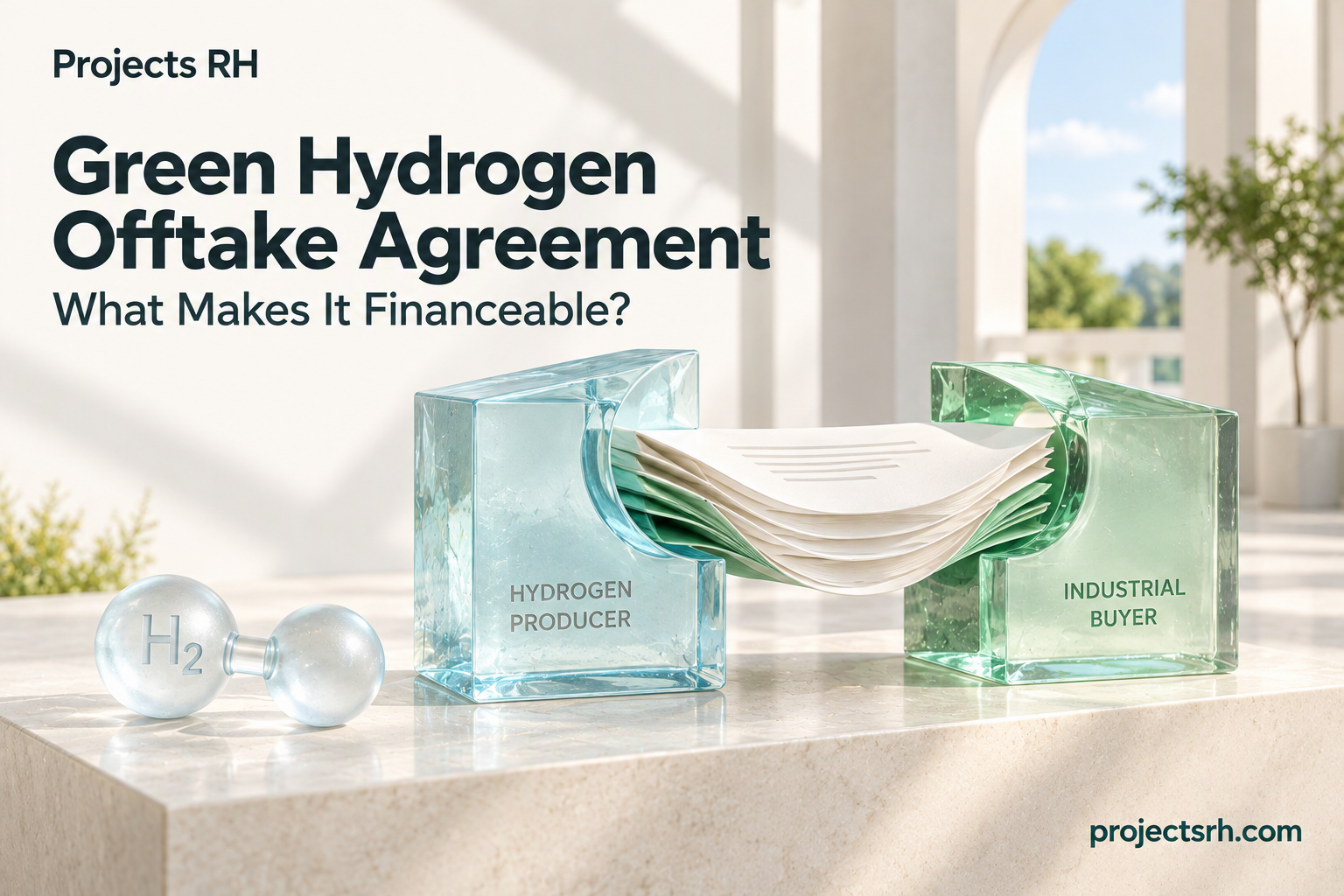
A green hydrogen offtake agreement can be one of the most important documents in determining whether a hydrogen project can support institutional debt.
Electrolysers can be specified. Renewable power can be contracted. Storage, compression and transport can be engineered.
But lenders still need to understand one fundamental commercial question:
Who will buy the hydrogen, how much will they buy, at what price, for how long and under what obligations?
That is where the offtake agreement becomes central to project bankability.
A financeable contract needs more than projected demand or a statement of interest. Investors and lenders may test volume commitments, take-or-pay protection, pricing, tenor, certification, termination rights, delivery obligations and the creditworthiness of the buyer.
A technically credible hydrogen project does not automatically create a financeable revenue stream. The offtake contract has to convert production into sufficiently predictable cash flow.
For sponsors, that commercial structure should be tested before broad capital engagement begins.
What a Green Hydrogen Offtake Agreement Must Prove
A green hydrogen offtake agreement defines the commercial relationship between the hydrogen producer and the buyer.
Depending on the project, it may address:
- Contracted volume
- Minimum purchase obligations
- Take-or-pay
- Price
- Price indexation
- Delivery point
- Product specification
- Hydrogen certification
- Renewable-energy requirements
- Transport
- Storage
- Force majeure
- Credit support
- Termination
- Change in law
- Remedies
- Contract tenor
For project finance, these provisions ultimately need to support sufficiently predictable project revenues.
The contract should therefore be evaluated not only as a commercial arrangement but also as an input into the financial model.
Why Offtake Is Central to Hydrogen Project Finance
Project finance depends substantially on project cash flow.
For green hydrogen, revenue can be particularly challenging to forecast because markets are still developing and contractual structures vary significantly between projects and jurisdictions.
Long-term offtake can therefore become an important part of the project's commercial and financing case.
The financing logic is:
Production → Contracted Volume → Price → Revenue → CFADS → Debt Service
If material uncertainty exists near the beginning of that chain, it can affect financing capacity at the end.
Take-or-Pay Can Strengthen Revenue Certainty
One of the most important provisions in a hydrogen offtake agreement can be take-or-pay.
Conceptually, a take-or-pay structure requires the buyer to pay for an agreed amount of product even when the buyer does not physically take the full contracted quantity, subject to the detailed terms and exceptions of the agreement.
From a financing perspective, this can help transfer part of the demand risk from the project to the buyer.
But the headline phrase take-or-pay is not enough.
Investors may need to understand:
- Minimum contracted quantity
- Make-up rights
- Carry-forward provisions
- Force majeure
- Buyer relief events
- Volume flexibility
- Liability caps
- Termination rights
- Payment remedies
A nominal take-or-pay arrangement with broad exceptions may provide materially less revenue protection than the headline suggests.
Volume Commitments Need to Match Actual Production
The contracted volume should connect directly to the technical case.
A project should reconcile:
Electrolyser Capacity → Operating Hours → Efficiency → Hydrogen Production → Contracted Volume
If the underlying electricity supply is variable, actual hydrogen production may also vary.
For example, a project powered predominantly by wind or solar may need to consider:
- Renewable-generation profile
- Grid electricity
- Storage
- Electrolyser turndown
- Buffer capacity
- Hydrogen storage
- Delivery flexibility
The contract should not promise a delivery profile that the technical configuration cannot reliably provide without explaining how the difference will be managed.
Contracted Volume and Nameplate Capacity Are Different
A common modelling risk is assuming that nameplate capacity translates directly into annual saleable production.
Actual output can depend on:
- Electrolyser availability
- Renewable-energy availability
- Electricity curtailment
- Maintenance
- Conversion efficiency
- Water supply
- Compression
- Storage
- Delivery constraints
The financial model should therefore distinguish between:
Nameplate Capacity → Utilisation → Gross Production → Losses → Saleable Hydrogen
Contracted volumes should be consistent with realistic saleable production.
Price Is Only Bankable if the Formula Is Understandable
A hydrogen offtake contract may use:
- Fixed pricing
- Indexed pricing
- Cost-plus pricing
- Floor pricing
- Collar mechanisms
- Benchmark-linked pricing
- Alternative-fuel parity
- Power-cost pass-through
Each approach allocates risk differently.
A fixed price can create predictable revenue but leave the producer exposed if electricity or other operating costs rise.
An indexed price can offer flexibility but introduce additional volatility.
A cost pass-through may protect certain margins but can be commercially harder for the buyer to accept.
The financial model should reproduce the actual pricing mechanism rather than use a simplified number disconnected from the agreement.
Price Floors and Ceilings Change Risk Allocation
Some contracts may use floors or ceilings.
A floor can protect the producer from very low prices.
A ceiling can protect the buyer from extreme price escalation.
Both affect project economics.
Sponsors should model:
- Base price
- Floor
- Ceiling
- Indexation
- Inflation
- Cost pass-through
- Reset mechanisms
The relevant question for a lender is not simply:
What is the expected hydrogen price?
It is:
How does contractual revenue behave when market and project conditions change?
Electricity Price Can Determine Hydrogen Margin
Electricity is a major input into electrolytic hydrogen production.
The hydrogen pricing formula therefore needs to be understood alongside the project's power arrangements.
A project can have a strong hydrogen selling price but weak margins if electricity costs rise faster.
The financial model should test:
Hydrogen Price − Electricity Cost − Other Operating Costs = Operating Margin
Where power price and hydrogen price are indexed differently, basis risk can emerge.
The offtake contract should therefore be tested against the power contract, not evaluated in isolation.
Tenor Should Align With Financing
The length of the offtake agreement matters to lenders.
If the proposed debt tenor materially exceeds the committed offtake period, the lender may need to assume future merchant or recontracted revenue.
For example:
Debt Tenor = 15 years
Firm Offtake Tenor = 10 years
The final five years create additional revenue risk.
A lender may respond by:
- Shortening debt tenor
- Reducing leverage
- Applying conservative merchant pricing
- Requiring additional coverage
- Requiring refinancing assumptions
- Requiring contract extension
Sponsors should therefore compare:
Offtake Tenor → Debt Tenor → Project Life
Buyer Creditworthiness Matters
A strong contract with a weak counterparty may provide limited protection.
Investors and lenders may examine:
- Buyer financial strength
- Credit rating
- Balance sheet
- Liquidity
- Existing obligations
- Industry exposure
- Strategic need for hydrogen
- Parent-company support
A newly formed SPV may require additional credit support.
Possible mechanisms can include:
- Parent guarantee
- Letter of credit
- Bank guarantee
- Security deposit
- Prepayment
- Other agreed credit enhancement
The strength and duration of that support can materially affect how lenders treat contracted revenue.
Buyer Demand Needs to Be Credible
Creditworthiness alone is not enough.
A lender may also ask why the buyer needs the hydrogen.
The buyer might require hydrogen for:
- Ammonia
- Refining
- Fertiliser
- Steel
- Chemicals
- Shipping fuel
- Heavy transport
- Power applications
- Synthetic fuels
The investor should understand whether the demand case depends on:
- Existing consumption
- New infrastructure
- New regulations
- New equipment
- Customer conversion
- Government support
A strong corporate buyer does not eliminate project risk if the buyer's intended hydrogen demand itself remains uncertain.
Delivery Point Determines Cost and Risk
The commercial agreement should define where delivery occurs.
Possible delivery points can include:
- Production plant gate
- Storage facility
- Pipeline connection
- Port
- Buyer's industrial facility
- Delivered destination
The delivery point and transfer of title and risk can affect which party bears:
- Compression
- Storage
- Pipeline cost
- Trucking
- Shipping
- Product losses
- Insurance
- Delivery infrastructure
The financial model should incorporate the same delivery assumption as the contract.
Hydrogen Storage Can Support Delivery Obligations
Storage may be required when production and buyer demand do not occur at the same time.
That can influence:
- CapEx
- Operating costs
- Hydrogen losses
- Compression
- Safety systems
- Land requirements
- Inventory
- Working capital
If the offtake requires continuous delivery but renewable production is variable, storage can become part of the bankability solution.
Its cost should therefore appear in the investment case.
Product Specification Must Be Defined
The contract should specify what the buyer is purchasing.
Depending on the application, requirements can include:
- Purity
- Pressure
- Temperature
- Moisture
- Delivery specification
- Certification
- Carbon intensity
Failure to meet product specifications can potentially affect:
- Acceptance
- Price
- Payment
- Remedies
- Contract performance
The technical design therefore needs to demonstrate that the project can consistently produce the contractual product.
Green Certification Can Affect Commercial Value
For renewable hydrogen, certification can have direct commercial consequences.
In the European Union, renewable hydrogen can qualify as a Renewable Fuel of Non-Biological Origin, or RFNBO, when applicable regulatory requirements are satisfied.
The European framework addresses the relationship between renewable hydrogen production and qualifying renewable electricity, including relevant additionality, temporal-correlation and geographic-correlation requirements.
For projects targeting European markets, those requirements can affect whether the product meets the contractual specification expected by the buyer.
The commercial model should therefore distinguish between:
Physical Hydrogen Production
and:
Hydrogen Qualifying for the Contracted Certification Standard
That distinction can affect both saleable volume and price.
Certification Risk Must Be Allocated
A green hydrogen offtake agreement should clarify what happens if hydrogen fails to meet applicable certification requirements.
Questions include:
- Can the buyer reject delivery?
- Is the product sold at a lower price?
- Does a replacement obligation apply?
- Who bears change-in-law risk?
- Who controls renewable-power compliance?
- Who provides certification evidence?
- What happens when certification rules change?
These questions become increasingly important when the buyer's willingness to pay a premium depends on regulatory treatment or environmental attributes.
Renewable Power Arrangements Must Support Certification
For applicable projects, renewable-hydrogen certification can depend on the underlying electricity used for electrolysis.
The investment case should therefore reconcile:
Renewable Power Contract → Electrolyser Operation → Certification → Saleable Hydrogen → Offtake Revenue
A hydrogen model that assumes premium certified revenue without demonstrating the supporting power arrangements contains a material gap.
The power assumptions in the technical model, financial model and offtake agreement should be consistent.
Regulatory Change Requires Attention
Hydrogen regulation remains an evolving area.
For a long-term contract, the parties need to consider who bears the risk if:
- Certification changes
- Carbon accounting changes
- Renewable-power requirements change
- Subsidies change
- Taxes change
- Import requirements change
The commercial and financing documents should address material change-in-law exposures appropriately.
The relevant legal treatment depends on jurisdiction and should be reviewed by qualified legal advisers.
Subsidies Should Not Replace Commercial Fundamentals
Hydrogen projects may depend partly on:
- Production incentives
- Grants
- Contracts for difference
- Tax credits
- Carbon pricing
- Demand mandates
These mechanisms can materially improve economics.
But lenders will still need to understand the commercial revenue structure.
A project should distinguish between:
Contracted Customer Revenue
and:
Public-Sector Support
Both can matter.
They represent different sources of cash flow and different risks.
Eligibility, timing, conditions and duration should be modelled transparently.
Termination Rights Can Change the Value of the Contract
A 15-year offtake agreement is not necessarily equivalent to 15 years of protected revenue.
Termination provisions can materially reduce practical certainty.
Sponsors should identify:
- Buyer termination rights
- Producer termination rights
- Termination for prolonged force majeure
- Performance termination
- Change-in-law termination
- Termination payments
- Cure periods
The financial significance is straightforward:
Contract Tenor ≠ Effective Revenue Protection if termination rights are broad
That difference should be understood before lenders review the agreement.
Force Majeure Requires Careful Analysis
Force majeure can excuse performance under specified circumstances.
The definition and consequences matter.
For hydrogen projects, relevant risks can potentially involve:
- Renewable electricity interruption
- Water disruption
- Grid constraints
- Pipeline failure
- Storage interruption
- Export infrastructure
- Port disruption
Sponsors need to understand whether a force-majeure event removes the buyer's payment obligation and for how long.
Broad relief provisions can weaken apparently strong take-or-pay commitments.
Change in Law Can Affect Both Parties
Hydrogen projects are expected to operate over long periods while regulation evolves.
Change-in-law provisions can therefore influence:
- Production cost
- Certification
- Power arrangements
- Delivery requirements
- Taxes
- Environmental compliance
The agreement should establish how material changes are treated.
This becomes particularly relevant when project finance debt extends across many years.
The Offtake Agreement Must Match the Financial Model
Lenders will compare the contract directly with the financial model.
Material items should reconcile, including:
- Contract volume
- Price
- Escalation
- Start date
- Tenor
- Availability
- Delivery point
- Product specification
- Take-or-pay
- Penalties
- Credit support
- Termination
A financial model that assumes stronger contractual protection than the actual agreement creates an obvious diligence issue.
The Contract Must Match the Technical Model
The same test applies technically.
The project should reconcile:
Power → Electrolyser → Production → Compression → Storage → Delivery → Contract Volume
If the offtake requires more hydrogen than the facility can reliably deliver, the commercial case is internally inconsistent.
The technical and financial assumptions should therefore use the same operating case.
Model the Downside, Not Only the Contracted Case
A financing model should test potential downside cases.
Relevant scenarios can include:
- Lower production
- Lower contracted volume
- Delayed buyer commissioning
- Lower hydrogen price
- Higher power cost
- Certification failure
- Lower availability
- Higher transport cost
- Contract termination
- Buyer default
The appropriate scenarios depend on the specific transaction.
The purpose is to determine how much of the investment case depends on perfect contractual performance.
Delayed Buyer Commissioning Can Become a Major Risk
Some hydrogen projects are developed in parallel with new industrial facilities that will consume the product.
This creates interface risk.
A hydrogen plant can potentially become operational before the buyer's facility is ready.
Questions include:
- Does take-or-pay begin anyway?
- Can deliveries be deferred?
- Who bears storage costs?
- Can hydrogen be sold elsewhere?
- Is there an alternative market?
The contract should allocate this risk explicitly.
Otherwise, a delay outside the producer's control can create an unexpected revenue gap.
Alternative Buyers Can Strengthen Resilience
A project with one buyer carries concentration risk.
Where technically and commercially possible, sponsors may consider:
- Multiple customers
- Alternative industrial users
- Merchant sales
- Export routes
- Hydrogen derivatives
Alternative markets are not automatically financeable revenue.
But credible optionality can strengthen project resilience if the primary offtaker experiences difficulty.
Any alternative-sales assumptions should be evidence-based.
Hydrogen Derivatives Change the Contract Structure
Some projects convert hydrogen into:
- Ammonia
- Methanol
- Sustainable fuels
- Other derivatives
This changes the commercial structure.
Additional considerations can include:
- Conversion efficiency
- Feedstocks
- Storage
- Shipping
- Port infrastructure
- Product specifications
- Certification
- International markets
The financial model and offtake documentation should clearly distinguish between hydrogen production and the economics of the derivative ultimately being sold.
Green Hydrogen Offtake Agreement Bankability Checklist
Before approaching institutional investors or lenders, sponsors should be able to answer:
- Who is the buyer?
- What is the buyer's credit quality?
- What volume is firmly contracted?
- Does take-or-pay apply?
- What exceptions weaken take-or-pay?
- How is price calculated?
- Is there a price floor or ceiling?
- How does price move relative to electricity cost?
- What is the contract tenor?
- How does tenor compare with debt maturity?
- Where does delivery occur?
- Who pays for transport and storage?
- What product specification applies?
- What certification is required?
- Who bears certification failure risk?
- What credit support exists?
- What termination rights apply?
- What force-majeure relief applies?
- How is change in law treated?
- Does the financial model exactly reflect the agreement?
- Can the technical configuration deliver contracted volume?
- What happens if buyer commissioning is delayed?
- What happens if the buyer defaults?
- Are credible alternative buyers available?
Material gaps should be identified before broad capital engagement.
Common Green Hydrogen Offtake Problems
Institutional reviewers may question:
- A non-binding memorandum of understanding presented as contracted revenue
- A buyer without sufficient credit support
- Volume commitments inconsistent with production
- Short contract tenor relative to debt
- A pricing formula disconnected from project costs
- Broad buyer termination rights
- Weak take-or-pay protection
- Certification assumptions that are not supported
- Incomplete delivery infrastructure
- A buyer project that is not yet sufficiently developed
- Subsidies treated as unconditional
- A financial model inconsistent with contract terms
None automatically makes financing impossible.
But each can affect the quality of the investment case and potentially the financing structure.
Green Hydrogen Offtake Agreement and Investor Readiness
A green hydrogen offtake agreement should form part of an integrated project-finance case.
The sequence is:
Renewable Power → Hydrogen Production → Certification → Storage and Delivery → Offtake → Revenue → Cash Flow → Debt Capacity
Weakness in one component can affect the others.
Projects RH helps sponsors connect commercial assumptions to wider project economics before approaching capital.
Sponsors can review /how-we-work.html to understand how assessment, investment preparation and capital raising fit together.
Sponsors can also explore /services.html to understand the available support for financial modelling, transaction preparation, investor readiness and capital raising.
What the Global Hydrogen Market Is Showing
The challenge facing hydrogen is not simply technology.
Commercial demand and financeability remain important.
For sponsors, the practical implication is straightforward:
The strongest hydrogen investment case connects technical production capability with a credible buyer, a financeable contract and a financial model that reflects the actual commercial terms.
Projects seeking institutional finance should therefore establish the commercial evidence before assuming future hydrogen demand will support project debt.
Frequently Asked Questions About Green Hydrogen Offtake Agreements
What is a green hydrogen offtake agreement?
A green hydrogen offtake agreement sets out the commercial terms under which a buyer purchases renewable hydrogen from a project, including volume, price, tenor, product specifications, delivery and other obligations.
Why is take-or-pay important?
Take-or-pay can provide greater revenue certainty by requiring payment for agreed volumes, subject to the exceptions and detailed terms of the contract.
What makes hydrogen offtake financeable?
There is no universal formula. Lenders may consider contracted volume, pricing, tenor, buyer creditworthiness, take-or-pay protection, termination provisions, certification and consistency with the project's technical and financial assumptions.
Why does buyer credit matter?
The commercial value of a long-term payment obligation depends partly on the counterparty's ability to meet that obligation.
What is RFNBO certification?
In the European Union, renewable hydrogen can qualify as a Renewable Fuel of Non-Biological Origin when applicable regulatory requirements concerning renewable electricity and greenhouse-gas emissions are satisfied.
Should the offtake tenor match the debt tenor?
Not necessarily exactly, but a material gap between contracted revenue and debt maturity creates additional revenue risk that lenders may need to evaluate.
Does an MoU count as bankable offtake?
An MoU can provide commercial evidence, but its legal commitments and conditions need to be understood. It should not automatically be treated as equivalent to a binding long-term purchase agreement.
Should subsidies be included in the financial model?
They may be included where appropriate, but eligibility, amount, timing, duration and conditions should be documented and modelled transparently.
Does a strong offtake agreement guarantee financing?
No. Financing remains subject to the complete investment case, lender requirements, due diligence, credit approval, transaction structure and market conditions.
Sources
- European Commission - Renewable Hydrogen
- European Commission - Questions and Answers on EU Delegated Acts on Renewable Hydrogen
- U.S. Department of Energy - Clean Hydrogen Projects
- U.S. Department of Energy - Hydrogen Program
- World Bank - Scaling Hydrogen Financing for Development
- Oxford Institute for Energy Studies - Bankability of Hydrogen Projects
Green Hydrogen Offtake Agreement and Investor Readiness
A green hydrogen offtake agreement should form part of an integrated project-finance case.
The sequence is:
Renewable Power → Hydrogen Production → Certification → Storage and Delivery → Offtake → Revenue → Cash Flow → Debt Capacity
Weakness in one component can affect the others.
Projects RH helps sponsors connect commercial assumptions to wider project economics before approaching capital.
Sponsors can review How Projects RH Works to understand how assessment, investment preparation and capital raising fit together.
Sponsors can also explore Projects RH Services to understand the available support for financial modelling, transaction preparation, investor readiness and capital raising.
What the Global Hydrogen Market Is Showing
The challenge facing hydrogen is not simply technology.
Commercial demand and financeability remain important.
For sponsors, the practical implication is straightforward:
The strongest hydrogen investment case connects technical production capability with a credible buyer, a financeable contract and a financial model that reflects the actual commercial terms.
Projects seeking institutional finance should therefore establish the commercial evidence before assuming that future hydrogen demand will support project debt.
Frequently Asked Questions About Green Hydrogen Offtake Agreements
What is a green hydrogen offtake agreement?
A green hydrogen offtake agreement sets out the commercial terms under which a buyer purchases renewable hydrogen from a project, including volume, price, tenor, product specifications, delivery and other obligations.
Why is take-or-pay important?
Take-or-pay can provide greater revenue certainty by requiring payment for agreed volumes, subject to the exceptions and detailed terms of the contract.
What makes hydrogen offtake financeable?
There is no universal formula. Lenders may consider contracted volume, pricing, tenor, buyer creditworthiness, take-or-pay protection, termination provisions, certification and consistency with the project's technical and financial assumptions.
Why does buyer credit matter?
The commercial value of a long-term payment obligation depends partly on the counterparty's ability to meet that obligation.
What is RFNBO certification?
In the European Union, renewable hydrogen can qualify as a Renewable Fuel of Non-Biological Origin when applicable regulatory requirements concerning renewable electricity and greenhouse-gas emissions are satisfied.
Should the offtake tenor match the debt tenor?
Not necessarily exactly, but a material gap between contracted revenue and debt maturity creates additional revenue risk that lenders may need to evaluate.
Does an MoU count as bankable offtake?
An MoU can provide commercial evidence, but its legal commitments and conditions need to be understood. It should not automatically be treated as equivalent to a binding long-term purchase agreement.
Should subsidies be included in the financial model?
They may be included where appropriate, but eligibility, amount, timing, duration and conditions should be documented and modelled transparently.
Does a strong offtake agreement guarantee financing?
No. Financing remains subject to the complete investment case, lender requirements, due diligence, credit approval, transaction structure and market conditions.
Sources
- European Commission - Renewable Hydrogen
- European Commission - Questions and Answers on EU Delegated Acts on Renewable Hydrogen
- U.S. Department of Energy - Clean Hydrogen Projects
- U.S. Department of Energy - Hydrogen Program
- World Bank - Scaling Hydrogen Financing for Development
- Oxford Institute for Energy Studies - Bankability of Hydrogen Projects
Is Your Green Hydrogen Offtake Agreement Financeable?
Projects RH helps hydrogen sponsors assess commercial structure, financial models, investor readiness and institutional documentation before approaching capital providers.
If you already have an offtake agreement, MoU, term sheet or financial model, submit your project for assessment so the Projects RH team can identify commercial, financial and documentation gaps before institutional engagement.
Learn more about How Projects RH Works and explore Projects RH Services.
Ready to prepare your green hydrogen project for finance? Submit your project to Projects RH.

What to do next
Projects RH prepares the company and the project first, then takes them to investors. The fastest way to find out where you stand is a short call.
Keep reading
Investor Readiness for Biogas and Energy Projects
Investor readiness helps biogas and renewable energy projects turn strong partnerships, feedstock, economics and contracts into credible investment cases.

Infrastructure Funding: Preparing Projects for Investors
Infrastructure funding requires more than capital. Learn how sponsors prepare projects for public programmes, lenders and institutional investors.

Metallurgical Testwork Mining Finance: Evidence Before Capital
Metallurgical testwork mining finance depends on recovery, variability, flowsheets and product quality. Learn what investors test before committing capital.