
Investor Readiness: Lessons From Building Projects RH
Investor readiness starts with facts, credible economics and clear expectations. Projects RH shares the lessons that shaped its approach to project preparation.

Investor readiness starts with something surprisingly simple: understanding the facts before making promises about capital. That principle has become one of the most important lessons in the development of Projects RH.
When Carmenza and I reviewed the business after its first intensive period of operation, we looked at what had worked, what had not, where expectations had been unclear and what needed to change.
Some lessons were encouraging.
Others were expensive.
But they helped clarify something fundamental.
Projects RH should not be measured by how many promises it makes about funding. It should be measured by the quality of the financial, commercial and transaction preparation provided to project sponsors.
That distinction shaped the business we have today.
Investor Readiness Starts With Clear Expectations
In advisory work, expectations matter.
A project sponsor may engage an adviser because management ultimately wants capital.
But producing a financial model, Information Memorandum or investor presentation does not guarantee that an investor will invest.
Nor does introducing a company to a potential capital provider guarantee a transaction.
Those distinctions need to be understood from the beginning.
This is why Projects RH places importance on clearly defining:
- the scope of work;
- deliverables;
- responsibilities;
- assumptions;
- exclusions;
- timing;
- fees; and
- the distinction between preparation and capital raising.
Good advisory work should make these boundaries clearer, not blur them.
We Do Not Promise Investment Outcomes
One of the most important lessons from the early Projects RH experience was the danger of allowing activity to be interpreted as a promised outcome.
An adviser can complete agreed work professionally and still have a client disappointed because the client expected something that was never actually guaranteed.
That experience reinforced a fundamental principle:
We do not promise funding. We prepare projects for serious capital evaluation.
Capital providers make their own decisions.
Investors may decline a transaction because of valuation.
Lenders may reject the risk profile.
A technical adviser may identify a material weakness.
Due diligence may uncover an issue that changes the economics.
Market conditions may change.
None of these variables should be hidden from a project sponsor.
The correct objective is credible preparation.
Projects Need Ownership From Their Sponsors
Projects RH can help develop financial models, investment documentation and transaction strategies.
But advisers cannot replace management.
The project sponsor needs to understand and own the investment case.
Management should be able to explain:
- what the project does;
- why the market needs it;
- how it generates revenue;
- what it will cost;
- how much capital is required;
- what that capital will fund;
- what the principal risks are; and
- why the management team can execute the plan.
An investor is not simply evaluating the adviser who prepared the materials.
The investor is evaluating the project and the people responsible for delivering it.
The Financial Model Is More Than a Spreadsheet
One of the areas where Projects RH has consistently focused is financial modelling.
For a capital-intensive project, the financial model should connect operational assumptions with financial outcomes.
Depending on the project, it may include:
- development schedule;
- CAPEX;
- OPEX;
- production;
- utilisation;
- pricing;
- revenue;
- working capital;
- taxation;
- financing;
- debt service;
- cash flow;
- investor returns; and
- sensitivities.
The objective is not to produce the most complicated spreadsheet possible.
It is to make the project's economics understandable.
If management cannot explain why the financial model produces its results, an investor may have difficulty trusting those results.
Evidence Matters More Than Presentation
A professional presentation can create a strong first impression.
Evidence sustains the investment case.
Revenue forecasts should be supported where possible by:
- contracts;
- offtake agreements;
- customer research;
- market studies;
- comparable transactions;
- historical performance; or
- credible independent analysis.
CAPEX assumptions may require:
- engineering estimates;
- EPC proposals;
- quotations;
- supplier information;
- comparable projects; and
- appropriate contingency.
A beautifully designed Information Memorandum cannot compensate for unsupported assumptions.
Investor readiness is therefore fundamentally an evidence-based process.
Project Preparation Supports Bankability
Project preparation is particularly important when projects expect private financing.
The World Bank - Infrastructure Finance explains that infrastructure seeking private finance needs financially sustainable revenues capable of supporting operating expenses and debt service while providing an appropriate return to equity.
That is an important principle.
Bankability is not something a lender adds to a project at the end.
It develops through decisions relating to:
- project economics;
- contracts;
- revenue;
- counterparties;
- construction;
- operations;
- risk allocation;
- management; and
- capital structure.
These elements need to develop together.
Not Every Interesting Project Is Investment-Ready
Projects RH has encountered opportunities across many sectors over the years.
The sectors have included:
- mining;
- renewable energy;
- infrastructure;
- technology;
- industrial projects;
- property;
- agriculture;
- food production;
- health services; and
- other capital-intensive businesses.
Sector diversity creates interesting work.
It also reinforces a consistent lesson.
A potentially valuable asset is not automatically an investment-ready asset.
Some opportunities need additional technical studies.
Others need better financial modelling.
Some require market validation.
Others have ownership, permitting or documentation gaps.
Investor readiness begins by identifying those gaps honestly.
Sometimes the Correct Decision Is Not to Proceed
An advisory business needs to be willing to say no.
During the early Projects RH years, we encountered opportunities where sponsors would not provide adequate information for even a preliminary assessment.
That creates a problem.
If management cannot provide fundamental project information, it becomes difficult to produce credible investor materials.
Missing information may include:
- ownership evidence;
- project studies;
- financial information;
- CAPEX;
- permits;
- contracts;
- production assumptions;
- revenue support; or
- corporate documentation.
A project should not proceed to investor outreach simply because management urgently needs capital.
The absence of necessary information is itself a readiness issue.
Due Diligence Begins Before Investor Outreach
Project sponsors sometimes think due diligence begins after an investor becomes interested.
In reality, management should be examining many of the same issues much earlier.
Internal preparation should ask:
- Are corporate records complete?
- Are material contracts available?
- Is ownership clear?
- Are permits current?
- Do forecasts reconcile with supporting studies?
- Does the financial model reflect the latest assumptions?
- Are project risks documented?
- Are management responsibilities clear?
- Is the intended use of funds properly defined?
Finding these problems internally is considerably better than having an investor discover them first.
Investors Ask Good Questions
One of the most useful lessons from investor interaction is that serious capital providers generally ask detailed questions.
Those questions can improve the project.
An investor may identify an assumption management has not tested.
A lender may question whether forecast cash flow can support the proposed leverage.
A strategic investor may see supply-chain or market risks differently from management.
The correct response is not to resist every difficult question.
It is to determine whether the question reveals a weakness that needs to be addressed.
Investor readiness therefore includes being prepared for scrutiny.
Financial Sensitivities Help Management Prepare
A base-case forecast is not enough.
Projects should test what happens when actual performance differs from management expectations.
Depending on the project, sensitivities may include:
- higher CAPEX;
- higher OPEX;
- construction delays;
- lower production;
- lower revenue;
- weaker pricing;
- slower demand;
- interest-rate increases;
- foreign-exchange movements;
- delayed approvals; and
- additional financing requirements.
Sensitivity analysis helps identify the assumptions that most strongly influence project economics.
That information can improve both management decisions and investor discussions.
Strategic Alliances Matter
Another lesson from building Projects RH was that no advisory company should pretend it can perform every specialist function internally.
Complex projects may require:
- engineers;
- accountants;
- lawyers;
- tax specialists;
- environmental advisers;
- technical consultants;
- insurance professionals;
- market specialists;
- financial advisers; and
- sector-specific experts.
Projects RH's role is not to replace those professions.
The objective is to help ensure that their work contributes to one coherent investment and transaction process.
That distinction becomes particularly important as projects move toward due diligence.
Specialists Need Clear Responsibilities
A large advisory group does not automatically create a better project.
Responsibilities still need to be clear.
Management should understand:
- who owns each workstream;
- what each adviser is delivering;
- how the workstreams interact;
- where assumptions originate;
- where conflicting information must be reconciled; and
- which decisions remain the responsibility of the project sponsor.
Good multidisciplinary work requires coordination.
Without it, individual specialists can each produce technically correct work that does not fit together into a coherent investment case.
Investor Readiness Is an Evidence-Based Process
Projects RH approaches investor readiness as structured preparation before serious capital engagement.
The assessment can include:
- project ownership;
- development stage;
- project economics;
- financial model;
- capital requirement;
- use of funds;
- technical support;
- market evidence;
- permits;
- contracts;
- counterparties;
- management;
- governance;
- risks;
- transaction structure; and
- investment documentation.
The purpose is to determine what is ready and what remains incomplete.
The Projects RH services support project sponsors through this readiness-led process.
Preparation and Capital Raising Are Different
This distinction has become increasingly important to our business.
Investor readiness may involve:
- financial modelling;
- investment-readiness assessment;
- financial validation;
- transaction structuring;
- investor documentation;
- management preparation; and
- data-room organisation.
Capital raising is a later stage.
Once a project is appropriately prepared, a separate mandate may involve controlled engagement with relevant capital providers.
Separating these two stages improves clarity.
Project preparation should not be marketed as guaranteed fundraising.
Capital raising should not begin before the project has reached an appropriate level of readiness.
Investor Readiness Does Not Guarantee Funding
This deserves to be stated explicitly.
No financial model guarantees investment.
No Information Memorandum guarantees investment.
No investor introduction guarantees investment.
No adviser can guarantee that a lender or investor will approve a transaction.
Capital providers conduct their own analysis and make independent decisions.
They may perform:
- financial due diligence;
- commercial due diligence;
- technical due diligence;
- legal due diligence;
- tax review;
- environmental assessment;
- ESG analysis;
- management assessment; and
- regulatory review.
The project's responsibility is to be prepared for that scrutiny.
Institutional Investors Expect Structured Information
The International Finance Corporation provides a useful example of the information expected by an institutional capital provider.
IFC identifies criteria including technical soundness, reasonable prospects of profitability and appropriate environmental and social performance.
Its preliminary investment requirements can include information covering:
- project description;
- sponsors;
- management;
- technical arrangements;
- market and sales;
- production;
- operating costs;
- infrastructure;
- financing; and
- project economics.
Different capital providers have different mandates.
The principle is consistent.
Serious capital requires structured information.
A Good Adviser Should Sometimes Deliver Difficult Messages
Project advisers are not employed simply to confirm what management already believes.
Sometimes the most valuable advice is unwelcome.
A financial model may show that forecast returns are insufficient.
A capital requirement may be larger than management expected.
The valuation being sought may be unrealistic.
Revenue assumptions may have inadequate evidence.
The proposed leverage may be unsustainable.
A project may simply be too early for institutional capital.
Professional advice requires honesty.
Avoiding a difficult conversation may preserve harmony temporarily.
It does not strengthen the transaction.
Selectivity Improves Advisory Quality
Projects RH also learned that not every potential engagement is appropriate.
Advisers should evaluate whether:
- adequate information exists;
- management is willing to provide data;
- expectations are realistic;
- the project fits the adviser's capabilities;
- the project sponsor accepts professional scrutiny;
- there is sufficient evidence to support the work; and
- the parties can agree on scope and responsibilities.
Being selective is not a rejection of entrepreneurship.
It is recognition that professional work requires the conditions necessary to deliver it properly.
Progress Should Be Measured in Reduced Uncertainty
Project sponsors often measure progress by activity.
More meetings.
More documents.
More introductions.
More conversations.
A better measure is whether uncertainty has actually been reduced.
Progress might mean:
- feasibility completed;
- CAPEX validated;
- customer demand demonstrated;
- financial model completed;
- permit obtained;
- commercial contract signed;
- management strengthened;
- data room organised;
- risk allocated contractually; or
- transaction structure clarified.
Those achievements improve the quality of the investment case.
Activity without reduced uncertainty may simply create more work.
The Lessons From 2019 Still Shape Projects RH
The original article was written after Carmenza and I reviewed the first intensive period of building Projects RH.
Much has changed since then.
The firm's positioning is more structured.
The language is more precise.
The services are more clearly defined.
But several early lessons remain fundamental.
Be Clear About Scope
Clients should understand exactly what is and is not being delivered.
Use Evidence
Investment materials should be supported by credible information.
Build the Economics First
Financial modelling should precede broad capital outreach.
Be Honest About Risk
Investors expect uncertainty. They also expect management to understand it.
Use Specialists
Do not pretend one adviser can replace every technical profession.
Select Projects Carefully
Good advisory work requires management willing to provide information and engage seriously with the process.
Never Promise Funding
Capital providers make independent investment decisions.
These principles remain highly relevant today.
Investor Readiness Creates Better Capital Conversations
A well-prepared project changes the nature of the conversation with investors.
Instead of beginning with:
Can you fund us?
management can begin with:
Here is the project, here are the economics, here is the evidence, here are the risks and here is the proposed transaction structure.
That is a fundamentally stronger discussion.
Investor readiness gives management the foundation for that conversation.
It does not determine the investor's answer.
It ensures the project is prepared to ask the question professionally.
Sources
- World Bank - Infrastructure Finance
- World Bank - Assessing Project Feasibility and Economic Viability
- International Finance Corporation - How to Apply for Financing
- International Finance Corporation - Performance Standards
Assess Your Project Before Approaching Capital
If your project is preparing for investors or lenders, establish the financial, commercial and documentation foundation before broad capital outreach begins.
Start the Projects RH Capital Readiness Questionnaire to identify financial, commercial and documentation gaps that may require attention.
Explore Projects RH services for investor readiness, financial modelling, investment documentation, project finance, capital raising and transaction preparation.
Paul Raftery
First published on ProjectsRH.com on 11 February 2020. Updated to reflect the current Projects RH investor-readiness, project-finance and transaction-preparation approach.

What to do next
Projects RH prepares the company and the project first, then takes them to investors. The fastest way to find out where you stand is a short call.
Keep reading
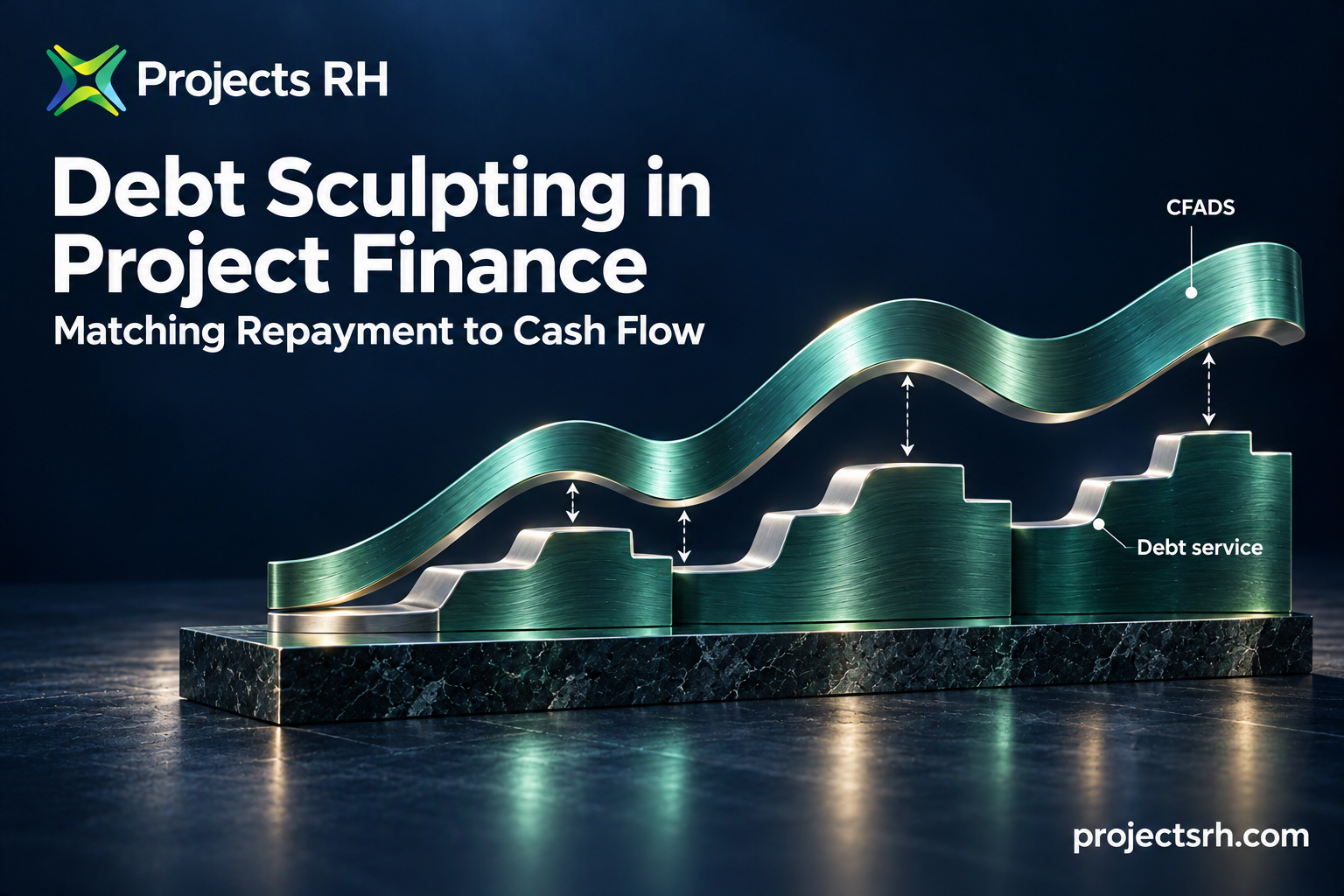
Debt Sculpting in Project Finance: Matching Repayment to Cash Flow
Debt sculpting in project finance matches repayment to CFADS. Learn how DSCR, tenor, LLCR and lender assumptions determine sustainable debt capacity.
Infrastructure Funding: Preparing Projects for Investors
Infrastructure funding requires more than capital. Learn how sponsors prepare projects for public programmes, lenders and institutional investors.

Green Hydrogen Offtake Agreement: What Makes It Financeable?
A green hydrogen offtake agreement must address price, volume, tenor, certification and buyer credit. Learn what lenders test before project finance.