
Metallurgical Testwork Mining Finance: Evidence Before Capital
Metallurgical testwork mining finance depends on recovery, variability, flowsheets and product quality. Learn what investors test before committing capital.
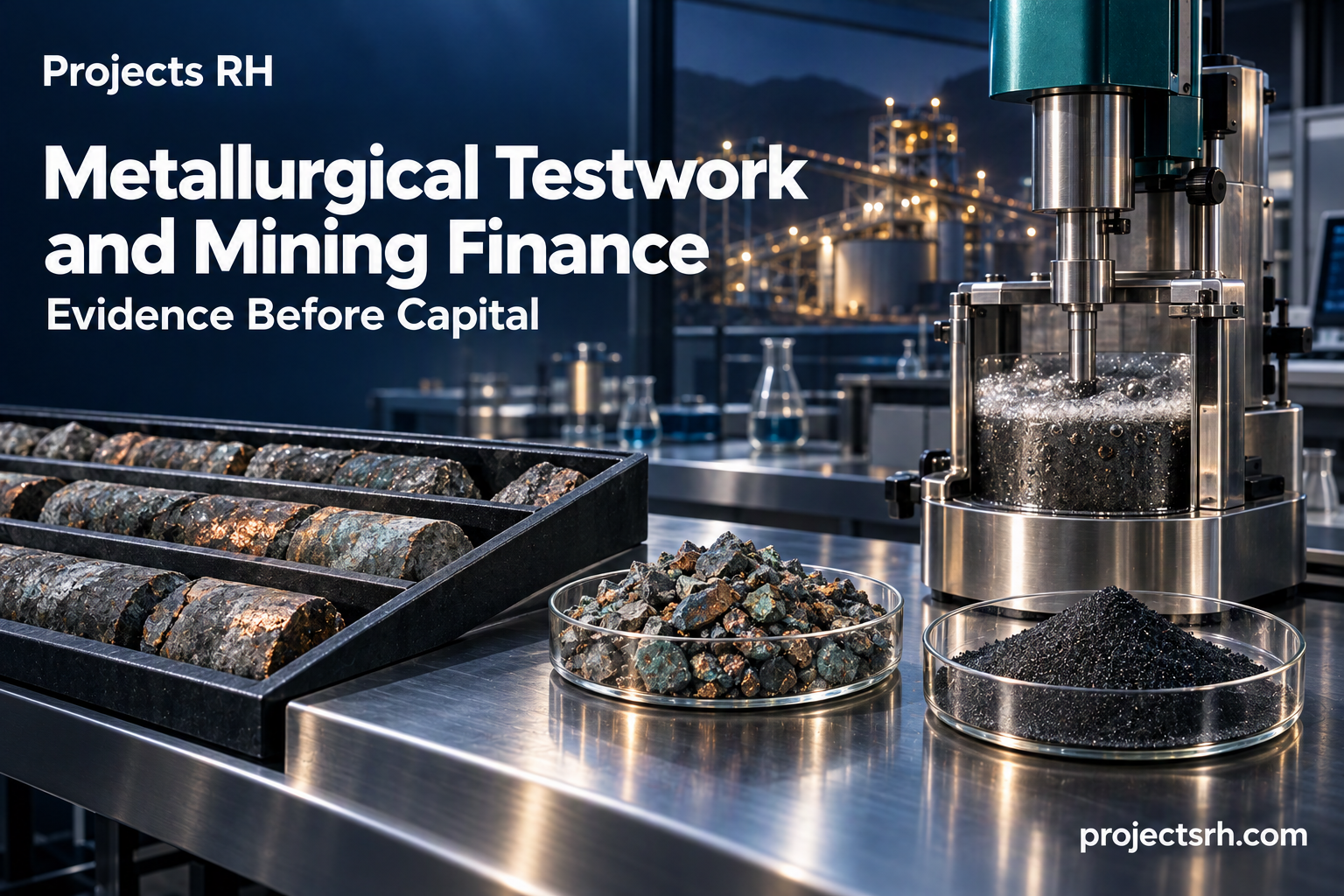
Metallurgical testwork mining finance connects one of the most technical parts of a mining project with one of the questions capital providers care about most:
How much saleable product can this orebody actually produce, at what cost and with what level of confidence?
A mineral resource identifies material in the ground.
It does not automatically establish how much of that material can be recovered economically into a saleable product.
That distinction matters because project revenue depends not simply on contained metal, but on recovered and ultimately payable metal.
Metallurgical recovery, variability, process design, reagent consumption, concentrate quality and deleterious elements can therefore influence:
- Revenue
- Operating costs
- Plant design
- Capital expenditure
- Product marketability
- Offtake
- Working capital
- Debt capacity
- Investor returns
- Overall project bankability
Investors cannot finance contained metal alone. The investment case ultimately depends on whether the project can recover, process and sell that metal economically.
For mining sponsors preparing to approach institutional capital, metallurgical evidence should therefore be integrated into the investment case before investor or lender due diligence begins.
Why Metallurgical Testwork Mining Finance Matters
A mining financial model can contain detailed assumptions for:
- Ore tonnes
- Grade
- Production
- Recovery
- Revenue
- Operating cost
- Capital expenditure
But those numbers require technical evidence.
Metallurgical testwork helps establish how mineralisation responds to the proposed processing route.
Depending on the commodity and process, testwork may examine:
- Liberation
- Grind size
- Recovery
- Flotation response
- Leach response
- Reagent consumption
- Residence time
- Concentrate grade
- Product quality
- Deleterious elements
- Tailings characteristics
- Water requirements
- Process variability
These results can influence both the process plant and project economics.
That makes metallurgy part of the investment case, not merely an engineering appendix.
Recovery Converts Geology Into Revenue
The financial relationship can be expressed conceptually as:
Contained Metal → Mining Recovery and Dilution → Process Feed → Metallurgical Recovery → Saleable Product → Payability → Revenue
Each stage can reduce the amount of economic metal ultimately sold.
For example, assume the mine delivers:
100 units of contained metal
If metallurgical recovery is:
90%
then approximately:
90 units
report to the recovered product before considering downstream payability or other commercial adjustments.
If recovery falls to:
85%
only:
85 units
are recovered.
A five-percentage-point difference can therefore affect revenue across every tonne processed under that assumption.
For capital providers, the important question is not simply whether a high recovery has been achieved in one test.
It is whether the recovery used in the financial model is supported by representative evidence.
Recovery and Payability Are Different
Metallurgical recovery should not be confused with commercial payability.
A project may achieve strong plant recovery but still receive less value because the final product is subject to:
- Smelter terms
- Treatment charges
- Refining charges
- Payability factors
- Moisture adjustments
- Penalties
- Transport costs
- Deleterious elements
The investment model should therefore connect:
Metallurgical Recovery → Product Grade → Payability → Penalties → Net Revenue
An investor needs to understand how technical performance becomes actual project cash flow.
Representative Samples Are Critical
The quality of metallurgical conclusions depends partly on whether the material tested represents the ore the project expects to process.
This is a central issue in internationally recognised mining disclosure frameworks.
The JORC Code requires public reporting to address sampling, technical and economic considerations with appropriate transparency, while its Table 1 template asks reporters to explain measures supporting sample representativity.
A strong testwork programme therefore needs to consider whether samples represent relevant differences across the deposit.
These can include:
- Lithology
- Mineralisation
- Alteration
- Grade
- Depth
- Oxidation
- Mineralogy
- Hardness
- Impurities
- Weathering
- Spatial location
- Planned mining sequence
A sample can reflect average grade while still failing to capture an important metallurgical characteristic.
That is why representativity should not be assumed simply because a sample is large.
Composite Testwork Cannot Answer Every Question
Composite samples can be useful during flowsheet development.
But composites can also blend away variability.
A master composite may answer:
How does this selected blend behave?
It may not answer:
How does every material domain in the mine plan behave?
For project finance, that distinction becomes important.
If weaker metallurgical material occurs during the first years of production, the project may experience lower cash flow precisely when:
- Debt service begins
- Liquidity is limited
- Ramp-up assumptions are being tested
- Investors expect distributions to start
The timing of metallurgical variability therefore matters as much as the average.
Variability Testwork Connects Metallurgy to the Mine Plan
Variability testing examines how different ore types or domains respond to processing.
Depending on the deposit, this may include samples representing differences in:
- Grade
- Mineralogy
- Alteration
- Oxidation
- Lithology
- Hardness
- Location
- Depth
The outputs should ultimately be considered against the mine schedule.
The key question becomes:
What material will actually enter the plant in each period, and what recovery and processing behaviour should the financial model assume for that material?
A life-of-mine model that applies one constant recovery assumption despite material evidence of variability may overstate or understate project economics.
Early Production Years Deserve Particular Attention
Institutional lenders can be particularly sensitive to early operating performance.
During the first years after construction:
- Debt balances can still be high
- Operational ramp-up is incomplete
- Cash reserves may be limited
- Debt-service obligations begin
- Technical assumptions are being proven in operation
If weak metallurgical domains are concentrated during the early mine plan, average life-of-mine recovery can conceal a meaningful financing risk.
Sponsors should therefore compare:
Metallurgical Domains → Mine Schedule → Annual Recovery → CFADS → Debt Service
The sequencing can be material to debt capacity and liquidity.
Bench-Scale Testwork Is the Beginning, Not Always the End
Metallurgical programmes often begin with bench-scale testing.
Depending on commodity and process, these tests can include:
- Flotation
- Bottle-roll leaching
- Gravity concentration
- Comminution
- Magnetic separation
- Diagnostic leaching
- Mineralogical analysis
Bench testing can identify promising process routes and operating conditions.
But some processes require additional evidence before design assumptions are considered sufficiently mature.
The appropriate programme depends on:
- Process complexity
- Ore variability
- Project stage
- Scale-up risk
- Technology maturity
- Capital commitment
The level of testwork should therefore match the decisions that depend on it.
Locked-Cycle Testing Can Test Process Recirculation
For flotation projects, locked-cycle tests can provide additional information about how the proposed flowsheet performs when intermediate streams are recycled.
This can help assess:
- Recovery
- Concentrate grade
- Circuit stability
- Recirculating loads
- Impurity behaviour
The relevance depends on the proposed flowsheet.
The broader investment principle is that the evidence should support the way the proposed process plant is expected to operate, rather than only an isolated laboratory response.
Pilot-Scale Testwork Can Reduce Scale-Up Uncertainty
Depending on project complexity and development stage, pilot-scale work may be appropriate.
Pilot programmes can help test:
- Integrated process behaviour
- Continuous operation
- Equipment assumptions
- Recycle streams
- Product quality
- Reagent consumption
- Material handling
- Scale-up behaviour
Pilot testing is not automatically required for every mining project.
But where material scale-up uncertainty exists, institutional reviewers may want to understand why the evidence available is sufficient for the proposed investment decision.
The important issue is proportionality:
Does the level of metallurgical evidence match the scale of the capital decision?
Process Recovery Must Match the Financial Model
One of the simplest investor-readiness controls is also one of the most important.
Compare recovery across:
- Metallurgical report
- Technical study
- Mine plan
- Financial model
- Information memorandum
- Investor presentation
The same investment case should not contain multiple unexplained recovery assumptions.
If the most recent testwork supports 88% while the investor presentation still uses 92%, the problem is not merely editorial.
The project revenue forecast has changed.
Every material update should be reflected consistently across the investment documentation.
The Testwork Must Support the Flowsheet
Metallurgical testing should help determine or confirm the process route.
Depending on the project, the flowsheet may include:
- Crushing
- Grinding
- Gravity recovery
- Flotation
- Leaching
- Thickening
- Filtration
- Concentrate handling
- Tailings treatment
- Water recovery
The flowsheet then influences plant design.
Plant design influences CapEx.
Operating requirements influence OpEx.
The financial chain becomes:
Testwork → Flowsheet → Plant Design → CapEx + OpEx → Recovery → Revenue → Project Economics
If those elements are not aligned, investors will identify inconsistencies.
Flowsheet Changes Can Invalidate Earlier Assumptions
Mining projects evolve.
A process route used during an early study may later change because of:
- Additional testwork
- New mineralogical information
- Different recovery performance
- New impurity information
- Equipment selection
- Water constraints
- Energy constraints
- Economics
When the flowsheet changes, sponsors should identify which previous test results remain relevant.
Historical recovery figures from a different process configuration should not automatically remain in the financial model.
Version control matters.
Concentrate Quality Is a Commercial Issue
A project can produce concentrate and still face weak commercial terms if the product does not meet market expectations.
Investors may therefore examine:
- Concentrate grade
- Moisture
- Particle characteristics
- Impurity levels
- Deleterious elements
- Transport requirements
- Treatment charges
- Refining charges
- Penalties
- Payability
Potential deleterious elements depend on commodity and deposit.
Their significance is commercial as well as technical.
A product specification should ultimately connect to credible assumptions about who may buy the product and on what terms.
Offtake Assumptions Should Reflect Metallurgical Evidence
If an investment case includes expected offtake terms, those terms should reflect the product the project is actually expected to produce.
The model should not assume premium pricing for a product whose testwork indicates potential penalties unless the assumption is supported.
Relevant commercial evidence can include:
- Indicative smelter terms
- Trader discussions
- Benchmark treatment charges
- Product specifications
- Letters of intent
- Offtake discussions
- Executed offtake agreements
The legal status of each should be described accurately.
An indicative conversation is not contracted revenue.
Reagent Consumption Drives Operating Cost
Metallurgical testwork can also influence the operating-cost assumptions used in the financial model.
Depending on the process, significant operating inputs may include:
- Lime
- Cyanide
- Collectors
- Frothers
- Flocculants
- Acids
- Grinding media
- Activated carbon
- Oxygen
A change in reagent consumption can affect annual OpEx materially.
Sponsors should therefore reconcile:
Testwork Consumption → Plant Design → Unit Cost → Annual OpEx
A recovery assumption and the cost required to achieve that recovery should be considered together.
Power and Grind Size Can Change Economics
Finer grinding may improve liberation and recovery.
It can also increase energy consumption and potentially require different equipment.
This creates another technical-economic trade-off.
The optimum economic recovery is not necessarily the maximum laboratory recovery.
Sponsors should understand:
- Grind size
- Recovery response
- Energy requirements
- Capital implications
- Operating cost
- Product quality
The financial model should reflect the selected design point.
Water Can Affect Metallurgical Performance
Water quality and availability can also influence process performance.
Relevant issues can include:
- Water chemistry
- Salinity
- Recycle water
- Reagent response
- Process stability
- Water balance
If the test programme used fresh laboratory water but the proposed plant will rely heavily on recycled water with materially different chemistry, an institutional technical reviewer may ask whether the effect has been tested appropriately.
This is particularly relevant where water availability is a material project constraint.
Tailings and Recovery Are Connected
Metallurgical testwork can also generate information relevant to tailings.
Investors may need to understand:
- Residual metals
- Chemical characteristics
- Water recovery
- Reagent residues
- Material properties
Not every aspect belongs in a metallurgical workstream alone, but project preparation should ensure the relevant technical disciplines remain aligned.
The process plant cannot be evaluated completely independently of the waste streams it creates.
QA/QC Strengthens Confidence in Testwork
Quality assurance and quality control are important in metallurgical sampling and testwork.
Relevant questions can include:
- Sample origin
- Sample preparation
- Chain of custody
- Laboratory procedures
- Repeat testing
- Analytical methods
- Mass balance
- Independent review
Investor readiness does not require the finance team to become the metallurgist.
It requires the investment materials to identify the technical evidence supporting material financial assumptions.
The JORC Code framework emphasises transparency and appropriate disclosure for information intended for investors. 【1-676bd2】 Its Table 1 requirements specifically address sample quality and representativity. 【2-90d8b0】
NI 43-101 Also Treats Metallurgy as Material Technical Evidence
Canadian mining disclosure provides another useful benchmark.
Form 43-101F1 Technical Report contains a dedicated Item 13 for Mineral Processing and Metallurgical Testing.
For advanced projects, that sits alongside sections covering:
- Recovery methods
- Infrastructure
- Market studies and contracts
- Environmental matters
- Capital and operating costs
- Economic analysis
This structure illustrates why metallurgy cannot be separated from project economics. 【3-380402】
NI 43-101 also addresses data verification and requires technical reporting appropriate for investors evaluating mineral projects. 【4-cb845c】【5-e9fe7a】
Metallurgical Evidence Should Match Project Stage
The level of metallurgical evidence expected from an early exploration opportunity is not the same as that expected from a project seeking construction finance.
Broadly, project maturity increases the need for evidence around:
- Representative sampling
- Variability
- Process selection
- Scale-up
- Recovery
- Product quality
- Reagent consumption
- Process costs
This does not mean early-stage projects must pretend to possess feasibility-level information.
The better approach is to identify clearly:
Known → Supported → Assumed → Outstanding
Investors can evaluate uncertainty.
They cannot evaluate uncertainty that has been hidden.
Sensitivity Analysis Should Test Metallurgical Risk
The financial model should not rely on one recovery figure without testing alternatives.
Relevant sensitivities can include:
- Lower recovery
- Lower concentrate grade
- Higher reagent consumption
- Higher power consumption
- Higher treatment charges
- Additional penalties
- Different payability
For example, if the base model assumes:
Recovery = 90%
the sponsor might also test:
Recovery = 87%
and:
Recovery = 84%
depending on the technical evidence.
The model can then show effects on:
- Revenue
- EBITDA
- Cash flow
- NPV
- IRR
- Debt capacity
- Payback
The objective is not to predict the exact downside.
It is to understand how dependent the investment case is on metallurgical performance.
Recovery Sensitivity Can Affect Debt Capacity
For a leveraged mining project, lower recovery does more than reduce equity returns.
It can reduce project cash available to service debt.
The chain becomes:
Lower Recovery → Lower Saleable Metal → Lower Revenue → Lower CFADS → Lower Debt Capacity
If early-year recovery underperforms, debt-service coverage may also weaken.
Projects considering project finance therefore need to understand metallurgical downside within the lender case, not only the equity case.
Metallurgical Testwork Mining Finance Documentation Checklist
Before approaching institutional capital, sponsors should be able to identify:
- Which testwork supports the recovery assumption.
- Which samples were tested.
- Why those samples are representative.
- Which material domains are not adequately tested.
- Whether variability work has been completed.
- Whether early mine-plan material has adequate coverage.
- Which flowsheet the testwork supports.
- Whether locked-cycle or pilot work is relevant.
- What concentrate or product quality is expected.
- Which deleterious elements are material.
- How payability is calculated.
- Which penalties are included.
- What reagent consumption the model assumes.
- What power and grind assumptions apply.
- Whether water conditions have been considered.
- Which laboratory performed the work.
- What QA/QC procedures applied.
- Whether an independent technical review exists.
- Whether the financial model uses the current recovery assumptions.
- Whether the Information Memorandum uses the same assumptions.
- Whether the investor deck uses the same assumptions.
- Whether recovery sensitivities have been modelled.
- Whether concentrate-quality sensitivities have been tested.
- Which metallurgical questions remain unresolved.
If several items remain unresolved, further technical or investment preparation may be appropriate before broad capital engagement.
Common Metallurgical Gaps Investors May Find
Common issues include:
- Recovery based on a small number of tests
- Overreliance on favourable composite samples
- Limited variability coverage
- Important ore domains not tested
- Early mine-plan material underrepresented
- Recovery assumptions exceeding testwork support
- Outdated flowsheet assumptions
- Insufficient scale-up evidence
- Concentrate impurities omitted from pricing
- Payability assumptions unsupported
- Penalties excluded
- Reagent consumption understated
- Power consumption inconsistent with grind size
- Different recovery figures across documents
- No downside sensitivity
No single weakness necessarily makes a project unfinanceable.
The important issue is whether the sponsor understands the gap, its potential economic impact and the work required to address it.
Metallurgical Testwork and the Financial Model
The financial model should convert technical evidence into project economics.
That means the model should reconcile:
Mine Plan × Grade × Metallurgical Recovery × Payability × Price = Revenue
Operating costs should incorporate relevant process assumptions.
Capital costs should correspond to the process plant required by the selected flowsheet.
The model should then test what happens when material assumptions change.
This is where metallurgical evidence and mining finance become directly connected.
Metallurgical Testwork Mining Finance and Investor Readiness
Metallurgical testwork mining finance should become part of the wider investor-readiness process rather than a separate technical exercise.
A disciplined sequence is:
Geology → Mine Plan → Metallurgical Evidence → Flowsheet → Recovery → Product Quality → CapEx and OpEx → Financial Model → Investment Documentation → Capital Strategy
Each stage depends on the previous evidence.
Projects RH does not replace metallurgical laboratories, process engineers, Competent Persons or Qualified Persons.
The role of investment preparation is to ensure the technical evidence and financial proposition are consistent before the project reaches institutional capital.
Sponsors can review How Projects RH Works to understand how assessment, modelling and documentation fit into the preparation process.
What Institutional Investors Ultimately Need to Know
Institutional investors do not need to become process engineers.
They do need confidence that material economic assumptions are supported.
The JORC Code exists to establish minimum standards for public reporting of Exploration s and Ore Reserves for investors and their advisers. 【1-676bd2】
Form 43-101F1 similarly requires technical reporting to include material scientific and technical information and gives metallurgical testing a dedicated section. 【3-380402】
Research on representative metallurgical sampling also emphasises that sample quality and representativity are as important as the testwork itself, with variability and QA/QC forming important components of credible programmes. 【6-bc2f1b】
The financing principle is therefore straightforward:
A recovery assumption becomes more credible when an investor can trace it from representative testwork, through the flowsheet and mine plan, into the financial model and ultimately into projected cash flow.
Frequently Asked Questions About Metallurgical Testwork Mining Finance
What is metallurgical testwork?
Metallurgical testwork examines how mineralised material responds to proposed processing methods and can provide evidence supporting recovery, flowsheet design, reagent consumption and product quality.
Why does metallurgical testwork matter for mining finance?
Metallurgical assumptions can directly affect saleable production, revenue, operating costs, plant design, capital expenditure, cash flow and debt capacity.
What is metallurgical recovery?
Metallurgical recovery is the proportion of valuable material in process feed that reports to the desired recovered product through the selected processing route.
Why is variability testwork important?
Variability testwork helps determine whether different ore types, mineralogical domains, grades or locations respond differently to the proposed process.
What is the difference between recovery and payability?
Recovery determines how much metal reaches the product, while payability determines how much of the metal in that product a buyer pays for after applicable commercial terms.
Why does concentrate quality matter?
Concentrate grade, moisture and deleterious elements can affect marketability, treatment charges, refining charges, penalties and net revenue.
Should metallurgical recovery be sensitivity-tested?
Yes. Where recovery is material to project economics, the financial model should show how changes in recovery affect revenue, cash flow, investment returns and, where relevant, debt capacity.
Does every project require pilot-scale testwork?
No. The appropriate testwork programme depends on project maturity, process complexity, scale-up risk and the decisions that the evidence needs to support.
Does metallurgical testwork guarantee project financing?
No. Metallurgical evidence supports the technical and economic investment case, but financing still depends on the wider project, due diligence, capital-provider criteria, market conditions and transaction structure.
Sources
- JORC - JORC Code and Mineral Resources and Ore Reserves
- JORC - Table 1 Reporting Template
- Ontario Securities Commission - NI 43-101 Standards of Disclosure for Mineral Projects
- BC Securities Commission - Form 43-101F1 Technical Report
- Minerals Journal - Representative Metallurgical Sampling and Gold Recovery Testwork
- SEC - S-K 1300 Technical Report Summary Example
Is Your Mining Project Ready for Institutional Review?
Projects RH helps mining sponsors identify financial, commercial, technical and documentation gaps before approaching institutional investors and lenders.
If you already have metallurgical testwork, a technical study, mine plan or financial model, submit your project for assessment so the Projects RH team can identify where the evidence and investment case still need to be aligned.
Learn more about How Projects RH Works and explore Projects RH Services.
Preparing a mining project for capital? Submit your project to Projects RH.

What to do next
Projects RH prepares the company and the project first, then takes them to investors. The fastest way to find out where you stand is a short call.
Keep reading
Mineral Processing Plant Finance: Beyond the Mine
Mineral processing plant finance depends on secure feedstock, proven recovery, saleable products, reliable energy, logistics, permits and credible offtake.
JORC vs NI 43-101: What Mining Investors Need to Know
JORC and NI 43-101 share resource categories but differ in legal status, expert responsibility, technical reporting and cross-border filing requirements.

Mining Royalties vs Streaming: Choosing Capital
Mining royalties, streaming and equity transfer value differently. Compare dilution, cash flow, control, commodity upside and long-term project economics. `