
Modular Data Centre Financing: Capital, Power and Risk
Modular Data Centre Financing requires more than fast deployment. Learn how power, phased capex, contracted revenue and execution risk determine bankability.
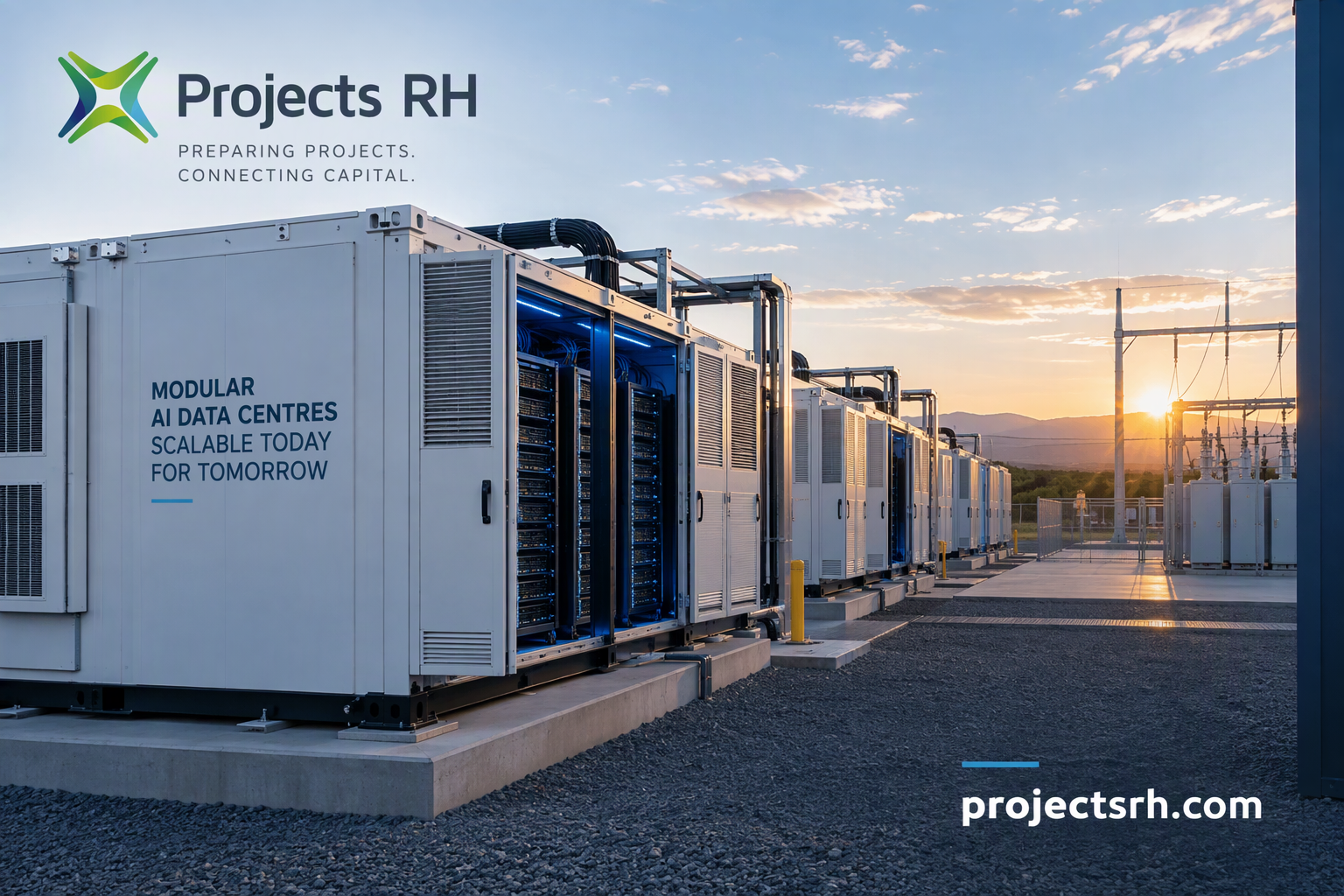
Modular Data Centre Financing is becoming increasingly important as AI infrastructure developers look for faster ways to convert available land, power and customer demand into operational compute capacity.
The commercial attraction is easy to understand. Conventional data centre construction can be slow, highly customised and exposed to extensive onsite coordination. Prefabricated modular systems can shift significant elements of power, cooling and IT infrastructure into controlled factory environments, allowing projects to be deployed in repeatable phases.
But speed should not be confused with bankability.
From a project-finance perspective, modularity changes the construction and deployment model. It does not remove the fundamental questions around power, customers, capital, counterparties, technology, commissioning and cash flow.
A modular AI data centre is not financeable simply because it can be built quickly. It becomes financeable when each deployed unit can convert secured power and contracted demand into predictable cash flow.
What Is Modular Data Centre Financing?
Modular Data Centre Financing is the structuring and funding of data centre infrastructure built from prefabricated or repeatable modules that can be deployed, commissioned and expanded in phases as power, customers and capital become available.
The modules can include:
- IT and server infrastructure
- High-density AI compute
- Electrical distribution
- UPS systems
- Switchgear
- Cooling infrastructure
- Direct-to-chip liquid cooling
- Data halls
- Network infrastructure
- Backup generation
- Monitoring and control systems
The financing distinction is important.
Instead of funding an entire campus before meaningful revenue is available, a modular project may potentially align capital expenditure with customer commitments and power availability.
That creates an attractive proposition:
Secure Power → Contract Capacity → Finance Module → Deploy → Commission → Generate Revenue → Expand
The difficulty is making each link sufficiently reliable for investors and lenders.
Why Modular AI Data Centres Are Attracting Capital
AI is increasing both the scale and the density of digital infrastructure.
The International Energy Agency estimates that data centres consumed approximately 415 TWh of electricity in 2024, around 1.5% of global electricity consumption. The IEA also reports that electricity demand from data centres grew by 17% in 2025 and expects global data centre electricity consumption to double by 2030.
AI-focused facilities are growing even faster.
This changes the infrastructure problem.
Developers are no longer thinking only about conventional data halls built around relatively predictable rack densities. AI and high-performance computing increasingly require high-density infrastructure combining advanced chips, substantial electrical capacity and sophisticated thermal management.
Modular designs can respond to that challenge by industrialising parts of the construction process.
Schneider Electric describes modular data centres as adaptable, quick-to-deploy infrastructure that can reduce onsite work and improve repeatability. Its RapidScale architecture combines prefabricated power, cooling, IT and lifecycle systems into scalable infrastructure.
Vertiv similarly describes factory-built modular infrastructure blocks combining power, cooling and IT that can support deployments ranging from tens of megawatts toward much larger campuses.
But this creates an important financing distinction:
Modularity can improve deployment efficiency. It does not automatically eliminate development risk.
The Financing Case for Modularity
A conventional data centre project can require substantial capital before the first customer begins paying.
Modular deployment creates the possibility of dividing that capital requirement into economically meaningful stages.
Consider a simplified project with a long-term plan for 100 MW.
Rather than financing the entire 100 MW development immediately, the sponsor might establish:
- Phase 1: 20 MW
- Phase 2: 20 MW
- Phase 3: 30 MW
- Phase 4: 30 MW
If each phase is connected to secured power, customer commitments and deliverable infrastructure, the financing requirement can potentially be sequenced.
The principle becomes:
Capital follows contracted and executable capacity rather than speculative ultimate capacity.
That can reduce several risks:
- Idle-capacity risk
- Unnecessary upfront capital expenditure
- Demand forecasting risk
- Technology obsolescence
- Construction exposure
- Equity dilution
- Negative carry before revenue
However, phased development also introduces new risks.
Later modules may have different equipment costs, different technology, different power conditions or different customer economics. Financing cannot therefore assume that a successful first module automatically proves the economics of every future phase.
Power Is the First Financing Constraint
The most important resource in an AI data centre is increasingly not land.
It is deliverable power.
The International Energy Agency has identified power availability, grid connection delays, transformers, generation equipment and regulatory approvals as material constraints on global data centre expansion.
This distinction is fundamental for Modular Data Centre Financing.
A developer may control land capable of accommodating 500 MW of infrastructure.
But if only 40 MW of power is secured within an investable timeframe, the lender is financing a 40 MW power position, not a theoretical 500 MW campus.
That leads to a principle we consider critical:
Do not finance the nameplate ambition. Finance the executable power envelope.
For each phase, investors should establish:
- How many MW are contractually available?
- When will that power be energised?
- What interconnection agreements are executed?
- What deposits have been paid?
- Which network upgrades are required?
- Who pays for those upgrades?
- Are transformers and switchgear secured?
- Is backup power available?
- What energy price assumptions apply?
- What happens if grid delivery is delayed?
- Can subsequent phases obtain additional capacity?
The availability date matters as much as the headline number of megawatts.
Time-to-Power Can Determine Project Value
AI customers can move extraordinarily quickly when seeking compute capacity.
Electricity infrastructure frequently cannot.
The IEA notes that data centres may typically take approximately one to two years to build while expansion of electricity infrastructure can involve much longer lead times. Grid constraints have already affected major European data centre markets, including Dublin and Amsterdam.
This creates a potential advantage for modular development.
If a site already has power, a modular solution may allow the developer to convert that electrical position into usable compute capacity faster than a fully bespoke development.
But if power is not available, modularity cannot solve the underlying interconnection problem.
The modules can be manufactured.
The grid cannot necessarily be accelerated at the same rate.
For investors, time-to-power should therefore be treated as a financing variable, not simply an engineering milestone.
Modular Deployment Can Reduce Construction Risk, but Not Remove It
Prefabrication can transfer substantial construction activity from the project site into a controlled manufacturing environment.
This has several potential advantages:
- Repeatable engineering
- Factory testing
- Reduced onsite labour
- Less weather exposure
- Improved installation sequencing
- Standardised components
- Shorter commissioning cycles
- More predictable expansion
Schneider Electric reported in 2026 that modular data centre approaches can reduce deployment time by up to 60%. A later time study co-authored with Compass Datacenters found that prefabricated white-space modules could reduce onsite installation time by 80%.
Vertiv has similarly stated that its prefabricated MegaMod CoolChip solution can deploy AI critical digital infrastructure up to 50% faster than traditional onsite construction.
Those figures are important, but developers should use them carefully.
A vendor's achievable installation reduction does not automatically equal the reduction in the project's total development schedule.
Site preparation, grid connection, substations, permitting, fibre, planning, water requirements and customer acceptance may still control the critical path.
The finance model should therefore distinguish:
Module Manufacturing Time
from:
Total Time to Revenue
They are not the same.
Capital Structure: Finance the Deployment, Not Just the Hardware
One mistake in early-stage modular AI projects is treating the financing requirement as an equipment purchase.
The actual investment case is broader.
A lender or investor needs to understand the complete Sources & Uses of Funds.
A realistic modular development budget may include:
- Site acquisition or lease
- Development costs
- Planning and permitting
- Grid connection
- Utility deposits
- Substation infrastructure
- Transformers
- Civil works
- Modular power infrastructure
- Cooling systems
- Data halls
- IT infrastructure
- GPUs where sponsor-funded
- Fibre connectivity
- Backup generation
- Battery systems
- Installation
- Commissioning
- Professional fees
- Financing costs
- Interest during construction
- Contingency
- Working capital
If the financial model captures only the modular boxes while excluding the infrastructure required to make them operational, the project will materially understate its funding requirement.
The Capital Stack for Modular Data Centre Financing
Not every part of a modular AI data centre carries the same risk.
That means different sources of capital may be appropriate at different stages.
Sponsor Equity
Sponsor capital usually absorbs early development risk.
It may fund:
- Site control
- Initial engineering
- Utility applications
- Deposits
- Permitting
- Customer development
- Initial professional costs
Investors will normally expect the sponsor to have meaningful capital at risk before institutional financing enters.
Development Equity
Development capital can bridge the project from site and power development toward construction readiness.
This capital is taking considerably more risk than senior project debt and should be priced accordingly.
Preferred Equity
Preferred equity may be suitable where the project has progressed beyond pure development risk but cannot yet support conventional senior leverage.
It can reduce common-equity dilution while accepting greater risk than senior debt.
Equipment Finance
Certain identifiable equipment may support separate financing structures, particularly where it retains value and can be clearly secured.
But rapidly changing GPU and AI hardware creates important residual-value and obsolescence questions.
Construction Debt
Once power, site, contracts, budget and delivery are sufficiently de-risked, construction financing becomes more credible.
The lender will focus heavily on:
- Cost certainty
- Construction schedule
- EPC or vendor structure
- Contingencies
- Customer contracts
- Completion tests
- Sponsor support
- Debt-service capability
Long-Term Project Debt
The strongest financing case emerges after construction risk is reduced and durable customer revenues have been established.
Recent AI infrastructure transactions demonstrate that this market is already capable of supporting significant project-level financing where power and contracted revenue are strong.
Contracted Revenue Changes Everything
The difference between an interesting AI infrastructure development and a financeable asset often lies in the customer contract.
Investors need to distinguish between:
- Customer discussions
- Expressions of interest
- Reservations
- Capacity agreements
- Binding commitments
- Take-or-pay obligations
- Long-term leases
- Credit-supported contracted revenue
A modular strategy is particularly powerful when deployment is directly connected to contractual demand.
Conceptually:
20 MW Customer Commitment → 20 MW Power → 20 MW Module → 20 MW Financing
is considerably easier to underwrite than:
200 MW Vision → Build Everything → Find Customers Later
The project does not need to eliminate every risk.
It needs to allocate risk coherently.
Real-World Financing Shows the Importance of Power and Contracts
Recent transactions illustrate how institutional capital is approaching AI infrastructure.
Hut 8 disclosed a 15-year lease for 245 MW of IT capacity at its River Bend campus in Louisiana with Fluidstack, with a reported base-term contract value of US$7.0 billion and a financial backstop from Google. The company also indicated expected project-level financing of up to 85% loan-to-cost, subject to final documentation and closing conditions.
In May 2026, Hut 8 subsequently reported closing US$3.25 billion of fully amortising 16.5-year investment-grade senior secured notes for River Bend, describing the financing as approximately 95% loan-to-cost and non-recourse to Hut 8.
The lesson is not that every AI data centre should seek leverage at those levels.
It is that strong contracted revenues, power, credit support and institutional execution can materially transform the financing profile of digital infrastructure.
A modular project without equivalent evidence should not assume institutional leverage merely because its physical deployment model is faster.
Customers Must Be Matched to the Capital Plan
Offtake and financing need to be designed together.
A customer agreement should be tested for:
- Contracted MW
- Contract tenor
- Commencement date
- Minimum payments
- Capacity reservation
- Customer prepayments
- Credit quality
- Parent guarantees
- Take-or-pay obligations
- Termination rights
- Early termination payments
- Service credits
- Expansion options
- Acceptance testing
A September 2026 filing by AIB Data Centers illustrates the relationship well. The company announced a binding agreement with Nebius for 50 MW of critical IT capacity and stated that customer prepayments, project-level debt and preferred equity were expected to fund a substantial portion of initial development costs. The capacity was supported by a previously announced 15-year electric service agreement for 65 MW of utility load.
The structure illustrates the type of alignment financiers look for:
Power + Contracted Capacity + Customer Funding + Debt + Equity
It also demonstrates why Modular Data Centre Financing cannot be analysed independently from the commercial contract.
Technology Risk Is Different in AI Infrastructure
Modular construction can reduce certain execution risks while creating another important consideration: technology moves faster than infrastructure finance.
A conventional building may have an economic life measured in decades.
AI computing hardware can change dramatically within a much shorter period.
Vertiv notes that AI and high-performance computing are already pushing rack densities beyond 25 kW and frequently into triple digits.
The financing model therefore needs to separate long-life infrastructure from shorter-life technology.
Longer-life assets can include:
- Land
- Grid connection
- Substation
- Electrical backbone
- Buildings
- Fibre routes
- Core cooling infrastructure
Shorter-life assets may include:
- GPUs
- Servers
- Certain networking equipment
- AI-specific hardware
- Some rack-level thermal equipment
Financing those categories under one uniform amortisation assumption can produce a distorted model.
Cooling Is Now a Financial Issue
Historically, cooling could be viewed largely as an engineering question.
For high-density AI, it increasingly affects bankability.
The IEA reports that cooling can account for approximately 7% of electricity consumption in efficient hyperscale data centres and more than 30% in less-efficient enterprise facilities.
Higher rack densities are accelerating the adoption of liquid cooling and more sophisticated thermal infrastructure.
The financial model should therefore test:
- Cooling capex
- Pumping loads
- Heat rejection
- Water requirements
- Maintenance
- Redundancy
- Equipment compatibility
- Energy efficiency
- Expansion capability
A cooling system that supports today's GPUs but cannot accommodate the next generation can create expensive retrofit risk.
Modularity should therefore mean adaptability, not simply repetition.
Factory Standardisation Creates a Supply-Chain Dependency
Standardisation lowers some risks and concentrates others.
A modular project may depend heavily on a small group of manufacturers for:
- Power modules
- Cooling infrastructure
- UPS equipment
- Switchgear
- Transformers
- Control systems
- Replacement components
That creates a different form of counterparty exposure.
Vendor due diligence should examine:
- Manufacturing capacity
- Factory location
- Delivery slots
- Warranty
- Performance guarantees
- Liquidated damages
- Parent support
- Replacement parts
- Service network
- Import exposure
- Tariffs
- Currency
- Logistics
- Interface risk
A module that is 90% complete in a factory on another continent has little value to project cash flow until it is delivered, installed, connected, tested and accepted.
Deployment Risk Is Really Interface Risk
Modular systems are frequently described as simpler projects.
Physically, they can be.
Contractually, they may not be.
The final facility still needs multiple systems to interact:
Grid → Substation → Power Module → Cooling → IT Module → Network → Customer
A delay at any interface can prevent commercial operation.
Projects RH therefore considers interface responsibility a central due-diligence issue.
The financing case should establish:
- Who owns the integrated design?
- Who guarantees overall performance?
- Who carries schedule risk?
- Where do vendor responsibilities begin and end?
- Who manages commissioning?
- What happens when one module passes testing but another does not?
- Who is responsible for customer acceptance?
- Are damages sufficient to address delay?
Multiple strong suppliers do not necessarily create one bankable project.
There must be contractual responsibility for integration.
How to Model a Modular AI Data Centre
A modular financial model should not treat the entire campus as if it becomes operational on one date.
Each module or phase should have its own:
- Capex
- Funding date
- Construction schedule
- Power availability
- Commissioning date
- Customer commencement
- Contracted revenue
- Operating costs
- Debt drawdown
- Interest during construction
- Debt-service commencement
This permits investors to see the actual capital cycle.
For example:
Phase 1 Development → Funding → Installation → Acceptance → Revenue
followed by:
Phase 2 Funding → Installation → Acceptance → Incremental Revenue
The model should also distinguish between committed phases and optional expansion.
A 500 MW master plan should not be modelled as 500 MW of bankable capacity if only 50 MW has secured power and customers.
Stress Testing Modular Data Centre Financing
A credible investment case should show what happens when assumptions fail.
At minimum, Projects RH would expect scenarios covering:
Power Delay
What happens if energisation occurs 6 or 12 months late?
Module Delay
What happens if fabrication or shipping misses the planned installation window?
Customer Delay
What happens if the customer accepts capacity later than planned?
Lower Utilisation
Does revenue decline if actual compute usage falls?
Capex Overrun
Can contingency absorb a 10% or 15% increase in relevant construction costs?
Energy Price Shock
Who carries increases in electricity costs?
Technology Change
Can the module support newer GPU densities without major redesign?
Interest Rate Pressure
What happens to debt-service coverage if financing costs increase?
Customer Default
Can capacity be remarketed, and how long would that take?
The purpose of stress testing is not to demonstrate that nothing can go wrong.
It is to show that the project can survive when something does.
Greenfield Modular Projects Need a Different Financing Mindset
A modular design can tempt developers to move directly from concept to fundraising.
That is usually a mistake.
Investors still expect an investment case containing:
- Verified site control
- Secured or credible power pathway
- Defined technology
- Development schedule
- Contracting strategy
- Customer evidence
- Full Sources & Uses
- Financial model
- Risk allocation
- Corporate structure
- Relevant permits
- Vendor strategy
- Investor documentation
The modular technology may shorten physical delivery.
It does not shorten institutional due diligence to zero.
The Modular Data Centre Financing Bankability Test
Before approaching institutional capital, a sponsor should be able to answer these questions:
- How much power is contractually secured?
- When will that power actually be available?
- How much capacity is contracted to customers?
- Who is legally obligated to pay?
- What is the minimum contracted revenue?
- What is the all-in capex for each module?
- Who carries construction and integration risk?
- When does each module reach commercial operation?
- Can the technology accommodate future AI hardware?
- What happens if power or deployment is delayed?
- How will each phase be financed?
- What debt can contracted cash flow realistically support?
If those answers are credible and supported by evidence, modularity can become a genuine financing advantage.
If they are not, faster construction simply allows an unbankable project to reach its problems sooner.
What Investors Should Look for
The strongest modular opportunities are likely to demonstrate alignment between five elements:
Power
Contracted, deliverable and sufficient for the relevant deployment phase.
Customers
Binding commitments with durable payment obligations and credible counterparties.
Technology
A repeatable architecture capable of supporting high-density AI workloads and future upgrades.
Capital
A Sources & Uses structure aligned with the actual timing of deployment and contracted revenue.
Execution
Experienced counterparties, coherent interface responsibility, contingency and realistic commissioning.
When those elements align, modular infrastructure can do something strategically important: convert a very large development into a sequence of smaller, more measurable investment decisions.
The Projects RH View
At Projects RH, we believe the principal financing advantage of modular AI infrastructure is not simply speed.
It is capital discipline.
A well-structured modular project can potentially connect each increment of investment to identifiable power, contracted customer capacity and a measurable route to cash flow.
That can reduce speculative capital deployment and create clearer financing milestones.
But only if the project is structured correctly.
The central financing sequence should remain:
Site → Power → Customer → Module → Capital → Commissioning → Cash Flow → Expansion
Changing that sequence can materially change the risk.
Committing large amounts of capital before power is secured creates power risk.
Building capacity before customers are contracted creates utilisation risk.
Financing short-life hardware with inappropriate long-term assumptions creates residual-value risk.
Scaling before the first deployment architecture has been proven creates execution risk.
The advantage of modularity is that developers do not necessarily have to take all of those risks at once.
The best modular financing strategy is not to build the largest campus as quickly as possible. It is to deploy each increment of capital when the power, customer, technology and contracts are ready to support it.
Is Your Modular AI Data Centre Ready for Capital?
Projects RH works with infrastructure project sponsors to assess investor readiness, strengthen financial models, prepare investment documentation and establish a credible capital strategy before approaching investors and lenders.
If you are developing a modular AI data centre or digital infrastructure project, start with Projects RH to identify the commercial, financial, technical and documentationssed before entering the capital market.
You can also learn more about /how-we-work.html and explore our /services.html.
Frequently Asked Questions
What is Modular Data Centre Financing?
Modular Data Centre Financing is the structuring of equity, debt and other capital for data centre infrastructure that is prefabricated or deployed in repeatable phases as power, customer commitments and development milestones become available.
Why are modular data centres attractive for AI?
Modular architecture can reduce onsite construction, standardise power and cooling infrastructure and accelerate the deployment of high-density compute. It can also allow capacity to be added incrementally rather than building an entire campus before customer demand materialises.
Does modular construction make a data centre easier to finance?
Not automatically. Investors still require credible evidence of site control, power availability, customer contracts, capex, technology, construction responsibilities and future cash flow. Modularity can improve execution, but it cannot substitute for project fundamentals.
What is the biggest risk in Modular Data Centre Financing?
Power availability is often one of the most important risks because modular infrastructure cannot generate revenue until sufficient electricity can be delivered. Customer commitment, integration, construction and technology obsolescence are also material financing risks.
Can a modular data centre be project-financed?
Potentially. Strong contracted revenues, secured power, credible counterparties, predictable construction costs and appropriate risk allocation can support project-level financing. The achievable leverage depends on the specific project and should be underwritten against contracted cash flow rather than headline campus capacity.
How should a modular AI data centre be financially modelled?
Each deployment phase should have its own capex, funding schedule, power date, commissioning milestone, customer commencement date, revenue, operating costs and debt-service profile. Future expansion should be separated from capacity that is already contracted and executable.
What should developers prepare before raising capital?
Developers should establish site control, power, technical design, customer strategy, development schedule, full Sources & Uses, financial model, construction and vendor strategy, risk allocation and investor-grade documentation before beginning a structured capital raise.
Sources
- International Energy Agency — Energy and AI — Global analysis of AI, data-centre electricity demand and energy infrastructure.
- International Energy Agency — Energy Demand from AI — Data on electricity consumption, servers, cooling and data-centre infrastructure.
- International Energy Agency — Powering Artificial Intelligence — Analysis of grid integration, electricity supply, infrastructure costs and regulatory considerations for data centres.
- Schneider Electric — RapidScale Modular Data Centers — Prefabricated modular power, IT and data-centre deployment architecture.
- Schneider Electric — Prefabricated Reference Design for Modular AI Factories — RapidScale modular AI infrastructure, liquid cooling and deployment research.
- Vertiv — MegaMod CoolChip Modular AI Data Centre — Prefabricated high-density infrastructure combining liquid cooling and AI-ready power systems.
- U.S. SEC — Hut 8 Q1 2026 AI Data Centre Financing — Public disclosure covering contracted AI data-centre revenue and project-level financing.
- U.S. SEC — Hut 8 River Bend 245 MW AI Data Centre Lease — Public disclosure covering the 15-year lease, financial backstop and anticipated project financing.
- U.S. SEC — AIB Data Centers and Nebius — Example of contracted AI capacity combining customer prepayments, project debt, preferred equity and secured utility capacity.

What to do next
Projects RH prepares the company and the project first, then takes them to investors. The fastest way to find out where you stand is a short call.
Keep reading
AI Data Centre Offtake: What Makes a Contract Bankable?
AI Data Centre Offtake can determine whether a compute project is financeable. Learn what makes reservations, capacity agreements, take-or-pay structures and hyperscaler leases bankable.

Capital Raising: Why Most Projects Fail
Capital raising often fails before investor outreach begins. Here are the project readiness, financial and execution gaps that serious capital providers identify first.
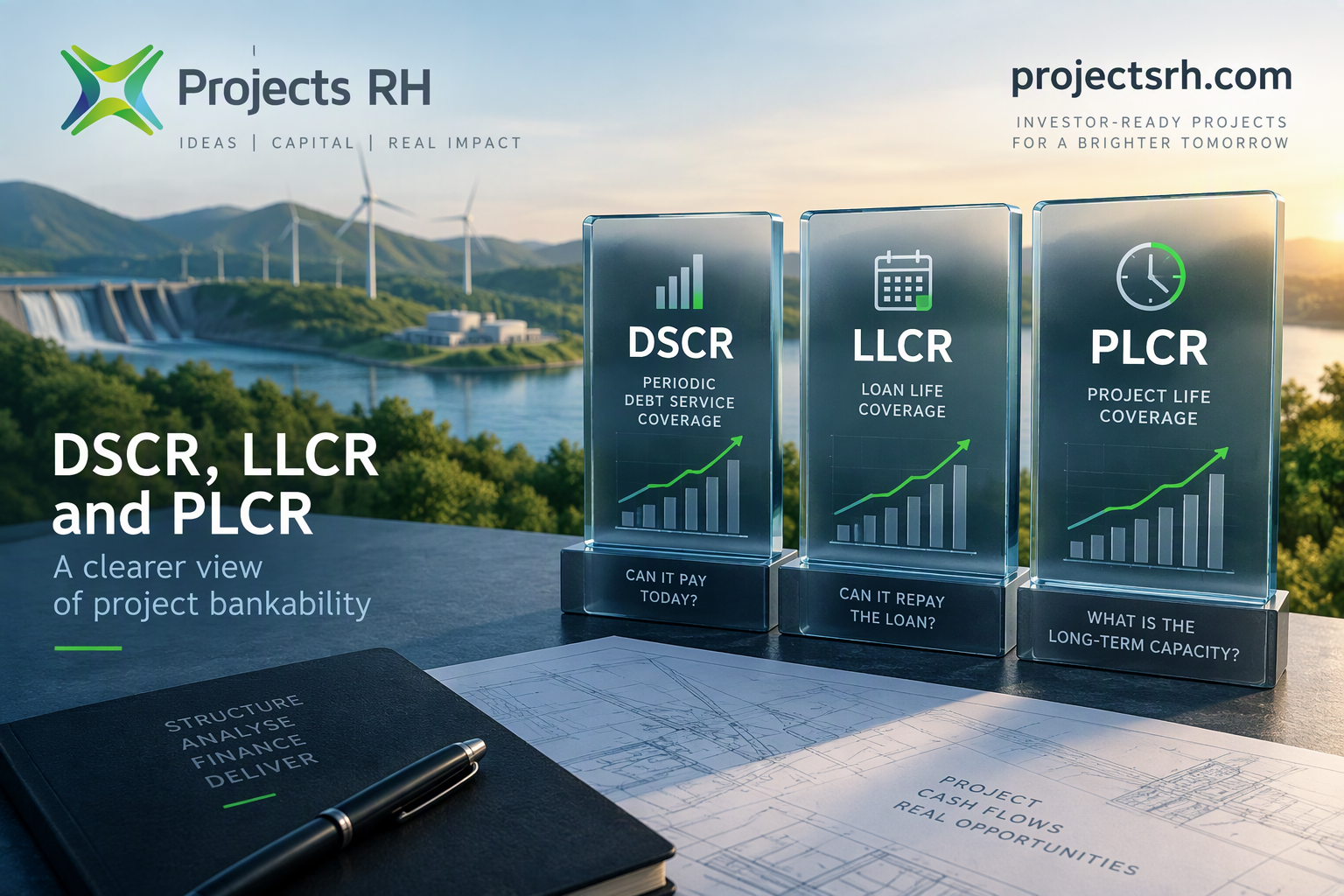
DSCR in Project Finance: How Lenders Use LLCR and PLCR
How do lenders use DSCR, LLCR and PLCR? Learn how these project finance ratios influence debt sizing, repayment, covenants and lender decisions.