
AI Data Centre Water Strategy: A New Test of Project Bankability
An AI data centre water strategy must prove supply, cooling, WUE, permits and resilience. Learn what investors and lenders test before financing.
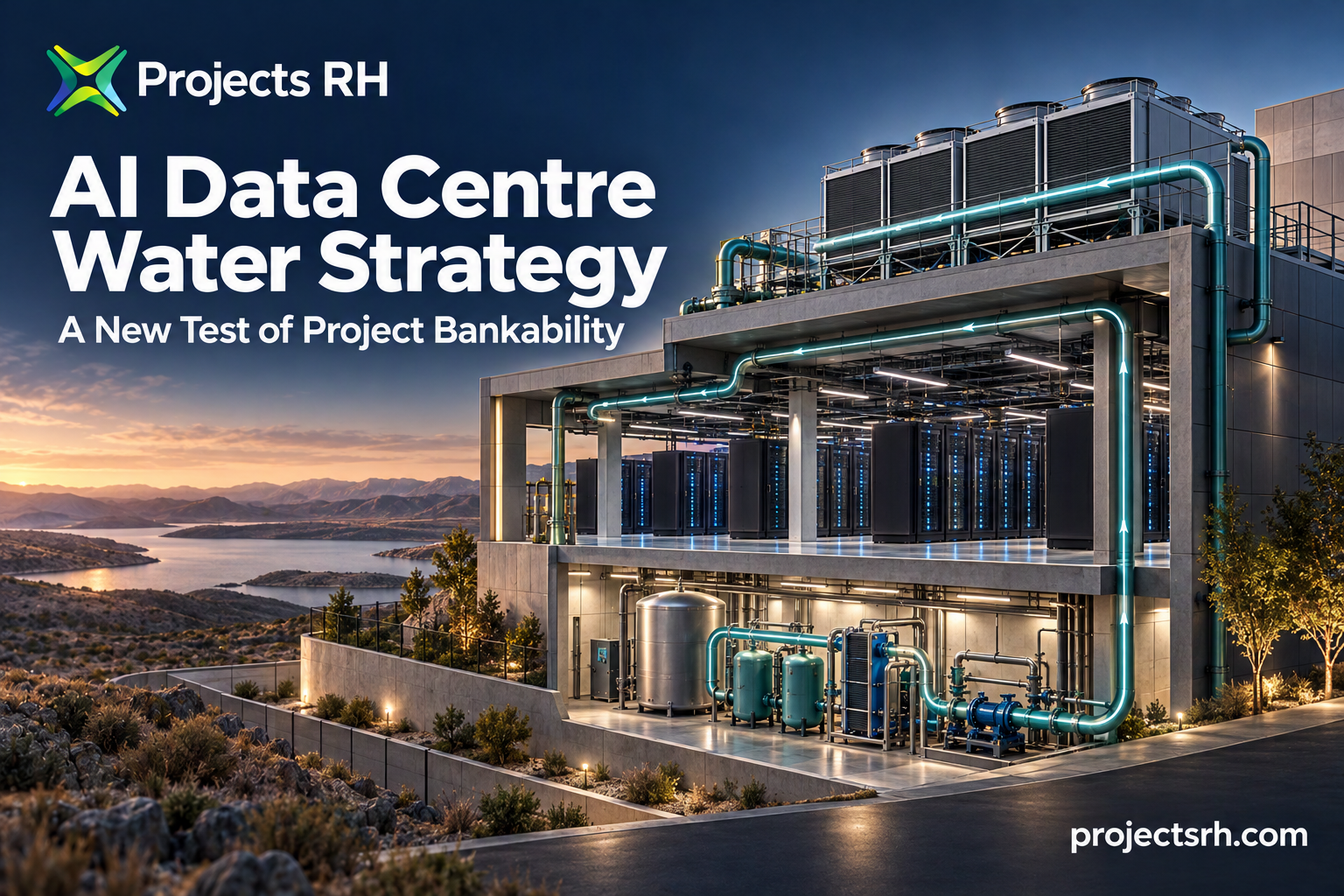
An AI data centre water strategy is becoming an increasingly important part of the investment case for new digital infrastructure.
Water is no longer simply a line in the utilities schedule.
For an AI data centre, investors and lenders may need to understand where water comes from, how much the cooling architecture requires, whether supply is secure, what permits allow, how Water Usage Effectiveness changes with operating conditions and what happens if the local water position becomes more constrained.
That makes water relevant to project bankability.
A bankable AI data centre water strategy does not simply show how much water a facility expects to use. It demonstrates whether the facility can operate reliably, legally and economically under the conditions assumed in the financial model.
Power, land, fibre and tenant demand all remain fundamental.
But if the cooling strategy depends on water that cannot be secured on acceptable terms, the investment case has another material infrastructure constraint.
Why AI Data Centre Water Strategy Now Matters
AI infrastructure is changing the physical requirements of data centres.
Advanced computing workloads can concentrate substantial power and heat within individual racks.
Higher heat density affects cooling architecture.
Cooling architecture affects:
- Water demand
- Power demand
- Capital expenditure
- Operating expenditure
- Site selection
- Utility infrastructure
- Permitting
- Operational resilience
The investment question therefore extends beyond:
How much water does the project use?
It becomes:
Can the proposed cooling and water infrastructure support the intended IT load throughout the financing period?
A credible AI data centre water strategy should answer that question with evidence.
Water Is Part of the Bankability Equation
Project bankability depends partly on whether the essential inputs required for operation are available on sufficiently predictable terms.
For an AI data centre, those inputs can include:
- Power
- Water
- Land
- Fibre connectivity
- Cooling infrastructure
- Equipment
- Permits
- Skilled operations
- Commercial demand
If one of those inputs is materially uncertain, investors may need to understand both the probability and financial consequence of disruption.
Water therefore needs to connect with:
Technical Design → Operations → Revenue → Cash Flow → Financing
This is why a water discussion cannot sit separately from the financial model.
Start With the Source of Water
The first question should be straightforward:
Where will the water come from?
Potential sources can include:
- Municipal potable water
- Municipal non-potable water
- Reclaimed wastewater
- Recycled water
- Groundwater
- Surface water
- Rainwater capture
- Multiple combined sources
The appropriate solution depends on the site, local regulation, cooling architecture and infrastructure availability.
But an institutional reader will generally want evidence supporting the proposed source.
Relevant evidence can include:
- Utility correspondence
- Capacity confirmation
- Supply agreement
- Connection agreement
- Water licence
- Abstraction permit
- Hydrological study
- Engineering study
- Infrastructure plan
- Reclaimed-water agreement
A conceptual water source is different from a secured water source.
That distinction should be explicit.
Water Availability Is Not the Same as Water Security
A region may contain significant water resources while the project still faces constraints.
Investors should understand:
- Allocation rights
- Seasonal availability
- Competing users
- Drought restrictions
- Infrastructure capacity
- Water pressure
- Water quality
- Connection timing
- Regulatory limitations
A municipal utility may theoretically have available supply but require substantial new infrastructure before the site can connect.
Groundwater may physically exist but require abstraction approval.
Reclaimed water may be attractive but depend on a new treatment or transport system.
The investment case should reflect the actual route from water source to reliable operations.
Calculate Water Demand Across the Full Build-Out
A data centre is often developed in phases.
Water requirements should therefore be tested at:
- Initial phase
- Intermediate expansion
- Full build-out
- Peak operating conditions
A water strategy based only on first-phase demand can materially understate future infrastructure requirements.
The model should connect:
IT Load → Cooling Architecture → Operating Profile → Water Demand
That relationship should then reconcile with:
- Utility capacity
- Permitted volume
- Connection infrastructure
- Storage
- Treatment
- Wastewater discharge
If the project expects substantial expansion, the water strategy should explain how that expansion will be supported.
Water Usage Effectiveness Needs Context
Water Usage Effectiveness, or WUE, is an important data centre metric.
WUE generally expresses water consumption relative to the energy consumed by IT equipment.
Conceptually:
WUE = Annual Water Used for Cooling and Humidification / Annual IT Energy Consumption
WUE is commonly expressed in:
litres per kilowatt-hour, or L/kWh
The metric gives investors a way to understand water intensity.
But WUE should not be assessed in isolation.
It can vary according to:
- Cooling design
- Climate
- Humidity
- IT utilisation
- Temperature
- Season
- Water source
- Operating mode
The project should therefore explain the engineering basis behind the assumed WUE rather than presenting one target number without context.
WUE and PUE Need to Be Read Together
Reducing water consumption can sometimes affect electricity consumption.
This creates an important trade-off between Water Usage Effectiveness and Power Usage Effectiveness.
A system relying less heavily on evaporative cooling may reduce on-site water consumption but require additional mechanical cooling.
Conversely, some water-based cooling approaches can reduce electricity used for heat rejection under suitable conditions.
There is therefore rarely a universal optimum.
The relevant question is:
What cooling architecture produces an acceptable combination of water consumption, power consumption, reliability and cost for this particular location?
The financial model should reflect that trade-off.
Cooling Design Determines Water Demand
Different cooling architectures can produce very different water profiles.
Possible approaches may include:
- Air cooling
- Evaporative cooling
- Adiabatic cooling
- Closed-loop water systems
- Direct-to-chip liquid cooling
- Immersion cooling
- Hybrid systems
The correct solution depends on site and equipment requirements.
For institutional review, the important issue is consistency.
If the technical design specifies one cooling architecture while the financial model assumes the costs of another, the investment case has a gap.
Direct-to-Chip Cooling Changes the Equation
AI workloads have increased interest in liquid-based thermal-management systems closer to the processors.
Direct-to-chip cooling transfers heat from high-density computing components through a liquid loop.
Depending on the complete cooling architecture, this can change:
- Facility water consumption
- Cooling electricity
- Heat rejection
- Equipment costs
- Mechanical systems
- Maintenance
- Supply-chain requirements
The investment case should therefore distinguish between the internal cooling loop and the ultimate method used to reject heat from the facility.
A closed loop can dramatically reduce continuous make-up requirements inside one part of the system while the overall facility still needs a clear heat-rejection strategy.
Zero-Water Cooling Is Possible, but Economics Still Matter
New data centre designs demonstrate that operating architectures can materially reduce or eliminate evaporative water consumption for cooling.
That does not mean water becomes irrelevant.
Water can still be required for other facility purposes, and alternative cooling designs can affect:
- Electricity consumption
- Equipment cost
- Cooling infrastructure
- Operating efficiency
- Site design
A sponsor therefore should not simply claim:
"Zero water cooling."
The investment case should explain:
- Which water use is eliminated
- Which water use remains
- How heat is rejected
- What additional power is required
- What the system costs
- How operational reliability is maintained
Investors need the complete system economics.
Reclaimed Water Can Reduce Freshwater Dependency
Some data centre developments use or evaluate reclaimed or recycled water.
This can reduce pressure on potable-water systems.
But reclaimed water introduces its own project requirements.
These can include:
- Treatment infrastructure
- Dedicated pipelines
- Water-quality specifications
- Storage
- Supply contracts
- Redundancy
- Regulatory approvals
The relevant investment question is not simply whether reclaimed water is technically possible.
It is whether the infrastructure and contractual arrangements required to deliver it are credible within the project's timetable and budget.
Water Quality Matters
Cooling systems do not only require a defined volume of water.
They may also require water within specified quality parameters.
Important variables can include:
- Hardness
- Mineral content
- Conductivity
- Biological contamination
- Suspended solids
- Temperature
Poor water quality can create:
- Scaling
- Corrosion
- Fouling
- Treatment costs
- Maintenance requirements
- Equipment-performance problems
The engineering design should identify whether additional treatment is required.
Those costs should appear in the financial model.
Water Infrastructure Can Become a CapEx Item
A data centre may require more than a utility connection.
Infrastructure can include:
- Supply pipelines
- Pumping stations
- Storage tanks
- Treatment plant
- Reclaimed-water connections
- Wastewater infrastructure
- Monitoring systems
These requirements can materially affect capital expenditure.
They can also affect construction timing.
A water strategy should therefore feed directly into the project's Sources & Uses and construction schedule.
Water Operating Costs Belong in the Financial Model
A model should capture relevant ongoing water costs.
These may include:
- Water tariffs
- Wastewater tariffs
- Treatment chemicals
- Filtration
- Pumping electricity
- Maintenance
- Monitoring
- Reclaimed-water charges
- Disposal costs
The financial model should also consider escalation.
A fixed water-cost assumption across a long financing period may be difficult to defend without a contractual or regulatory basis.
Water Permits Can Become Schedule-Critical
Water approvals may operate on timelines different from power, planning or construction permits.
Depending on jurisdiction and source, approvals may include:
- Abstraction licences
- Discharge permits
- Environmental permits
- Water-quality approvals
- Construction permits
- Utility approvals
- Planning conditions
The development schedule should distinguish:
Granted → Submitted → In Preparation → Not Started
That status should also be reflected accurately in investor documentation.
An application is not a permit.
An expected approval is not a granted right.
Discharge Needs Its Own Strategy
Water entering the facility is only one side of the system.
Sponsors should also establish what happens to water leaving the site.
Questions include:
- What volume is discharged?
- Where does it go?
- Does it require treatment?
- What temperature restrictions apply?
- Is discharge infrastructure available?
- Which permits are required?
- Are there quality restrictions?
A project can secure adequate water supply and still face constraints around wastewater or discharge.
Site Selection Should Incorporate Water Risk
A location can be attractive because of:
- Low-cost power
- Grid access
- Fibre
- Land
- Tax incentives
- Customer proximity
But weak water conditions can offset those advantages.
Site selection should consider:
- Watershed conditions
- Current water stress
- Future water stress
- Drought exposure
- Competing demand
- Municipal capacity
- Water infrastructure
- Regulation
- Community considerations
This analysis becomes particularly important when the investment horizon extends over decades.
Water Stress Is a Local Question
Water risk is not uniform across a country or even across a region.
A data centre can sit near another facility with apparently similar conditions while depending on a different watershed, utility system or source.
That means broad national averages can be insufficient.
A bankability assessment should move from:
Country → Region → Watershed → Utility → Site
The more material water is to operations, the more specific that evidence should become.
Community Impact Can Become Project Risk
Large infrastructure projects operate within communities.
Water-intensive facilities can face scrutiny where local households, agriculture or industry depend on the same constrained resources.
This can affect:
- Public acceptance
- Permitting
- Political attention
- Development timelines
- Reputation
- Tenant perception
Community issues should not automatically be interpreted as a financing barrier.
They should be treated as risks that need evidence, engagement and appropriate mitigation.
Tenants May Also Test the Water Strategy
Data centre tenants increasingly evaluate the environmental performance of their infrastructure supply chain.
That can increase scrutiny around:
- Water consumption
- WUE
- Renewable energy
- Carbon intensity
- Water replenishment
- Water sourcing
- Sustainability reporting
The water strategy can therefore affect more than permitting.
It can also enter the commercial proposition.
Water Risk Should Be Reflected in the Financial Model
A robust AI data centre water strategy should connect directly to project economics.
Potential financial variables include:
- Cooling CapEx
- Water infrastructure CapEx
- Water tariffs
- Treatment costs
- Electricity consumption
- Wastewater costs
- Maintenance
- Permitting delays
- Expansion constraints
Investors should be able to trace the technical water assumptions into the model.
If the engineering report forecasts one water requirement while the model assumes another, the investment case loses consistency.
Stress Test Water Cost and Availability
A base case is not enough.
Sponsors should consider sensitivities such as:
- Higher water tariffs
- Lower permitted volume
- Delayed connection
- Reduced supply during drought
- Higher treatment cost
- Additional infrastructure CapEx
- Higher power demand from alternative cooling
- Delayed expansion
The appropriate downside cases depend on site and design.
The objective is to understand which water-related variables could materially affect project economics.
Build a Water Contingency Plan
Investors and lenders may ask what happens when the primary assumption fails.
Possible contingency planning can include:
- Alternative water supply
- Reclaimed water
- On-site storage
- Reduced-water operating mode
- Alternative cooling mode
- Phased capacity
- Backup connection
- Demand management
A credible contingency should be technically and commercially realistic.
It should not simply be described as an option if no infrastructure, permission or cost analysis supports it.
AI Data Centre Water Strategy Checklist
Before institutional investor or lender review, sponsors should be able to confirm:
- The primary water source is identified.
- The legal or contractual basis of supply is understood.
- Water demand is calculated for the current phase.
- Water demand is calculated for full build-out.
- Peak demand has been tested.
- WUE has an engineering basis.
- The relationship between WUE and PUE is understood.
- Cooling architecture matches the financial model.
- Water infrastructure CapEx is included.
- Water operating costs are included.
- Treatment requirements are understood.
- Discharge requirements are understood.
- Required permits are identified.
- Permit status is current.
- Water stress has been assessed at site level.
- Alternative sources have been considered where appropriate.
- Drought or curtailment risk has been assessed.
- Water-cost sensitivities have been modelled.
- Expansion water requirements have been included.
- A credible contingency strategy exists.
If several of these items remain unresolved, further project preparation may be appropriate before broad capital engagement.
AI Data Centre Water Strategy and Investor Readiness
An AI data centre water strategy should form part of the wider investor-readiness assessment.
For a data centre project, investors may need to understand:
Land → Power → Water → Cooling → Fibre → Permits → Tenant Demand → Financial Model → Funding Strategy
These elements are connected.
A change in cooling architecture may change power consumption.
A change in water availability may require a new cooling solution.
A new cooling design may change CapEx.
Higher CapEx may change the funding requirement.
A delayed water connection may change the construction schedule and commercial operation date.
The investment case should therefore be evaluated as one integrated system.
Sponsors can review How Projects RH Works to understand how project assessment, financial modelling, documentation and investor readiness connect.
How Hyperscalers Are Approaching Water
Large data centre operators demonstrate that water strategy is increasingly site-specific rather than based on a single global cooling solution.
Microsoft reports Water Usage Effectiveness in litres per kilowatt-hour and has developed next-generation data centre cooling based on a closed-loop system designed to eliminate water evaporation for cooling.
Google evaluates cooling decisions according to local conditions and considers factors including watershed health, energy and alternative water sources. In areas with higher water risk, alternative approaches can include reclaimed water or air cooling.
AWS similarly focuses on reducing freshwater demand, using recycled or reclaimed water where appropriate and supporting water replenishment.
These approaches do not prescribe one design for every independent data centre project.
They demonstrate a more important principle:
Cooling and water strategy should respond to the specific technical, geographic and resource conditions of the site.
Frequently Asked Questions About AI Data Centre Water Strategy
What is an AI data centre water strategy?
An AI data centre water strategy defines the facility's expected water demand, sources, cooling requirements, WUE, infrastructure, permits, discharge arrangements, risks and contingency measures.
Why does water affect data centre bankability?
If the cooling architecture requires water, restrictions on supply, permits, infrastructure or cost can affect operations, revenue, CapEx, operating expenditure and project timing.
What is WUE?
Water Usage Effectiveness measures water consumed for data-centre cooling and humidification relative to the energy consumed by IT equipment and is generally expressed in litres per kilowatt-hour.
What is the difference between WUE and PUE?
WUE examines water efficiency, while Power Usage Effectiveness examines energy efficiency. Cooling choices can create trade-offs between the two, so both metrics should be considered together.
Can an AI data centre operate without consuming water for cooling?
Certain modern closed-loop and other cooling architectures can eliminate or substantially reduce evaporative water use for cooling. The complete design still needs to consider energy, heat rejection, cost and other facility water requirements.
Can reclaimed water be used for data centre cooling?
Potentially, depending on local infrastructure, regulation, treatment and the technical requirements of the cooling system.
Should water costs be included in the financial model?
Yes. Relevant tariffs, treatment, pumping, wastewater, infrastructure, maintenance and other material water-related costs should be incorporated into project economics.
What should investors test about water supply?
Investors may examine the source, available capacity, contractual security, permits, water quality, infrastructure, drought exposure, competing demand, expansion requirements and contingency plans.
Does a strong water strategy guarantee financing?
No. A strong water strategy can improve clarity and investor readiness, but funding still depends on the complete investment case, due diligence, capital-provider criteria and market conditions.
Sources
- Microsoft - Sustainable by Design: Next-Generation Datacenters Consume Zero Water for Cooling
- Microsoft - Measuring Energy and Water Efficiency for Datacenters
- Google Data Centers - Advancing Responsible Water Use
- Google Cloud - Assessing Watershed Health in Data Center Host Communities
- Amazon Sustainability - Water Stewardship
- Amazon Sustainability - AWS Water Positive Methodology
Is Your AI Data Centre Water Strategy Investment-Ready?
Projects RH helps data centre sponsors identify infrastructure, financial and investment-readiness gaps before approaching institutional investors and lenders.
If you are developing an AI data centre, submit your project for assessment so the Projects RH team can review how water, cooling, power, permits, project economics and supporting evidence fit together.
Learn more about How Projects RH Works and explore Projects RH Services.
Preparing an AI data centre for capital? Submit your project to Projects RH.
What to do next
Projects RH prepares the company and the project first, then takes them to investors. The fastest way to find out where you stand is a short call.
Keep reading

GPU-as-a-Service Finance: How Investors Assess Compute
GPU-as-a-Service Finance depends on utilisation, contracted revenue, customer concentration, lease terms, hardware obsolescence and residual value.
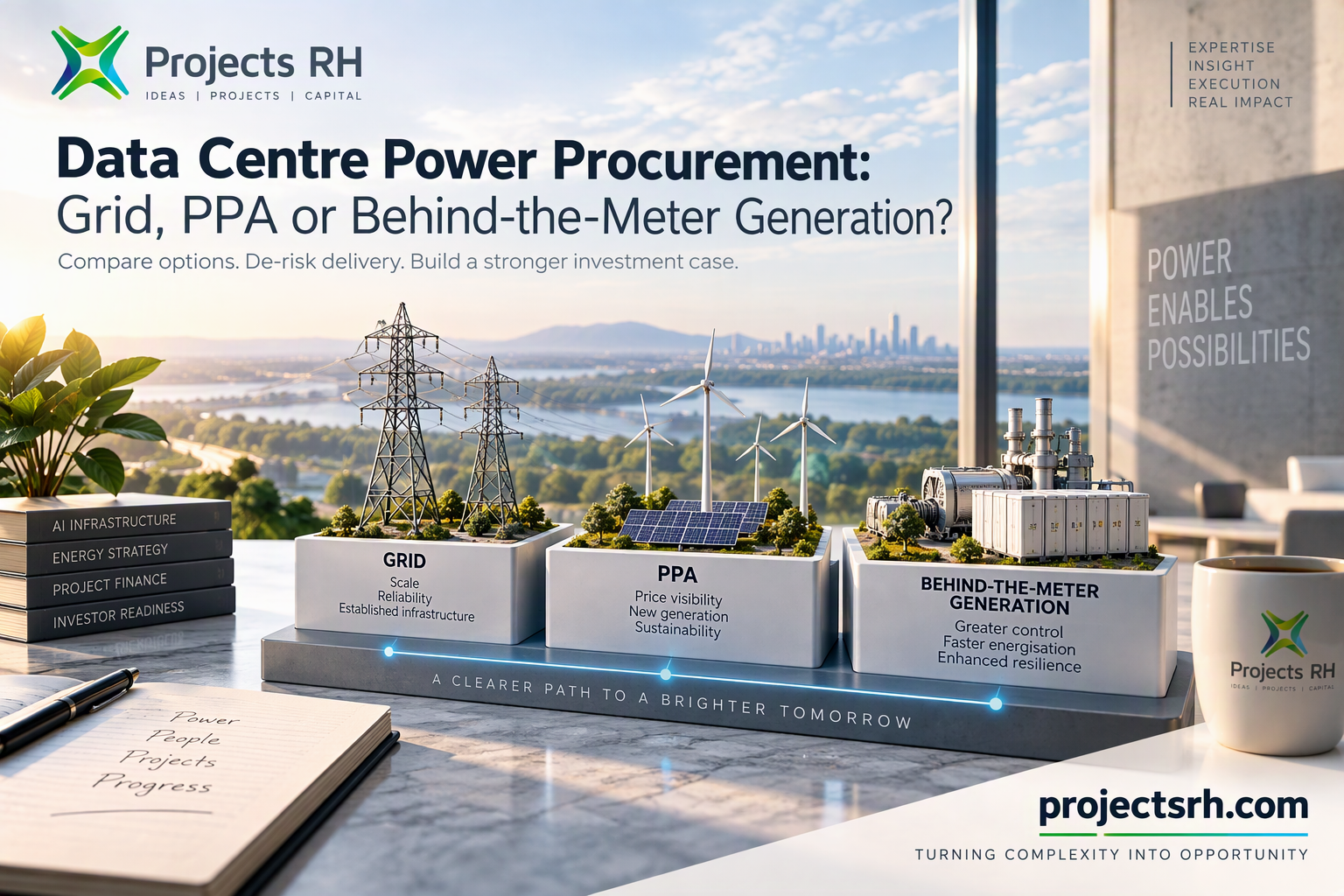
Data Centre Power Procurement: Grid, PPA or Behind-the-Meter?
Data Centre Power Procurement requires a choice between grid supply, PPAs, behind-the-meter generation or a hybrid strategy built around cost, speed and reliability.
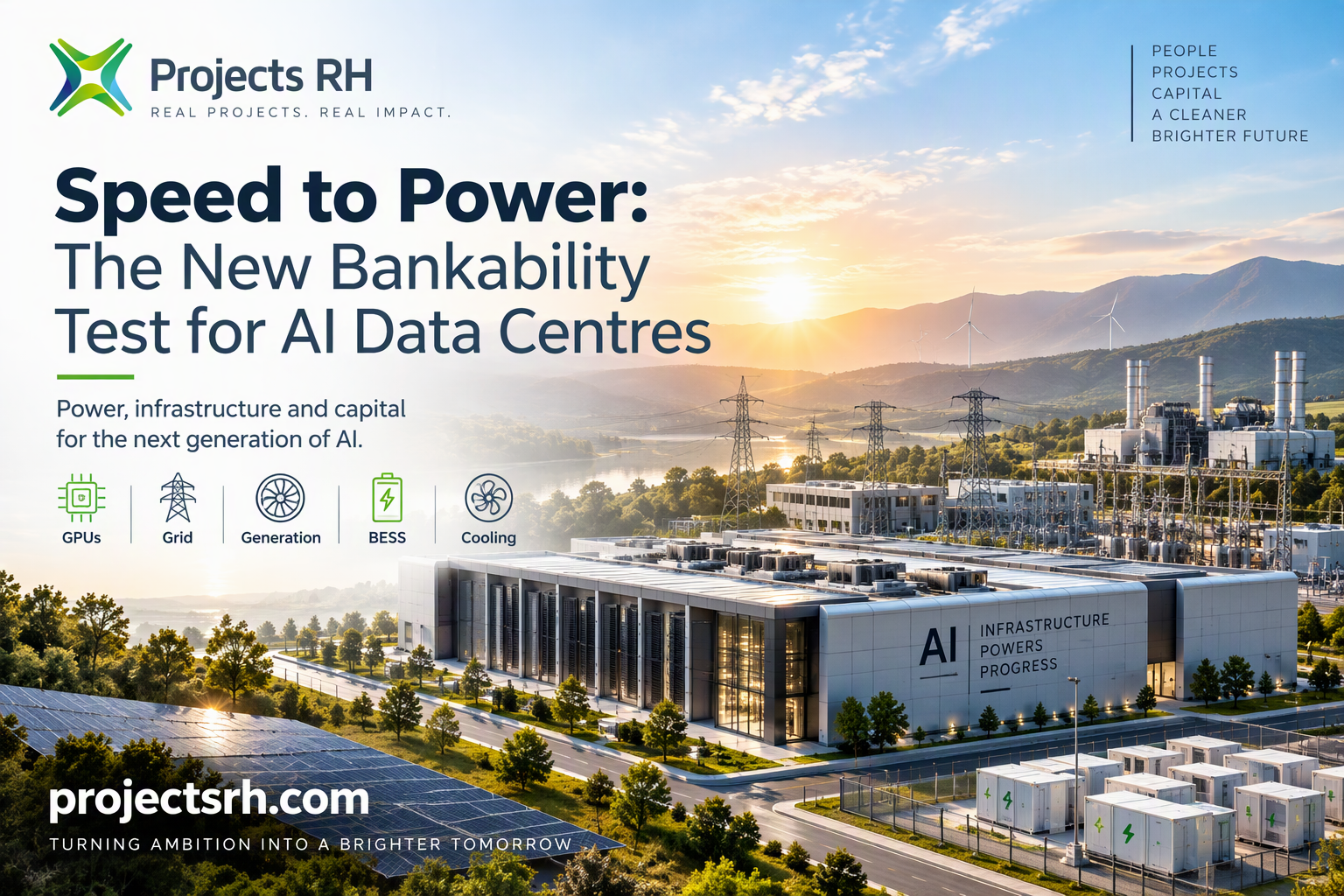
Speed to Power for Data Centres: The New Bankability Test
Speed to Power for Data Centres depends on grid capacity, PPAs, generation, transformers, turbines, BESS, permits and credible delivery schedules.