
Data Centre Power Procurement: Grid, PPA or Behind-the-Meter?
Data Centre Power Procurement requires a choice between grid supply, PPAs, behind-the-meter generation or a hybrid strategy built around cost, speed and reliability.
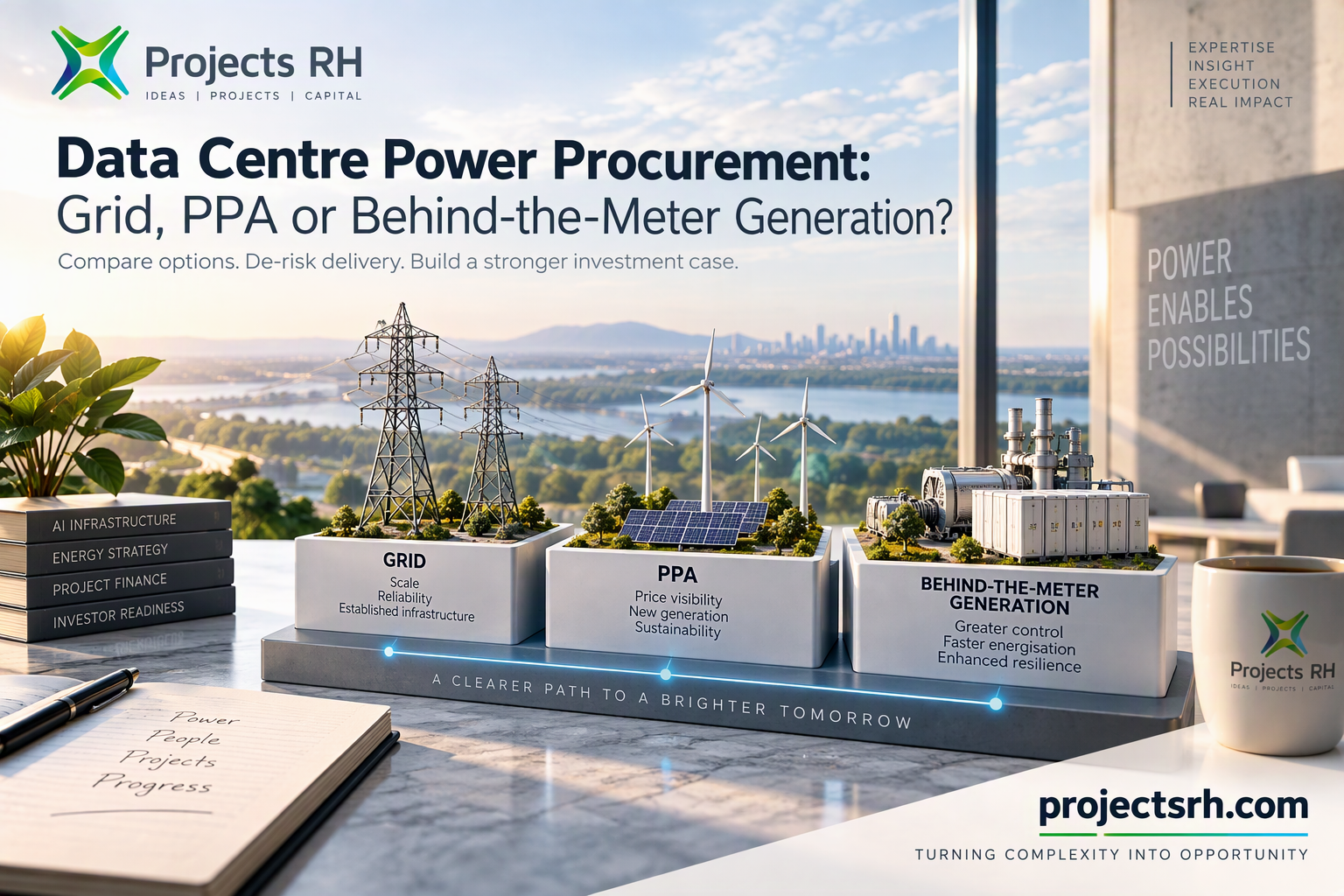
Data Centre Power Procurement is becoming a strategic decision rather than a routine operating purchase. For AI data centres requiring tens or hundreds of megawatts, the choice between grid supply, a power purchase agreement or behind-the-meter generation can determine energisation timing, operating cost, reliability, capital requirements and ultimately whether the project is financeable.
There is no universally correct procurement structure.
Grid power may offer simplicity and access to a diversified electricity system but can expose a project to connection delays and network constraints.
A power purchase agreement can improve price visibility and support new generation, but a PPA does not automatically create physical grid capacity.
Behind-the-meter generation can provide greater control over power delivery and potentially accelerate energisation, but it transfers generation, fuel, permitting and operating risks directly into the project.
Increasingly, the most credible answer may be a combination of all three.
For investors, the key question is not simply where the electricity comes from. It is whether the selected power strategy can deliver the required MW, at the required time, with acceptable reliability, predictable economics and a risk allocation capable of supporting institutional capital.
What Is Data Centre Power Procurement?
Data Centre Power Procurement is the process of securing the electricity capacity, energy supply, contractual rights and supporting infrastructure required to operate a data centre reliably and economically over its investment life.
For large AI data centres, procurement can include:
- Utility grid service
- Transmission-level connections
- Power purchase agreements
- Renewable PPAs
- Physical PPAs
- Sleeved PPAs
- On-site PPAs
- Wholesale market supply
- Behind-the-meter generation
- Natural gas turbines
- Reciprocating engines
- Fuel cells
- Solar generation
- Battery energy storage systems
- Microgrids
- Backup generation
- Demand response
- Flexible interconnection
- Capacity contracts
- Renewable-energy certificates
Power procurement is therefore broader than selecting an electricity tariff.
It links:
Generation → Grid → Connection → Contract → Reliability → Operating Cost → Cash Flow → Bankability
For a data centre, each link matters.
Why Data Centre Power Procurement Has Become a Strategic Issue
Electricity demand from AI and data-centre infrastructure is expanding rapidly.
The International Energy Agency: Electricity 2026 identifies AI and data centres among the dynamic sources contributing to global electricity-demand growth and places particular emphasis on grids, flexibility and resource adequacy.
The Electric Power Research Institute: Powering Intelligence 2026 estimates that U.S. data centres currently account for approximately 4%–5% of national electricity consumption and projects approximately 9%–17% by 2030 across its scenarios.
That growth changes how power should be procured.
A 5 MW enterprise facility and a 500 MW AI campus do not approach electricity markets in the same way.
At scale, the project can affect:
- Utility planning
- Transmission
- Generation requirements
- Substation investment
- Transformer procurement
- Capacity markets
- Local permitting
- Electricity prices
- Infrastructure allocation
Data Centre Power Procurement has therefore become part of project development and financing strategy.
The Three Core Data Centre Power Procurement Options
At a high level, an AI data-centre project can procure power through three principal routes:
- Grid
- Power Purchase Agreement
- Behind-the-Meter Generation
In practice, sophisticated projects may combine them.
The correct strategy depends on:
- Required MW
- Energisation schedule
- Location
- Grid capacity
- Electricity market structure
- Customer requirements
- Reliability
- Sustainability targets
- Permitting
- Fuel availability
- Capital structure
- Investment horizon
The financing analysis should compare those factors systematically.
Option 1: Grid Power
Grid procurement is the conventional model.
The facility connects to a utility or transmission system and purchases electricity under an applicable tariff, retail contract or wholesale arrangement.
Potential advantages include:
- Established infrastructure
- Diversified generation
- Utility operating responsibility
- Lower on-site generation complexity
- Access to system reserves
- Potentially lower upfront generation CapEx
- Mature contractual frameworks
For many data centres, grid supply remains the preferred long-term operating model.
But grid supply has one increasingly important limitation:
The power may not be available when the project needs it.
Grid Capacity Is Different From Grid Energy
A region can generate substantial amounts of electricity annually and still lack the ability to connect another large data-centre load at a specific location.
The constraint may be:
- Transmission
- Distribution
- Substation capacity
- Transformers
- Generation adequacy
- Stability
- Short-circuit limits
- Protection systems
- Local congestion
That means investors should distinguish:
Annual energy availability
from
Deliverable capacity at the project site.
The distinction becomes critical for developments requiring hundreds of megawatts.
Grid Procurement Requires Connection Evidence
A project should not describe electricity as secured merely because discussions with a utility have begun.
Investors should identify the actual stage:
- Initial utility enquiry
- Load request submitted
- Application accepted
- System study underway
- Study completed
- Upgrade scope identified
- Connection costs allocated
- Connection agreement executed
- Construction commenced
- Substation completed
- Transformers installed
- Facility energised
Each stage has a different financing value.
Requested MW are not the same as deliverable MW.
Grid Advantages
Grid supply can provide:
- Access to multiple generators
- System redundancy
- Operational simplicity
- Lower direct fuel-management exposure
- Lower on-site emissions complexity
- Utility balancing services
- Easier integration of diversified resources
It can also allow the data centre to procure renewable power contractually while remaining physically connected to a wider electricity system.
Grid Risks
Potential disadvantages can include:
- Multi-year connection schedules
- Network-upgrade costs
- Uncertain energisation dates
- Utility construction dependencies
- Tariff escalation
- Capacity charges
- Curtailment exposure
- Regulatory change
- Limited project control
Grid availability should therefore be evaluated as a project-development risk, not simply an operating assumption.
Option 2: Power Purchase Agreements
A power purchase agreement, or PPA, is a long-term contract governing the purchase of electricity from a generator or supplier.
PPAs can help data centres secure:
- Electricity volumes
- Long-term prices
- Renewable generation
- Environmental attributes
- New generation capacity
- Commercial visibility
The International Energy Agency: Firm Power Technologies for Data Centres tracks PPAs and offtake agreements across firm-power technologies, reflecting how electricity contracting is becoming increasingly connected to data-centre development.
But the term “PPA” covers several very different structures.
Physical PPA
Under a physical PPA, electricity is sold under contractual delivery arrangements connected to the physical electricity system.
The agreement can define:
- Contract quantity
- Delivery point
- Price
- Escalation
- Settlement
- Curtailment
- Tenor
- Credit support
- Environmental attributes
However, the underlying electricity still needs network infrastructure capable of delivering power to the data centre.
A physical PPA cannot solve a transmission constraint by itself.
Virtual PPA
A virtual PPA is primarily a financial arrangement rather than a direct physical electricity supply contract.
It can provide:
- Price hedging
- Renewable-energy support
- Environmental benefits
- Long-term financial exposure to generation
But electricity consumed by the facility still arrives through the physical power system under separate supply arrangements.
This distinction matters enormously in bankability analysis.
A virtual PPA can hedge electricity economics without solving physical power delivery.
Sleeved PPA
A sleeved PPA typically involves a licensed utility or supplier providing the commercial and physical interface between the generator and the data-centre customer.
The structure can simplify:
- Scheduling
- Balancing
- Settlement
- Regulatory compliance
- Physical supply
But the project still needs adequate network capacity.
The intermediary also introduces:
- Fees
- Credit requirements
- Contract interfaces
- Counterparty risk
On-Site PPA
Under an on-site PPA, a third party develops and owns generation at or near the facility and sells electricity directly to the data centre.
Possible technologies include:
- Solar
- Fuel cells
- Batteries
- Gas generation
- Hybrid systems
This structure can reduce some sponsor CapEx while transferring ownership and operating responsibility to an energy provider.
However, investors should examine:
- Contract tenor
- Availability guarantees
- Pricing
- Escalation
- Change in law
- Equipment replacement
- Termination
- Lender step-in rights
Why PPA Design Must Follow the Load Profile
The data centre and generating asset need compatible operating characteristics.
A 24/7 AI load cannot be evaluated using annual generation alone.
The procurement strategy should consider:
- Hourly demand
- Seasonal demand
- Load factor
- Ramp profile
- Reliability target
- Customer requirements
The Pillsbury analysis of Power Purchase and Interconnection Agreements for Data Centers highlights the importance of matching PPA structures to data-centre load characteristics and coordinating milestones across power and data-centre development.
The commercial contract should follow the physical system.
Renewable PPAs Are Not Automatically Firm Power
A renewable PPA can provide valuable low-carbon electricity procurement.
But wind and solar production varies.
A facility operating continuously may therefore require additional resources during periods of lower renewable production.
A complete supply strategy can combine:
- Renewable PPAs
- Grid supply
- BESS
- Firm generation
- Demand flexibility
- Geographic diversity
Investors should avoid treating annual renewable-energy matching as equivalent to continuous physical electricity supply.
Option 3: Behind-the-Meter Generation
Behind-the-meter generation produces electricity on the customer side of the utility meter and directly serves the data-centre load.
Common options include:
- Gas turbines
- Reciprocating engines
- Fuel cells
- Solar
- Batteries
- Microgrids
- Hybrid generation systems
The attraction is straightforward.
If the grid cannot provide the necessary MW quickly enough, the project may build its own power.
Behind-the-meter generation can potentially improve:
- Speed to power
- Supply control
- Reliability
- Resilience
- Phased expansion
- Cost visibility
But the strategy fundamentally changes the project.
Behind-the-Meter Power Creates a Second Infrastructure Business
A data-centre developer that builds primary generation is no longer developing only a digital facility.
The project may also need to develop:
- A power plant
- Fuel infrastructure
- Electrical distribution
- BESS
- Controls
- Protection systems
- Environmental systems
- Maintenance facilities
The project takes responsibility for issues normally managed by the power system.
These can include:
- Frequency
- Voltage
- Reserves
- Availability
- Fuel
- Black start
- Maintenance
- Emissions
- Redundancy
Greater power control therefore comes with greater project complexity.
Gas Turbines
Gas turbines can provide firm, dispatchable electricity at substantial scale.
Potential advantages can include:
- High output
- Dispatchability
- Strong availability
- Compatibility with baseload requirements
- Potential combined-cycle efficiency
Constraints can include:
- Equipment lead times
- Gas-pipeline capacity
- Fuel contracts
- Air permits
- Water
- Noise
- Emissions
- Carbon exposure
- Maintenance
The investment case must therefore consider far more than generator nameplate capacity.
Reciprocating Engines
Reciprocating engines can provide a more modular generation strategy.
Potential benefits include:
- Smaller individual units
- Phased deployment
- Flexible operation
- Reduced single-unit outage exposure
- Potentially faster deployment
Potential disadvantages include:
- Fuel cost
- Maintenance
- Noise
- Emissions
- Physical footprint
They can be particularly useful where data-centre capacity is also being delivered in phases.
Fuel Cells
Fuel cells offer another behind-the-meter option.
Economic viability depends on:
- Fuel
- Equipment cost
- Efficiency
- Scale
- Availability
- Maintenance
- Equipment replacement
- Vendor support
Fuel cells may suit specific applications but should be modelled using actual project and supplier assumptions.
BESS Is an Infrastructure Tool, Not an Energy Source
Battery energy storage systems can play an important role in Data Centre Power Procurement.
BESS can provide:
- UPS support
- Peak shaving
- Power quality
- Ramp-rate control
- Flexible interconnection
- Renewable integration
- Short-duration backup
- Black-start support
- Demand response
However, a battery stores electricity.
It does not create net energy.
A project relying on BESS should define:
- MW capacity
- MWh duration
- Charge source
- Cycle frequency
- Degradation
- Warranty
- Augmentation
- Replacement
- Fire protection
The storage system should have a clearly defined operating duty.
Grid vs PPA vs Behind-the-Meter Generation
The three approaches can be compared as follows:
| Issue | Grid Supply | PPA | Behind-the-Meter | |---|---|---|---| | Physical power | Yes, when connected | Depends on structure | Yes | | Connection required | Yes | Usually | Potentially reduced | | Speed to power | Depends on grid | Depends on grid and project | Potentially faster | | Upfront CapEx | Usually lower | Usually moderate | Potentially high | | Operating complexity | Lower | Moderate | High | | Fuel risk | Indirect | Depends on contract | Can be direct | | Price visibility | Tariff dependent | Potentially strong | Depends on fuel and CapEx | | Sustainability | Grid mix dependent | Can support renewables | Technology dependent | | Reliability | Grid plus backup | Depends on physical supply | Project controlled | | Development risk | Grid infrastructure | Generation + grid + contract | Generation + permits + fuel | | Control | Lower | Moderate | Higher | | Financing complexity | Established | Contract dependent | Potentially significant |
There is no automatic winner.
The correct answer depends on the project.
When Grid Supply Is Likely to Be Best
Grid supply can be attractive when:
- Sufficient capacity already exists
- Energisation timing matches development
- Utility contracts provide adequate certainty
- Network-upgrade obligations are manageable
- Tariffs are economically competitive
- Reliability is acceptable
- Sustainability requirements can be met contractually
In these circumstances, building a dedicated power system may introduce unnecessary complexity.
When a PPA Is Likely to Be Best
A PPA can be particularly useful when the project seeks:
- Long-term price visibility
- Renewable procurement
- Support for new generation
- Sustainability alignment
- Contractual supply certainty
A PPA is strongest when combined with credible physical delivery arrangements.
It should not be used to disguise an unresolved grid constraint.
When Behind-the-Meter Generation Is Likely to Be Best
Behind-the-meter generation becomes particularly relevant when:
- Grid delivery is too slow
- The project has high power density
- Customer demand values early energisation
- Fuel is available
- Permitting is feasible
- Generation equipment can be procured
- The project can support additional CapEx
- The developer can manage operating complexity
The critical calculation becomes:
What is the value of earlier energisation compared with the additional cost and risk of owning or contracting dedicated generation?
That is a financial-model question.
The Hybrid Strategy May Be More Bankable
Many AI data centres may ultimately use a combination of procurement routes.
For example:
Phase 1
- Limited utility connection
- Behind-the-meter generation
- BESS
Phase 2
- Expanded grid connection
- Renewable PPA
- BESS
Long-Term
- Full grid service
- Long-term PPA portfolio
- On-site generation retained for resilience or peak support
This can reduce reliance on a single power source.
But hybrid systems introduce interface risk.
The financing model must capture:
- Transition timing
- Duplicate infrastructure
- Fuel costs
- Exit costs
- Grid charges
- PPA obligations
- BESS augmentation
- Generation retirement or repurposing
Hybrid should mean diversified, not unnecessarily complicated.
Procurement Strategy Must Follow the Customer Contract
The data-centre electricity strategy should not be designed independently from customer commitments.
Investors should compare:
- Customer start date
- Contracted MW
- SLA requirements
- Power availability guarantees
- Revenue ramp-up
- Termination rights
- Penalties
- Power procurement milestones
A customer expecting 100 MW on a defined date creates a different electricity obligation from speculative future demand.
Power contracts and customer contracts should therefore be developed together.
Reliability Has Financial Value
AI computing hardware represents substantial capital.
An electricity interruption can reduce productive utilisation of:
- GPUs
- Servers
- Networking
- Cooling
- Software
- Customer capacity
That creates a direct relationship:
Power reliability → Compute utilisation → Revenue → Cash flow → Debt service
Investors should translate reliability assumptions into financial scenarios.
Price Must Be Measured at the Data-Centre Busbar
Power-pricing comparisons can be misleading.
Grid power may include:
- Energy
- Capacity
- Transmission
- Distribution
- Demand charges
- Network upgrades
- Taxes
A PPA may include:
- Contract price
- Sleeving
- Balancing
- Transmission
- Basis risk
- Settlement costs
- Credit support
Behind-the-meter generation may include:
- Fuel
- CapEx
- Maintenance
- BESS losses
- Major overhaul
- Carbon costs
- Insurance
- Replacement reserves
The correct comparison is the fully delivered cost of reliable electricity at the data-centre busbar.
Capital Structure Changes With the Procurement Model
Grid procurement may require:
- Connection deposits
- Network contributions
- Substation CapEx
PPA procurement may require:
- Credit support
- Guarantees
- Collateral
- Long-term contractual commitments
Behind-the-meter generation may require:
- Generation equity
- Construction debt
- Equipment finance
- Fuel contracts
- BESS financing
- Long-term project debt
Data Centre Power Procurement and financing strategy therefore need to be developed simultaneously.
A structured Investment Readiness Assessment can help sponsors identify power, commercial, financial and execution gaps before institutional outreach.
Data Centre Power Procurement: Illustrative Decision Matrix
A project could compare strategies using a weighted framework:
| Criterion | Suggested Weight | |---|---:| | Speed to power | 25% | | Reliability | 20% | | Delivered cost | 20% | | CapEx | 10% | | Contract certainty | 10% | | Sustainability | 5% | | Permitting risk | 5% | | Operational complexity | 5% |
The weights should be project-specific.
An AI campus with a signed customer requiring rapid delivery may assign significantly more weight to speed.
A long-duration infrastructure investor may place greater emphasis on operating cost and contractual stability.
The purpose is to make the trade-offs explicit.
Financial Stress Tests Should Compare Procurement Options
The financial model should not contain only a base electricity assumption.
It should test:
Grid Stress
- Connection delayed 6 months
- Connection delayed 12 months
- Network CapEx increased
- Tariffs increased
- Curtailment imposed
PPA Stress
- Generation delayed
- Basis risk increased
- Curtailment increased
- Counterparty default
- Market prices diverge from contract assumptions
Behind-the-Meter Stress
- Turbine delivery delayed
- Fuel price increased
- Gas capacity unavailable
- BESS CapEx increased
- Availability reduced
- Environmental approval delayed
The model should measure impact on:
- Revenue
- EBITDA
- DSCR
- Interest during construction
- Liquidity
- Equity IRR
- Customer penalties
- Completion date
The best procurement solution is the one that remains financeable under credible downside conditions.
Data Centre Power Procurement: Investor Bankability Checklist
Load
- What is the initial MW requirement?
- What is ultimate capacity?
- What is the load factor?
- How quickly does demand ramp?
- Which customer commitments support the load?
Grid
- What capacity is available?
- What studies are complete?
- What upgrades are required?
- Who pays for them?
- When can the project energise?
- Is the date contractually supported?
PPA
- Is the PPA physical or financial?
- What MW are contracted?
- What is the generation technology?
- What is the tenor?
- What is the delivery point?
- What curtailment rights exist?
- What credit support applies?
Behind-the-Meter
- Which generation technology is proposed?
- Is equipment available?
- Is fuel secured?
- Are permits available?
- What redundancy is required?
- Who operates the plant?
BESS
- What MW are required?
- What MWh are required?
- What operating duty is expected?
- What degradation is modelled?
- What augmentation is required?
- What warranties apply?
Commercial
- Does the power ramp match customer contracts?
- Are availability requirements aligned?
- Are penalties modelled?
- Who carries delay risk?
Financial
- Is total power CapEx included?
- Is all delivered power cost included?
- Is adequate contingency available?
- Is delay liquidity available?
- What is downside DSCR?
- What is the equity return under each procurement option?
Execution
- Who integrates the system?
- Are long-lead items identified?
- Are equipment slots secured?
- Are completion tests defined?
- Are utility, power and data-centre schedules integrated?
If these questions remain unresolved, the project's electricity strategy is not sufficiently developed for serious institutional financing.
Common Mistakes in Data Centre Power Procurement
Choosing the Lowest Electricity Price
The lowest quoted MWh price may not provide the lowest fully delivered cost.
Treating a PPA as Physical Grid Capacity
A PPA and an interconnection are different assets.
Treating Grid Capacity as Guaranteed
A request or study does not necessarily constitute deliverable electricity.
Underestimating Behind-the-Meter CapEx
Generation requires more than a turbine or engine.
Ignoring Fuel Infrastructure
Gas generation without adequate pipeline capacity is not a complete solution.
Treating BESS as Generation
BESS stores electricity but does not create sustained energy.
Separating Customer Contracts From Power Contracts
The revenue and power ramps should align.
Ignoring Transition Risk
A bridge-to-grid strategy needs a credible transition from temporary to permanent supply.
Comparing Power Sources on an Inconsistent Basis
Procurement options should be compared using fully delivered, reliability-adjusted cost.
Frequently Asked Questions About Data Centre Power Procurement
What is Data Centre Power Procurement?
Data Centre Power Procurement is the process of securing the electricity capacity, energy contracts and supporting infrastructure required to operate a data centre reliably and economically.
Is grid power better than a PPA for id service provides physical electricity once connected, while a PPA can provide price certainty, support generation or meet sustainability objectives.
The best structure depends on physical grid capacity, contract design and project requirements.
Does a PPA guarantee electricity delivery?
Not automatically.
A PPA defines commercial rights and obligations, but physical delivery may still depend on transmission, distribution and grid interconnection.
What is behind-the-meter generation?
Behind-the-meter generation is electricity produced on the customer side of the utility meter and used directly by the data centre.
It can include gas turbines, reciprocating engines, fuel cells, solar generation and batteries.
Why are AI data centres considering behind-the-meter power?
Behind-the-meter generation can potentially accelerate energisation where grid capacity is constrained and can provide greater control over reliability and expansion.
Is behind-the-meter generation cheaper than grid power?
Not automatically.
The comparison should include generation CapEx, fuel, operations, maintenance, BESS, permits, emissions, insurance and replacement reserves.
Can BESS replace the grid?
Usually not for sustained operation.
BESS can provide storage, short-duration backup, peak management and flexibility but requires another energy source for recharging.
Can an AI data centre combine grid power, PPAs and on-site generation?
Yes.
Hybrid strategies can combine grid supply, PPAs, BESS and behind-the-meter generation to balance speed, cost, reliability and sustainability.
Which power procurement option is most bankable?
The most bankable option is the structure that can demonstrate deliverable capacity, reliable operation, credible contracts, realistic costs, appropriate risk allocation and financial resilience.
What should investors evaluate first?
Investors should establish the exact MW requirement, required energisation date, physical grid status, customer commitments and credible alternatives if the primary power strategy is delayed.
Sources
- International Energy Agency: Electricity 2026
- International Energy Agency: PPAs and Offtake Agreements for Data Centres
- Electric Power Research Institute: Powering Intelligence 2026
- Electric Power Research Institute: Hyperscale Data Center Grid Integration
- Pillsbury: Power Purchase and Interconnection Agreements for Data Centers
- GE Vernova: Data Center Power Procurement
Final Perspective: Procurement Is Really About Deliverable Power
The question Grid, PPA or Behind-the-Meter? sounds like a choice between three electricity products.
It is more fundamental than that.
Institutional capital is ultimately concerned with whether the project can turn electricity into contracted compute revenue at an acceptable level of risk.
Grid power can provide a strong long-term platform when sufficient capacity is physically available.
PPAs can provide price visibility, support new generation and contribute to sustainability strategies.
Behind-the-meter generation can provide greater control and potentially faster energisation where grid infrastructure cannot keep pace.
But none of these structures is automatically bankable.
The strongest Data Centre Power Procurement strategy may combine them, allocating each solution to the role it performs best while ensuring that power delivery, customer commitments, construction milestones and financing remain aligned.
The right power strategy is not necessarily the cheapest source of electricity. It is the structure that can deliver the required MW, when the data centre needs them, at a predictable cost, with sufficient reliability to protect compute revenue and investor returns.

What to do next
Projects RH prepares the company and the project first, then takes them to investors. The fastest way to find out where you stand is a short call.
Keep reading
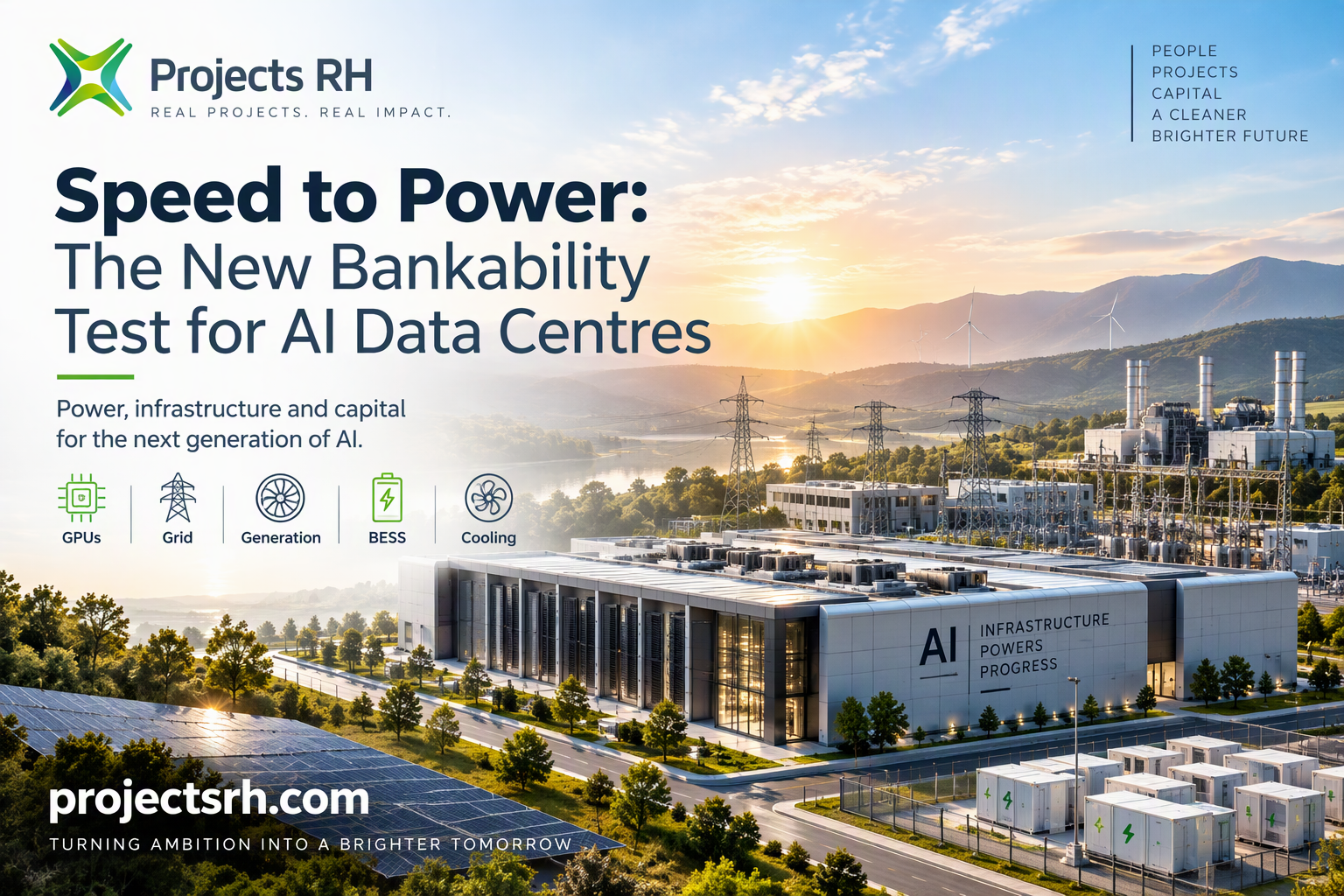
Speed to Power for Data Centres: The New Bankability Test
Speed to Power for Data Centres depends on grid capacity, PPAs, generation, transformers, turbines, BESS, permits and credible delivery schedules.
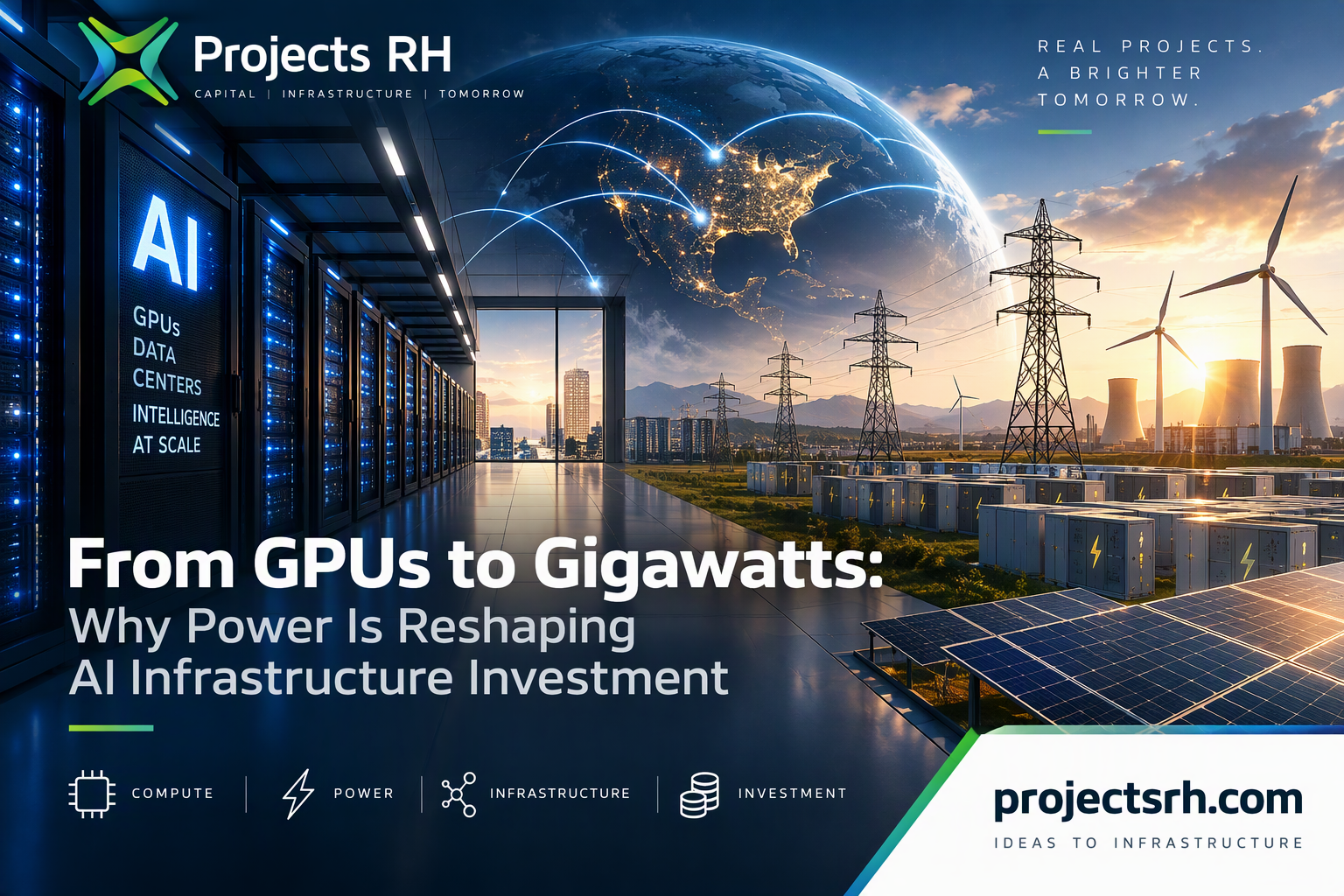
From GPUs to Gigawatts: Why Power Is Reshaping AI Infrastructure Investment
AI Infrastructure Investment is becoming a power story as data centers compete for electricity, grid access, generation, storage and capital.

Disruptive Technology Projects and Investments: Get Ready
Disruptive technology draws investor interest, but technical promise alone is not fundable. What investors test, the risks they weigh, and how to prepare before raising capital.