
GPU-as-a-Service Finance: How Investors Assess Compute
GPU-as-a-Service Finance depends on utilisation, contracted revenue, customer concentration, lease terms, hardware obsolescence and residual value.
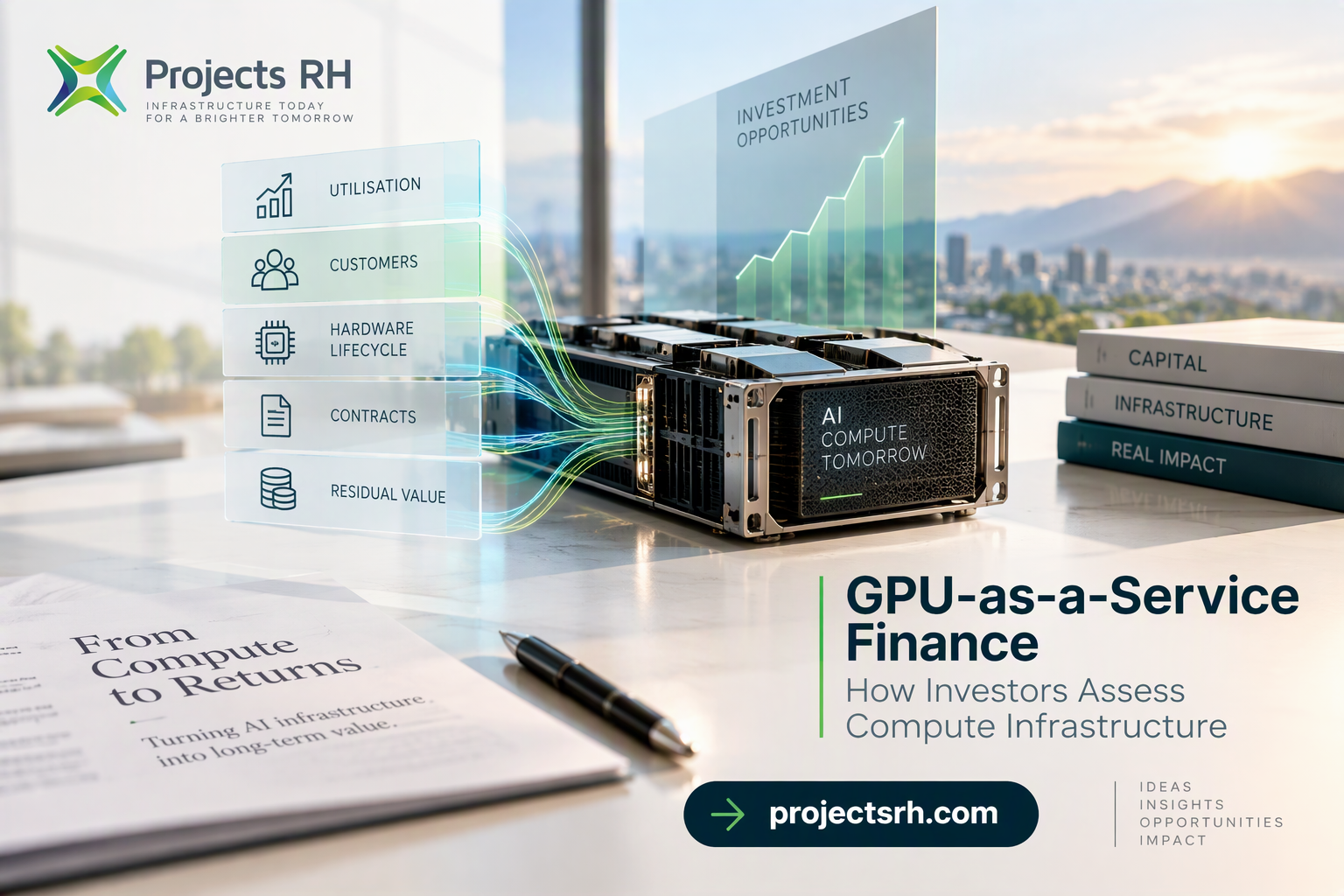
GPU-as-a-Service Finance is becoming a new infrastructure underwriting discipline. Investors are no longer looking only at how many GPUs an operator owns or how quickly demand for AI compute is growing. They are asking whether expensive, rapidly evolving hardware can generate predictable contracted cash flow before utilisation falls, customers leave, technology changes or residual values decline.
That distinction matters.
A GPU cluster may be technically impressive.
It may contain the latest accelerators, high-speed networking and sophisticated orchestration software.
But investors are financing cash flow.
The real questions are:
Who will use the compute?
For how long?
At what utilisation?
Under what contract?
How quickly does the equipment amortise?
What happens when a newer GPU generation changes pricing?
And ultimately:
What is the hardware worth if the original customer disappears?
GPU-as-a-Service becomes financeable when compute demand, utilisation, customer contracts, infrastructure availability and hardware value can be converted into a resilient cash-flow case.
What Is GPU-as-a-Service Finance?
GPU-as-a-Service Finance is the financing of GPU compute infrastructure that generates revenue by providing customers with access to accelerated computing capacity under hourly, reserved, dedicated or long-term contractual arrangements.
The financing can cover:
- GPUs
- GPU servers
- High-speed networking
- Storage
- Racks
- Cooling infrastructure
- Data-centre capacity
- Power infrastructure
- Software orchestration
- Deployment
- Maintenance
- Hardware refresh programmes
GPU-as-a-Service, or GPUaaS, transforms computing hardware into a revenue-producing infrastructure asset.
Customers do not necessarily buy the equipment.
They buy access to compute.
That creates a financing chain:
Capital → GPUs → Data Centre → Power → Compute Capacity → Utilisation → Customer Revenue → Debt Service
Every link matters.
For sponsors moving from technical development toward institutional capital, an early Investment Readiness Assessment can help identify weaknesses before formal investor outreach.
Why GPU-as-a-Service Finance Is Different From Traditional IT Finance
Traditional IT equipment is often financed principally against the creditworthiness of the corporate user.
GPU infrastructure introduces a different model.
The hardware itself may be located inside a third-party data centre.
The operator may lease the facility.
The GPUs may be owned by a financing SPV.
The end customer may contract only for compute capacity.
The power infrastructure may belong to another party.
This creates several separate exposures:
- Hardware risk
- Operator risk
- Customer risk
- Data-centre risk
- Power risk
- Technology risk
- Residual-value risk
- Contract risk
Investors therefore need to underwrite the entire operating ecosystem.
The Clifford Chance analysis of GPU infrastructure financing describes AI compute as an increasingly investable infrastructure class in which bankability depends heavily on contractual frameworks, revenue certainty, ecosystem alignment and risk allocation.
That is an important shift.
The collateral is not enough.
The operating system around the collateral needs to work.
GPU-as-a-Service Finance Is Becoming Institutional Infrastructure
GPU-backed financing has moved beyond experimental structures.
In March 2026, CoreWeave announced a USD 8.5 billion delayed-draw term loan.
The facility was structured as non-recourse financing secured by HPC infrastructure and an associated customer contract.
CoreWeave reported ratings of A3 from Moody's and A (low) from DBRS.
The structure initially allowed approximately USD 7.5 billion to be borrowed, with capacity increasing to USD 8.5 billion as underlying assets reached stabilisation.
This is strategically important.
It demonstrates that institutional lenders can evaluate GPU infrastructure through a framework combining:
Hardware + Contracted Compute Revenue + Structural Protections
rather than treating every GPU investment as venture-style technology exposure.
Utilisation Is the First Economic Variable
GPUs produce economic value when customers use them.
An idle GPU still:
- Depreciates
- Consumes capital
- Occupies rack capacity
- Requires reserved power
- Requires cooling infrastructure
- Incurs financing cost
- Requires software and maintenance
Utilisation therefore directly affects revenue generation.
Consider a simplified example.
A cluster contains 1,000 GPUs.
At 90% billable utilisation:
1,000 × 90% = 900 equivalent fully utilised GPUs
At 60%:
1,000 × 60% = 600 equivalent fully utilised GPUs
The same physical infrastructure produces very different revenue.
That affects:
- Revenue
- EBITDA
- Debt service
- DSCR
- Liquidity
- Equity returns
- Hardware payback
- Refinancing capacity
Utilisation assumptions therefore belong at the centre of GPU-as-a-Service Finance.
Not All Utilisation Is Equal
A headline utilisation percentage can conceal important differences.
Investors should distinguish between:
Physical Utilisation
Whether the GPU is technically in use.
Billable Utilisation
Whether usage actually generates customer revenue.
Contracted Utilisation
Capacity supported by contractual customer commitments.
Realised Utilisation
Actual revenue-generating usage after downtime, credits, discounts and operational interruptions.
Economic Utilisation
The utilisation required to cover the complete cost of the asset and generate the targeted return.
A GPU can be occupied while producing weak economics if pricing is too low.
Similarly, a cluster can have contracted capacity that has not yet translated into recognised revenue.
Investors should therefore analyse utilisation and pricing together.
The Financial Model Needs a Utilisation Curve
A credible financial model should not assume immediate steady-state operation.
GPU infrastructure normally ramps.
A simplified case might look like this:
| Period | Illustrative Utilisation | |---|---:| | Commissioning | 20% | | Quarter 1 | 45% | | Quarter 2 | 65% | | Quarter 3 | 80% | | Stabilised | 90% |
These percentages are illustrative.
Actual assumptions should reflect:
- Customer onboarding
- Cluster commissioning
- Software readiness
- Power availability
- Network configuration
- Workload migration
- Sales pipeline
- Customer contracts
The financing case should demonstrate sufficient liquidity during the ramp period.
Contracted Utilisation Is More Financeable Than Forecast Utilisation
A forecast that customers should rent 90% of a GPU fleet is not equivalent to contractual revenue.
Investors should distinguish between:
- Market demand
- Sales pipeline
- Letters of intent
- Capacity reservations
- Minimum-spend agreements
- Take-or-pay contracts
- Long-term committed contracts
Each provides a different degree of revenue visibility.
A strong market forecast can support the investment thesis.
A strong contract can support debt.
That difference is fundamental.
Customer Credit Quality Changes the Financing Case
The identity and creditworthiness of each customer matter.
A multi-year contract with a financially strong hyperscaler or enterprise customer can carry substantially greater financing value than expected demand from unidentified users.
Investors may assess:
- Customer creditworthiness
- Contract tenor
- Minimum commitment
- Take-or-pay provisions
- Termination rights
- Pricing
- Escalation
- Service credits
- Renewal rights
- Security deposits
- Parent guarantees
The customer contract effectively becomes part of the collateral package.
This is one reason GPU financing can increasingly resemble infrastructure or equipment finance rather than speculative hardware investment.
Customer Concentration Is a Material Risk
A strong anchor customer can improve bankability.
Too much dependence on one customer can create concentration risk.
If one customer generates most of the revenue and that contract terminates, the operator may suddenly need to re-market a significant amount of compute capacity.
The credit question becomes:
How replaceable is that revenue?
Investors should consider:
- Percentage of revenue from the largest customer
- Top-three customer concentration
- Contract-expiration profile
- Customer credit quality
- Workload portability
- Alternative customers
- Re-leasing period
- Pricing required to attract replacement demand
Customer concentration can therefore be both a financing strength and a risk.
Contract Strength Matters More Than Customer Names Alone
A well-known customer does not automatically create bankable revenue.
Investors need to understand whether the agreement contains:
- Binding minimum commitments
- Capacity reservations
- Take-or-pay obligations
- Credit support
- Termination rights
- Service-level obligations
- Pricing adjustments
- Renewal mechanisms
A recognizable customer with a cancellable, short-duration agreement can potentially provide less financing value than a strong multi-year contract with a smaller but creditworthy counterparty.
Lease Terms Need to Match Hardware Economics
GPU infrastructure evolves quickly.
A financing term should therefore reflect the economic life of the equipment.
The lease or loan should consider:
- Initial equipment cost
- Contracted revenue
- Expected utilisation
- Hardware refresh cycle
- Depreciation
- Residual value
- Maintenance
- Reconfiguration
- Redeployment
A ten-year financing structure requires very different assumptions from a two- or three-year equipment lease.
The longer financing extends beyond the high-value operating period of a GPU generation, the more dependent repayment becomes on residual value, re-leasing or refinancing.
Hardware Obsolescence Is Different From Physical Failure
A GPU does not need to stop working to lose economic value.
The hardware can remain technically functional while becoming commercially less attractive because a newer generation offers:
- Higher performance
- Better energy efficiency
- Greater memory
- Faster interconnect
- Improved software optimisation
- Lower cost per unit of compute
This creates technology-age risk.
The important question is not only:
How old is the GPU?
It is:
How competitive is the GPU against the hardware customers can rent tomorrow?
That is the more relevant underwriting question.
Hardware Refresh Cycles Need to Be Financed
GPU operators cannot assume that one equipment purchase creates a permanent compute platform.
The business can require recurring investment in:
- New GPU generations
- Networking
- Storage
- Cooling
- Power distribution
- Firmware
- Software
- Cluster architecture
The financing strategy should therefore consider:
Initial Deployment → Operating Period → Refresh → Redeployment → Residual Value
not simply initial CapEx.
NVIDIA DGX Lifecycle Management frames hardware acquisition around lifecycle planning and flexible acquisition strategies intended to align infrastructure with technology evolution.
Hardware refresh should therefore be treated as a planned financial event.
Residual Value Is One of the Hardest Assumptions
Residual value is the equipment's estimated economic value when the initial lease, loan or customer contract ends.
It matters because a financier may expect repayment from:
- Contracted cash flow
- Asset resale
- Re-leasing
- Redeployment
The greater the residual assumed, the less principal may appear to need recovery during the original contract period.
That can improve apparent economics.
It can also increase risk substantially.
Aggressive Residual Values Can Hide Leverage
Suppose GPU infrastructure costs USD 100 million.
Consider two illustrative assumptions.
Conservative Case
Expected residual after the financing period:
10% = USD 10 million
The financing structure therefore needs to recover most of the original equipment value during the core operating term.
Aggressive Case
Expected residual:
40% = USD 40 million
Less capital appears to require recovery through initial operating cash flow.
Lease payments may consequently appear lower.
But the financing now depends far more heavily on the future market value of older hardware.
If actual residual value is USD 15 million rather than USD 40 million, somebody absorbs a USD 25 million shortfall.
Residual value is therefore not an accounting detail.
It is risk allocation.
Secondary-Market Evidence Matters
Residual assumptions should be supported by actual secondary-market evidence where available.
Investors should evaluate:
- Actual secondary transactions
- GPU generation
- Hardware configuration
- OEM
- Server condition
- Software compatibility
- Geography
- Remaining support
- Network architecture
- Transaction period
- Sale timeframe
The American Compute GPU Residual Value Report 2026 argues that GPU residuals are better evaluated using bands and scenarios than a single smooth depreciation curve.
That principle is useful for underwriting.
The future value of rapidly changing compute equipment is a distribution, not a certainty.
Complete Systems May Have Different Residual Economics
Investors should distinguish individual GPU value from complete cluster value.
A functioning system can include:
- GPU nodes
- CPUs
- RAM
- NVMe storage
- Networking
- InfiniBand or Ethernet switching
- Racks
- Cabling
- Software configuration
Equipment may generate more value as an operating cluster than as separate components.
However, re-leasing an entire cluster requires:
- Suitable data-centre space
- Power
- Cooling
- Networking
- Operating capability
- Customers
Collateral recovery therefore depends on infrastructure access as well as hardware resale.
Data-Centre Access Is Part of GPU Collateral Value
A GPU cannot generate compute revenue sitting in a warehouse.
Its productive value depends on access to:
- Energised racks
- Cooling
- High-speed networking
- Storage
- Security
- Connectivity
- Operating software
The financing package should therefore examine the relationship between the GPU assets and the data centre hosting them.
Investors should check:
- Data-centre contract tenor
- Power allocation
- Termination rights
- Access rights
- Step-in rights
- Equipment-removal rights
- Landlord claims
- Insurance
- Security arrangements
If a borrower defaults, lenders need to understand whether the equipment can actually be accessed, operated, transferred or sold.
Power Availability Can Determine Compute Revenue
GPU infrastructure is highly power dependent.
The financing analysis should establish:
- MW required
- Energised MW
- Power cost
- Reliability
- Redundancy
- Expansion capacity
- Cooling load
- Connection timetable
A contract involving 10,000 GPUs has limited economic value if insufficient electricity exists to operate the cluster.
Compute finance and data-centre power finance therefore cannot be analysed independently.
Networking Is Part of the Product
AI compute is not simply the sum of individual GPUs.
Large-model training and advanced workloads can depend heavily on:
- High-speed interconnect
- Network topology
- Switch capacity
- Latency
- Storage throughput
A collection of valuable GPUs connected through an inadequate network may fail to provide the performance customers expect.
Investors should therefore assess the complete compute system.
The Revenue Model Matters
GPU-as-a-Service revenue can be generated through:
- On-demand hourly usage
- Reserved instances
- Dedicated clusters
- Minimum-spend contracts
- Take-or-pay agreements
- Multi-year capacity contracts
- Managed AI infrastructure
- Training contracts
- Inference services
These models have different financing characteristics.
On-Demand
Potentially higher pricing but less predictable utilisation.
Reserved Capacity
Greater revenue visibility in exchange for contractual pricing commitments.
Dedicated Cluster
The customer receives defined computing capacity over a specified period.
Take-or-Pay
The customer commits to minimum payments irrespective of actual utilisation.
For debt financing, predictable contractual cash flow normally has more value than theoretical peak pricing.
Price per GPU-Hour Is Not Enough
Investors should not evaluate a GPU platform solely from advertised rental pricing.
Net economics depend on:
- Realised GPU-hour price
- Discounts
- Utilisation
- Power
- Cooling
- Data-centre rent
- Networking
- Storage
- Maintenance
- Software
- Financing cost
- Customer acquisition
- Service credits
A more useful metric is:
Net Revenue per Available GPU-Hour
rather than headline rental price.
A Simple GPU Revenue Model
An illustrative revenue formula is:
Revenue = Number of GPUs × Available Hours × Billable Utilisation × Realised Price
Assume:
- 1,000 GPUs
- 8,760 annual hours
- 80% billable utilisation
- USD 2.00 realised GPU-hour
Illustrative annual revenue:
1,000 × 8,760 × 80% × USD 2.00 = USD 14.016 million
At 50% utilisation:
1,000 × 8,760 × 50% × USD 2.00 = USD 8.76 million
The same physical assets produce a difference of more than USD 5 million in annual revenue.
These assumptions are illustrative.
The principle is fundamental:
Utilisation is a financing variable.
Pricing Compression Should Be Stress-Tested
Even when utilisation remains strong, revenue can decline when GPU rental pricing falls.
New GPU generations may create pricing pressure on older hardware.
Cloud providers may compete aggressively.
Customers may renegotiate rates.
The financial model should therefore stress:
Utilisation + Realised GPU-Hour Price
simultaneously.
A downside model that stresses utilisation while assuming constant pricing may materially understate revenue risk.
GPU-as-a-Service Finance Stress Test
An illustrative downside framework could be:
| Scenario | Utilisation | Realised Price | Residual Value | |---|---:|---:|---:| | Base | 85% | 100% of base | 20% | | Moderate stress | 70% | 85% of base | 10% | | Severe stress | 50% | 65% of base | 5% |
These percentages are illustrative.
The financial model should calculate effects on:
- Revenue
- EBITDA
- DSCR
- Liquidity
- Debt balance
- Loan-to-value
- Equity IRR
- Refinancing
- Exit proceeds
A structure that remains financeable only with high utilisation, stable pricing and high residual value is not robust.
Customer Concentration Should Be Stress-Tested Separately
Suppose a GPUaaS operator has:
- Customer A: 60% of revenue
- Customer B: 20%
- Other customers: 20%
The model should test what happens if Customer A:
- Renegotiates pricing
- Reduces capacity
- Delays deployment
- Terminates
- Defaults
The analysis should include both the revenue loss and the time required to re-lease released compute capacity.
Hardware capable of being re-contracted rapidly has a different risk profile from a specialised cluster requiring months of repositioning.
Contract Expiry Can Create a Refinancing Wall
A financing structure may appear secure while major customer contracts remain active.
The real risk can arise when:
Customer Contract Expiry + Debt Maturity + Hardware Refresh
occur within the same period.
Investors should map:
- Contract expiries
- Lease expiries
- Debt amortisation
- Data-centre contract expiry
- GPU refresh dates
- Residual-value assumptions
These dates should be analysed together.
Amortisation Should Follow Economic Depreciation
Fast-changing hardware generally requires faster debt reduction than long-lived infrastructure.
The underwriting principle is:
Debt should decline sufficiently quickly that contracted cash flow and collateral value remain comfortably ahead of the outstanding balance.
A long-dated bullet loan backed by rapidly depreciating equipment and short-duration contracts can create substantial refinancing risk.
The amortisation schedule should therefore be tested against:
- Technology cycle
- Customer tenor
- Residual value
- Secondary-market liquidity
- Expected re-leasing period
Lease Structures Allocate Obsolescence Differently
GPU infrastructure can use several financing structures.
Operating or Fair-Market-Value Lease
The lessor retains residual-value exposure and the user can return, renew or potentially purchase the equipment at lease end.
Finance Lease
The lessee effectively finances most of the equipment's economic value.
Equipment Loan
The borrower owns the equipment and the lender takes security over the assets.
Sale-Leaseback
An operator sells existing equipment to a financier and leases the equipment back.
SPV Financing
A dedicated vehicle owns the GPU infrastructure and receives contracted payments supporting financing.
Each structure allocates:
- Ownership
- Depreciation
- Residual value
- Obsolescence
- Tax exposure
- Repossession risk
differently.
The cheapest headline cost of financing is not automatically the best risk allocation.
Contracted Revenue Can Transform Hardware Credit
The emergence of contract-backed GPU financing is particularly important because lenders no longer need to rely exclusively on hardware resale value.
In March 2026, CoreWeave's USD 8.5 billion financing facility combined HPC infrastructure with an associated customer contract.
CoreWeave reported:
- Approximately USD 7.5 billion initial borrowing capacity
- Potential expansion to USD 8.5 billion
- A3 rating from Moody's
- A (low) rating from DBRS
- SOFR + 2.25% floating-rate tranche
- Approximately 5.9% fixed-rate tranche
- March 2032 maturity
The broader underwriting principle matters more than the individual transaction.
High-quality contracted compute revenue can materially change how GPU infrastructure is financed.
The Operator Still Matters
An SPV can isolate assets.
A contract can improve revenue certainty.
But somebody still has to operate the GPU cluster successfully.
Investorsience
- Cluster management
- Customer onboarding
- Maintenance
- Hardware replacement
- Cybersecurity
- Software stack
- Billing
- Capacity optimisation
- Incident management
Weak operations can reduce utilisation even when underlying compute demand is strong.
OEM and Vendor Support Matter
GPU infrastructure depends on specialist hardware and software ecosystems.
Vendor support can affect:
- Warranty
- Drivers
- Firmware
- Replacement
- Software compatibility
- Hardware refresh
- Residual value
NVIDIA Financing Solutions describes fair-market-value and full-payment lease structures for DGX systems, networking and storage.
NVIDIA DGX Lifecycle Management also focuses on lifecycle planning, acquisition flexibility and hardware evolution.
Vendor support can reduce some operating and lifecycle risks.
It does not eliminate utilisation, pricing or customer risk.
Hardware Concentration Is Also a Risk
Customer concentration is not the only concentration exposure.
A compute platform may also be concentrated by:
- GPU generation
- OEM
- Data centre
- Power market
- Geography
- Networking architecture
- Software ecosystem
A fleet consisting primarily of one GPU generation can be operationally efficient.
It can also create concentrated technology-refresh exposure.
Diversification should therefore be evaluated commercially rather than pursued mechanically.
Insurance and Residual Support Need Careful Reading
Residual-value insurance or other support mechanisms can potentially strengthen financing.
Investors should determine precisely:
- Who provides the support?
- What event triggers payment?
- Which assets are covered?
- What amount is protected?
- What exclusions apply?
- What is the term?
- What happens after expiration?
A guarantee protecting lease payments is different from a guarantee protecting the resale value of hardware.
The contractual wording matters.
Working Capital Still Matters
GPU infrastructure requires cash before all customer revenue arrives.
Potential working-capital requirements include:
- Hardware deposits
- Data-centre deposits
- Power deposits
- Networking
- Deployment costs
- Inventory
- Spare equipment
- Customer onboarding
- Interest during ramp-up
A growing GPUaaS operator can therefore produce attractive gross margins while consuming substantial cash.
Liquidity needs to be analysed alongside profitability.
GPU-as-a-Service Finance Requires an Integrated Capital Stack
A large compute platform can combine:
| Capital Source | Potential Role | |---|---| | Sponsor equity | Development and first-loss capital | | Strategic equity | Hardware, technology or cloud partner | | Customer prepayments | Deployment funding | | Equipment lease | GPU acquisition | | Asset-backed loan | Hardware and contract financing | | Private credit | Growth or subordinated capital | | Data-centre financing | Facility infrastructure | | Project-level debt | Contracted compute infrastructure |
The appropriate capital stack depends on:
- Contract quality
- Customer credit
- Hardware
- Utilisation
- Residual value
- Operator strength
- Data-centre structure
- Power availability
The capital stack should mirror the underlying risk stack.
What Investors Should Ask Before Financing GPU Infrastructure
Hardware
- Which GPU generation is being deployed?
- What is the purchase price?
- What warranties exist?
- What refresh cycle is assumed?
- What residual value is expected?
Utilisation
- What utilisation is contracted?
- What utilisation is forecast?
- What has historically been achieved?
- How long is the ramp period?
- What is break-even utilisation?
Customers
- Who are the customers?
- What percentage of revenue comes from each customer?
- How creditworthy are they?
- What are the contract terms?
- Are payments take-or-pay?
Pricing
- What is the realised GPU-hour price?
- What discounts apply?
- How does pricing vary by contract term?
- What price compression is assumed?
Infrastructure
- Is data-centre capacity secured?
- Is power energised?
- Is cooling adequate?
- Is networking sufficient?
- Is expansion capacity available?
Financing
- What is the advance rate?
- How quickly does debt amortise?
- What covenants apply?
- What residual value is assumed?
- What happens if utilisation falls?
Exit
- Can the equipment be re-leased?
- Can the equipment move to another facility?
- Is there a functioning secondary market?
- What does liquidation cost?
- How long could disposal take?
If these questions remain unresolved, the infrastructure is not ready for institutional underwriting.
GPU-as-a-Service Finance: Investor Bankability Checklist
Before approaching institutional capital, I would want evidence across seven areas.
Revenue
- Signed customer contracts
- Minimum commitments
- Contract tenor
- Pricing
- Renewal rights
- Termination provisions
Utilisation
- Contracted utilisation
- Historical utilisation
- Stabilised assumption
- Break-even threshold
- Downside utilisation
Customer Quality
- Credit analysis
- Concentration analysis
- Parent support where applicable
- Replacement demand
- Contract-expiry profile
Hardware
- GPU specification
- OEM
- Acquisition cost
- Warranty
- Refresh strategy
- Residual-value analysis
Infrastructure
- Energised power
- Data-centre contracts
- Cooling
- Network
- Storage
- Redundancy
Financial
- Complete CapEx
- Working capital
- Debt amortisation
- Interest cost
- DSCR
- Residual value
- Downside liquidity
Execution
- Hardware procurement
- Deployment schedule
- Customer onboarding
- Power availability
- Long-lead equipment
- Maintenance capability
A structured /intake.html can help identify weaknesses in utilisation, contracted revenue, customer concentration, hardware lifecycle, power availability, financial modelling and capital structure before formal investor outreach.
Common Mistakes in GPU-as-a-Service Finance
Financing GPUs Without Financing the Revenue
Hardware alone does not service debt.
The underwriting case needs to connect GPU assets with credible compute revenue.
Using Peak Rental Prices in the Base Case
Advertised GPU-hour prices may exceed realised pricing after:
- Discounts
- Reserved-capacity pricing
- Customer negotiations
- Competitive pressure
- Service credits
The financial model should use realistic net pricing.
Assuming 90% Utilisation From Day One
GPU clusters require commissioning, customer onboarding and workload migration.
The model should include a realistic ramp.
Ignoring Customer Concentration
One strong anchor customer can support financing while simultaneously creating significant concentration exposure.
Investors should model loss, renegotiation and non-renewal scenarios.
Treating Accounting Depreciation as Market Value
Book depreciation and secondary-market value are different measures.
Residual assumptions need market evidence.
Assuming Hardware Becomes Worthless
Older GPU generations can remain useful for:
- Inference
- Enterprise AI
- Research
- Development
- Less compute-intensive workloads
The relevant question is whether the equipment can continue producing economic returns.
Assuming Residual Value Is Guaranteed
Secondary-market values can change rapidly.
Residual value should be conservative and should not become the principal debt-repayment source.
Ignoring Data-Centre and Power Contracts
Compute hardware requires a functioning operating environment.
Data-centre and power contracts therefore form part of the underwriting case.
Mismatching Debt and Customer Tenor
Debt should not materially outlive reliable contracted revenue without a credible re-leasing or refinancing strategy.
Ignoring Technology-Age Risk
A recently purchased GPU can become commercially challenged by a newer generation before physical deterioration becomes relevant.
Frequently Asked Questions About GPU-as-a-Service Finance
What is GPU-as-a-Service Finance?
GPU-as-a-Service Finance is the financing of GPU compute infrastructure that generates revenue by renting accelerated computing capacity under usage-based, reserved or contractual arrangements.
The financed infrastructure can include GPUs, servers, networking, storage and supporting data-centre infrastructure.
Why does utilisation matter?
Utilisation determines how much available GPU capacity actually generates revenue.
Low utilisation can materially reduce:
- Revenue
- EBITDA
- DSCR
- Debt-service capacity
- Liquidity
- Equity returns
What is contracted utilisation?
Contracted utilisation is GPU capacity supported by binding customer commitments rather than forecast demand alone.
It can include:
- Reserved capacity
- Minimum-spend contracts
- Take-or-pay arrangements
- Dedicated-cluster agreements
- Long-term compute contracts
Contracted utilisation can provide stronger revenue visibility.
Why is customer concentration important?
A platform dependent on one or two major customers can experience a significant revenue shock if a contract is terminated, renegotiated or not renewed.
Investors therefore analyse:
- Customer credit
- Revenue concentration
- Contract tenor
- Termination provisions
- Replacement demand
- Re-leasing periods
What is GPU hardware-obsolescence risk?
Hardware-obsolescence risk is the possibility that newer GPU generations reduce the economic competitiveness or market value of existing equipment before the end of its physical life.
A GPU can remain technically functional while losing commercial value.
What is GPU residual value?
Residual value is the estimated economic value of GPU equipment at the end of a lease, customer contract or financing period.
Residual value can influence:
- Loan sizing
- Lease pricing
- Advance rates
- Refinancing
- Default recovery
- Equity returns
Residual assumptions should be supported by market evidence and stress tests.
Can GPUs be financed with asset-backed debt?
Yes.
GPU infrastructure can support:
- Equipment loans
- Leases
- Asset-backed facilities
- Sale-leasebacks
- Contract-backed SPV financing
The strength of the structure depends on both collateral value and contracted compute revenue.
Why do lease terms matter?
Lease tenor determines how much equipment value must be recovered from operating cash flow before the financier relies on resale, re-leasing or residual value.
Lease tenor should therefore reflect:
- Hardware lifecycle
- Customer-contract tenor
- Technology evolution
- Expected residual value
- Refresh strategy
Is a long customer contract enough to make GPU infrastructure bankable?
Not necessarily.
Investors also need to evaluate:
- Customer credit
- Contract enforceability
- Utilisation
- Realised pricing
- Hardware competitiveness
- Data-centre access
- Power availability
- Cooling
- Networking
- Operations
- Debt amortisation
- Residual value
- Downside liquidity
The customer contract is one component of the complete underwriting case.
What makes GPU-as-a-Service Finance bankable?
A bankable GPU-as-a-Service Finance structure normally combines:
- Credible customer contracts
- Durable utilisation
- Creditworthy counterparties
- Competitive hardware
- Energised data-centre capacity
- Reliable power and cooling
- High-performance networking
- Conservative residual assumptions
- Appropriate debt amortisation
- Adequate liquidity
- Clear risk allocation
The objective is to demonstrate that contracted compute revenue can support invested capital under realistic downside scenarios.
Sources
- Clifford Chance: GPU Infrastructure - Financing and Contracting for AI Compute Capacity
- CoreWeave: USD 8.5 Billion Investment-Grade GPU-Backed Financing
- NVIDIA: DGX Lifecycle Management
- NVIDIA: Financing Solutions for DGX Systems
- American Compute: GPU Residual Value Report 2026
Final Perspective: GPU-as-a-Service Finance Is About Compute Cash Flow
GPU-as-a-Service Finance is often described as a new form of equipment finance.
That description is incomplete.
The GPU is necessary, but the economic asset is the ability to turn that GPU into reliable, contracted and repeatable compute revenue.
That requires more than hardware.
The equipment needs power.
It needs cooling.
It needs high-performance networking.
It needs software.
It needs customers.
It needs utilisation.
And it needs contracts capable of supporting capital invested in equipment that may face rapid technological change.
That is why the strongest GPU-as-a-Service Finance structures connect hardware, infrastructure, customer credit, utilisation, contract tenor, debt amortisation and conservative residual assumptions into one defensible underwriting case.
The bankable asset is not simply the GPU. It is the contracted, powered and utilised compute capacity that the GPU can produce before its economic value changes.
If you are preparing GPU infrastructure for institutional capital, test utilisation, customer concentration, contracted revenue, hardware lifecycle, residual value and financing assumptions before approaching investors.

What to do next
Projects RH prepares the company and the project first, then takes them to investors. The fastest way to find out where you stand is a short call.
Keep reading

Data Centre Power Procurement: Grid, PPA or Behind-the-Meter?
Data Centre Power Procurement requires a choice between grid supply, PPAs, behind-the-meter generation or a hybrid strategy built around cost, speed and reliability.

Speed to Power for Data Centres: The New Bankability Test
Speed to Power for Data Centres depends on grid capacity, PPAs, generation, transformers, turbines, BESS, permits and credible delivery schedules.

From GPUs to Gigawatts: Why Power Is Reshaping AI Infrastructure Investment
AI Infrastructure Investment is becoming a power story as data centers compete for electricity, grid access, generation, storage and capital.