
Speed to Power for Data Centres: The New Bankability Test
Speed to Power for Data Centres depends on grid capacity, PPAs, generation, transformers, turbines, BESS, permits and credible delivery schedules.
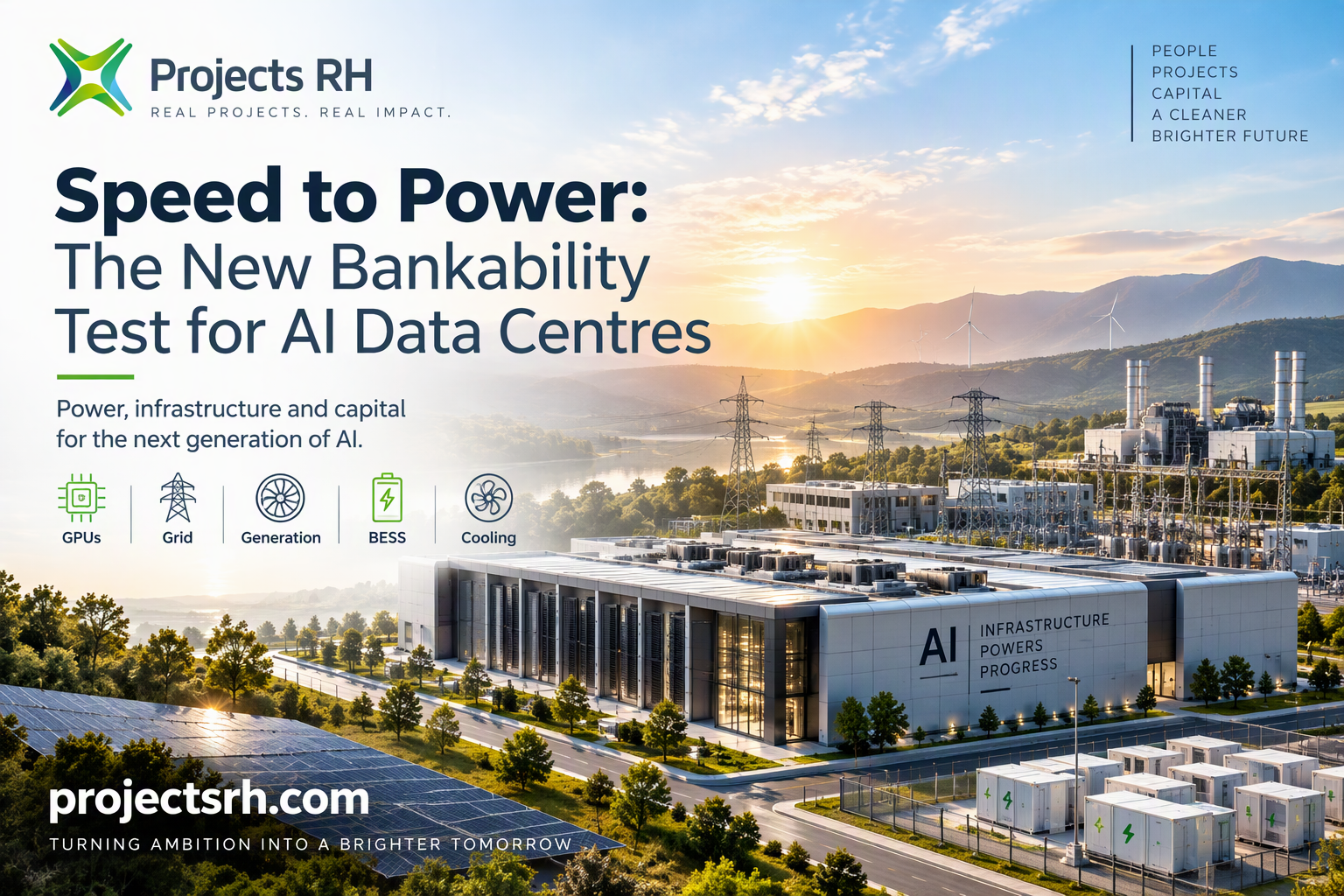
Speed to Power for Data Centres is becoming one of the most important bankability tests in AI infrastructure investment. A project may control land, secure customers, design a technically advanced facility and attract substantial capital, yet still fail to reach operation if reliable electricity cannot be delivered at the required scale, location, cost and date.
That changes how investors should assess AI data centres.
The critical question is no longer simply:
How many megawatts does the project need?
It is:
How many megawatts can actually be delivered, through which assets, under what contracts, by what date and with which party carrying the delay and cost-overrun risks?
This distinction matters because requested power is not secured power.
A grid-study position is not an energised connection.
A power purchase agreement is not necessarily deliverable electricity.
A planned turbine is not operating capacity.
A transformer order is not installed infrastructure.
Speed to power becomes bankable only when the path from generation to operating compute capacity is technically credible, contractually supported, properly permitted and fully reflected in the financial model.
What Is Speed to Power for Data Centres?
Speed to Power for Data Centres is the time required to secure, construct, connect, commission and energise the electricity infrastructure needed to operate a data centre at its planned capacity.
It is broader than the utility interconnection date.
A complete speed-to-power strategy can include:
- Power-demand definition
- Utility engagement
- Grid-capacity assessment
- Interconnection studies
- Network upgrades
- Generation capacity
- Transmission
- Substations
- Transformers
- Switchgear
- Power purchase agreements
- Behind-the-meter generation
- Gas turbines or reciprocating engines
- Fuel cells
- Battery energy storage systems
- Backup generation
- Environmental approvals
- Equipment procurement
- Testing and commissioning
- Phased energisation
The objective is not merely to identify an electricity source.
The objective is to demonstrate a credible route from today’s development stage to reliable, revenue-generating operation.
Why Speed to Power Has Become a Bankability Issue
AI infrastructure development is moving faster than many power systems can expand.
The International Energy Agency: Energy and AI estimates that data centres consumed approximately 415 TWh of electricity globally in 2024, representing around 1.5% of global electricity consumption.
The IEA projects that global data-centre electricity consumption could rise to approximately 945 TWh by 2030.
The issue is not only the total volume of energy.
Demand is concentrated in specific locations and often arrives in large increments.
A proposed AI campus can require:
- 100 MW
- 300 MW
- 500 MW
- 1 GW or more
Electricity systems are not designed, permitted and constructed on the same schedule as servers or modular data halls.
A data centre can potentially be constructed in phases while transmission upgrades, substations and new generation require substantially longer development programmes.
This creates a mismatch between:
Compute deployment timelines
and
Power infrastructure timelines
That mismatch can delay revenue, increase interest during construction, reduce equipment utilisation and weaken investment returns.
The Four Speed-to-Power Strategies
The Electric Power Research Institute: Speed to Power Data Centers evaluates four broad strategies for supplying new data centres:
- Grid-connected and inflexible
- Grid-connected and flexible
- Bridge-to-grid
- Permanently islanded
These strategies are not economically or operationally equivalent.
Grid-Connected and Inflexible
The facility relies primarily on the electricity network and expects power to remain available whenever workloads require it.
This can provide access to a broad generation portfolio, but development may depend on:
- Available grid headroom
- Transmission upgrades
- Interconnection studies
- Utility construction
- Substation delivery
- Regulatory approvals
The project remains exposed to the grid-development timetable.
Grid-Connected and Flexible
The data centre connects to the grid but can reduce, shift or support its electricity demand under defined conditions.
Flexibility may involve:
- Workload scheduling
- Geographic workload shifting
- Battery discharge
- Thermal storage
- On-site generation
- Demand response
- Flexible interconnection
This can potentially accelerate energisation or reduce network requirements.
However, flexibility has commercial consequences.
An investor needs to know:
- How many MW can be reduced?
- How quickly can the facility respond?
- For how long?
- How frequently?
- Which workloads can be interrupted?
- What compensation is available?
- What happens if flexibility is not delivered?
Flexibility must be measurable and contractible to have financing value.
Bridge-to-Grid
The project uses temporary or transitional generation while waiting for a permanent grid connection.
A bridge solution may include:
- Natural gas turbines
- Reciprocating engines
- Fuel cells
- Battery storage
- Temporary substations
- Modular generation
This can improve speed to market.
But it also creates two infrastructure programmes:
- The temporary power solution
- The permanent grid solution
The financial model must account for both.
Permanently Islanded
The facility operates independently from the public grid or uses the grid only in a limited role.
This strategy requires the data-centre campus to function as a power system.
The project must manage:
- Generation adequacy
- Frequency
- Voltage
- Reserves
- Fuel supply
- Black-start capability
- Maintenance
- Redundancy
- Load fluctuations
- Environmental compliance
Permanent isolation can improve control over delivery timing but transfers substantial power-system risk to the project.
Grid Queues Are Only Part of the Problem
The term “grid queue” can hide several different processes.
A data-centre project may require:
- A load connection application
- System-impact studies
- Facilities studies
- Transmission planning
- Utility approvals
- New-generation interconnection
- Environmental approvals
- Land rights
- Construction agreements
- Equipment procurement
The queue position alone does not establish a reliable energisation date.
Investors should distinguish between:
- Initial utility discussions
- Submitted application
- Accepted application
- Study commenced
- Study completed
- Upgrade scope agreed
- Costs allocated
- Connection agreement executed
- Construction commenced
- Assets commissioned
- Power energised
A project described as “in the queue” may still be years away from operation.
Requested Power Is Not Secured Power
This is one of the most important distinctions in data-centre finance.
Developers may refer to:
- Target power
- Requested power
- Reserved power
- Contracted power
- Deliverable power
- Energised power
These terms should not be used interchangeably.
Target Power
The capacity included in the development plan.
Requested Power
The capacity included in a grid or utility application.
Reserved Power
Capacity provisionally allocated, potentially subject to conditions.
Contracted Power
Capacity covered by executed agreements.
Deliverable Power
Capacity that the network and associated infrastructure can physically provide.
Energised Power
Capacity that has been commissioned and made operational.
Institutional investors should require evidence supporting the precise status of every claimed megawatt.
Power Purchase Agreements Do Not Solve Every Constraint
A power purchase agreement can support long-term energy procurement.
A PPA may define:
- Contract volume
- Pricing
- Escalation
- Generation source
- Delivery point
- Tenor
- Credit support
- Curtailment
- Settlement
- Environmental attributes
But a PPA does not automatically create:
- Grid capacity
- Transmission access
- Substation capacity
- Physical delivery
- Firm 24/7 power
- An energised connection
The financing value of a PPA depends on its structure.
Physical PPA
Electricity is physically delivered under the contract, subject to network arrangements.
Virtual PPA
The contract operates primarily as a financial hedge and may not supply electricity physically to the data centre.
Sleeved PPA
A utility or licensed supplier manages physical delivery and settlement between the generator and customer.
On-Site PPA
Generation is installed at or near the facility, with electricity delivered directly to the user.
Investors need to understand whether a PPA supports energy pricing, physical supply, sustainability claims or all three.
Firm Power Is Different From Annual Energy Matching
A data centre may procure enough renewable electricity over a year to match annual consumption.
That does not necessarily provide electricity during every operating hour.
AI infrastructure requires:
- Instantaneous capacity
- Energy over time
- Power quality
- Reliability
- Reserves
- Backup
A solar PPA can deliver substantial annual energy without providing power at night.
A wind PPA can provide low-cost energy while remaining weather dependent.
A credible solution may therefore combine:
- Grid electricity
- Renewable PPAs
- Firm generation
- Battery storage
- Flexible workloads
- Backup systems
Investors should model the hourly operating architecture, not only annual MWh.
Behind-the-Meter Generation Can Accelerate Energisation
Behind-the-meter generation produces electricity on the customer side of the utility meter.
It can include:
- Gas turbines
- Reciprocating engines
- Fuel cells
- Solar generation
- Battery storage
- Microgrids
- Hybrid systems
This can reduce dependence on immediate utility capacity.
However, behind-the-meter power does not eliminate infrastructure risk.
It changes the allocation of that risk.
The project may become responsible for:
- Fuel procurement
- Generation construction
- Operating reserves
- Emissions
- Maintenance
- Reliability
- Equipment replacement
- Power-system control
- Environmental approvals
A data-centre developer can effectively become an independent power producer and microgrid operator.
That requires different capabilities, contracts and financing.
Gas Turbines Can Improve Speed but Create New Constraints
Gas turbines can provide large amounts of firm electricity.
Potential advantages include:
- Dispatchable power
- High availability
- Scalable generation
- Rapid response
- Compatibility with combined-cycle configurations
- Potential use in bridge-to-grid strategies
But turbine-based solutions create additional dependencies:
- Turbine availability
- Manufacturing lead times
- Pipeline capacity
- Firm gas supply
- Emissions permits
- Noise limits
- Water requirements
- Maintenance agreements
- Carbon exposure
The correct question is not simply whether a turbine can produce the required MW.
The project must demonstrate:
- When the turbine will arrive
- Who will install it
- What fuel will supply it
- Which permits are required
- How outages will be covered
- Whether the design can manage AI-load fluctuations
A turbine reservation without a complete delivery plan does not create bankable power.
Reciprocating Engines Can Support Modular Development
Reciprocating engines can provide a modular alternative to large turbines.
Potential advantages can include:
- Smaller unit sizes
- Phased installation
- Operational flexibility
- Faster deployment in some markets
- Reduced single-unit outage exposure
A campus could add generating units alongside successive data-hall phases.
However, developers should assess:
- Fuel efficiency
- Emissions
- Noise
- Maintenance
- Footprint
- Equipment availability
- Operating cost
- Long-term replacement strategy
Modularity can improve delivery flexibility but may not produce the lowest lifetime cost.
Fuel Cells Can Support On-Site Power
Fuel cells can provide distributed power with different emissions and operating characteristics from combustion technologies.
Their viability depends on:
- Fuel source
- Equipment cost
- Efficiency
- Availability
- Maintenance
- Scale
- Supplier support
- Replacement schedule
Fuel cells may suit particular sites or phased developments.
They should not be treated as a universal solution.
The investment model must reflect actual vendor performance, warranties and long-term service requirements.
Battery Energy Storage Is More Than Backup
A battery energy storage system, or BESS, can perform several roles:
- UPS support
- Peak shaving
- Ramp-rate control
- Power-quality management
- Demand response
- Renewable firming
- Flexible interconnection
- Black-start support
- Bridge support during generator transitions
The Electric Power Research Institute: DCFlex is examining how data-centre flexibility, including storage and on-site resources, can support faster integration while maintaining grid reliability.
But a BESS must be sized for a defined duty.
Investors should require clarity on:
- MW capacity
- MWh duration
- Response time
- Cycle frequency
- Degradation
- Warranty
- Augmentation
- Fire protection
- Replacement cost
- Revenue stacking
A 100 MW battery with one hour of storage performs a different role from a 100 MW battery with four hours of storage.
The financial model must reflect that distinction.
BESS Can Support Bridge-to-Grid Strategies
An on-site generation system may need batteries to manage:
- Sudden load changes
- Generator ramp limitations
- Short interruptions
- Black-start events
- Renewable variability
- Grid-support obligations
AI workloads can create rapid and material changes in electricity demand.
A BESS can separate the instantaneous data-centre load from the slower operating response of turbines or engines.
However, batteries cannot generate net energy over sustained periods.
They must be recharged.
BESS should therefore be designed as part of a complete generation and grid architecture.
Transformers Can Determine the Real Energisation Date
A project can secure land, utility support and contractual power while remaining unable to energise because the required transformer is not available.
Transformers are not generic components.
The project may require equipment designed for:
- Specific voltage levels
- Exact capacity
- Cooling conditions
- Protection requirements
- Grid standards
- Redundancy architecture
The delivery programme can include:
- Engineering
- Manufacturing
- Factory acceptance testing
- Transport
- Installation
- Oil filling
- Site testing
- Commissioning
For large transformers, transport can itself require permits, route studies and specialised equipment.
The transformer schedule should therefore sit on the same critical-path plan as construction and grid connection.
Switchgear and Protection Systems Also Matter
Transformers are not the only electrical-equipment risk.
A data-centre project can also depend on:
- High-voltage switchgear
- Medium-voltage switchgear
- Circuit breakers
- Protection relays
- Bus ducts
- UPS systems
- Static transfer switches
- Power-distribution units
Investors should request a long-lead equipment schedule that identifies:
- Specification date
- Purchase-order date
- Manufacturer
- Factory slot
- Delivery date
- Testing
- Installation
- Commissioning
- Contingency
An energisation date unsupported by procurement evidence should not be treated as bankable.
Substations Are Projects Within the Project
A large data-centre campus may require one or more dedicated substations.
Substation development can involve:
- Land
- Engineering
- High-voltage equipment
- Transformers
- Protection systems
- Utility approvals
- Transmission connection
- Control systems
- Civil works
- Testing
The project must establish who owns, finances, constructs and operates each asset.
Possible structures include:
- Utility-owned assets
- Developer-owned assets
- Joint infrastructure
- Dedicated special-purpose companies
- Third-party energy-service providers
The ownership structure affects CapEx, control, operating responsibility and lender security.
Grid Flexibility Can Become a Commercial Asset
Flexibility may help a data centre connect sooner or avoid some network upgrades.
The value depends on whether flexibility can be delivered without damaging customer service or compute economics.
Possible sources include:
- Shifting training workloads
- Geographic load transfer
- BESS discharge
- On-site generation
- Thermal storage
- Temporary load reduction
- Phased capacity growth
The EPRI Speed to Power framework notes that the practical flexibility of a data centre depends on workload, ownership model and infrastructure design.
AI training may be more schedulable than latency-sensitive inference.
A single-user campus may be easier to control than a colocation facility serving several customers.
Flexibility assumptions should therefore be based on actual operating capability rather than generic percentages.
A Data Centre Needs a Power Ramp, Not Only a Final Number
Developers often present the ultimate power requirement.
But a project usually ramps over time.
For example:
| Development Stage | Illustrative Power Requirement | |---|---:| | Commissioning | 20 MW | | Phase 1 | 80 MW | | Phase 2 | 180 MW | | Phase 3 | 350 MW | | Full campus | 500 MW |
These numbers are illustrative.
A phased power plan can create greater flexibility.
The project might combine:
- Initial utility capacity
- Temporary generation
- BESS
- Later transmission upgrades
- Permanent grid supply
However, the transition between phases must be contractually and technically credible.
Power Availability Must Match Customer Ramp-Up
Unused power infrastructure can impose significant costs.
Insufficient power can delay customer revenue.
The power schedule should therefore match:
- Data-hall completion
- GPU delivery
- Customer occupancy
- Cooling capacity
- Fiber availability
- Commercial contracts
A project that energises too early may carry underutilised infrastructure.
A project that energises too late may breach customer commitments.
Speed to power is consequently a scheduling and commercial-optimisation problem, not simply a race to energise.
Power Costs Must Be Modelled Completely
The delivered cost of power can include:
- Energy charges
- Capacity charges
- Transmission
- Distribution
- Demand charges
- Network-upgrade contributions
- PPA settlements
- Fuel
- Generator operations
- BESS losses
- Maintenance
- Carbon costs
- Taxes
- Standby charges
Projects should avoid comparing a wholesale energy price with a fully delivered utility tariff.
The financial model should calculate the cost at the data-centre busbar under each operating scenario.
Reliability Has a Financial Value
AI hardware is expensive.
A power interruption can reduce utilisation of substantial investment in:
- GPUs
- Servers
- Networking
- Cooling
- Software
- Customer workloads
The financial relationship is:
Reliable power → Higher compute utilisation → Stronger revenue → Better debt service
Investors should therefore evaluate:
- Availability targets
- Redundancy
- Maintenance strategy
- Fuel security
- Spare parts
- Black-start capability
- Recovery time
- Performance guarantees
Reliability should be translated into financial consequences.
The Power Contract Must Match the Financing Tenor
A project financed over a long period should not rely on a short or uncertain power arrangement without a credible replacement strategy.
Investors may compare:
- PPA tenor
- Customer-contract tenor
- Debt maturity
- Fuel-supply tenor
- Equipment warranties
- Land tenure
- Grid-connection rights
Misaligned contract periods can create refinancing or repricing risk.
A 15-year customer contract supported by a three-year temporary power solution requires a credible transition plan.
Completion Tests Should Include Power Performance
A data centre is not complete merely because the building is finished.
Financing completion tests may need to cover:
- Energised MW
- Power quality
- Generation availability
- BESS response
- Cooling performance
- Redundancy
- Grid compliance
- Sustained operations
- Customer service levels
For behind-the-meter projects, completion testing may need to verify both the data centre and the power plant.
Speed to Power Must Be Reflected in the Capital Structure
The financing structure should distinguish between:
- Development capital
- Grid deposits
- Utility contributions
- Generation CapEx
- Substation CapEx
- Transformer procurement
- BESS financing
- Construction debt
- Equipment finance
- Long-term project debt
An illustrative capital stack could include:
| Capital Source | Illustrative Role | |---|---| | Sponsor equity | Development and early procurement | | Strategic equity | Energy or technology partner | | Infrastructure equity | Long-duration ownership capital | | Construction debt | Data-centre and electrical construction | | Equipment finance | GPUs, turbines, transformers or BESS | | Project debt | Long-term contracted infrastructure | | Customer prepayment | Capacity reservation and build support |
The correct structure depends on risk allocation.
A project cannot finance uncertain future power as though it were already operating infrastructure.
Speed-to-Power Financial Stress Tests
A credible model should test multiple energisation cases.
| Scenario | Energisation | Power Cost | Utilisation | |---|---|---|---:| | Base | On schedule | Base case | 90% | | Moderate stress | 6 months late | +15% | 80% | | Severe stress | 12 months late | +30% | 65% |
These figures are illustrative.
The model should measure effects on:
- Revenue
- EBITDA
- Interest during construction
- Liquidity
- DSCR
- Equity returns
- Completion date
- Customer penalties
If a six-month delay creates a liquidity crisis, the capital structure may not be resilient.
Speed to Power for Data Centres: Investor Bankability Checklist
Before approaching institutional capital, I would test the following areas.
Demand
- What is the initial MW requirement?
- What is the ultimate campus requirement?
- What is the ramp-up schedule?
- Which customer contracts support demand?
Grid Connection
- Has an application been submitted?
- What studies are complete?
- Which network upgrades are required?
- Who pays for them?
- Is the energisation date contractual?
- What delay remedies exist?
Power Procurement
- Is supply physical or financial?
- What volumes are contracted?
- Is power firm?
- What is the contract tenor?
- How are prices escalated?
- What credit support is required?
Behind-the-Meter Generation
- Which technology is proposed?
- Is equipment reserved?
- Is fuel available?
- Are permits secured?
- Who operates the plant?
- What redundancy is included?
Transformers and Electrical Equipment
- Are specifications complete?
- Have orders been placed?
- Are factory slots confirmed?
- What testing is required?
- Is transport planned?
- Are spares available?
BESS
- What MW and MWh are required?
- What operating duty is expected?
- What degradation is assumed?
- Is augmentation included?
- What warranties apply?
- How is fire risk managed?
Permitting
- Which environmental approvals are required?
- What emissions limits apply?
- Are noise and water constraints resolved?
- Are transmission and pipeline rights available?
Financial
- Is all power CapEx included?
- Is contingency sufficient?
- Is delay liquidity available?
- Are delivered electricity costs modelled?
- What is downside DSCR?
- Does debt tenor match the contracts?
Execution
- Who integrates the power system?
- Which party carries interface risk?
- Is the grid schedule aligned with construction?
- Are long-lead items on the critical path?
- Are completion tests defined?
A project unable to answer these questions is not ready for serious institutional financing.
A structured Investment Readiness Assessment can identify gaps across grid access, PPAs, generation, transformers, turbines, BESS, permits, financial modelling and capital strategy before formal outreach begins.
Common Mistakes in Speed-to-Power Planning
Treating a Grid Application as Secured Capacity
An application establishes a request, not deliverable power.
Using One Energisation Date
The financial model should test delays and phased delivery.
Assuming a PPA Creates Physical Capacity
A financial PPA may hedge price without supplying the facility directly.
Ignoring Transformer Procurement
A completed grid connection cannot energise a campus without the necessary electrical equipment.
Treating BESS as Unlimited Backup
Battery duration, degradation and recharge constraints matter.
Assuming Turbines Are Immediately Available
Factory slots, fuel, permits and EPC schedules can determine delivery.
Failing to Model the Transition to Grid Power
Bridge-to-grid solutions require credible technical and financial transition plans.
Separating Power Finance From Data-Centre Finance
The data centre and its power solution form one economic system.
Ignoring Interface Risk
Utilities, EPC contractors, equipment suppliers, fuel providers and data-centre contractors must operate on an integrated schedule.
Frequently Asked Questions About Speed to Power for Data Centres
What is Speed to Power for Data Centres?
Speed to Power for Data Centres is the time required to secure, construct, connect, commission and energise the power infrastructure needed to operate a data centre at its planned capacity.
Why is speed to power important?
A data centre cannot generate compute revenue without reliable electricity.
Delays can increase construction interest, postpone customer revenue, reduce equipment utilisation and weaken equity returns.
Does a grid-connection application secure power?
No.
An application begins a process that may include studies, upgrades, contracts, construction and commissioning.
Power is not fully secured until the delivery arrangements and infrastructure are sufficiently established.
Can a PPA accelerate speed to power?
A PPA can support energy procurement and price certainty, but it does not automatically create grid capacity, transmission access or an energised connection.
What is behind-the-meter generation?
Behind-the-meter generation produces electricity on the customer side of the utility meter for direct use by the data centre.
It can include turbines, engines, fuel cells, renewable generation and batteries.
Can gas turbines power AI data centres?
Yes.
Gas turbines can provide dispatchable power, but projects must address equipment availability, fuel supply, emissions, permits, maintenance and operating flexibility.
What role does BESS play?
BESS can support UPS functions, ramp-rate control, peak management, power quality, flexible interconnection, renewable integration and short-duration backup.
Its role depends on MW capacity, MWh duration and operating strategy.
Why are transformers important?
Transformers convert electricity between voltage levels and form a critical part of connecting generation, transmission, substations and the data-centre campus.
Long procurement and commissioning programmes can determine the actual energisation date.
What is a bridge-to-grid strategy?
A bridge-to-grid strategy uses temporary or transitional power, often on-site generation and storage, while permanent grid infrastructure is developed.
What makes a speed-to-power plan bankable?
A bankable plan requires evidence of deliverable capacity, credible contracts, permits, equipment procurement, realistic construction schedules, clear risk allocation, sufficient contingency and financial resilience under delay scenarios.
Sources
- International Energy Agency: Energy and AI
- International Energy Agency: Energy Demand from AI
- Electric Power Research Institute: Speed to Power Data Centers
- Electric Power Research Institute: Grid-Connected Flexible Strategy
- Electric Power Research Institute: DCFlex
- U.S. Department of Energy: Speed to Power
- U.S. Department of Energy: Speed to Power Stakeholder Input
Final Perspective: Power Delivery Is Now Part of Project Completion
The AI infrastructure market often speaks about data-centre capacity as though megawatts can be ordered alongside GPUs.
They cannot.
Power must be generated, transmitted, transformed, controlled, permitted, contracted, tested and delivered.
Each stage introduces interfaces, costs, dependencies and potential delays.
The strongest developments will not simply announce ambitious power requirements.
They will demonstrate a complete route from grid or generation source to energised data halls, supported by credible contracts, equipment orders, permits, construction schedules, completion tests and resilient financing.
That is the new bankability test.
For AI infrastructure investors, the most valuable megawatt is not the one requested in an application. It is the one that can be delivered reliably, on time, at a financeable cost and converted into contracted compute revenue.

What to do next
Projects RH prepares the company and the project first, then takes them to investors. The fastest way to find out where you stand is a short call.
Keep reading
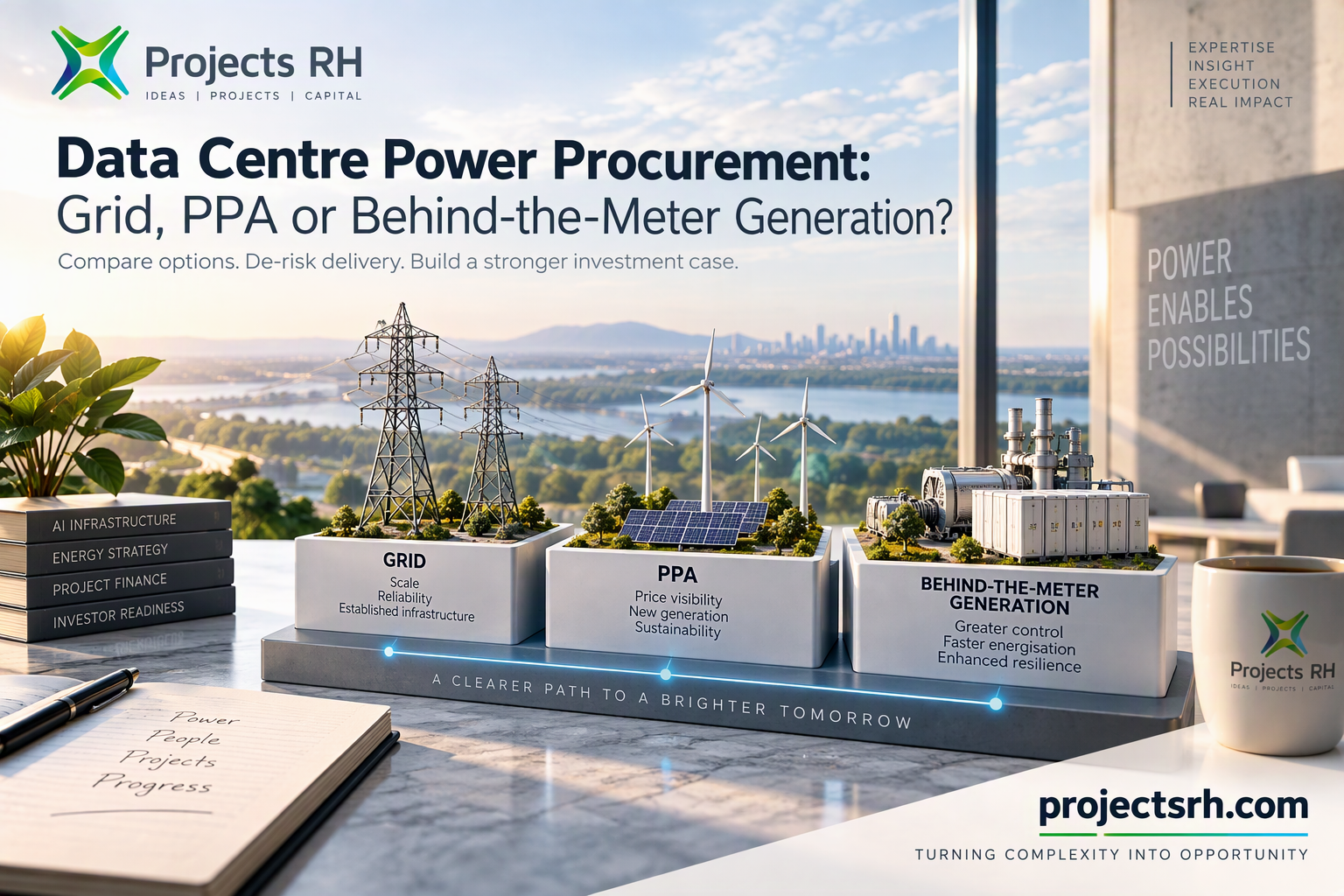
Data Centre Power Procurement: Grid, PPA or Behind-the-Meter?
Data Centre Power Procurement requires a choice between grid supply, PPAs, behind-the-meter generation or a hybrid strategy built around cost, speed and reliability.

From GPUs to Gigawatts: Why Power Is Reshaping AI Infrastructure Investment
AI Infrastructure Investment is becoming a power story as data centers compete for electricity, grid access, generation, storage and capital.

Disruptive Technology Projects and Investments: Get Ready
Disruptive technology draws investor interest, but technical promise alone is not fundable. What investors test, the risks they weigh, and how to prepare before raising capital.