
From GPUs to Gigawatts: Why Power Is Reshaping AI Infrastructure Investment
AI Infrastructure Investment is becoming a power story as data centers compete for electricity, grid access, generation, storage and capital.
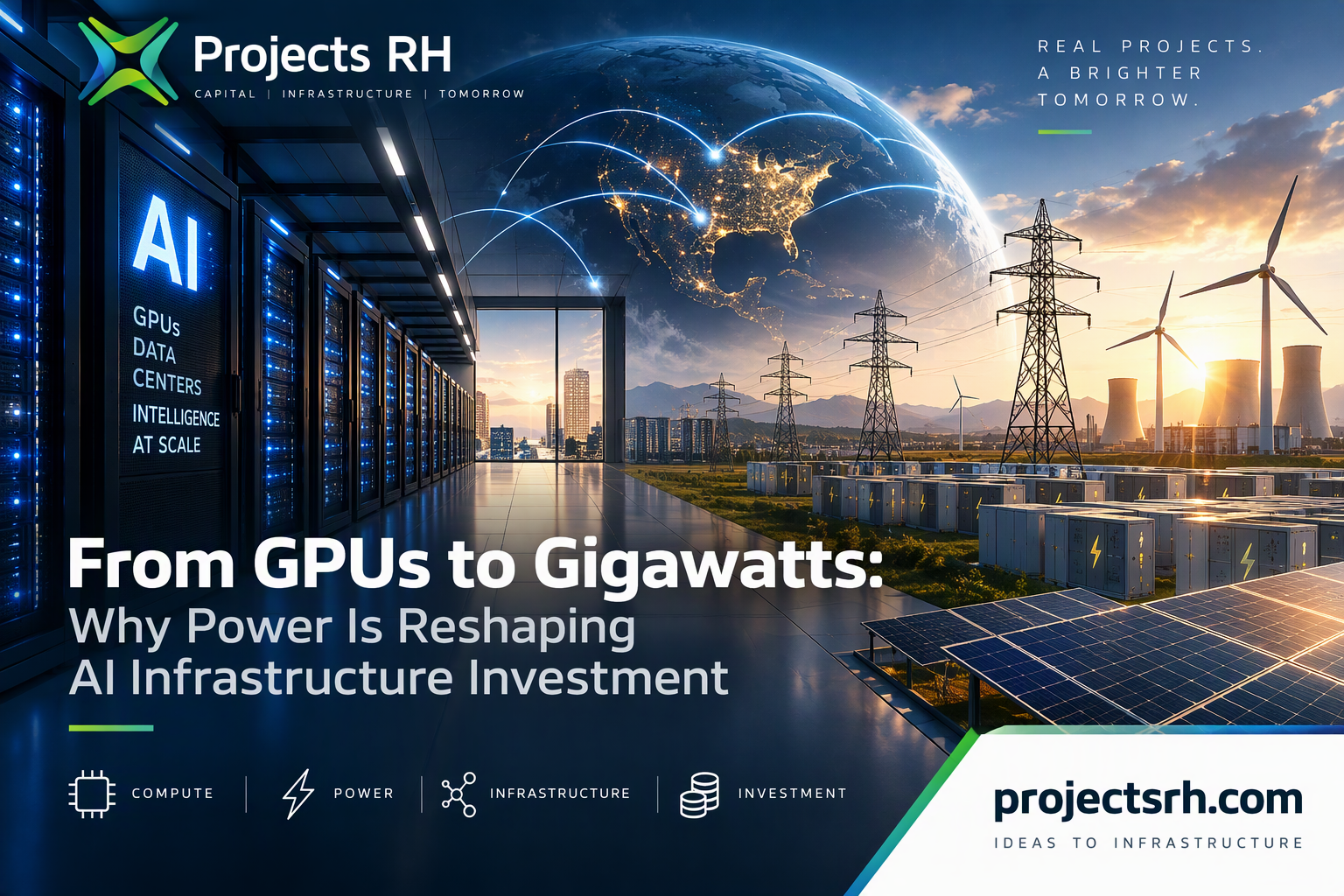
AI Infrastructure Investment is no longer simply a technology story. It is becoming a power, infrastructure and capital-allocation story. As artificial intelligence moves from models and GPUs into hyperscale physical infrastructure, access to electricity may increasingly determine where projects are built, how quickly they reach operation and whether their economics support institutional capital.
For years, the AI investment narrative focused primarily on compute.
More GPUs meant more training capacity.
More advanced chips meant better models.
More data centers meant more digital capacity.
That logic still matters, but it is no longer sufficient.
The new constraint is increasingly physical:
Can the project secure enough reliable power, at the right location, within the required timeframe and at an economically sustainable cost?
That question changes the investment case.
The next phase of AI Infrastructure Investment will not be determined by compute alone. It will be shaped by the ability to convert megawatts and gigawatts of reliable power into productive, financeable digital infrastructure.
What Is AI Infrastructure Investment?
AI Infrastructure Investment is the deployment of capital into the physical and digital systems required to develop, operate and scale artificial intelligence computing capacity.
It can include investment in:
- AI data centers
- Hyperscale campuses
- GPUs and accelerated computing
- Servers and networking
- Cooling systems
- Grid connections
- Transmission infrastructure
- Substations
- On-site generation
- Renewable generation
- Natural gas generation
- Nuclear power
- Battery energy storage
- Backup generation
- Water infrastructure
- Fiber connectivity
- Land and site development
This broader definition matters because AI infrastructure does not stop at the server rack.
A GPU without electricity has no productive value.
A data center without sufficient cooling cannot sustain high-density computing.
A site without a viable grid connection may have land, permits and demand but still be unable to operate.
The real infrastructure stack is broader:
Capital → Land → Power → Grid → Cooling → Connectivity → Compute → Customers → Cash Flow
Each component affects bankability.
For sponsors preparing an AI infrastructure project for institutional capital, an early Investment Readiness Assessment can help identify weaknesses before formal investor or lender outreach.
From GPUs to Gigawatts: The Power Shift
The scale of AI power demand is changing the investment conversation.
The International Energy Agency: Energy and AI estimates that data centers consumed approximately 415 TWh of electricity globally in 2024, equivalent to around 1.5% of global electricity consumption.
The IEA projects global data-center electricity consumption to rise to approximately 945 TWh by 2030.
That is more than double the 2024 level.
The implication is significant.
AI infrastructure developers are no longer planning facilities measured only in racks, servers or GPUs.
Increasingly, projects are discussed in:
- Megawatts
- Hundreds of megawatts
- Gigawatts
- Transmission capacity
- Generation capacity
- Firm-power availability
At this scale, electricity infrastructure moves from an operating input to a strategic asset.
Power Is Becoming a Competitive Advantage
For an AI infrastructure developer, securing GPUs can be difficult.
Securing power at scale can be even harder.
A viable site may require:
- Utility capacity
- Transmission access
- Substation capacity
- Interconnection approval
- Generation
- Energy storage
- Backup systems
- Cooling
- Water
- Fiber
- Permitting
The investment question is therefore shifting from:
Where can we build a data center?
to:
Where can we secure sufficient reliable power quickly enough to build an economically viable AI campus?
That is a fundamentally different site-selection problem.
AI Infrastructure Investment Is Becoming an Energy Infrastructure Strategy
A large AI campus effectively connects two infrastructure systems.
The first is digital:
- Accelerators
- Servers
- Storage
- Networking
- Software
The second is physical:
- Generation
- Transmission
- Distribution
- Transformers
- Substations
- Cooling
- Storage
- Backup generation
Financing depends on both systems working together.
A sophisticated compute architecture cannot overcome an inadequate power connection.
Likewise, abundant electricity does not create value without competitive computing capacity and customers.
The investment case sits at the intersection.
Data Centers Are Becoming Major Grid Participants
The Electric Power Research Institute: Powering Intelligence 2026 estimates that data centers currently represent approximately 4%–5% of U.S. electricity demand.
Under its scenarios, that share could rise to approximately 9%–17% by 2030 and 10%–20% by 2035.
The impact is highly concentrated geographically.
This matters because electricity systems are regional.
A national market may have sufficient aggregate generating capacity while a particular data-center cluster faces:
- Transmission congestion
- Transformer shortages
- Substation constraints
- Interconnection delays
- Generation shortfalls
- Regulatory restrictions
For investors, national electricity capacity is therefore less important than site-specific access to deliverable power.
Speed to Power Is Becoming a Bankability Metric
For some AI data-center developments, the principal constraint may not be capital but energisation.
A project with financing, land and customers can still face material delays if sufficient grid capacity is unavailable.
This creates an increasingly important investment metric:
Speed to power.
Investors should understand:
- How many MW are required?
- When are they required?
- Is the power already available?
- Does the connection require network upgrades?
- Who pays for those upgrades?
- How long will interconnection take?
- Is temporary or phased power possible?
- Can generation be built behind the meter?
- Can storage reduce required grid capacity?
These questions directly affect schedule, valuation and capital structure.
Grid Connection Is Becoming a Development Asset
Historically, digital-infrastructure developers could focus heavily on:
Land + zoning + connectivity
For large AI infrastructure projects, the formula increasingly becomes:
Land + power + connectivity + permits + customers
A site with a credible grid connection can therefore have materially different strategic value from an otherwise comparable site without one.
Investors should distinguish carefully between:
- Power requested
- Power reserved
- Power contracted
- Power under interconnection study
- Power capable of being delivered
- Power actually energised
These are not equivalent.
A project should never present speculative future capacity as secured power.
AI Infrastructure Requires More Than Electricity Volume
Data centers do not simply require energy.
They require reliable electricity delivered within specific operating parameters.
The International Energy Agency: Energy Demand from AI reports that servers account for a substantial share of electricity consumption in modern data centers, while cooling requirements vary materially according to facility design.
Reliability infrastructure can include:
- UPS systems
- Batteries
- Backup generators
- Redundant connections
- Multiple feeds
- Power-quality equipment
For institutional investors, the question is therefore not simply how many MWh a facility consumes.
The question is whether the electricity architecture can support high-value computing assets at commercially acceptable levels of reliability.
GPU Economics Make Reliability More Valuable
AI computing hardware is expensive.
That changes the economic cost of downtime.
A power interruption does not simply reduce electricity consumption. It can interrupt utilisation of substantial investment in:
- GPUs
- Servers
- Networking
- Cooling
- Software infrastructure
- Customer workloads
The financial relationship is straightforward:
Electricity reliability → Compute utilisation → Revenue → Cash flow → Debt service
Power-system reliability is therefore part of AI infrastructure economics, not simply an engineering consideration.
Power Density Changes Data Center Design
AI workloads can require substantially greater power density than traditional enterprise computing.
Higher rack density affects:
- Electrical architecture
- Cooling
- Floor design
- Power distribution
- Backup systems
- Water demand
- Heat rejection
- CapEx
This matters because existing facilities cannot always be converted economically into AI-ready infrastructure.
A building may have sufficient floor area while lacking:
- Electrical capacity
- Cooling density
- Transformer capacity
- Distribution infrastructure
AI infrastructure investors therefore need to evaluate usable compute capacity rather than real-estate capacity alone.
Cooling Is Becoming Part of the Investment Case
Electricity entering a data center ultimately becomes heat.
The higher the compute density, the more important thermal management becomes.
Cooling solutions can include:
- Air cooling
- Direct-to-chip liquid cooling
- Rear-door heat exchangers
- Immersion cooling
- Hybrid systems
Investors should assess:
- Cooling technology
- Water requirements
- Energy consumption
- Climate
- Redundancy
- Maintenance
- Technology maturity
- Retrofit requirements
Cooling design can influence CapEx, operating cost and facility efficiency.
Water Can Become a Site Constraint
Some cooling architectures create material water requirements.
Data-center development can therefore intersect with:
- Water availability
- Water rights
- Local communities
- Drought exposure
- Environmental permitting
- Competing industrial demand
A site with excellent electricity access may still face constraints if water requirements are unresolved.
The optimum location should therefore be evaluated across the complete infrastructure package.
Behind-the-Meter Generation Changes the Model
If grid capacity cannot arrive quickly enough, developers may consider generating electricity on or near the site.
Possible solutions can include:
- Natural gas generation
- Renewable generation
- Battery storage
- Fuel cells
- Microgrids
- Nuclear technologies
- Hybrid systems
This changes the nature of the project.
A data-center developer can effectively become an energy-infrastructure developer.
That introduces additional:
- CapEx
- Permitting
- Fuel risk
- Construction risk
- Operational complexity
- Environmental obligations
- Financing requirements
The solution to a power constraint can therefore create a second major infrastructure project.
Natural Gas May Play a Bridging Role
AI campuses require speed, reliability and significant amounts of power.
In some markets, natural gas generation may support:
- Bridge power
- Behind-the-meter generation
- Firming
- Backup
- Long-term supply
The Electric Power Research Institute: Generation and Capacity Impacts examines how higher data-center demand can affect generation-capacity requirements.
Gas-based strategies can introduce:
- Fuel-supply risk
- Pipeline constraints
- Emissions
- Environmental approvals
- Carbon exposure
- Community acceptance
- Equipment availability
Speed to power should not be confused with simplicity.
Renewable Energy Remains Important
Renewable generation can support:
- Long-term energy procurement
- Sustainability targets
- Price hedging
- Additional generation capacity
But intermittent generation creates an important distinction:
Annual renewable-energy matching is not the same as 24/7 firm electricity supply.
AI infrastructure needs electricity when computational workloads require it.
Renewable procurement may therefore need to be combined with:
- Grid supply
- Storage
- Flexible workloads
- Firm generation
- Geographic diversification
Investors should understand the actual supply architecture rather than rely solely on annual renewable-energy claims.
Battery Storage Can Become Strategic Infrastructure
Battery energy storage can help AI infrastructure manage:
- Peak demand
- Grid constraints
- Backup requirements
- Power quality
- Renewable integration
- Flexible interconnection
Storage cannot automatically solve a fundamental shortage of generation or transmission capacity.
But storage can improve the operating characteristics of a site.
The financial model should therefore quantify exactly what a battery system is expected to accomplish.
Data Center Flexibility Could Become Valuable
The Electric Power Research Institute: DCFlex is examining how flexible data-center designs and operations can support grid integration and reliability.
Flexibility can potentially involve:
- Workload scheduling
- Geographic workload shifting
- Batteries
- On-site generation
- Thermal storage
- Demand response
- Flexible interconnection agreements
Instead of viewing a data center only as a large inflexible load, utilities may increasingly consider whether some portion of that load can respond to grid conditions.
For developers, flexibility may create economic value if it reduces interconnection time, infrastructure requirements or operating costs.
Not Every AI Workload Has the Same Power Profile
Training
Model training can be compute intensive and may run for long periods.
Some training workloads may potentially be scheduled or geographically distributed according to infrastructure availability.
Inference
Inference supports live AI applications.
Some inference workloads can be latency-sensitive and may need to operate closer to end users.
Enterprise AI
Corporate deployments can operate at smaller scale with different utilisation profiles.
Edge AI
Edge workloads can require geographic distribution rather than hyperscale concentration.
These distinctions matter because power architecture should follow workload requirements.
Not every AI infrastructure project needs to become a gigawatt campus.
Smaller Data Centers Still Matter
The AI infrastructure narrative is dominated by hyperscale projects, but not every workload requires hyperscale transmission-level interconnection.
The Electric Power Research Institute: Distribution-Connected Data Centers examines smaller facilities, including applications involving AI inference and latency-sensitive workloads.
Potential investment strategies include:
- Regional data centers
- Edge infrastructure
- Distributed inference
- Modular facilities
- Phased developments
Scale itself is not the objective.
The objective is matching infrastructure with economically valuable compute demand.
Power Availability Is Reshaping Geography
Traditional data-center hubs developed around combinations of:
- Fiber
- Customers
- Cloud ecosystems
- Land
- Tax incentives
- Skilled labour
Power constraints can alter that geography.
Future AI infrastructure may increasingly migrate toward locations offering:
- Abundant electricity
- Expandable generation
- Faster interconnection
- Suitable land
- Fiber connectivity
- Competitive energy costs
- Supportive permitting
This can create investment opportunities outside traditional data-center markets.
Transmission Is Becoming Part of AI Infrastructure Investment
At very large scale, the data center cannot be separated from the transmission system.
A gigawatt-class campus may require:
- High-voltage transmission
- New substations
- Network reinforcement
- Multiple grid connections
- Additional generation
The U.S. Department of Energy: Data Center Resource Hub connects the expansion of AI computing capacity with the development of supporting energy infrastructure.
For capital providers, this means the AI infrastructure opportunity extends beyond the data center itself.
It can include:
- Generation
- Transmission
- Substations
- Transformers
- Storage
- Cooling
- Energy services
The AI investment ecosystem is increasingly an infrastructure ecosystem.
Transformers and Equipment Can Become Critical-Path Items
Grid capacity on paper is not enough.
Physical equipment must also be available.
AI infrastructure projects may require:
- Large power transformers
- Switchgear
- Generators
- UPS equipment
- Cooling systems
- Electrical distribution systems
Long equipment lead times can delay energisation even when permits, customers and financing are available.
Procurement should therefore be integrated into scheduling and financial modelling.
Financing AI Infrastructure Requires an Integrated Capital Stack
Large-scale AI infrastructure can require several forms of capital.
| Capital Source | Illustrative Role | |---|---| | Sponsor equity | Development and first-loss capital | | Strategic equity | Technology, utility or infrastructure partner | | Infrastructure equity | Long-duration institutional capital | | Construction debt | Facility development and equipment tructure financing | | Equipment finance | GPUs, servers and electrical equipment | | Power-project finance | Generation or storage assets | | Customer commitments | Support for revenue visibility |
The exact structure depends on:
- Ownership
- Credit quality
- Contracts
- Technology risk
- Power arrangements
- Customer profile
- Development stage
A gigawatt-scale AI campus should not automatically be financed as though it were simply a large commercial building.
Sponsors preparing for institutional capital should test their technical, commercial and financial readiness through a structured /intake.html before launching a capital-raising process.
Contracted Revenue Matters
The financing value of an AI data center depends heavily on who uses the capacity and under what contract.
Investors may examine:
- Customer creditworthiness
- Contract duration
- Minimum commitments
- Pricing
- Capacity reservation
- Termination rights
- Renewal
- Escalation
- Performance requirements
Projected demand is not equivalent to contracted revenue.
Developers should distinguish between:
- Market demand
- Customer discussions
- Letters of intent
- Reservation agreements
- Binding contracts
- Credit-supported obligations
That distinction matters to lenders.
Power Contracts Matter Just as Much
The revenue side is only half of the financing equation.
The project must also secure its critical input.
Power arrangements may include:
- Utility tariffs
- Power purchase agreements
- Bilateral supply
- On-site generation
- Renewable PPAs
- Capacity agreements
- Grid-service agreements
Investors should understand:
- Price
- Escalation
- Tenor
- Reliability
- Curtailment
- Capacity
- Credit support
- Regulatory exposure
An AI infrastructure project can have excellent customer contracts and still face weak economics if its power structure is not bankable.
The Economics Should Be Stress-Tested Around Power
A credible financial model should not assume one electricity scenario.
Investors should test:
- Base power price
- Higher electricity prices
- Delayed energisation
- Lower load factor
- Additional grid CapEx
- Higher cooling costs
- Battery requirements
- Generation cost
- Equipment delays
- Customer ramp-up
For example:
| Scenario | Energisation | Power Cost | Utilisation | |---|---|---|---:| | Base | On schedule | Base | 90% | | Moderate stress | +6 months | +15% | 80% | | Severe stress | +12 months | +30% | 65% |
These figures are illustrative.
The important point is that power risk should feed directly into the investment model.
AI Infrastructure Investment Is Becoming a Bankability Question
The strongest AI infrastructure projects combine:
Compute demand + power + land + connectivity + permits + customers + capital
A weakness in any one component can impair the entire development.
Power
- How many MW are required?
- When are they required?
- Is capacity secured?
- What is the energisation date?
- What upgrades are necessary?
- What is the delivered electricity cost?
Site
- Is the land controlled?
- Is zoning appropriate?
- Is water available?
- Is fiber available?
- Can the site expand?
Technology
- What compute architecture is planned?
- What rack density is required?
- What cooling technology is necessary?
- How quickly can the equipment become obsolete?
Commercial
- Who are the customers?
- What capacity is contracted?
- What is the contract tenor?
- What commitments are binding?
Financial
- What is total CapEx?
- What contingency is included?
- How much equity is required?
- What revenue supports debt?
- What downside case remains financeable?
This is where AI infrastructure becomes a project-finance discipline rather than simply a technology thesis.
Common Mistakes in AI Infrastructure Investment
Treating Power as an Operating Detail
Power availability can determine whether the project exists at all.
Confusing Requested Power With Secured Power
A grid application does not automatically create deliverable capacity.
Underestimating Energisation Time
A project can be construction-ready before the grid is ready.
Ignoring Transmission
Large campuses can require infrastructure far beyond the site boundary.
Assuming Renewable Procurement Equals Firm Power
Annual energy matching does not automatically provide 24/7 reliability.
Underestimating Cooling
GPU density can materially change facility design and CapEx.
Ignoring Equipment Lead Times
Transformers and other electrical systems can become critical-path items.
Assuming AI Demand Guarantees Bankability
Demand needs to translate into contracts and predictable cash flow.
Financing the Data Center but Not the Power Solution
Behind-the-meter generation may itself require a separate financing strategy.
AI Infrastructure Investment: Investor Readiness Checklist
Before approaching institutional capital, I would test six areas.
Power Readiness
- Power requirement defined
- Grid capacity identified
- Interconnection status confirmed
- Energisation schedule credible
- Power price modelled
- Backup strategy defined
Technical Readiness
- Compute architecture established
- Cooling design developed
- Equipment availability assessed
- Expansion strategy defined
- Technology-obsolescence risk considered
Site Readiness
- Land controlled
- Permits identified
- Water assessed
- Fiber confirmed
- Environmental constraints understood
Commercial Readiness
- Customer strategy established
- Contract structure defined
- Pricing model developed
- Customer credit analysed
Financial Readiness
- CapEx budget prepared
- Contingency included
- Power infrastructure cost captured
- Working capital modelled
- Downside scenarios tested
- Capital structure developed
Execution Readiness
- EPC strategy defined
- Long-lead equipment identified
- Construction schedule integrated with energisation
- Key counterparties identified
- Risk allocation documented
A project that cannot answer these questions is not ready for serious institutional capital.
A structured /intake.html can help identify weaknesses across power availability, site readiness, commercial contracts, financial modelling, capital structure and execution strategy before formal investor outreach.
Frequently Asked Questions About AI Infrastructure Investment
What is AI Infrastructure Investment?
AI Infrastructure Investment is capital deployed into the computing, data-center, energy, cooling, connectivity and supporting infrastructure required to develop and operate artificial intelligence capacity.
Why is power important for AI infrastructure?
AI workloads require substantial computing capacity, which translates into significant electricity demand.
Power availability, reliability, price and connection timing can therefore influence site selection, CapEx, operating costs and project schedule.
How much electricity do data centers use?
The International Energy Agency estimates that global data centers consumed approximately 415 TWh in 2024 and projects consumption of around 945 TWh by 2030.
Why do AI data centers require more infrastructure than conventional facilities?
High-density AI computing can create greater electrical and cooling requirements, while large campuses may require substations, transmission, generation, storage and water infrastructure.
What is speed to power?
Speed to power is the time required for a data-center project to obtain the electricity capacity necessary to begin or expand operations.
It can become a major determinant of development schedule and investment value.
Can renewable energy power AI data centers?
Renewable energy can form part of the supply strategy, but reliable AI operations may also require grid supply, storage, flexible demand or another source of firm power.
Can battery storage solve data-center power constraints?
Storage can help with peak demand, resilience, flexible operation and renewable integration, but it cannot automatically replace insufficient generation or transmission capacity.
Can AI data centers use their own generation?
Yes.
On-site or behind-the-meter generation can be considered where grid capacity is constrained, although it introduces additional development, permitting, fuel, environmental and financing considerations.
What makes an AI infrastructure project bankable?
A bankable AI infrastructure project typically requires credible access to power, a viable site, appropriate cooling and connectivity, clear customer demand, robust contracts, realistic project economics and a capital structure aligned with construction and operating risks.
Is AI Infrastructure Investment only about data centers?
No.
The opportunity can extend across generation, transmission, substations, storage, cooling, networking, equipment and supporting digital infrastructure.
Sources
- International Energy Agency: Energy and AI
- International Energy Agency: Energy Demand from AI
- Electric Power Research Institute: Powering Intelligence 2026
- Electric Power Research Institute: Generation and Capacity Impacts of Data Center Load
- Electric Power Research Institute: DCFlex
- Electric Power Research Institute: Distribution-Connected Data Centers
- U.S. Department of Energy: Data Center Resource Hub
- Goldman Sachs Research: Data Center Power Demand and Constraints
Final Perspective: Power Is Becoming Part of the AI Investment Thesis
The AI infrastructure race began with compute.
It is rapidly becoming a race for infrastructure.
The limiting factor for the next generation of AI projects may not be whether investors can buy GPUs.
It may be whether developers can secure hundreds of megawatts of reliable electricity, connect them to the grid, build the required transmission and cooling infrastructure, obtain approvals, procure equipment, secure customers and finance the entire system within a commercially viable timeframe.
That changes how AI infrastructure should be evaluated.
The strongest projects will not simply have the most ambitious compute plans.
They will demonstrate that digital infrastructure and energy infrastructure have been designed as one investment proposition.
The next winners in AI Infrastructure Investment may be those that understand that intelligence scales in GPUs, but infrastructure scales in gigawatts.

What to do next
Projects RH prepares the company and the project first, then takes them to investors. The fastest way to find out where you stand is a short call.
Keep reading
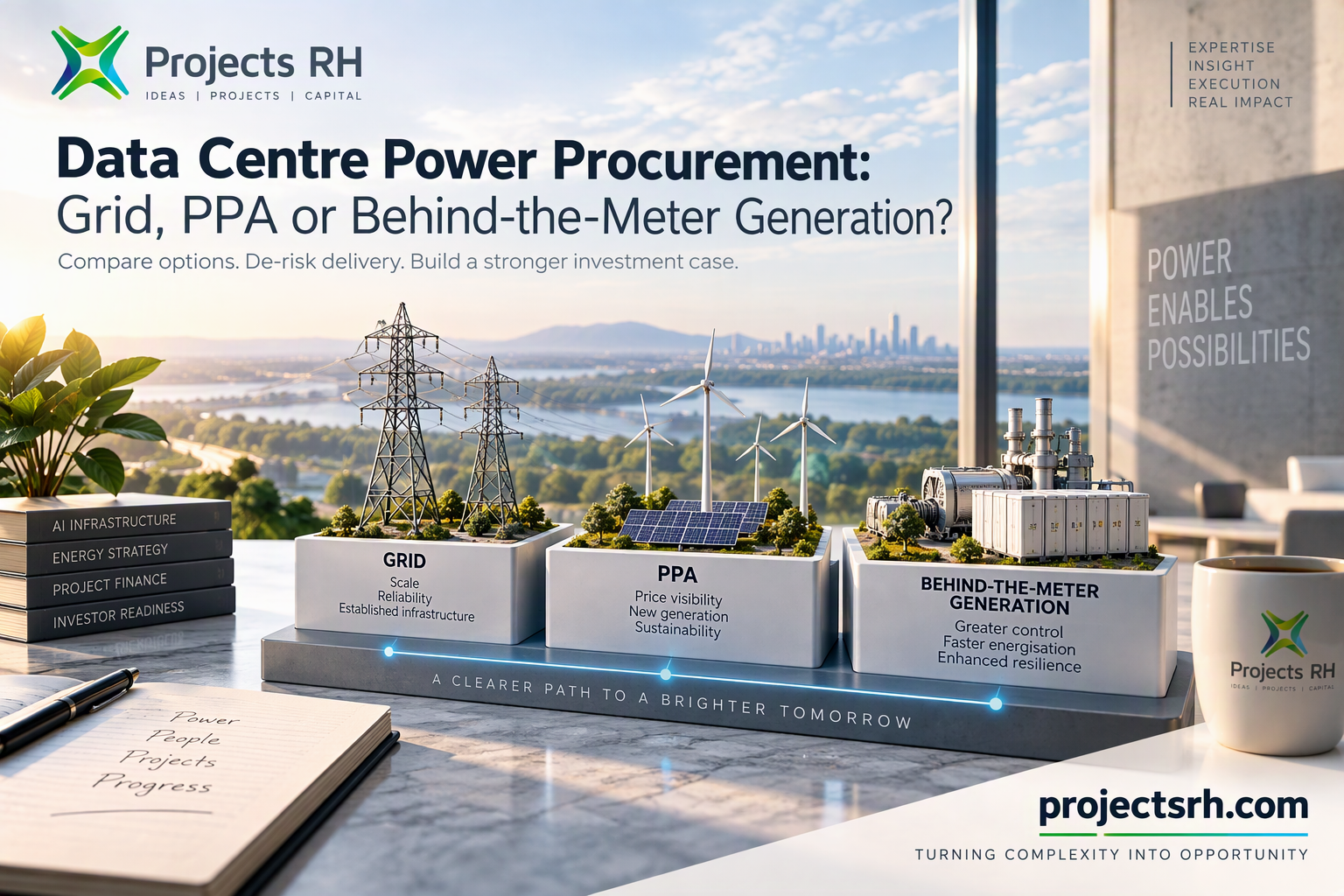
Data Centre Power Procurement: Grid, PPA or Behind-the-Meter?
Data Centre Power Procurement requires a choice between grid supply, PPAs, behind-the-meter generation or a hybrid strategy built around cost, speed and reliability.
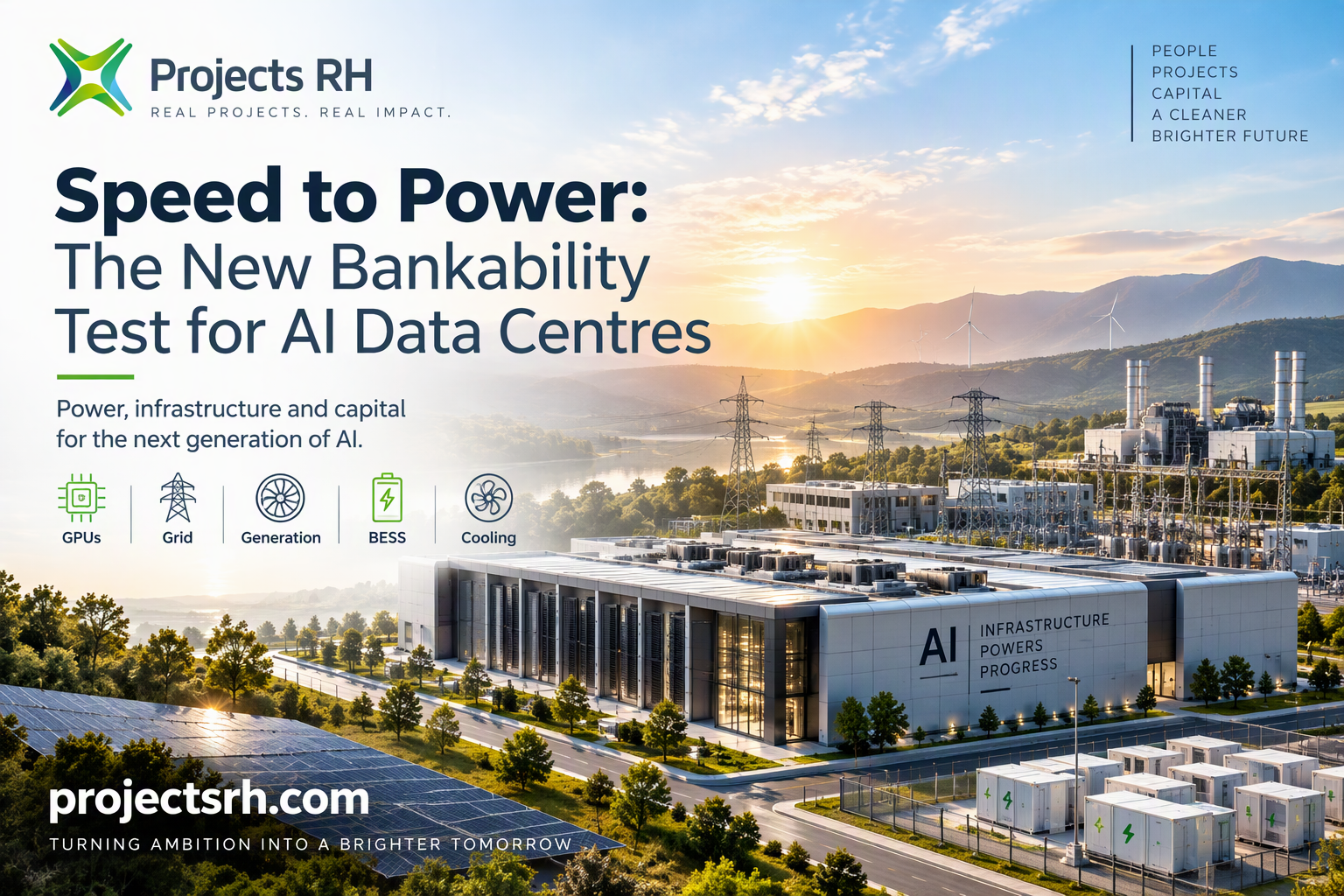
Speed to Power for Data Centres: The New Bankability Test
Speed to Power for Data Centres depends on grid capacity, PPAs, generation, transformers, turbines, BESS, permits and credible delivery schedules.

Disruptive Technology Projects and Investments: Get Ready
Disruptive technology draws investor interest, but technical promise alone is not fundable. What investors test, the risks they weigh, and how to prepare before raising capital.