
BESS Project Finance: Revenue, Risk and Bankability
BESS Project Finance depends on bankable revenue, degradation, warranties and lifecycle CapEx. See what lenders test before financing battery storage.
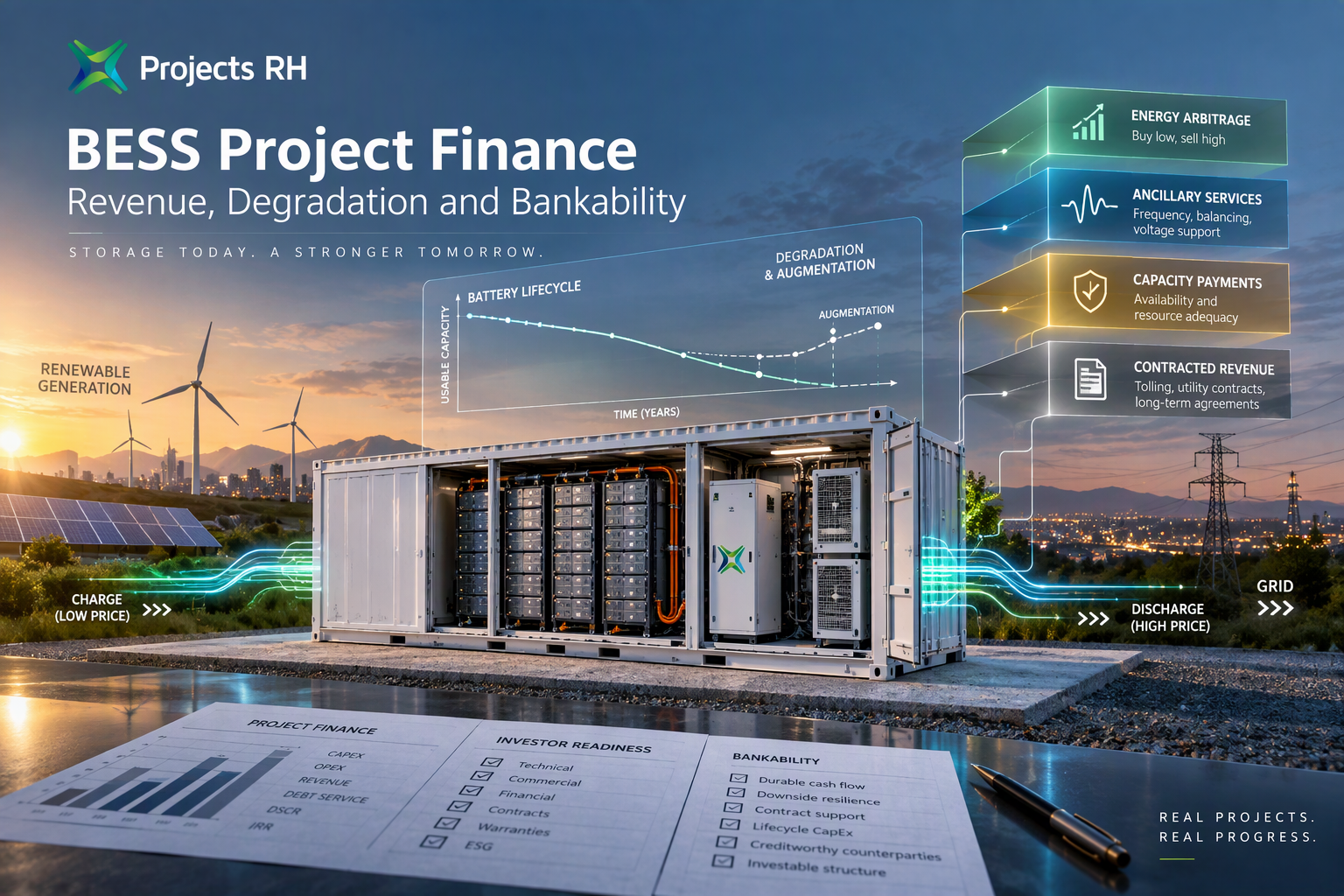
BESS Project Finance is moving rapidly into the mainstream of energy infrastructure as battery energy storage becomes essential to electricity systems with growing renewable generation, price volatility and flexibility requirements.
But financing a battery is not the same as financing a solar plant, wind farm or conventional generator.
A battery does not create electricity. It stores electricity, moves it through time and monetises flexibility. The same asset can trade energy, provide ancillary services, earn capacity payments and support grid reliability. At the same time, every commercial decision affects cycling, degradation, warranty exposure and future augmentation requirements.
For lenders and infrastructure investors, the issue is not simply whether a BESS can generate attractive revenue today.
The real question is whether revenue, degradation, warranty protection, operating strategy and lifecycle capital expenditure can support durable cash flow throughout the financing period.
A bankable BESS is not the battery with the highest forecast revenue. It is the battery whose realistic revenue, technical performance and lifecycle costs can support capital through credible downside cases.
What Is BESS Project Finance?
BESS Project Finance is the financing of a battery energy storage system primarily against the project's expected cash flows, contracts, assets and risk allocation rather than solely against the sponsor's balance sheet.
A bankable investment case should connect:
Site → Grid → Battery → Market → Dispatch → Revenue → Degradation → Warranty → Augmentation → Cash Flow → Debt Service
A weakness anywhere in that chain can affect bankability.
Battery storage is becoming a major component of global power infrastructure as electricity systems integrate larger volumes of renewable generation and require greater flexibility.
The commercial opportunity is substantial. But growth in the sector does not automatically make an individual project financeable.
A lender finances a project's ability to generate and preserve cash flow.
Why BESS Project Finance Is Different
Conventional renewable-energy projects frequently begin with a relatively straightforward relationship between production and revenue.
A solar project generates electricity.
A wind project generates electricity.
A BESS operates differently.
At different times, a battery may:
- Charge when electricity is inexpensive
- Discharge when electricity is expensive
- Provide frequency regulation
- Supply balancing services
- Reserve capacity
- Support resource adequacy
- Reduce curtailment
- Provide grid flexibility
- Support a co-located renewable project
That optionality creates commercial value, but it also creates an underwriting challenge.
The battery's revenue is partly determined by how the asset is operated, and how the asset is operated influences how quickly it degrades.
The technical model and financial model therefore cannot be separated.
The Revenue Stack in BESS Project Finance
A financeable BESS investment case should clearly distinguish its sources of revenue.
The principal categories are:
- Merchant energy revenue
- Ancillary-service revenue
- Capacity or availability payments
- Contracted revenue
These revenue streams should not automatically receive equal credit when debt is sized.
A dollar of long-term contracted revenue from a creditworthy counterparty can have a very different financing value from a dollar projected from future merchant price volatility.
Merchant Revenue and Energy Arbitrage
Energy arbitrage is one of the most visible BESS revenue strategies.
The concept appears straightforward:
Buy low → Store → Sell high
The actual economics are more complicated.
A merchant BESS needs credible assumptions for:
- Intraday price spreads
- Charging prices
- Discharging prices
- Round-trip efficiency
- Market fees
- Grid charges
- State-of-charge management
- Cycling frequency
- Availability
- Degradation
- Trading and optimisation costs
The headline electricity-price spread is not the project's profit margin.
Merchant Revenue Can Cannibalise Itself
Battery storage can reduce the same volatility it is designed to monetise.
If a market has large price spreads, developers may respond by adding additional BESS capacity.
Additional storage can absorb surplus electricity during low-price periods and inject power during high-price periods.
Over time, that can compress the spread.
The commercial sequence may become:
High Volatility → Attractive BESS Revenue → New Storage Capacity → Reduced Price Spreads
This is merchant cannibalisation risk.
A long-term BESS financial model should therefore avoid treating today's merchant conditions as permanent.
Stress Testing Merchant Revenue
If a base-case financial model forecasts merchant revenue of US$100/kW-year, lenders should not automatically underwrite the project solely against US$100/kW-year.
A credible downside analysis might test:
- 90% of base-case revenue
- 75% of base-case revenue
- 60% of base-case revenue
- Lower dispatch frequency
- Lower ancillary-service prices
- Higher charging costs
The purpose is not to predict one exact future.
The purpose is to establish whether the capital structure remains viable under plausible adverse conditions.
Merchant revenue is a forecast. Debt service is an obligation. The difference matters.
Ancillary Services and Grid Revenue
BESS can respond rapidly to grid conditions, making battery storage particularly suitable for ancillary services.
Depending on the market, opportunities may include:
- Frequency regulation
- Frequency containment
- Fast frequency response
- Balancing reserves
- Spinning reserve
- Non-spinning reserve
- Voltage support
- Reactive power
- Other grid-stability services
The challenge for financing is that some ancillary-service markets are relatively shallow.
An attractive market can bring additional storage capacity quickly.
The sequence can become:
High Ancillary Pricing → New BESS Competition → Market Saturation → Lower Revenue
Lenders therefore need to understand the depth of the relevant market compared with the battery capacity expected to compete for it.
The existence of an ancillary-service market does not necessarily prove durable long-term revenue.
Capacity Payments Can Strengthen Bankability
Capacity payments can provide a different form of revenue.
Instead of paying solely for electricity discharged, a capacity mechanism may compensate a BESS for being available when the system requires it.
Depending on the jurisdiction, this can include:
- Capacity-market payments
- Resource adequacy contracts
- Availability payments
- Utility arrangements
- Tolling agreements
- Grid-service contracts
This revenue can improve predictability.
However, investors and lenders need to understand:
- Qualification rules
- Duration requirements
- Derating factors
- Availability obligations
- Performance tests
- Penalties
- Requalification
- Contract tenor
- Market-rule risk
A 100 MW battery does not necessarily receive 100 MW of recognised capacity value.
Nameplate capacity and financeable capacity are not necessarily the same thing.
Contracted Revenue Versus Merchant Revenue
For financing purposes, the revenue stack should be separated according to risk.
Contracted Revenue
Examples can include:
- Tolling agreements
- Fixed availability payments
- Utility contracts
- Long-term capacity agreements
- Contracted grid services
Merchant Revenue
Examples can include:
- Wholesale arbitrage
- Balancing-market revenue
- Spot ancillary services
- Other market-dependent income
This distinction is fundamental.
Debt should be sized against durable cash flow, not simply against the highest revenue scenario in the model.
Merchant-heavy projects may require:
- Lower leverage
- Higher equity
- Stronger reserves
- Conservative revenue cases
- Shorter debt tenor
- Additional contractual support
Revenue Stacking Needs Physical Discipline
A common BESS investment thesis assumes that a battery can simultaneously monetise numerous services.
Potentially, yes.
But those revenues cannot simply be added together.
Consider:
Arbitrage + Frequency Regulation + Capacity Payments
The battery still has physical and contractual constraints.
Optimisation must consider:
- State of charge
- Available MW
- Available MWh
- Reserved capacity
- Response obligations
- Duration
- Dispatch conflicts
- Warranty limitations
- Cycling
- Degradation
The central question is not:
How many revenue streams exist?
It is:
Which revenue streams can the asset genuinely deliver at the same time without violating technical, contractual or warranty constraints?
Battery Degradation Is a Financial Variable
Unlike many conventional infrastructure assets, a battery's available performance changes materially during its operating life.
Degradation may result from:
- Calendar ageing
- Cycling
- Depth of discharge
- Temperature
- Charge rate
- Discharge rate
- State of charge
- Operating strategy
The battery operating in year ten is therefore not economically identical to the battery commissioned in year one.
Degradation affects:
- Usable MWh
- Duration
- Revenue
- Capacity qualification
- Warranty compliance
- Augmentation requirements
- Debt-service coverage
- Terminal value
For BESS Project Finance, degradation belongs directly in the financial model.
Dispatch and Degradation Must Be Connected
A highly active dispatch strategy can generate more revenue in the short term.
Additional cycling may also accelerate degradation.
The project therefore faces an economic trade-off:
Incremental Revenue from Dispatch vs Incremental Lifetime Cost of Degradation
A revenue optimiser that ignores degradation can maximise today's gross income while reducing tomorrow's asset value.
A financeable model should therefore capture:
Revenue Today + Remaining Capacity Tomorrow
This is particularly important for merchant BESS projects where optimisation strategies may change as electricity-market conditions evolve.
BESS Warranties Are Financial Documents
A BESS warranty is not simply a technical specification.
It can materially affect project economics and bankability.
Relevant warranty provisions can include:
- Capacity retention
- Energy throughput
- Round-trip efficiency
- Availability
- Permitted cycles
- Depth of discharge
- Operating temperature
- State-of-charge limits
- Charge and discharge rates
The key financing question is:
Does the operating strategy assumed by the revenue model remain inside the warranty envelope?
If not, the project may have two incompatible assumptions:
the operating strategy that generates the forecast revenue
and
the operating strategy protected by the warranty
That is a bankability problem.
Warranty Remedies Matter
A warranty is only as valuable as the remedy behind it.
Due diligence should establish:
- Who provides the warranty?
- Is there parent-company support?
- What triggers a claim?
- How is degradation measured?
- Is the remedy replacement?
- Is the remedy augmentation?
- Is cash compensation available?
- Who pays labour?
- Who pays freight?
- Who carries downtime?
- Is the warranty assignable to lenders?
- What happens if the supplier becomes insolvent?
A technically strong warranty supported by a financially weak counterparty may provide less protection than its headline specification suggests.
Augmentation Is Lifecycle CapEx
Battery degradation can be managed.
One common approach is augmentation.
Additional battery capacity can be installed during operations to compensate for degradation and maintain required usable energy.
Suppose a project must provide a contractual four-hour duration.
If degradation reduces usable energy sufficiently, additional battery modules may need to be installed.
That future investment is not merely an engineering choice.
It is lifecycle capital expenditure.
Augmentation Must Appear in the Financial Model
Consider two financial models.
Model A assumes:
- Initial CapEx
- Constant usable capacity
- Constant revenue
- No augmentation expenditure
Model B assumes:
- Initial CapEx
- Degradation
- Scheduled augmentation
- Realistic performance
- Lifecycle cash requirements
Model A will generally look more attractive.
That does not make Model A more accurate.
The true economic investment supporting the required capacity is:
Initial CapEx + Future Augmentation CapEx
Equity IRR, project IRR and debt-service coverage should therefore be tested against the complete lifecycle investment.
Who Pays for Augmentation?
This question should be resolved before financing closes.
Possible structures include:
- Sponsor-funded augmentation
- Operating cash flow
- Equity reserve
- Pre-funded augmentation reserve
- Supplier-funded augmentation
- Long-term service agreement
- Lifecycle financing facility
The project should not simply assume that future cash will be available.
If augmentation becomes necessary during a period of weak merchant revenue, the battery may require additional capital precisely when free cash is constrained.
That is why lenders may require an augmentation reserve or another dedicated funding mechanism.
MW and MWh Are Not the Same Thing
BESS projects have two fundamental ratings:
MW = Power
MWh = Energy
Consider:
100 MW / 100 MWh
versus:
100 MW / 400 MWh
Both projects have 100 MW of power.
But one nominally stores one hour of electricity at rated output while the other stores four hours.
That difference affects:
- Revenue opportunities
- Capacity qualification
- Arbitrage
- CapEx
- Cycling
- Degradation
- Augmentation
- Contracting
A financing presentation should therefore never describe a battery solely by MW when MWh and duration materially affect its economics.
Round-Trip Efficiency Changes Merchant Economics
A battery uses more electricity while charging than it returns to the grid.
If 100 MWh enters the battery and only 88 MWh is returned, the economics must absorb the cost of the lost energy.
Therefore:
Gross Spread ≠ Net Arbitrage Margin
The financial model should consider:
- Charging cost
- Discharging revenue
- Round-trip losses
- Auxiliary load
- Market fees
- Network charges
- Degradation
- Optimisation fees
The relevant financing metric is the net cash margin after storage losses and operating costs.
Availability Is Revenue
A physically installed battery cannot generate the assumed revenue when it is unavailable.
Availability may be affected by:
- Battery failures
- PCS failures
- Transformer failures
- Cooling systems
- Fire-safety systems
- Controls
- Communications
- Scheduled maintenance
- Grid outages
Operations and maintenance agreements should therefore address:
- Guaranteed availability
- Measurement methodology
- Exclusions
- Maintenance windows
- Response times
- Spare-parts strategy
- Liquidated damages
- Performance remedies
Availability assumptions in the financial model should correspond to contractual protection in the project documents.
BESS CapEx Is More Than Battery Cells
A complete Sources & Uses of Funds should include the complete investment required to reach operations and maintain required performance.
Relevant expenditure can include:
- Battery modules
- Containers
- Power conversion systems
- Transformers
- Switchgear
- Energy management systems
- SCADA
- Fire protection
- Thermal management
- Civil works
- Grid connection
- Substation
- Land
- Development costs
- EPC
- Testing
- Commissioning
- Professional fees
- Financing fees
- Interest during construction
- Contingency
- Spare parts
- Working capital
- Future augmentation
A budget that finances battery cells but understates balance-of-system, grid infrastructure or augmentation is not a complete capital plan.
Debt Sizing Should Follow Sustainable Cash Flow
Developers often begin by asking:
How much debt can the project raise?
A better question is:
How much debt can sustainable project cash flow responsibly support?
Debt sizing should incorporate:
- Contracted revenue
- Conservative merchant revenue
- Operating costs
- Round-trip efficiency
- Degradation
- Availability
- Augmentation
- Debt-service reserves
- Interest rates
- Debt maturity
- Downside scenarios
The resulting leverage may be lower than leverage implied by an optimistic revenue case.
That is not necessarily a weakness.
A more conservative capital structure may be precisely what makes the project financeable.
Stress Testing BESS Project Finance
A bankable investment case should demonstrate what happens when assumptions are wrong.
Merchant Revenue Downside
What happens if merchant revenue is 20%, 30% or 40% below the base case?
Ancillary-Service Saturation
What happens if ancillary-service pricing falls materially as additional batteries enter the market?
Faster Degradation
What happens if usable MWh declines faster than forecast?
Higher Augmentation Cost
What happens if replacement battery costs do not fall as expected?
Availability Failure
What happens if operational availability is lower than forecast?
Grid Constraint
What happens if charging or discharging is constrained?
Delayed Commercial Operation
What happens if commercial operation occurs six months late?
Interest Rate Pressure
What happens if the cost of debt increases?
Counterparty Default
What happens if a tolling, capacity or utility counterparty fails?
A financial model that works only under the sponsor's base case is not yet a robust financing model.
The BESS Project Finance Bankability Test
Before approaching institutional capital, a sponsor should be able to answer:
- What are the project's MW and MWh ratings?
- What duration can the asset deliver?
- Which revenue streams are genuinely available?
- What percentage of revenue is contracted?
- What percentage remains merchant?
- How has revenue stacking been validated?
- What degradation curve is being used?
- Does dispatch remain inside the warranty envelope?
- What performance is contractually guaranteed?
- Who stands behind the warranty?
- When is augmentation required?
- How much augmentation CapEx is included?
- Who funds augmentation?
- How does merchant downside affect debt service?
- What reserves protect the project?
- Does the project remain viable under realistic downside cases?
If a project cannot answer these questions with evidence, further preparation is likely required before a structured capital raise.
What Makes a BESS Project Bankable?
In our experience, six elements need to align.
Revenue
Revenue opportunities must exist in the relevant market and be modelled conservatively.
Contracts
Contracted revenue needs clear payment obligations, enforceable terms and credible counterparties.
Technology
The battery, PCS, thermal systems and control architecture must support the assumed commercial strategy.
Warranty
The warranty must accommodate the operating profile required to generate forecast revenue.
Lifecycle CapEx
Degradation, replacement and augmentation need to appear transparently in the financial model.
Capital Structure
Debt and equity must be sized against sustainable cash flow rather than the most optimistic revenue forecast.
When these six elements support the same investment case, a BESS project becomes substantially easier for lenders and investors to evaluate.
The Projects RH View on BESS Project Finance
At Projects RH, we do not view battery-storage financing as conventional renewable-energy financing with different equipment.
A BESS is simultaneously:
- Infrastructure
- A flexible grid asset
- A merchant trading asset
- A contracted service provider
- A degrading electrochemical asset
That combination is exactly why financing analysis must integrate technical and commercial assumptions.
The proper sequence is:
Market Opportunity → Revenue Stack → Dispatch → Degradation → Warranty → Augmentation → Cash Flow → Debt Capacity
If the financial model requires operation outside the warranty, the investment case has a structural weakness.
If augmentation is necessary but absent from Sources & Uses, lifecycle CapEx is understated.
If the debt case relies on unusually strong ancillary-service prices continuing indefinitely, downside risk may be understated.
And if a merchant optimiser assumes perfect dispatch decisions throughout a long financing period, the forecast requires challenge.
BESS bankability is not about maximising theoretical revenue. It is about proving that achievable revenue and technical performance can preserve enough cash flow to support capital throughout the life of the project.
That is the distinction between an attractive battery opportunity and a financeable battery project.
Frequently Asked Questions About BESS Project Finance
What is BESS Project Finance?
BESS Project Finance is the financing of a battery energy storage system primarily against the project's expected cash flow, contracts, assets and risk allocation rather than solely against the sponsor's balance sheet.
How does a BESS project generate revenue?
Common BESS revenue sources include energy arbitrage, ancillary services, capacity or availability revenues and contracted arrangements such as tolling agreements. The available revenue stack depends on the electricity market and technical configuration of the battery.
What is merchant BESS revenue?
Merchant BESS revenue is cash flow exposed to electricity-market conditions rather than fixed under a long-term contract. Examples include wholesale price arbitrage and some balancing or ancillary-service revenues.
Why does degradation matter in BESS Project Finance?
Degradation reduces usable battery capacity over time. That can affect duration, revenue, capacity qualification, warranty compliance, augmentation requirements and debt-service coverage.
What is battery augmentation?
Battery augmentation involves installing additional battery capacity during operations to compensate for degradation or maintain a required level of usable energy.
Should augmentation be included in BESS CapEx?
Yes. Where augmentation is required to preserve contracted or modelled performance, its expected timing and cost should be included in lifecycle financial analysis and funding plans.
What should lenders review in a BESS warranty?
Lenders should review capacity-retention guarantees, throughput, efficiency, availability, permitted operating conditions, remedies, exclusions, testing methodology, warranty assignment and the creditworthiness of the warranty provider.
Can a merchant BESS obtain project finance?
Potentially. The financing structure depends on market volatility, forecast methodology, degradation, technical performance, downside resilience and lender appetite. Merchant-heavy projects may support less leverage than projects backed by durable contracted revenue.
What is revenue stacking in BESS?
Revenue stacking means using the same BESS to earn revenue from multiple services, such as energy arbitrage, frequency regulation and capacity payments. A credible model must demonstrate that those services can be provided simultaneously within physical, market and warranty constraints.
What is the main test of BESS bankability?
The central test is whether revenue assumptions, dispatch strategy, degradation, warranty protection, augmentation requirements and the capital structure support the same defensible long-term cash-flow case.
Sources
Is Your BESS Project Ready for Capital?
Projects RH helps energy and infrastructure sponsors assess investor readiness, strengthen financial models and prepare investment-grade documentation before approaching investors and lenders.
If you are developing a battery energy storage project, /intake.html to assess the technical, commercial, financial and documentation gaps that may affect bankability.
Learn more about /how-we-work.html and explore our /services.html.
Ready to move forward? /intake.html.

What to do next
Projects RH prepares the company and the project first, then takes them to investors. The fastest way to find out where you stand is a short call.
Keep reading

What Is Biogas? A Complete Guide to Renewable Energy
What is biogas? Learn how organic waste becomes renewable energy, how biomethane is produced, its uses and what investors assess before financing a project.

How Can Waste Products Be Used as a Renewable Resource?
How can waste products be used as a renewable resource? Explore biogas, recycling, waste-to-energy and what makes resource-recovery projects investable.
Is Anaerobic Digestion Profitable? Costs and Returns
Is anaerobic digestion profitable? Learn how feedstock, CAPEX, OPEX, biogas revenue, biomethane, offtake and financing determine project returns.