
Biogas Project Investment Opportunities: What Investors Test
A growing sector does not make a biogas project investable. What investors test in feedstock, technology, offtake, policy and the financial model, and how to prepare before raising capital.
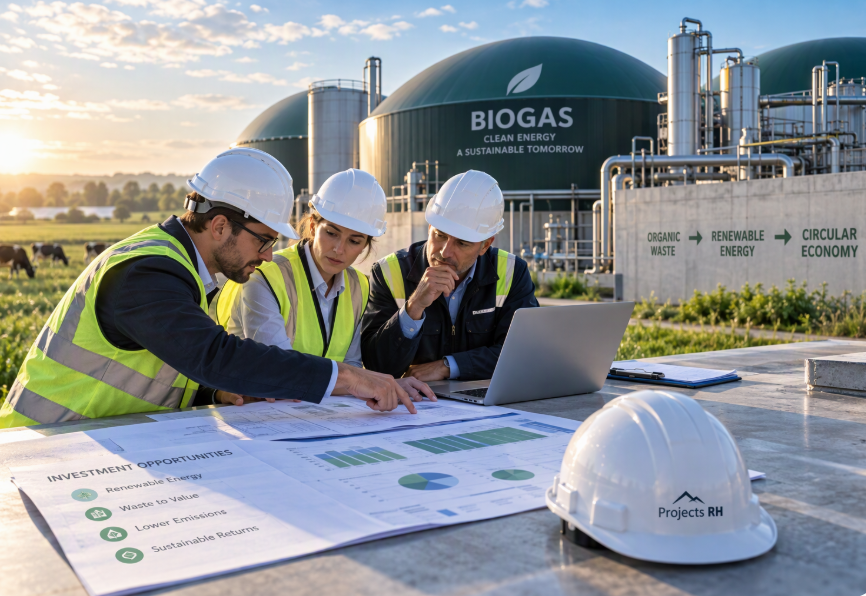
Biogas project investment opportunities are drawing interest because one plant can handle organic waste, produce energy and cut methane emissions at the same time. But a growing sector does not make an individual project investable. An investor is asked to fund one plant, in one place, with one set of contracts. They want to see that feedstock, technology, permits, offtake and the numbers hold together as a single, credible case.
This article sets out what investors typically test in a biogas or biomethane project, and how a project developer can prepare before approaching capital.
Why biogas project investment opportunities need more than a growing sector
Biogas can be used directly for heat or electricity. Once it is upgraded to biomethane, often called renewable natural gas (RNG), it can replace fossil gas where specifications and infrastructure allow. That flexibility produces several kinds of project:
- agricultural and manure digestion
- food, municipal and industrial organic waste
- wastewater treatment and landfill gas
- upgrading for grid injection, industrial use or transport fuel
The International Energy Agency's work on biogas and biomethane points to substantial untapped potential. It also stresses that economics vary sharply with geography, feedstock density and distance to roads, grids and pipelines.
That second point is the one that matters to you. A large market tells an investor nothing about whether your plant works. Their question is narrower: can this particular project be understood, tested and financed?
Feedstock, technology and location
Feedstock is the foundation of the investment case. Expect an investor to ask:
- What feedstock will be used, how much, and of what quality?
- Who controls it, is supply contracted, and for how long?
- How much does it vary by season, and who else competes for it?
- Who pays for transport?
- What happens if volume or composition changes?
Technology comes next. Anaerobic digestion is established, but performance still depends on design, feedstock characteristics, equipment selection, operating discipline and maintenance. Investors will look at expected gas yield and methane content, the upgrading system, plant availability, the plant's own energy use, warranties, the operator's experience and access to spare parts and service.
Location can change the economics entirely. A project with good feedstock but expensive haulage, or a difficult grid or pipeline connection, may perform very differently from a similar project elsewhere. Water supply and a market for digestate belong in the same analysis.
Revenue, offtake and policy
A biogas plant can earn from more than one source: electricity, heat, biomethane sales, gate or tipping fees for accepting waste, digestate products, renewable fuel incentives and environmental attributes where these are legally and commercially available.
Diversification can strengthen a project, but only where each stream is supported by evidence. An investor will separate three things that a weak case tends to blur: contracted revenue, market assumptions that can reasonably be supported, and possible upside. They are not the same, and they should not be presented as if they were.
Offtake agreements reduce uncertainty where they can be secured, whether with utilities, gas distributors, industrial users, transport fuel buyers or municipalities. Investors will read the pricing mechanism, duration, volume commitments, the counterparty's credit quality, termination rights and indexation. A signed agreement is worth only what its terms actually support in the financial model.
Policy needs the same care. Tax credits, renewable fuel schemes and other incentives can improve a project materially, but eligibility and value are technically specific. They often depend on the fuel, its emissions intensity and the circumstances of production, and the rules change. Until qualified tax and legal advisers have confirmed eligibility, an incentive is an assumption, not revenue. A model that only works with an unsecured incentive is a model an investor will question.
How investors test the financial model
There is no credible universal return or payback period for biogas. Results depend on feedstock, technology, plant size, capital and operating costs, financing, energy prices, offtake structure, incentives, tax, geography, construction schedule and how well the plant actually runs. Any generic figure tells an investor nothing about your project.
What they want instead is a base case whose drivers are explained: feedstock volumes and costs, gas yield, biomethane output, availability, prices and fees, capital and operating expenditure, construction timing, financing costs, incentives, tax and working capital.
Then they want to see what happens when reality differs from the plan:
- feedstock costs more, or arrives in smaller volumes
- commissioning is delayed
- gas yield or availability is lower than designed
- capital costs overrun
- an incentive changes or the offtake price falls
Those questions map directly onto the risks investors weigh: feedstock, construction, operating, offtake, regulatory, incentive, technology and execution. A project can have sound technology and real demand and still miss its plan because of weak procurement, project management or operations. Investors need to understand not only the return projected, but what produces it and what could undo it.
Documents that agree with each other
An investor reads a biogas project as a chain: feedstock, technology, production, offtake, revenue, costs, cash flow, capital structure and, finally, investor return. If one link is unsupported, the rest is hard to evaluate.
That is why the documents must work as one package. In the material Projects RH prepares, there are five, and they agree with each other:
- Financial model: the single point of truth for every figure the other documents use.
- Information memorandum: the written investment case, covering the business, the plan, the structure and the risks.
- Investor deck: the short form of the same case, for the first meeting.
- Teaser: the summary that goes out before identity does.
- Data room: contracts, permits, financials and diligence materials, organised before the first investor asks.
In biogas, where several assumptions interact, inconsistency is quickly noticed. A gas yield in the deck that differs from the model, or a feedstock contract described in the memorandum but missing from the data room, invites questions about everything else. Projects RH works on a simple principle: preparation comes before capital. That means establishing the facts, testing the financial foundations and identifying material gaps before any investor sees the project.
What you can do next with Projects RH
If you are developing a biogas or biomethane project and want to know how an institutional reader would see it, start with a complimentary 20-minute discovery call. There is nothing to prepare.
You can then send the documents you already have by upload, by email or by connecting your document system. Nothing new needs to be prepared. A person at the firm reads what you send and replies in writing within 3 business days. No confidentiality agreement is in place at that point, so if your documents are confidential, ask for the firm's agreement first.
The next step is the Investment Readiness Assessment: research on the project and its sponsor, reviewed and approved by a professional before release. It gives you a readiness profile in words, a gap analysis and a recommended preparation package. Preparation then produces the investor materials of the package you contract.
Capital raising comes only after preparation, under a separately accepted mandate that can be declined, and nothing in it is guaranteed. You can read how we work, step by step before you book.

What to do next
Projects RH prepares the company and the project first, then takes them to investors. The fastest way to find out where you stand is a short call.
Keep reading

Tax Equity Financing: How US Renewable Projects Are Structured
How tax equity financing works in US renewable energy: where it sits in the capital stack, the three common structures, how returns are built, and why preparation matters before investors.
Power Purchase Agreements: The Foundation of Energy Project Debt
Understand how PPAs drive project finance debt capacity. Learn offtaker credit, tenor, and structural terms that lenders scrutinize before funding.
Renewable Energy Project Finance: How Power Projects Raise Capital
The question that surfaces most persistently in conversations across the renewable energy sector is not about levelised cost of energy, it is about why so