
Critical Minerals Project Finance: Strategic Capital
Critical minerals need more than conventional debt. Strategic capital, DFIs, ECAs and offtake are reshaping how projects reach bankability.
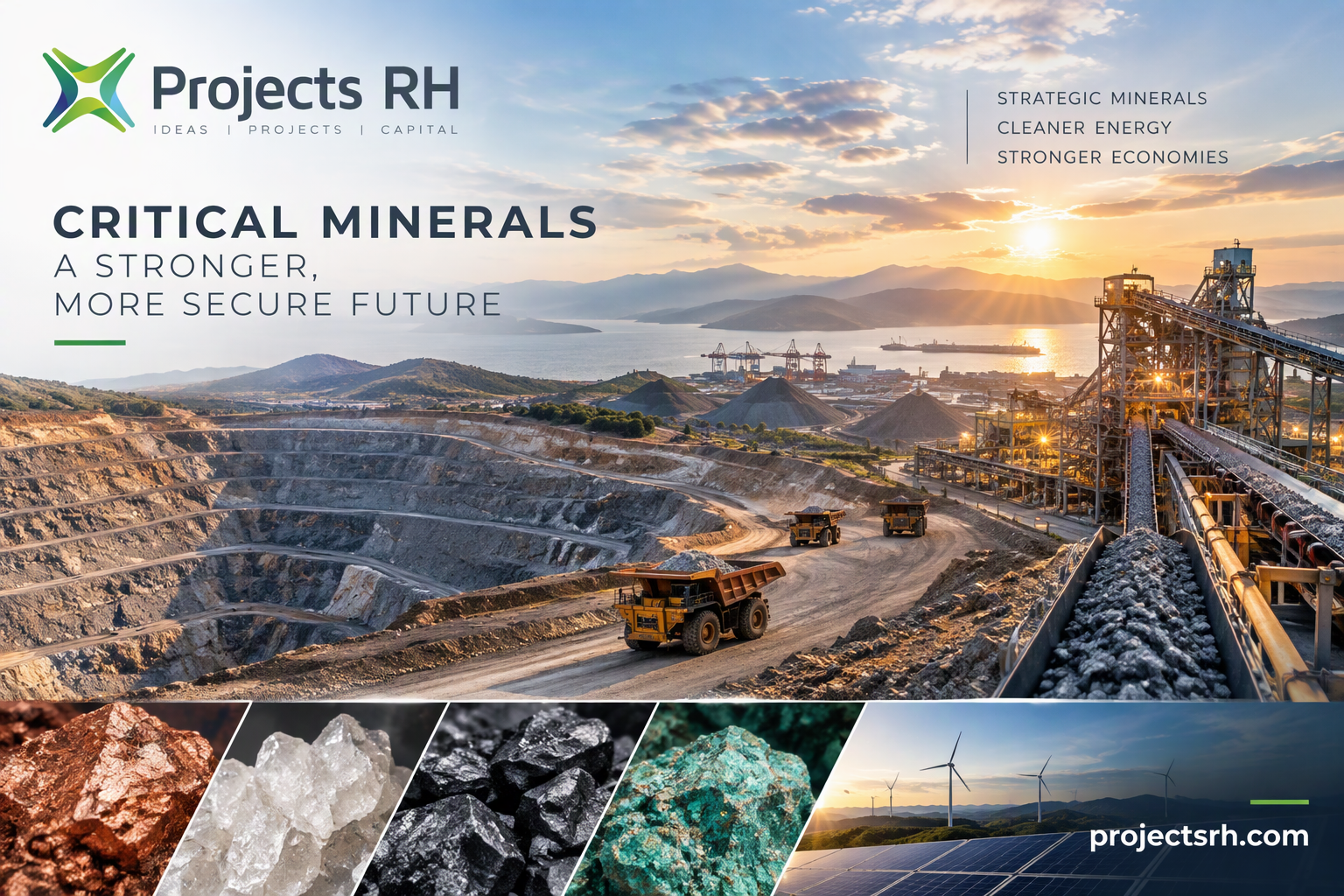
I have seen many technically strong mining projects struggle to raise capital for one simple reason: sponsors assume that because the underlying resource is valuable, the project itself must be financeable.
It does not work that way.
Critical Minerals Project Finance is increasingly about combining conventional project finance with strategic capital, government-backed financing, development finance, export credit and long-term offtake.
The important change is not simply that more money is interested in critical minerals. Governments, development finance institutions, export credit agencies, manufacturers and strategic investors increasingly have different reasons for wanting particular projects and supply chains to succeed.
That creates new financing possibilities. But it does not remove the fundamental discipline of project finance.
Strategic relevance can broaden the capital available to a project. It cannot replace bankability.
What Is Critical Minerals Project Finance?
Critical Minerals Project Finance is the structuring of debt, equity, strategic capital, government-backed finance and commercial agreements to finance mining, processing and associated infrastructure for strategically important minerals.
Depending on the project, that capital structure may involve:
- Sponsor equity
- Commercial project finance debt
- Sovereign or government-backed capital
- Development finance institutions (DFIs)
- Export credit agencies (ECAs)
- Strategic industrial investors
- Commodity traders
- Downstream manufacturers
- Long-term offtakers
- Royalty or streaming capital
This is very different from simply preparing a financial model and asking a bank or investor to fund the entire project.
The real question is: which risks exist, who is best positioned to accept them, and what would make that party willing to provide capital?
That is where financing strategy begins.
Why Critical Minerals Financing Is Changing
Copper, lithium, nickel, graphite, cobalt, rare earths and other strategic minerals increasingly sit at the intersection of energy security, advanced manufacturing, digital infrastructure and national industrial policy.
The International Energy Agency's Global Critical Minerals Outlook 2025 identifies price volatility, supply-chain bottlenecks and geopolitical concerns as significant risks to mineral security. It also found that while demand continued to grow strongly in 2024, investment momentum weakened, with nominal investment growth slowing to approximately 5% and real investment growth, adjusted for cost inflation, to around 2%.
The financing challenge is therefore more complicated than simply anticipating greater future demand.
Governments are increasingly looking beyond mining to processing capacity, refining, infrastructure and diversification of strategically important supply chains.
The 2026 Critical Minerals Ministerial brought together representatives from 54 countries and the European Commission and included new bilateral critical-minerals frameworks and government financing initiatives.
For project sponsors, that changes the financing conversation.
But it is important not to draw the wrong conclusion.
Greater strategic interest does not mean easier money.
If anything, capital is becoming more selective about deciding which projects genuinely deserve support.
In my view, the better question for a project sponsor is therefore not:
"Who can finance my project?"
It is:
"Who has a strategic reason for this project to succeed?"
The answer can materially change the financing strategy.
How Sovereign Capital Can Support Critical Minerals Projects
Governments increasingly view certain critical minerals through the lens of economic security, industrial competitiveness and supply-chain resilience.
This can create financing opportunities through:
- Direct investment
- Government-backed loans
- Loan guarantees
- Strategic investment funds
- Infrastructure support
- Export credit
- Political-risk mitigation
- Public-private financing structures
The World Bank Group's metals and minerals strategy illustrates how mineral development increasingly connects public-sector reforms, private investment, infrastructure, institutional capacity and risk mitigation.
For sponsors, government engagement should therefore not necessarily begin after the entire financing structure has already been designed.
If the project genuinely supports a government's strategic priorities, that alignment should be considered early.
But there is an important qualification.
A government may regard a particular mineral as strategically important and still conclude that an individual project is technically immature, economically uncompetitive or insufficiently prepared.
Strategic relevance gets attention. Project quality gets capital.
The Role of DFIs in Critical Minerals Project Finance
Development finance institutions can play a particularly important role in projects located in emerging and developing markets.
The International Finance Corporation's metals and minerals activities include equity and quasi-equity, corporate and project-level debt and mobilisation of third-party capital. IFC reports that it has invested and mobilised approximately USD 5.3 billion in mining projects over the past decade.
DFIs may contribute:
- Senior debt
- Subordinated debt
- Equity
- Quasi-equity
- Guarantees
- Risk mitigation
- Capital mobilisation
Their importance, however, goes beyond the amount of capital they provide.
Institutional participation can bring additional discipline around:
- Governance
- Environmental performance
- Social impact
- Community relationships
- Financial transparency
- Risk management
For a project sponsor, these are not requirements to address immediately before financing.
They form part of project preparation and ultimately part of bankability.
A project seeking DFI capital needs to be prepared for serious scrutiny.
That is a good thing.
How Export Credit Agencies Can Support Project Financing
Export credit agencies can become particularly relevant when a mine, processing facility or associated infrastructure requires substantial imported equipment, engineering or technology.
U.S. EXIM's critical minerals programme demonstrates how export-credit financing can be connected to critical minerals projects.
Rather than looking at a development simply as a USD 500 million or USD 1 billion funding requirement, sponsors should examine the procurement component separately.
I would want to know:
- What equipment is required?
- Where will it be manufactured?
- Which ECA could potentially support that procurement?
- What national-content requirements apply?
- How much of the equipment package may qualify?
- What financing tenor may be available?
- How would ECA-backed debt rank alongside commercial lenders?
This is why procurement and financing strategy increasingly need to be considered together.
Trying to introduce ECA financing after procurement has effectively been decided can significantly reduce the available options.
Why Offtake Agreements Matter to Critical Minerals Finance
An offtake agreement can be much more than a contract to sell future production.
Properly structured, it can influence financing.
A credible agreement can establish:
- A defined buyer
- Committed volumes
- Product specifications
- Pricing mechanisms
- Contract duration
- Revenue visibility
- Counterparty credit quality
The U.S. EXIM Supply Chain Resiliency Initiative provides a practical example of how financing can be connected with qualifying critical-minerals projects and long-term offtake arrangements.
But I would make one distinction very clearly:
An offtake agreement is not automatically a bankable offtake agreement.
A lender will want to understand:
- Who is the buyer?
- What is its credit quality?
- How long is the commitment?
- What volumes are actually committed?
- How is the product priced?
- Can the purchaser terminate the agreement?
- What happens if specifications are not met?
- Are there minimum purchase obligations?
- What remedies exist when either party fails to perform?
Those are not simply commercial questions.
They are financing questions.
A strong offtake becomes valuable to project finance when it genuinely reduces revenue uncertainty.
Strategic Investors: Capital, Offtake and Industrial Alignment
Not all equity is equal.
A strategic investor may contribute capital while also providing:
- Market access
- Technical expertise
- Processing capability
- Downstream relationships
- Logistics
- Procurement capabilities
- Credibility
- Offtake
For the right project, this can be considerably more valuable than conventional financial equity.
However, strategic capital has to be negotiated carefully.
The investor may seek:
- Preferential offtake rights
- Exclusivity
- Board representation
- Information rights
- Pre-emption rights
- Pricing advantages
- Restrictions on subsequent financing
- Influence over future production
I have always believed that the source of capital matters almost as much as its price.
Capital that resolves today's problem while significantly restricting tomorrow's flexibility can become very expensive capital.
How to Structure a Critical Minerals Capital Stack
Suppose a project requires USD 600 million.
The wrong starting question is:
"Where do we find USD 600 million?"
The better question is:
"How should the USD 600 million be structured so that each material risk is allocated to the capital provider best equipped to accept it?"
An illustrative capital structure could include:
| Capital Source | Potential Role | |---|---| | Sponsor equity | Development capital and sponsor commitment | | Strategic equity | Capital combined with industrial alignment | | DFI financing | Long-term institutional capital | | ECA-backed debt | Eligible equipment and procurement | | Commercial debt | Senior project financing | | Government support | Guarantees, infrastructure or strategic support | | Offtake-linked finance | Financing supported by future production | | Royalty or streaming capital | Alternative financing where appropriate |
This is illustrative rather than prescriptive.
Every project will require a different structure depending on jurisdiction, technical maturity, commodity exposure, procurement, revenue arrangements and risk allocation.
That is precisely the point.
Critical minerals financing increasingly requires capital architecture rather than simply capital searching.
Why a Strategic Mineral Is Not Automatically a Bankable Project
This may be the most important distinction in the entire discussion.
A world-class mineral resource is not automatically a world-class investment opportunity.
A project can have exceptional geology and still fail to reach financial close because of:
- Unrealistic CAPEX
- Weak metallurgy
- Poor recovery assumptions
- Missing permits
- Infrastructure constraints
- Inadequate power or water
- Logistics problems
- Community opposition
- Weak management
- Commodity-price exposure
- Insufficient contingency
- Construction risk
- Lack of credible buyers
Project sponsors naturally focus on resource size, grade and exploration upside.
Financiers look much further.
Investors do not finance tonnes in the ground. They finance a credible pathway for converting those tonnes into sustainable cash flow.
That is the difference between an attractive resource and an investable project.
What Investors and Lenders Test Before Financing a Project
If a sponsor brought me a critical minerals project tomorrow, I would want to understand at least six areas before discussing capital.
1. Is the Technical Case Credible?
I would examine:
- Resource definition
- Metallurgy
- Process design
- Recoveries
- Infrastructure
- CAPEX
- OPEX
- Construction schedule
- Contingency
If those assumptions cannot withstand serious independent scrutiny, the capital raising process is premature.
2. Are the Economics Resilient?
The base case is only the beginning.
What I really want to understand is what happens when the assumptions become less comfortable.
What happens if:
- Commodity prices fall?
- CAPEX increases?
- Construction is delayed?
- Ramp-up takes longer?
- Recovery is lower?
- Operating costs rise?
That downside case often tells me more about a project than the headline IRR.
3. Who Will Buy the Product?
Not theoretically.
Actually.
Who needs the mineral?
What specification do they require?
In what quantity?
Under what pricing mechanism?
For how long?
And what is the financial strength of that counterparty?
That discussion connects project economics directly to offtake and finance.
4. Why Does the Government Care?
Does the project provide:
- Strategic supply?
- Employment?
- Export revenue?
- Processing capacity?
- New infrastructure?
- Regional development?
- Supply-chain resilience?
The stronger and more credible those answers are, the more relevant sovereign or government-supported capital may become.
5. Where Does Each Risk Sit?
Every significant project risk ultimately belongs to someone.
That includes:
- Construction risk
- Completion risk
- Operating risk
- Commodity-price risk
- Political risk
- Currency risk
- Logistics risk
- Offtake risk
- Counterparty risk
If the sponsor cannot explain who carries each material risk, the financing structure is not complete.
6. Why This Particular Capital Provider?
This is frequently overlooked.
Commercial banks, sovereign investment institutions, DFIs, ECAs, commodity traders and strategic industrial investors do not have the same mandates.
The investment proposition should explain why this particular project fits the mandate and objectives of the capital provider being approached.
That is the difference between targeted capital raising and simply distributing a presentation to a long list of investors.
Capital Providers Look at Different Risks
Understanding the motivation of each financing source helps sponsors avoid treating every investor as if they were interchangeable.
| Capital Source | Why It May Participate | What It Will Typically Examine | |---|---|---| | Commercial lenders | Predictable debt service | Cash flow, debt service, completion and security | | DFIs | Development and institutional impact | ESG, governance, economics and jurisdiction | | ECAs | Supporting national exports | Eligible equipment, procurement and country risk | | Sovereign capital | Strategic supply security | National interest, scale and strategic relevance | | Strategic investors | Long-term supply or industrial positioning | Product, economics, rights and offtake | | Offtakers | Reliable long-term access to material | Quality, volume, pricing and delivery | | Sponsor equity | Project development and upside | Returns, dilution and overall project risk |
The objective is not to find one institution willing to take every risk.
It is to build a structure in which the risks are allocated intelligently.
Why Government Support Cannot Replace Commercial Discipline
There is a danger in today's market that the label "critical mineral" begins to be treated as a substitute for commercial viability.
It is not.
Government support cannot permanently compensate for:
- Weak project economics
- Unrealistic assumptions
- Unresolved metallurgy
- Excessive CAPEX
- Poor management
- Inadequate governance
- Unresolved permitting
- An uncompetitive cost structure
Government and strategic capital should strengthen an otherwise credible project.
They should not be expected to manufacture bankability where it does not exist.
Critical minerals may be strategic. Capital is still disciplined.
From Financing Mines to Financing Critical Mineral Supply Chains
One of the most interesting changes is that financing discussions increasingly extend beyond the mine itself.
The relevant chain may look more like:
Resource → Mine → Processing → Infrastructure → Logistics → Refining → Manufacturing → End User
The World Bank Group highlights the broader importance of infrastructure, institutional capacity, private investment and long-term development in translating mineral resources into economic value.
That has important implications.
A copper project connected to a strategically important electricity-grid supply chain can present a different financing proposition from a project simply producing concentrate for the open market.
A graphite project integrated into a downstream battery-material strategy may look different to strategic capital from an isolated mining operation.
The geology may be identical.
The project's position within the supply chain changes the financing conversation.
This is why sponsors need to understand not only their mineral resource, but who ultimately needs the product and why.
A Practical Critical Minerals Project Finance Strategy
I would approach Critical Minerals Project Finance in a disciplined sequence.
Step 1: Test Project Readiness
Before approaching investors, determine whether the technical, financial, permitting, legal, ESG and commercial work is sufficiently mature.
Investor readiness starts before investor outreach.
A disciplined investment readiness assessment should identify the issues most likely to concern institutional capital before formal capital raising begins.
Step 2: Build the Financial Model Properly
The financial model should be capable of withstanding lender scrutiny.
That means credible assumptions for:
- CAPEX
- OPEX
- Production
- Ramp-up
- Commodity prices
- Contingency
- Working capital
- Debt capacity
- Downside scenarios
A financial model for capital raising should explain the economics and resilience of a project rather than merely produce an attractive headline return.
Step 3: Map Strategic Stakeholders
Identify the:
- Governments
- DFIs
- ECAs
- Manufacturers
- Processors
- Commodity traders
- Strategic investors
- Potential offtakers
that have a genuine strategic or commercial reason to care about the project.
Step 4: Develop the Offtake Strategy
Determine whether the project simply needs a buyer or needs an offtaker capable of strengthening the financing proposition.
They are not necessarily the same counterparty.
A potential buyer may offer commercial demand without providing the contractual strength lenders require.
Step 5: Design the Capital Stack
Determine what should appropriately be funded through:
- Sponsor equity
- Strategic equity
- Senior debt
- DFI capital
- ECA-backed finance
- Government-supported finance
- Offtake-linked facilities
- Royalties or streams
The capital structure should reflect the project's actual risks rather than being built around whichever investor happens to respond first.
Step 6: Allocate the Risks
Map each material risk to the party expected to carry it.
This is fundamental to project finance.
Project sponsors should be capable of explaining clearly who carries construction, completion, operating, commodity-price, political, currency, logistics and revenue risk.
Step 7: Approach Capital in the Right Sequence
Capital raising should not necessarily happen simultaneously across every investor category.
Sometimes offtake needs to come first.
Sometimes government alignment strengthens the DFI proposition.
Sometimes ECA eligibility must be established before procurement is finalised.
Sometimes strategic equity materially improves the proposition subsequently presented to commercial lenders.
Sequence matters.
Good project preparation therefore concerns not only what information is presented to capital, but also when, how and to whom it is presented.
Frequently Asked Questions About Critical Minerals Project Finance
What is Critical Minerals Project Finance?
Critical Minerals Project Finance is the structuring of debt, equity, strategic capital, government-backed finance and commercial arrangements to finance mining, processing and associated infrastructure for strategically important minerals.
Depending on the project, it can involve commercial lenders, DFIs, ECAs, sovereign capital, strategic investors and long-term offtakers.
How are critical minerals projects financed?
Critical minerals projects can be financed through combinations of sponsor equity, strategic equity, senior debt, DFI financing, ECA-backed facilities, sovereign or government support, royalty or streaming finance and offtake-linked financing.
The appropriate structure depends on the project's maturity, economics, jurisdiction, procurement strategy, revenue model and allocation of risk.
Can an offtake agreement help finance a critical minerals project?
Yes.
A sufficiently long-term and creditworthy offtake agreement can reduce revenue uncertainty and strengthen a project's financing proposition.
However, lenders will still examine the buyer's credit quality, pricing mechanism, contracted volumes, duration, product specifications, termination provisions and contractual obligations.
What role do DFIs play in critical minerals finance?
DFIs can provide debt, equity, quasi-equity, guarantees and capital mobilisation, particularly in emerging markets or where certain risks are difficult for conventional lenders to assume alone.
They normally also require strong environmental, social and governance standards.
How can export credit agencies finance mining projects?
ECAs can potentially support eligible equipment, technology and services sourced from their respective countries through loans, guarantees or insurance.
Sponsors should investigate ECA eligibility early because procurement and sourcing decisions can materially influence available financing.
Does critical mineral status make a mining project bankable?
No.
Strategic importance may provide access to additional sources of capital, but financiers will still examine technical feasibility, resource quality, metallurgy, CAPEX, OPEX, infrastructure, permitting, management, ESG, construction risk, revenue certainty and debt-service capacity.
What makes a critical minerals project attractive to strategic investors?
Strategic investors may value secure long-term supply, appropriate product specifications, downstream integration, geographic diversification, processing capability and alignment with their broader industrial or supply-chain requirements.
However, they will still assess project economics and the commercial terms associated with their participation.
What should a critical minerals project prepare before capital raising?
Before approaching capital, a project should have a coherent technical case, credible financial model, permitting strategy, realistic development schedule, risk allocation framework, financing strategy and evidence supporting its commercial assumptions.
A strong investor readiness process should also identify the information that lenders, DFIs, ECAs, sovereign institutions, strategic investors and offtakers will require before committing resources.
Project Readiness Before Capital Raising
Before approaching institutional capital, sponsors should be able to demonstrate that the technical case, financial model, permitting strategy, offtake assumptions, risk allocation and proposed capital structure can withstand serious scrutiny.
For critical minerals projects, project preparation should go one step further.
Sponsors should understand which sources of capital have a genuine strategic reason to participate, which risks those institutions are capable of accepting, and what conditions must be satisfied before an investment can realistically proceed.
That is why investor readiness comes before capital raising.
A structured investment readiness assessment can help identify material technical, financial, commercial and financing gaps before formal discussions begin with investors, lenders, DFIs, ECAs, strategic investors or offtake counterparties.
The purpose is not simply to produce more documentation.
It is to understand whether the project is ready for the type of capital it intends to approach and, if not, what needs to change before that conversation begins.
Final Perspective
There is undoubtedly more strategic capital paying attention to critical minerals.
But I would caution sponsors against confusing more interest with easier money.
Institutional investors, sovereign capital providers, DFIs, ECAs and strategic investors will still ask difficult questions.
And they should.
The opportunity is to stop treating capital raising as a search for a cheque and instead answer four more useful questions:
Who needs this project to succeed?
What risks prevent conventional capital from participating?
Which institution is best positioned to carry those risks?
What must the project accomplish before that institution can invest?
Answer those questions properly and the financing discussion becomes considerably more sophisticated.
Because ultimately, Critical Minerals Project Finance is not about finding one source of money. It is about creating a capital structure in which the strategic and commercial interests of multiple parties can align around a credible, bankable project.
And that, in my experience, is where serious capital starts paying attention.
Critical minerals may be strategic. Capital is still disciplined.
If you are preparing a critical minerals project for financing, the practical next step is to identify the gaps institutional capital is likely to question before approaching the market. Start your project investment readiness assessment.
Sources
- International Energy Agency: Global Critical Minerals Outlook 2025
- World Bank Group: Metals and Minerals
- International Finance Corporation: Metals and Minerals
- U.S. EXIM: Support for Critical Minerals Transactions
- U.S. EXIM: Supply Chain Resiliency Initiative
- U.S. Department of State: 2026 Critical Minerals Ministerial

What to do next
Projects RH prepares the company and the project first, then takes them to investors. The fastest way to find out where you stand is a short call.
Keep reading
Lithium vs Copper Project Finance: Investor Requirements
Lithium and copper projects face different financing tests. Compare pricing, offtake, processing, CapEx, risk and development timelines.
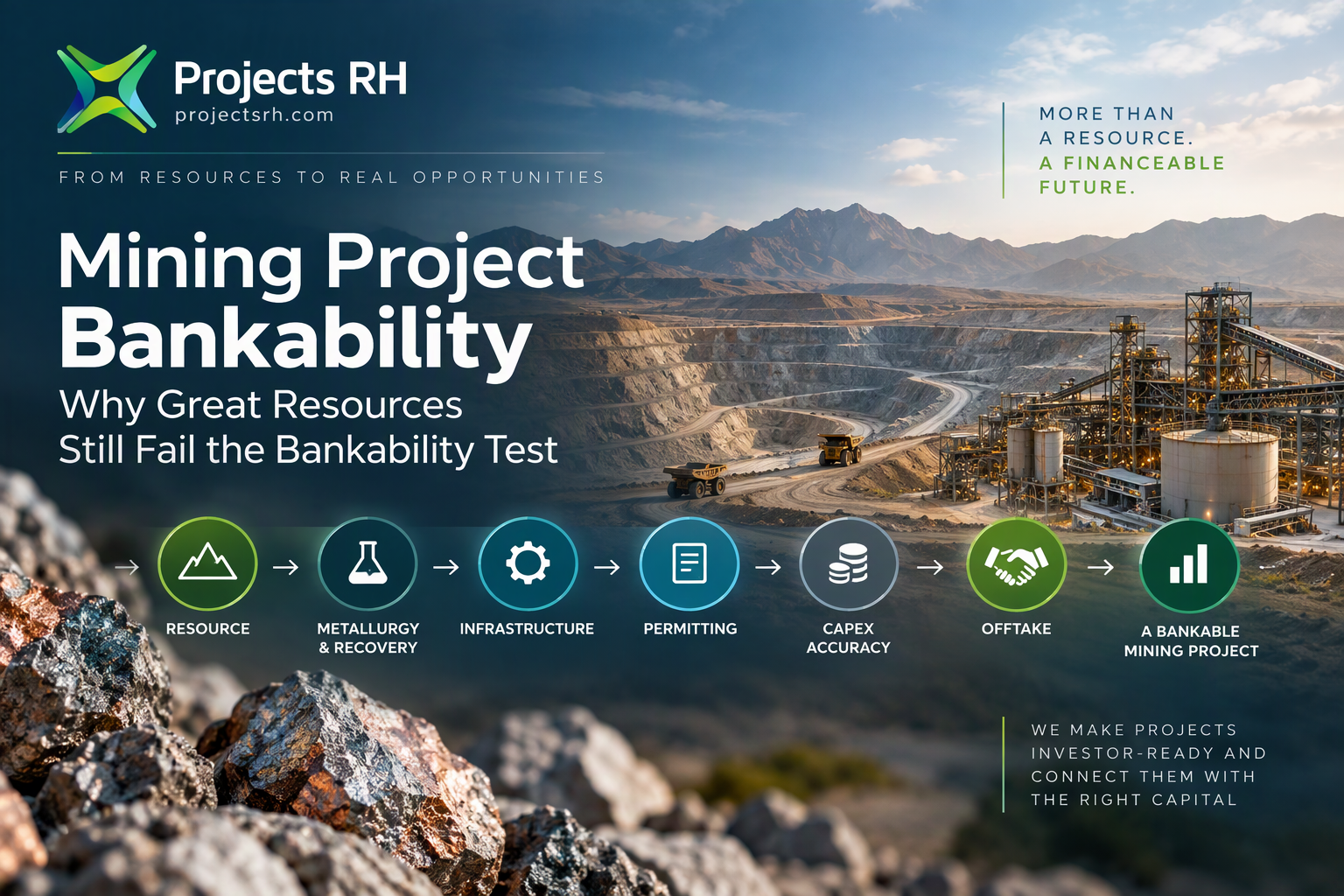
Mining Project Bankability: Why Great Resources Still Fail
A world-class resource is not automatically financeable. Discover how metallurgy, recovery, infrastructure, permits, CapEx and offtake shape mining bankability.
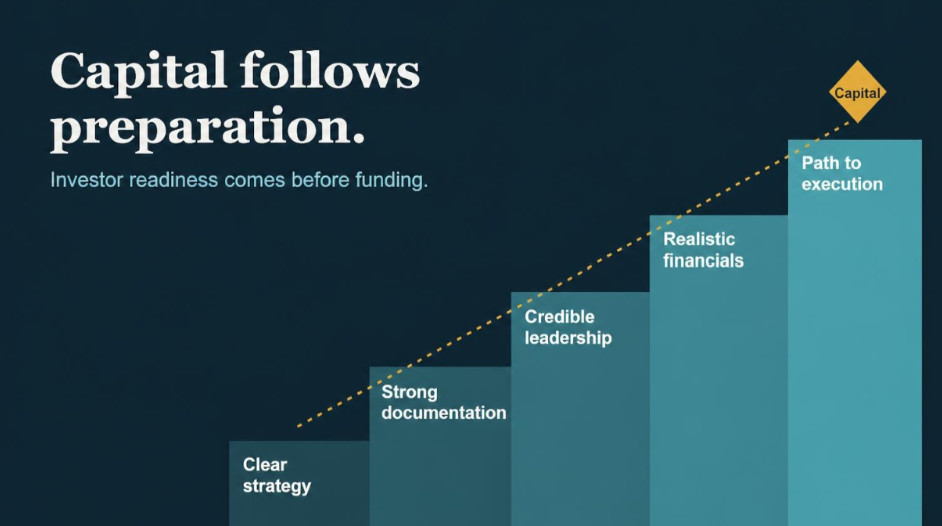
Mining Finance: Why Investor Readiness Comes First
Mining finance starts before investor outreach. Why investor readiness, a tested financial model and consistent documentation matter before a mining project meets investors.