
JORC vs NI 43-101: What Mining Investors Need to Know
JORC and NI 43-101 share resource categories but differ in legal status, expert responsibility, technical reporting and cross-border filing requirements.
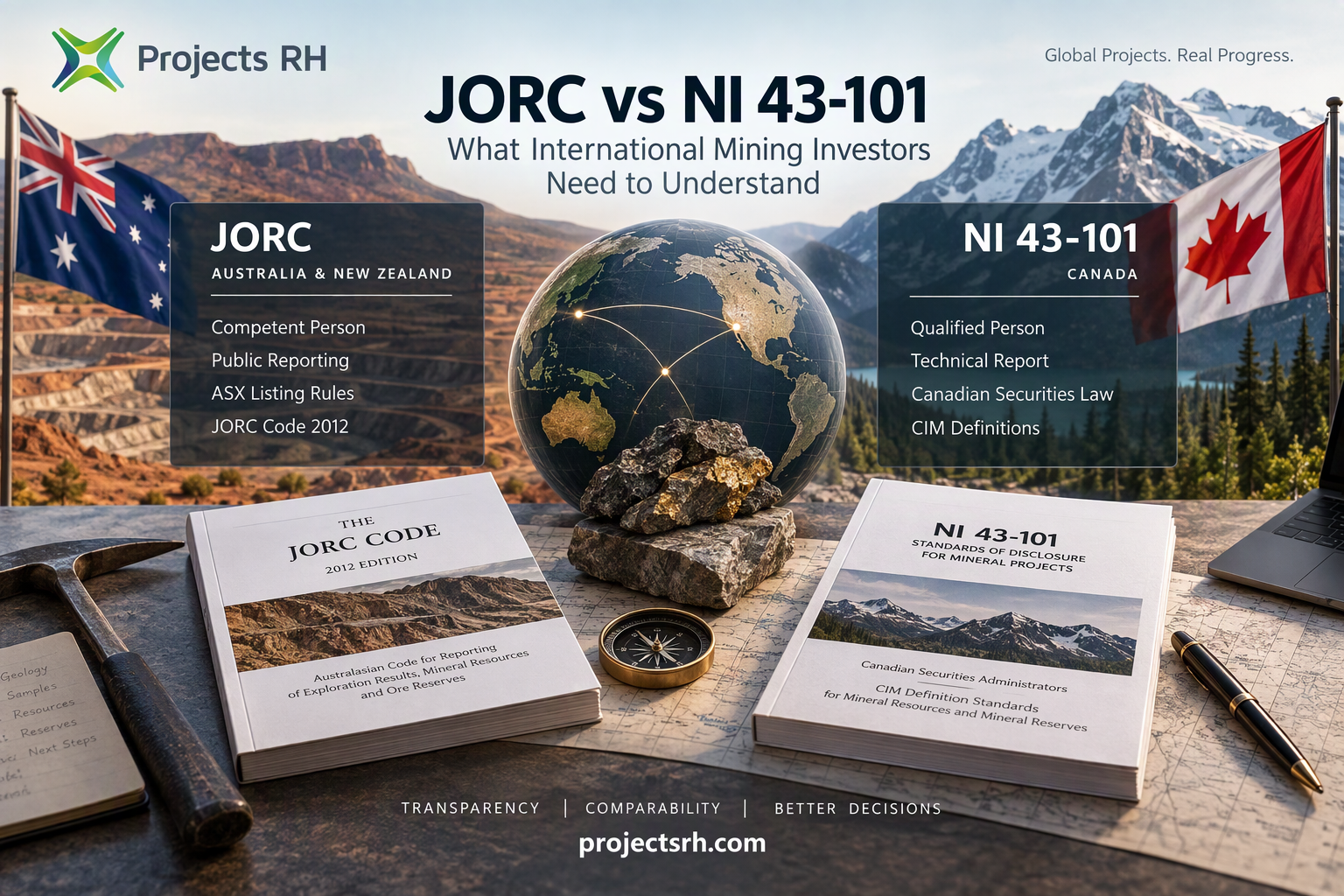
JORC vs NI 43-101 is not a comparison between a good reporting standard and a bad one. Both frameworks are designed to improve the quality, transparency and professional accountability of public mineral-project disclosure.
The practical difference lies in how each framework operates.
The JORC Code is a professional reporting code incorporated into the listing rules used in Australia and New Zealand. NI 43-101 is a Canadian securities-law instrument governing public disclosure of scientific and technical information about mineral projects.
Both use internationally aligned resource and reserve terminology.
Both rely on appropriately experienced professionals.
Both aim to protect investors from incomplete, exaggerated or misleading technical claims.
But they are not interchangeable in every transaction.
For international mining investors, the essential question is not simply whether a project has a "JORC resource" or an "NI 43-101 report."
The better questions are:
- Which disclosure regime applies?
- Who accepted professional responsibility?
- What information was publicly disclosed?
- How current is the estimate?
- What assumptions support it?
- Was a prescribed technical report required?
- Can the disclosure support the intended listing, transaction or financing?
A reporting standard improves the reliability of disclosure. It does not guarantee that the mineral project is economic, financeable or ready for investment.
What Is JORC vs NI 43-101?
JORC vs NI 43-101 compares the Australasian and Canadian frameworks used to disclose exploration results, mineral resources and mineral reserves to public markets.
The JORC Code establishes minimum standards, recommendations and guidelines for public reporting in Australasia.
NI 43-101 establishes Canadian securities-disclosure requirements for scientific and technical information concerning mineral projects.
At a high level, both frameworks address:
- Exploration information
- Sampling and data quality
- Geological interpretation
- Mineral Resource classification
- Mineral Reserve classification
- Technical studies
- Professional responsibility
- Materiality
- Transparency
- Public disclosure
The frameworks share considerable technical alignment because both operate within the international family of CRIRSCO-style reporting systems.
However, their legal structures, reporting mechanisms and filing requirements differ.
JORC vs NI 43-101: The Key Differences
| Comparison | JORC Code | NI 43-101 | |---|---|---| | Primary market | Australia and New Zealand | Canada | | Nature | Professional reporting code incorporated into applicable listing rules | Canadian securities-law instrument | | Responsible expert | Competent Person | Qualified Person | | Resource terminology | JORC definitions | CIM definitions incorporated by reference | | Supporting framework | JORC Code and Table 1 | NI 43-101, Companion Policy and Form 43-101F1 | | Reporting approach | Transparency, materiality and competence | Securities disclosure with prescribed requirements | | Formal technical report | Depends on applicable disclosure context | Required for specified regulatory triggers | | Independence | Depends on context and applicable requirements | Required in specified circumstances | | Cross-border use | Subject to target-market requirements | Subject to target-market requirements |
This comparison is a starting point.
The real analysis begins with how the disclosure was prepared and what decision an investor is trying to make.
The Common Foundation: CRIRSCO
JORC and the Canadian mineral-resource reporting system share a broadly aligned international foundation.
CRIRSCO, the Committee for Mineral Reserves International Reporting Standards, promotes internationally consistent terminology and principles for public reporting of mineral resources and mineral reserves.
That alignment makes cross-border comparison easier.
Both systems use familiar resource categories:
- Inferred Mineral Resource
- Indicated Mineral Resource
- Measured Mineral Resource
Both also use reserve categories corresponding to:
- Probable Reserve
- Proven Reserve
That does not mean estimates can be compared solely by reading the category label.
An Indicated Resource remains dependent on:
- Data density
- Sampling quality
- Geological continuity
- Estimation methodology
- Cut-off assumptions
- Commodity prices
- Metallurgy
- Mining method
- Professional judgment
The category is important.
The assumptions behind the category are more important.
What Is the JORC Code?
The Australasian Code for Reporting of Exploration Results, Mineral Resources and Ore Reserves is commonly called the JORC Code.
The 2012 Edition establishes minimum standards for public reporting concerning:
- Exploration Results
- Mineral Resources
- Ore Reserves
The framework is built around three fundamental principles.
Transparency
The reader should receive sufficient information presented clearly and without ambiguity.
Materiality
The report should contain information that investors and their professional advisers would reasonably require to make a balanced judgment.
Competence
Public reporting must be based on work undertaken by appropriately qualified and experienced professionals.
These principles matter because JORC does not attempt to turn every mineral-property disclosure into an identical fixed-form report.
It places significant responsibility on the Competent Person and reporting company to determine what technical information is material.
What Is NI 43-101?
National Instrument 43-101, Standards of Disclosure for Mineral Projects, is the Canadian securities framework governing public disclosure of scientific and technical information concerning mineral projects.
NI 43-101 operates alongside:
- Companion Policy 43-101CP
- Form 43-101F1
- CIM Definition Standards
- Applicable Canadian securities requirements
- Relevant exchange requirements
Applicable scientific and technical information must be prepared by, under the supervision of, or approved by a Qualified Person.
A technical report may also be required for specified disclosure events involving material mineral properties.
When required, the technical report follows Form 43-101F1.
This distinction is critical:
NI 43-101 is not simply a mineral-resource classification system. It is a securities-disclosure framework with specific technical-report requirements.
Competent Person vs Qualified Person
One of the most visible differences in JORC vs NI 43-101 is the title of the responsible technical expert.
JORC uses:
Competent Person
NI 43-101 uses:
Qualified Person
Both roles require relevant professional standing, education and experience.
But investors should never treat either designation as a generic credential.
Relevant experience should match:
- Deposit type
- Commodity
- Technical discipline
- Reporting stage
- Responsibility being accepted
A professional experienced in estimating operating porphyry copper deposits is not automatically the appropriate expert for lithium brines, rare-earth processing or narrow-vein gold.
Relevant experience matters.
The JORC Competent Person
Under the JORC Code, a Competent Person must satisfy applicable professional-membership and experience requirements.
The professional needs relevant experience in the style of mineralisation or deposit under consideration and in the activity being undertaken.
The Competent Person:
- Accepts responsibility for relevant technical information
- Provides required consent
- Ensures disclosure fairly reflects supporting documentation
- Applies professional judgment to material technical issues
The reporting company also retains responsibility for its public disclosure.
Professional technical responsibility does not replace corporate disclosure controls.
The NI 43-101 Qualified Person
Under NI 43-101, a Qualified Person is an engineer or geoscientist satisfying the applicable education, experience and professional-association requirements.
Depending on the disclosure and technical report, the Qualified Person may be responsible for:
- Preparing technical information
- Supervising technical work
- Approving public disclosure
- Preparing or supervising a technical report
- Conducting required personal inspection, where applicable
- Signing the technical report and certificate
Specified circumstances can also require independence.
An issuer may therefore need a Qualified Person who is independent rather than part of management or the project team.
JORC Public Report vs NI 43-101 Technical Report
This distinction is frequently misunderstood.
People sometimes refer to a "JORC report" as though JORC requires one standard document equivalent to Canada's Form 43-101F1.
That is not the best way to understand the framework.
Under JORC
Public reporting can include material released through:
- Exchange announcements
- Annual reporting
- Quarterly reporting
- Press releases
- Information memoranda
- Technical papers
- Website disclosure
- Public presentations
The relevant disclosure must comply with applicable JORC and exchange requirements.
Under NI 43-101
Scientific and technical disclosure is governed broadly by the Instrument.
In addition, a formal technical report following Form 43-101F1 is required when specified regulatory triggers apply.
This distinction can affect:
- Report format
- Public filing
- Professional certificates
- Consents
- Personal inspection
- Independence
- Transaction timing
- Disclosure preparation
What Is JORC Table 1?
JORC Table 1 is a checklist of assessment and reporting criteria supporting disclosure of Exploration Results, Mineral Resources and Ore Reserves.
It addresses matters including:
- Sampling
- Drilling
- Sample recovery
- Logging
- Sub-sampling
- Assaying
- Data verification
- Location accuracy
- Data spacing
- Geological interpretation
- Estimation methodology
- Cut-off grades
- Mining assumptions
- Metallurgy
- Environmental considerations
- Classification
- Audits and reviews
For initial or materially changed reporting concerning significant projects, relevant Table 1 information is addressed on an "if not, why not" basis.
That does not mean every criterion requires identical disclosure.
It means relevant criteria should be considered and material omissions should be explainable.
For investors, Table 1 helps expose the technical foundations beneath the headline estimate.
What Is Form 43-101F1?
Form 43-101F1 establishes the structure and content requirements for an NI 43-101 technical report.
Depending on project stage, a report may address:
- Property description and location
- Accessibility and infrastructure
- History
- Geological setting
- Deposit type
- Exploration
- Drilling
- Sample preparation and analysis
- Data verification
- Mineral processing and metallurgical testing
- Mineral Resource estimates
- Mineral Reserve estimates
- Mining methods
- Recovery methods
- Project infrastructure
- Market studies and contracts
- Environmental studies
- Permitting
- Capital costs
- Operating costs
- Economic analysis
- Interpretation and conclusions
- Recommendations
An exploration-stage project will not contain the same development information as an advanced mine.
But international investors benefit from a recognisable technical-report architecture.
Are JORC and NI 43-101 Resource Categories Equivalent?
The frameworks are substantially aligned at the level of CRIRSCO-style resource and reserve classification.
A project may report:
- Inferred
- Indicated
- Measured
and reserves as:
- Probable
- Proven
However, investors should never conclude that two projects are equally advanced simply because both report an Indicated Resource.
Consider two hypothetical projects.
Project A may have:
- Close drill spacing
- Strong geological continuity
- Established metallurgy
- Conservative cut-off assumptions
- Current topography
- Verified density measurements
Project B may have:
- Wider drilling
- Complex mineralisation
- Limited metallurgical testing
- Aggressive commodity-price assumptions
- Uncertain recovery
- Difficult infrastructure
Both may contain an Indicated Resource.
They do not necessarily contain the same investment risk.
Mineral Resources Are Not Mineral Reserves
This distinction is fundamental under both frameworks.
A Mineral Resource represents mineralisation with reasonable prospects for eventual economic extraction under the relevant definitions and assumptions.
A Mineral Reserve is the economically mineable part of a Measured or Indicated Mineral Resource after appropriate modifying factors have been applied.
Those factors may include:
- Mining
- Metallurgy
- Processing
- Infrastructure
- Economics
- Marketing
- Legal matters
- Environmental considerations
- Social considerations
- Government approvals
An investor should therefore never treat resources and reserves as interchangeable.
Geological confidence does not automatically equal economic viability.
Why Inferred Resources Need Special Care
Inferred Resources represent a lower level of geological confidence than Indicated or Measured Resources.
They can still be strategically valuable.
They may indicate expansion potential.
They may justify additional drilling.
But investors should ask:
- What proportion of the project is Inferred?
- Is project development dependent on conversion?
- How much drilling is required?
- How long could conversion take?
- Is the drilling programme funded?
- Does the project remain viable if resource conversion underperforms expectations?
A large headline resource dominated by Inferred material can be materially less advanced than its total tonnage suggests.
Reasonable Prospects for Eventual Economic Extraction
Mineral Resource estimates are not intended to be unconstrained inventories of every mineralised block.
The estimate must satisfy the relevant requirement relating to reasonable prospects for eventual economic extraction.
That assessment can involve:
- Commodity price
- Cut-off grade
- Mining method
- Recovery
- Processing route
- Infrastructure
- Scale
- Geometry
- Costs
- Marketability
- Legal constraints
- Environmental constraints
The assumptions are not necessarily equivalent to a completed feasibility study.
But they need to provide a credible basis for including material within a Mineral Resource.
For investors, these assumptions are essential due-diligence inputs.
JORC vs NI 43-101: Legal and Regulatory Context
The legal architecture differs.
JORC Context
The JORC Code is a professional reporting code incorporated into relevant Australian and New Zealand market requirements.
For an ASX-listed issuer, JORC disclosure operates alongside applicable exchange requirements and guidance.
NI 43-101 Context
NI 43-101 is a Canadian securities-law instrument applying to relevant public scientific and technical disclosure.
This distinction can affect:
- Enforcement
- Filing obligations
- Disclosure processes
- Required forms
- Professional responsibility
- Regulatory review
Cross-border transactions therefore require coordination between technical professionals, securities advisers and transaction teams.
A technically credible estimate can still require additional work before satisfying another market's disclosure requirements.
Is NI 43-101 More Prescriptive Than JORC?
NI 43-101 is generally more prescriptive regarding formal technical-report structure and specified filing requirements.
Form 43-101F1 establishes a defined technical-report architecture.
NI 43-101 also addresses areas such as:
- Technical-report triggers
- Qualified Person responsibility
- Independence
- Personal inspection
- Certificates
- Consents
- Historical estimates
- Restricted disclosure
JORC is strongly principles-based.
It relies heavily on:
- Transparency
- Materiality
- Competence
- Professional judgment
- Table 1
- Applicable exchange requirements
This does not make JORC less rigorous.
It means the frameworks apply different regulatory mechanisms.
Can a JORC Estimate Be Used in Canada?
Existing JORC disclosure can provide an important technical foundation for a Canadian transaction.
But international investors and project sponsors should not assume that it can simply be copied into Canadian public disclosure without further analysis.
Potential issues can include:
- Canadian terminology
- Qualified Person approval
- Technical-report triggers
- Form 43-101F1 requirements
- Independence
- Personal inspection
- Certificates and consents
- Data verification
- Material-property disclosure
The commercial lesson is straightforward:
Technical similarity does not automatically create regulatory portability.
Cross-border conversion should be planned before it becomes a transaction-timetable problem.
Can an NI 43-101 Estimate Be Used for an ASX Transaction?
An NI 43-101 technical report can provide valuable technical information for an Australian transaction.
But an issuer subject to Australian requirements still needs to satisfy applicable JORC and market-disclosure obligations.
Depending on the circumstances, additional work can include:
- JORC-compliant disclosure
- Competent Person review
- Appropriate consent
- JORC terminology
- Table 1 disclosure
- Reconciliation of assumptions
An existing NI 43-101 technical report therefore provides a valuable starting point.
It does not automatically replace the requirements of the target market.
Cross-Border Conversion Is More Than Renaming the Expert
A common mistake is to assume conversion means changing:
Qualified Person
to:
Competent Person
or vice versa.
That is not enough.
A cross-border review may need to consider:
- Governing disclosure requirements
- Professional eligibility
- Property materiality
- Effective date
- Data verification
- Personal inspection or site-visit requirements
- Technical-report format
- Classification terminology
- Economic assumptions
- Supporting technical studies
- Consents and certificates
- Filing deadlines
Cross-border technical disclosure should therefore be built into transaction planning from the beginning.
JORC vs NI 43-101: Investor Comparison Table
| Investor Question | JORC | NI 43-101 | |---|---|---| | Who is responsible? | Competent Person | Qualified Person | | Governing environment | Australasian professional code and listing requirements | Canadian securities law | | Resource definitions | JORC definitions aligned with CRIRSCO principles | CIM definitions incorporated by reference | | Structured framework | Table 1 | Form 43-101F1 and related requirements | | Formal technical report | Depends on applicable disclosure context | Required for specified triggers | | Independent professional | Context-dependent | Required in specified circumstances | | Personal inspection | Depends on professional and disclosure context | Relevant to technical-report requirements where applicable | | Public filing | Exchange disclosure framework | Canadian securities filing when required | | Cross-border use | Subject to target-market requirements | Subject to target-market requirements | | Guarantees project economics? | No | No |
The final row is the most important.
Neither framework guarantees bankability.
What International Mining Investors Should Review First
When reviewing either type of disclosure, I would begin with the following questions.
1. What Is the Effective Date?
A technically compliant estimate can still be old.
Since the effective date:
- Commodity prices may have changed
- Additional drilling may have occurred
- Costs may have increased
- Metallurgical results may have changed
- Infrastructure assumptions may have changed
- Permitting status may have changed
- Ownership may have changed
An older technical report may remain informative without being adequate for a current investment decision.
2. Who Accepted Professional Responsibility?
Review:
- Name
- Professional designation
- Relevant experience
- Employer
- Independence
- Scope of responsibility
- Consent
- Potential conflicts
The technical professional's experience should match the deposit type and responsibility being accepted.
3. What Percentage Is Inferred?
Do not focus only on total tonnage.
Separate:
- Measured Resources
- Indicated Resources
- Inferred Resources
- Probable Reserves
- Proven Reserves
Then determine which categories actually support the project's development and economic analysis.
4. What Commodity Price Was Used?
Resource and economic assumptions can be sensitive to commodity prices.
Compare the assumed prices with:
- Current market conditions
- Long-term consensus
- Lender assumptions
- Downside assumptions
- Historical volatility
5. What Cut-Off Grade Was Used?
A lower cut-off can increase tonnage while reducing average grade.
A higher cut-off can improve average grade while reducing scale.
An investor should understand the relationship between:
- Cut-off
- Recovery
- Mining method
- Costs
- Payability
- Product value
- Processing constraints
6. What Metallurgical Evidence Exists?
A large resource can still be commercially weak if mineral recovery is difficult or expensive.
Review:
- Testwork stage
- Sample representativity
- Recovery
- Variability
- Deleterious elements
- Reagent consumption
- Product specification
- Scale-up risk
7. What Infrastructure Is Required?
Determine whether the project requires:
- Grid connection
- New power generation
- Water supply
- Roads
- Rail
- Port infrastructure
- Tailings storage
- Camps
- Processing infrastructure
Infrastructure can dominate development cost and schedule.
8. What Is Still Missing?
One of the most valuable parts of technical due diligence is identifying what a report does not yet resolve.
Those gaps may determine the next financing milestone.
Common Investor Mistakes With JORC and NI 43-101
Treating Compliance as Investment Approval
Compliance improves disclosure discipline.
It does not mean regulators, exchanges, a Competent Person or a Qualified Person endorse the investment.
Equating Resources With Reserves
Mineral Resources are not automatically economically mineable Mineral Reserves.
Ignoring Resource Categories
Measured, Indicated and Inferred categories represent different levels of geological confidence.
Ignoring the Effective Date
A technically compliant report can become commercially stale.
Comparing Tonnage Without Grade
A larger deposit is not automatically a better project.
Comparing Grade Without Recovery
Contained metal is not equivalent to recoverable or saleable product.
Ignoring Cut-Off Assumptions
Cut-off assumptions can materially alter both tonnage and grade.
Ignoring Professional Scope
A single professional may not accept responsibility for every technical discipline.
Assuming Cross-Border Acceptance Is Automatic
Target-market disclosure requirements still apply.
Why Technical Compliance Does Not Equal Bankability
A JORC-compliant disclosure or NI 43-101 technical report can be an important foundation for investment.
But project finance requires much more.
Institutional investors and lenders may also examine:
- Mine plan
- Metallurgy
- CapEx
- Opex
- Construction strategy
- Permitting
- Infrastructure
- ESG
- Community relationships
- Product marketability
- Offtake
- Management capability
- Capital structure
- Downside resilience
A compliant Mineral Resource estimate helps answer:
What mineralisation has been identified, at what confidence level and under what assumptions?
It does not fully answer:
Can this project be built, operated and financed successfully?
That distinction is fundamental to international mining investment.
How JORC and NI 43-101 Affect Capital Raising
Technical disclosure influences multiple stages of capital raising.
Investor Screening
Institutional investors may use technical disclosure to determine whether a project warrants deeper due diligence.
Valuation
Resource and reserve information can support:
- NAV analysis
- Comparable-company analysis
- Transaction modelling
- Commodity sensitivity analysis
Due Diligence
Technical reports help organise geological, mining, metallurgical, environmental and economic questions.
Exchange Compliance
The applicable market determines what technical information can be disclosed publicly and what supporting documentation is required.
Transaction Timetable
Cross-border conversion, report preparation and technical sign-off can affect the timing of:
- Listings
- Acquisitions
- Capital raises
- Prospectuses
- Resource announcements
- Economic-study announcements
Credibility
Clear and internally consistent technical disclosure can improve investor confidence.
Weak, promotional or inconsistent disclosure can damage it.
A Practical Cross-Border Reporting Strategy
For a company seeking international mining capital, I would use the following sequence.
Step 1: Choose the Target Market
Identify whether the project is primarily targeting:
- ASX
- TSX
- TSXV
- Another exchange
- Private institutional investors
- Strategic investors
- Project lenders
Step 2: Map the Applicable Disclosure Requirements
Determine:
- Governing framework
- Required professional
- Independence requirements
- Filing requirements
- Report format
- Consent requirements
- Timing
Step 3: Audit Existing Technical Information
Review:
- Drill database
- QA/QC
- Assays
- Density
- Topography
- Geological model
- Estimation
- Metallurgy
- Mining assumptions
- Environmental work
Step 4: Confirm Professional Eligibility
Determine whether the proposed Competent Person or Qualified Person has the required:
- Education
- Professional membership
- Good standing
- Relevant experience
- Independence, where applicable
Step 5: Identify Cross-Border Conversion Gaps
Do not wait until filing.
Determine whether additional work is required for:
- Personal inspection or site visit
- Data verification
- Updated resource estimate
- Table 1
- Form 43-101F1
- Economic analysis
- Certificates
- Consents
Step 6: Align Public Materials
The website, investor presentation, information memorandum and market announcements should not contain technical claims inconsistent with the governing disclosure framework.
Step 7: Build Technical Work Into the Transaction Timetable
Technical disclosure can affect:
- Financing launch
- Prospectus timing
- Listing process
- Acquisition
- Resource announcements
- Economic-study announcements
Sequence matters.
Investor Readiness Before International Disclosure
Before presenting a mining project to cross-border investors, sponsors should determine whether their technical disclosure supports the intended capital strategy.
A structured Investment Readiness Assessment can identify gaps between the existing technical package and what international investors, exchanges or lenders are likely to require.
I would test:
- Reporting jurisdiction
- Effective date
- Resource categories
- Professional eligibility
- Data verification
- Personal inspection requirements
- Metallurgy
- Mining assumptions
- Infrastructure
- Environmental status
- Economic studies
- Technical-report triggers
- Cross-border conversion requirements
- Consistency of investor materials
The objective is not to select the framework that produces the most attractive headline number.
It is to develop disclosure that can survive professional, regulatory and investor scrutiny.
Frequently Asked Questions About JORC vs NI 43-101
What is JORC vs NI 43-101?
JORC vs NI 43-101 compares the Australasian and Canadian frameworks used to disclose mineral exploration results, resources and reserves to public markets.
JORC operates through a professional reporting code incorporated into applicable market requirements, while NI 43-101 is a Canadian securities-law instrument.
Is JORC equivalent to NI 43-101?
The frameworks are broadly aligned through CRIRSCO-style resource and reserve concepts, but they are not procedurally identical.
Different requirements can apply to professional responsibility, report format, public filing, independence, personal inspection and transaction-specific disclosure.
What is the difference between a Competent Person and a Qualified Person?
A Competent Person is the responsible technical professional under the JORC framework.
A Qualified Person is the responsible technical professional under NI 43-101.
Both require appropriate professional standing and relevant experience, but eligibility must be tested against the applicable framework.
Is a JORC report the same as an NI 43-101 technical report?
No.
JORC governs public reporting and uses Table 1 as an important supporting checklist.
NI 43-101 requires a formal technical report following Form 43-101F1 when specified regulatory triggers apply.
Can a JORC resource be used in Canada?
Potentially, subject to applicable Canadian disclosure requirements.
An issuer may still need to address Qualified Person responsibility, terminology, data verification, disclosure requirements and any applicable technical-report obligation.
The original disclosure should not simply be assumed to be directly portable.
Can an NI 43-101 report be used in Australia?
The technical information may be relevant, but an issuer subject to Australian reporting requirements still needs to comply with applicable JORC and market-disclosure obligations.
Additional Competent Person review, consent and JORC-aligned disclosure may therefore be needed.
Does a JORC or NI 43-101 resource prove that a project is economic?
No.
A compliant Mineral Resource estimate is not the same as a Mineral Reserve, feasibility study, financeable project or investment recommendation.
Are Inferred Resources bankable?
Inferred Resources can carry strategic value but represent lower geological confidence.
Investors and lenders should distinguish Inferred material from higher-confidence Resources and Reserves when assessing development and financing assumptions.
Why does the effective date matter?
The effective date establishes when the technical information and assumptions applied.
Commodity prices, costs, drilling, permitting, infrastructure and ownership can change materially after that date.
What should investors compare across JORC and NI 43-101 disclosures?
Investors should compare:
- Effective date
- Professional responsibility
- Resource category
- Cut-off grade
- Commodity-price assumptions
- Metallurgy
- Recovery
- Mining assumptions
- Infrastructure
- Permitting
- Economic studies
- Remaining technical risks
Which framework should an international mining project use?
The applicable framework generally depends on listing venue, securities-law obligations, investor market and transaction structure.
Projects targeting multiple markets should plan cross-border technical disclosure before launching the transaction.
Sources
- JORC: The JORC Code 2012
- JORC: Mineral Resources and Ore Reserves
- CIM: Canadian Securities Regulatory Standards for Mineral Projects
- CIM: Understanding NI 43-101
- CIM: Comparison of Reporting Environments
- NI 43-101: Standards of Disclosure for Mineral Projects
- British Columbia Securities Commission: Proposed NI 43-101 Modernization
Final Perspective: Reporting Standards Are the Beginning of Due Diligence
JORC and NI 43-101 create a common language for communicating mineral-project information to investors.
That common language is valuable.
It enables international capital to distinguish Exploration Results from Mineral Resources, Mineral Resources from Mineral Reserves, and lower-confidence estimates from more advanced technical evidence.
But a reporting framework should never become a substitute for analysis.
A compliant estimate can still depend on aggressive commodity-price assumptions.
A current Resource can still have weak metallurgy.
A large deposit can still require uneconomic infrastructure.
An experienced Competent Person or Qualified Person can improve accountability, but investors must still understand the assumptions and limitations of the work.
Sophisticated international investors therefore do not ask only:
"Is this JORC or NI 43-101 compliant?"
They also ask:
- Is the information current?
- Is the estimate technically credible?
- Are the assumptions commercially realistic?
- What remains unresolved?
- Can the project convert mineralisation into sustainable cash flow?
- Does the disclosure support the transaction being proposed?
The reporting standard tells investors how the technical case has been communicated. Due diligence determines whether the project deserves capital.
If you are preparing a mining project for an international listing, cross-border transaction or capital raise, identify the technical-disclosure and investor-readiness gaps before approaching the market. Start your Investment Readiness Assessment

What to do next
Projects RH prepares the company and the project first, then takes them to investors. The fastest way to find out where you stand is a short call.
Keep reading

Mining Royalties vs Streaming: Choosing Capital
Mining royalties, streaming and equity transfer value differently. Compare dilution, cash flow, control, commodity upside and long-term project economics. `

Mining Offtake Agreements: How They Support Finance
Mining offtake agreements can strengthen project finance through committed volumes, pricing protection, prepayments and creditworthy buyers.

Lithium vs Copper Project Finance: Investor Requirements
Lithium and copper projects face different financing tests. Compare pricing, offtake, processing, CapEx, risk and development timelines.