
Mineral Processing Plant Finance: Beyond the Mine
Mineral processing plant finance depends on secure feedstock, proven recovery, saleable products, reliable energy, logistics, permits and credible offtake.
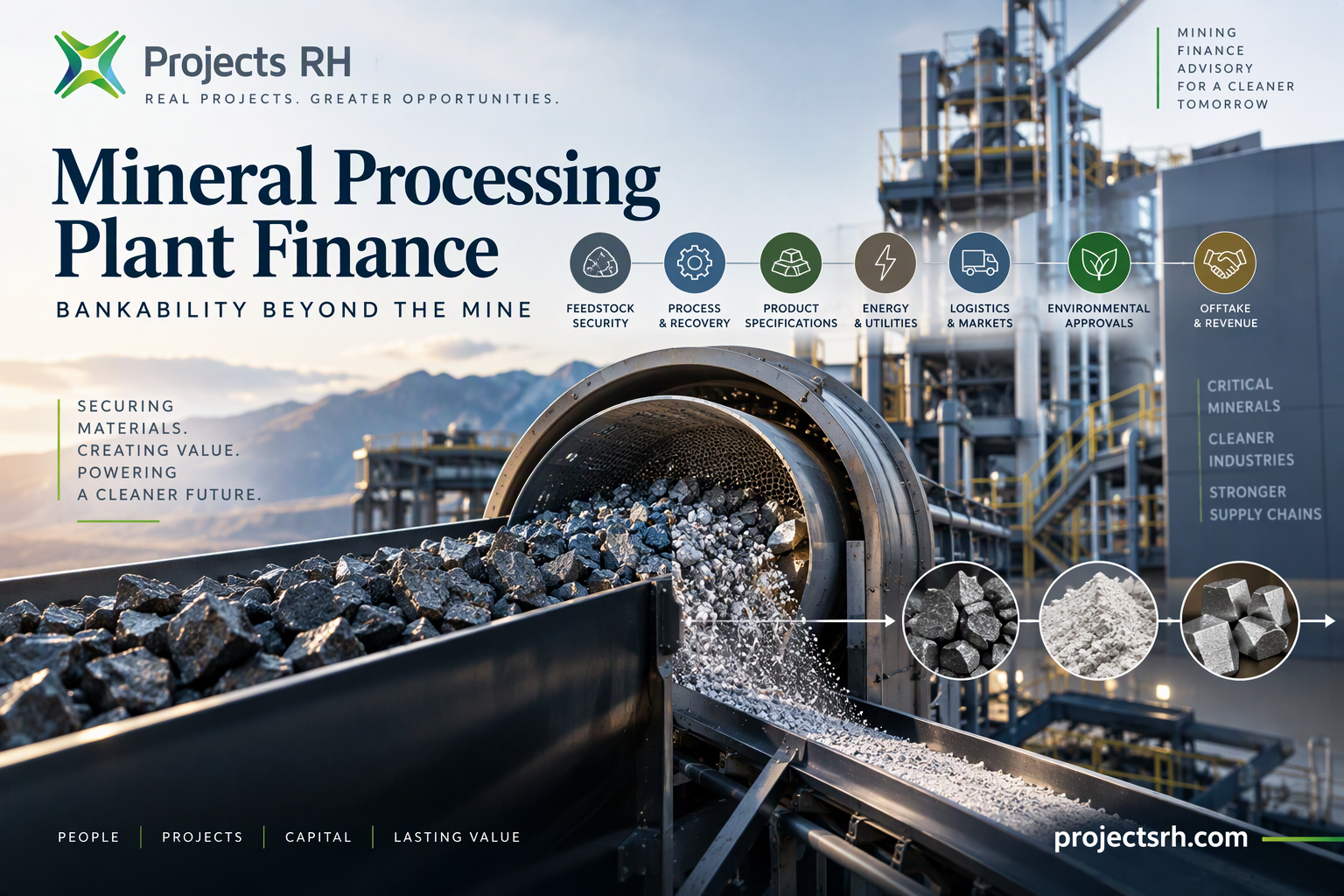
Mineral Processing Plant Finance requires a different bankability test from financing the mine itself. A processing plant can have proven technology, strong market demand and attractive margins and still fail to secure capital if feedstock, recovery, product quality, energy, logistics, environmental approvals or offtake are not sufficiently robust.
A mine begins with control over a mineral resource.
A standalone or third-party processing facility may depend on material supplied by other producers, transported across multiple jurisdictions and transformed through a process that must consistently achieve commercial product specifications.
For lenders and institutional investors, this creates a connected chain of risk:
Feedstock → Logistics → Processing → Recovery → Product Specification → Buyer → Revenue → Debt Service
Every link matters.
A processing plant is not bankable simply because demand exists for the final product. It becomes financeable when sufficient feedstock can enter the plant, be converted reliably into a saleable product, reach a credible buyer and generate resilient cash flow.
What Is Mineral Processing Plant Finance?
Mineral Processing Plant Finance is the financing of facilities that concentrate, separate, refine, convert or otherwise process mineral feedstocks into products with greater commercial value.
These facilities can include:
- Concentrators
- Smelters
- Refineries
- Hydrometallurgical plants
- Beneficiation plants
- Lithium conversion facilities
- Nickel processing facilities
- Cobalt refineries
- Rare-earth separation plants
- Graphite purification facilities
- Battery-material plants
- Mineral recovery plants
- Tailings reprocessing facilities
A processing facility may sit next to a mine, process material from several mines, receive concentrates or intermediates from another country or form part of an integrated mine-to-product development.
For investors, these configurations are not economically equivalent.
Why Mineral Processing Plant Finance Is Different From Mine Finance
A mine is fundamentally exposed to geological and extraction risk.
A processing facility introduces additional technical, supply-chain and commercial interfaces.
A lender financing the plant needs to understand:
- Where feedstock comes from
- How much feedstock will be available
- How variable its composition may be
- Whether the plant can process that variability
- What recovery can be achieved
- What product will be produced
- Whether the product meets buyer specifications
- How much energy, water and reagents are required
- How material enters and leaves the plant
- Whether environmental approvals cover the operation
- Who will buy the product
- Whether operating cash flow can support debt service
A mine may therefore be technically robust while the downstream processing project remains difficult to finance.
Conversely, a processing facility may be viable without owning a captive mine if its feedstock contracts, technology and commercial arrangements are sufficiently strong.
Mineral Processing Plant Finance: The Bankability Chain
The financing case can be reduced to seven connected pillars:
Feedstock Security → Proven Process → Recovery → Product Quality → Infrastructure → Offtake → Cash Flow
A weakness in any pillar can undermine the entire financing structure.
- Strong plant design without secure feedstock creates stranded capacity.
- Secure feedstock without reliable recovery destroys margins.
- High recovery without saleable product specifications creates inventory risk.
- A marketable product without dependable power compromises production.
- Attractive margins without permits cannot support operation.
- Production without credible buyers creates revenue uncertainty.
Investors should therefore evaluate the facility as an integrated commercial system rather than a collection of separate technical components.
Feedstock Security Is the Plant's Equivalent of a Mineral Resource
For many processing facilities, the first financing question is not:
How much can the plant process?
It is:
Where will the material come from for the next 10, 15 or 20 years?
A facility designed for one million tonnes per year has limited financing value if only 400,000 tonnes of dependable feedstock can be demonstrated.
Lenders will investigate:
- Feedstock source
- Ownership
- Mineralogy
- Grade
- Volume
- Variability
- Contract duration
- Supplier creditworthiness
- Delivery obligations
- Pricing mechanism
- Alternative supply
- Transportation
- Competition for material
Feedstock contracts can therefore be as important to a processing plant as offtake agreements are to mining projects.
Captive, Third-Party and Mixed Feedstock
Captive Feedstock
An integrated project may own both the mine and processing plant.
This can reduce third-party supply exposure, but the plant remains dependent on:
- Mine production
- Grade
- Mineralogy
- Mining schedule
- Ramp-up
- Reserve life
If mine production underperforms, plant utilisation may fall.
Third-Party Feedstock
A standalone facility may source material from several producers.
This can diversify geological exposure but creates commercial counterparty risk.
The project must demonstrate that suppliers are contractually and operationally capable of delivering sufficient material.
Mixed Feedstock
A facility may combine captive material with third-party supply.
This can improve utilisation and diversification, but the process design must accommodate differences in mineralogy, grade, moisture and impurities.
Feedstock Variability Can Destroy Processing Economics
Two tonnes of ore or concentrate are not necessarily equivalent.
Feedstock can vary in:
- Grade
- Mineralogy
- Moisture
- Particle size
- Impurities
- Deleterious elements
- Recoverability
- Reagent consumption
- Energy requirements
A financial model assuming constant recovery from variable feedstock may materially overstate performance.
Technical due diligence should stress-test:
- Low-grade feed
- High impurity levels
- Different mineralogical domains
- Variable moisture
- Mixed suppliers
- Feed shortages
- Ramp-up conditions
Feedstock quality is not merely an operating matter. It is a financial-model assumption.
Metallurgical Recovery Is a Financing Variable
A processing facility creates revenue by converting incoming material into saleable output.
Recovery therefore affects revenue directly.
Assume feedstock contains 100 units of payable metal.
At 90% recovery:
100 × 90% = 90 units recovered
At 80% recovery:
100 × 80% = 80 units recovered
That ten-unit decrease may materially affect:
- Revenue
- EBITDA
- DSCR
- Working capital
- Debt capacity
- Project NPV
Lenders need sufficient metallurgical evidence rather than an unsupported design-recovery assumption.
Laboratory Success Is Not Commercial Proof
A process may succeed:
- In laboratory testing
- At bench scale
- In a pilot plant
- In a demonstration facility
without having been proven at full commercial scale.
A lender will examine:
- Technology readiness
- Pilot duration
- Feedstock representativity
- Equipment scale
- Process-control requirements
- Reagent consumption
- Recovery variability
- Impurity removal
- Waste generation
- Ramp-up assumptions
- Performance guarantees
The greater the scale-up risk, the harder it becomes to support conventional project debt.
Bankability Requires Proven Performance
A proprietary process can create competitive advantage.
But lenders are not financing patents. They are financing future cash flow.
Novel technology may require:
- Independent technical review
- Pilot and demonstration data
- Vendor guarantees
- Performance testing
- Completion tests
- Additional contingency
- Greater sponsor equity
- Liquidity support during ramp-up
The financing structure must reflect the technology's actual maturity.
Product Specifications Determine Marketability
A processing plant does not simply produce lithium, nickel, graphite or rare earths.
It produces a specific commercial product.
That product may need defined:
- Purity
- Chemical composition
- Moisture
- Particle size
- Density
- Impurity limits
- Physical characteristics
- Packaging
- Certification
A battery-material customer may require specifications that differ substantially from those accepted by a commodity trader.
A technically successful facility can therefore fail commercially if its product does not meet customer requirements.
Customer Qualification Can Become a Financing Milestone
Specialised materials may need customer qualification before commercial acceptance.
Qualification can require:
- Samples
- Testing
- Repeat batches
- Quality assurance
- Production consistency
- Customer audits
- Extended validation
If the financial model assumes immediate full sales but qualification takes several months, working-capital and liquidity requirements may be understated.
Customer qualification should therefore be integrated into commissioning, ramp-up and financing assumptions.
Energy Can Determine Whether a Plant Is Competitive
Mineral processing can be energy intensive, particularly in:
- Smelting
- Refining
- Comminution
- Electrowinning
- High-temperature processing
- Chemical conversion
The World Bank Group's Metals and Minerals Strategy provides useful context for mineral-sector development and enabling infrastructure.
Energy analysis should include:
- Required MW
- Annual MWh consumption
- Tariff
- Escalation
- Reliability
- Grid capacity
- Connection timing
- Backup supply
- Renewable generation
- Storage
- Fuel supply
- Carbon intensity
A facility with attractive theoretical margins can become uncompetitive if energy assumptions are unrealistic.
Power Reliability Matters as Much as Power Price
A low tariff has limited value if electricity is unreliable.
Outages can affect:
- Plant utilisation
- Recovery
- Equipment condition
- Reagent consumption
- Product consistency
- Maintenance
- Delivery schedules
Some processing systems cannot be stopped and restarted without material operating consequences.
Lenders may therefore require analysis of:
- Grid interruptions
- Redundancy
- Backup generation
- Black-start capability
- Energy storage
- Emergency systems
Energy security is part of the bankability case.
Water Security Is Equally Important
Many processing routes depend heavily on water.
The project should demonstrate:
- Water source
- Legal entitlement
- Required volume
- Seasonal availability
- Competing users
- Treatment
- Recycling
- Discharge
- Long-term cost
Water scarcity can create operational, environmental and social risk.
A processing plant cannot be considered fully bankable while its long-term water requirement remains unresolved.
Reagents Have Their Own Supply Chain
Processing plants may depend on:
- Sulfuric acid
- Hydrochloric acid
- Lime
- Cyanide
- Solvent-extraction reagents
- Flocculants
- Grinding media
- Industrial gases
The project must evaluate:
- Supplier availability
- Transport
- Storage
- Hazardous-material requirements
- Price volatility
- Import restrictions
- Alternative suppliers
A facility can have secure mineral feedstock while remaining exposed to a critical reagent bottleneck.
Logistics Connect Feedstock to Revenue
Processing projects can require two logistics systems.
Inbound logistics move feedstock, reagents and consumables to the facility.
Outbound logistics move finished products to customers.
The financial model should include:
- Road
- Rail
- Port
- Handling
- Storage
- Shipping
- Insurance
- Customs
- Border delays
- Demurrage
- Product loss
- Hazardous-material requirements
A plant that appears competitive at the factory gate may become uncompetitive after full logistics costs are included.
Location Is a Financial Decision
The best location is not automatically next to the mine, port, customer or cheapest land.
Site selection should optimise:
- Feedstock access
- Energy
- Water
- Labour
- Logistics
- Permitting
- Waste management
- Customer access
- Tax
- Infrastructure
- Political risk
Location should be tested through detailed technical and financial modelling.
Environmental Approvals Can Determine the Financing Schedule
Processing facilities can create environmental risks involving:
- Air emissions
- Wastewater
- Tailings
- Slag
- Chemical storage
- Hazardous waste
- Noise
- Dust
- Energy consumption
- Greenhouse-gas emissions
The IFC Environmental, Health and Safety Guidelines for Mining provide an established reference for relevant environmental, health and safety considerations.
Investors will examine:
- Required approvals
- Approval status
- Permit conditions
- Monitoring requirements
- Closure obligations
- Remediation
- Environmental liabilities
A permit expected next month should not be modelled as though it already exists.
ESG Is Part of Processing Economics
Environmental and social issues can affect:
- CapEx
- Opex
- Schedule
- Insurance
- Financing conditions
- Community relationships
- Infrastructure access
- Customer acceptance
- Project reputation
The International Finance Corporation's Metals and Minerals practice provides relevant institutional context for financing across the metals and minerals sector.
Environmental and social analysis should therefore develop alongside plant engineering and commercial planning.
Offtake Converts Production Into Revenue Visibility
A technically successful processing facility still needs credible buyers.
An offtake agreement can define:
- Buyer
- Product
- Specification
- Volume
- Pricing formula
- Delivery
- Payment terms
- Contract duration
- Credit support
However, lenders will examine more than the presence of a signed contract.
They will evaluate:
- Buyer creditworthiness
- Minimum purchase obligations
- Pricing
- Market benchmarks
- Penalties
- Termination rights
- Conditions precedent
- Assignment
- Lender protections
A weak counterparty does not become bankable by signing a long-term agreement.
Pricing Must Match the Product
Processing facilities may sell:
- Commodity concentrates
- Refined metals
- Chemical compounds
- Intermediate products
- Battery-grade materials
- Specialty materials
Pricing may depend on:
- Exchange benchmarks
- Published indices
- Formula pricing
- Negotiated contracts
- Payability
- Treatment charges
- Premiums
- Discounts
- Quality adjustments
The financial model must replicate the actual commercial formula.
Otherwise, projected revenue may not represent the contract accurately.
Working Capital Is Often Underestimated
The facility may pay for feedstock, energy, reagents, freight and labour before receiving customer payments.
Cash can remain tied up in:
- Feedstock inventory
- Work in progress
- Finished product
- Goods in transit
- Receivables
A 60-day cash-conversion cycle can create a substantial liquidity requirement.
A plant may be profitable on an EBITDA basis while experiencing serious cash pressure during ramp-up.
Working capital belongs in the financing plan from the beginning.
Ramp-Up Is a Major Processing Risk
Financial models often assume rapid progress toward nameplate capacity.
Reality may be slower because of:
- Mechanical failures
- Recovery losses
- Feed variability
- Product-quality failures
- Customer qualification
- Labour constraints
- Reagent optimisation
An illustrative lender stress test might include:
| Case | Plant Utilisation | Recovery | |---|---:|---:| | Base | 90% | 90% | | Moderate stress | 80% | 85% | | Severe stress | 65% | 80% |
The assumptions should be project-specific.
Utilisation and recovery should be stressed together because both affect saleable production.
Completion Tests Matter to Lenders
Construction completion is not necessarily achieved when the building is finished.
Lenders may require the project to demonstrate:
- Throughput
- Recovery
- Product specifications
- Availability
- Operating costs
- Environmental compliance
- Sustained operations
Completion testing protects lenders from treating an unresolved technical ramp-up as a fully operational project.
EPC and Technology Guarantees Can Improve Bankability
Construction and performance risk can be mitigated through:
- EPC or EPCM arrangements
- Process guarantees
- Equipment warranties
- Liquidated damages
- Performance guarantees
- Parent guarantees
- Contingency
- Cost-overrun support
Not every project can obtain a fully wrapped EPC contract at an acceptable cost.
But lenders need clear allocation of:
- Cost-overrun risk
- Delay risk
- Performance risk
- Technology risk
Any risk that is not allocated contractually ultimately returns to the project company.
Capital Structure Must Reflect Processing Risk
A processing development could combine:
| Capital Source | Illustrative Amount | |---|---:| | Sponsor equity | USD 50m | | Strategic investor | USD 40m | | Government or development support | USD 30m | | Customer prepayment | USD 30m | | Senior project debt | USD 100m | | Total | USD 250m |
These amounts are illustrative.
A first-of-a-kind processing technology may require substantially more equity than a proven conventional plant.
A facility supported by long-term feedstock and offtake contracts may support greater leverage.
The capital structure should reflect the actual risk allocation.
Strategic Capital Can Add More Than Money
Potential strategic investors can include:
- Mining companies
- Commodity traders
- Battery manufacturers
- Automotive companies
- Chemical companies
- Industrial manufacturers
- Governments
- Development-finance institutions
A strategic investor may provide:
- Feedstock
- Offtake
- Technology
- Customer qualification
- Market knowledge
- Logistics
- Credit support
But strategic investment may require:
- Exclusivity
- Preferential pricing
- Board rights
- Product rights
- Change-of-control protection
Sponsors should value those rights carefully before accepting capital.
Government Support and Critical-Minerals Processing
Mineral processing has become an important part of industrial and supply-chain policy.
The U.S. Department of Energy Critical Minerals and Materials Program focuses on critical-mineral and materials supply chains.
The Critical Minerals and Materials Accelerator provides another example of public-sector support for processing innovation.
Government support can improve project economics and financing.
However, sponsors should not rely on it until eligibility, timing, cost-sharing, milestones and award conditions have been confirmed.
Why Processing Capacity Matters Beyond the Mine
The International Energy Agency's Global Critical Minerals Outlook 2026 examines supply-chain issues involving critical-mineral processing and refining.
Processing capacity may remain concentrated even when mining supply becomes more geographically diverse.
The International Energy Agency's critical-mineral supply analysis provides additional context on concentration, investment and supply security.
This creates an investment opportunity.
But strategic importance does not automatically produce attractive economics.
A processing facility still needs:
- Competitive costs
- Secure feedstock
- Proven technical performance
- Saleable product quality
- Reliable infrastructure
- Market access
- Environmental compliance
- Sustainable cash flow
Policy support cannot permanently compensate for a structurally uncompetitive facility.
Mineral Processing Plant Finance: Investor Bankability Checklist
Feedstock
- What material enters the plant?
- Who supplies it?
- What volumes are contractually secured?
- For how long?
- What variability exists?
- Are alternative suppliers available?
Process
- Is the process commercially proven?
- At what scale?
- Has representative feedstock been tested?
- What are expected recoveries?
- What happens under stressed conditions?
Product
- What exactly will the plant produce?
- Does it meet customer specifications?
- Has customer qualification occurred?
- What penalties apply to off-specification material?
Infrastructure
- Is power available and reliable?
- Is water secured?
- Are transport links sufficient?
- Are reagents available?
- Are backup systems adequate?
Environmental
- Which permits are required?
- Which approvals have been obtained?
- What waste will be generated?
- What closure and remediation obligations exist?
Commercial
- Who buys the product?
- What volumes are committed?
- How is pricing calculated?
- Is the buyer creditworthy?
- What termination rights exist?
Financial
- What is total CapEx?
- What contingency is included?
- How much working capital is required?
- What is the realistic ramp-up profile?
- What is the downside DSCR?
- How much equity is required?
When these questions remain unresolved, the project is not ready for serious financing discussions.
Common Mistakes in Mineral Processing Plant Finance
- Designing capacity before securing feedstock
- Treating laboratory recovery as commercial recovery
- Ignoring feedstock variability
- Assuming the product will automatically be saleable
- Underestimating energy and water requirements
- Underestimating working capital
- Treating permits as administrative formalities
- Signing weak feedstock or offtake contracts
- Assuming strategic importance guarantees funding
Government and investor interest can strengthen an opportunity, but institutional capital still requires credible technical and commercial fundamentals.
Mineral Processing Plant Finance vs Mine Finance
| Bankability Issue | Mine | Processing Plant | |---|---|---| | Core input | Mineral Resource and Reserve | Feedstock | | Primary technical risk | Geology and mining | Processing and recovery | | Volume basis | Mine plan | Feedstock contracts and throughput | | Product risk | Ore or concentrate marketability | Finished-product specifications | | Key infrastructure | Mine infrastructure | Power, water, logistics and reagents | | Commercial contracts | Primarily offtake | Feedstock and offtake | | Ramp-up | Mine and plant ramp-up | Process stability and customer qualification | | Working capital | Material | Potentially substantial | | Technology risk | Usually established mining methods | Can be material for novel processing | | Revenue | Mineral sales | Processed-product sales |
This distinction is why financiers should not apply a mine-financing template unchanged to a standalone processing facility.
Investor Readiness Before Financing a Mineral Processing Plant
Before entering the market, sponsors should determine whether the technical, commercial and financing case is sufficiently integrated for institutional review.
A structured Investment Readiness Assessment can help identify gaps in:
- Feedstock security
- Processing technology
- Metallurgical recovery
- Product specifications
- Energy and water
- Logistics
- Environmental approvals
- Offtake arrangements
- Working capital
- Financial modelling
- Capital structure
- Financing strategy
This assessment should happen before formal lender or investor outreach.
The objective is to identify the issues most likely to prevent financial close while there is still time to address them.
Frequently Asked Questions About Mineral Processing Plant Finance
What is Mineral Processing Plant Finance?
Mineral Processing Plant Finance is the funding of facilities that concentrate, separate, refine or convert mineral feedstocks into higher-value saleable products.
Bankability normally depends on feedstock security, proven processing, recovery, product quality, infrastructure, approvals, commercial contracts and resilient cash flow.
Why is feedstock security important?
A processing facility cannot maintain sustainable utilisation without sufficient material.
Long-term feedstock security helps lenders evaluate throughput, operating margins and debt-service capacity.
What is feedstock risk?
Feedstock risk is the possibility that a facility receives insufficient material, receives unsuitable material or experiences composition changes that affect recovery and plant performance.
Why does metallurgical recovery matter?
Recovery determines how much saleable product can be produced from incoming feedstock.
Lower recovery can reduce revenue, EBITDA, DSCR and debt capacity.
Does successful pilot testing make a plant bankable?
Not automatically.
Investors must still assess scale-up, feedstock representativity, equipment, process control, commercial operating evidence and completion risk.
Why are product specifications important?
Customers purchase products meeting defined technical requirements.
Off-specification material may face discounts, rejection or additional processing costs.
How does energy affect financing?
Energy can represent a material part of operating costs.
Investors examine availability, price, reliability, grid infrastructure and exposure to interruptions.
Why is working capital important?
Facilities may pay for feedstock, energy, labour, reagents and freight before receiving customer revenue.
Inventory and receivables can therefore create substantial liquidity requirements.
Can offtake agreements support financing?
Yes.
A credible offtake agreement can provide revenue visibility by defining buyers, volumes, prices, specifications and payment terms.
Its financing value depends on contract strength and buyer creditworthiness.
Can government support make a project bankable?
Government grants, loans, guarantees or tax support can strengthen financing.
Government support does not replace credible technical, commercial and financial fundamentals.
What makes a mineral processing plant bankable?
A bankable plant generally requires secure feedstock, proven processing, realistic recovery, saleable product specifications, dependable energy and water, viable logistics, environmental approvals, credible buyers and sufficient liquidity to survive construction and ramp-up.
Sources
- World Bank Group: Metals and Minerals
- IFC: Metals and Minerals
- IFC: Environmental, Health and Safety Guidelines for Mining
- IEA: Global Critical Minerals Outlook 2026
- IEA: Critical Mineral Supply Concentration and Investment
- U.S. Department of Energy: Critical Minerals and Materials Program
- U.S. Department of Energy: Critical Minerals and Materials Accelerator
Final Perspective: Bankability Begins With the Entire Processing Chain
The financing case for a mineral processing facility extends far beyond the plant itself.
Investors are financing a conversion system.
Feedstock must arrive in sufficient quantity and quality.
The process must work at commercial scale.
Recovery must remain stable.
Energy, water and reagents must be available.
The final product must satisfy customer requirements.
Environmental approvals and logistics must support continuous operations.
Buyers must perform under credible commercial contracts.
The resulting cash flow must withstand construction delays, ramp-up challenges, operational variability and commodity-market stress while still servicing capital.
The most financeable processing projects connect technical performance, feedstock security, infrastructure, product quality, environmental compliance and market demand into one defensible cash-flow case.
If you are preparing a mineral processing facility for capital raising or project finance, identify the technical, commercial and financial gaps before approaching institutional capital. /intake.html

What to do next
Projects RH prepares the company and the project first, then takes them to investors. The fastest way to find out where you stand is a short call.
Keep reading
JORC vs NI 43-101: What Mining Investors Need to Know
JORC and NI 43-101 share resource categories but differ in legal status, expert responsibility, technical reporting and cross-border filing requirements.
Mining Royalties vs Streaming: Choosing Capital
Mining royalties, streaming and equity transfer value differently. Compare dilution, cash flow, control, commodity upside and long-term project economics. `
Mining Offtake Agreements: How They Support Finance
Mining offtake agreements can strengthen project finance through committed volumes, pricing protection, prepayments and creditworthy buyers.