
Mining Royalties vs Streaming: Choosing Capital
Mining royalties, streaming and equity transfer value differently. Compare dilution, cash flow, control, commodity upside and long-term project economics. `
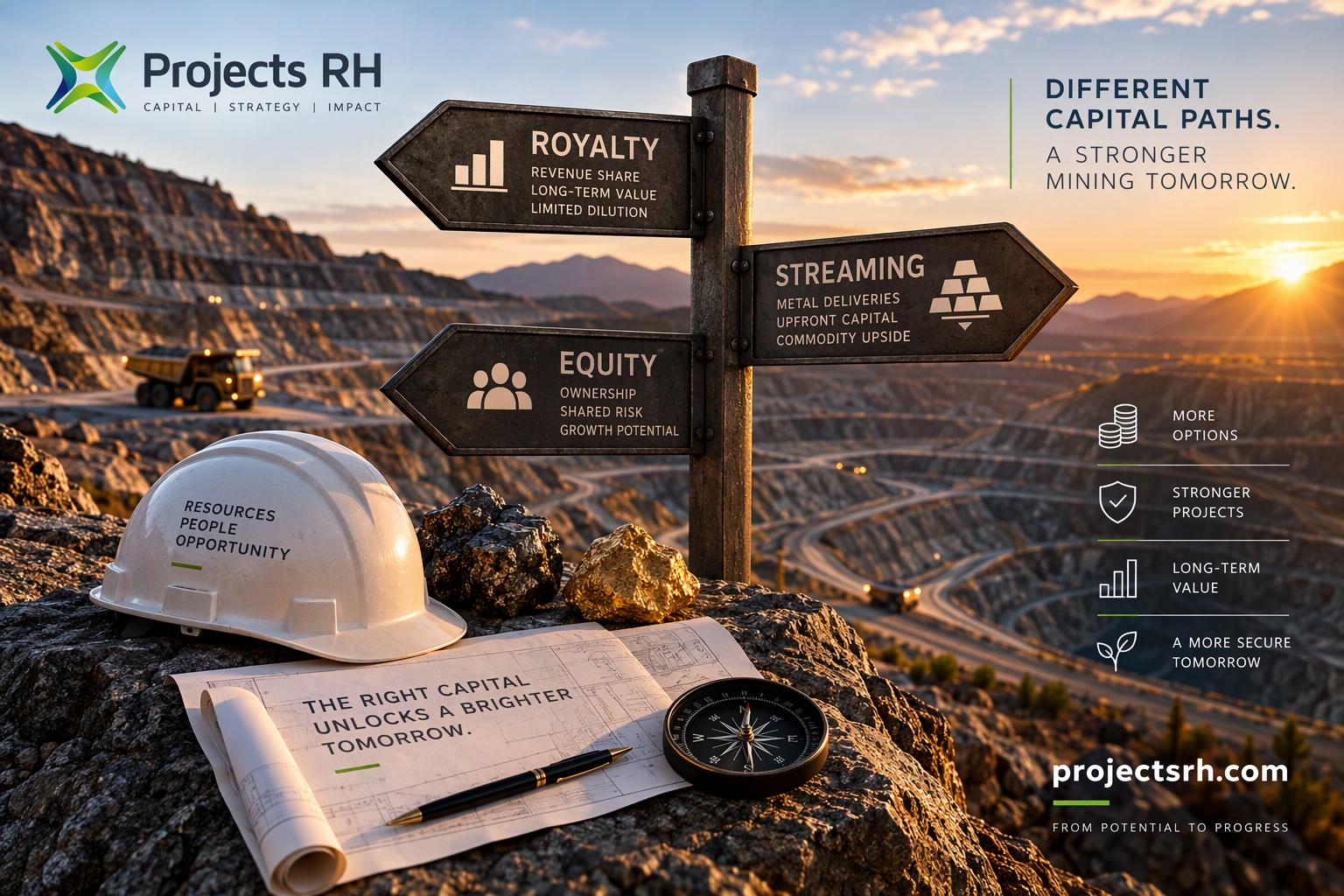
Mining Royalties vs Streaming is ultimately a question about what a mining company is prepared to give up in exchange for capital today. Add equity to the decision, and the comparison becomes even more important: royalties transfer a defined share of future project economics, streams commit part of future production, while equity dilutes ownership across the company or project.
None of these structures is inherently better.
The right choice depends on what the project is trying to protect.
Is the priority to avoid shareholder dilution?
Preserve commodity-price upside?
Avoid scheduled debt repayments?
Retain operational control?
Protect future financing flexibility?
Or simply secure enough capital to reach construction and production?
That is why I would never compare royalty, streaming and equity financing solely by asking which source provides the cheapest capital today.
The more important question is:
How much future project value are we transferring, for how long, and what strategic flexibility are we giving up in return?
What Is Mining Royalties vs Streaming?
Mining Royalties vs Streaming compares two forms of production-linked mining finance: a royalty generally gives the capital provider a contractual economic interest linked to future project revenue, production or profits, while a stream generally gives the capital provider the right to purchase an agreed share of future metal production for an upfront payment plus an agreed ongoing delivery payment.
Equity is structurally different.
An equity investor receives ownership in the company or project rather than a contractual claim on specific production or revenue.
For a mining sponsor choosing capital, the three structures therefore need to be compared across:
- Upfront capital
- Ownership dilution
- Cash-flow burden
- Commodity-price upside
- Production exposure
- Mine-life exposure
- Control
- Security
- Future expansions
- Exploration upside
- Buyback rights
- Future debt capacity
- Refinancing flexibility
- Change-of-control consequences
A financing decision that looks inexpensive at financial close can become extraordinarily expensive if the project ultimately performs far better than expected.
Mining Royalties vs Streaming vs Equity: The Core Difference
At a high level, I would describe the alternatives this way:
| Financing Structure | What the Project Receives | What the Capital Provider Receives | Key Sponsor Trade-Off | |---|---|---|---| | Royalty | Upfront capital | Contractual share of defined revenue, production or profits | Long-term transfer of project economics | | Streaming | Upfront capital | Right to purchase defined future production under agreed pricing | Future production and commodity upside committed | | Equity | Cash investment | Ownership interest | Dilution of existing shareholders | | Debt | Loan capital | Interest and principal | Fixed repayment and financial covenants |
This distinction sounds simple.
Its financial consequences are not.
How Mining Royalties Work
A mining royalty represents an economic interest tied to a mineral property or its production, subject to the agreement and applicable law.
Franco-Nevada Corporation - Our Assets - Terms Explained explains that revenue-based royalties can be calculated from the value of production or net proceeds after contractually defined deductions, while profit-based royalties use an agreed operating-profit calculation. Common structures include:
- Net Smelter Return royalty or NSR
- Gross revenue royalty
- Overriding royalty
- Net profit interest or NPI
- Net royalty interest
Net Smelter Return Royalty
An NSR typically applies a defined percentage to revenue after specified permitted deductions.
The exact contractual definition matters enormously.
A "2% royalty" tells me almost nothing unless I know:
- 2% of what?
- Before or after which deductions?
- Which minerals are covered?
- Which property boundaries apply?
- Does it include future discoveries?
- Does it apply to stockpiles?
- What happens to expansions?
- Can it be bought back?
- Can the percentage step up or down?
Those questions determine the actual economics.
How Mining Streaming Works
Streaming uses a different mechanism.
Wheaton Precious Metals - About - Our Business Model describes its model as purchasing a percentage of metals produced by a mine in exchange for an upfront payment plus an additional predetermined payment when metal is delivered. 【3-e53b23】
A typical structure might therefore look conceptually like:
- Streamer provides capital upfront.
- Mining company builds, expands, acquires or strengthens the project.
- Mine begins producing.
- Agreed percentage of streamed metal is delivered.
- Streamer makes the contractual delivery payment.
- Stream continues according to the agreed term, often potentially for a substantial portion of mine life.
The crucial distinction is physical metal.
McKinsey Metals streaming-and-royalty financing explains that streams are normally settled through physical metal delivery, whereas royalty arrangements are generally settled through a share of revenue. 【4-b718ac】
That difference affects project economics differently.
How Equity Finance Works
Equity is more familiar.
The sponsor issues shares in the company or ownership in the project in exchange for capital.
Equity can have an enormous advantage during development:
there is generally no fixed contractual principal repayment schedule equivalent to conventional debt.
If construction is delayed, the company does not ordinarily owe an equity investor principal repayment simply because the project has not reached production.
But that flexibility has a price.
The investor now owns part of the business.
If the company issues 25% of its post-money equity to finance construction, existing shareholders have permanently shared future enterprise value with the new investor unless that interest is subsequently repurchased.
This creates a fundamentally different economic transfer from a royalty or stream.
Mining Royalties vs Streaming: Which Causes More Dilution?
Neither necessarily causes conventional shareholder dilution.
That is precisely why royalties and streams can appeal to mining sponsors.
A royalty financier does not necessarily require common shares.
A streaming company does not necessarily require corporate ownership.
The sponsor can therefore receive significant upfront capital without issuing the same amount of common equity.
This is frequently described as non-dilutive capital.
But I would be careful with that expression.
It may be non-dilutive to share ownership.
It is not free of economic dilution.
You can avoid diluting the share count while still diluting the future economics of the asset.
That distinction is critical.
Share Dilution vs Economic Dilution
Suppose a mining company is currently worth USD 400 million and needs USD 100 million.
For simplicity, imagine the company raises the entire amount through new equity at that valuation.
The post-money value would conceptually be:
USD 400m + USD 100m = USD 500m
The new investor would hold:
USD 100m / USD 500m = 20%
Existing shareholders move collectively from 100% ownership to 80%.
That dilution is visible.
Now suppose the sponsor obtains USD 100 million through a royalty instead.
There may be no immediate share issuance.
Existing holders still own 100% of the company.
But the project has transferred a percentage of future economics, potentially for the life of the mine.
That dilution is contractual rather than corporate.
Both need to be valued.
Why Royalties Can Become Very Expensive When a Mine Outperforms
Royalties can look attractive when a project is struggling to finance construction.
The problem appears later if the mine becomes much better than originally expected.
Imagine an illustrative gross revenue royalty of 2%.
If mine revenue is USD 300 million annually:
2% × USD 300m = USD 6m per year
If revenue later rises to USD 600 million:
2% × USD 600m = USD 12m per year
If exploration extends mine life by ten years, the royalty may also continue for those additional years depending on its contractual scope.
The original capital injection may have been received decades earlier.
Yet the economic participation continues.
This highlights one of the most important principles in Mining Royalties vs Streaming:
The true cost of capital cannot be measured only by the capital received today.
Mine-Life Extension Changes Royalty Economics
Mining projects frequently change after financing.
Resources expand.
Reserves increase.
New zones are discovered.
Processing improves.
Commodity prices rise.
Existing infrastructure supports additional production.
For a royalty holder, these developments can create considerable upside without requiring equivalent new capital contributions, depending on the terms of the royalty.
Franco-Nevada Corporation - Our Assets - Terms Explained states that royalties can provide exposure to commodity-price increases, reserve growth, production increases and, in some cases, new discoveries associated with the relevant property.
From the sponsor's perspective, these are precisely the economics that must be valued before creating the royalty.
Streams Transfer Value Differently
A stream is different because the financier normally receives an agreed share of future metal production and pays an additional amount upon delivery.
That creates two important economic variables:
Stream percentage
and
Delivery price
Suppose a copper project produces significant gold as a by-product.
Instead of issuing equity, the operator might sell a gold stream.
The operator receives a large payment today.
In exchange, a streamer obtains the right to purchase a defined percentage of future gold output at the contractually agreed delivery price.
The mining company retains its core copper exposure.
But some future gold economics have been monetised upfront.
This can be an extremely effective financing tool when the streamed commodity is not central to the sponsor's strategic investment thesis.
The USD 4.3 Billion Antamina Example
A major 2026 transaction illustrates the scale that streaming can reach.
In February 2026, BHP enters into a silver streaming agreement announced a long-term silver stream with Wheaton Precious Metals relating to BHP's share of silver production from Antamina in Peru.
BHP was to receive USD 4.3 billion upfront at completion in exchange for agreed future silver deliveries calculated by reference to its share of Antamina production. BHP stated that it retained full exposure to the copper, zinc and lead production from its share of the asset.
That case provides a useful lesson.
Streaming does not necessarily mean sacrificing exposure to the project's principal commodity.
It can instead monetise a by-product to release capital while preserving exposure to the sponsor's strategic commodity.
Why By-Product Streams Can Be Particularly Attractive
Many mines produce more than one metal.
A copper mine may produce:
- Gold
- Silver
- Molybdenum
A lead-zinc operation may produce significant silver.
A nickel development may contain cobalt or precious-metal credits.
The market may primarily value the operator as a copper or base-metals company.
That can create an opportunity.
Wheaton Precious Metals - About - Our Business Model describes streaming as a mechanism through which operators can unlock capital from by-product metals and use the upfront proceeds for development, expansion, acquisitions or balance-sheet strengthening.
That is one reason streaming can be strategically powerful.
The sponsor can monetise one part of the revenue stack without selling ownership of the entire company.
Does Streaming Affect Project Revenue?
Absolutely.
This should never be lost in the phrase "non-dilutive financing."
Take a simplified example.
Assume a mine produces:
- 100,000 ounces of streamed metal annually
- Market price: USD 2,500/oz
- Stream percentage: 30%
- Contractual delivery payment: USD 500/oz
The streamed quantity is:
100,000 × 30% = 30,000 ounces
The operator receives:
30,000 × USD 500 = USD 15 million
But at the hypothetical market price, those ounces represent:
30,000 × USD 2,500 = USD 75 million
The difference represents substantial economics transferred to the streamer in exchange for the original upfront capital.
This example is entirely illustrative.
The correct comparison must incorporate:
- Initial payment
- Delivery price
- Production
- Commodity price
- Mine life
- Taxes
- Discount rate
- Contract duration
- Step-down provisions
- Expansion assumptions
Mining Royalties vs Streaming: Which Preserves More Commodity Upside?
It depends entirely on the terms.
A revenue royalty normally participates directly when the value of covered production increases.
If commodity prices rise, royalty payments can rise.
If production increases, royalty payments can rise.
A stream also gives the financier exposure to commodity-price upside because the purchase price for streamed metal may be materially below market.
But the project sponsor's retained exposure can differ materially depending on:
- Streamed percentage
- Delivery payment
- Commodity
- Term
- Step-down
- Buyback
- Production coverage
There is therefore no credible answer to:
"Are royalties cheaper than streams?"
without modelling the actual contracts.
Equity Preserves Project Revenue but Dilutes Enterprise Upside
This is the mirror image of royalty and streaming finance.
With equity, the project generally does not carve out the same defined production-linked entitlement.
The project's revenue remains within the corporate or project structure.
However, the new investor participates in the broader enterprise.
That can include:
- Existing project
- Exploration
- Future discoveries
- New projects
- Acquisitions
- Technology
- Cash flow
- Corporate growth
Equity can therefore become extraordinarily expensive if company value subsequently multiplies.
But unlike a royalty, diluted shareholders may benefit indirectly because the capital raised enabled the company to reach that higher valuation.
The decision is therefore not simple.
Mining Royalties vs Streaming vs Equity: Practical Comparison
| Factor | Royalty | Streaming | Equity | |---|---|---|---| | Share dilution | Usually none directly | Usually none directly | Yes | | Future revenue transfer | Yes | Yes, through streamed metal economics | Indirect through ownership | | Scheduled principal repayment | Generally no conventional amortisation | Generally no conventional amortisation | No | | Operational control ceded | Usually limited | Usually limited | Potentially, depending on rights | | Board rights | Usually no | Usually no | Possible | | Commodity upside shared | Yes | Yes | Yes through enterprise value | | Mine-life extension exposure | Often yes | Often yes | Yes while ownership remains | | Exploration upside | Can apply depending on royalty boundary | Depends on stream agreement | Yes through corporate ownership | | Security requirements | Transaction-specific | Transaction-specific | Usually none over assets for common equity | | Cash flow before production | Usually none to provider after upfront funding | Delivery economics begin with production | No scheduled distributions required | | Future debt capacity | Can be affected | Can be affected | May strengthen balance sheet | | Buyback possible | If negotiated | If negotiated | Market or negotiated repurchase | | Governance dilution | Usually low | Usually low | Potentially material |
This comparison is where boards should begin.
It is not where they should finish.
1. Compare the Economic Value Transferred
The first test should calculate the present value of the economics being transferred.
For a royalty:
Royalty payment = contractual royalty percentage × applicable revenue or profit base
For a stream, conceptually:
Transferred stream economics = streamed volume × (market price − contractual delivery payment)
For equity:
Future value transferred = investor ownership percentage × future enterprise equity value
The calculations are not perfectly comparable because timing, risk, tax and probability differ.
But without quantification, the financing decision is incomplete.
2. Model Three Commodity-Price Scenarios
I would run at least:
- Downside
- Base case
- Upside
For every financing alternative.
A royalty may look inexpensive in the downside case and very expensive in a strong commodity cycle.
A stream may show similar convexity.
Equity may seem highly dilutive today but comparatively attractive if avoiding a perpetual production encumbrance becomes strategically valuable later.
Financing decisions should survive all three cases.
3. Model Mine-Life Extension
Do not model only the current reserve case.
Run:
- Current reserve life
- Moderate extension
- Major exploration success
This is particularly important for royalties.
If a royalty applies to future discoveries within the property boundary, exploration success changes the lifetime economic cost of the financing dramatically.
The same logic can apply to streams depending on contractual coverage.
4. Understand NSR vs NPI
Not all royalties behave alike.
Franco-Nevada Corporation - Our Assets - Terms Explained distinguishes revenue-based royalties such as NSRs from profit-based interests such as NPIs. 【2-72afee】
An NSR is typically more resilient from the royalty holder's perspective because payment is linked more closely to revenue, subject to specified deductions.
An NPI depends on the defined profit calculation.
For the sponsor, that distinction matters because operating-cost increases can affect the structures very differently.
Never compare royalty percentages without comparing the underlying definitions.
5. Examine Property Boundaries
A royalty may apply to:
- Existing reserves only
- Entire mineral concession
- Defined claims
- Future discoveries
- Extensions
- Additional minerals
- Processing of third-party material
The wider the coverage, the greater the potential value transferred.
A 1% royalty over a highly prospective district can ultimately cost more than a higher percentage over a tightly defined orebody.
Property definition is therefore financial economics, not just legal drafting.
6. Buyback Rights Can Preserve Strategic Flexibility
A sponsor may negotiate the right to repurchase:
- All of a royalty
- A portion
- A defined percentage
- The royalty before a deadline
- The royalty after a milestone
Buyback pricing might be:
- Fixed
- Formula-based
- Multiple of invested capital
- Fair-market-value based
A buyback can significantly improve future optionality.
It also has value to the financing provider, so it will influence transaction pricing.
If sponsors believe the mine has substantial exploration upside, negotiating a buyback mechanism can be particularly important.
7. Step-Down Structures Can Balance Capital and Upside
Streaming agreements may incorporate reductions after specific delivery thresholds.
A historical example comes from Capstone Announces $150M Cozamin Silver Stream.
In 2020, Capstone Copper announced a USD 150 million stream with Wheaton Precious Metals covering 50% of payable silver from Cozamin until 10 million ounces had been delivered, after which the stream reduced to 33%. 【5-7b3ae5】
Structurally, a step-down allows the capital provider to receive stronger economics first while the operator can retain a greater proportion later.
That concept can help balance upfront funding with long-term value retention.
8. Royalties Can Affect Future M&A Value
Suppose two otherwise identical copper projects are for sale.
Project A carries no royalty.
Project B carries a substantial life-of-mine royalty.
A potential acquirer will not necessarily value them identically.
The royalty affects future project cash flow.
Depending on its scope, it may also affect:
- Exploration value
- Mine-life extensions
- New discoveries
- Expansion economics
- Marginal ore
- Cut-off grade decisions
That does not mean royalties make assets unattractive.
It means the encumbrance becomes part of valuation.
Sponsors need to consider that at the moment the financing is originated, not years later at exit.
9. Streams Can Affect Future Debt Capacity
Streams also remove part of future project economics.
That means lenders need to model revenue after stream obligations.
This can affect:
- EBITDA
- Cash flow
- DSCR
- Debt sizing
- Reserves
- Covenant headroom
However, the upfront stream capital may also reduce the amount of senior debt required.
This can improve overall project resilience.
The correct question is therefore not:
"Does streaming reduce debt capacity?"
The relevant question is:
"Does the combination of stream proceeds and remaining project cash flow produce a stronger financing structure than the available alternatives?"
10. Equity Can Improve Future Debt Capacity
Equity has another advantage.
New equity increases the capital base without imposing a production-linked payment.
That can provide lenders with additional sponsor support and reduce leverage.
A lender may therefore prefer a project funded with substantial equity rather than a project where most future revenue has been heavily encumbered by royalties or streams.
This is particularly relevant during construction.
When completion risk is high, conventional lenders want sufficient equity at risk.
A royalty or stream may complement the equity requirement.
It does not automatically replace it.
Royalty, Streaming and Equity Can Be Combined
Mining financing rarely has to be binary.
A project requiring USD 500 million might theoretically combine:
| Capital Source | Illustrative Amount | |---|---:| | Sponsor equity | USD 100m | | New equity | USD 75m | | Royalty financing | USD 50m | | By-product stream | USD 75m | | Senior project debt | USD 200m | | Total | USD 500m |
These numbers are illustrative only.
But the structure demonstrates an important concept.
The sponsor does not necessarily need to choose one source.
The objective is to allocate each type of risk to the capital best positioned to accept it.
When a Royalty May Be Attractive
I would consider royalty finance particularly carefully when:
- The sponsor wants to avoid significant equity dilution
- The project has a definable revenue base
- Conventional debt capacity is constrained
- The royalty percentage is economically acceptable
- The property boundary can be appropriately defined
- Future expansions remain viable after royalty payments
- Buyback or step-down provisions can preserve optionality
- The sponsor values operational control
A royalty can be elegant capital.
But the lifetime cost must be modelled.
When Streaming May Be Attractive
Streaming can be particularly powerful when:
- A mine produces a valuable by-product
- The sponsor's strategic focus is another commodity
- The streamed metal is marketable
- A specialist streamer values the by-product more highly than equity markets do
- Upfront capital can materially reduce equity or debt requirements
- The retained project economics remain bankable
- The delivery payment leaves appropriate cash flow
- The stream does not compromise future financing flexibility
This is why precious-metal streams have frequently been used by base-metal operators.
When Equity May Be the Better Choice
Mining sponsors understandably dislike dilution.
But avoiding dilution at any price can be a mistake.
Equity may be preferable when:
- The project is early-stage
- Technical risk remains substantial
- Production is distant
- Cash flows remain highly uncertain
- Streaming terms are too aggressive
- A royalty would materially impair project NAV
- The asset has large exploration upside
- Future optionality is strategically important
- The company needs balance-sheet strength
- New shareholders bring strategic value beyond capital
Sometimes dilution is cheaper than permanent contractual value leakage.
That needs to be calculated, not assumed.
When Equity Can Be the Most Expensive Option
The reverse also occurs.
Suppose a mining company raises USD 50 million at a depressed valuation immediately before a major re-rating.
If the equity investor receives 25% ownership and the company later becomes worth USD 1 billion, that ownership interest represents USD 250 million of value.
Again, this is illustrative.
The point is that common equity does not have a contractual interest rate, but that does not mean it is cheap.
Its cost is the ownership transferred.
How Specialist Streaming Companies Evaluate Projects
The capital provider has its own underwriting process.
Wheaton Precious Metals' streaming materials describe due diligence that includes:
- Counterparty credit
- Geological analysis
- Reserves and resources
- Mining methods
- Processing
- Political risk
- Social licence
- ESG
- Life-of-mine production
【6-8c3c02】
This should matter to sponsors.
A streamer is not simply buying discounted metal.
It is underwriting the ability of the mine to produce and deliver that metal for many years.
Why Royalties Appeal to Specialist Capital
From the royalty investor's perspective, a core attraction is exposure to production and commodity prices without taking on the same ongoing funding obligations as the mine operator.
Franco-Nevada Corporation - Our Assets - Terms Explained notes that its royalties generally do not require cash calls to fund exploration, development, capital, environmental or closure costs, while still providing exposure to commodity prices, reserves and production upside. 【2-72afee】
That asymmetric profile helps explain why specialist royalty capital exists.
It also explains why sponsors should negotiate carefully.
The characteristics that make a royalty attractive to the financier can represent valuable economics being transferred by the project.
A 2026 Reality Check: Alternative Mining Capital Is Material
This is no longer a niche theoretical financing market.
BHP enters into a silver streaming agreement's USD 4.3 billion Antamina transaction demonstrates that streaming can operate at very significant institutional scale. 【1-791d4d】
Franco-Nevada Corporation - The GOLD Investment that WORKS describes itself as the leading gold-focused royalty and streaming company with a large diversified portfolio of producing assets. 【7-4f9b6c】
Wheaton Precious Metals - Portfolio reports a portfolio of 57 assets spanning operating mines, development projects and exploration or other-stage projects globally. 【8-5a1254】
Alternative mining capital should therefore be evaluated alongside conventional debt and equity, not treated as an afterthought.
The Five Tests I Would Use Before Choosing Capital
Test 1: What Happens in the Downside Case?
If commodity prices fall 30%, which financing structure gives the project the most liquidity?
Test 2: What Happens in the Upside Case?
If commodity prices double, which structure transfers the most value?
Test 3: What Happens if Mine Life Doubles?
Does the royalty or stream continue?
How much value does that transfer?
Test 4: What Happens at the Next Financing?
Will senior lenders accept the existing structure?
Has future debt capacity been compromised?
Test 5: What Happens at Exit?
Will a potential buyer discount the asset because of existing royalties, streams or governance rights?
If the board cannot answer all five, the capital comparison is incomplete.
A Practical Capital Selection Framework
For each alternative, I would model:
Upfront
- Capital received
- Transaction fees
- Tax consequences
- Security
- Closing conditions
During Construction
- Funding certainty
- Additional capital obligations
- Covenants
- Control rights
- Completion requirements
During Operations
- Royalty payments
- Stream deliveries
- Delivery payments
- Dividends
- Cash available for debt service
- Debt capacity
Upside
- Commodity-price exposure retained
- Production upside retained
- Exploration upside retained
- Expansion economics
Strategic
- Board rights
- Voting dilution
- Asset encumbrance
- Buybacks
- Transfers
- Change of control
- M&A consequences
- Future refinancing
Only after that analysis should management compare the headline cost of capital.
Mining Royalties vs Streaming: What Investors Will Ask
When evaluating a royalty structure, I would expect questions such as:
- What is the royalty percentage?
- What is the revenue base?
- What deductions apply?
- What property does it cover?
- Which commodities are covered?
- Does it apply to future discoveries?
- Is there a buyback?
- Does it step up or step down?
- How is it treated after a change of control?
For streams:
- What percentage of production is streamed?
- Which commodity?
- What is the ongoing delivery payment?
- Does the stream step down?
- How long does it continue?
- What happens with future expansions?
- What delivery guarantees exist?
- What happens after a production shortfall?
- Does it survive asset transfer?
These are not legal details sitting outside the financial model.
They are financial-model assumptions.
Project Bankability Comes Before Capital Optimisation
The danger with alternative financing is that a sponsor sometimes uses creativity to avoid addressing basic bankability.
A royalty cannot repair weak metallurgy.
A stream cannot resolve an unrealistic mine plan.
Equity cannot fix an uneconomic resource.
Before optimising the financing structure, the project still needs:
- Technical credibility
- Realistic CapEx
- Competitive Opex
- Permits
- Infrastructure
- Marketability
- Management capability
- Risk allocation
- Financial resilience
Capital structure can improve a good project.
It cannot permanently disguise a bad one.
Investor Readiness Before Choosing Royalty, Streaming or Equity
Before negotiating any of these structures, sponsors should understand how each alternative affects the entire investment case.
That is part of investor readiness.
A structured investment readiness assessment can identify financing gaps before management locks the project into a long-term royalty, stream or heavily dilutive equity transaction.
I would specifically test:
- Funding requirement
- Current valuation
- Resource and reserve case
- Mine life
- Exploration potential
- Commodity scenarios
- Project NPV
- Debt capacity
- Dilution
- Lifetime royalty payments
- Lifetime stream economics
- Expansion assumptions
- Future financing
- Exit value
The purpose is not to find the structure with the largest upfront cheque.
It is to find the structure that funds the project while preserving the greatest risk-adjusted long-term value.
Frequently Asked Questions About Mining Royalties vs Streaming
What is the difference between a mining royalty and a stream?
A mining royalty generally provides a contractual economic interest linked to a mine's revenue, production or profits, while a stream generally gives the financing provider the right to purchase an agreed portion of future metal production in exchange for upfront capital and an additional contractual payment on delivery.
The precise economics depend on the agreement.
Are mining royalties non-dilutive?
Mining royalties generally do not require the same issuance of common shares as an equity financing and can therefore be non-dilutive to share ownership.
However, a royalty transfers part of future project economics and can therefore create significant economic dilution over the mine's life.
Is streaming non-dilutive financing?
Streaming can provide capital without issuing common shares.
However, the project transfers part of the economics of future metal production to the streaming company.
It should therefore be evaluated on lifetime value transfer, not simply share dilution.
What is an NSR royalty?
A Net Smelter Return or NSR royalty is generally a revenue-based royalty calculated from the defined value of mineral production after contractually specified deductions.
The precise definition and permitted deductions depend on the royalty agreement.
What is an NPI royalty?
A Net Profits Interest is a profit-based royalty linked to project profitability under the contractual definition.
Because profitability is affected by costs, its economics differ substantially from a revenue-based royalty.
What is a mining stream?
A mining stream is generally a metal purchase agreement under which a streaming company provides upfront capital in exchange for the right to purchase an agreed portion of future production, normally with an additional contractual payment when metal is delivered.
Why are precious-metal streams used on copper mines?
Copper and other base-metal mines can produce economically significant gold or silver by-products.
Streaming those by-products can release upfront capital while allowing the mine operator to retain direct exposure to the core commodity.
Are royalties cheaper than equity?
Not necessarily.
A royalty can avoid immediate share dilution but become expensive if production, mine life or commodity prices significantly outperform the original financing assumptions.
Equity may be expensive when issued at a low valuation, but it does not necessarily encumber a defined percentage of project revenue for life.
Are streams cheaper than royalties?
There is no universal answer.
The economics depend on the upfront consideration, streamed percentage, ongoing purchase price, commodity assumptions, production profile, mine life, expansion potential and contractual protections.
Can royalties and streams be used with project debt?
Yes, subject to transaction structure and lender acceptance.
Senior lenders will assess how royalty or streaming obligations affect cash flow, security, debt capacity and contractual flexibility.
Can a company buy back a mining royalty?
Only if the relevant agreement provides a buyback or the royalty holder later agrees to sell.
For that reason, buyback rights are best considered during original negotiation rather than Which is better for a mining project: royalty, streaming or equity?
The best financing structure is the one that provides sufficient capital while preserving acceptable liquidity, control, commodity upside, future financing capacity and long-term project value.
The correct choice depends on project stage, valuation, resource quality, commodity mix, cash flow, mine life and available transaction terms.
Sources
- Franco-Nevada: Royalties and Streams Explained
- Franco-Nevada: Corporate and Portfolio Overview
- Wheaton Precious Metals: Our Business Model
- Wheaton Precious Metals: Global Portfolio
- BHP: US$4.3 Billion Antamina Silver Streaming Agreement
- Capstone Copper: Cozamin Silver Streaming Agreement
- McKinsey & Company: Streaming and Royalties in Mining
Final Perspective: Choose Capital by the Value You Keep
Mining sponsors understandably focus on securing enough capital to reach the next milestone.
But the best financing decision is not necessarily the structure with the largest upfront payment, the smallest immediate dilution or the simplest headline terms.
A royalty transfers future project economics.
A stream monetises defined future production.
Equity transfers ownership.
Debt commits future cash flow to repayment.
Every form of capital has a cost.
The challenge is that some costs are immediately visible while others only become obvious after the mine succeeds.
That is why I would model every financing alternative through downside, base-case and upside scenarios and then ask a much more important question:
If this mine becomes significantly more valuable than we expect today, which financing structure will we wish we had chosen?
That question forces management to think beyond financial close.
It considers mine-life extensions, commodity upside, exploration success, future debt capacity, M&A value and shareholder ownership.
For serious mining projects, that is how capital should be selected.
If you are deciding between royalty, streaming, equity or a blended capital structure, the practical next step is to quantify the lifetime value transferred under each alternative before committing the project. /intake.html.

What to do next
Projects RH prepares the company and the project first, then takes them to investors. The fastest way to find out where you stand is a short call.
Keep reading
JORC vs NI 43-101: What Mining Investors Need to Know
JORC and NI 43-101 share resource categories but differ in legal status, expert responsibility, technical reporting and cross-border filing requirements.
Mining Offtake Agreements: How They Support Finance
Mining offtake agreements can strengthen project finance through committed volumes, pricing protection, prepayments and creditworthy buyers.
Lithium vs Copper Project Finance: Investor Requirements
Lithium and copper projects face different financing tests. Compare pricing, offtake, processing, CapEx, risk and development timelines.